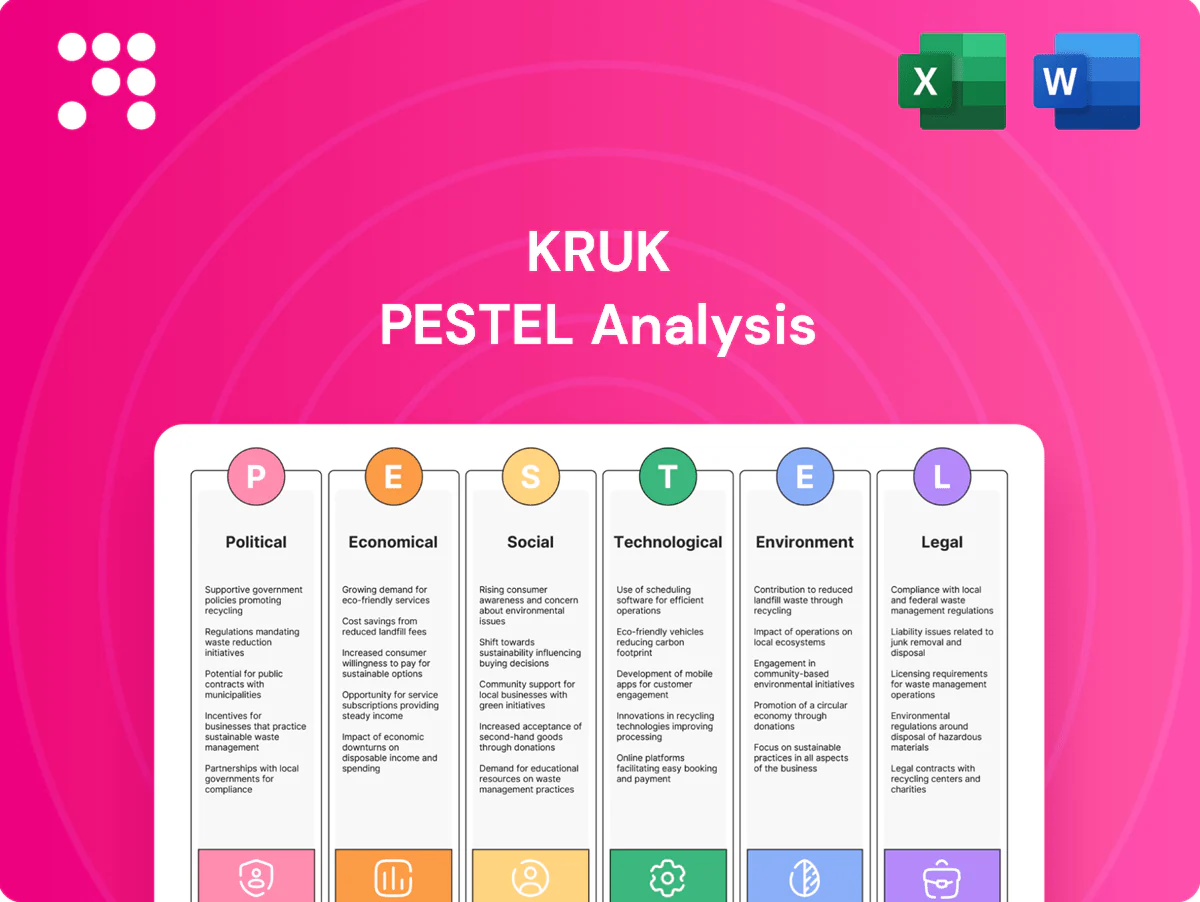
Kruk PESTLE Analysis

Your Competitive Advantage Starts with This Report
Our PESTLE analysis reveals how regulatory shifts, economic cycles, and tech trends are reshaping Kruk’s risk profile and growth prospects. Use these concise insights to refine investment or strategic plans. Purchase the full PESTLE for the complete, actionable breakdown and ready-to-use files.
Political factors

Government stability and policy direction
Political continuity in CEE shapes credit markets, privatizations and bank cleanup programs; stable governments facilitate NPL sales and predictable enforcement, helping firms like Kruk access portfolios. ECB data showed EU NPL ratio around 2.4% at end‑2023, while Poland held parliamentary elections in October 2023, illustrating why monitoring election cycles and fiscal agendas is critical for pipeline visibility as instability can delay transactions and court rulings.
EU-level financial sector initiatives
EU guidance on NPL reduction and ECB supervision of roughly 120 significant banks (ECB data) has pushed the EU banking NPL ratio down to about 1.3% in 2024, reducing distressed supply and affecting Kruk’s sourcing. Cross-border harmonization of insolvency frameworks and secondary market rules lowers transaction frictions, tightening bid-ask spreads and improving pricing. Shifts in EU priorities or funding (NPL market ~€20bn in 2023) can accelerate or slow deal flow, so engagement in EU consultative processes helps Kruk anticipate rule changes and position portfolios.

Public sentiment and political stance on consumer protection
Politicians may push debtor-relief measures during downturns, as seen with Poland's 2020–2021 loan moratoria, which forced creditors to adjust settlement strategies and slowed recoveries. Caps on fees, interest limits and temporary moratoria can arise from political pressure, reducing expected collections and NPL recovery timelines. Proactive, ethical collection aligns with voter-sensitive policies and helps maintain public trust. Strong reputation management lowers the risk of heightened regulatory scrutiny.

Geopolitical risk and regional security
Geopolitical shocks from the Russia‑Ukraine war (over 8 million displaced, UNHCR) and sanctions-driven energy disruptions can weaken borrower solvency and bank stability, while cross‑border funding and investor appetite often tighten during heightened risk; Kruk needs contingency plans for affected markets and geographic diversification to mitigate shocks.
- War spillovers: credit stress rises
- Sanctions/energy: liquidity & costs impact
- Contingency planning essential
- Diversify across countries to reduce risk
State involvement in banking sector clean-ups
State-backed bad-bank schemes and guarantee programs materially shift NPL supply and pricing, creating windows for large portfolio purchases; the euro-area NPL stock peaked near €1 trillion in 2014 per ECB, underscoring scale and state leverage in clean-ups. Policy-driven tenders create sizable opportunities, but country-by-country criteria and transparency vary, so close dialogue with public agencies is essential to secure pipeline access and improve win rates.
- State schemes influence supply/pricing
- Policy tenders create large deals
- Criteria/transparency differ by country
- Close public-agency dialogue raises win rates
Policy swings, EU oversight and Ukraine shock tighten NPL supply and reshape recovery strategies
Political stability and election cycles (Poland Oct 2023) shape enforcement and NPL sales; EU/ECB oversight lowered EU NPL ratio to ~1.3% in 2024, tightening supply and pricing. Debt relief, moratoria and fee caps (seen 2020–21) reduce recoveries and require adaptive strategies. Geopolitical shocks (Russia‑Ukraine: >8m displaced) raise credit stress and push diversification.
| Factor | Impact | Key stats |
|---|---|---|
| Elections/fiscal | Delays, enforcement risk | Poland Oct 2023 |
| EU supervision | Lower supply, tighter pricing | EU NPL 1.3% (2024) |
| State schemes | Large tenders, variable transparency | NPL market ~€20bn (2023) |
What is included in the product
 Detailed Word Document
Explores how external macro-environmental factors uniquely affect Kruk across six dimensions—Political, Economic, Social, Technological, Environmental, and Legal—each backed by data and current trends. Designed for executives and investors, the analysis reflects regional market and regulatory dynamics, offers forward-looking insights, and is formatted for easy inclusion in reports or pitch decks.

 Customizable Excel Spreadsheet
Provides a clean, visually segmented PESTLE summary of Kruk that speeds meeting prep, is editable for regional or business-line notes, and can be dropped into presentations to align teams and surface external risks quickly.
Economic factors

Interest rate cycle and cost of capital
Higher rates (NBP peak 6.75% in 2023) increase borrower stress and NPL inflows while raising funding costs for portfolios, compressing IRRs. Yield requirements rise with benchmark rates, pushing bid prices lower and widening expected returns. Timing acquisitions across rate cycles materially improves realized returns. Active hedging of interest exposure and FX in 2024–2025 helps stabilize portfolio cash flows.
Unemployment and household income dynamics
Labor market health directly shapes KRUK clients' repayment capacity and settlement conversion; Poland unemployment was 5.1% in 2024 (GUS) and Euro area 6.3% (Eurostat), pressures that lift delinquency and extend recovery timelines. Rising joblessness historically correlates with higher NPL conversion times, prompting tailored restructuring to improve affordability during downturns. Continuous macro monitoring informs precise client segmentation and workout strategies.

Inflation and real disposable income
High inflation (around 6% in Poland in 2024) erodes debtor budgets and reduces recoveries in unsecured retail portfolios, with GUS reporting real disposable income declines near 3% in 2023–24. Wage indexation lags behind price growth, raising slippage risk. Flexible payment plans and dynamic scoring can mitigate write-offs. Pricing models must adjust for real cash recovery erosion and shorter recovery horizons.

Credit growth and banking NPL stock
Credit booms tend to precede NPL waves, shaping medium-term supply; Polish bank NPLs returned to ~3.7% by end-2023 while credit growth of roughly 6% YoY in 2023 expanded future risk pools. De-risking cycles by banks have released portfolio volumes to collectors like Kruk, altering pricing and vintage mix. Shifts in sectoral exposure—consumer, SME, mortgages—raise complexity and recovery timelines, so data-driven diligence is essential to avoid adverse selection.
- Credit boom → future NPL supply
- Bank de-risking releases portfolios
- Sector mix: consumer, SME, mortgages
- Data-driven diligence prevents adverse selection
FX volatility across CEE markets
FX volatility across CEE markets strains Kruk’s cross-border funding and asset valuation, as currency swings change EUR/PLN/HUF cash flows and mark-to-market portfolio values; mismatches between local-currency receivables and foreign-currency debt can compress margins and increase provisioning.
- Currency risk: impacts funding and asset marks
- Cash-flow mismatch: margin compression
- Hedging: stabilizes returns but raises costs
- Country choice: assess FX regime and liquidity
Policy swings, EU oversight and Ukraine shock tighten NPL supply and reshape recovery strategies
Higher policy rates (NBP peak 6.75% in 2023) and 2024 inflation (~6%) raise funding costs, compress IRRs and erode real recoveries; Poland unemployment 5.1% in 2024 weakens repayment capacity and extends recoveries. Credit growth (~6% YoY in 2023) signals future NPL supply; FX volatility in CEE increases funding and valuation risk.
| Indicator | Value | Source | Relevance |
|---|---|---|---|
| Policy rate | 6.75% | NBP 2023 | funding cost |
| Inflation | ~6% | GUS 2024 | real recoveries |
| Unemployment | 5.1% | GUS 2024 | repayment capacity |
| Bank NPLs | ~3.7% | end-2023 | supply |
Preview the Actual Deliverable
Kruk PESTLE Analysis
The preview shown here is the exact Kruk PESTLE Analysis document you’ll receive after purchase—fully formatted, professionally structured, and ready to use. It contains the complete political, economic, social, technological, legal, and environmental assessment as displayed, with no placeholders or teasers. After payment you’ll instantly download this identical final file.

Your Competitive Advantage Starts with This Report
Our PESTLE analysis reveals how regulatory shifts, economic cycles, and tech trends are reshaping Kruk’s risk profile and growth prospects. Use these concise insights to refine investment or strategic plans. Purchase the full PESTLE for the complete, actionable breakdown and ready-to-use files.
Political factors
Government stability and policy direction
Political continuity in CEE shapes credit markets, privatizations and bank cleanup programs; stable governments facilitate NPL sales and predictable enforcement, helping firms like Kruk access portfolios. ECB data showed EU NPL ratio around 2.4% at end‑2023, while Poland held parliamentary elections in October 2023, illustrating why monitoring election cycles and fiscal agendas is critical for pipeline visibility as instability can delay transactions and court rulings.
EU-level financial sector initiatives
EU guidance on NPL reduction and ECB supervision of roughly 120 significant banks (ECB data) has pushed the EU banking NPL ratio down to about 1.3% in 2024, reducing distressed supply and affecting Kruk’s sourcing. Cross-border harmonization of insolvency frameworks and secondary market rules lowers transaction frictions, tightening bid-ask spreads and improving pricing. Shifts in EU priorities or funding (NPL market ~€20bn in 2023) can accelerate or slow deal flow, so engagement in EU consultative processes helps Kruk anticipate rule changes and position portfolios.
Public sentiment and political stance on consumer protection
Politicians may push debtor-relief measures during downturns, as seen with Poland's 2020–2021 loan moratoria, which forced creditors to adjust settlement strategies and slowed recoveries. Caps on fees, interest limits and temporary moratoria can arise from political pressure, reducing expected collections and NPL recovery timelines. Proactive, ethical collection aligns with voter-sensitive policies and helps maintain public trust. Strong reputation management lowers the risk of heightened regulatory scrutiny.
Geopolitical risk and regional security
Geopolitical shocks from the Russia‑Ukraine war (over 8 million displaced, UNHCR) and sanctions-driven energy disruptions can weaken borrower solvency and bank stability, while cross‑border funding and investor appetite often tighten during heightened risk; Kruk needs contingency plans for affected markets and geographic diversification to mitigate shocks.
- War spillovers: credit stress rises
- Sanctions/energy: liquidity & costs impact
- Contingency planning essential
- Diversify across countries to reduce risk
State involvement in banking sector clean-ups
State-backed bad-bank schemes and guarantee programs materially shift NPL supply and pricing, creating windows for large portfolio purchases; the euro-area NPL stock peaked near €1 trillion in 2014 per ECB, underscoring scale and state leverage in clean-ups. Policy-driven tenders create sizable opportunities, but country-by-country criteria and transparency vary, so close dialogue with public agencies is essential to secure pipeline access and improve win rates.
- State schemes influence supply/pricing
- Policy tenders create large deals
- Criteria/transparency differ by country
- Close public-agency dialogue raises win rates
Policy swings, EU oversight and Ukraine shock tighten NPL supply and reshape recovery strategies
Political stability and election cycles (Poland Oct 2023) shape enforcement and NPL sales; EU/ECB oversight lowered EU NPL ratio to ~1.3% in 2024, tightening supply and pricing. Debt relief, moratoria and fee caps (seen 2020–21) reduce recoveries and require adaptive strategies. Geopolitical shocks (Russia‑Ukraine: >8m displaced) raise credit stress and push diversification.
| Factor | Impact | Key stats |
|---|---|---|
| Elections/fiscal | Delays, enforcement risk | Poland Oct 2023 |
| EU supervision | Lower supply, tighter pricing | EU NPL 1.3% (2024) |
| State schemes | Large tenders, variable transparency | NPL market ~€20bn (2023) |
What is included in the product
Detailed Word Document
Explores how external macro-environmental factors uniquely affect Kruk across six dimensions—Political, Economic, Social, Technological, Environmental, and Legal—each backed by data and current trends. Designed for executives and investors, the analysis reflects regional market and regulatory dynamics, offers forward-looking insights, and is formatted for easy inclusion in reports or pitch decks.
Customizable Excel Spreadsheet
Provides a clean, visually segmented PESTLE summary of Kruk that speeds meeting prep, is editable for regional or business-line notes, and can be dropped into presentations to align teams and surface external risks quickly.
Economic factors
Interest rate cycle and cost of capital
Higher rates (NBP peak 6.75% in 2023) increase borrower stress and NPL inflows while raising funding costs for portfolios, compressing IRRs. Yield requirements rise with benchmark rates, pushing bid prices lower and widening expected returns. Timing acquisitions across rate cycles materially improves realized returns. Active hedging of interest exposure and FX in 2024–2025 helps stabilize portfolio cash flows.
Unemployment and household income dynamics
Labor market health directly shapes KRUK clients' repayment capacity and settlement conversion; Poland unemployment was 5.1% in 2024 (GUS) and Euro area 6.3% (Eurostat), pressures that lift delinquency and extend recovery timelines. Rising joblessness historically correlates with higher NPL conversion times, prompting tailored restructuring to improve affordability during downturns. Continuous macro monitoring informs precise client segmentation and workout strategies.
Inflation and real disposable income
High inflation (around 6% in Poland in 2024) erodes debtor budgets and reduces recoveries in unsecured retail portfolios, with GUS reporting real disposable income declines near 3% in 2023–24. Wage indexation lags behind price growth, raising slippage risk. Flexible payment plans and dynamic scoring can mitigate write-offs. Pricing models must adjust for real cash recovery erosion and shorter recovery horizons.
Credit growth and banking NPL stock
Credit booms tend to precede NPL waves, shaping medium-term supply; Polish bank NPLs returned to ~3.7% by end-2023 while credit growth of roughly 6% YoY in 2023 expanded future risk pools. De-risking cycles by banks have released portfolio volumes to collectors like Kruk, altering pricing and vintage mix. Shifts in sectoral exposure—consumer, SME, mortgages—raise complexity and recovery timelines, so data-driven diligence is essential to avoid adverse selection.
- Credit boom → future NPL supply
- Bank de-risking releases portfolios
- Sector mix: consumer, SME, mortgages
- Data-driven diligence prevents adverse selection
FX volatility across CEE markets
FX volatility across CEE markets strains Kruk’s cross-border funding and asset valuation, as currency swings change EUR/PLN/HUF cash flows and mark-to-market portfolio values; mismatches between local-currency receivables and foreign-currency debt can compress margins and increase provisioning.
- Currency risk: impacts funding and asset marks
- Cash-flow mismatch: margin compression
- Hedging: stabilizes returns but raises costs
- Country choice: assess FX regime and liquidity
Policy swings, EU oversight and Ukraine shock tighten NPL supply and reshape recovery strategies
Higher policy rates (NBP peak 6.75% in 2023) and 2024 inflation (~6%) raise funding costs, compress IRRs and erode real recoveries; Poland unemployment 5.1% in 2024 weakens repayment capacity and extends recoveries. Credit growth (~6% YoY in 2023) signals future NPL supply; FX volatility in CEE increases funding and valuation risk.
| Indicator | Value | Source | Relevance |
|---|---|---|---|
| Policy rate | 6.75% | NBP 2023 | funding cost |
| Inflation | ~6% | GUS 2024 | real recoveries |
| Unemployment | 5.1% | GUS 2024 | repayment capacity |
| Bank NPLs | ~3.7% | end-2023 | supply |
Preview the Actual Deliverable
Kruk PESTLE Analysis
The preview shown here is the exact Kruk PESTLE Analysis document you’ll receive after purchase—fully formatted, professionally structured, and ready to use. It contains the complete political, economic, social, technological, legal, and environmental assessment as displayed, with no placeholders or teasers. After payment you’ll instantly download this identical final file.
Original: $10.00
-65%$10.00
$3.50Description
Your Competitive Advantage Starts with This Report
Our PESTLE analysis reveals how regulatory shifts, economic cycles, and tech trends are reshaping Kruk’s risk profile and growth prospects. Use these concise insights to refine investment or strategic plans. Purchase the full PESTLE for the complete, actionable breakdown and ready-to-use files.
Political factors
Government stability and policy direction
Political continuity in CEE shapes credit markets, privatizations and bank cleanup programs; stable governments facilitate NPL sales and predictable enforcement, helping firms like Kruk access portfolios. ECB data showed EU NPL ratio around 2.4% at end‑2023, while Poland held parliamentary elections in October 2023, illustrating why monitoring election cycles and fiscal agendas is critical for pipeline visibility as instability can delay transactions and court rulings.
EU-level financial sector initiatives
EU guidance on NPL reduction and ECB supervision of roughly 120 significant banks (ECB data) has pushed the EU banking NPL ratio down to about 1.3% in 2024, reducing distressed supply and affecting Kruk’s sourcing. Cross-border harmonization of insolvency frameworks and secondary market rules lowers transaction frictions, tightening bid-ask spreads and improving pricing. Shifts in EU priorities or funding (NPL market ~€20bn in 2023) can accelerate or slow deal flow, so engagement in EU consultative processes helps Kruk anticipate rule changes and position portfolios.
Public sentiment and political stance on consumer protection
Politicians may push debtor-relief measures during downturns, as seen with Poland's 2020–2021 loan moratoria, which forced creditors to adjust settlement strategies and slowed recoveries. Caps on fees, interest limits and temporary moratoria can arise from political pressure, reducing expected collections and NPL recovery timelines. Proactive, ethical collection aligns with voter-sensitive policies and helps maintain public trust. Strong reputation management lowers the risk of heightened regulatory scrutiny.
Geopolitical risk and regional security
Geopolitical shocks from the Russia‑Ukraine war (over 8 million displaced, UNHCR) and sanctions-driven energy disruptions can weaken borrower solvency and bank stability, while cross‑border funding and investor appetite often tighten during heightened risk; Kruk needs contingency plans for affected markets and geographic diversification to mitigate shocks.
- War spillovers: credit stress rises
- Sanctions/energy: liquidity & costs impact
- Contingency planning essential
- Diversify across countries to reduce risk
State involvement in banking sector clean-ups
State-backed bad-bank schemes and guarantee programs materially shift NPL supply and pricing, creating windows for large portfolio purchases; the euro-area NPL stock peaked near €1 trillion in 2014 per ECB, underscoring scale and state leverage in clean-ups. Policy-driven tenders create sizable opportunities, but country-by-country criteria and transparency vary, so close dialogue with public agencies is essential to secure pipeline access and improve win rates.
- State schemes influence supply/pricing
- Policy tenders create large deals
- Criteria/transparency differ by country
- Close public-agency dialogue raises win rates
Policy swings, EU oversight and Ukraine shock tighten NPL supply and reshape recovery strategies
Political stability and election cycles (Poland Oct 2023) shape enforcement and NPL sales; EU/ECB oversight lowered EU NPL ratio to ~1.3% in 2024, tightening supply and pricing. Debt relief, moratoria and fee caps (seen 2020–21) reduce recoveries and require adaptive strategies. Geopolitical shocks (Russia‑Ukraine: >8m displaced) raise credit stress and push diversification.
| Factor | Impact | Key stats |
|---|---|---|
| Elections/fiscal | Delays, enforcement risk | Poland Oct 2023 |
| EU supervision | Lower supply, tighter pricing | EU NPL 1.3% (2024) |
| State schemes | Large tenders, variable transparency | NPL market ~€20bn (2023) |
What is included in the product
Detailed Word Document
Explores how external macro-environmental factors uniquely affect Kruk across six dimensions—Political, Economic, Social, Technological, Environmental, and Legal—each backed by data and current trends. Designed for executives and investors, the analysis reflects regional market and regulatory dynamics, offers forward-looking insights, and is formatted for easy inclusion in reports or pitch decks.
Customizable Excel Spreadsheet
Provides a clean, visually segmented PESTLE summary of Kruk that speeds meeting prep, is editable for regional or business-line notes, and can be dropped into presentations to align teams and surface external risks quickly.
Economic factors
Interest rate cycle and cost of capital
Higher rates (NBP peak 6.75% in 2023) increase borrower stress and NPL inflows while raising funding costs for portfolios, compressing IRRs. Yield requirements rise with benchmark rates, pushing bid prices lower and widening expected returns. Timing acquisitions across rate cycles materially improves realized returns. Active hedging of interest exposure and FX in 2024–2025 helps stabilize portfolio cash flows.
Unemployment and household income dynamics
Labor market health directly shapes KRUK clients' repayment capacity and settlement conversion; Poland unemployment was 5.1% in 2024 (GUS) and Euro area 6.3% (Eurostat), pressures that lift delinquency and extend recovery timelines. Rising joblessness historically correlates with higher NPL conversion times, prompting tailored restructuring to improve affordability during downturns. Continuous macro monitoring informs precise client segmentation and workout strategies.
Inflation and real disposable income
High inflation (around 6% in Poland in 2024) erodes debtor budgets and reduces recoveries in unsecured retail portfolios, with GUS reporting real disposable income declines near 3% in 2023–24. Wage indexation lags behind price growth, raising slippage risk. Flexible payment plans and dynamic scoring can mitigate write-offs. Pricing models must adjust for real cash recovery erosion and shorter recovery horizons.
Credit growth and banking NPL stock
Credit booms tend to precede NPL waves, shaping medium-term supply; Polish bank NPLs returned to ~3.7% by end-2023 while credit growth of roughly 6% YoY in 2023 expanded future risk pools. De-risking cycles by banks have released portfolio volumes to collectors like Kruk, altering pricing and vintage mix. Shifts in sectoral exposure—consumer, SME, mortgages—raise complexity and recovery timelines, so data-driven diligence is essential to avoid adverse selection.
- Credit boom → future NPL supply
- Bank de-risking releases portfolios
- Sector mix: consumer, SME, mortgages
- Data-driven diligence prevents adverse selection
FX volatility across CEE markets
FX volatility across CEE markets strains Kruk’s cross-border funding and asset valuation, as currency swings change EUR/PLN/HUF cash flows and mark-to-market portfolio values; mismatches between local-currency receivables and foreign-currency debt can compress margins and increase provisioning.
- Currency risk: impacts funding and asset marks
- Cash-flow mismatch: margin compression
- Hedging: stabilizes returns but raises costs
- Country choice: assess FX regime and liquidity
Policy swings, EU oversight and Ukraine shock tighten NPL supply and reshape recovery strategies
Higher policy rates (NBP peak 6.75% in 2023) and 2024 inflation (~6%) raise funding costs, compress IRRs and erode real recoveries; Poland unemployment 5.1% in 2024 weakens repayment capacity and extends recoveries. Credit growth (~6% YoY in 2023) signals future NPL supply; FX volatility in CEE increases funding and valuation risk.
| Indicator | Value | Source | Relevance |
|---|---|---|---|
| Policy rate | 6.75% | NBP 2023 | funding cost |
| Inflation | ~6% | GUS 2024 | real recoveries |
| Unemployment | 5.1% | GUS 2024 | repayment capacity |
| Bank NPLs | ~3.7% | end-2023 | supply |
Preview the Actual Deliverable
Kruk PESTLE Analysis
The preview shown here is the exact Kruk PESTLE Analysis document you’ll receive after purchase—fully formatted, professionally structured, and ready to use. It contains the complete political, economic, social, technological, legal, and environmental assessment as displayed, with no placeholders or teasers. After payment you’ll instantly download this identical final file.











