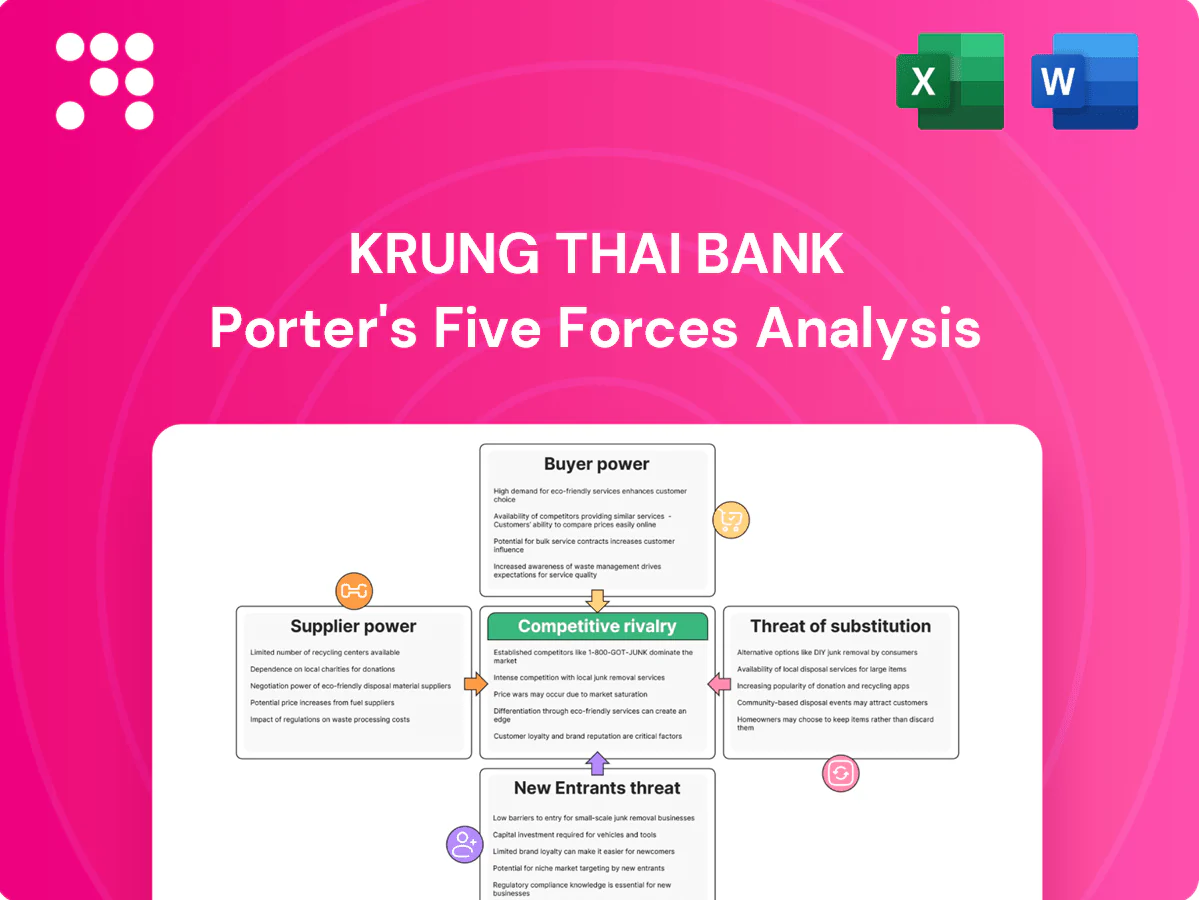
Krung Thai Bank Porter's Five Forces Analysis

A Must-Have Tool for Decision-Makers
Krung Thai Bank faces moderate buyer power, intense rivalry among Thai banks, regulatory constraints, and evolving fintech threats that reshape margins and growth prospects. This snapshot highlights key competitive pressures but leaves out force-by-force ratings and visuals. Unlock the full Porter’s Five Forces analysis for a complete, actionable strategic picture.
Suppliers Bargaining Power

Concentrated funding sources
Deposits are KTB’s primary funding source, with total deposits exceeding 2.5 trillion baht in 2024 and large corporates and government clients able to shift sizable balances, pressuring funding costs during rate cycles. KTB’s wide retail base and state affiliation temper volatility, while diversification across current, savings and time deposits reduces single-supplier leverage.
Regulators as quasi-suppliers
The Bank of Thailand supplies licenses, liquidity facilities and permissions that directly shape Krung Thai Bank’s capacity and product scope, and its policy tools (including standing lending facilities) influence funding costs and market access. Compliance demands and capital rules raise operating costs and limit flexibility, while KTB’s majority state ownership (>50%) aligns it with policy objectives and eases coordination. Still, sudden rule changes can shift bargaining power abruptly, altering capital or liquidity requirements with immediate impact on margins.

Technology and infrastructure vendors
Core-banking, cloud, cybersecurity and payment-rail vendors exert strong switching-cost power via complex 5–7 year integrations; global public-cloud spend reached about 600–700 billion USD in 2024, driving vendor leverage. Long contracts and bespoke integrations increase KTB dependence, but multi-vendor sourcing and selective in-house development reduce lock-in. KTB’s scale enables negotiation of better pricing and SLAs, lowering unit costs per transaction.

Skilled labor and data suppliers
Top tech, risk and data science talent is scarce in Thailand, driving higher wage and retention costs for Krung Thai Bank and making specialist hires a bottleneck for product rollout.
- Supplier type: skilled labor and data partners
- Impact: higher compensation and churn risk
- Mitigant: employer brand and public-mission appeal
Capital market dependence
Wholesale funding and subordinated debt provide supplemental capital and liquidity for Krung Thai Bank; market stress can widen spreads and increase funding costs, while KTB’s government ownership supports investor confidence and placement; a diversified mix of instruments and maturities reduces dependence on any single provider and limits supplier bargaining power.
- Wholesale funding: supplemental liquidity
- Government ownership: stronger placement confidence
- Diversification: lowers single-provider risk
Deposits dominate funding; BoT rules, cloud vendors and talent drive bank cost dynamics
Deposits (>2.5 trillion baht in 2024) remain primary funding, limiting supplier power though large corporates can shift balances; Bank of Thailand rules and liquidity facilities strongly shape costs and product scope. Tech vendors (global cloud spend ~600–700bn USD in 2024) and scarce specialist talent raise switching and wage pressure; diversification and state ownership mitigate risk.
| Supplier | 2024 metric | Impact | Mitigant |
|---|---|---|---|
| Depositors | >2.5T THB | Funding cost volatility | Retail mix, govt backing |
| Regulator | BoT policy | Cost/regulatory risk | State ownership |
| Tech vendors | Cloud spend 600–700B USD | Switching costs | Multi-vendor, scale |
What is included in the product
 Detailed Word Document
Tailored Porter's Five Forces analysis for Krung Thai Bank revealing competitive rivalry, buyer and supplier power, threat of entrants and substitutes, and regulatory dynamics shaping profitability. Identifies key disruptive threats, market entry barriers, and strategic levers to defend market share and optimize pricing power.

 Customizable Excel Spreadsheet
A clear one-sheet Porter’s Five Forces for Krung Thai Bank—customize pressure levels and instantly visualize strategic tension with a spider chart, ready to drop into pitch decks or Excel dashboards.
Customers Bargaining Power

Price-sensitive retail customers
Price-sensitive retail customers routinely compare deposit rates, fees and loan pricing across mobile apps, increasing pressure on margins. Switching is easier via PromptPay, which exceeded 60 million registered IDs in 2024, and fast open digital onboarding. KTB’s loyalty programs and embedded government services on its channels can temper churn. Transparent pricing and clear fees remain crucial to defend NIMs.
Demanding corporate and SME clients
Large corporates extract bespoke pricing and cash-management fees thanks to volume, while SMEs prioritise credit speed and collateral flexibility; multi-banking (common among 60%+ Thai corporates) reduces lock-in and raises buyer leverage. Krung Thai Bank’s THB 3.2 trillion asset base and ~55% state ownership, plus its role in government projects, help anchor key client relationships despite pricing pressure.

Government and public sector clients
Public sector clients are sizable, mission-critical customers that exert strong bargaining clout due to scale and policy impact. They prioritize reliability, compliance and alignment with government mandates over pure price, reducing sensitivity to short-term fee competition. KTB’s stewardship of national initiatives and payroll/fiscal accounts increases client stickiness, though formal procurement rules and competitive tenders can compress margins and lengthen sales cycles.

Digital experience expectations
Buyers now demand instant, low-friction mobile banking and 24/7 support, and poor UX drives migration to neobanks and e-wallets, raising customer bargaining power; continuous app upgrades and high service uptime weaken it by reducing churn. Data-driven personalization increases cross-sell and retention, lowering price sensitivity and switch intent.
- UX quality directly affects churn vs neobanks
- 24/7 support expectations raise service SLAs
- Continuous releases cut buyer power
- Personalization lifts cross-sell and retention
Credit quality and transparency
Customers demand clear terms, fair lending and flexible restructuring; in 2024 Krung Thai Bank reported proactive restructuring programs as NPL pressure peaked, with bank-wide NPLs around 3.1% and loan-loss provisions rising to safeguard asset quality. In downturns borrowers seek extensions and rate relief, but tailored workouts and risk monitoring limit opportunistic buyer leverage while preserving credit standards.
- Credit clarity: clear terms reduce dispute-driven exits
- Downturn relief: extensions and rate relief common in 2024
- Risk balance: 3.1% NPLs and higher provisions protect assets
PromptPay tops 60M; customers wield pricing leverage as NPLs near 3.1%
Customers wield high price and service leverage: retail churn rises with mobile comparison and PromptPay surpassing 60 million IDs in 2024. Corporates and public-sector clients exert bespoke pricing power despite KTB’s THB 3.2 trillion assets and ~55% state ownership. NPLs ~3.1% in 2024 raise demand for clear restructuring and prudent provisioning, tempering opportunistic bargaining.
| Metric | 2024 |
|---|---|
| PromptPay IDs | >60 million |
| KTB assets | THB 3.2 trillion |
| State ownership | ~55% |
| NPL ratio | ~3.1% |
| Multi-banking (corporates) | >60% |
Preview the Actual Deliverable
Krung Thai Bank Porter's Five Forces Analysis
This preview shows the exact Krung Thai Bank Porter’s Five Forces analysis you’ll receive—no placeholders or samples. The full document is professionally formatted, comprehensive and ready for download immediately after purchase. What you see here is the final deliverable, ready to use for decision-making.

A Must-Have Tool for Decision-Makers
Krung Thai Bank faces moderate buyer power, intense rivalry among Thai banks, regulatory constraints, and evolving fintech threats that reshape margins and growth prospects. This snapshot highlights key competitive pressures but leaves out force-by-force ratings and visuals. Unlock the full Porter’s Five Forces analysis for a complete, actionable strategic picture.
Suppliers Bargaining Power
Concentrated funding sources
Deposits are KTB’s primary funding source, with total deposits exceeding 2.5 trillion baht in 2024 and large corporates and government clients able to shift sizable balances, pressuring funding costs during rate cycles. KTB’s wide retail base and state affiliation temper volatility, while diversification across current, savings and time deposits reduces single-supplier leverage.
Regulators as quasi-suppliers
The Bank of Thailand supplies licenses, liquidity facilities and permissions that directly shape Krung Thai Bank’s capacity and product scope, and its policy tools (including standing lending facilities) influence funding costs and market access. Compliance demands and capital rules raise operating costs and limit flexibility, while KTB’s majority state ownership (>50%) aligns it with policy objectives and eases coordination. Still, sudden rule changes can shift bargaining power abruptly, altering capital or liquidity requirements with immediate impact on margins.
Technology and infrastructure vendors
Core-banking, cloud, cybersecurity and payment-rail vendors exert strong switching-cost power via complex 5–7 year integrations; global public-cloud spend reached about 600–700 billion USD in 2024, driving vendor leverage. Long contracts and bespoke integrations increase KTB dependence, but multi-vendor sourcing and selective in-house development reduce lock-in. KTB’s scale enables negotiation of better pricing and SLAs, lowering unit costs per transaction.
Skilled labor and data suppliers
Top tech, risk and data science talent is scarce in Thailand, driving higher wage and retention costs for Krung Thai Bank and making specialist hires a bottleneck for product rollout.
- Supplier type: skilled labor and data partners
- Impact: higher compensation and churn risk
- Mitigant: employer brand and public-mission appeal
Capital market dependence
Wholesale funding and subordinated debt provide supplemental capital and liquidity for Krung Thai Bank; market stress can widen spreads and increase funding costs, while KTB’s government ownership supports investor confidence and placement; a diversified mix of instruments and maturities reduces dependence on any single provider and limits supplier bargaining power.
- Wholesale funding: supplemental liquidity
- Government ownership: stronger placement confidence
- Diversification: lowers single-provider risk
Deposits dominate funding; BoT rules, cloud vendors and talent drive bank cost dynamics
Deposits (>2.5 trillion baht in 2024) remain primary funding, limiting supplier power though large corporates can shift balances; Bank of Thailand rules and liquidity facilities strongly shape costs and product scope. Tech vendors (global cloud spend ~600–700bn USD in 2024) and scarce specialist talent raise switching and wage pressure; diversification and state ownership mitigate risk.
| Supplier | 2024 metric | Impact | Mitigant |
|---|---|---|---|
| Depositors | >2.5T THB | Funding cost volatility | Retail mix, govt backing |
| Regulator | BoT policy | Cost/regulatory risk | State ownership |
| Tech vendors | Cloud spend 600–700B USD | Switching costs | Multi-vendor, scale |
What is included in the product
Detailed Word Document
Tailored Porter's Five Forces analysis for Krung Thai Bank revealing competitive rivalry, buyer and supplier power, threat of entrants and substitutes, and regulatory dynamics shaping profitability. Identifies key disruptive threats, market entry barriers, and strategic levers to defend market share and optimize pricing power.
Customizable Excel Spreadsheet
A clear one-sheet Porter’s Five Forces for Krung Thai Bank—customize pressure levels and instantly visualize strategic tension with a spider chart, ready to drop into pitch decks or Excel dashboards.
Customers Bargaining Power
Price-sensitive retail customers
Price-sensitive retail customers routinely compare deposit rates, fees and loan pricing across mobile apps, increasing pressure on margins. Switching is easier via PromptPay, which exceeded 60 million registered IDs in 2024, and fast open digital onboarding. KTB’s loyalty programs and embedded government services on its channels can temper churn. Transparent pricing and clear fees remain crucial to defend NIMs.
Demanding corporate and SME clients
Large corporates extract bespoke pricing and cash-management fees thanks to volume, while SMEs prioritise credit speed and collateral flexibility; multi-banking (common among 60%+ Thai corporates) reduces lock-in and raises buyer leverage. Krung Thai Bank’s THB 3.2 trillion asset base and ~55% state ownership, plus its role in government projects, help anchor key client relationships despite pricing pressure.
Government and public sector clients
Public sector clients are sizable, mission-critical customers that exert strong bargaining clout due to scale and policy impact. They prioritize reliability, compliance and alignment with government mandates over pure price, reducing sensitivity to short-term fee competition. KTB’s stewardship of national initiatives and payroll/fiscal accounts increases client stickiness, though formal procurement rules and competitive tenders can compress margins and lengthen sales cycles.
Digital experience expectations
Buyers now demand instant, low-friction mobile banking and 24/7 support, and poor UX drives migration to neobanks and e-wallets, raising customer bargaining power; continuous app upgrades and high service uptime weaken it by reducing churn. Data-driven personalization increases cross-sell and retention, lowering price sensitivity and switch intent.
- UX quality directly affects churn vs neobanks
- 24/7 support expectations raise service SLAs
- Continuous releases cut buyer power
- Personalization lifts cross-sell and retention
Credit quality and transparency
Customers demand clear terms, fair lending and flexible restructuring; in 2024 Krung Thai Bank reported proactive restructuring programs as NPL pressure peaked, with bank-wide NPLs around 3.1% and loan-loss provisions rising to safeguard asset quality. In downturns borrowers seek extensions and rate relief, but tailored workouts and risk monitoring limit opportunistic buyer leverage while preserving credit standards.
- Credit clarity: clear terms reduce dispute-driven exits
- Downturn relief: extensions and rate relief common in 2024
- Risk balance: 3.1% NPLs and higher provisions protect assets
PromptPay tops 60M; customers wield pricing leverage as NPLs near 3.1%
Customers wield high price and service leverage: retail churn rises with mobile comparison and PromptPay surpassing 60 million IDs in 2024. Corporates and public-sector clients exert bespoke pricing power despite KTB’s THB 3.2 trillion assets and ~55% state ownership. NPLs ~3.1% in 2024 raise demand for clear restructuring and prudent provisioning, tempering opportunistic bargaining.
| Metric | 2024 |
|---|---|
| PromptPay IDs | >60 million |
| KTB assets | THB 3.2 trillion |
| State ownership | ~55% |
| NPL ratio | ~3.1% |
| Multi-banking (corporates) | >60% |
Preview the Actual Deliverable
Krung Thai Bank Porter's Five Forces Analysis
This preview shows the exact Krung Thai Bank Porter’s Five Forces analysis you’ll receive—no placeholders or samples. The full document is professionally formatted, comprehensive and ready for download immediately after purchase. What you see here is the final deliverable, ready to use for decision-making.
Description
A Must-Have Tool for Decision-Makers
Krung Thai Bank faces moderate buyer power, intense rivalry among Thai banks, regulatory constraints, and evolving fintech threats that reshape margins and growth prospects. This snapshot highlights key competitive pressures but leaves out force-by-force ratings and visuals. Unlock the full Porter’s Five Forces analysis for a complete, actionable strategic picture.
Suppliers Bargaining Power
Concentrated funding sources
Deposits are KTB’s primary funding source, with total deposits exceeding 2.5 trillion baht in 2024 and large corporates and government clients able to shift sizable balances, pressuring funding costs during rate cycles. KTB’s wide retail base and state affiliation temper volatility, while diversification across current, savings and time deposits reduces single-supplier leverage.
Regulators as quasi-suppliers
The Bank of Thailand supplies licenses, liquidity facilities and permissions that directly shape Krung Thai Bank’s capacity and product scope, and its policy tools (including standing lending facilities) influence funding costs and market access. Compliance demands and capital rules raise operating costs and limit flexibility, while KTB’s majority state ownership (>50%) aligns it with policy objectives and eases coordination. Still, sudden rule changes can shift bargaining power abruptly, altering capital or liquidity requirements with immediate impact on margins.
Technology and infrastructure vendors
Core-banking, cloud, cybersecurity and payment-rail vendors exert strong switching-cost power via complex 5–7 year integrations; global public-cloud spend reached about 600–700 billion USD in 2024, driving vendor leverage. Long contracts and bespoke integrations increase KTB dependence, but multi-vendor sourcing and selective in-house development reduce lock-in. KTB’s scale enables negotiation of better pricing and SLAs, lowering unit costs per transaction.
Skilled labor and data suppliers
Top tech, risk and data science talent is scarce in Thailand, driving higher wage and retention costs for Krung Thai Bank and making specialist hires a bottleneck for product rollout.
- Supplier type: skilled labor and data partners
- Impact: higher compensation and churn risk
- Mitigant: employer brand and public-mission appeal
Capital market dependence
Wholesale funding and subordinated debt provide supplemental capital and liquidity for Krung Thai Bank; market stress can widen spreads and increase funding costs, while KTB’s government ownership supports investor confidence and placement; a diversified mix of instruments and maturities reduces dependence on any single provider and limits supplier bargaining power.
- Wholesale funding: supplemental liquidity
- Government ownership: stronger placement confidence
- Diversification: lowers single-provider risk
Deposits dominate funding; BoT rules, cloud vendors and talent drive bank cost dynamics
Deposits (>2.5 trillion baht in 2024) remain primary funding, limiting supplier power though large corporates can shift balances; Bank of Thailand rules and liquidity facilities strongly shape costs and product scope. Tech vendors (global cloud spend ~600–700bn USD in 2024) and scarce specialist talent raise switching and wage pressure; diversification and state ownership mitigate risk.
| Supplier | 2024 metric | Impact | Mitigant |
|---|---|---|---|
| Depositors | >2.5T THB | Funding cost volatility | Retail mix, govt backing |
| Regulator | BoT policy | Cost/regulatory risk | State ownership |
| Tech vendors | Cloud spend 600–700B USD | Switching costs | Multi-vendor, scale |
What is included in the product
Detailed Word Document
Tailored Porter's Five Forces analysis for Krung Thai Bank revealing competitive rivalry, buyer and supplier power, threat of entrants and substitutes, and regulatory dynamics shaping profitability. Identifies key disruptive threats, market entry barriers, and strategic levers to defend market share and optimize pricing power.
Customizable Excel Spreadsheet
A clear one-sheet Porter’s Five Forces for Krung Thai Bank—customize pressure levels and instantly visualize strategic tension with a spider chart, ready to drop into pitch decks or Excel dashboards.
Customers Bargaining Power
Price-sensitive retail customers
Price-sensitive retail customers routinely compare deposit rates, fees and loan pricing across mobile apps, increasing pressure on margins. Switching is easier via PromptPay, which exceeded 60 million registered IDs in 2024, and fast open digital onboarding. KTB’s loyalty programs and embedded government services on its channels can temper churn. Transparent pricing and clear fees remain crucial to defend NIMs.
Demanding corporate and SME clients
Large corporates extract bespoke pricing and cash-management fees thanks to volume, while SMEs prioritise credit speed and collateral flexibility; multi-banking (common among 60%+ Thai corporates) reduces lock-in and raises buyer leverage. Krung Thai Bank’s THB 3.2 trillion asset base and ~55% state ownership, plus its role in government projects, help anchor key client relationships despite pricing pressure.
Government and public sector clients
Public sector clients are sizable, mission-critical customers that exert strong bargaining clout due to scale and policy impact. They prioritize reliability, compliance and alignment with government mandates over pure price, reducing sensitivity to short-term fee competition. KTB’s stewardship of national initiatives and payroll/fiscal accounts increases client stickiness, though formal procurement rules and competitive tenders can compress margins and lengthen sales cycles.
Digital experience expectations
Buyers now demand instant, low-friction mobile banking and 24/7 support, and poor UX drives migration to neobanks and e-wallets, raising customer bargaining power; continuous app upgrades and high service uptime weaken it by reducing churn. Data-driven personalization increases cross-sell and retention, lowering price sensitivity and switch intent.
- UX quality directly affects churn vs neobanks
- 24/7 support expectations raise service SLAs
- Continuous releases cut buyer power
- Personalization lifts cross-sell and retention
Credit quality and transparency
Customers demand clear terms, fair lending and flexible restructuring; in 2024 Krung Thai Bank reported proactive restructuring programs as NPL pressure peaked, with bank-wide NPLs around 3.1% and loan-loss provisions rising to safeguard asset quality. In downturns borrowers seek extensions and rate relief, but tailored workouts and risk monitoring limit opportunistic buyer leverage while preserving credit standards.
- Credit clarity: clear terms reduce dispute-driven exits
- Downturn relief: extensions and rate relief common in 2024
- Risk balance: 3.1% NPLs and higher provisions protect assets
PromptPay tops 60M; customers wield pricing leverage as NPLs near 3.1%
Customers wield high price and service leverage: retail churn rises with mobile comparison and PromptPay surpassing 60 million IDs in 2024. Corporates and public-sector clients exert bespoke pricing power despite KTB’s THB 3.2 trillion assets and ~55% state ownership. NPLs ~3.1% in 2024 raise demand for clear restructuring and prudent provisioning, tempering opportunistic bargaining.
| Metric | 2024 |
|---|---|
| PromptPay IDs | >60 million |
| KTB assets | THB 3.2 trillion |
| State ownership | ~55% |
| NPL ratio | ~3.1% |
| Multi-banking (corporates) | >60% |
Preview the Actual Deliverable
Krung Thai Bank Porter's Five Forces Analysis
This preview shows the exact Krung Thai Bank Porter’s Five Forces analysis you’ll receive—no placeholders or samples. The full document is professionally formatted, comprehensive and ready for download immediately after purchase. What you see here is the final deliverable, ready to use for decision-making.











