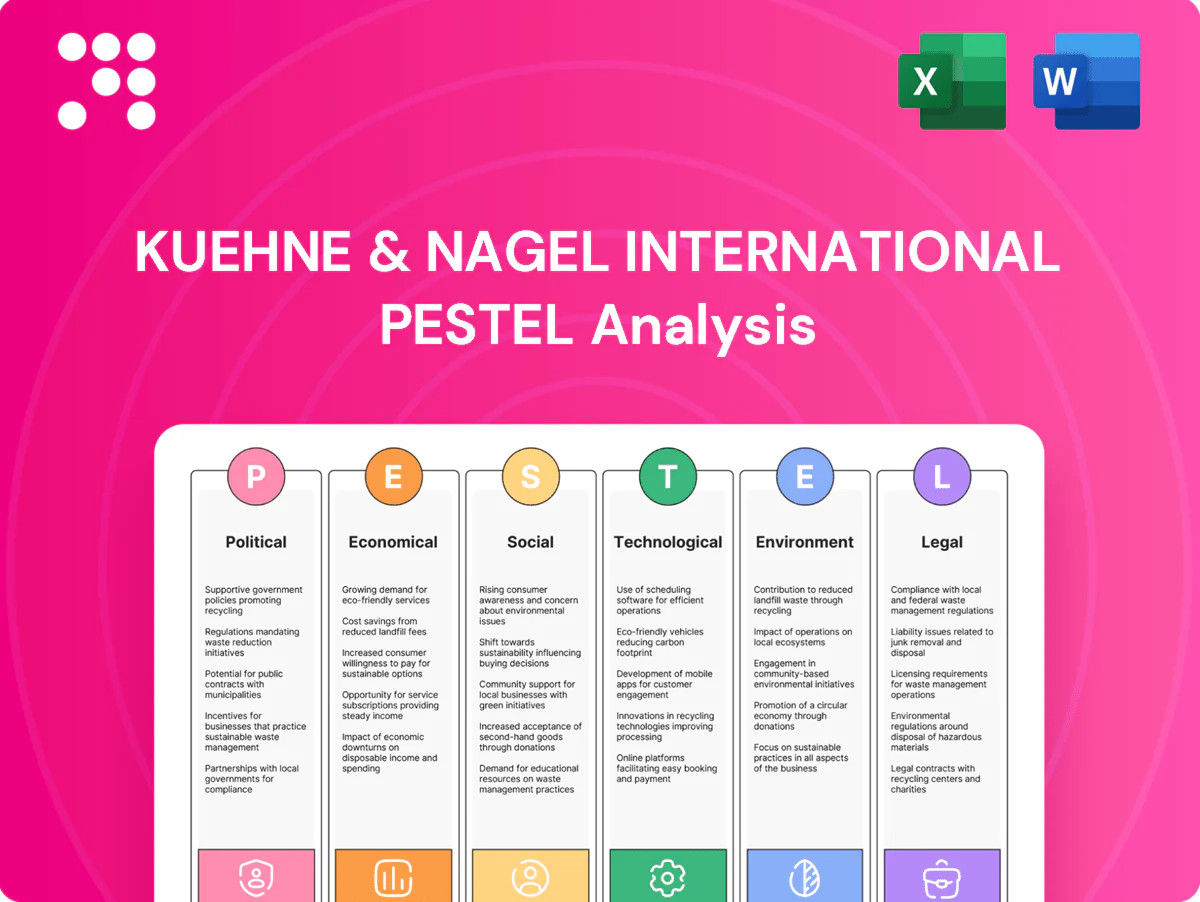
Kuehne & Nagel International PESTLE Analysis

Plan Smarter. Present Sharper. Compete Stronger.
Our PESTLE analysis of Kuehne & Nagel International reveals how political shifts, economic cycles, and technological change shape logistics strategy and operational risk. Backed by current data, it highlights regulatory threats, sustainability pressures, and market opportunities that matter to investors and executives. Purchase the full report to access actionable insights and editable charts for immediate strategic use.
Political factors

Trade policy volatility
Shifts in tariffs, sanctions and export controls directly alter routing, cost-to-serve and transit times for Kuehne+Nagel, pressuring margins across its network present in over 100 countries. Rapid policy swings force dynamic capacity reallocation across sea, air and road and higher short-term spot costs. The group must keep multi-country brokerage expertise and diversified trade lanes and customer portfolios to mitigate policy shocks; workforce ~83,000 (2024).
Customs harmonization and border regimes
Divergent customs rules across jurisdictions slow clearance and raise compliance workload, increasing lead-time variability for shippers. AEO/CTPAT and trusted-trader programs can cut inspections but demand ongoing investment and audits to retain status. Digital customs and single-window systems reward high data quality and API connectivity. Kuehne+Nagel’s brokerage scale—operations in over 100 countries and roughly 84,000 employees (2024)—is a key competitive lever in stringent regimes.

Geopolitical hotspots and security
Geopolitical hotspots like the Red Sea and Black Sea force many carriers to reroute around the Cape of Good Hope, adding roughly 3,000 nautical miles and 10–14 days to transit, creating capacity constraints and higher insurance/war-risk surcharges. Airspace closures and elevated port security shift optimal modes and hubs and increase demand for air charters. Customers now prioritize contingency planning, multi-gateway strategies, proactive risk monitoring and charter options to preserve service continuity.

Public infrastructure and port governance
Government investment in ports, airports and corridors directly dictates throughput and reliability, while labor disputes at publicly influenced terminals trigger strikes and bottlenecks that raise lead times; concession policies drive handling charges and dwell times. Kuehne+Nagel, present in over 100 countries with ~1,300 offices, benefits from aligning with efficient gateways and inland nodes to protect margins.
- Investment: public capex shapes capacity
- Labor: strikes = bottlenecks, delays
- Concessions: fees affect dwell times
- K+N: >100 countries, ~1,300 offices
Trade agreements and regional blocs
FTAs and blocs (EU, USMCA, RCEP) are reshaping sourcing footprints and duty profiles: RCEP covers ~30% of global GDP and trade, the EU single market ~447m people and ~€16tn GDP, USMCA goods trade exceeds ~$1.7tn annually. Tightening rules of origin drive documentation and value-add relocation; preferential access accelerates nearshoring. Kuehne+Nagel can map tariff-optimized routings and DC networks to preserve margins and compliance.
- FTAs alter tariffs and sourcing
- Rules of origin increase documentation
- Preferential access enables nearshoring
- KN designs compliant, tariff-optimized networks
Geopolitics and tariffs squeeze global logistics: higher routing costs, 10-14 day reroutes
Shifts in tariffs, sanctions and geopolitics raise routing costs and spot rates, pressuring margins across Kuehne+Nagel’s network in >100 countries. Divergent customs regimes and FTAs (RCEP ~30% global GDP; EU ~447m people) increase documentation and compliance spend. Port/air investment and hotspot reroutes (≈10–14 days via Cape) force capacity reallocation; workforce ~84,000 (2024), ~1,300 offices.
| Metric | Value |
|---|---|
| Countries | >100 |
| Employees (2024) | ~84,000 |
| Offices | ~1,300 |
| Hotspot reroute delay | ≈10–14 days |
What is included in the product
 Detailed Word Document
Explores how macro-environmental factors—Political, Economic, Social, Technological, Environmental and Legal—uniquely affect Kuehne & Nagel International, combining data-driven trends and region/industry-specific examples. Designed for executives and investors, it highlights risks, opportunities and forward-looking implications for strategy and scenario planning.

 Customizable Excel Spreadsheet
Concise Kuehne & Nagel International PESTLE analysis, visually segmented by category for quick interpretation and drop‑in PowerPoint use, streamlining meeting prep and cross‑team alignment. Easily editable for region or business‑line notes, it relieves research pain by surfacing external risks and market positioning for faster strategic decisions.
Economic factors

Global trade cycles and demand elasticity
Freight volumes closely track GDP, retail sales and industrial production — IMF estimated world GDP growth at 3.0% in 2024, driving a trade rebound that tightened capacity and lifted spot rates late 2024. Downturns compress yields and raise competition while rebounds strain capacity; Kuehne+Nagel must flex between forwarding margins and contract logistics stability. Diversification by sector and lane tempers volatility; K+N reported FY 2024 net turnover of CHF 46.5bn.
Fuel prices and bunker/jet surcharges
Oil price swings (Brent averaged about 86 USD/b in 2024) directly raise ocean bunker and air jet fuel surcharges, increasing end-to-end costs for Kuehne & Nagel. Transparent pass-through mechanisms protect margins but strain customer tolerance during spikes. Efficiency and load optimization cut fuel exposure, while gradual adoption of VLSFO and SAF offers potential to stabilize long-term cost profiles.

Currency and interest rate dynamics
Multi-currency revenues and costs across 100+ countries (Kuehne+Nagel reported CHF 31.5bn turnover in 2023) create material FX translation and transaction risks that can swing margins. Interest rate cycles affect warehousing capex, vehicle leases and working capital financing costs, increasing expense during rate hikes. Hedging and natural currency offsets are essential for earnings stability, and pricing discipline must reflect local inflationary realities.

Nearshoring and supply chain reconfiguration
Nearshoring shortens lane lengths and shifts modal mix toward road, air and regional ocean services, increasing demand for shorter, more frequent shipments; Kuehne+Nagel, present in 100+ countries with ~1,300 offices, can monetise this via new cross-border corridors and enhanced border logistics. Network redesign and supply‑chain reconfiguration services are becoming clear growth drivers for the company.
- Shorter lanes → more road/air
- Regional ocean services expand
- Cross-border corridors = revenue opportunity
- Network redesign services = growth
E-commerce and omni-channel growth
E-commerce GMV crossed roughly $5.7 trillion in 2023 and topped an estimated $6.1 trillion in 2024, driving higher parcel density and rapid-fulfillment demand that forces Kuehne + Nagel to expand flexible warehousing and last‑mile interfaces. Peak-season spikes (holiday quarters) amplify labor and capacity needs, with parcel volumes up double digits in many markets, increasing seasonal cost volatility. High customer service expectations reward investments in real‑time visibility and strict SLA adherence, while contract logistics tied to retail cycles help smooth forwarding revenue swings.
- Parcel density: rising with e‑commerce; drives flexible warehousing
- Peak seasonality: larger labor/capacity needs, double‑digit parcel growth in many markets
- Service expectations: visibility and SLA adherence critical
- Contract logistics: buffers forwarding volatility via retail cycles
Geopolitics and tariffs squeeze global logistics: higher routing costs, 10-14 day reroutes
Global GDP ~3.0% in 2024 drove trade rebound, tightening capacity; Kuehne+Nagel FY2024 turnover CHF46.5bn. Brent ~86 USD/b in 2024 raised fuel surcharges; e‑commerce GMV ~6.1tn USD amplified parcel/warehousing demand. Multi‑currency exposure and higher rates increase financing and capex costs, making pricing, hedging and modal mix optimization critical.
| Metric | 2024 |
|---|---|
| World GDP growth (IMF) | 3.0% |
| K+N turnover | CHF46.5bn |
| Brent avg | ~86 USD/b |
| E‑commerce GMV | ~6.1tn USD |
Same Document Delivered
Kuehne & Nagel International PESTLE Analysis
The Kuehne & Nagel International PESTLE Analysis preview shown here is the exact document you’ll receive after purchase—fully formatted and ready to use. The content, layout, and insights on political, economic, social, technological, legal, and environmental factors are delivered exactly as displayed. No placeholders or teasers—this is the final file available for immediate download.

Plan Smarter. Present Sharper. Compete Stronger.
Our PESTLE analysis of Kuehne & Nagel International reveals how political shifts, economic cycles, and technological change shape logistics strategy and operational risk. Backed by current data, it highlights regulatory threats, sustainability pressures, and market opportunities that matter to investors and executives. Purchase the full report to access actionable insights and editable charts for immediate strategic use.
Political factors
Trade policy volatility
Shifts in tariffs, sanctions and export controls directly alter routing, cost-to-serve and transit times for Kuehne+Nagel, pressuring margins across its network present in over 100 countries. Rapid policy swings force dynamic capacity reallocation across sea, air and road and higher short-term spot costs. The group must keep multi-country brokerage expertise and diversified trade lanes and customer portfolios to mitigate policy shocks; workforce ~83,000 (2024).
Customs harmonization and border regimes
Divergent customs rules across jurisdictions slow clearance and raise compliance workload, increasing lead-time variability for shippers. AEO/CTPAT and trusted-trader programs can cut inspections but demand ongoing investment and audits to retain status. Digital customs and single-window systems reward high data quality and API connectivity. Kuehne+Nagel’s brokerage scale—operations in over 100 countries and roughly 84,000 employees (2024)—is a key competitive lever in stringent regimes.
Geopolitical hotspots and security
Geopolitical hotspots like the Red Sea and Black Sea force many carriers to reroute around the Cape of Good Hope, adding roughly 3,000 nautical miles and 10–14 days to transit, creating capacity constraints and higher insurance/war-risk surcharges. Airspace closures and elevated port security shift optimal modes and hubs and increase demand for air charters. Customers now prioritize contingency planning, multi-gateway strategies, proactive risk monitoring and charter options to preserve service continuity.
Public infrastructure and port governance
Government investment in ports, airports and corridors directly dictates throughput and reliability, while labor disputes at publicly influenced terminals trigger strikes and bottlenecks that raise lead times; concession policies drive handling charges and dwell times. Kuehne+Nagel, present in over 100 countries with ~1,300 offices, benefits from aligning with efficient gateways and inland nodes to protect margins.
- Investment: public capex shapes capacity
- Labor: strikes = bottlenecks, delays
- Concessions: fees affect dwell times
- K+N: >100 countries, ~1,300 offices
Trade agreements and regional blocs
FTAs and blocs (EU, USMCA, RCEP) are reshaping sourcing footprints and duty profiles: RCEP covers ~30% of global GDP and trade, the EU single market ~447m people and ~€16tn GDP, USMCA goods trade exceeds ~$1.7tn annually. Tightening rules of origin drive documentation and value-add relocation; preferential access accelerates nearshoring. Kuehne+Nagel can map tariff-optimized routings and DC networks to preserve margins and compliance.
- FTAs alter tariffs and sourcing
- Rules of origin increase documentation
- Preferential access enables nearshoring
- KN designs compliant, tariff-optimized networks
Geopolitics and tariffs squeeze global logistics: higher routing costs, 10-14 day reroutes
Shifts in tariffs, sanctions and geopolitics raise routing costs and spot rates, pressuring margins across Kuehne+Nagel’s network in >100 countries. Divergent customs regimes and FTAs (RCEP ~30% global GDP; EU ~447m people) increase documentation and compliance spend. Port/air investment and hotspot reroutes (≈10–14 days via Cape) force capacity reallocation; workforce ~84,000 (2024), ~1,300 offices.
| Metric | Value |
|---|---|
| Countries | >100 |
| Employees (2024) | ~84,000 |
| Offices | ~1,300 |
| Hotspot reroute delay | ≈10–14 days |
What is included in the product
Detailed Word Document
Explores how macro-environmental factors—Political, Economic, Social, Technological, Environmental and Legal—uniquely affect Kuehne & Nagel International, combining data-driven trends and region/industry-specific examples. Designed for executives and investors, it highlights risks, opportunities and forward-looking implications for strategy and scenario planning.
Customizable Excel Spreadsheet
Concise Kuehne & Nagel International PESTLE analysis, visually segmented by category for quick interpretation and drop‑in PowerPoint use, streamlining meeting prep and cross‑team alignment. Easily editable for region or business‑line notes, it relieves research pain by surfacing external risks and market positioning for faster strategic decisions.
Economic factors
Global trade cycles and demand elasticity
Freight volumes closely track GDP, retail sales and industrial production — IMF estimated world GDP growth at 3.0% in 2024, driving a trade rebound that tightened capacity and lifted spot rates late 2024. Downturns compress yields and raise competition while rebounds strain capacity; Kuehne+Nagel must flex between forwarding margins and contract logistics stability. Diversification by sector and lane tempers volatility; K+N reported FY 2024 net turnover of CHF 46.5bn.
Fuel prices and bunker/jet surcharges
Oil price swings (Brent averaged about 86 USD/b in 2024) directly raise ocean bunker and air jet fuel surcharges, increasing end-to-end costs for Kuehne & Nagel. Transparent pass-through mechanisms protect margins but strain customer tolerance during spikes. Efficiency and load optimization cut fuel exposure, while gradual adoption of VLSFO and SAF offers potential to stabilize long-term cost profiles.
Currency and interest rate dynamics
Multi-currency revenues and costs across 100+ countries (Kuehne+Nagel reported CHF 31.5bn turnover in 2023) create material FX translation and transaction risks that can swing margins. Interest rate cycles affect warehousing capex, vehicle leases and working capital financing costs, increasing expense during rate hikes. Hedging and natural currency offsets are essential for earnings stability, and pricing discipline must reflect local inflationary realities.
Nearshoring and supply chain reconfiguration
Nearshoring shortens lane lengths and shifts modal mix toward road, air and regional ocean services, increasing demand for shorter, more frequent shipments; Kuehne+Nagel, present in 100+ countries with ~1,300 offices, can monetise this via new cross-border corridors and enhanced border logistics. Network redesign and supply‑chain reconfiguration services are becoming clear growth drivers for the company.
- Shorter lanes → more road/air
- Regional ocean services expand
- Cross-border corridors = revenue opportunity
- Network redesign services = growth
E-commerce and omni-channel growth
E-commerce GMV crossed roughly $5.7 trillion in 2023 and topped an estimated $6.1 trillion in 2024, driving higher parcel density and rapid-fulfillment demand that forces Kuehne + Nagel to expand flexible warehousing and last‑mile interfaces. Peak-season spikes (holiday quarters) amplify labor and capacity needs, with parcel volumes up double digits in many markets, increasing seasonal cost volatility. High customer service expectations reward investments in real‑time visibility and strict SLA adherence, while contract logistics tied to retail cycles help smooth forwarding revenue swings.
- Parcel density: rising with e‑commerce; drives flexible warehousing
- Peak seasonality: larger labor/capacity needs, double‑digit parcel growth in many markets
- Service expectations: visibility and SLA adherence critical
- Contract logistics: buffers forwarding volatility via retail cycles
Geopolitics and tariffs squeeze global logistics: higher routing costs, 10-14 day reroutes
Global GDP ~3.0% in 2024 drove trade rebound, tightening capacity; Kuehne+Nagel FY2024 turnover CHF46.5bn. Brent ~86 USD/b in 2024 raised fuel surcharges; e‑commerce GMV ~6.1tn USD amplified parcel/warehousing demand. Multi‑currency exposure and higher rates increase financing and capex costs, making pricing, hedging and modal mix optimization critical.
| Metric | 2024 |
|---|---|
| World GDP growth (IMF) | 3.0% |
| K+N turnover | CHF46.5bn |
| Brent avg | ~86 USD/b |
| E‑commerce GMV | ~6.1tn USD |
Same Document Delivered
Kuehne & Nagel International PESTLE Analysis
The Kuehne & Nagel International PESTLE Analysis preview shown here is the exact document you’ll receive after purchase—fully formatted and ready to use. The content, layout, and insights on political, economic, social, technological, legal, and environmental factors are delivered exactly as displayed. No placeholders or teasers—this is the final file available for immediate download.
Original: $10.00
-65%$10.00
$3.50Description
Plan Smarter. Present Sharper. Compete Stronger.
Our PESTLE analysis of Kuehne & Nagel International reveals how political shifts, economic cycles, and technological change shape logistics strategy and operational risk. Backed by current data, it highlights regulatory threats, sustainability pressures, and market opportunities that matter to investors and executives. Purchase the full report to access actionable insights and editable charts for immediate strategic use.
Political factors
Trade policy volatility
Shifts in tariffs, sanctions and export controls directly alter routing, cost-to-serve and transit times for Kuehne+Nagel, pressuring margins across its network present in over 100 countries. Rapid policy swings force dynamic capacity reallocation across sea, air and road and higher short-term spot costs. The group must keep multi-country brokerage expertise and diversified trade lanes and customer portfolios to mitigate policy shocks; workforce ~83,000 (2024).
Customs harmonization and border regimes
Divergent customs rules across jurisdictions slow clearance and raise compliance workload, increasing lead-time variability for shippers. AEO/CTPAT and trusted-trader programs can cut inspections but demand ongoing investment and audits to retain status. Digital customs and single-window systems reward high data quality and API connectivity. Kuehne+Nagel’s brokerage scale—operations in over 100 countries and roughly 84,000 employees (2024)—is a key competitive lever in stringent regimes.
Geopolitical hotspots and security
Geopolitical hotspots like the Red Sea and Black Sea force many carriers to reroute around the Cape of Good Hope, adding roughly 3,000 nautical miles and 10–14 days to transit, creating capacity constraints and higher insurance/war-risk surcharges. Airspace closures and elevated port security shift optimal modes and hubs and increase demand for air charters. Customers now prioritize contingency planning, multi-gateway strategies, proactive risk monitoring and charter options to preserve service continuity.
Public infrastructure and port governance
Government investment in ports, airports and corridors directly dictates throughput and reliability, while labor disputes at publicly influenced terminals trigger strikes and bottlenecks that raise lead times; concession policies drive handling charges and dwell times. Kuehne+Nagel, present in over 100 countries with ~1,300 offices, benefits from aligning with efficient gateways and inland nodes to protect margins.
- Investment: public capex shapes capacity
- Labor: strikes = bottlenecks, delays
- Concessions: fees affect dwell times
- K+N: >100 countries, ~1,300 offices
Trade agreements and regional blocs
FTAs and blocs (EU, USMCA, RCEP) are reshaping sourcing footprints and duty profiles: RCEP covers ~30% of global GDP and trade, the EU single market ~447m people and ~€16tn GDP, USMCA goods trade exceeds ~$1.7tn annually. Tightening rules of origin drive documentation and value-add relocation; preferential access accelerates nearshoring. Kuehne+Nagel can map tariff-optimized routings and DC networks to preserve margins and compliance.
- FTAs alter tariffs and sourcing
- Rules of origin increase documentation
- Preferential access enables nearshoring
- KN designs compliant, tariff-optimized networks
Geopolitics and tariffs squeeze global logistics: higher routing costs, 10-14 day reroutes
Shifts in tariffs, sanctions and geopolitics raise routing costs and spot rates, pressuring margins across Kuehne+Nagel’s network in >100 countries. Divergent customs regimes and FTAs (RCEP ~30% global GDP; EU ~447m people) increase documentation and compliance spend. Port/air investment and hotspot reroutes (≈10–14 days via Cape) force capacity reallocation; workforce ~84,000 (2024), ~1,300 offices.
| Metric | Value |
|---|---|
| Countries | >100 |
| Employees (2024) | ~84,000 |
| Offices | ~1,300 |
| Hotspot reroute delay | ≈10–14 days |
What is included in the product
Detailed Word Document
Explores how macro-environmental factors—Political, Economic, Social, Technological, Environmental and Legal—uniquely affect Kuehne & Nagel International, combining data-driven trends and region/industry-specific examples. Designed for executives and investors, it highlights risks, opportunities and forward-looking implications for strategy and scenario planning.
Customizable Excel Spreadsheet
Concise Kuehne & Nagel International PESTLE analysis, visually segmented by category for quick interpretation and drop‑in PowerPoint use, streamlining meeting prep and cross‑team alignment. Easily editable for region or business‑line notes, it relieves research pain by surfacing external risks and market positioning for faster strategic decisions.
Economic factors
Global trade cycles and demand elasticity
Freight volumes closely track GDP, retail sales and industrial production — IMF estimated world GDP growth at 3.0% in 2024, driving a trade rebound that tightened capacity and lifted spot rates late 2024. Downturns compress yields and raise competition while rebounds strain capacity; Kuehne+Nagel must flex between forwarding margins and contract logistics stability. Diversification by sector and lane tempers volatility; K+N reported FY 2024 net turnover of CHF 46.5bn.
Fuel prices and bunker/jet surcharges
Oil price swings (Brent averaged about 86 USD/b in 2024) directly raise ocean bunker and air jet fuel surcharges, increasing end-to-end costs for Kuehne & Nagel. Transparent pass-through mechanisms protect margins but strain customer tolerance during spikes. Efficiency and load optimization cut fuel exposure, while gradual adoption of VLSFO and SAF offers potential to stabilize long-term cost profiles.
Currency and interest rate dynamics
Multi-currency revenues and costs across 100+ countries (Kuehne+Nagel reported CHF 31.5bn turnover in 2023) create material FX translation and transaction risks that can swing margins. Interest rate cycles affect warehousing capex, vehicle leases and working capital financing costs, increasing expense during rate hikes. Hedging and natural currency offsets are essential for earnings stability, and pricing discipline must reflect local inflationary realities.
Nearshoring and supply chain reconfiguration
Nearshoring shortens lane lengths and shifts modal mix toward road, air and regional ocean services, increasing demand for shorter, more frequent shipments; Kuehne+Nagel, present in 100+ countries with ~1,300 offices, can monetise this via new cross-border corridors and enhanced border logistics. Network redesign and supply‑chain reconfiguration services are becoming clear growth drivers for the company.
- Shorter lanes → more road/air
- Regional ocean services expand
- Cross-border corridors = revenue opportunity
- Network redesign services = growth
E-commerce and omni-channel growth
E-commerce GMV crossed roughly $5.7 trillion in 2023 and topped an estimated $6.1 trillion in 2024, driving higher parcel density and rapid-fulfillment demand that forces Kuehne + Nagel to expand flexible warehousing and last‑mile interfaces. Peak-season spikes (holiday quarters) amplify labor and capacity needs, with parcel volumes up double digits in many markets, increasing seasonal cost volatility. High customer service expectations reward investments in real‑time visibility and strict SLA adherence, while contract logistics tied to retail cycles help smooth forwarding revenue swings.
- Parcel density: rising with e‑commerce; drives flexible warehousing
- Peak seasonality: larger labor/capacity needs, double‑digit parcel growth in many markets
- Service expectations: visibility and SLA adherence critical
- Contract logistics: buffers forwarding volatility via retail cycles
Geopolitics and tariffs squeeze global logistics: higher routing costs, 10-14 day reroutes
Global GDP ~3.0% in 2024 drove trade rebound, tightening capacity; Kuehne+Nagel FY2024 turnover CHF46.5bn. Brent ~86 USD/b in 2024 raised fuel surcharges; e‑commerce GMV ~6.1tn USD amplified parcel/warehousing demand. Multi‑currency exposure and higher rates increase financing and capex costs, making pricing, hedging and modal mix optimization critical.
| Metric | 2024 |
|---|---|
| World GDP growth (IMF) | 3.0% |
| K+N turnover | CHF46.5bn |
| Brent avg | ~86 USD/b |
| E‑commerce GMV | ~6.1tn USD |
Same Document Delivered
Kuehne & Nagel International PESTLE Analysis
The Kuehne & Nagel International PESTLE Analysis preview shown here is the exact document you’ll receive after purchase—fully formatted and ready to use. The content, layout, and insights on political, economic, social, technological, legal, and environmental factors are delivered exactly as displayed. No placeholders or teasers—this is the final file available for immediate download.











