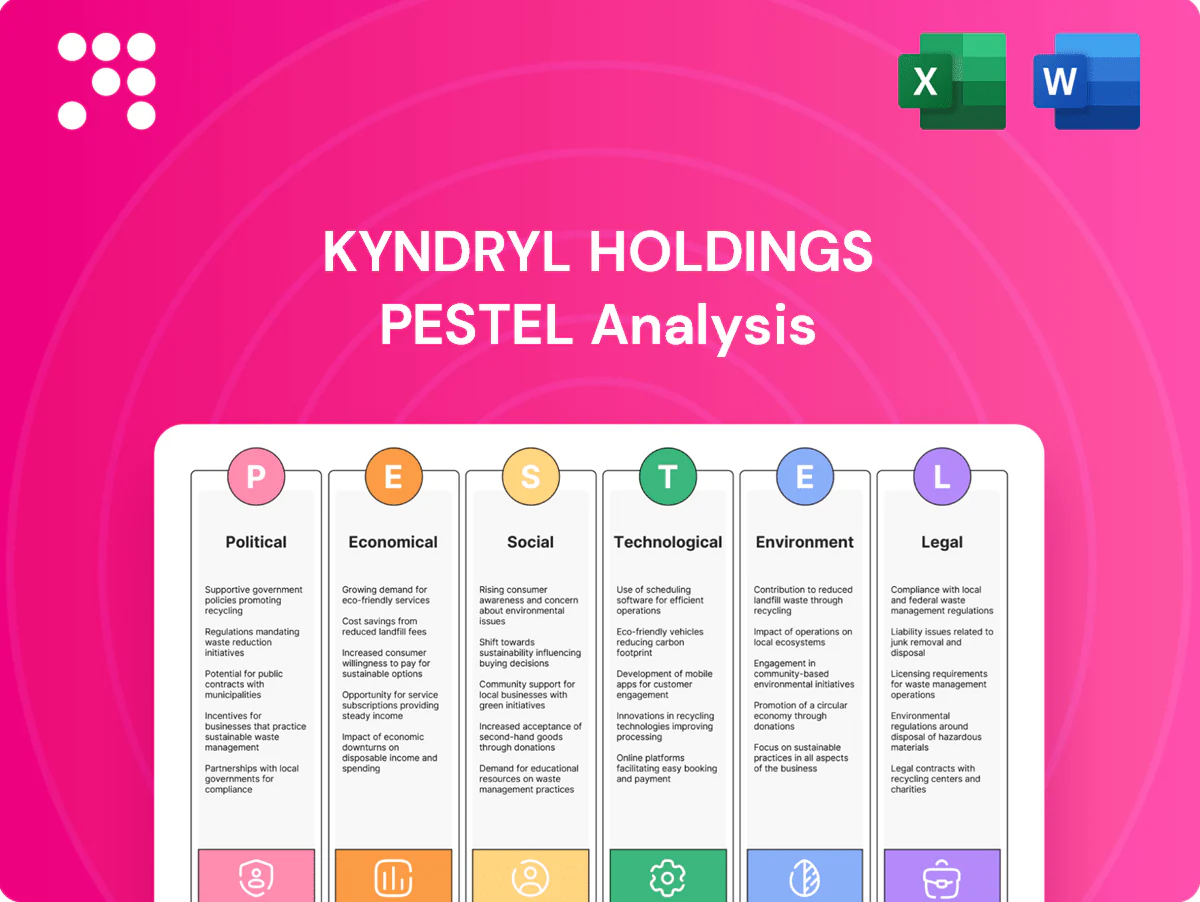
Kyndryl Holdings PESTLE Analysis

Your Shortcut to Market Insight Starts Here
Get strategic advantage with our PESTLE analysis of Kyndryl Holdings—unpacking political, economic and technological forces shaping its future. Identify regulatory and market risks, pinpoint growth opportunities, and refine investment theses. Ready-made and actionable for professionals. Buy the full report for the complete breakdown.
Political factors

Data sovereignty and localization mandates
Governments are tightening rules requiring sensitive data to remain within national borders, shaping Kyndryl's cloud architecture, colocation strategies and contract scoping across 60+ countries.
This fragments standardized global delivery but creates demand for sovereign cloud and compliant managed services that Kyndryl can monetize.
Compliance missteps can delay deployments and raise operational and capital costs, squeezing margins.
Geopolitical tension and supply chain security
US‑China tech restrictions—notably US Commerce export controls first tightened in October 2022 and expanded through 2023–24—can disrupt hardware sourcing, OEM partnerships, and end‑customer industries, forcing Kyndryl to diversify vendors and redesign logistics. The firm must validate firmware/software provenance and map geopolitical risk to sustain service continuity. Longer lead times and inventory buffers raise working capital needs and operational costs.

Public sector digitalization and critical infrastructure
Governments are prioritizing cybersecurity, AI and legacy modernization—the global cybersecurity market was valued at about $173B in 2022 and is forecast to exceed $300B by 2027—creating opportunities for Kyndryl to win multi‑year defense, health, tax and transport contracts with stringent SLAs. Procurement cycles remain lengthy and politically sensitive, requiring local certifications and bidding experience, while election‑driven budget shifts can re‑prioritize programs mid‑contract.

Trade policy, tariffs, and localization of services
Tariffs on IT hardware—notably US Section 301 duties reaching up to 25%—and national data‑localization rules force Kyndryl to shift delivery footprints toward nearshore/onshore centers for regulated workloads, raising labor costs but improving eligibility for public contracts; leveraging bilateral deals such as USMCA and select EU trade pacts can reduce supply‑chain frictions and unlock market access.
- Tariffs: up to 25%
- Localization: data residency drives onshore
- Labor: higher wages vs offshore
- Public contracts: improved access
- Agreements: USMCA/FTAs ease entry
Cyber sovereignty and government cloud frameworks
Cyber sovereignty regimes and national cloud frameworks such as FedRAMP and EU sovereign initiatives set security and data‑residency baselines; FedRAMP lists over 400 authorized cloud offerings (2024) while Gaia‑X counted about 300 members (2024). Alignment lets Kyndryl host mission‑critical government and strategic industry workloads; non‑alignment can exclude bids or force costly, fragmented architectures. Ongoing policy evolution requires continuous compliance investment.
- Baseline: FedRAMP >400 offerings (2024)
- EU: Gaia‑X ~300 members (2024)
- Risk: exclusion from public tenders
- Action: continuous compliance spend
Data-residency in 60+ countries fragments delivery; cyber > $300B
Governments' data‑residency and export controls (US Oct 2022; expansions 2023–24) across 60+ countries fragment delivery but boost demand for sovereign cloud and compliant services; tariffs up to 25% and longer lead times raise working capital. Cybersecurity market ~$173B (2022), >$300B by 2027, FedRAMP >400 offerings (2024) and Gaia‑X ~300 members (2024) create bid opportunities needing continuous compliance spend.
| Metric | Value |
|---|---|
| Countries | 60+ |
| Tariffs | up to 25% |
| Cybersecurity market | $173B (2022); >$300B (2027) |
| FedRAMP | >400 offerings (2024) |
| Gaia‑X | ~300 members (2024) |
What is included in the product
 Detailed Word Document
Explores how Political, Economic, Social, Technological, Environmental and Legal forces specifically impact Kyndryl Holdings, with data-backed trends and region/industry relevance to reveal risks, opportunities and strategic implications for executives, investors and advisors, plus forward-looking insights to support scenario planning and decision-making.

 Customizable Excel Spreadsheet
A concise PESTLE snapshot of Kyndryl, visually segmented for quick interpretation and editable for regional or business-line notes, making it easy to drop into presentations, share across teams, and support risk and market-positioning discussions during planning sessions.
Economic factors

Enterprise IT spending cycles
Macro slowdowns push CIOs to defer modernization and shift spend from capex to opex, favoring managed services but pressuring pricing; Gartner projected global IT spending near 4.6 trillion in 2025, keeping procurement cautious. In upcycles clients fund multi‑year transformation and AI programs, expanding deal scope and contract sizes. Kyndryl must balance resilience services with growth projects to smooth revenues; pipeline visibility and backlog quality are key.
Currency volatility across 60+ markets
FX swings across 60+ markets materially affect Kyndryl’s reported revenue, margins and pricing competitiveness, with the US dollar trading near an index level of ~105 in mid‑2025 intensifying translation headwinds. Multi‑currency contracts and active hedging programs reduce volatility but cannot fully eliminate timing and basis risks. Delivery centers in lower‑cost geographies provide partial natural hedges through local cost bases. Persistent dollar strength continues to compress international results.

Labor costs and skills inflation
High demand for cloud, cybersecurity and AI talent drove tech wage inflation of about 7% in 2024 and sector attrition near 20%, pressuring Kyndryl’s margins. Disciplined pyramid management, expansion of nearshore pools and automation are required to offset rising labor spend. Strategic training and certification pipelines cut external hiring premiums, while rate‑card adjustments must capture value without eroding win rates.

Partner ecosystem economics
Partner ecosystem economics shape Kyndryl deal economics: revenue sharing with hyperscalers and OEMs alters solution design and can compress gross margins even as co-sell incentives accelerate bookings; global cloud infra share (2024) is roughly AWS 33%, Azure 24%, GCP 10%, concentrating partner leverage.
- co-sell: faster bookings, margin compression
- rev-share: influences pricing and design
- multi-cloud neutrality: preserves bargaining power
- strong alliances: unlock MDF and demand-gen funding
Interest rates and contract financing
Higher interest rates (US fed funds ~5.25–5.50% and 10‑yr Treasury ~4.2% in mid‑2025) raise Kyndryl's working capital, equipment financing and customer payment‑plan costs; clients are shifting to shorter terms, outcome‑based models and consumption pricing, so Kyndryl must tighten cash conversion, milestone billing and push asset‑light solutions; falling rates could re‑accelerate large transformation commitments.
- Higher borrowing costs: increases financing expense
- Client preference: shorter/outcome/consumption
- Company action: optimize DSO, milestone billing, asset‑light
- Downside upside: rate declines → larger projects resume
Data-residency in 60+ countries fragments delivery; cyber > $300B
Macro slowdown keeps CIOs deferring capex to opex; Gartner projects global IT spend ~4.6T in 2025, pressuring pricing and pipeline. USD index ~105 (mid‑2025) and multi‑currency exposure compress margins; tech wage inflation ~7% (2024) with ~20% attrition raises delivery costs. Fed funds ~5.25–5.50% and 10Y ~4.2% tighten client financing, favoring outcome/consumption models.
| Metric | Value | Impact on Kyndryl |
|---|---|---|
| Global IT spend (Gartner) | ~4.6T (2025) | Constrained budgets, cautious procurement |
| USD index | ~105 (mid‑2025) | Translation headwinds |
| Tech wage inflation | ~7% (2024) | Margin pressure |
| Fed funds / 10Y | 5.25–5.50% / ~4.2% | Higher financing costs, shift to consumption |
| Cloud share (2024) | AWS 33% / Azure 24% / GCP 10% | Partner leverage, rev‑share effects |
Same Document Delivered
Kyndryl Holdings PESTLE Analysis
The preview shown here is the exact document you’ll receive after purchase—fully formatted and ready to use. This Kyndryl Holdings PESTLE Analysis presents comprehensive Political, Economic, Social, Technological, Legal and Environmental factors with clear structure and actionable insights. No placeholders—instant download of the final file upon checkout.

Your Shortcut to Market Insight Starts Here
Get strategic advantage with our PESTLE analysis of Kyndryl Holdings—unpacking political, economic and technological forces shaping its future. Identify regulatory and market risks, pinpoint growth opportunities, and refine investment theses. Ready-made and actionable for professionals. Buy the full report for the complete breakdown.
Political factors
Data sovereignty and localization mandates
Governments are tightening rules requiring sensitive data to remain within national borders, shaping Kyndryl's cloud architecture, colocation strategies and contract scoping across 60+ countries.
This fragments standardized global delivery but creates demand for sovereign cloud and compliant managed services that Kyndryl can monetize.
Compliance missteps can delay deployments and raise operational and capital costs, squeezing margins.
Geopolitical tension and supply chain security
US‑China tech restrictions—notably US Commerce export controls first tightened in October 2022 and expanded through 2023–24—can disrupt hardware sourcing, OEM partnerships, and end‑customer industries, forcing Kyndryl to diversify vendors and redesign logistics. The firm must validate firmware/software provenance and map geopolitical risk to sustain service continuity. Longer lead times and inventory buffers raise working capital needs and operational costs.
Public sector digitalization and critical infrastructure
Governments are prioritizing cybersecurity, AI and legacy modernization—the global cybersecurity market was valued at about $173B in 2022 and is forecast to exceed $300B by 2027—creating opportunities for Kyndryl to win multi‑year defense, health, tax and transport contracts with stringent SLAs. Procurement cycles remain lengthy and politically sensitive, requiring local certifications and bidding experience, while election‑driven budget shifts can re‑prioritize programs mid‑contract.
Trade policy, tariffs, and localization of services
Tariffs on IT hardware—notably US Section 301 duties reaching up to 25%—and national data‑localization rules force Kyndryl to shift delivery footprints toward nearshore/onshore centers for regulated workloads, raising labor costs but improving eligibility for public contracts; leveraging bilateral deals such as USMCA and select EU trade pacts can reduce supply‑chain frictions and unlock market access.
- Tariffs: up to 25%
- Localization: data residency drives onshore
- Labor: higher wages vs offshore
- Public contracts: improved access
- Agreements: USMCA/FTAs ease entry
Cyber sovereignty and government cloud frameworks
Cyber sovereignty regimes and national cloud frameworks such as FedRAMP and EU sovereign initiatives set security and data‑residency baselines; FedRAMP lists over 400 authorized cloud offerings (2024) while Gaia‑X counted about 300 members (2024). Alignment lets Kyndryl host mission‑critical government and strategic industry workloads; non‑alignment can exclude bids or force costly, fragmented architectures. Ongoing policy evolution requires continuous compliance investment.
- Baseline: FedRAMP >400 offerings (2024)
- EU: Gaia‑X ~300 members (2024)
- Risk: exclusion from public tenders
- Action: continuous compliance spend
Data-residency in 60+ countries fragments delivery; cyber > $300B
Governments' data‑residency and export controls (US Oct 2022; expansions 2023–24) across 60+ countries fragment delivery but boost demand for sovereign cloud and compliant services; tariffs up to 25% and longer lead times raise working capital. Cybersecurity market ~$173B (2022), >$300B by 2027, FedRAMP >400 offerings (2024) and Gaia‑X ~300 members (2024) create bid opportunities needing continuous compliance spend.
| Metric | Value |
|---|---|
| Countries | 60+ |
| Tariffs | up to 25% |
| Cybersecurity market | $173B (2022); >$300B (2027) |
| FedRAMP | >400 offerings (2024) |
| Gaia‑X | ~300 members (2024) |
What is included in the product
Detailed Word Document
Explores how Political, Economic, Social, Technological, Environmental and Legal forces specifically impact Kyndryl Holdings, with data-backed trends and region/industry relevance to reveal risks, opportunities and strategic implications for executives, investors and advisors, plus forward-looking insights to support scenario planning and decision-making.
Customizable Excel Spreadsheet
A concise PESTLE snapshot of Kyndryl, visually segmented for quick interpretation and editable for regional or business-line notes, making it easy to drop into presentations, share across teams, and support risk and market-positioning discussions during planning sessions.
Economic factors
Enterprise IT spending cycles
Macro slowdowns push CIOs to defer modernization and shift spend from capex to opex, favoring managed services but pressuring pricing; Gartner projected global IT spending near 4.6 trillion in 2025, keeping procurement cautious. In upcycles clients fund multi‑year transformation and AI programs, expanding deal scope and contract sizes. Kyndryl must balance resilience services with growth projects to smooth revenues; pipeline visibility and backlog quality are key.
Currency volatility across 60+ markets
FX swings across 60+ markets materially affect Kyndryl’s reported revenue, margins and pricing competitiveness, with the US dollar trading near an index level of ~105 in mid‑2025 intensifying translation headwinds. Multi‑currency contracts and active hedging programs reduce volatility but cannot fully eliminate timing and basis risks. Delivery centers in lower‑cost geographies provide partial natural hedges through local cost bases. Persistent dollar strength continues to compress international results.
Labor costs and skills inflation
High demand for cloud, cybersecurity and AI talent drove tech wage inflation of about 7% in 2024 and sector attrition near 20%, pressuring Kyndryl’s margins. Disciplined pyramid management, expansion of nearshore pools and automation are required to offset rising labor spend. Strategic training and certification pipelines cut external hiring premiums, while rate‑card adjustments must capture value without eroding win rates.
Partner ecosystem economics
Partner ecosystem economics shape Kyndryl deal economics: revenue sharing with hyperscalers and OEMs alters solution design and can compress gross margins even as co-sell incentives accelerate bookings; global cloud infra share (2024) is roughly AWS 33%, Azure 24%, GCP 10%, concentrating partner leverage.
- co-sell: faster bookings, margin compression
- rev-share: influences pricing and design
- multi-cloud neutrality: preserves bargaining power
- strong alliances: unlock MDF and demand-gen funding
Interest rates and contract financing
Higher interest rates (US fed funds ~5.25–5.50% and 10‑yr Treasury ~4.2% in mid‑2025) raise Kyndryl's working capital, equipment financing and customer payment‑plan costs; clients are shifting to shorter terms, outcome‑based models and consumption pricing, so Kyndryl must tighten cash conversion, milestone billing and push asset‑light solutions; falling rates could re‑accelerate large transformation commitments.
- Higher borrowing costs: increases financing expense
- Client preference: shorter/outcome/consumption
- Company action: optimize DSO, milestone billing, asset‑light
- Downside upside: rate declines → larger projects resume
Data-residency in 60+ countries fragments delivery; cyber > $300B
Macro slowdown keeps CIOs deferring capex to opex; Gartner projects global IT spend ~4.6T in 2025, pressuring pricing and pipeline. USD index ~105 (mid‑2025) and multi‑currency exposure compress margins; tech wage inflation ~7% (2024) with ~20% attrition raises delivery costs. Fed funds ~5.25–5.50% and 10Y ~4.2% tighten client financing, favoring outcome/consumption models.
| Metric | Value | Impact on Kyndryl |
|---|---|---|
| Global IT spend (Gartner) | ~4.6T (2025) | Constrained budgets, cautious procurement |
| USD index | ~105 (mid‑2025) | Translation headwinds |
| Tech wage inflation | ~7% (2024) | Margin pressure |
| Fed funds / 10Y | 5.25–5.50% / ~4.2% | Higher financing costs, shift to consumption |
| Cloud share (2024) | AWS 33% / Azure 24% / GCP 10% | Partner leverage, rev‑share effects |
Same Document Delivered
Kyndryl Holdings PESTLE Analysis
The preview shown here is the exact document you’ll receive after purchase—fully formatted and ready to use. This Kyndryl Holdings PESTLE Analysis presents comprehensive Political, Economic, Social, Technological, Legal and Environmental factors with clear structure and actionable insights. No placeholders—instant download of the final file upon checkout.
Original: $10.00
-65%$10.00
$3.50Description
Your Shortcut to Market Insight Starts Here
Get strategic advantage with our PESTLE analysis of Kyndryl Holdings—unpacking political, economic and technological forces shaping its future. Identify regulatory and market risks, pinpoint growth opportunities, and refine investment theses. Ready-made and actionable for professionals. Buy the full report for the complete breakdown.
Political factors
Data sovereignty and localization mandates
Governments are tightening rules requiring sensitive data to remain within national borders, shaping Kyndryl's cloud architecture, colocation strategies and contract scoping across 60+ countries.
This fragments standardized global delivery but creates demand for sovereign cloud and compliant managed services that Kyndryl can monetize.
Compliance missteps can delay deployments and raise operational and capital costs, squeezing margins.
Geopolitical tension and supply chain security
US‑China tech restrictions—notably US Commerce export controls first tightened in October 2022 and expanded through 2023–24—can disrupt hardware sourcing, OEM partnerships, and end‑customer industries, forcing Kyndryl to diversify vendors and redesign logistics. The firm must validate firmware/software provenance and map geopolitical risk to sustain service continuity. Longer lead times and inventory buffers raise working capital needs and operational costs.
Public sector digitalization and critical infrastructure
Governments are prioritizing cybersecurity, AI and legacy modernization—the global cybersecurity market was valued at about $173B in 2022 and is forecast to exceed $300B by 2027—creating opportunities for Kyndryl to win multi‑year defense, health, tax and transport contracts with stringent SLAs. Procurement cycles remain lengthy and politically sensitive, requiring local certifications and bidding experience, while election‑driven budget shifts can re‑prioritize programs mid‑contract.
Trade policy, tariffs, and localization of services
Tariffs on IT hardware—notably US Section 301 duties reaching up to 25%—and national data‑localization rules force Kyndryl to shift delivery footprints toward nearshore/onshore centers for regulated workloads, raising labor costs but improving eligibility for public contracts; leveraging bilateral deals such as USMCA and select EU trade pacts can reduce supply‑chain frictions and unlock market access.
- Tariffs: up to 25%
- Localization: data residency drives onshore
- Labor: higher wages vs offshore
- Public contracts: improved access
- Agreements: USMCA/FTAs ease entry
Cyber sovereignty and government cloud frameworks
Cyber sovereignty regimes and national cloud frameworks such as FedRAMP and EU sovereign initiatives set security and data‑residency baselines; FedRAMP lists over 400 authorized cloud offerings (2024) while Gaia‑X counted about 300 members (2024). Alignment lets Kyndryl host mission‑critical government and strategic industry workloads; non‑alignment can exclude bids or force costly, fragmented architectures. Ongoing policy evolution requires continuous compliance investment.
- Baseline: FedRAMP >400 offerings (2024)
- EU: Gaia‑X ~300 members (2024)
- Risk: exclusion from public tenders
- Action: continuous compliance spend
Data-residency in 60+ countries fragments delivery; cyber > $300B
Governments' data‑residency and export controls (US Oct 2022; expansions 2023–24) across 60+ countries fragment delivery but boost demand for sovereign cloud and compliant services; tariffs up to 25% and longer lead times raise working capital. Cybersecurity market ~$173B (2022), >$300B by 2027, FedRAMP >400 offerings (2024) and Gaia‑X ~300 members (2024) create bid opportunities needing continuous compliance spend.
| Metric | Value |
|---|---|
| Countries | 60+ |
| Tariffs | up to 25% |
| Cybersecurity market | $173B (2022); >$300B (2027) |
| FedRAMP | >400 offerings (2024) |
| Gaia‑X | ~300 members (2024) |
What is included in the product
Detailed Word Document
Explores how Political, Economic, Social, Technological, Environmental and Legal forces specifically impact Kyndryl Holdings, with data-backed trends and region/industry relevance to reveal risks, opportunities and strategic implications for executives, investors and advisors, plus forward-looking insights to support scenario planning and decision-making.
Customizable Excel Spreadsheet
A concise PESTLE snapshot of Kyndryl, visually segmented for quick interpretation and editable for regional or business-line notes, making it easy to drop into presentations, share across teams, and support risk and market-positioning discussions during planning sessions.
Economic factors
Enterprise IT spending cycles
Macro slowdowns push CIOs to defer modernization and shift spend from capex to opex, favoring managed services but pressuring pricing; Gartner projected global IT spending near 4.6 trillion in 2025, keeping procurement cautious. In upcycles clients fund multi‑year transformation and AI programs, expanding deal scope and contract sizes. Kyndryl must balance resilience services with growth projects to smooth revenues; pipeline visibility and backlog quality are key.
Currency volatility across 60+ markets
FX swings across 60+ markets materially affect Kyndryl’s reported revenue, margins and pricing competitiveness, with the US dollar trading near an index level of ~105 in mid‑2025 intensifying translation headwinds. Multi‑currency contracts and active hedging programs reduce volatility but cannot fully eliminate timing and basis risks. Delivery centers in lower‑cost geographies provide partial natural hedges through local cost bases. Persistent dollar strength continues to compress international results.
Labor costs and skills inflation
High demand for cloud, cybersecurity and AI talent drove tech wage inflation of about 7% in 2024 and sector attrition near 20%, pressuring Kyndryl’s margins. Disciplined pyramid management, expansion of nearshore pools and automation are required to offset rising labor spend. Strategic training and certification pipelines cut external hiring premiums, while rate‑card adjustments must capture value without eroding win rates.
Partner ecosystem economics
Partner ecosystem economics shape Kyndryl deal economics: revenue sharing with hyperscalers and OEMs alters solution design and can compress gross margins even as co-sell incentives accelerate bookings; global cloud infra share (2024) is roughly AWS 33%, Azure 24%, GCP 10%, concentrating partner leverage.
- co-sell: faster bookings, margin compression
- rev-share: influences pricing and design
- multi-cloud neutrality: preserves bargaining power
- strong alliances: unlock MDF and demand-gen funding
Interest rates and contract financing
Higher interest rates (US fed funds ~5.25–5.50% and 10‑yr Treasury ~4.2% in mid‑2025) raise Kyndryl's working capital, equipment financing and customer payment‑plan costs; clients are shifting to shorter terms, outcome‑based models and consumption pricing, so Kyndryl must tighten cash conversion, milestone billing and push asset‑light solutions; falling rates could re‑accelerate large transformation commitments.
- Higher borrowing costs: increases financing expense
- Client preference: shorter/outcome/consumption
- Company action: optimize DSO, milestone billing, asset‑light
- Downside upside: rate declines → larger projects resume
Data-residency in 60+ countries fragments delivery; cyber > $300B
Macro slowdown keeps CIOs deferring capex to opex; Gartner projects global IT spend ~4.6T in 2025, pressuring pricing and pipeline. USD index ~105 (mid‑2025) and multi‑currency exposure compress margins; tech wage inflation ~7% (2024) with ~20% attrition raises delivery costs. Fed funds ~5.25–5.50% and 10Y ~4.2% tighten client financing, favoring outcome/consumption models.
| Metric | Value | Impact on Kyndryl |
|---|---|---|
| Global IT spend (Gartner) | ~4.6T (2025) | Constrained budgets, cautious procurement |
| USD index | ~105 (mid‑2025) | Translation headwinds |
| Tech wage inflation | ~7% (2024) | Margin pressure |
| Fed funds / 10Y | 5.25–5.50% / ~4.2% | Higher financing costs, shift to consumption |
| Cloud share (2024) | AWS 33% / Azure 24% / GCP 10% | Partner leverage, rev‑share effects |
Same Document Delivered
Kyndryl Holdings PESTLE Analysis
The preview shown here is the exact document you’ll receive after purchase—fully formatted and ready to use. This Kyndryl Holdings PESTLE Analysis presents comprehensive Political, Economic, Social, Technological, Legal and Environmental factors with clear structure and actionable insights. No placeholders—instant download of the final file upon checkout.











