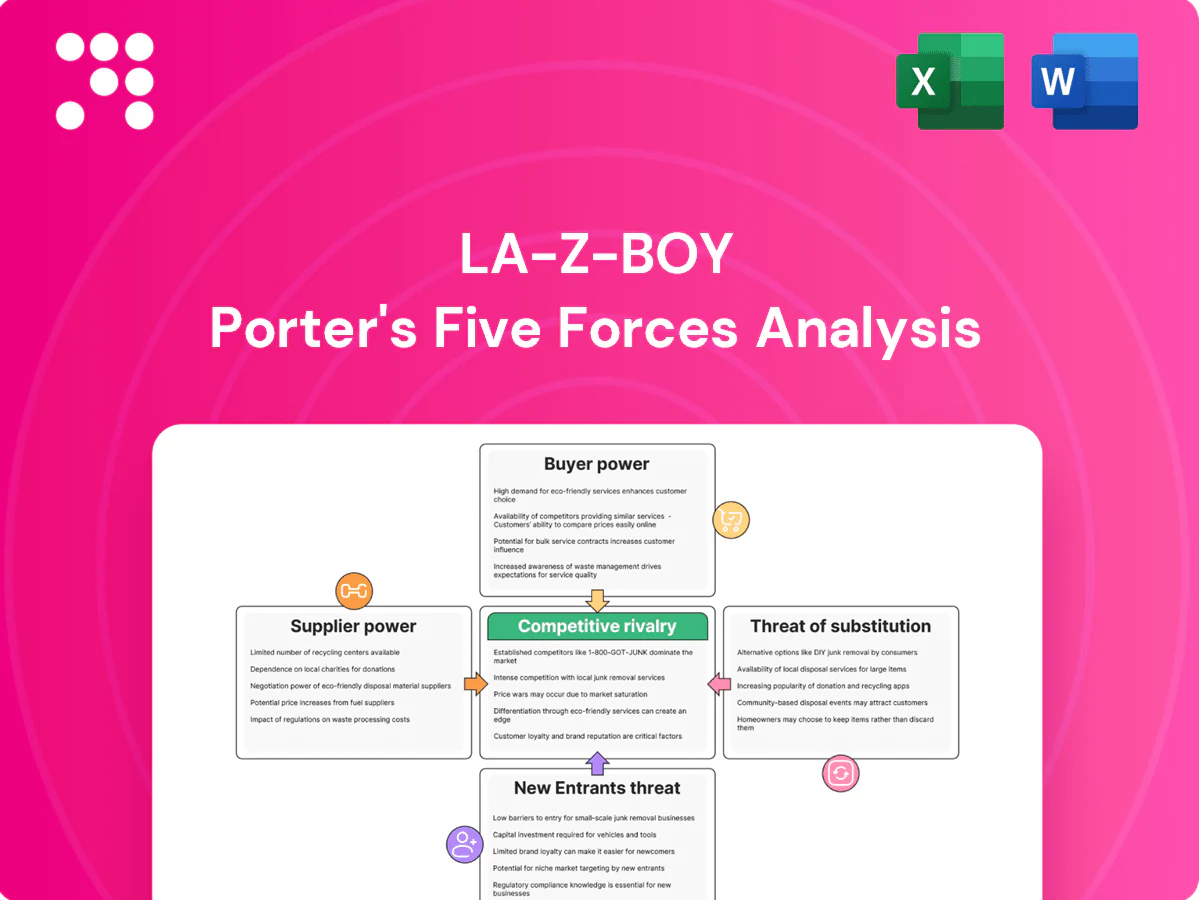
La-Z-Boy Porter's Five Forces Analysis

Don't Miss the Bigger Picture
La‑Z‑Boy faces moderate supplier power, intense rivalry from national and online furniture brands, and rising substitute threats from modular and rental offerings. Buyer power is heightened by online transparency and price sensitivity, while entry barriers remain moderate due to brand and distribution needs. This snapshot highlights key competitive tensions and strategic levers. Unlock the full Porter's Five Forces Analysis to explore La‑Z‑Boy’s competitive dynamics, market pressures, and strategic advantages in detail.
Suppliers Bargaining Power

Key material concentration
La-Z-Boy faces concentrated supplier power for foam, motion mechanisms, lumber, textiles and leather, with motion mechanisms and specialized foam chemistries notably less commoditized, increasing supplier leverage. In 2024 capacity tightness allowed suppliers to push price increases and priority allocations. La-Z-Boy reduces risk via multi-sourcing and long-term agreements but remains exposed to periodic cost and allocation spikes.
Commodity price volatility
Input-cost swings of roughly 10–30% in 2024 across petrochemicals, steel and lumber can compress La-Z-Boy margins if not rapidly passed through. Suppliers frequently implement surcharges faster than retailers accept retail hikes, shifting pressure upstream. Hedging and staggered pricing clauses mitigate but lag effects persist, and volatility in tight supply cycles amplifies supplier bargaining power.

Switching and qualification costs
Changing upholstery, foam specs, or mechanism vendors requires testing, retooling, and warranty validation that in 2024 industry surveys typically add 6–12 weeks and increase per-unit costs by roughly 3–7%, elevating supplier stickiness.

Nearshoring and vertical control
La-Z-Boy’s North American manufacturing footprint and vertical capabilities reduce dependence on distant suppliers, shortening lead times and enabling faster sourcing pivots; in 2024 the company reported roughly $2.3 billion in net sales, reflecting strong regional production leverage. Many raw materials and components still originate from global supply chains, so supplier power is moderated but not eliminated.
- Nearshoring: regional plants shorten lead times
- Vertical control: in-house capabilities bolster resilience
- Global inputs: some exposure to overseas suppliers
- Net effect: supplier power tempered, not neutralized
Logistics and capacity constraints
Ocean freight volatility (Drewry WCI ~ USD 1,350 per 40ft in 2024), tight trucking capacity (US utilization ~94%) and supplier labor shortfalls (ATA driver gap ~80,000) raise costs and service risk; during disruptions carriers push higher rates and allocations while integrated suppliers capture better terms.
- Contracted capacity
- Inventory buffers
- Integrated logistics leverage
Suppliers retain leverage as input-cost swings, logistics strain and vendor-switch costs squeeze margins
Suppliers held elevated leverage in 2024 as input-cost swings of 10–30% and capacity tightness let vendors push surcharges, squeezing margins despite La‑Z‑Boy’s $2.3B net sales and multi‑sourcing. Switching vendors adds ~6–12 weeks and 3–7% unit cost; nearshoring and verticals reduce but do not eliminate supplier stickiness. Logistics pressure (Drewry WCI ~1,350 USD/40ft; US trucking util ~94%; driver gap ~80,000) sustains supplier bargaining power.
| Metric | 2024 Value |
|---|---|
| Net sales | $2.3B |
| Input-cost swing | 10–30% |
| Vendor switch impact | 6–12 weeks; 3–7% cost |
| Drewry WCI | $1,350/40ft |
| US trucking util. | ~94% |
| Driver gap (ATA) | ~80,000 |
What is included in the product
 Detailed Word Document
Tailored Porter’s Five Forces analysis for La‑Z‑Boy, uncovering competitive rivalry, buyer and supplier power, threat of substitutes, and entry barriers that shape pricing and profitability. Includes strategic insights on disruptive threats and defensive levers for incumbency.

 Customizable Excel Spreadsheet
A clear one-sheet Porter's Five Forces for La-Z-Boy that distills competitive pressures into customizable scores and a spider chart for instant strategic clarity; ready to drop into pitch decks or duplicate for different scenarios without macros.
Customers Bargaining Power

Retail partner leverage
National furniture chains and big-box retailers use volume concentration to extract concessions on price, promotions and payment terms, redirecting floor space to private labels or rivals if margins lag. Their purchasing scale gives them substantial leverage versus suppliers; La-Z-Boy’s 2024 net sales of about $1.8 billion bolster its placement but do not remove margin pressure. Retailer switching threats keep pricing and promotional demands high.
Direct consumers’ price sensitivity
Household furniture is discretionary, so demand is elastic in downturns; La-Z-Boy reported net sales of about 2.05 billion in 2023, showing exposure to macro swings. Consumers comparison-shop in stores and online, pressuring discounts and financing and normalizing promotional cadences that limit pricing power, while custom options and brand trust partially mitigate sensitivity.

E-commerce transparency
In 2024, online reviews, price trackers and marketplace listings make deals and alternatives highly visible, reducing information asymmetry and increasing buyer power. Shoppers now weigh delivery speed and return policies alongside price when choosing furniture. La-Z-Boy must meet or exceed these service expectations to justify and sustain premium pricing. Failure to match service levels risks margin erosion.

Product differentiation and comfort
La‑Z‑Boy's signature recliner ergonomics, power features and broad customization create perceived uniqueness that reduces buyer price sensitivity; flagship upholstered lines supported FY2024 net sales of about $1.9 billion, reinforcing brand stickiness. In‑gallery comfort testing lowers propensity to switch, while multi‑year warranties and dealer service networks increase retention and aftersales revenue. This differentiation materially dampens bargaining power of customers for premium models.
- Ergonomics: signature recliners drive loyalty
- Experience: gallery testing reduces churn
- Service: warranties and dealer support boost stickiness
Channel mix and private labels
Independent dealers and La-Z-Boy Furniture Galleries reduce dependence on any single buyer, but growing retailer private-label programs create lower-cost substitutes that compress retail margins; La-Z-Boy reported roughly $1.9 billion in net sales in 2024, underscoring scale but exposure to channel pressure. To retain floor space the company must deliver margin, inventory turns, and co-op marketing; its channel mix balances control with broad reach.
- Channel diversification: independent dealers + company galleries
- Private-label risk: lower-cost retailer alternatives
- Retail demands: margin, turns, marketing support
- Strategy: trade-off between control and distribution reach
Chains extract price concessions while premium recliners preserve customer loyalty
National chains and big-box retailers leverage volume to extract price, promotional and payment concessions; La-Z-Boy reported net sales of about $2.05B in 2023 and ~$1.9B in 2024 but still faces margin pressure. Shoppers comparison-shop online and demand fast delivery/lenient returns, raising buyer power, while signature recliners, customization and warranties sustain premium stickiness.
| Metric | 2023 | 2024 |
|---|---|---|
| La-Z-Boy net sales | $2.05B | $1.9B |
Full Version Awaits
La-Z-Boy Porter's Five Forces Analysis
This preview shows the exact La-Z-Boy Porter's Five Forces Analysis you'll receive immediately after purchase—no surprises or placeholders. The file covers competitive rivalry, supplier and buyer power, and threats of new entrants and substitutes in a professionally formatted report. You'll get instant access to this identical, ready-to-use document.

Don't Miss the Bigger Picture
La‑Z‑Boy faces moderate supplier power, intense rivalry from national and online furniture brands, and rising substitute threats from modular and rental offerings. Buyer power is heightened by online transparency and price sensitivity, while entry barriers remain moderate due to brand and distribution needs. This snapshot highlights key competitive tensions and strategic levers. Unlock the full Porter's Five Forces Analysis to explore La‑Z‑Boy’s competitive dynamics, market pressures, and strategic advantages in detail.
Suppliers Bargaining Power
Key material concentration
La-Z-Boy faces concentrated supplier power for foam, motion mechanisms, lumber, textiles and leather, with motion mechanisms and specialized foam chemistries notably less commoditized, increasing supplier leverage. In 2024 capacity tightness allowed suppliers to push price increases and priority allocations. La-Z-Boy reduces risk via multi-sourcing and long-term agreements but remains exposed to periodic cost and allocation spikes.
Commodity price volatility
Input-cost swings of roughly 10–30% in 2024 across petrochemicals, steel and lumber can compress La-Z-Boy margins if not rapidly passed through. Suppliers frequently implement surcharges faster than retailers accept retail hikes, shifting pressure upstream. Hedging and staggered pricing clauses mitigate but lag effects persist, and volatility in tight supply cycles amplifies supplier bargaining power.
Switching and qualification costs
Changing upholstery, foam specs, or mechanism vendors requires testing, retooling, and warranty validation that in 2024 industry surveys typically add 6–12 weeks and increase per-unit costs by roughly 3–7%, elevating supplier stickiness.
Nearshoring and vertical control
La-Z-Boy’s North American manufacturing footprint and vertical capabilities reduce dependence on distant suppliers, shortening lead times and enabling faster sourcing pivots; in 2024 the company reported roughly $2.3 billion in net sales, reflecting strong regional production leverage. Many raw materials and components still originate from global supply chains, so supplier power is moderated but not eliminated.
- Nearshoring: regional plants shorten lead times
- Vertical control: in-house capabilities bolster resilience
- Global inputs: some exposure to overseas suppliers
- Net effect: supplier power tempered, not neutralized
Logistics and capacity constraints
Ocean freight volatility (Drewry WCI ~ USD 1,350 per 40ft in 2024), tight trucking capacity (US utilization ~94%) and supplier labor shortfalls (ATA driver gap ~80,000) raise costs and service risk; during disruptions carriers push higher rates and allocations while integrated suppliers capture better terms.
- Contracted capacity
- Inventory buffers
- Integrated logistics leverage
Suppliers retain leverage as input-cost swings, logistics strain and vendor-switch costs squeeze margins
Suppliers held elevated leverage in 2024 as input-cost swings of 10–30% and capacity tightness let vendors push surcharges, squeezing margins despite La‑Z‑Boy’s $2.3B net sales and multi‑sourcing. Switching vendors adds ~6–12 weeks and 3–7% unit cost; nearshoring and verticals reduce but do not eliminate supplier stickiness. Logistics pressure (Drewry WCI ~1,350 USD/40ft; US trucking util ~94%; driver gap ~80,000) sustains supplier bargaining power.
| Metric | 2024 Value |
|---|---|
| Net sales | $2.3B |
| Input-cost swing | 10–30% |
| Vendor switch impact | 6–12 weeks; 3–7% cost |
| Drewry WCI | $1,350/40ft |
| US trucking util. | ~94% |
| Driver gap (ATA) | ~80,000 |
What is included in the product
Detailed Word Document
Tailored Porter’s Five Forces analysis for La‑Z‑Boy, uncovering competitive rivalry, buyer and supplier power, threat of substitutes, and entry barriers that shape pricing and profitability. Includes strategic insights on disruptive threats and defensive levers for incumbency.
Customizable Excel Spreadsheet
A clear one-sheet Porter's Five Forces for La-Z-Boy that distills competitive pressures into customizable scores and a spider chart for instant strategic clarity; ready to drop into pitch decks or duplicate for different scenarios without macros.
Customers Bargaining Power
Retail partner leverage
National furniture chains and big-box retailers use volume concentration to extract concessions on price, promotions and payment terms, redirecting floor space to private labels or rivals if margins lag. Their purchasing scale gives them substantial leverage versus suppliers; La-Z-Boy’s 2024 net sales of about $1.8 billion bolster its placement but do not remove margin pressure. Retailer switching threats keep pricing and promotional demands high.
Direct consumers’ price sensitivity
Household furniture is discretionary, so demand is elastic in downturns; La-Z-Boy reported net sales of about 2.05 billion in 2023, showing exposure to macro swings. Consumers comparison-shop in stores and online, pressuring discounts and financing and normalizing promotional cadences that limit pricing power, while custom options and brand trust partially mitigate sensitivity.
E-commerce transparency
In 2024, online reviews, price trackers and marketplace listings make deals and alternatives highly visible, reducing information asymmetry and increasing buyer power. Shoppers now weigh delivery speed and return policies alongside price when choosing furniture. La-Z-Boy must meet or exceed these service expectations to justify and sustain premium pricing. Failure to match service levels risks margin erosion.
Product differentiation and comfort
La‑Z‑Boy's signature recliner ergonomics, power features and broad customization create perceived uniqueness that reduces buyer price sensitivity; flagship upholstered lines supported FY2024 net sales of about $1.9 billion, reinforcing brand stickiness. In‑gallery comfort testing lowers propensity to switch, while multi‑year warranties and dealer service networks increase retention and aftersales revenue. This differentiation materially dampens bargaining power of customers for premium models.
- Ergonomics: signature recliners drive loyalty
- Experience: gallery testing reduces churn
- Service: warranties and dealer support boost stickiness
Channel mix and private labels
Independent dealers and La-Z-Boy Furniture Galleries reduce dependence on any single buyer, but growing retailer private-label programs create lower-cost substitutes that compress retail margins; La-Z-Boy reported roughly $1.9 billion in net sales in 2024, underscoring scale but exposure to channel pressure. To retain floor space the company must deliver margin, inventory turns, and co-op marketing; its channel mix balances control with broad reach.
- Channel diversification: independent dealers + company galleries
- Private-label risk: lower-cost retailer alternatives
- Retail demands: margin, turns, marketing support
- Strategy: trade-off between control and distribution reach
Chains extract price concessions while premium recliners preserve customer loyalty
National chains and big-box retailers leverage volume to extract price, promotional and payment concessions; La-Z-Boy reported net sales of about $2.05B in 2023 and ~$1.9B in 2024 but still faces margin pressure. Shoppers comparison-shop online and demand fast delivery/lenient returns, raising buyer power, while signature recliners, customization and warranties sustain premium stickiness.
| Metric | 2023 | 2024 |
|---|---|---|
| La-Z-Boy net sales | $2.05B | $1.9B |
Full Version Awaits
La-Z-Boy Porter's Five Forces Analysis
This preview shows the exact La-Z-Boy Porter's Five Forces Analysis you'll receive immediately after purchase—no surprises or placeholders. The file covers competitive rivalry, supplier and buyer power, and threats of new entrants and substitutes in a professionally formatted report. You'll get instant access to this identical, ready-to-use document.
Description
Don't Miss the Bigger Picture
La‑Z‑Boy faces moderate supplier power, intense rivalry from national and online furniture brands, and rising substitute threats from modular and rental offerings. Buyer power is heightened by online transparency and price sensitivity, while entry barriers remain moderate due to brand and distribution needs. This snapshot highlights key competitive tensions and strategic levers. Unlock the full Porter's Five Forces Analysis to explore La‑Z‑Boy’s competitive dynamics, market pressures, and strategic advantages in detail.
Suppliers Bargaining Power
Key material concentration
La-Z-Boy faces concentrated supplier power for foam, motion mechanisms, lumber, textiles and leather, with motion mechanisms and specialized foam chemistries notably less commoditized, increasing supplier leverage. In 2024 capacity tightness allowed suppliers to push price increases and priority allocations. La-Z-Boy reduces risk via multi-sourcing and long-term agreements but remains exposed to periodic cost and allocation spikes.
Commodity price volatility
Input-cost swings of roughly 10–30% in 2024 across petrochemicals, steel and lumber can compress La-Z-Boy margins if not rapidly passed through. Suppliers frequently implement surcharges faster than retailers accept retail hikes, shifting pressure upstream. Hedging and staggered pricing clauses mitigate but lag effects persist, and volatility in tight supply cycles amplifies supplier bargaining power.
Switching and qualification costs
Changing upholstery, foam specs, or mechanism vendors requires testing, retooling, and warranty validation that in 2024 industry surveys typically add 6–12 weeks and increase per-unit costs by roughly 3–7%, elevating supplier stickiness.
Nearshoring and vertical control
La-Z-Boy’s North American manufacturing footprint and vertical capabilities reduce dependence on distant suppliers, shortening lead times and enabling faster sourcing pivots; in 2024 the company reported roughly $2.3 billion in net sales, reflecting strong regional production leverage. Many raw materials and components still originate from global supply chains, so supplier power is moderated but not eliminated.
- Nearshoring: regional plants shorten lead times
- Vertical control: in-house capabilities bolster resilience
- Global inputs: some exposure to overseas suppliers
- Net effect: supplier power tempered, not neutralized
Logistics and capacity constraints
Ocean freight volatility (Drewry WCI ~ USD 1,350 per 40ft in 2024), tight trucking capacity (US utilization ~94%) and supplier labor shortfalls (ATA driver gap ~80,000) raise costs and service risk; during disruptions carriers push higher rates and allocations while integrated suppliers capture better terms.
- Contracted capacity
- Inventory buffers
- Integrated logistics leverage
Suppliers retain leverage as input-cost swings, logistics strain and vendor-switch costs squeeze margins
Suppliers held elevated leverage in 2024 as input-cost swings of 10–30% and capacity tightness let vendors push surcharges, squeezing margins despite La‑Z‑Boy’s $2.3B net sales and multi‑sourcing. Switching vendors adds ~6–12 weeks and 3–7% unit cost; nearshoring and verticals reduce but do not eliminate supplier stickiness. Logistics pressure (Drewry WCI ~1,350 USD/40ft; US trucking util ~94%; driver gap ~80,000) sustains supplier bargaining power.
| Metric | 2024 Value |
|---|---|
| Net sales | $2.3B |
| Input-cost swing | 10–30% |
| Vendor switch impact | 6–12 weeks; 3–7% cost |
| Drewry WCI | $1,350/40ft |
| US trucking util. | ~94% |
| Driver gap (ATA) | ~80,000 |
What is included in the product
Detailed Word Document
Tailored Porter’s Five Forces analysis for La‑Z‑Boy, uncovering competitive rivalry, buyer and supplier power, threat of substitutes, and entry barriers that shape pricing and profitability. Includes strategic insights on disruptive threats and defensive levers for incumbency.
Customizable Excel Spreadsheet
A clear one-sheet Porter's Five Forces for La-Z-Boy that distills competitive pressures into customizable scores and a spider chart for instant strategic clarity; ready to drop into pitch decks or duplicate for different scenarios without macros.
Customers Bargaining Power
Retail partner leverage
National furniture chains and big-box retailers use volume concentration to extract concessions on price, promotions and payment terms, redirecting floor space to private labels or rivals if margins lag. Their purchasing scale gives them substantial leverage versus suppliers; La-Z-Boy’s 2024 net sales of about $1.8 billion bolster its placement but do not remove margin pressure. Retailer switching threats keep pricing and promotional demands high.
Direct consumers’ price sensitivity
Household furniture is discretionary, so demand is elastic in downturns; La-Z-Boy reported net sales of about 2.05 billion in 2023, showing exposure to macro swings. Consumers comparison-shop in stores and online, pressuring discounts and financing and normalizing promotional cadences that limit pricing power, while custom options and brand trust partially mitigate sensitivity.
E-commerce transparency
In 2024, online reviews, price trackers and marketplace listings make deals and alternatives highly visible, reducing information asymmetry and increasing buyer power. Shoppers now weigh delivery speed and return policies alongside price when choosing furniture. La-Z-Boy must meet or exceed these service expectations to justify and sustain premium pricing. Failure to match service levels risks margin erosion.
Product differentiation and comfort
La‑Z‑Boy's signature recliner ergonomics, power features and broad customization create perceived uniqueness that reduces buyer price sensitivity; flagship upholstered lines supported FY2024 net sales of about $1.9 billion, reinforcing brand stickiness. In‑gallery comfort testing lowers propensity to switch, while multi‑year warranties and dealer service networks increase retention and aftersales revenue. This differentiation materially dampens bargaining power of customers for premium models.
- Ergonomics: signature recliners drive loyalty
- Experience: gallery testing reduces churn
- Service: warranties and dealer support boost stickiness
Channel mix and private labels
Independent dealers and La-Z-Boy Furniture Galleries reduce dependence on any single buyer, but growing retailer private-label programs create lower-cost substitutes that compress retail margins; La-Z-Boy reported roughly $1.9 billion in net sales in 2024, underscoring scale but exposure to channel pressure. To retain floor space the company must deliver margin, inventory turns, and co-op marketing; its channel mix balances control with broad reach.
- Channel diversification: independent dealers + company galleries
- Private-label risk: lower-cost retailer alternatives
- Retail demands: margin, turns, marketing support
- Strategy: trade-off between control and distribution reach
Chains extract price concessions while premium recliners preserve customer loyalty
National chains and big-box retailers leverage volume to extract price, promotional and payment concessions; La-Z-Boy reported net sales of about $2.05B in 2023 and ~$1.9B in 2024 but still faces margin pressure. Shoppers comparison-shop online and demand fast delivery/lenient returns, raising buyer power, while signature recliners, customization and warranties sustain premium stickiness.
| Metric | 2023 | 2024 |
|---|---|---|
| La-Z-Boy net sales | $2.05B | $1.9B |
Full Version Awaits
La-Z-Boy Porter's Five Forces Analysis
This preview shows the exact La-Z-Boy Porter's Five Forces Analysis you'll receive immediately after purchase—no surprises or placeholders. The file covers competitive rivalry, supplier and buyer power, and threats of new entrants and substitutes in a professionally formatted report. You'll get instant access to this identical, ready-to-use document.











