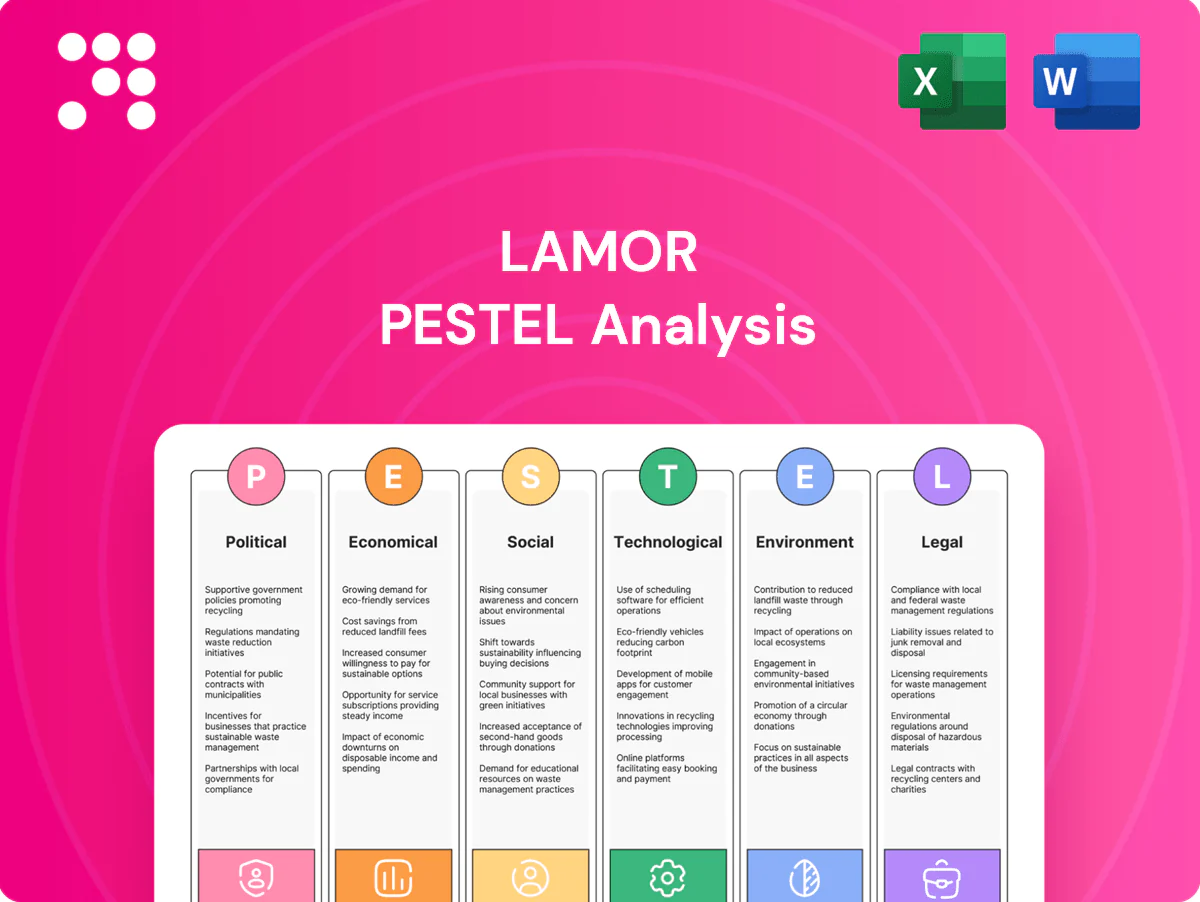
Lamor PESTLE Analysis

Your Competitive Advantage Starts with This Report
Unlock strategic clarity with our Lamor PESTLE Analysis — three to five concise insights on how political, economic, social, technological, legal and environmental forces shape its future. Ideal for investors and strategists. Purchase the full report to access the complete, editable breakdown and actionable recommendations.
Political factors

Government spill-response priorities
Public agencies fund and mandate oil-spill preparedness, shaping procurement pipelines and contractor selection; for example the EU rescEU reserve was boosted to about €1.6 billion for 2021–2027 to strengthen collective response capacity. Shifts in administration can reallocate budgets between prevention, response and climate adaptation, altering near‑term demand. Lamor benefits when national contingency plans are updated and financed; political deprioritization or austerity can delay procurements and contract awards.
Geopolitical stability and maritime security
Geopolitical conflicts and chokepoint tensions raise spill risk and heighten demand for rapid response; over 80% of global trade by volume moves by sea and more than 20% of seaborne oil transits key chokepoints such as Hormuz and Malacca. Instability can, however, disrupt project execution, logistics, and staff safety, increasing operational costs and insurance premiums. Lamor must diversify geographies to balance risk and opportunity, while partnerships with local authorities enhance access and continuity.

International cooperation and aid flows
Multilateral programs such as the IMO (175 member states), World Bank and regional funds finance pollution control and capacity building, often via grants and concessional loans. Donor priorities shape equipment standards and training scope, steering procurement toward compliant technologies. Lamor can increase tender wins by mapping products to donor frameworks and reporting requirements. Delays in aid disbursement commonly stretch sales cycles and extend procurement timelines.

Local content and procurement policies
Local content and procurement rules requiring domestic assembly, staffing or JV structures can increase project costs and timelines; many public tenders worldwide allocate up to 30% of scoring to local-content criteria, rewarding compliant suppliers.
Lamor may need to localize manufacturing or service bases to access public contracts; establishing local operations requires capital expenditure and regulatory approvals, while non-compliance risks disqualification and reputational damage.
- Domestic assembly/JV mandates
- Tender scoring up to 30% for local content
- Need to localize production/services
- Non-compliance: disqualification + reputational risk
Energy transition politics
Policy pushes to decarbonize shift public and corporate budgets from hydrocarbons to renewables and environmental remediation; the EU target of at least 55% emissions cuts by 2030 and 130+ countries with net‑zero pledges drive demand for decommissioning, waste and water treatment while rapid fossil fuel wind‑down can reduce oil‑spill equipment needs; diversified transition services hedge exposure.
- Budgets shift to renewables & remediation
- Decommissioning expands waste/water markets
- Faster fossil decline cuts oil‑spill demand
- Service diversification hedges revenue risk
Public funding (rescEU €1.6bn) and chokepoints (80%+ sea trade) reshape procurement
Public funding and mandates (EU rescEU ≈€1.6bn 2021–27) shape procurement while administration shifts reallocate prevention vs adaptation budgets. Geopolitical chokepoints (80%+ seaborne trade; >20% oil via key straits) raise spill risk but also disrupt operations. IMO (175 states) and 130+ net‑zero pledges redirect spending to decommissioning; local‑content rules (up to 30% tender score) force localization.
| Factor | Key data | Impact |
|---|---|---|
| Funding | rescEU €1.6bn | Procurement volumes |
| Trade risk | 80%+ sea; >20% oil | Higher demand + logistic risk |
| Regulation | IMO 175; 130+ net‑zero | Shift to remediation |
What is included in the product
 Detailed Word Document
Explores how external macro-environmental factors uniquely affect Lamor across Political, Economic, Social, Technological, Environmental, and Legal dimensions, with each section backed by current data and trend analysis to identify threats and opportunities for executives, consultants, and entrepreneurs.

 Customizable Excel Spreadsheet
Provides a clean, visually segmented Lamor PESTLE summary for quick interpretation in meetings, easily dropped into presentations or shared across teams to align on external risks and market positioning.
Economic factors

Oil price and offshore CAPEX cycles
Higher oil prices—Brent averaged about $86/bbl in 2024—spur offshore exploration and maritime traffic, raising spill risk and driving preparedness spending. Downcycles compress client budgets and defer vessel and system upgrades, tightening demand for one-off projects. Lamor’s recurring service contracts and maintenance work provide partial revenue smoothing. Diversification into waste and water services mitigates upstream cyclicality.
Public finance and infrastructure spending
Fiscal space constrains government procurement for environmental protection; with EU Recovery and Resilience Facility €723.8bn and the US Inflation Reduction Act allocating about $369bn to climate, stimulus tied to resilience can accelerate Lamor-relevant projects. UN estimates adaptation needs of $140–300bn/year to 2030 highlight opportunity, while austerity delays replacements and training. OPEX-friendly service models lower upfront costs and boost municipal adoption.

Currency fluctuations
Global operations expose Lamor to FX risk between manufacturing costs and contract revenues in USD, NOK and AED; EUR/USD averaged 1.09 in 2024, increasing translation volatility. Depreciations can erode margins on fixed-price tenders; hedging and local sourcing mitigate swings, and pricing clauses indexed to major currencies (USD, EUR, NOK) improve protection.

Cost inflation and supply chain
Input-cost inflation for steel, polymers, electronics and logistics squeezed Lamor equipment margins in 2024, with raw steel prices down about 15% from 2022 peaks but still above pre‑pandemic levels, while component lead times for electronics remained elevated into 2024, delaying deliveries and revenue recognition.
Multi-sourcing and modular designs adopted in 2023–24 reduced single‑supplier bottleneck exposure; strict inventory discipline balanced resilience against working capital strain.
- Steel prices ~15% below 2022 peaks
- Electronics lead times still elevated in 2024
- Modular design and multi-sourcing implemented 2023–24
- Inventory focus to limit working capital draw
Client mix and payment risk
Government clients offer scale but often have long payment cycles (commonly 30–120 days across markets), while industrial clients typically pay faster but are more sensitive to economic downturns; Lamor mitigates cash risk with strict credit vetting and milestone billing, and aftermarket services in 2024 continued to deepen recurring revenue streams and improve cash resilience.
- Payment cycles: government 30–120 days
- Industrial: faster, cyclical-sensitive
- Controls: credit vetting, milestone billing
- Aftermarket: recurring revenue, boosts liquidity
Public funding (rescEU €1.6bn) and chokepoints (80%+ sea trade) reshape procurement
Higher oil (Brent ~$86/bbl in 2024) and input inflation raise preparedness spending but squeeze margins; recurring service and waste/water diversification provide revenue smoothing. FX volatility (EUR/USD ~1.09 in 2024) and long government payment cycles (30–120 days) increase working-capital risk; hedging and milestone billing mitigate exposure.
| Metric | 2024 |
|---|---|
| Brent | $86/bbl |
| EUR/USD | 1.09 |
| Steel vs 2022 | -15% |
| Govt payment | 30–120 days |
Same Document Delivered
Lamor PESTLE Analysis
The Lamor PESTLE Analysis preview shown here is the exact document you’ll receive after purchase—fully formatted and ready to use. It contains the complete political, economic, social, technological, legal, and environmental assessment as displayed, with no placeholders or edits. After checkout you’ll instantly download this same professionally structured file.

Your Competitive Advantage Starts with This Report
Unlock strategic clarity with our Lamor PESTLE Analysis — three to five concise insights on how political, economic, social, technological, legal and environmental forces shape its future. Ideal for investors and strategists. Purchase the full report to access the complete, editable breakdown and actionable recommendations.
Political factors
Government spill-response priorities
Public agencies fund and mandate oil-spill preparedness, shaping procurement pipelines and contractor selection; for example the EU rescEU reserve was boosted to about €1.6 billion for 2021–2027 to strengthen collective response capacity. Shifts in administration can reallocate budgets between prevention, response and climate adaptation, altering near‑term demand. Lamor benefits when national contingency plans are updated and financed; political deprioritization or austerity can delay procurements and contract awards.
Geopolitical stability and maritime security
Geopolitical conflicts and chokepoint tensions raise spill risk and heighten demand for rapid response; over 80% of global trade by volume moves by sea and more than 20% of seaborne oil transits key chokepoints such as Hormuz and Malacca. Instability can, however, disrupt project execution, logistics, and staff safety, increasing operational costs and insurance premiums. Lamor must diversify geographies to balance risk and opportunity, while partnerships with local authorities enhance access and continuity.
International cooperation and aid flows
Multilateral programs such as the IMO (175 member states), World Bank and regional funds finance pollution control and capacity building, often via grants and concessional loans. Donor priorities shape equipment standards and training scope, steering procurement toward compliant technologies. Lamor can increase tender wins by mapping products to donor frameworks and reporting requirements. Delays in aid disbursement commonly stretch sales cycles and extend procurement timelines.
Local content and procurement policies
Local content and procurement rules requiring domestic assembly, staffing or JV structures can increase project costs and timelines; many public tenders worldwide allocate up to 30% of scoring to local-content criteria, rewarding compliant suppliers.
Lamor may need to localize manufacturing or service bases to access public contracts; establishing local operations requires capital expenditure and regulatory approvals, while non-compliance risks disqualification and reputational damage.
- Domestic assembly/JV mandates
- Tender scoring up to 30% for local content
- Need to localize production/services
- Non-compliance: disqualification + reputational risk
Energy transition politics
Policy pushes to decarbonize shift public and corporate budgets from hydrocarbons to renewables and environmental remediation; the EU target of at least 55% emissions cuts by 2030 and 130+ countries with net‑zero pledges drive demand for decommissioning, waste and water treatment while rapid fossil fuel wind‑down can reduce oil‑spill equipment needs; diversified transition services hedge exposure.
- Budgets shift to renewables & remediation
- Decommissioning expands waste/water markets
- Faster fossil decline cuts oil‑spill demand
- Service diversification hedges revenue risk
Public funding (rescEU €1.6bn) and chokepoints (80%+ sea trade) reshape procurement
Public funding and mandates (EU rescEU ≈€1.6bn 2021–27) shape procurement while administration shifts reallocate prevention vs adaptation budgets. Geopolitical chokepoints (80%+ seaborne trade; >20% oil via key straits) raise spill risk but also disrupt operations. IMO (175 states) and 130+ net‑zero pledges redirect spending to decommissioning; local‑content rules (up to 30% tender score) force localization.
| Factor | Key data | Impact |
|---|---|---|
| Funding | rescEU €1.6bn | Procurement volumes |
| Trade risk | 80%+ sea; >20% oil | Higher demand + logistic risk |
| Regulation | IMO 175; 130+ net‑zero | Shift to remediation |
What is included in the product
Detailed Word Document
Explores how external macro-environmental factors uniquely affect Lamor across Political, Economic, Social, Technological, Environmental, and Legal dimensions, with each section backed by current data and trend analysis to identify threats and opportunities for executives, consultants, and entrepreneurs.
Customizable Excel Spreadsheet
Provides a clean, visually segmented Lamor PESTLE summary for quick interpretation in meetings, easily dropped into presentations or shared across teams to align on external risks and market positioning.
Economic factors
Oil price and offshore CAPEX cycles
Higher oil prices—Brent averaged about $86/bbl in 2024—spur offshore exploration and maritime traffic, raising spill risk and driving preparedness spending. Downcycles compress client budgets and defer vessel and system upgrades, tightening demand for one-off projects. Lamor’s recurring service contracts and maintenance work provide partial revenue smoothing. Diversification into waste and water services mitigates upstream cyclicality.
Public finance and infrastructure spending
Fiscal space constrains government procurement for environmental protection; with EU Recovery and Resilience Facility €723.8bn and the US Inflation Reduction Act allocating about $369bn to climate, stimulus tied to resilience can accelerate Lamor-relevant projects. UN estimates adaptation needs of $140–300bn/year to 2030 highlight opportunity, while austerity delays replacements and training. OPEX-friendly service models lower upfront costs and boost municipal adoption.
Currency fluctuations
Global operations expose Lamor to FX risk between manufacturing costs and contract revenues in USD, NOK and AED; EUR/USD averaged 1.09 in 2024, increasing translation volatility. Depreciations can erode margins on fixed-price tenders; hedging and local sourcing mitigate swings, and pricing clauses indexed to major currencies (USD, EUR, NOK) improve protection.
Cost inflation and supply chain
Input-cost inflation for steel, polymers, electronics and logistics squeezed Lamor equipment margins in 2024, with raw steel prices down about 15% from 2022 peaks but still above pre‑pandemic levels, while component lead times for electronics remained elevated into 2024, delaying deliveries and revenue recognition.
Multi-sourcing and modular designs adopted in 2023–24 reduced single‑supplier bottleneck exposure; strict inventory discipline balanced resilience against working capital strain.
- Steel prices ~15% below 2022 peaks
- Electronics lead times still elevated in 2024
- Modular design and multi-sourcing implemented 2023–24
- Inventory focus to limit working capital draw
Client mix and payment risk
Government clients offer scale but often have long payment cycles (commonly 30–120 days across markets), while industrial clients typically pay faster but are more sensitive to economic downturns; Lamor mitigates cash risk with strict credit vetting and milestone billing, and aftermarket services in 2024 continued to deepen recurring revenue streams and improve cash resilience.
- Payment cycles: government 30–120 days
- Industrial: faster, cyclical-sensitive
- Controls: credit vetting, milestone billing
- Aftermarket: recurring revenue, boosts liquidity
Public funding (rescEU €1.6bn) and chokepoints (80%+ sea trade) reshape procurement
Higher oil (Brent ~$86/bbl in 2024) and input inflation raise preparedness spending but squeeze margins; recurring service and waste/water diversification provide revenue smoothing. FX volatility (EUR/USD ~1.09 in 2024) and long government payment cycles (30–120 days) increase working-capital risk; hedging and milestone billing mitigate exposure.
| Metric | 2024 |
|---|---|
| Brent | $86/bbl |
| EUR/USD | 1.09 |
| Steel vs 2022 | -15% |
| Govt payment | 30–120 days |
Same Document Delivered
Lamor PESTLE Analysis
The Lamor PESTLE Analysis preview shown here is the exact document you’ll receive after purchase—fully formatted and ready to use. It contains the complete political, economic, social, technological, legal, and environmental assessment as displayed, with no placeholders or edits. After checkout you’ll instantly download this same professionally structured file.
Original: $10.00
-65%$10.00
$3.50Description
Your Competitive Advantage Starts with This Report
Unlock strategic clarity with our Lamor PESTLE Analysis — three to five concise insights on how political, economic, social, technological, legal and environmental forces shape its future. Ideal for investors and strategists. Purchase the full report to access the complete, editable breakdown and actionable recommendations.
Political factors
Government spill-response priorities
Public agencies fund and mandate oil-spill preparedness, shaping procurement pipelines and contractor selection; for example the EU rescEU reserve was boosted to about €1.6 billion for 2021–2027 to strengthen collective response capacity. Shifts in administration can reallocate budgets between prevention, response and climate adaptation, altering near‑term demand. Lamor benefits when national contingency plans are updated and financed; political deprioritization or austerity can delay procurements and contract awards.
Geopolitical stability and maritime security
Geopolitical conflicts and chokepoint tensions raise spill risk and heighten demand for rapid response; over 80% of global trade by volume moves by sea and more than 20% of seaborne oil transits key chokepoints such as Hormuz and Malacca. Instability can, however, disrupt project execution, logistics, and staff safety, increasing operational costs and insurance premiums. Lamor must diversify geographies to balance risk and opportunity, while partnerships with local authorities enhance access and continuity.
International cooperation and aid flows
Multilateral programs such as the IMO (175 member states), World Bank and regional funds finance pollution control and capacity building, often via grants and concessional loans. Donor priorities shape equipment standards and training scope, steering procurement toward compliant technologies. Lamor can increase tender wins by mapping products to donor frameworks and reporting requirements. Delays in aid disbursement commonly stretch sales cycles and extend procurement timelines.
Local content and procurement policies
Local content and procurement rules requiring domestic assembly, staffing or JV structures can increase project costs and timelines; many public tenders worldwide allocate up to 30% of scoring to local-content criteria, rewarding compliant suppliers.
Lamor may need to localize manufacturing or service bases to access public contracts; establishing local operations requires capital expenditure and regulatory approvals, while non-compliance risks disqualification and reputational damage.
- Domestic assembly/JV mandates
- Tender scoring up to 30% for local content
- Need to localize production/services
- Non-compliance: disqualification + reputational risk
Energy transition politics
Policy pushes to decarbonize shift public and corporate budgets from hydrocarbons to renewables and environmental remediation; the EU target of at least 55% emissions cuts by 2030 and 130+ countries with net‑zero pledges drive demand for decommissioning, waste and water treatment while rapid fossil fuel wind‑down can reduce oil‑spill equipment needs; diversified transition services hedge exposure.
- Budgets shift to renewables & remediation
- Decommissioning expands waste/water markets
- Faster fossil decline cuts oil‑spill demand
- Service diversification hedges revenue risk
Public funding (rescEU €1.6bn) and chokepoints (80%+ sea trade) reshape procurement
Public funding and mandates (EU rescEU ≈€1.6bn 2021–27) shape procurement while administration shifts reallocate prevention vs adaptation budgets. Geopolitical chokepoints (80%+ seaborne trade; >20% oil via key straits) raise spill risk but also disrupt operations. IMO (175 states) and 130+ net‑zero pledges redirect spending to decommissioning; local‑content rules (up to 30% tender score) force localization.
| Factor | Key data | Impact |
|---|---|---|
| Funding | rescEU €1.6bn | Procurement volumes |
| Trade risk | 80%+ sea; >20% oil | Higher demand + logistic risk |
| Regulation | IMO 175; 130+ net‑zero | Shift to remediation |
What is included in the product
Detailed Word Document
Explores how external macro-environmental factors uniquely affect Lamor across Political, Economic, Social, Technological, Environmental, and Legal dimensions, with each section backed by current data and trend analysis to identify threats and opportunities for executives, consultants, and entrepreneurs.
Customizable Excel Spreadsheet
Provides a clean, visually segmented Lamor PESTLE summary for quick interpretation in meetings, easily dropped into presentations or shared across teams to align on external risks and market positioning.
Economic factors
Oil price and offshore CAPEX cycles
Higher oil prices—Brent averaged about $86/bbl in 2024—spur offshore exploration and maritime traffic, raising spill risk and driving preparedness spending. Downcycles compress client budgets and defer vessel and system upgrades, tightening demand for one-off projects. Lamor’s recurring service contracts and maintenance work provide partial revenue smoothing. Diversification into waste and water services mitigates upstream cyclicality.
Public finance and infrastructure spending
Fiscal space constrains government procurement for environmental protection; with EU Recovery and Resilience Facility €723.8bn and the US Inflation Reduction Act allocating about $369bn to climate, stimulus tied to resilience can accelerate Lamor-relevant projects. UN estimates adaptation needs of $140–300bn/year to 2030 highlight opportunity, while austerity delays replacements and training. OPEX-friendly service models lower upfront costs and boost municipal adoption.
Currency fluctuations
Global operations expose Lamor to FX risk between manufacturing costs and contract revenues in USD, NOK and AED; EUR/USD averaged 1.09 in 2024, increasing translation volatility. Depreciations can erode margins on fixed-price tenders; hedging and local sourcing mitigate swings, and pricing clauses indexed to major currencies (USD, EUR, NOK) improve protection.
Cost inflation and supply chain
Input-cost inflation for steel, polymers, electronics and logistics squeezed Lamor equipment margins in 2024, with raw steel prices down about 15% from 2022 peaks but still above pre‑pandemic levels, while component lead times for electronics remained elevated into 2024, delaying deliveries and revenue recognition.
Multi-sourcing and modular designs adopted in 2023–24 reduced single‑supplier bottleneck exposure; strict inventory discipline balanced resilience against working capital strain.
- Steel prices ~15% below 2022 peaks
- Electronics lead times still elevated in 2024
- Modular design and multi-sourcing implemented 2023–24
- Inventory focus to limit working capital draw
Client mix and payment risk
Government clients offer scale but often have long payment cycles (commonly 30–120 days across markets), while industrial clients typically pay faster but are more sensitive to economic downturns; Lamor mitigates cash risk with strict credit vetting and milestone billing, and aftermarket services in 2024 continued to deepen recurring revenue streams and improve cash resilience.
- Payment cycles: government 30–120 days
- Industrial: faster, cyclical-sensitive
- Controls: credit vetting, milestone billing
- Aftermarket: recurring revenue, boosts liquidity
Public funding (rescEU €1.6bn) and chokepoints (80%+ sea trade) reshape procurement
Higher oil (Brent ~$86/bbl in 2024) and input inflation raise preparedness spending but squeeze margins; recurring service and waste/water diversification provide revenue smoothing. FX volatility (EUR/USD ~1.09 in 2024) and long government payment cycles (30–120 days) increase working-capital risk; hedging and milestone billing mitigate exposure.
| Metric | 2024 |
|---|---|
| Brent | $86/bbl |
| EUR/USD | 1.09 |
| Steel vs 2022 | -15% |
| Govt payment | 30–120 days |
Same Document Delivered
Lamor PESTLE Analysis
The Lamor PESTLE Analysis preview shown here is the exact document you’ll receive after purchase—fully formatted and ready to use. It contains the complete political, economic, social, technological, legal, and environmental assessment as displayed, with no placeholders or edits. After checkout you’ll instantly download this same professionally structured file.











