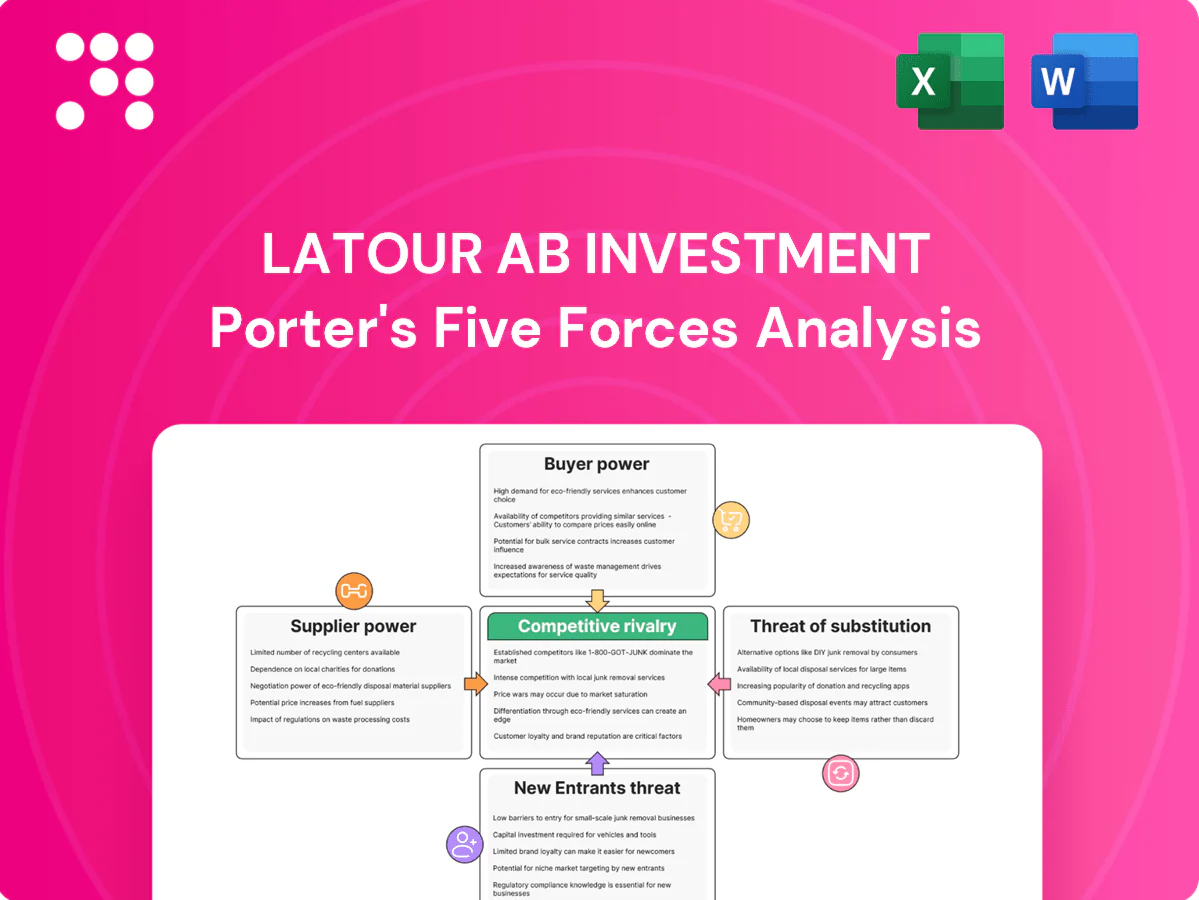
Latour Ab Investment Porter's Five Forces Analysis

A Must-Have Tool for Decision-Makers
Latour Ab Investment faces moderate supplier power, steady buyer influence, evolving substitute threats, and competitive rivalry shaped by high entry barriers and strategic holdings. This snapshot highlights key risks and opportunities for investors and managers. Unlock the full Porter's Five Forces Analysis for force-by-force ratings, visuals, and actionable implications to inform smarter decisions.
Suppliers Bargaining Power

Concentrated deal flow sources
Latour relies on founders, industrial families, banks and advisors for proprietary deal flow, and high-quality industrial targets are scarce, giving key intermediaries leverage over access and timelines. Latour mitigates this through long-standing relationships and a reputation as a patient owner. Competition for quality assets is intense — global private equity dry powder was ≈1.9 trillion USD in 2024, which elevates entry valuations.
Skilled management and board talent
Skilled executives for portfolio companies are scarce, raising bargaining power of top talent and allowing compensation and governance terms to be bid up; Korn Ferry projected a global leadership talent gap of about 85 million by 2030, reinforcing this pressure in 2024. Latour’s active ownership platform and multi-decade track record attract leaders on non-monetary merits, while structured succession planning across holdings reduces single-point dependency.

Financing providers and credit markets
Debt markets, rating agencies and banks shape Latour’s cost and availability of leverage, with Sweden’s policy rate near 4.0% in 2024 pushing funding costs higher. Tight credit cycles increase supplier power via stricter covenants and wider pricing, but Latour’s strong balance sheet and diversified cash flows materially dampen this effect. Long-term lender relationships and staggered maturities reduce refinancing vulnerability.

Industrial inputs for portfolio firms
Industrial inputs such as energy and logistics are often concentrated, allowing suppliers to pass through cost inflation and compress margins; energy volatility remained a primary input risk in 2024. Latour leverages procurement scale and localization to dilute supplier power, and enforces dual-sourcing and product redesign to mitigate single-supplier exposure. These actions help protect portfolio EBITDA against input-driven margin squeeze.
- Concentration: energy and logistics major risks in 2024
- Mitigation: procurement scale and localization
- Operational: dual-sourcing and redesign to reduce single-supplier risk
Technology and automation vendors
Technology and automation vendors exert meaningful supplier power for Latour AB as portfolio digitalization relies on select software, robotics and data providers; 2024 global enterprise software spend was roughly 600 billion USD and the industrial robotics market about 50 billion USD, creating concentrated supplier markets and high switching costs that can exceed 20% of implementation budgets.
- Interoperable stacks reduce lock-in
- Group-negotiated contracts lower unit costs
- In-house expertise strengthens bargaining and implementation
Rising supplier power: energy, tech and lenders squeeze margins; scale and dual-sourcing offset
Suppliers exert moderate-to-high power: concentrated energy, logistics and tech vendors raised input and switching costs in 2024 (energy volatility, enterprise software spend ≈600B USD, robotics ≈50B USD). Debt providers and rating agencies lifted funding costs (Sweden policy rate ≈4.0% in 2024). Latour offsets this via scale procurement, dual-sourcing, in-house tech and long-term lender relationships.
| Supplier Type | 2024 Indicator | Impact | Mitigation |
|---|---|---|---|
| Energy/Logistics | High volatility | Margin squeeze | Procurement scale |
| Tech/Automation | SW spend 600B, robotics 50B | Switching costs | Interoperable stacks |
| Debt/Lenders | Policy rate ≈4.0% | Higher cost/covenants | Staggered maturities |
What is included in the product
 Detailed Word Document
Comprehensive Porter's Five Forces review tailored for Latour Ab Investment, revealing competitive intensity, buyer/supplier leverage, entry barriers, substitution risks, and strategic levers to protect market position.

 Customizable Excel Spreadsheet
A one-sheet, customizable Porter's Five Forces summary with pressure sliders and radar chart—clean, code-free layout ready to drop into decks, update with your data, duplicate for scenarios, and integrate into Excel or Word reports for fast, boardroom-ready decisions.
Customers Bargaining Power

Diversified industrial customer bases
Latour’s industrial holdings serve fragmented B2B markets, which limits bargaining power of individual buyers, though major OEMs and distributors can leverage scale to negotiate volume discounts; value-added products and integrated service models reduce price sensitivity and support margin resilience, while long-term contracts across the portfolio stabilize demand and pricing.
Price transparency and benchmarking
Industrial buyers benchmark globally on cost, quality and service, and 2024 market dynamics show rising price transparency strengthens buyer negotiations, pressuring margins.
Latour counters by pushing differentiation via performance, reliability and total cost of ownership, while bundled services and lifecycle support limit pure price comparisons, preserving contract value.

Switching costs and embedded solutions
Engineered components and integrated systems create high switching frictions for buyers, with certification, downtime risk and retraining cited as primary barriers; industry data in 2024 shows aftermarket services representing roughly 30–40% of lifecycle revenues for industrial equipment makers, reinforcing lock-in. Latour pushes deeper integration and expanded aftermarket offerings to raise customer stickiness. Over time this strategy measurably lowers buyer bargaining power.

Procurement professionalization
Corporate procurement at Latour AB is highly professionalized: by 2024 roughly 68% of large corporates use advanced analytics in sourcing, driving RFQs and framework agreements that compress margins. Portfolio sales teams counter with solution selling and quantified ROI, using reference cases and performance guarantees to defend pricing. This shifts negotiations from price-only to outcome-based contracts.
- procurement analytics: 68% adoption (2024)
- frameworks: sustained margin pressure
- sales response: solution selling + ROI
- pricing support: reference cases & guarantees
Demand cyclicality
Industrial end-markets are cyclical, amplifying buyer power in downturns as buyers defer orders and extract concessions when capacity is slack; 2024 global manufacturing PMI hovered around 50, reflecting weak demand that strengthens buyer leverage. Latour mitigates this by balancing exposure across verticals and geographies and maintaining flexible cost bases to defend margins through cycles.
- Buyer leverage rises in downturns
- 2024 manufacturing PMI ≈ 50
- Diversification across verticals/geographies
- Flexible cost base preserves margins
Moderate buyer power — analytics 68%, aftermarket 30–40%, PMI ≈50
Latour faces moderate buyer power: fragmented B2B markets limit individual leverage, but large OEMs/distributors secure volume discounts.
2024 trends — 68% procurement analytics adoption and PMI ≈50 — increase price transparency and squeeze margins in downturns.
Aftermarket services (30–40% lifecycle revenue) plus long contracts and performance guarantees reduce price-only comparisons and raise switching costs.
| Metric | 2024 |
|---|---|
| Procurement analytics | 68% |
| Aftermarket revenue | 30–40% |
| Global manuf. PMI | ≈50 |
Full Version Awaits
Latour Ab Investment Porter's Five Forces Analysis
This preview shows the exact Latour Ab Investment Porter's Five Forces Analysis you'll receive immediately after purchase—no surprises, no placeholders. The document displayed is the full, professionally formatted analysis ready for download and use the moment you buy. You're previewing the final version; once payment is complete, you’ll have instant access to this identical file.

A Must-Have Tool for Decision-Makers
Latour Ab Investment faces moderate supplier power, steady buyer influence, evolving substitute threats, and competitive rivalry shaped by high entry barriers and strategic holdings. This snapshot highlights key risks and opportunities for investors and managers. Unlock the full Porter's Five Forces Analysis for force-by-force ratings, visuals, and actionable implications to inform smarter decisions.
Suppliers Bargaining Power
Concentrated deal flow sources
Latour relies on founders, industrial families, banks and advisors for proprietary deal flow, and high-quality industrial targets are scarce, giving key intermediaries leverage over access and timelines. Latour mitigates this through long-standing relationships and a reputation as a patient owner. Competition for quality assets is intense — global private equity dry powder was ≈1.9 trillion USD in 2024, which elevates entry valuations.
Skilled management and board talent
Skilled executives for portfolio companies are scarce, raising bargaining power of top talent and allowing compensation and governance terms to be bid up; Korn Ferry projected a global leadership talent gap of about 85 million by 2030, reinforcing this pressure in 2024. Latour’s active ownership platform and multi-decade track record attract leaders on non-monetary merits, while structured succession planning across holdings reduces single-point dependency.
Financing providers and credit markets
Debt markets, rating agencies and banks shape Latour’s cost and availability of leverage, with Sweden’s policy rate near 4.0% in 2024 pushing funding costs higher. Tight credit cycles increase supplier power via stricter covenants and wider pricing, but Latour’s strong balance sheet and diversified cash flows materially dampen this effect. Long-term lender relationships and staggered maturities reduce refinancing vulnerability.
Industrial inputs for portfolio firms
Industrial inputs such as energy and logistics are often concentrated, allowing suppliers to pass through cost inflation and compress margins; energy volatility remained a primary input risk in 2024. Latour leverages procurement scale and localization to dilute supplier power, and enforces dual-sourcing and product redesign to mitigate single-supplier exposure. These actions help protect portfolio EBITDA against input-driven margin squeeze.
- Concentration: energy and logistics major risks in 2024
- Mitigation: procurement scale and localization
- Operational: dual-sourcing and redesign to reduce single-supplier risk
Technology and automation vendors
Technology and automation vendors exert meaningful supplier power for Latour AB as portfolio digitalization relies on select software, robotics and data providers; 2024 global enterprise software spend was roughly 600 billion USD and the industrial robotics market about 50 billion USD, creating concentrated supplier markets and high switching costs that can exceed 20% of implementation budgets.
- Interoperable stacks reduce lock-in
- Group-negotiated contracts lower unit costs
- In-house expertise strengthens bargaining and implementation
Rising supplier power: energy, tech and lenders squeeze margins; scale and dual-sourcing offset
Suppliers exert moderate-to-high power: concentrated energy, logistics and tech vendors raised input and switching costs in 2024 (energy volatility, enterprise software spend ≈600B USD, robotics ≈50B USD). Debt providers and rating agencies lifted funding costs (Sweden policy rate ≈4.0% in 2024). Latour offsets this via scale procurement, dual-sourcing, in-house tech and long-term lender relationships.
| Supplier Type | 2024 Indicator | Impact | Mitigation |
|---|---|---|---|
| Energy/Logistics | High volatility | Margin squeeze | Procurement scale |
| Tech/Automation | SW spend 600B, robotics 50B | Switching costs | Interoperable stacks |
| Debt/Lenders | Policy rate ≈4.0% | Higher cost/covenants | Staggered maturities |
What is included in the product
Detailed Word Document
Comprehensive Porter's Five Forces review tailored for Latour Ab Investment, revealing competitive intensity, buyer/supplier leverage, entry barriers, substitution risks, and strategic levers to protect market position.
Customizable Excel Spreadsheet
A one-sheet, customizable Porter's Five Forces summary with pressure sliders and radar chart—clean, code-free layout ready to drop into decks, update with your data, duplicate for scenarios, and integrate into Excel or Word reports for fast, boardroom-ready decisions.
Customers Bargaining Power
Diversified industrial customer bases
Latour’s industrial holdings serve fragmented B2B markets, which limits bargaining power of individual buyers, though major OEMs and distributors can leverage scale to negotiate volume discounts; value-added products and integrated service models reduce price sensitivity and support margin resilience, while long-term contracts across the portfolio stabilize demand and pricing.
Price transparency and benchmarking
Industrial buyers benchmark globally on cost, quality and service, and 2024 market dynamics show rising price transparency strengthens buyer negotiations, pressuring margins.
Latour counters by pushing differentiation via performance, reliability and total cost of ownership, while bundled services and lifecycle support limit pure price comparisons, preserving contract value.
Switching costs and embedded solutions
Engineered components and integrated systems create high switching frictions for buyers, with certification, downtime risk and retraining cited as primary barriers; industry data in 2024 shows aftermarket services representing roughly 30–40% of lifecycle revenues for industrial equipment makers, reinforcing lock-in. Latour pushes deeper integration and expanded aftermarket offerings to raise customer stickiness. Over time this strategy measurably lowers buyer bargaining power.
Procurement professionalization
Corporate procurement at Latour AB is highly professionalized: by 2024 roughly 68% of large corporates use advanced analytics in sourcing, driving RFQs and framework agreements that compress margins. Portfolio sales teams counter with solution selling and quantified ROI, using reference cases and performance guarantees to defend pricing. This shifts negotiations from price-only to outcome-based contracts.
- procurement analytics: 68% adoption (2024)
- frameworks: sustained margin pressure
- sales response: solution selling + ROI
- pricing support: reference cases & guarantees
Demand cyclicality
Industrial end-markets are cyclical, amplifying buyer power in downturns as buyers defer orders and extract concessions when capacity is slack; 2024 global manufacturing PMI hovered around 50, reflecting weak demand that strengthens buyer leverage. Latour mitigates this by balancing exposure across verticals and geographies and maintaining flexible cost bases to defend margins through cycles.
- Buyer leverage rises in downturns
- 2024 manufacturing PMI ≈ 50
- Diversification across verticals/geographies
- Flexible cost base preserves margins
Moderate buyer power — analytics 68%, aftermarket 30–40%, PMI ≈50
Latour faces moderate buyer power: fragmented B2B markets limit individual leverage, but large OEMs/distributors secure volume discounts.
2024 trends — 68% procurement analytics adoption and PMI ≈50 — increase price transparency and squeeze margins in downturns.
Aftermarket services (30–40% lifecycle revenue) plus long contracts and performance guarantees reduce price-only comparisons and raise switching costs.
| Metric | 2024 |
|---|---|
| Procurement analytics | 68% |
| Aftermarket revenue | 30–40% |
| Global manuf. PMI | ≈50 |
Full Version Awaits
Latour Ab Investment Porter's Five Forces Analysis
This preview shows the exact Latour Ab Investment Porter's Five Forces Analysis you'll receive immediately after purchase—no surprises, no placeholders. The document displayed is the full, professionally formatted analysis ready for download and use the moment you buy. You're previewing the final version; once payment is complete, you’ll have instant access to this identical file.
Original: $10.00
-65%$10.00
$3.50Description
A Must-Have Tool for Decision-Makers
Latour Ab Investment faces moderate supplier power, steady buyer influence, evolving substitute threats, and competitive rivalry shaped by high entry barriers and strategic holdings. This snapshot highlights key risks and opportunities for investors and managers. Unlock the full Porter's Five Forces Analysis for force-by-force ratings, visuals, and actionable implications to inform smarter decisions.
Suppliers Bargaining Power
Concentrated deal flow sources
Latour relies on founders, industrial families, banks and advisors for proprietary deal flow, and high-quality industrial targets are scarce, giving key intermediaries leverage over access and timelines. Latour mitigates this through long-standing relationships and a reputation as a patient owner. Competition for quality assets is intense — global private equity dry powder was ≈1.9 trillion USD in 2024, which elevates entry valuations.
Skilled management and board talent
Skilled executives for portfolio companies are scarce, raising bargaining power of top talent and allowing compensation and governance terms to be bid up; Korn Ferry projected a global leadership talent gap of about 85 million by 2030, reinforcing this pressure in 2024. Latour’s active ownership platform and multi-decade track record attract leaders on non-monetary merits, while structured succession planning across holdings reduces single-point dependency.
Financing providers and credit markets
Debt markets, rating agencies and banks shape Latour’s cost and availability of leverage, with Sweden’s policy rate near 4.0% in 2024 pushing funding costs higher. Tight credit cycles increase supplier power via stricter covenants and wider pricing, but Latour’s strong balance sheet and diversified cash flows materially dampen this effect. Long-term lender relationships and staggered maturities reduce refinancing vulnerability.
Industrial inputs for portfolio firms
Industrial inputs such as energy and logistics are often concentrated, allowing suppliers to pass through cost inflation and compress margins; energy volatility remained a primary input risk in 2024. Latour leverages procurement scale and localization to dilute supplier power, and enforces dual-sourcing and product redesign to mitigate single-supplier exposure. These actions help protect portfolio EBITDA against input-driven margin squeeze.
- Concentration: energy and logistics major risks in 2024
- Mitigation: procurement scale and localization
- Operational: dual-sourcing and redesign to reduce single-supplier risk
Technology and automation vendors
Technology and automation vendors exert meaningful supplier power for Latour AB as portfolio digitalization relies on select software, robotics and data providers; 2024 global enterprise software spend was roughly 600 billion USD and the industrial robotics market about 50 billion USD, creating concentrated supplier markets and high switching costs that can exceed 20% of implementation budgets.
- Interoperable stacks reduce lock-in
- Group-negotiated contracts lower unit costs
- In-house expertise strengthens bargaining and implementation
Rising supplier power: energy, tech and lenders squeeze margins; scale and dual-sourcing offset
Suppliers exert moderate-to-high power: concentrated energy, logistics and tech vendors raised input and switching costs in 2024 (energy volatility, enterprise software spend ≈600B USD, robotics ≈50B USD). Debt providers and rating agencies lifted funding costs (Sweden policy rate ≈4.0% in 2024). Latour offsets this via scale procurement, dual-sourcing, in-house tech and long-term lender relationships.
| Supplier Type | 2024 Indicator | Impact | Mitigation |
|---|---|---|---|
| Energy/Logistics | High volatility | Margin squeeze | Procurement scale |
| Tech/Automation | SW spend 600B, robotics 50B | Switching costs | Interoperable stacks |
| Debt/Lenders | Policy rate ≈4.0% | Higher cost/covenants | Staggered maturities |
What is included in the product
Detailed Word Document
Comprehensive Porter's Five Forces review tailored for Latour Ab Investment, revealing competitive intensity, buyer/supplier leverage, entry barriers, substitution risks, and strategic levers to protect market position.
Customizable Excel Spreadsheet
A one-sheet, customizable Porter's Five Forces summary with pressure sliders and radar chart—clean, code-free layout ready to drop into decks, update with your data, duplicate for scenarios, and integrate into Excel or Word reports for fast, boardroom-ready decisions.
Customers Bargaining Power
Diversified industrial customer bases
Latour’s industrial holdings serve fragmented B2B markets, which limits bargaining power of individual buyers, though major OEMs and distributors can leverage scale to negotiate volume discounts; value-added products and integrated service models reduce price sensitivity and support margin resilience, while long-term contracts across the portfolio stabilize demand and pricing.
Price transparency and benchmarking
Industrial buyers benchmark globally on cost, quality and service, and 2024 market dynamics show rising price transparency strengthens buyer negotiations, pressuring margins.
Latour counters by pushing differentiation via performance, reliability and total cost of ownership, while bundled services and lifecycle support limit pure price comparisons, preserving contract value.
Switching costs and embedded solutions
Engineered components and integrated systems create high switching frictions for buyers, with certification, downtime risk and retraining cited as primary barriers; industry data in 2024 shows aftermarket services representing roughly 30–40% of lifecycle revenues for industrial equipment makers, reinforcing lock-in. Latour pushes deeper integration and expanded aftermarket offerings to raise customer stickiness. Over time this strategy measurably lowers buyer bargaining power.
Procurement professionalization
Corporate procurement at Latour AB is highly professionalized: by 2024 roughly 68% of large corporates use advanced analytics in sourcing, driving RFQs and framework agreements that compress margins. Portfolio sales teams counter with solution selling and quantified ROI, using reference cases and performance guarantees to defend pricing. This shifts negotiations from price-only to outcome-based contracts.
- procurement analytics: 68% adoption (2024)
- frameworks: sustained margin pressure
- sales response: solution selling + ROI
- pricing support: reference cases & guarantees
Demand cyclicality
Industrial end-markets are cyclical, amplifying buyer power in downturns as buyers defer orders and extract concessions when capacity is slack; 2024 global manufacturing PMI hovered around 50, reflecting weak demand that strengthens buyer leverage. Latour mitigates this by balancing exposure across verticals and geographies and maintaining flexible cost bases to defend margins through cycles.
- Buyer leverage rises in downturns
- 2024 manufacturing PMI ≈ 50
- Diversification across verticals/geographies
- Flexible cost base preserves margins
Moderate buyer power — analytics 68%, aftermarket 30–40%, PMI ≈50
Latour faces moderate buyer power: fragmented B2B markets limit individual leverage, but large OEMs/distributors secure volume discounts.
2024 trends — 68% procurement analytics adoption and PMI ≈50 — increase price transparency and squeeze margins in downturns.
Aftermarket services (30–40% lifecycle revenue) plus long contracts and performance guarantees reduce price-only comparisons and raise switching costs.
| Metric | 2024 |
|---|---|
| Procurement analytics | 68% |
| Aftermarket revenue | 30–40% |
| Global manuf. PMI | ≈50 |
Full Version Awaits
Latour Ab Investment Porter's Five Forces Analysis
This preview shows the exact Latour Ab Investment Porter's Five Forces Analysis you'll receive immediately after purchase—no surprises, no placeholders. The document displayed is the full, professionally formatted analysis ready for download and use the moment you buy. You're previewing the final version; once payment is complete, you’ll have instant access to this identical file.











