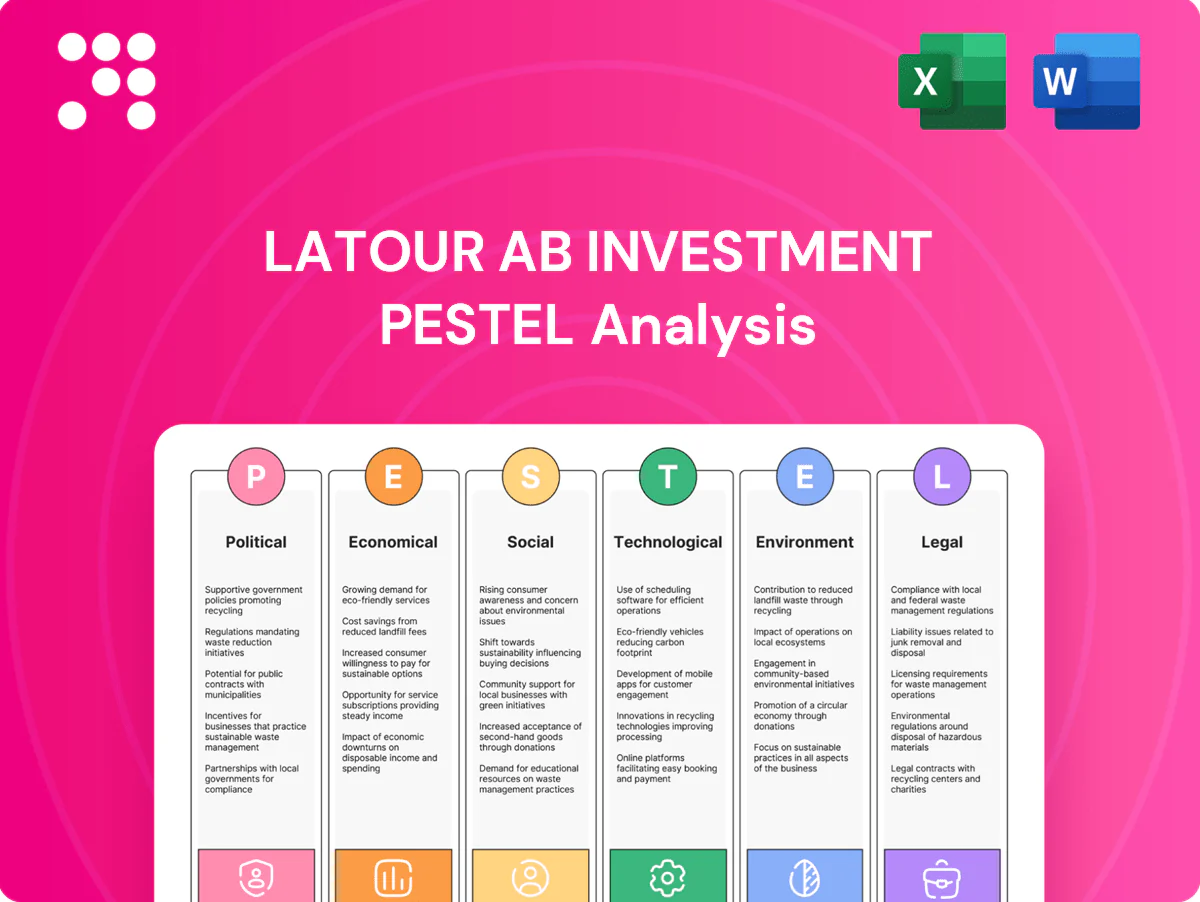
Latour Ab Investment PESTLE Analysis

Skip the Research. Get the Strategy.
Gain a strategic edge with our PESTLE Analysis of Latour Ab Investment—three to five sentence snapshot revealing how political shifts, economic cycles, and regulatory changes affect its portfolio decisions. This concise preview shows the value of the full report. Purchase now to access the complete, actionable analysis.
Political factors

EU industrial and trade policy
EU directives and trade agreements shape market access for Latour’s industrial holdings. CBAM entered a reporting phase in October 2023 with full application planned from 2026, and the Fit-for-55 target seeks -55% GHG by 2030, shifting cost structures and pricing power. Active ownership enables early alignment with evolving EU priorities. Monitoring Brussels’ agenda mitigates regulatory surprises.
Swedish government stability
Sweden’s stable, coalition-based government tradition and predictable policy framework support Latour Ab Investment’s long-term allocations. The corporate tax rate was lowered to 20.6% in 2021, shaping corporate returns and deal structuring. General government gross debt stood near 40% of GDP (Eurostat 2023), leaving fiscal room for targeted infrastructure or state-aid shifts. Active policy dialogue and public–private initiatives can unlock co-investment and incentive opportunities for portfolio firms.

Geopolitical risk and sanctions
Supply chains and sales into sensitive regions face heightened sanction and export-control exposure after the 2022–2025 escalation of coordinated EU and US measures; Latour must map counterparties and end-uses across holdings to avoid blocked transactions. Rapid re-routing and robust compliance programs preserve operational continuity. Geographic diversification lowers concentration risk and strengthens resilience.

Public procurement dynamics
Many Latour Ab end-markets sell into government and municipal buyers, where public procurement represents roughly 14% of EU GDP—about €2 trillion annually—so budget cycles and tender timing materially swing order intake. Recent post-2022 procurement trends emphasize green criteria and security-of-supply/local content clauses, favoring EU-based production in strategic sectors. Strong bid capability and compliance teams measurably raise win rates and contract sizes.
- Public procurement ~14% EU GDP (~€2tn/yr)
- Green and security/local-content clauses rising post-2022
- Budget cycles drive order timing
- Dedicated bid/compliance teams increase win rates
Industrial policy and subsidies
EU NextGenerationEU recovery package (€800bn) and Horizon Europe (€95.5bn, 2021–27), together with ~€105bn of EU ETS revenues in 2023, channel capital to decarbonization, electrification and automation that can catalyse Latour Ab Investment growth.
Portfolio firms aligned to these themes gain access to grants and tax credits; active ownership can coordinate applications and project pipelines and time execution to call windows to improve hit rates.
- Funding channels: NextGenerationEU €800bn, Horizon Europe €95.5bn, EU ETS ~€105bn (2023)
- Benefits: grant/tax credit access for aligned portfolio firms
- Active ownership: centralised applications, coordinated project pipelines
- Execution: timing to calls raises hit ratios
EU green rules and Sweden fiscal stability reshape holding companies' costs and pricing power
EU policy (CBAM reporting since Oct 2023; full application 2026) and Fit-for-55 (-55% GHG by 2030) reshape cost structures and pricing power for Latour holdings.
Sweden’s stable policy, 20.6% corporate tax (2021) and ~40% government debt (Eurostat 2023) support long-term allocations and co-investment options.
Public procurement ~14% EU GDP (~€2tn/yr) and funding (NextGenerationEU €800bn, Horizon €95.5bn, EU ETS ~€105bn 2023) favor green/security-aligned assets.
| Item | Value |
|---|---|
| CBAM | Reporting 10/2023; full 2026 |
| Fit-for-55 | -55% GHG by 2030 |
| Sweden tax | 20.6% (2021) |
| Public procurement | ~14% EU GDP (~€2tn/yr) |
| EU funds | NextGen €800bn; Horizon €95.5bn; EU ETS €105bn (2023) |
What is included in the product
 Detailed Word Document
Explores how Political, Economic, Social, Technological, Environmental and Legal forces uniquely impact the Latour Ab investment, combining data-backed trends and forward-looking scenarios to identify risks and opportunities; formatted for executives, consultants and investors to use in plans, pitch decks and funding discussions reflecting regional market and regulatory dynamics.

 Customizable Excel Spreadsheet
A concise, visually segmented PESTLE summary of Latour AB investments that’s easily editable and shareable, enabling quick alignment in meetings, support for external risk discussions, and seamless inclusion into presentations or client reports.
Economic factors

Interest rates and cost of capital
Rate moves (policy rates around 3–4% in 2024–25) directly affect valuation, debt capacity and M&A timing by raising WACC and compressing multiples; higher WACC prioritizes efficiency and cash-generative deals. Latour can pivot between bolt-on acquisitions and deleveraging across cycles to preserve ROE. Managing a fixed–floating debt mix stabilizes cash flows and reduces refinance risk.
Industrial cycle sensitivity
End-markets such as construction, machinery and automation are cyclical—Eurostat reports EU construction production fell about 4% in 2023—so Latour watches order books and backlog metrics to steer capacity and inventory decisions. Diversified exposure across industrial segments smooths revenue volatility and helped Latour-insights manage swings in 2023–24. Strategic, counter-cyclical investments target dislocations to buy value during downturns.

Currency (SEK, EUR, USD)
FX swings between SEK, EUR and USD materially affect translation and transaction margins for Latour Ab subsidiaries; SEK traded roughly 11–12 per USD and 10–11 per EUR in H1 2025, amplifying reported earnings volatility. Natural hedging from matched revenues and costs limits exposure, while treasury policies and selective forwards/options hedges have reduced quarterly FX P&L swings. Currency moves also drive pricing and sourcing decisions across the group.

Inflation and input costs
Inflation and rising input costs—energy, metals and logistics—compressed industrial margins for Latour portfolio companies in 2024 as Swedish CPIF remained elevated (~6.5% y/y in 2024). Strong pricing power and indexation clauses were decisive to pass-through higher costs, while lean operations and supplier diversification limited margin erosion. Disciplined working-capital management preserved cash through 2024–H1 2025.
- Energy: higher procurement costs pressured margins
- Pricing: indexation clauses critical for pass-through
- Operations: lean processes, supplier mix reduced exposure
- Cash: tight working-capital preserved liquidity
M&A market and valuations
Latour Ab faces strong deal flow but elevated private equity competition—global PE dry powder ~1.6 trillion USD (mid-2024)—keeping entry discipline critical; sector EV/EBITDA multiples averaged ~10–11x in 2024, shaping opportunity quality.
Proprietary sourcing through executive networks secures reasonable entry prices; commercial, operational and digital value-creation levers consistently drive post-close uplift and clear exit optionality supports target IRRs.
- Deal flow: sustained but competitive
- PE competition: dry powder ~1.6T (mid-2024)
- Sector multiples: ~10–11x EV/EBITDA (2024)
- Value creation: commercial, ops, digital
- Exit: clear optionality underpinning IRR
EU green rules and Sweden fiscal stability reshape holding companies' costs and pricing power
Policy rates ~3–4% in 2024–25 lift WACC, compress multiples and prioritize cash-generative deals; Latour balances bolt-on M&A and deleveraging. Cyclical end-markets (EU construction -4% in 2023) and input-cost inflation (Swedish CPIF ~6.5% y/y in 2024) pressure margins; pricing power and lean ops preserved cash. FX (SEK 11–12/USD; 10–11/EUR H1 2025) and PE competition (dry powder ~1.6T mid-2024; sector EV/EBITDA 10–11x 2024) shape sourcing and exits.
| Indicator | Value |
|---|---|
| Policy rate | ~3–4% (2024–25) |
| EU construction | -4% (2023) |
| Swedish CPIF | ~6.5% y/y (2024) |
| FX | SEK 11–12/USD; 10–11/EUR (H1 2025) |
| PE dry powder | ~1.6T USD (mid-2024) |
| Sector EV/EBITDA | ~10–11x (2024) |
Preview Before You Purchase
Latour Ab Investment PESTLE Analysis
The preview of the Latour Ab Investment PESTLE Analysis shown here is the exact document you’ll receive after purchase—fully formatted and ready to use. The structure, content, and professional layout are final with no placeholders. After payment you’ll instantly download this same comprehensive file.

Skip the Research. Get the Strategy.
Gain a strategic edge with our PESTLE Analysis of Latour Ab Investment—three to five sentence snapshot revealing how political shifts, economic cycles, and regulatory changes affect its portfolio decisions. This concise preview shows the value of the full report. Purchase now to access the complete, actionable analysis.
Political factors
EU industrial and trade policy
EU directives and trade agreements shape market access for Latour’s industrial holdings. CBAM entered a reporting phase in October 2023 with full application planned from 2026, and the Fit-for-55 target seeks -55% GHG by 2030, shifting cost structures and pricing power. Active ownership enables early alignment with evolving EU priorities. Monitoring Brussels’ agenda mitigates regulatory surprises.
Swedish government stability
Sweden’s stable, coalition-based government tradition and predictable policy framework support Latour Ab Investment’s long-term allocations. The corporate tax rate was lowered to 20.6% in 2021, shaping corporate returns and deal structuring. General government gross debt stood near 40% of GDP (Eurostat 2023), leaving fiscal room for targeted infrastructure or state-aid shifts. Active policy dialogue and public–private initiatives can unlock co-investment and incentive opportunities for portfolio firms.
Geopolitical risk and sanctions
Supply chains and sales into sensitive regions face heightened sanction and export-control exposure after the 2022–2025 escalation of coordinated EU and US measures; Latour must map counterparties and end-uses across holdings to avoid blocked transactions. Rapid re-routing and robust compliance programs preserve operational continuity. Geographic diversification lowers concentration risk and strengthens resilience.
Public procurement dynamics
Many Latour Ab end-markets sell into government and municipal buyers, where public procurement represents roughly 14% of EU GDP—about €2 trillion annually—so budget cycles and tender timing materially swing order intake. Recent post-2022 procurement trends emphasize green criteria and security-of-supply/local content clauses, favoring EU-based production in strategic sectors. Strong bid capability and compliance teams measurably raise win rates and contract sizes.
- Public procurement ~14% EU GDP (~€2tn/yr)
- Green and security/local-content clauses rising post-2022
- Budget cycles drive order timing
- Dedicated bid/compliance teams increase win rates
Industrial policy and subsidies
EU NextGenerationEU recovery package (€800bn) and Horizon Europe (€95.5bn, 2021–27), together with ~€105bn of EU ETS revenues in 2023, channel capital to decarbonization, electrification and automation that can catalyse Latour Ab Investment growth.
Portfolio firms aligned to these themes gain access to grants and tax credits; active ownership can coordinate applications and project pipelines and time execution to call windows to improve hit rates.
- Funding channels: NextGenerationEU €800bn, Horizon Europe €95.5bn, EU ETS ~€105bn (2023)
- Benefits: grant/tax credit access for aligned portfolio firms
- Active ownership: centralised applications, coordinated project pipelines
- Execution: timing to calls raises hit ratios
EU green rules and Sweden fiscal stability reshape holding companies' costs and pricing power
EU policy (CBAM reporting since Oct 2023; full application 2026) and Fit-for-55 (-55% GHG by 2030) reshape cost structures and pricing power for Latour holdings.
Sweden’s stable policy, 20.6% corporate tax (2021) and ~40% government debt (Eurostat 2023) support long-term allocations and co-investment options.
Public procurement ~14% EU GDP (~€2tn/yr) and funding (NextGenerationEU €800bn, Horizon €95.5bn, EU ETS ~€105bn 2023) favor green/security-aligned assets.
| Item | Value |
|---|---|
| CBAM | Reporting 10/2023; full 2026 |
| Fit-for-55 | -55% GHG by 2030 |
| Sweden tax | 20.6% (2021) |
| Public procurement | ~14% EU GDP (~€2tn/yr) |
| EU funds | NextGen €800bn; Horizon €95.5bn; EU ETS €105bn (2023) |
What is included in the product
Detailed Word Document
Explores how Political, Economic, Social, Technological, Environmental and Legal forces uniquely impact the Latour Ab investment, combining data-backed trends and forward-looking scenarios to identify risks and opportunities; formatted for executives, consultants and investors to use in plans, pitch decks and funding discussions reflecting regional market and regulatory dynamics.
Customizable Excel Spreadsheet
A concise, visually segmented PESTLE summary of Latour AB investments that’s easily editable and shareable, enabling quick alignment in meetings, support for external risk discussions, and seamless inclusion into presentations or client reports.
Economic factors
Interest rates and cost of capital
Rate moves (policy rates around 3–4% in 2024–25) directly affect valuation, debt capacity and M&A timing by raising WACC and compressing multiples; higher WACC prioritizes efficiency and cash-generative deals. Latour can pivot between bolt-on acquisitions and deleveraging across cycles to preserve ROE. Managing a fixed–floating debt mix stabilizes cash flows and reduces refinance risk.
Industrial cycle sensitivity
End-markets such as construction, machinery and automation are cyclical—Eurostat reports EU construction production fell about 4% in 2023—so Latour watches order books and backlog metrics to steer capacity and inventory decisions. Diversified exposure across industrial segments smooths revenue volatility and helped Latour-insights manage swings in 2023–24. Strategic, counter-cyclical investments target dislocations to buy value during downturns.
Currency (SEK, EUR, USD)
FX swings between SEK, EUR and USD materially affect translation and transaction margins for Latour Ab subsidiaries; SEK traded roughly 11–12 per USD and 10–11 per EUR in H1 2025, amplifying reported earnings volatility. Natural hedging from matched revenues and costs limits exposure, while treasury policies and selective forwards/options hedges have reduced quarterly FX P&L swings. Currency moves also drive pricing and sourcing decisions across the group.
Inflation and input costs
Inflation and rising input costs—energy, metals and logistics—compressed industrial margins for Latour portfolio companies in 2024 as Swedish CPIF remained elevated (~6.5% y/y in 2024). Strong pricing power and indexation clauses were decisive to pass-through higher costs, while lean operations and supplier diversification limited margin erosion. Disciplined working-capital management preserved cash through 2024–H1 2025.
- Energy: higher procurement costs pressured margins
- Pricing: indexation clauses critical for pass-through
- Operations: lean processes, supplier mix reduced exposure
- Cash: tight working-capital preserved liquidity
M&A market and valuations
Latour Ab faces strong deal flow but elevated private equity competition—global PE dry powder ~1.6 trillion USD (mid-2024)—keeping entry discipline critical; sector EV/EBITDA multiples averaged ~10–11x in 2024, shaping opportunity quality.
Proprietary sourcing through executive networks secures reasonable entry prices; commercial, operational and digital value-creation levers consistently drive post-close uplift and clear exit optionality supports target IRRs.
- Deal flow: sustained but competitive
- PE competition: dry powder ~1.6T (mid-2024)
- Sector multiples: ~10–11x EV/EBITDA (2024)
- Value creation: commercial, ops, digital
- Exit: clear optionality underpinning IRR
EU green rules and Sweden fiscal stability reshape holding companies' costs and pricing power
Policy rates ~3–4% in 2024–25 lift WACC, compress multiples and prioritize cash-generative deals; Latour balances bolt-on M&A and deleveraging. Cyclical end-markets (EU construction -4% in 2023) and input-cost inflation (Swedish CPIF ~6.5% y/y in 2024) pressure margins; pricing power and lean ops preserved cash. FX (SEK 11–12/USD; 10–11/EUR H1 2025) and PE competition (dry powder ~1.6T mid-2024; sector EV/EBITDA 10–11x 2024) shape sourcing and exits.
| Indicator | Value |
|---|---|
| Policy rate | ~3–4% (2024–25) |
| EU construction | -4% (2023) |
| Swedish CPIF | ~6.5% y/y (2024) |
| FX | SEK 11–12/USD; 10–11/EUR (H1 2025) |
| PE dry powder | ~1.6T USD (mid-2024) |
| Sector EV/EBITDA | ~10–11x (2024) |
Preview Before You Purchase
Latour Ab Investment PESTLE Analysis
The preview of the Latour Ab Investment PESTLE Analysis shown here is the exact document you’ll receive after purchase—fully formatted and ready to use. The structure, content, and professional layout are final with no placeholders. After payment you’ll instantly download this same comprehensive file.
Original: $10.00
-65%$10.00
$3.50Description
Skip the Research. Get the Strategy.
Gain a strategic edge with our PESTLE Analysis of Latour Ab Investment—three to five sentence snapshot revealing how political shifts, economic cycles, and regulatory changes affect its portfolio decisions. This concise preview shows the value of the full report. Purchase now to access the complete, actionable analysis.
Political factors
EU industrial and trade policy
EU directives and trade agreements shape market access for Latour’s industrial holdings. CBAM entered a reporting phase in October 2023 with full application planned from 2026, and the Fit-for-55 target seeks -55% GHG by 2030, shifting cost structures and pricing power. Active ownership enables early alignment with evolving EU priorities. Monitoring Brussels’ agenda mitigates regulatory surprises.
Swedish government stability
Sweden’s stable, coalition-based government tradition and predictable policy framework support Latour Ab Investment’s long-term allocations. The corporate tax rate was lowered to 20.6% in 2021, shaping corporate returns and deal structuring. General government gross debt stood near 40% of GDP (Eurostat 2023), leaving fiscal room for targeted infrastructure or state-aid shifts. Active policy dialogue and public–private initiatives can unlock co-investment and incentive opportunities for portfolio firms.
Geopolitical risk and sanctions
Supply chains and sales into sensitive regions face heightened sanction and export-control exposure after the 2022–2025 escalation of coordinated EU and US measures; Latour must map counterparties and end-uses across holdings to avoid blocked transactions. Rapid re-routing and robust compliance programs preserve operational continuity. Geographic diversification lowers concentration risk and strengthens resilience.
Public procurement dynamics
Many Latour Ab end-markets sell into government and municipal buyers, where public procurement represents roughly 14% of EU GDP—about €2 trillion annually—so budget cycles and tender timing materially swing order intake. Recent post-2022 procurement trends emphasize green criteria and security-of-supply/local content clauses, favoring EU-based production in strategic sectors. Strong bid capability and compliance teams measurably raise win rates and contract sizes.
- Public procurement ~14% EU GDP (~€2tn/yr)
- Green and security/local-content clauses rising post-2022
- Budget cycles drive order timing
- Dedicated bid/compliance teams increase win rates
Industrial policy and subsidies
EU NextGenerationEU recovery package (€800bn) and Horizon Europe (€95.5bn, 2021–27), together with ~€105bn of EU ETS revenues in 2023, channel capital to decarbonization, electrification and automation that can catalyse Latour Ab Investment growth.
Portfolio firms aligned to these themes gain access to grants and tax credits; active ownership can coordinate applications and project pipelines and time execution to call windows to improve hit rates.
- Funding channels: NextGenerationEU €800bn, Horizon Europe €95.5bn, EU ETS ~€105bn (2023)
- Benefits: grant/tax credit access for aligned portfolio firms
- Active ownership: centralised applications, coordinated project pipelines
- Execution: timing to calls raises hit ratios
EU green rules and Sweden fiscal stability reshape holding companies' costs and pricing power
EU policy (CBAM reporting since Oct 2023; full application 2026) and Fit-for-55 (-55% GHG by 2030) reshape cost structures and pricing power for Latour holdings.
Sweden’s stable policy, 20.6% corporate tax (2021) and ~40% government debt (Eurostat 2023) support long-term allocations and co-investment options.
Public procurement ~14% EU GDP (~€2tn/yr) and funding (NextGenerationEU €800bn, Horizon €95.5bn, EU ETS ~€105bn 2023) favor green/security-aligned assets.
| Item | Value |
|---|---|
| CBAM | Reporting 10/2023; full 2026 |
| Fit-for-55 | -55% GHG by 2030 |
| Sweden tax | 20.6% (2021) |
| Public procurement | ~14% EU GDP (~€2tn/yr) |
| EU funds | NextGen €800bn; Horizon €95.5bn; EU ETS €105bn (2023) |
What is included in the product
Detailed Word Document
Explores how Political, Economic, Social, Technological, Environmental and Legal forces uniquely impact the Latour Ab investment, combining data-backed trends and forward-looking scenarios to identify risks and opportunities; formatted for executives, consultants and investors to use in plans, pitch decks and funding discussions reflecting regional market and regulatory dynamics.
Customizable Excel Spreadsheet
A concise, visually segmented PESTLE summary of Latour AB investments that’s easily editable and shareable, enabling quick alignment in meetings, support for external risk discussions, and seamless inclusion into presentations or client reports.
Economic factors
Interest rates and cost of capital
Rate moves (policy rates around 3–4% in 2024–25) directly affect valuation, debt capacity and M&A timing by raising WACC and compressing multiples; higher WACC prioritizes efficiency and cash-generative deals. Latour can pivot between bolt-on acquisitions and deleveraging across cycles to preserve ROE. Managing a fixed–floating debt mix stabilizes cash flows and reduces refinance risk.
Industrial cycle sensitivity
End-markets such as construction, machinery and automation are cyclical—Eurostat reports EU construction production fell about 4% in 2023—so Latour watches order books and backlog metrics to steer capacity and inventory decisions. Diversified exposure across industrial segments smooths revenue volatility and helped Latour-insights manage swings in 2023–24. Strategic, counter-cyclical investments target dislocations to buy value during downturns.
Currency (SEK, EUR, USD)
FX swings between SEK, EUR and USD materially affect translation and transaction margins for Latour Ab subsidiaries; SEK traded roughly 11–12 per USD and 10–11 per EUR in H1 2025, amplifying reported earnings volatility. Natural hedging from matched revenues and costs limits exposure, while treasury policies and selective forwards/options hedges have reduced quarterly FX P&L swings. Currency moves also drive pricing and sourcing decisions across the group.
Inflation and input costs
Inflation and rising input costs—energy, metals and logistics—compressed industrial margins for Latour portfolio companies in 2024 as Swedish CPIF remained elevated (~6.5% y/y in 2024). Strong pricing power and indexation clauses were decisive to pass-through higher costs, while lean operations and supplier diversification limited margin erosion. Disciplined working-capital management preserved cash through 2024–H1 2025.
- Energy: higher procurement costs pressured margins
- Pricing: indexation clauses critical for pass-through
- Operations: lean processes, supplier mix reduced exposure
- Cash: tight working-capital preserved liquidity
M&A market and valuations
Latour Ab faces strong deal flow but elevated private equity competition—global PE dry powder ~1.6 trillion USD (mid-2024)—keeping entry discipline critical; sector EV/EBITDA multiples averaged ~10–11x in 2024, shaping opportunity quality.
Proprietary sourcing through executive networks secures reasonable entry prices; commercial, operational and digital value-creation levers consistently drive post-close uplift and clear exit optionality supports target IRRs.
- Deal flow: sustained but competitive
- PE competition: dry powder ~1.6T (mid-2024)
- Sector multiples: ~10–11x EV/EBITDA (2024)
- Value creation: commercial, ops, digital
- Exit: clear optionality underpinning IRR
EU green rules and Sweden fiscal stability reshape holding companies' costs and pricing power
Policy rates ~3–4% in 2024–25 lift WACC, compress multiples and prioritize cash-generative deals; Latour balances bolt-on M&A and deleveraging. Cyclical end-markets (EU construction -4% in 2023) and input-cost inflation (Swedish CPIF ~6.5% y/y in 2024) pressure margins; pricing power and lean ops preserved cash. FX (SEK 11–12/USD; 10–11/EUR H1 2025) and PE competition (dry powder ~1.6T mid-2024; sector EV/EBITDA 10–11x 2024) shape sourcing and exits.
| Indicator | Value |
|---|---|
| Policy rate | ~3–4% (2024–25) |
| EU construction | -4% (2023) |
| Swedish CPIF | ~6.5% y/y (2024) |
| FX | SEK 11–12/USD; 10–11/EUR (H1 2025) |
| PE dry powder | ~1.6T USD (mid-2024) |
| Sector EV/EBITDA | ~10–11x (2024) |
Preview Before You Purchase
Latour Ab Investment PESTLE Analysis
The preview of the Latour Ab Investment PESTLE Analysis shown here is the exact document you’ll receive after purchase—fully formatted and ready to use. The structure, content, and professional layout are final with no placeholders. After payment you’ll instantly download this same comprehensive file.











