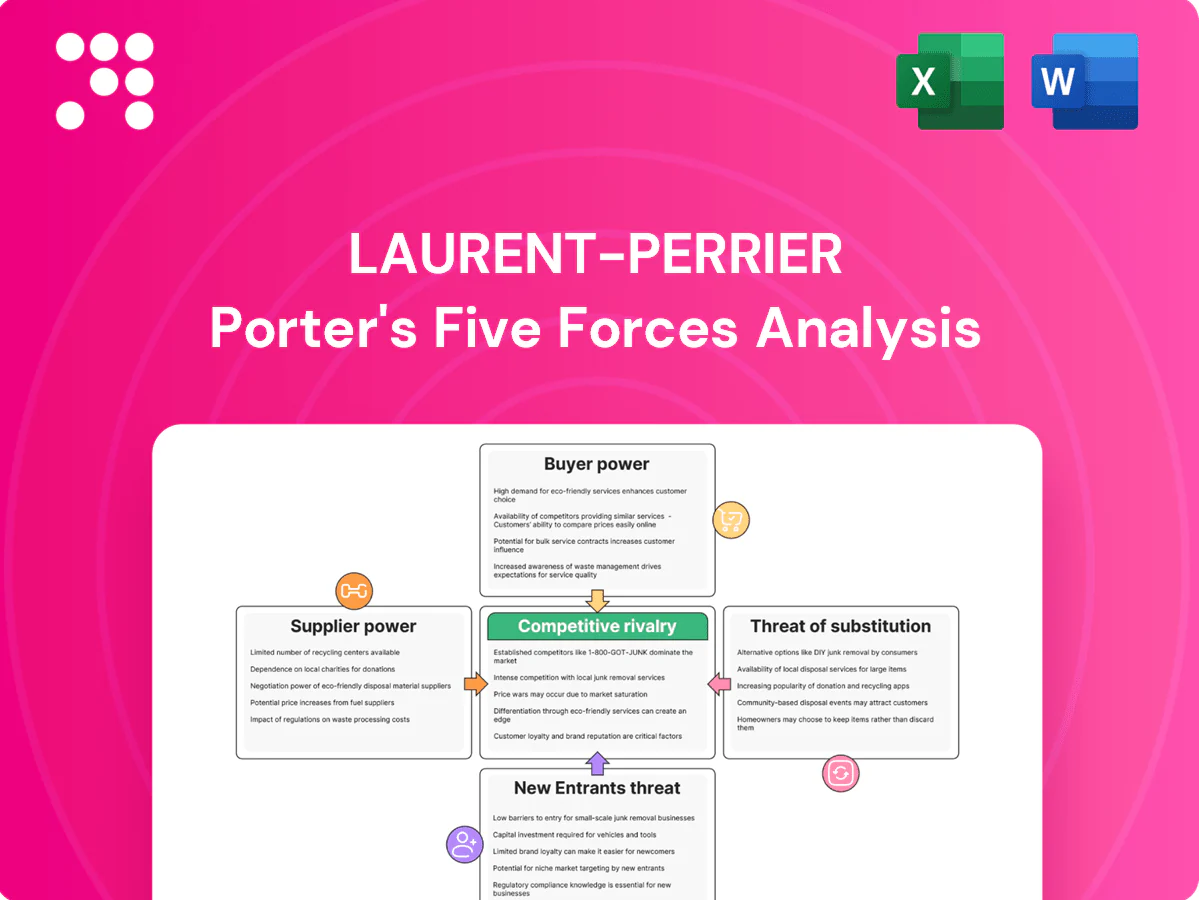
Laurent-Perrier Porter's Five Forces Analysis

Don't Miss the Bigger Picture
Laurent-Perrier's Five Forces show strong brand-driven supplier leverage, moderate buyer power, high rivalry among luxury champagnes, limited new-entrant threat, and meaningful substitute risk from other sparkling options. Strategic focus: defend brand premium and optimize channels. This brief snapshot only scratches the surface. Unlock the full Porter's Five Forces Analysis to explore Laurent-Perrier’s competitive dynamics, market pressures, and strategic advantages in detail.
Suppliers Bargaining Power

Concentrated grand cru grape supply
Champagne AOC Chardonnay and grand cru parcels are scarce—only 17 grand cru villages within roughly 34,000 ha of Champagne, with Chardonnay ≈31% of plantings—so prized growers command premium prices and strict terms. Laurent-Perrier’s partial estate holdings reduce but do not eliminate dependence on contracted growers, preserving supplier leverage. Post-2021 frost impacts and ongoing climate variability kept top-quality allocations tight through 2024.
Specialized inputs and craftsmanship
Bespoke glass bottles, natural corks, select yeasts and coopers represent niche inputs with few qualified suppliers, constraining Laurent-Perrier’s switching options. Champagne rules mandate non-vintage aging of at least 15 months and vintage 3 years, locking procurement into long cycles. Bespoke bottle and cork lead times commonly span 6–12 months, deepening supplier dependence. These factors raise supplier bargaining power over cost and contract terms.

Appellation and regulatory constraints
Appellation yield caps, reserve-wine rules and AOC input controls sharply limit Laurent-Perrier’s volume flexibility; Champagne AOC constraints and tight 2024 region output of ~307 million bottles strengthen grape and reserve-wine suppliers’ bargaining power. When base-wine stocks are scarce, suppliers gain price and delivery leverage, compliance narrows acceptable input pools, and regulatory rigidity magnifies supplier influence in tight vintages.

Vintage risk and climate pressure
Frost, heat and mildew have heightened vintage risk, reducing yields and quality and increasing Laurent-Perrier’s reliance on growers with resilient plots; 2024 industry reports flagged continued vintage variability across Champagne. Scarcity shifts pricing power upstream, prompting multi-year contracts and sustainability investments to secure supply and spread risk. Nonetheless, ongoing climate-driven volatility strengthens supplier clout and price leverage.
- Higher dependency on resilient plots
- Multi-year contracts + sustainability to mitigate
- Volatility increases supplier pricing power
Switching costs and brand consistency
Maintaining Laurent-Perrier house style requires stable sourcing from specific crus and growers; switching suppliers risks cuvée consistency and long-term aging plans. These implicit switching costs weaken buyer leverage over suppliers in a Champagne region spanning about 34,000 ha and producing ~300 million bottles annually. Long-term grower partnerships thus become strategically necessary to secure quality and vintage continuity.
- Stable sourcing = reduced buyer leverage
- 34,000 ha / ~300m bottles: tight supply dynamics
- Long-term contracts = strategic necessity
Scarce inputs, 6–12 month lead times lift Champagne growers' pricing power
Scarce inputs and 17 grand cru villages across ~34,000 ha, with Chardonnay ≈31% of plantings, give growers pricing power; Laurent-Perrier’s partial estates limit but do not remove dependence. 2024 Champagne output ≈307 million bottles and long lead times (6–12 months) for bottles/corks heighten supplier leverage. Climate-driven yield volatility since 2021 increases multi-year contracting and supplier bargaining power.
| Metric | Value |
|---|---|
| Champagne area | ~34,000 ha |
| 2024 output | ≈307 million bottles |
| Chardonnay share | ≈31% |
| Grand cru villages | 17 |
| Input lead times | 6–12 months |
What is included in the product
 Detailed Word Document
Uncovers key drivers of competition, customer influence, and market entry risks tailored to Laurent‑Perrier's luxury Champagne position. Evaluates supplier and buyer power, substitutes and disruptive threats, and market dynamics that deter entrants, with strategic commentary suitable for investor and internal reports.

 Customizable Excel Spreadsheet
A concise one-sheet Porter’s Five Forces for Laurent-Perrier that reveals competitive pressures, supplier/buyer dynamics and regulatory risks—ready to copy into decks, adapt with fresh data, and clarify strategic pain points for faster decision-making.
Customers Bargaining Power

Consolidated on- and off-trade channels
Global retailers, hotel groups, airlines and distributors demand volume rebates and placement fees, leveraging scale to press pricing and trade terms; Champagne exports reached about €5.2bn in 2023, amplifying buyers' bargaining clout. Laurent-Perrier limits exposure via diversified on- and off-trade channels, but major accounts—often representing sizable shares of off-trade volumes—can still extract visible concessions.
Premium consumers with brand sensitivity
End consumers prioritize prestige, terroir and style over pure price, so Laurent-Perrier's strong brand equity materially reduces buyer power at shelf; Comité Champagne reported a 2024 export recovery supporting premium demand. Holiday promotional cycles still drive short-term deal-seeking, pressuring margin intermittently. Focused storytelling and limited editions preserve pricing power and defend margins.

E-commerce and DTC transparency
Online price comparison boosts buyer knowledge and bargaining—online wine sales rose to about 15% of global wine value in 2024, intensifying price sensitivity. DTC channels can lift margins and direct data capture, partially offsetting distributor power, but require careful channel conflict management to protect trade relationships. Transparent pricing mandates disciplined revenue management and SKU-level margin control.

Substitution to other premium sparklings
Buyers can shift to English sparkling, Franciacorta, or top Cava for value, a dynamic amplified by a global sparkling wine market estimated at $38.2B in 2024; this outside option increases bargaining leverage for mainstream cuvées. Laurent-Perrier's Chardonnay-led styles and extended aging create differentiation, making flagship and vintage tiers far less substitutable.
- Value substitutes raise pressure on mainstream cuvées
- Chardonnay-led identity reduces churn for premium tiers
- Flagship/vintage = low substitutability
Event-driven and gifting demand
Event-driven spikes (holidays, weddings) and gifting drive bulk buys, increasing buyers' leverage for promotional discounts and tiered pricing in corporate/banqueting channels; packaging and personalization offer upsell paths that can offset margin erosion. Strategic allocation of limited cuvées and promotional cadence can limit discount pressure and preserve list pricing.
- Buyer leverage: bulk/event driven demand
- Corporate: seeks tiered pricing
- Upsell: packaging/customization
- Mitigation: allocation, cadence
Retailer leverage rises as Champagne exports hit €5.2bn, global sparkling $38.2bn
Large global buyers extract rebates and placement fees; Champagne exports were about €5.2bn in 2023, strengthening retailer/distributor leverage. Laurent-Perrier’s brand and premium tiers limit substitutability despite a $38.2bn global sparkling market (2024) and 15% online wine sales (2024) raising price transparency. DTC growth and allocation strategy partially offsets buyer pressure.
| Metric | Value |
|---|---|
| Champagne exports (2023) | €5.2bn |
| Global sparkling market (2024) | $38.2bn |
| Online wine share (2024) | 15% |
What You See Is What You Get
Laurent-Perrier Porter's Five Forces Analysis
This preview shows the exact Laurent-Perrier Porter’s Five Forces analysis you’ll receive—no placeholders, no mockups. The file is the final, professionally formatted document covering industry rivalry, buyer/supplier power, threats of entry and substitutes, ready for immediate download upon purchase. What you see is what you get.

Don't Miss the Bigger Picture
Laurent-Perrier's Five Forces show strong brand-driven supplier leverage, moderate buyer power, high rivalry among luxury champagnes, limited new-entrant threat, and meaningful substitute risk from other sparkling options. Strategic focus: defend brand premium and optimize channels. This brief snapshot only scratches the surface. Unlock the full Porter's Five Forces Analysis to explore Laurent-Perrier’s competitive dynamics, market pressures, and strategic advantages in detail.
Suppliers Bargaining Power
Concentrated grand cru grape supply
Champagne AOC Chardonnay and grand cru parcels are scarce—only 17 grand cru villages within roughly 34,000 ha of Champagne, with Chardonnay ≈31% of plantings—so prized growers command premium prices and strict terms. Laurent-Perrier’s partial estate holdings reduce but do not eliminate dependence on contracted growers, preserving supplier leverage. Post-2021 frost impacts and ongoing climate variability kept top-quality allocations tight through 2024.
Specialized inputs and craftsmanship
Bespoke glass bottles, natural corks, select yeasts and coopers represent niche inputs with few qualified suppliers, constraining Laurent-Perrier’s switching options. Champagne rules mandate non-vintage aging of at least 15 months and vintage 3 years, locking procurement into long cycles. Bespoke bottle and cork lead times commonly span 6–12 months, deepening supplier dependence. These factors raise supplier bargaining power over cost and contract terms.
Appellation and regulatory constraints
Appellation yield caps, reserve-wine rules and AOC input controls sharply limit Laurent-Perrier’s volume flexibility; Champagne AOC constraints and tight 2024 region output of ~307 million bottles strengthen grape and reserve-wine suppliers’ bargaining power. When base-wine stocks are scarce, suppliers gain price and delivery leverage, compliance narrows acceptable input pools, and regulatory rigidity magnifies supplier influence in tight vintages.
Vintage risk and climate pressure
Frost, heat and mildew have heightened vintage risk, reducing yields and quality and increasing Laurent-Perrier’s reliance on growers with resilient plots; 2024 industry reports flagged continued vintage variability across Champagne. Scarcity shifts pricing power upstream, prompting multi-year contracts and sustainability investments to secure supply and spread risk. Nonetheless, ongoing climate-driven volatility strengthens supplier clout and price leverage.
- Higher dependency on resilient plots
- Multi-year contracts + sustainability to mitigate
- Volatility increases supplier pricing power
Switching costs and brand consistency
Maintaining Laurent-Perrier house style requires stable sourcing from specific crus and growers; switching suppliers risks cuvée consistency and long-term aging plans. These implicit switching costs weaken buyer leverage over suppliers in a Champagne region spanning about 34,000 ha and producing ~300 million bottles annually. Long-term grower partnerships thus become strategically necessary to secure quality and vintage continuity.
- Stable sourcing = reduced buyer leverage
- 34,000 ha / ~300m bottles: tight supply dynamics
- Long-term contracts = strategic necessity
Scarce inputs, 6–12 month lead times lift Champagne growers' pricing power
Scarce inputs and 17 grand cru villages across ~34,000 ha, with Chardonnay ≈31% of plantings, give growers pricing power; Laurent-Perrier’s partial estates limit but do not remove dependence. 2024 Champagne output ≈307 million bottles and long lead times (6–12 months) for bottles/corks heighten supplier leverage. Climate-driven yield volatility since 2021 increases multi-year contracting and supplier bargaining power.
| Metric | Value |
|---|---|
| Champagne area | ~34,000 ha |
| 2024 output | ≈307 million bottles |
| Chardonnay share | ≈31% |
| Grand cru villages | 17 |
| Input lead times | 6–12 months |
What is included in the product
Detailed Word Document
Uncovers key drivers of competition, customer influence, and market entry risks tailored to Laurent‑Perrier's luxury Champagne position. Evaluates supplier and buyer power, substitutes and disruptive threats, and market dynamics that deter entrants, with strategic commentary suitable for investor and internal reports.
Customizable Excel Spreadsheet
A concise one-sheet Porter’s Five Forces for Laurent-Perrier that reveals competitive pressures, supplier/buyer dynamics and regulatory risks—ready to copy into decks, adapt with fresh data, and clarify strategic pain points for faster decision-making.
Customers Bargaining Power
Consolidated on- and off-trade channels
Global retailers, hotel groups, airlines and distributors demand volume rebates and placement fees, leveraging scale to press pricing and trade terms; Champagne exports reached about €5.2bn in 2023, amplifying buyers' bargaining clout. Laurent-Perrier limits exposure via diversified on- and off-trade channels, but major accounts—often representing sizable shares of off-trade volumes—can still extract visible concessions.
Premium consumers with brand sensitivity
End consumers prioritize prestige, terroir and style over pure price, so Laurent-Perrier's strong brand equity materially reduces buyer power at shelf; Comité Champagne reported a 2024 export recovery supporting premium demand. Holiday promotional cycles still drive short-term deal-seeking, pressuring margin intermittently. Focused storytelling and limited editions preserve pricing power and defend margins.
E-commerce and DTC transparency
Online price comparison boosts buyer knowledge and bargaining—online wine sales rose to about 15% of global wine value in 2024, intensifying price sensitivity. DTC channels can lift margins and direct data capture, partially offsetting distributor power, but require careful channel conflict management to protect trade relationships. Transparent pricing mandates disciplined revenue management and SKU-level margin control.
Substitution to other premium sparklings
Buyers can shift to English sparkling, Franciacorta, or top Cava for value, a dynamic amplified by a global sparkling wine market estimated at $38.2B in 2024; this outside option increases bargaining leverage for mainstream cuvées. Laurent-Perrier's Chardonnay-led styles and extended aging create differentiation, making flagship and vintage tiers far less substitutable.
- Value substitutes raise pressure on mainstream cuvées
- Chardonnay-led identity reduces churn for premium tiers
- Flagship/vintage = low substitutability
Event-driven and gifting demand
Event-driven spikes (holidays, weddings) and gifting drive bulk buys, increasing buyers' leverage for promotional discounts and tiered pricing in corporate/banqueting channels; packaging and personalization offer upsell paths that can offset margin erosion. Strategic allocation of limited cuvées and promotional cadence can limit discount pressure and preserve list pricing.
- Buyer leverage: bulk/event driven demand
- Corporate: seeks tiered pricing
- Upsell: packaging/customization
- Mitigation: allocation, cadence
Retailer leverage rises as Champagne exports hit €5.2bn, global sparkling $38.2bn
Large global buyers extract rebates and placement fees; Champagne exports were about €5.2bn in 2023, strengthening retailer/distributor leverage. Laurent-Perrier’s brand and premium tiers limit substitutability despite a $38.2bn global sparkling market (2024) and 15% online wine sales (2024) raising price transparency. DTC growth and allocation strategy partially offsets buyer pressure.
| Metric | Value |
|---|---|
| Champagne exports (2023) | €5.2bn |
| Global sparkling market (2024) | $38.2bn |
| Online wine share (2024) | 15% |
What You See Is What You Get
Laurent-Perrier Porter's Five Forces Analysis
This preview shows the exact Laurent-Perrier Porter’s Five Forces analysis you’ll receive—no placeholders, no mockups. The file is the final, professionally formatted document covering industry rivalry, buyer/supplier power, threats of entry and substitutes, ready for immediate download upon purchase. What you see is what you get.
Original: $10.00
-65%$10.00
$3.50Description
Don't Miss the Bigger Picture
Laurent-Perrier's Five Forces show strong brand-driven supplier leverage, moderate buyer power, high rivalry among luxury champagnes, limited new-entrant threat, and meaningful substitute risk from other sparkling options. Strategic focus: defend brand premium and optimize channels. This brief snapshot only scratches the surface. Unlock the full Porter's Five Forces Analysis to explore Laurent-Perrier’s competitive dynamics, market pressures, and strategic advantages in detail.
Suppliers Bargaining Power
Concentrated grand cru grape supply
Champagne AOC Chardonnay and grand cru parcels are scarce—only 17 grand cru villages within roughly 34,000 ha of Champagne, with Chardonnay ≈31% of plantings—so prized growers command premium prices and strict terms. Laurent-Perrier’s partial estate holdings reduce but do not eliminate dependence on contracted growers, preserving supplier leverage. Post-2021 frost impacts and ongoing climate variability kept top-quality allocations tight through 2024.
Specialized inputs and craftsmanship
Bespoke glass bottles, natural corks, select yeasts and coopers represent niche inputs with few qualified suppliers, constraining Laurent-Perrier’s switching options. Champagne rules mandate non-vintage aging of at least 15 months and vintage 3 years, locking procurement into long cycles. Bespoke bottle and cork lead times commonly span 6–12 months, deepening supplier dependence. These factors raise supplier bargaining power over cost and contract terms.
Appellation and regulatory constraints
Appellation yield caps, reserve-wine rules and AOC input controls sharply limit Laurent-Perrier’s volume flexibility; Champagne AOC constraints and tight 2024 region output of ~307 million bottles strengthen grape and reserve-wine suppliers’ bargaining power. When base-wine stocks are scarce, suppliers gain price and delivery leverage, compliance narrows acceptable input pools, and regulatory rigidity magnifies supplier influence in tight vintages.
Vintage risk and climate pressure
Frost, heat and mildew have heightened vintage risk, reducing yields and quality and increasing Laurent-Perrier’s reliance on growers with resilient plots; 2024 industry reports flagged continued vintage variability across Champagne. Scarcity shifts pricing power upstream, prompting multi-year contracts and sustainability investments to secure supply and spread risk. Nonetheless, ongoing climate-driven volatility strengthens supplier clout and price leverage.
- Higher dependency on resilient plots
- Multi-year contracts + sustainability to mitigate
- Volatility increases supplier pricing power
Switching costs and brand consistency
Maintaining Laurent-Perrier house style requires stable sourcing from specific crus and growers; switching suppliers risks cuvée consistency and long-term aging plans. These implicit switching costs weaken buyer leverage over suppliers in a Champagne region spanning about 34,000 ha and producing ~300 million bottles annually. Long-term grower partnerships thus become strategically necessary to secure quality and vintage continuity.
- Stable sourcing = reduced buyer leverage
- 34,000 ha / ~300m bottles: tight supply dynamics
- Long-term contracts = strategic necessity
Scarce inputs, 6–12 month lead times lift Champagne growers' pricing power
Scarce inputs and 17 grand cru villages across ~34,000 ha, with Chardonnay ≈31% of plantings, give growers pricing power; Laurent-Perrier’s partial estates limit but do not remove dependence. 2024 Champagne output ≈307 million bottles and long lead times (6–12 months) for bottles/corks heighten supplier leverage. Climate-driven yield volatility since 2021 increases multi-year contracting and supplier bargaining power.
| Metric | Value |
|---|---|
| Champagne area | ~34,000 ha |
| 2024 output | ≈307 million bottles |
| Chardonnay share | ≈31% |
| Grand cru villages | 17 |
| Input lead times | 6–12 months |
What is included in the product
Detailed Word Document
Uncovers key drivers of competition, customer influence, and market entry risks tailored to Laurent‑Perrier's luxury Champagne position. Evaluates supplier and buyer power, substitutes and disruptive threats, and market dynamics that deter entrants, with strategic commentary suitable for investor and internal reports.
Customizable Excel Spreadsheet
A concise one-sheet Porter’s Five Forces for Laurent-Perrier that reveals competitive pressures, supplier/buyer dynamics and regulatory risks—ready to copy into decks, adapt with fresh data, and clarify strategic pain points for faster decision-making.
Customers Bargaining Power
Consolidated on- and off-trade channels
Global retailers, hotel groups, airlines and distributors demand volume rebates and placement fees, leveraging scale to press pricing and trade terms; Champagne exports reached about €5.2bn in 2023, amplifying buyers' bargaining clout. Laurent-Perrier limits exposure via diversified on- and off-trade channels, but major accounts—often representing sizable shares of off-trade volumes—can still extract visible concessions.
Premium consumers with brand sensitivity
End consumers prioritize prestige, terroir and style over pure price, so Laurent-Perrier's strong brand equity materially reduces buyer power at shelf; Comité Champagne reported a 2024 export recovery supporting premium demand. Holiday promotional cycles still drive short-term deal-seeking, pressuring margin intermittently. Focused storytelling and limited editions preserve pricing power and defend margins.
E-commerce and DTC transparency
Online price comparison boosts buyer knowledge and bargaining—online wine sales rose to about 15% of global wine value in 2024, intensifying price sensitivity. DTC channels can lift margins and direct data capture, partially offsetting distributor power, but require careful channel conflict management to protect trade relationships. Transparent pricing mandates disciplined revenue management and SKU-level margin control.
Substitution to other premium sparklings
Buyers can shift to English sparkling, Franciacorta, or top Cava for value, a dynamic amplified by a global sparkling wine market estimated at $38.2B in 2024; this outside option increases bargaining leverage for mainstream cuvées. Laurent-Perrier's Chardonnay-led styles and extended aging create differentiation, making flagship and vintage tiers far less substitutable.
- Value substitutes raise pressure on mainstream cuvées
- Chardonnay-led identity reduces churn for premium tiers
- Flagship/vintage = low substitutability
Event-driven and gifting demand
Event-driven spikes (holidays, weddings) and gifting drive bulk buys, increasing buyers' leverage for promotional discounts and tiered pricing in corporate/banqueting channels; packaging and personalization offer upsell paths that can offset margin erosion. Strategic allocation of limited cuvées and promotional cadence can limit discount pressure and preserve list pricing.
- Buyer leverage: bulk/event driven demand
- Corporate: seeks tiered pricing
- Upsell: packaging/customization
- Mitigation: allocation, cadence
Retailer leverage rises as Champagne exports hit €5.2bn, global sparkling $38.2bn
Large global buyers extract rebates and placement fees; Champagne exports were about €5.2bn in 2023, strengthening retailer/distributor leverage. Laurent-Perrier’s brand and premium tiers limit substitutability despite a $38.2bn global sparkling market (2024) and 15% online wine sales (2024) raising price transparency. DTC growth and allocation strategy partially offsets buyer pressure.
| Metric | Value |
|---|---|
| Champagne exports (2023) | €5.2bn |
| Global sparkling market (2024) | $38.2bn |
| Online wine share (2024) | 15% |
What You See Is What You Get
Laurent-Perrier Porter's Five Forces Analysis
This preview shows the exact Laurent-Perrier Porter’s Five Forces analysis you’ll receive—no placeholders, no mockups. The file is the final, professionally formatted document covering industry rivalry, buyer/supplier power, threats of entry and substitutes, ready for immediate download upon purchase. What you see is what you get.











