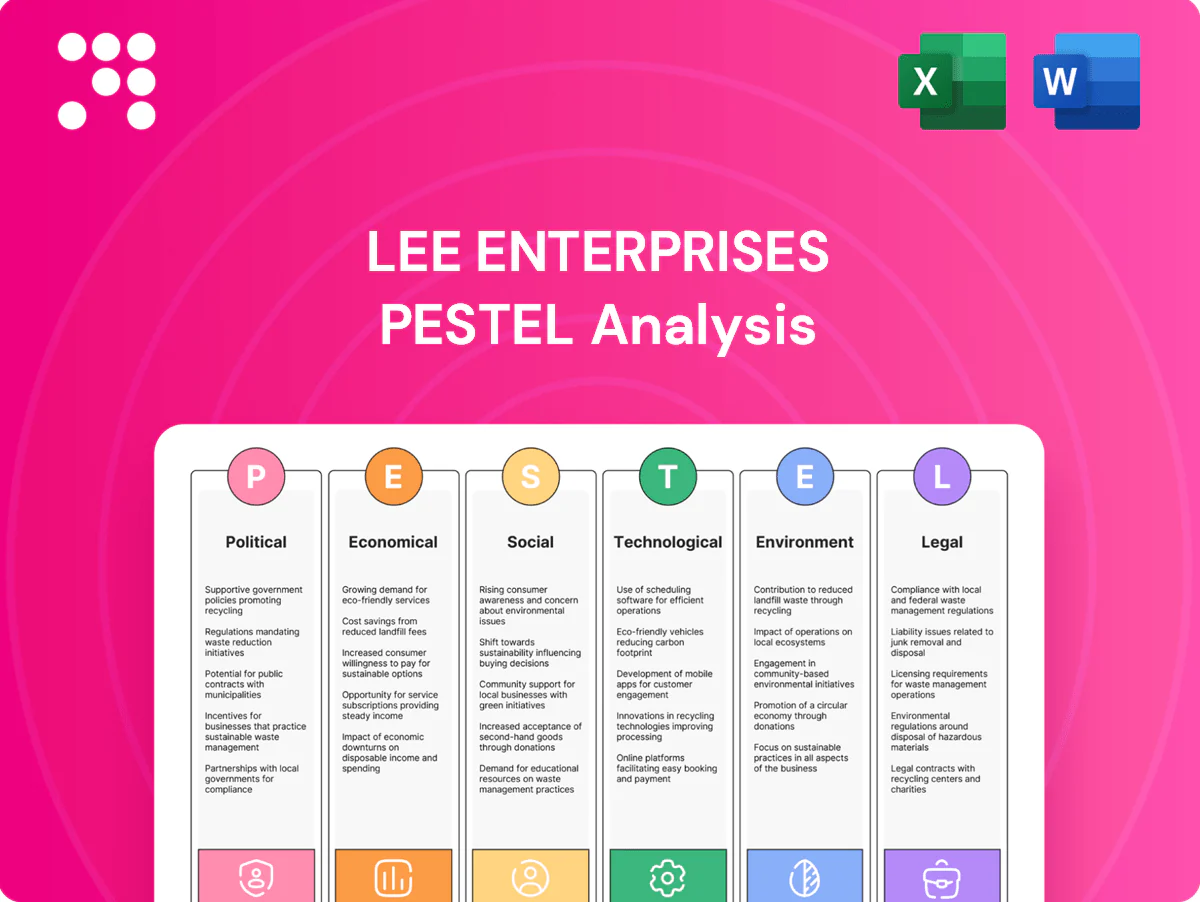
Lee Enterprises PESTLE Analysis

Your Competitive Advantage Starts with This Report
Discover how regulatory shifts, digital disruption, and changing consumer habits are shaping Lee Enterprises' prospects in our focused PESTLE analysis. This concise report highlights risks and opportunities that matter to investors and strategists. Purchase the full PESTLE to get the complete, actionable intelligence you can use today.
Political factors

Local journalism policy
Debates over tax credits or subsidies for local news could materially change Lee Enterprises (NYSE: LEE) revenue mix, particularly if federal or state programs mirror proposed tax-credit models for publishers. Government support may fund hiring and expanded coverage in midsize markets where Lee operates about 70 daily newspapers. Policy inertia, however, forces continued cost cuts and digital-growth focus, so monitoring municipal and state initiatives is critical.
Postal and delivery costs
USPS delivered about 121 billion mailpieces in 2023, so pricing and delivery standards directly shape Lee Enterprises print distribution economics. Higher postal rates compress margins on print subscriptions and inserts, accelerating circulation revenue pressure. Any USPS service reductions can hasten readers' shift to digital. Targeted advocacy and route optimization help mitigate cost impact.

Election-year advertising
Election-year political cycles lift local print and digital ad demand sharply; Borrell Associates projected roughly $9.8 billion in 2024 U.S. political ad spending, concentrating budget into short peak windows. Tighter finance rules or platform curbs can reallocate spend across channels, creating rapid surge-and-drop patterns that strain pricing and inventory. Lee must align sales operations and flexible inventory/pricing tools to capture peak windows and stabilize yield.

Public records and transparency
Lee Enterprises depends on open meeting and FOIA statutes to enable impactful local reporting; federal FOIA (1966) and 50 state public-records laws underpin access. Weakening transparency laws reduces content differentiation and civic value, harming subscription and advertising appeal. Strong protections boost accountability journalism and subscriber trust. Ongoing legal support and reporter training ensure consistent records access.
- FOIA 1966
- 50 state public-records laws
- Accountability journalism = higher retention
- Legal support & training = consistent access
Polarization and press climate
Political polarization is eroding audience trust and raising safety risks for journalists covering charged local issues; Lee Enterprises (ticker LEE) operates approximately 77 daily newspapers, amplifying exposure across diverse communities. A local-first focus can buffer national-level hostility but does not eliminate targeted harassment or access barriers, which increase security and compliance costs. Maintaining balanced editorial standards is essential to sustain community relationships and advertiser confidence.
- audience trust: local focus mitigates but doesn't remove risk
- security costs: harassment and access barriers drive higher compliance spend
- scale: ~77 daily newspapers increases exposure
- editorial: balance sustains community and advertiser relationships
Policy, USPS pricing and 2024 political ad spikes reshape regional publisher revenue mix
Policy shifts in federal/state news subsidies could alter Lee Enterprises revenue mix; monitor proposed publisher tax-credit models. USPS pricing and service (≈121 billion mailpieces in 2023) directly affect print margins. 2024 political ad spending (~$9.8B) creates volatile demand spikes; FOIA 1966 plus 50 state laws enable local reporting across Lee's ~77 dailies.
| Metric | Value |
|---|---|
| USPS mailpieces 2023 | ≈121B |
| 2024 political ad spend | ≈$9.8B |
| Lee dailies | ~77 |
| Records law | FOIA 1966; 50 states |
What is included in the product
 Detailed Word Document
Explores how macro-environmental factors uniquely affect Lee Enterprises across Political, Economic, Social, Technological, Environmental and Legal dimensions, with data-driven subpoints and region-specific examples; designed to help executives and investors identify risks, opportunities and forward-looking scenarios for strategy and funding decisions.

 Customizable Excel Spreadsheet
A concise, visually segmented Lee Enterprises PESTLE summary that’s easily dropped into presentations or shared across teams, helping streamline external risk discussions and accelerate strategic alignment.
Economic factors

Advertising cyclicality
Local SMB ad budgets are highly cyclical—small businesses cut marketing spend roughly 20% during the 2020 downturn, sharply reducing print inserts and programmatic CPMs. Programmatic pricing and insert volumes fell, then recovery favored performance-based, targeted digital buys as US digital ad revenue reached 211.4 billion in 2023. Diversifying services stabilizes cash flow across cycles.
Subscription affordability
Household budgets under pressure—US median household income $74,580 (Census 2023) and 2024 CPI about 3.4%—heighten churn and force ARPU trade-offs for Lee Enterprises. Across a price hike, subscriber losses are likely unless perceived value rises, as seen industry-wide. Bundling digital features (local alerts, premium archives) can preserve pricing power. Dynamic, cohort-specific offers improve conversion and boost LTV.

Input and distribution costs
Lee Enterprises reports that newsprint, ink and fuel price volatility have pressured print margins, prompting consolidation of print plants and route optimization to offset cost shocks.
The company has pursued vendor renegotiations and selective hedging to provide partial relief from input cost swings.
Ongoing digital migration continues to shrink print circulation and distribution exposure over time, lowering sensitivity to these cost inputs.

Interest rates and leverage
Higher interest rates (Fed funds 5.25–5.50% in mid‑2025) raise Lee Enterprises’ debt service costs and constrain discretionary investment; management prioritizes refinancing windows and covenant headroom to avoid restrictive triggers. Cash generation from legacy print assets continues to subsidize digital growth while scenario planning guides capex pacing across maturities.
- refinancing windows
- covenant headroom
- cash from legacy assets
- scenario-driven capex pacing
Market consolidation
Market consolidation reshaped Lee Enterprises when it acquired Berkshire Hathaway's newspaper operations in 2020 for about 140 million dollars while assuming roughly 576 million dollars in pension liabilities; such deals expand local footprints, strengthen ad networks and tech leverage, and drive back-office efficiencies. Antitrust scrutiny can delay transactions, but local revenue synergies and disciplined M&A underwriting protect returns.
- 2020 BH Media deal: $140M purchase, ~$576M pensions
- Scale: stronger ad networks and shared tech
- Risk: antitrust review can slow deals
- Mitigation: disciplined underwriting preserves returns
Policy, USPS pricing and 2024 political ad spikes reshape regional publisher revenue mix
Local SMB ad cyclicality and shifting spend to targeted digital compress print revenue but boost digital ARPU potential; US digital ads $211.4B (2023). Household pressure (median income $74,580; CPI ~3.4% in 2024) risks subscriber churn; price-sensitive cohorts need bundles. Input cost volatility and Fed funds 5.25–5.50% (mid‑2025) raise margins and debt service, driving plant consolidation and refinancing focus.
| Metric | Value |
|---|---|
| Digital ad revenue (2023) | $211.4B |
| Median HH income (2023) | $74,580 |
| CPI (2024) | ~3.4% |
| Fed funds (mid‑2025) | 5.25–5.50% |
| BH Media deal (2020) | $140M; ~$576M pensions |
What You See Is What You Get
Lee Enterprises PESTLE Analysis
The preview shown here is the exact Lee Enterprises PESTLE Analysis document you’ll receive after purchase—fully formatted and ready to use. It contains comprehensive political, economic, social, technological, legal, and environmental insights tailored to Lee Enterprises, with structured findings and actionable implications. No placeholders or teasers; what you see is the final, downloadable file.

Your Competitive Advantage Starts with This Report
Discover how regulatory shifts, digital disruption, and changing consumer habits are shaping Lee Enterprises' prospects in our focused PESTLE analysis. This concise report highlights risks and opportunities that matter to investors and strategists. Purchase the full PESTLE to get the complete, actionable intelligence you can use today.
Political factors
Local journalism policy
Debates over tax credits or subsidies for local news could materially change Lee Enterprises (NYSE: LEE) revenue mix, particularly if federal or state programs mirror proposed tax-credit models for publishers. Government support may fund hiring and expanded coverage in midsize markets where Lee operates about 70 daily newspapers. Policy inertia, however, forces continued cost cuts and digital-growth focus, so monitoring municipal and state initiatives is critical.
Postal and delivery costs
USPS delivered about 121 billion mailpieces in 2023, so pricing and delivery standards directly shape Lee Enterprises print distribution economics. Higher postal rates compress margins on print subscriptions and inserts, accelerating circulation revenue pressure. Any USPS service reductions can hasten readers' shift to digital. Targeted advocacy and route optimization help mitigate cost impact.
Election-year advertising
Election-year political cycles lift local print and digital ad demand sharply; Borrell Associates projected roughly $9.8 billion in 2024 U.S. political ad spending, concentrating budget into short peak windows. Tighter finance rules or platform curbs can reallocate spend across channels, creating rapid surge-and-drop patterns that strain pricing and inventory. Lee must align sales operations and flexible inventory/pricing tools to capture peak windows and stabilize yield.
Public records and transparency
Lee Enterprises depends on open meeting and FOIA statutes to enable impactful local reporting; federal FOIA (1966) and 50 state public-records laws underpin access. Weakening transparency laws reduces content differentiation and civic value, harming subscription and advertising appeal. Strong protections boost accountability journalism and subscriber trust. Ongoing legal support and reporter training ensure consistent records access.
- FOIA 1966
- 50 state public-records laws
- Accountability journalism = higher retention
- Legal support & training = consistent access
Polarization and press climate
Political polarization is eroding audience trust and raising safety risks for journalists covering charged local issues; Lee Enterprises (ticker LEE) operates approximately 77 daily newspapers, amplifying exposure across diverse communities. A local-first focus can buffer national-level hostility but does not eliminate targeted harassment or access barriers, which increase security and compliance costs. Maintaining balanced editorial standards is essential to sustain community relationships and advertiser confidence.
- audience trust: local focus mitigates but doesn't remove risk
- security costs: harassment and access barriers drive higher compliance spend
- scale: ~77 daily newspapers increases exposure
- editorial: balance sustains community and advertiser relationships
Policy, USPS pricing and 2024 political ad spikes reshape regional publisher revenue mix
Policy shifts in federal/state news subsidies could alter Lee Enterprises revenue mix; monitor proposed publisher tax-credit models. USPS pricing and service (≈121 billion mailpieces in 2023) directly affect print margins. 2024 political ad spending (~$9.8B) creates volatile demand spikes; FOIA 1966 plus 50 state laws enable local reporting across Lee's ~77 dailies.
| Metric | Value |
|---|---|
| USPS mailpieces 2023 | ≈121B |
| 2024 political ad spend | ≈$9.8B |
| Lee dailies | ~77 |
| Records law | FOIA 1966; 50 states |
What is included in the product
Detailed Word Document
Explores how macro-environmental factors uniquely affect Lee Enterprises across Political, Economic, Social, Technological, Environmental and Legal dimensions, with data-driven subpoints and region-specific examples; designed to help executives and investors identify risks, opportunities and forward-looking scenarios for strategy and funding decisions.
Customizable Excel Spreadsheet
A concise, visually segmented Lee Enterprises PESTLE summary that’s easily dropped into presentations or shared across teams, helping streamline external risk discussions and accelerate strategic alignment.
Economic factors
Advertising cyclicality
Local SMB ad budgets are highly cyclical—small businesses cut marketing spend roughly 20% during the 2020 downturn, sharply reducing print inserts and programmatic CPMs. Programmatic pricing and insert volumes fell, then recovery favored performance-based, targeted digital buys as US digital ad revenue reached 211.4 billion in 2023. Diversifying services stabilizes cash flow across cycles.
Subscription affordability
Household budgets under pressure—US median household income $74,580 (Census 2023) and 2024 CPI about 3.4%—heighten churn and force ARPU trade-offs for Lee Enterprises. Across a price hike, subscriber losses are likely unless perceived value rises, as seen industry-wide. Bundling digital features (local alerts, premium archives) can preserve pricing power. Dynamic, cohort-specific offers improve conversion and boost LTV.
Input and distribution costs
Lee Enterprises reports that newsprint, ink and fuel price volatility have pressured print margins, prompting consolidation of print plants and route optimization to offset cost shocks.
The company has pursued vendor renegotiations and selective hedging to provide partial relief from input cost swings.
Ongoing digital migration continues to shrink print circulation and distribution exposure over time, lowering sensitivity to these cost inputs.
Interest rates and leverage
Higher interest rates (Fed funds 5.25–5.50% in mid‑2025) raise Lee Enterprises’ debt service costs and constrain discretionary investment; management prioritizes refinancing windows and covenant headroom to avoid restrictive triggers. Cash generation from legacy print assets continues to subsidize digital growth while scenario planning guides capex pacing across maturities.
- refinancing windows
- covenant headroom
- cash from legacy assets
- scenario-driven capex pacing
Market consolidation
Market consolidation reshaped Lee Enterprises when it acquired Berkshire Hathaway's newspaper operations in 2020 for about 140 million dollars while assuming roughly 576 million dollars in pension liabilities; such deals expand local footprints, strengthen ad networks and tech leverage, and drive back-office efficiencies. Antitrust scrutiny can delay transactions, but local revenue synergies and disciplined M&A underwriting protect returns.
- 2020 BH Media deal: $140M purchase, ~$576M pensions
- Scale: stronger ad networks and shared tech
- Risk: antitrust review can slow deals
- Mitigation: disciplined underwriting preserves returns
Policy, USPS pricing and 2024 political ad spikes reshape regional publisher revenue mix
Local SMB ad cyclicality and shifting spend to targeted digital compress print revenue but boost digital ARPU potential; US digital ads $211.4B (2023). Household pressure (median income $74,580; CPI ~3.4% in 2024) risks subscriber churn; price-sensitive cohorts need bundles. Input cost volatility and Fed funds 5.25–5.50% (mid‑2025) raise margins and debt service, driving plant consolidation and refinancing focus.
| Metric | Value |
|---|---|
| Digital ad revenue (2023) | $211.4B |
| Median HH income (2023) | $74,580 |
| CPI (2024) | ~3.4% |
| Fed funds (mid‑2025) | 5.25–5.50% |
| BH Media deal (2020) | $140M; ~$576M pensions |
What You See Is What You Get
Lee Enterprises PESTLE Analysis
The preview shown here is the exact Lee Enterprises PESTLE Analysis document you’ll receive after purchase—fully formatted and ready to use. It contains comprehensive political, economic, social, technological, legal, and environmental insights tailored to Lee Enterprises, with structured findings and actionable implications. No placeholders or teasers; what you see is the final, downloadable file.
Original: $10.00
-65%$10.00
$3.50Description
Your Competitive Advantage Starts with This Report
Discover how regulatory shifts, digital disruption, and changing consumer habits are shaping Lee Enterprises' prospects in our focused PESTLE analysis. This concise report highlights risks and opportunities that matter to investors and strategists. Purchase the full PESTLE to get the complete, actionable intelligence you can use today.
Political factors
Local journalism policy
Debates over tax credits or subsidies for local news could materially change Lee Enterprises (NYSE: LEE) revenue mix, particularly if federal or state programs mirror proposed tax-credit models for publishers. Government support may fund hiring and expanded coverage in midsize markets where Lee operates about 70 daily newspapers. Policy inertia, however, forces continued cost cuts and digital-growth focus, so monitoring municipal and state initiatives is critical.
Postal and delivery costs
USPS delivered about 121 billion mailpieces in 2023, so pricing and delivery standards directly shape Lee Enterprises print distribution economics. Higher postal rates compress margins on print subscriptions and inserts, accelerating circulation revenue pressure. Any USPS service reductions can hasten readers' shift to digital. Targeted advocacy and route optimization help mitigate cost impact.
Election-year advertising
Election-year political cycles lift local print and digital ad demand sharply; Borrell Associates projected roughly $9.8 billion in 2024 U.S. political ad spending, concentrating budget into short peak windows. Tighter finance rules or platform curbs can reallocate spend across channels, creating rapid surge-and-drop patterns that strain pricing and inventory. Lee must align sales operations and flexible inventory/pricing tools to capture peak windows and stabilize yield.
Public records and transparency
Lee Enterprises depends on open meeting and FOIA statutes to enable impactful local reporting; federal FOIA (1966) and 50 state public-records laws underpin access. Weakening transparency laws reduces content differentiation and civic value, harming subscription and advertising appeal. Strong protections boost accountability journalism and subscriber trust. Ongoing legal support and reporter training ensure consistent records access.
- FOIA 1966
- 50 state public-records laws
- Accountability journalism = higher retention
- Legal support & training = consistent access
Polarization and press climate
Political polarization is eroding audience trust and raising safety risks for journalists covering charged local issues; Lee Enterprises (ticker LEE) operates approximately 77 daily newspapers, amplifying exposure across diverse communities. A local-first focus can buffer national-level hostility but does not eliminate targeted harassment or access barriers, which increase security and compliance costs. Maintaining balanced editorial standards is essential to sustain community relationships and advertiser confidence.
- audience trust: local focus mitigates but doesn't remove risk
- security costs: harassment and access barriers drive higher compliance spend
- scale: ~77 daily newspapers increases exposure
- editorial: balance sustains community and advertiser relationships
Policy, USPS pricing and 2024 political ad spikes reshape regional publisher revenue mix
Policy shifts in federal/state news subsidies could alter Lee Enterprises revenue mix; monitor proposed publisher tax-credit models. USPS pricing and service (≈121 billion mailpieces in 2023) directly affect print margins. 2024 political ad spending (~$9.8B) creates volatile demand spikes; FOIA 1966 plus 50 state laws enable local reporting across Lee's ~77 dailies.
| Metric | Value |
|---|---|
| USPS mailpieces 2023 | ≈121B |
| 2024 political ad spend | ≈$9.8B |
| Lee dailies | ~77 |
| Records law | FOIA 1966; 50 states |
What is included in the product
Detailed Word Document
Explores how macro-environmental factors uniquely affect Lee Enterprises across Political, Economic, Social, Technological, Environmental and Legal dimensions, with data-driven subpoints and region-specific examples; designed to help executives and investors identify risks, opportunities and forward-looking scenarios for strategy and funding decisions.
Customizable Excel Spreadsheet
A concise, visually segmented Lee Enterprises PESTLE summary that’s easily dropped into presentations or shared across teams, helping streamline external risk discussions and accelerate strategic alignment.
Economic factors
Advertising cyclicality
Local SMB ad budgets are highly cyclical—small businesses cut marketing spend roughly 20% during the 2020 downturn, sharply reducing print inserts and programmatic CPMs. Programmatic pricing and insert volumes fell, then recovery favored performance-based, targeted digital buys as US digital ad revenue reached 211.4 billion in 2023. Diversifying services stabilizes cash flow across cycles.
Subscription affordability
Household budgets under pressure—US median household income $74,580 (Census 2023) and 2024 CPI about 3.4%—heighten churn and force ARPU trade-offs for Lee Enterprises. Across a price hike, subscriber losses are likely unless perceived value rises, as seen industry-wide. Bundling digital features (local alerts, premium archives) can preserve pricing power. Dynamic, cohort-specific offers improve conversion and boost LTV.
Input and distribution costs
Lee Enterprises reports that newsprint, ink and fuel price volatility have pressured print margins, prompting consolidation of print plants and route optimization to offset cost shocks.
The company has pursued vendor renegotiations and selective hedging to provide partial relief from input cost swings.
Ongoing digital migration continues to shrink print circulation and distribution exposure over time, lowering sensitivity to these cost inputs.
Interest rates and leverage
Higher interest rates (Fed funds 5.25–5.50% in mid‑2025) raise Lee Enterprises’ debt service costs and constrain discretionary investment; management prioritizes refinancing windows and covenant headroom to avoid restrictive triggers. Cash generation from legacy print assets continues to subsidize digital growth while scenario planning guides capex pacing across maturities.
- refinancing windows
- covenant headroom
- cash from legacy assets
- scenario-driven capex pacing
Market consolidation
Market consolidation reshaped Lee Enterprises when it acquired Berkshire Hathaway's newspaper operations in 2020 for about 140 million dollars while assuming roughly 576 million dollars in pension liabilities; such deals expand local footprints, strengthen ad networks and tech leverage, and drive back-office efficiencies. Antitrust scrutiny can delay transactions, but local revenue synergies and disciplined M&A underwriting protect returns.
- 2020 BH Media deal: $140M purchase, ~$576M pensions
- Scale: stronger ad networks and shared tech
- Risk: antitrust review can slow deals
- Mitigation: disciplined underwriting preserves returns
Policy, USPS pricing and 2024 political ad spikes reshape regional publisher revenue mix
Local SMB ad cyclicality and shifting spend to targeted digital compress print revenue but boost digital ARPU potential; US digital ads $211.4B (2023). Household pressure (median income $74,580; CPI ~3.4% in 2024) risks subscriber churn; price-sensitive cohorts need bundles. Input cost volatility and Fed funds 5.25–5.50% (mid‑2025) raise margins and debt service, driving plant consolidation and refinancing focus.
| Metric | Value |
|---|---|
| Digital ad revenue (2023) | $211.4B |
| Median HH income (2023) | $74,580 |
| CPI (2024) | ~3.4% |
| Fed funds (mid‑2025) | 5.25–5.50% |
| BH Media deal (2020) | $140M; ~$576M pensions |
What You See Is What You Get
Lee Enterprises PESTLE Analysis
The preview shown here is the exact Lee Enterprises PESTLE Analysis document you’ll receive after purchase—fully formatted and ready to use. It contains comprehensive political, economic, social, technological, legal, and environmental insights tailored to Lee Enterprises, with structured findings and actionable implications. No placeholders or teasers; what you see is the final, downloadable file.











