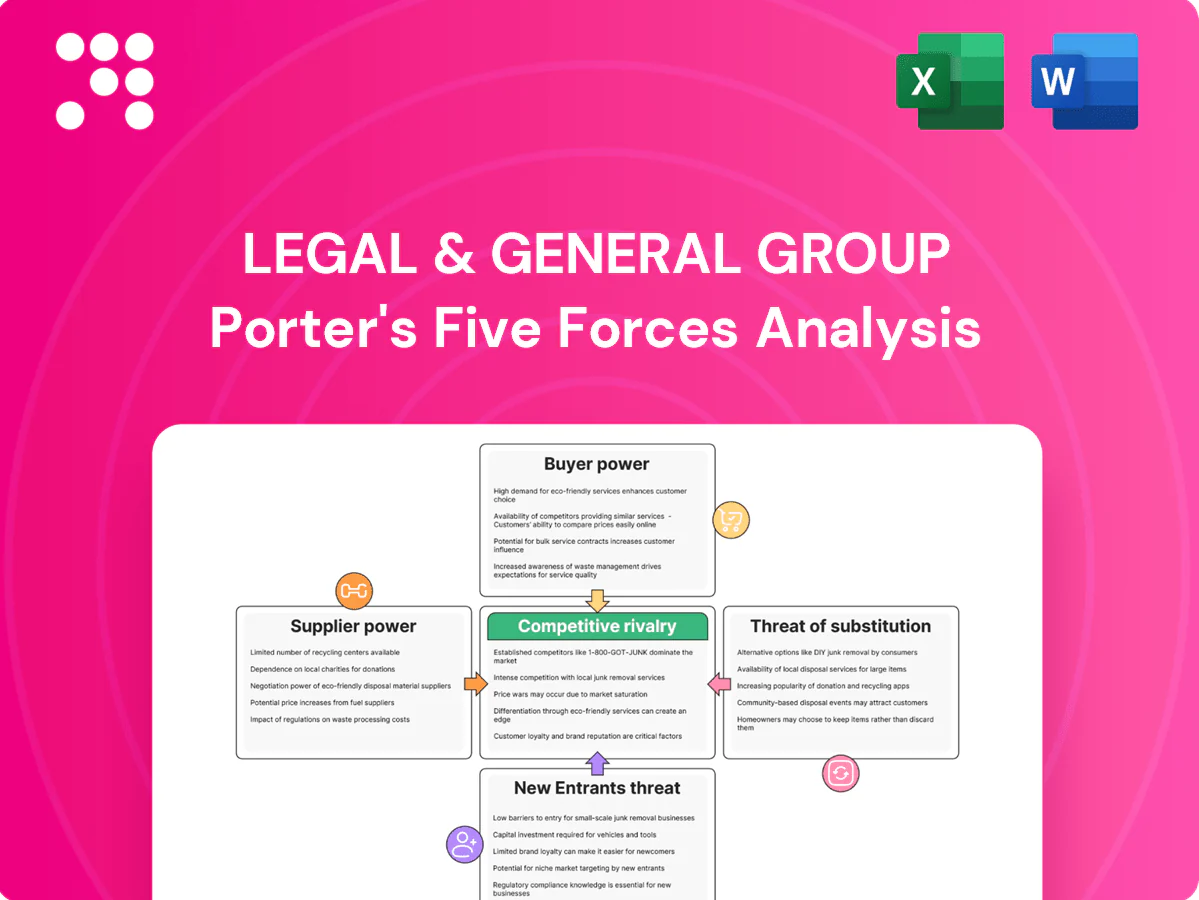
Legal & General Group Porter's Five Forces Analysis

Go Beyond the Preview—Access the Full Strategic Report
Legal & General Group faces complex competitive forces—from regulatory pressures and capital-intensive barriers to rising substitute products and concentrated buyer segments. This snapshot highlights key tensions but omits force-by-force ratings and strategic implications. Unlock the full Porter’s Five Forces Analysis for detailed visuals, actionable insights, and investor-ready recommendations.
Suppliers Bargaining Power

Concentrated reinsurers
Legal & General relies on a limited pool of highly rated reinsurers for risk transfer, giving suppliers leverage over pricing and contract terms; global reinsurance rates rose about 10% from 2023–2024 after loss-heavy years, increasing L&G's costs. Strong credit ratings and diversification improve L&G's negotiating position, but scarcity of AA-rated counterparties keeps supplier power moderate. Long-term partnerships smooth volatility but reduce switching flexibility.
Critical data & tech vendors
Market data, pricing models and core platforms (top three cloud providers holding ~67% of the global IaaS market in 2024) are mission-critical, creating high switching costs. Vendor consolidation in fintech infrastructure elevates supplier bargaining power. Multi-vendor sourcing and selective in-house capabilities reduce dependence. UK regulatory operational resilience expectations (FCA/PRA) implemented since 2022 further entrench key suppliers.

Distribution intermediaries
IFAs, brokers and platforms act as gatekeepers to retail and workplace clients, with c.27,000 regulated IFAs and the top three UK platforms controlling roughly 60% of the retail platform market (2024), giving them strong negotiating leverage. High-performing channels demand higher commissions and service levels. L&G’s strong brand and c.£1.2tn AUM and direct workplace channels mitigate but do not eliminate channel power.

Specialist talent
Actuaries, portfolio managers, data scientists and risk experts are scarce and mobile, giving this human-capital supplier significant bargaining power as wage inflation and retention packages rise; Legal & General, with ~£1.2tn AUM (2024), uses scale, culture and purpose-led projects to attract talent, but competition from asset managers, fintechs and Big Tech keeps pressure high.
- Scarcity: high mobility
- Cost: rising wages/retention
- L&G strength: scale & purpose
- Threats: asset managers, fintech, Big Tech
Debt & capital markets
Capital is a critical input for L&G’s growth, M&A and asset–liability management; in 2024 Legal & General reported group AUM of about £1.4tn, meaning funding conditions materially affect strategy. When credit spreads widen or risk appetite falls, funding costs rise and terms tighten, pressuring new deals and ALM flexibility. L&G’s strong balance sheet and ratings mitigate dependence on markets but do not remove cyclicality, and regulatory capital frameworks can amplify supplier power during stress.
- 2024 AUM: ~£1.4tn
- Higher spreads → costlier M&A and tighter ALM
- Regulatory capital can magnify market-driven supplier power
Supply squeeze: reinsurers +10% and cloud/platform concentration raise costs, AUM ≈£1.4tn
Suppliers exert moderate-to-high power: reinsurers (global rates +10% 2023–24) and concentrated cloud/fintech vendors (top 3 IaaS ~67% 2024) raise costs; IFAs/platforms (~27,000 IFAs; top 3 platforms ~60% retail 2024) and scarce talent push fees; L&G scale (≈£1.4tn AUM 2024) and ratings mitigate but do not eliminate leverage.
| Supplier | 2024 metric |
|---|---|
| Reinsurance | Rates +10% (2023–24) |
| Cloud/IaaS | Top3 ~67% |
| Platforms/IFAs | Top3 ~60%; ~27,000 IFAs |
| AUM | ≈£1.4tn |
What is included in the product
 Detailed Word Document
Concise Porter's Five Forces assessment of Legal & General Group highlighting competitive rivalry, buyer and supplier bargaining power, threats from new entrants and substitutes, and regulatory/disruptive risks shaping its profitability and strategic positioning in insurance, asset management, and retirement markets.

 Customizable Excel Spreadsheet
A one-sheet Porter's Five Forces for Legal & General Group that instantly maps competitive pressure with an editable radar chart, lets you tweak force levels for regulatory or market shifts, and drops cleanly into decks—no macros, easy for non-finance users and ready to integrate into broader analysis.
Customers Bargaining Power

Institutional RFP muscle
Pensions, insurers and sovereigns running competitive mandates have driven fee compression, with institutional passive fees falling below 20 bps in many mandates by 2024. Sophisticated due diligence and performance benchmarking increase buyer leverage, as institutional RFPs commonly require multi-year track records. L&G’s scale—about £1.2tn AUM in 2024—diverse solutions and long track record help defend margins, though mandate portability keeps switching costs moderate.
Retail price sensitivity
Individuals now compare fees, guarantees and service across providers online, pressuring margins even for large players; Legal & General managed about £1.3 trillion AUM in 2024, so scale helps but does not immunize pricing. Price transparency and comparison tools elevate customer bargaining power, while brand trust and product complexity create temporary inertia. Claims experience and customer service materially drive retention and switching decisions.

Workplace scheme sponsors
Employers and trustees negotiate pensions, de‑risking and benefits with growing leverage as UK DB liabilities exceed £1.7tn (2024), boosting deal sizes via scheme consolidation. Larger tickets increase sponsor bargaining power, but L&G’s integrated retirement solutions and execution scale mitigate pricing pressure. Regulatory oversight from TPR and FCA mandates fair‑value outcomes, supporting buyer protections.

Switching & portability
Auto-enrolment and open banking have reduced switching friction for routine products, while Legal & General reported c.£1.3tn AUM in 2024 facilitating custody transitions with managed frictions; investment moves remain feasible though operationally non-trivial. Insurance and annuities carry materially higher post-issuance switching costs, leaving buyers with moderate-to-high bargaining power across lines.
- Auto-enrolment: easier switching
- Open banking: increases portability
- Investment custody: feasible, managed frictions
- Insurance/annuities: high switching costs
- Overall: moderate-to-high buyer power
Demand for ESG & impact
Institutions increasingly demand ESG integration and measurable outcomes — sustainable assets hit about $35.3tn globally in 2024, driving custom mandates that extract limited fee premia and operational change. Legal & General (around £1.3tn AUM in 2024) aligns strategically but must substantiate claims with robust data to retain mandates; buyers can reallocate quickly if expectations falter.
- ESG demand: $35.3tn (2024)
- Custom mandates: limited fee premia
- L&G scale: ~£1.3tn AUM (2024)
- Switch risk: rapid reallocation if metrics fail
Scale ~£1.3tn and sub-20 bps passive fees boost buyer leverage
Pension funds, insurers and sovereign mandates pushed passive fees below 20 bps by 2024, increasing buyer leverage. L&G’s scale (~£1.3tn AUM in 2024) and integrated retirement offer limit margin loss but mandate portability keeps switching costs moderate. Transparency, open banking and ESG ($35.3tn sustainable assets globally, 2024) raise institutional and retail bargaining power.
| Metric | 2024 | Impact |
|---|---|---|
| L&G AUM | ~£1.3tn | Defensive scale |
| Passive fees | <20 bps | Higher buyer leverage |
| DB liabilities (UK) | £1.7tn | Trustee negotiating power |
| Sustainable assets | $35.3tn | Custom mandates, fee pressure |
Preview the Actual Deliverable
Legal & General Group Porter's Five Forces Analysis
This preview displays the exact Legal & General Group Porter’s Five Forces analysis you will receive upon purchase—no placeholders or mockups. The document is complete, professionally formatted and ready for download immediately after payment. Use it as-is for strategic or investment decision-making.

Go Beyond the Preview—Access the Full Strategic Report
Legal & General Group faces complex competitive forces—from regulatory pressures and capital-intensive barriers to rising substitute products and concentrated buyer segments. This snapshot highlights key tensions but omits force-by-force ratings and strategic implications. Unlock the full Porter’s Five Forces Analysis for detailed visuals, actionable insights, and investor-ready recommendations.
Suppliers Bargaining Power
Concentrated reinsurers
Legal & General relies on a limited pool of highly rated reinsurers for risk transfer, giving suppliers leverage over pricing and contract terms; global reinsurance rates rose about 10% from 2023–2024 after loss-heavy years, increasing L&G's costs. Strong credit ratings and diversification improve L&G's negotiating position, but scarcity of AA-rated counterparties keeps supplier power moderate. Long-term partnerships smooth volatility but reduce switching flexibility.
Critical data & tech vendors
Market data, pricing models and core platforms (top three cloud providers holding ~67% of the global IaaS market in 2024) are mission-critical, creating high switching costs. Vendor consolidation in fintech infrastructure elevates supplier bargaining power. Multi-vendor sourcing and selective in-house capabilities reduce dependence. UK regulatory operational resilience expectations (FCA/PRA) implemented since 2022 further entrench key suppliers.
Distribution intermediaries
IFAs, brokers and platforms act as gatekeepers to retail and workplace clients, with c.27,000 regulated IFAs and the top three UK platforms controlling roughly 60% of the retail platform market (2024), giving them strong negotiating leverage. High-performing channels demand higher commissions and service levels. L&G’s strong brand and c.£1.2tn AUM and direct workplace channels mitigate but do not eliminate channel power.
Specialist talent
Actuaries, portfolio managers, data scientists and risk experts are scarce and mobile, giving this human-capital supplier significant bargaining power as wage inflation and retention packages rise; Legal & General, with ~£1.2tn AUM (2024), uses scale, culture and purpose-led projects to attract talent, but competition from asset managers, fintechs and Big Tech keeps pressure high.
- Scarcity: high mobility
- Cost: rising wages/retention
- L&G strength: scale & purpose
- Threats: asset managers, fintech, Big Tech
Debt & capital markets
Capital is a critical input for L&G’s growth, M&A and asset–liability management; in 2024 Legal & General reported group AUM of about £1.4tn, meaning funding conditions materially affect strategy. When credit spreads widen or risk appetite falls, funding costs rise and terms tighten, pressuring new deals and ALM flexibility. L&G’s strong balance sheet and ratings mitigate dependence on markets but do not remove cyclicality, and regulatory capital frameworks can amplify supplier power during stress.
- 2024 AUM: ~£1.4tn
- Higher spreads → costlier M&A and tighter ALM
- Regulatory capital can magnify market-driven supplier power
Supply squeeze: reinsurers +10% and cloud/platform concentration raise costs, AUM ≈£1.4tn
Suppliers exert moderate-to-high power: reinsurers (global rates +10% 2023–24) and concentrated cloud/fintech vendors (top 3 IaaS ~67% 2024) raise costs; IFAs/platforms (~27,000 IFAs; top 3 platforms ~60% retail 2024) and scarce talent push fees; L&G scale (≈£1.4tn AUM 2024) and ratings mitigate but do not eliminate leverage.
| Supplier | 2024 metric |
|---|---|
| Reinsurance | Rates +10% (2023–24) |
| Cloud/IaaS | Top3 ~67% |
| Platforms/IFAs | Top3 ~60%; ~27,000 IFAs |
| AUM | ≈£1.4tn |
What is included in the product
Detailed Word Document
Concise Porter's Five Forces assessment of Legal & General Group highlighting competitive rivalry, buyer and supplier bargaining power, threats from new entrants and substitutes, and regulatory/disruptive risks shaping its profitability and strategic positioning in insurance, asset management, and retirement markets.
Customizable Excel Spreadsheet
A one-sheet Porter's Five Forces for Legal & General Group that instantly maps competitive pressure with an editable radar chart, lets you tweak force levels for regulatory or market shifts, and drops cleanly into decks—no macros, easy for non-finance users and ready to integrate into broader analysis.
Customers Bargaining Power
Institutional RFP muscle
Pensions, insurers and sovereigns running competitive mandates have driven fee compression, with institutional passive fees falling below 20 bps in many mandates by 2024. Sophisticated due diligence and performance benchmarking increase buyer leverage, as institutional RFPs commonly require multi-year track records. L&G’s scale—about £1.2tn AUM in 2024—diverse solutions and long track record help defend margins, though mandate portability keeps switching costs moderate.
Retail price sensitivity
Individuals now compare fees, guarantees and service across providers online, pressuring margins even for large players; Legal & General managed about £1.3 trillion AUM in 2024, so scale helps but does not immunize pricing. Price transparency and comparison tools elevate customer bargaining power, while brand trust and product complexity create temporary inertia. Claims experience and customer service materially drive retention and switching decisions.
Workplace scheme sponsors
Employers and trustees negotiate pensions, de‑risking and benefits with growing leverage as UK DB liabilities exceed £1.7tn (2024), boosting deal sizes via scheme consolidation. Larger tickets increase sponsor bargaining power, but L&G’s integrated retirement solutions and execution scale mitigate pricing pressure. Regulatory oversight from TPR and FCA mandates fair‑value outcomes, supporting buyer protections.
Switching & portability
Auto-enrolment and open banking have reduced switching friction for routine products, while Legal & General reported c.£1.3tn AUM in 2024 facilitating custody transitions with managed frictions; investment moves remain feasible though operationally non-trivial. Insurance and annuities carry materially higher post-issuance switching costs, leaving buyers with moderate-to-high bargaining power across lines.
- Auto-enrolment: easier switching
- Open banking: increases portability
- Investment custody: feasible, managed frictions
- Insurance/annuities: high switching costs
- Overall: moderate-to-high buyer power
Demand for ESG & impact
Institutions increasingly demand ESG integration and measurable outcomes — sustainable assets hit about $35.3tn globally in 2024, driving custom mandates that extract limited fee premia and operational change. Legal & General (around £1.3tn AUM in 2024) aligns strategically but must substantiate claims with robust data to retain mandates; buyers can reallocate quickly if expectations falter.
- ESG demand: $35.3tn (2024)
- Custom mandates: limited fee premia
- L&G scale: ~£1.3tn AUM (2024)
- Switch risk: rapid reallocation if metrics fail
Scale ~£1.3tn and sub-20 bps passive fees boost buyer leverage
Pension funds, insurers and sovereign mandates pushed passive fees below 20 bps by 2024, increasing buyer leverage. L&G’s scale (~£1.3tn AUM in 2024) and integrated retirement offer limit margin loss but mandate portability keeps switching costs moderate. Transparency, open banking and ESG ($35.3tn sustainable assets globally, 2024) raise institutional and retail bargaining power.
| Metric | 2024 | Impact |
|---|---|---|
| L&G AUM | ~£1.3tn | Defensive scale |
| Passive fees | <20 bps | Higher buyer leverage |
| DB liabilities (UK) | £1.7tn | Trustee negotiating power |
| Sustainable assets | $35.3tn | Custom mandates, fee pressure |
Preview the Actual Deliverable
Legal & General Group Porter's Five Forces Analysis
This preview displays the exact Legal & General Group Porter’s Five Forces analysis you will receive upon purchase—no placeholders or mockups. The document is complete, professionally formatted and ready for download immediately after payment. Use it as-is for strategic or investment decision-making.
Description
Go Beyond the Preview—Access the Full Strategic Report
Legal & General Group faces complex competitive forces—from regulatory pressures and capital-intensive barriers to rising substitute products and concentrated buyer segments. This snapshot highlights key tensions but omits force-by-force ratings and strategic implications. Unlock the full Porter’s Five Forces Analysis for detailed visuals, actionable insights, and investor-ready recommendations.
Suppliers Bargaining Power
Concentrated reinsurers
Legal & General relies on a limited pool of highly rated reinsurers for risk transfer, giving suppliers leverage over pricing and contract terms; global reinsurance rates rose about 10% from 2023–2024 after loss-heavy years, increasing L&G's costs. Strong credit ratings and diversification improve L&G's negotiating position, but scarcity of AA-rated counterparties keeps supplier power moderate. Long-term partnerships smooth volatility but reduce switching flexibility.
Critical data & tech vendors
Market data, pricing models and core platforms (top three cloud providers holding ~67% of the global IaaS market in 2024) are mission-critical, creating high switching costs. Vendor consolidation in fintech infrastructure elevates supplier bargaining power. Multi-vendor sourcing and selective in-house capabilities reduce dependence. UK regulatory operational resilience expectations (FCA/PRA) implemented since 2022 further entrench key suppliers.
Distribution intermediaries
IFAs, brokers and platforms act as gatekeepers to retail and workplace clients, with c.27,000 regulated IFAs and the top three UK platforms controlling roughly 60% of the retail platform market (2024), giving them strong negotiating leverage. High-performing channels demand higher commissions and service levels. L&G’s strong brand and c.£1.2tn AUM and direct workplace channels mitigate but do not eliminate channel power.
Specialist talent
Actuaries, portfolio managers, data scientists and risk experts are scarce and mobile, giving this human-capital supplier significant bargaining power as wage inflation and retention packages rise; Legal & General, with ~£1.2tn AUM (2024), uses scale, culture and purpose-led projects to attract talent, but competition from asset managers, fintechs and Big Tech keeps pressure high.
- Scarcity: high mobility
- Cost: rising wages/retention
- L&G strength: scale & purpose
- Threats: asset managers, fintech, Big Tech
Debt & capital markets
Capital is a critical input for L&G’s growth, M&A and asset–liability management; in 2024 Legal & General reported group AUM of about £1.4tn, meaning funding conditions materially affect strategy. When credit spreads widen or risk appetite falls, funding costs rise and terms tighten, pressuring new deals and ALM flexibility. L&G’s strong balance sheet and ratings mitigate dependence on markets but do not remove cyclicality, and regulatory capital frameworks can amplify supplier power during stress.
- 2024 AUM: ~£1.4tn
- Higher spreads → costlier M&A and tighter ALM
- Regulatory capital can magnify market-driven supplier power
Supply squeeze: reinsurers +10% and cloud/platform concentration raise costs, AUM ≈£1.4tn
Suppliers exert moderate-to-high power: reinsurers (global rates +10% 2023–24) and concentrated cloud/fintech vendors (top 3 IaaS ~67% 2024) raise costs; IFAs/platforms (~27,000 IFAs; top 3 platforms ~60% retail 2024) and scarce talent push fees; L&G scale (≈£1.4tn AUM 2024) and ratings mitigate but do not eliminate leverage.
| Supplier | 2024 metric |
|---|---|
| Reinsurance | Rates +10% (2023–24) |
| Cloud/IaaS | Top3 ~67% |
| Platforms/IFAs | Top3 ~60%; ~27,000 IFAs |
| AUM | ≈£1.4tn |
What is included in the product
Detailed Word Document
Concise Porter's Five Forces assessment of Legal & General Group highlighting competitive rivalry, buyer and supplier bargaining power, threats from new entrants and substitutes, and regulatory/disruptive risks shaping its profitability and strategic positioning in insurance, asset management, and retirement markets.
Customizable Excel Spreadsheet
A one-sheet Porter's Five Forces for Legal & General Group that instantly maps competitive pressure with an editable radar chart, lets you tweak force levels for regulatory or market shifts, and drops cleanly into decks—no macros, easy for non-finance users and ready to integrate into broader analysis.
Customers Bargaining Power
Institutional RFP muscle
Pensions, insurers and sovereigns running competitive mandates have driven fee compression, with institutional passive fees falling below 20 bps in many mandates by 2024. Sophisticated due diligence and performance benchmarking increase buyer leverage, as institutional RFPs commonly require multi-year track records. L&G’s scale—about £1.2tn AUM in 2024—diverse solutions and long track record help defend margins, though mandate portability keeps switching costs moderate.
Retail price sensitivity
Individuals now compare fees, guarantees and service across providers online, pressuring margins even for large players; Legal & General managed about £1.3 trillion AUM in 2024, so scale helps but does not immunize pricing. Price transparency and comparison tools elevate customer bargaining power, while brand trust and product complexity create temporary inertia. Claims experience and customer service materially drive retention and switching decisions.
Workplace scheme sponsors
Employers and trustees negotiate pensions, de‑risking and benefits with growing leverage as UK DB liabilities exceed £1.7tn (2024), boosting deal sizes via scheme consolidation. Larger tickets increase sponsor bargaining power, but L&G’s integrated retirement solutions and execution scale mitigate pricing pressure. Regulatory oversight from TPR and FCA mandates fair‑value outcomes, supporting buyer protections.
Switching & portability
Auto-enrolment and open banking have reduced switching friction for routine products, while Legal & General reported c.£1.3tn AUM in 2024 facilitating custody transitions with managed frictions; investment moves remain feasible though operationally non-trivial. Insurance and annuities carry materially higher post-issuance switching costs, leaving buyers with moderate-to-high bargaining power across lines.
- Auto-enrolment: easier switching
- Open banking: increases portability
- Investment custody: feasible, managed frictions
- Insurance/annuities: high switching costs
- Overall: moderate-to-high buyer power
Demand for ESG & impact
Institutions increasingly demand ESG integration and measurable outcomes — sustainable assets hit about $35.3tn globally in 2024, driving custom mandates that extract limited fee premia and operational change. Legal & General (around £1.3tn AUM in 2024) aligns strategically but must substantiate claims with robust data to retain mandates; buyers can reallocate quickly if expectations falter.
- ESG demand: $35.3tn (2024)
- Custom mandates: limited fee premia
- L&G scale: ~£1.3tn AUM (2024)
- Switch risk: rapid reallocation if metrics fail
Scale ~£1.3tn and sub-20 bps passive fees boost buyer leverage
Pension funds, insurers and sovereign mandates pushed passive fees below 20 bps by 2024, increasing buyer leverage. L&G’s scale (~£1.3tn AUM in 2024) and integrated retirement offer limit margin loss but mandate portability keeps switching costs moderate. Transparency, open banking and ESG ($35.3tn sustainable assets globally, 2024) raise institutional and retail bargaining power.
| Metric | 2024 | Impact |
|---|---|---|
| L&G AUM | ~£1.3tn | Defensive scale |
| Passive fees | <20 bps | Higher buyer leverage |
| DB liabilities (UK) | £1.7tn | Trustee negotiating power |
| Sustainable assets | $35.3tn | Custom mandates, fee pressure |
Preview the Actual Deliverable
Legal & General Group Porter's Five Forces Analysis
This preview displays the exact Legal & General Group Porter’s Five Forces analysis you will receive upon purchase—no placeholders or mockups. The document is complete, professionally formatted and ready for download immediately after payment. Use it as-is for strategic or investment decision-making.











