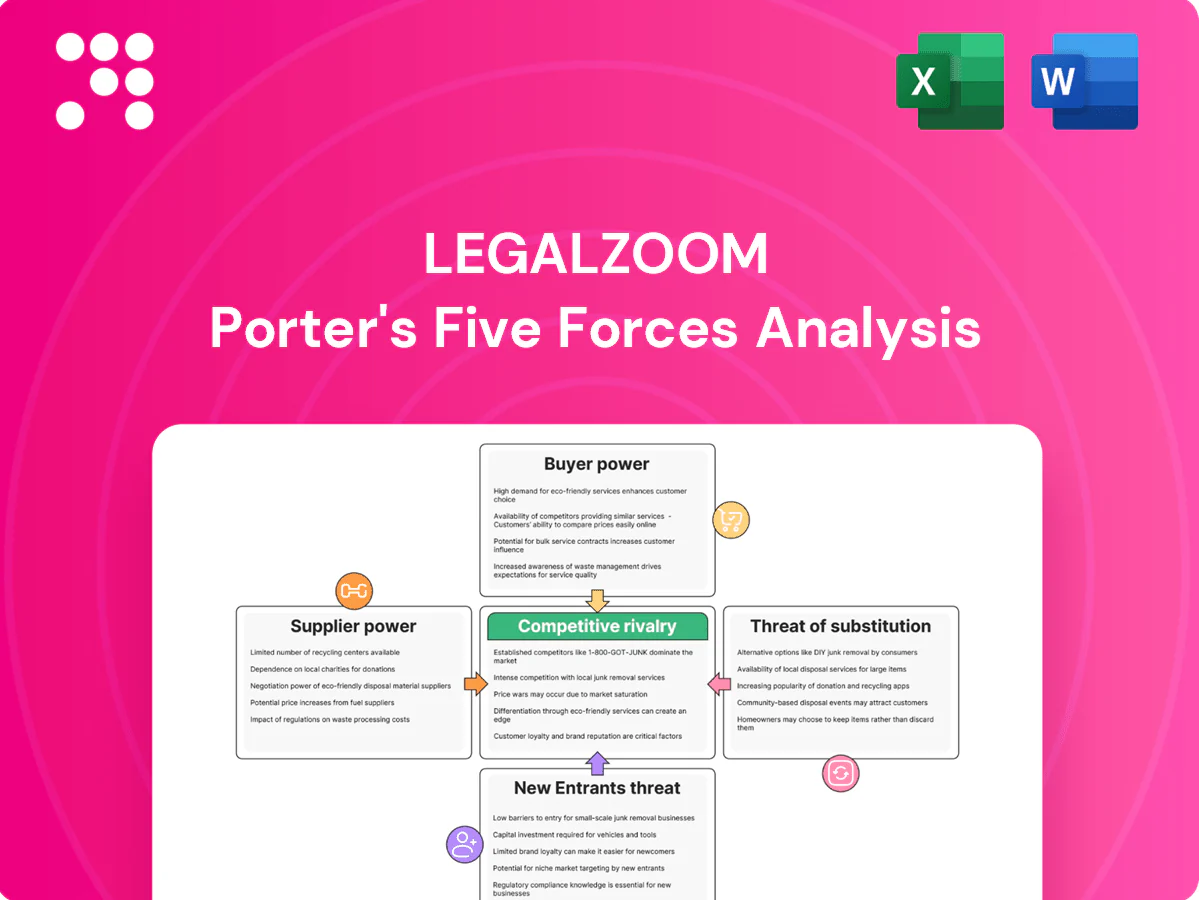
LegalZoom Porter's Five Forces Analysis

From Overview to Strategy Blueprint
LegalZoom’s Porter's Five Forces snapshot highlights key pressures—from buyer bargaining and online substitute threats to entry barriers and supplier dynamics—framing the firm's strategic challenges and advantages. This brief overview teases critical insights but leaves force-by-force ratings and implications unexplored. Unlock the full Porter's Five Forces Analysis for a deep, data-driven breakdown to inform investment or strategy decisions.
Suppliers Bargaining Power

Attorney network dependence
Independent attorneys supply on-demand expertise across jurisdictions, with about 1.37 million lawyers in the US (BLS 2024) but far fewer in niche areas like IP or immigration, raising rates and response times. Platform reputation and lead volume give LegalZoom some leverage, yet high-quality lawyers commonly multihome across marketplaces. Maintaining SLAs and pricing consistency requires robust vetting, incentives, and performance monitoring.
State filing systems/data
Secretary of State portals (51 jurisdictions), the USPTO, and courts (94 federal district courts plus state systems) act as critical infrastructure suppliers for LegalZoom and process hundreds of thousands of filings annually, so idiosyncratic rules, fee changes, and processing delays create dependency and pass-through costs to clients. Access terms are standardized and non-negotiable, limiting supplier bargaining power. Robust API integration and real-time status feeds materially reduce operational risk and customer churn.

Cloud and tech vendors
Reliance on cloud, communications, and identity/KYC providers concentrates supplier risk for LegalZoom given AWS 32%, Microsoft Azure 23% and Google Cloud 11% market shares (Synergy Research, 2024). Pricing tiers and egress fees can squeeze margins during scale or migration, while 92% of enterprises report multi-cloud strategies (Flexera, 2024) so multi-cloud and modular architecture can lower switching costs. Volume commitments and co-marketing deals can secure better commercial terms.

Content/IP and data sources
Legal templates, research and compliance datasets are core inputs that drive automation quality; LegalZoom has served over 4 million customers, increasing dependence on up-to-date content. Proprietary content reduces supplier power, but statutory updates and third-party citations remain necessary. Exclusive or time-sensitive datasets command price premiums, and continuous refresh across 50 states is required to maintain accuracy.
- Core inputs: templates, research, compliance
- Proprietary content lowers supplier power
- Third-party updates still needed
- Exclusive/time-sensitive data = higher price
- Continuous refresh across 50 states
Registered agent/fulfillment
Incorporation and compliance services depend on third-party registered agents and mail handling, which must cover all 50 US states and directly affect SLA performance and churn.
Consolidated vendors with nationwide footprints gain leverage through scale and location density, raising switching costs for providers like LegalZoom.
Diversifying suppliers and insourcing key states (common industry tactic in 2024) can rebalance supplier power and improve service reliability.
- Coverage requirement: all 50 states
- Risk: vendor consolidation increases switching costs
- Mitigation: diversify suppliers and insource high-volume states
Platform multihoming, public filings & cloud concentration shape 4M market
Independent attorneys (1.37M US lawyers, BLS 2024) and platform-multihoming limit LegalZoom leverage; core public infrastructure (51 SoS, USPTO) is non-negotiable and creates pass-through costs. Cloud concentration (AWS 32%, Azure 23%, Google 11% Synergy 2024) and registered-agent coverage across 50 states raise switching costs; proprietary content and 4M customers lower supplier power.
| Supplier | Metric | 2024 stat |
|---|---|---|
| Attorneys | Availability | 1.37M (BLS 2024) |
| Cloud | Market share | AWS 32% Azure 23% GCP 11% (Synergy 2024) |
| Customers | Base | 4M served |
| Reg. agents | Coverage | 50 states required |
What is included in the product
 Detailed Word Document
Comprehensive Porter's Five Forces analysis tailored to LegalZoom, evaluating competitive rivalry, supplier and buyer power, threats of new entrants and substitutes, and regulatory/tech disruptors; includes strategic commentary and editable Word format for use in investor, internal, or academic materials.

 Customizable Excel Spreadsheet
One-sheet Porter's Five Forces for LegalZoom pinpoints competitive pain points and defensive moves—ideal for rapid boardroom decisions. Swap in your own data or toggle scenarios to test impacts of regulation, new entrants, or pricing pressure without complex tools.
Customers Bargaining Power

Price-sensitive SMBs/consumers
Small businesses and individuals — among 33.2 million US small businesses (SBA 2024) — can compare prices across platforms easily, raising customer bargaining power. Transparent bundles and promo codes amplify this pressure; LegalZoom, which has served over 4 million customers, faces commoditization in simple filings where low differentiation shifts competition to price. Value messaging must stress reliability, speed, and support to defend margins.
Low switching costs
For one-off documents buyers can switch at checkout or at the next renewal, keeping customer bargaining power high; subscription packages and registered-agent renewals create modest stickiness by introducing recurring fees. Data portability and standardized document outputs limit vendor lock-in, so retention hinges on lifecycle services and cross-sell of compliance and advisory offerings.

Information-rich buyers
Reviews, forums, and legal blogs have driven down information asymmetry for LegalZoom customers, with the firm serving over 5 million customers by 2024 and facing highly visible peer feedback channels that amplify complaints and comparisons. Feature-by-feature comparisons across rivals weaken pricing discretion and push commoditization of basic filing and form services. Buyers increasingly demand refund guarantees and clear SLAs as risk mitigants, pressuring margins. Strategic thought leadership, credentials, and trust signals can partially moderate this buyer power.

Segment heterogeneity
Customer segments vary: cost-driven DIY users seek the lowest price while time-poor small business owners pay for convenience; higher-complexity matters push buyers toward attorney consultations, affecting LegalZoom's conversion funnel amid 33.2 million U.S. small businesses in 2024 (SBA).
Tiered plans enable price discrimination to capture surplus but misaligned packaging risks churn or under-monetization.
- DIY: price-sensitive
- Time-poor: convenience premium
- Complex needs: attorney migration
- Tiering: captures surplus; mispricing risks churn
Enterprise/channel buyers
Enterprise and channel buyers such as accounting firms, fintechs, and marketplaces aggregate client demand and extract volume discounts plus white‑label flexibility, negotiating integrations and SLAs that raise their bargaining power; LegalZoom reported 2023 revenue of about $515 million, highlighting scale that makes such partnerships strategically material in 2024. Strategic alliances in 2024 continue to lower CAC and stabilize volumes for LegalZoom and partners, shifting negotiation leverage toward large resellers and platforms.
- Demand aggregation: accounting firms, fintechs, marketplaces
- Negotiation levers: volume discounts, SLAs, integrations
- White‑labeling: increases switching leverage
- Alliances: reduce CAC, stabilize volumes in 2024
SMBs' price sensitivity and data portability squeeze margins across legal services
Customers wield high bargaining power: 33.2 million US small businesses (SBA 2024) can price-shop, and LegalZoom’s commoditized filings (over 5 million customers by 2024) shift competition to price. Subscriptions and registered-agent services add modest stickiness while data portability limits lock-in. Enterprise partners demand volume discounts and SLAs, pressuring margins.
| Metric | Value |
|---|---|
| US small businesses (SBA 2024) | 33.2M |
| LegalZoom customers (2024) | >5M |
| LegalZoom revenue (2023) | $515M |
Same Document Delivered
LegalZoom Porter's Five Forces Analysis
This preview displays the exact LegalZoom Porter's Five Forces Analysis you'll receive upon purchase—no placeholders or samples. The document is fully formatted, professionally written, and ready for immediate download and use. What you see here is precisely what will be available to you after payment.

From Overview to Strategy Blueprint
LegalZoom’s Porter's Five Forces snapshot highlights key pressures—from buyer bargaining and online substitute threats to entry barriers and supplier dynamics—framing the firm's strategic challenges and advantages. This brief overview teases critical insights but leaves force-by-force ratings and implications unexplored. Unlock the full Porter's Five Forces Analysis for a deep, data-driven breakdown to inform investment or strategy decisions.
Suppliers Bargaining Power
Attorney network dependence
Independent attorneys supply on-demand expertise across jurisdictions, with about 1.37 million lawyers in the US (BLS 2024) but far fewer in niche areas like IP or immigration, raising rates and response times. Platform reputation and lead volume give LegalZoom some leverage, yet high-quality lawyers commonly multihome across marketplaces. Maintaining SLAs and pricing consistency requires robust vetting, incentives, and performance monitoring.
State filing systems/data
Secretary of State portals (51 jurisdictions), the USPTO, and courts (94 federal district courts plus state systems) act as critical infrastructure suppliers for LegalZoom and process hundreds of thousands of filings annually, so idiosyncratic rules, fee changes, and processing delays create dependency and pass-through costs to clients. Access terms are standardized and non-negotiable, limiting supplier bargaining power. Robust API integration and real-time status feeds materially reduce operational risk and customer churn.
Cloud and tech vendors
Reliance on cloud, communications, and identity/KYC providers concentrates supplier risk for LegalZoom given AWS 32%, Microsoft Azure 23% and Google Cloud 11% market shares (Synergy Research, 2024). Pricing tiers and egress fees can squeeze margins during scale or migration, while 92% of enterprises report multi-cloud strategies (Flexera, 2024) so multi-cloud and modular architecture can lower switching costs. Volume commitments and co-marketing deals can secure better commercial terms.
Content/IP and data sources
Legal templates, research and compliance datasets are core inputs that drive automation quality; LegalZoom has served over 4 million customers, increasing dependence on up-to-date content. Proprietary content reduces supplier power, but statutory updates and third-party citations remain necessary. Exclusive or time-sensitive datasets command price premiums, and continuous refresh across 50 states is required to maintain accuracy.
- Core inputs: templates, research, compliance
- Proprietary content lowers supplier power
- Third-party updates still needed
- Exclusive/time-sensitive data = higher price
- Continuous refresh across 50 states
Registered agent/fulfillment
Incorporation and compliance services depend on third-party registered agents and mail handling, which must cover all 50 US states and directly affect SLA performance and churn.
Consolidated vendors with nationwide footprints gain leverage through scale and location density, raising switching costs for providers like LegalZoom.
Diversifying suppliers and insourcing key states (common industry tactic in 2024) can rebalance supplier power and improve service reliability.
- Coverage requirement: all 50 states
- Risk: vendor consolidation increases switching costs
- Mitigation: diversify suppliers and insource high-volume states
Platform multihoming, public filings & cloud concentration shape 4M market
Independent attorneys (1.37M US lawyers, BLS 2024) and platform-multihoming limit LegalZoom leverage; core public infrastructure (51 SoS, USPTO) is non-negotiable and creates pass-through costs. Cloud concentration (AWS 32%, Azure 23%, Google 11% Synergy 2024) and registered-agent coverage across 50 states raise switching costs; proprietary content and 4M customers lower supplier power.
| Supplier | Metric | 2024 stat |
|---|---|---|
| Attorneys | Availability | 1.37M (BLS 2024) |
| Cloud | Market share | AWS 32% Azure 23% GCP 11% (Synergy 2024) |
| Customers | Base | 4M served |
| Reg. agents | Coverage | 50 states required |
What is included in the product
Detailed Word Document
Comprehensive Porter's Five Forces analysis tailored to LegalZoom, evaluating competitive rivalry, supplier and buyer power, threats of new entrants and substitutes, and regulatory/tech disruptors; includes strategic commentary and editable Word format for use in investor, internal, or academic materials.
Customizable Excel Spreadsheet
One-sheet Porter's Five Forces for LegalZoom pinpoints competitive pain points and defensive moves—ideal for rapid boardroom decisions. Swap in your own data or toggle scenarios to test impacts of regulation, new entrants, or pricing pressure without complex tools.
Customers Bargaining Power
Price-sensitive SMBs/consumers
Small businesses and individuals — among 33.2 million US small businesses (SBA 2024) — can compare prices across platforms easily, raising customer bargaining power. Transparent bundles and promo codes amplify this pressure; LegalZoom, which has served over 4 million customers, faces commoditization in simple filings where low differentiation shifts competition to price. Value messaging must stress reliability, speed, and support to defend margins.
Low switching costs
For one-off documents buyers can switch at checkout or at the next renewal, keeping customer bargaining power high; subscription packages and registered-agent renewals create modest stickiness by introducing recurring fees. Data portability and standardized document outputs limit vendor lock-in, so retention hinges on lifecycle services and cross-sell of compliance and advisory offerings.
Information-rich buyers
Reviews, forums, and legal blogs have driven down information asymmetry for LegalZoom customers, with the firm serving over 5 million customers by 2024 and facing highly visible peer feedback channels that amplify complaints and comparisons. Feature-by-feature comparisons across rivals weaken pricing discretion and push commoditization of basic filing and form services. Buyers increasingly demand refund guarantees and clear SLAs as risk mitigants, pressuring margins. Strategic thought leadership, credentials, and trust signals can partially moderate this buyer power.
Segment heterogeneity
Customer segments vary: cost-driven DIY users seek the lowest price while time-poor small business owners pay for convenience; higher-complexity matters push buyers toward attorney consultations, affecting LegalZoom's conversion funnel amid 33.2 million U.S. small businesses in 2024 (SBA).
Tiered plans enable price discrimination to capture surplus but misaligned packaging risks churn or under-monetization.
- DIY: price-sensitive
- Time-poor: convenience premium
- Complex needs: attorney migration
- Tiering: captures surplus; mispricing risks churn
Enterprise/channel buyers
Enterprise and channel buyers such as accounting firms, fintechs, and marketplaces aggregate client demand and extract volume discounts plus white‑label flexibility, negotiating integrations and SLAs that raise their bargaining power; LegalZoom reported 2023 revenue of about $515 million, highlighting scale that makes such partnerships strategically material in 2024. Strategic alliances in 2024 continue to lower CAC and stabilize volumes for LegalZoom and partners, shifting negotiation leverage toward large resellers and platforms.
- Demand aggregation: accounting firms, fintechs, marketplaces
- Negotiation levers: volume discounts, SLAs, integrations
- White‑labeling: increases switching leverage
- Alliances: reduce CAC, stabilize volumes in 2024
SMBs' price sensitivity and data portability squeeze margins across legal services
Customers wield high bargaining power: 33.2 million US small businesses (SBA 2024) can price-shop, and LegalZoom’s commoditized filings (over 5 million customers by 2024) shift competition to price. Subscriptions and registered-agent services add modest stickiness while data portability limits lock-in. Enterprise partners demand volume discounts and SLAs, pressuring margins.
| Metric | Value |
|---|---|
| US small businesses (SBA 2024) | 33.2M |
| LegalZoom customers (2024) | >5M |
| LegalZoom revenue (2023) | $515M |
Same Document Delivered
LegalZoom Porter's Five Forces Analysis
This preview displays the exact LegalZoom Porter's Five Forces Analysis you'll receive upon purchase—no placeholders or samples. The document is fully formatted, professionally written, and ready for immediate download and use. What you see here is precisely what will be available to you after payment.
Original: $10.00
-65%$10.00
$3.50Description
From Overview to Strategy Blueprint
LegalZoom’s Porter's Five Forces snapshot highlights key pressures—from buyer bargaining and online substitute threats to entry barriers and supplier dynamics—framing the firm's strategic challenges and advantages. This brief overview teases critical insights but leaves force-by-force ratings and implications unexplored. Unlock the full Porter's Five Forces Analysis for a deep, data-driven breakdown to inform investment or strategy decisions.
Suppliers Bargaining Power
Attorney network dependence
Independent attorneys supply on-demand expertise across jurisdictions, with about 1.37 million lawyers in the US (BLS 2024) but far fewer in niche areas like IP or immigration, raising rates and response times. Platform reputation and lead volume give LegalZoom some leverage, yet high-quality lawyers commonly multihome across marketplaces. Maintaining SLAs and pricing consistency requires robust vetting, incentives, and performance monitoring.
State filing systems/data
Secretary of State portals (51 jurisdictions), the USPTO, and courts (94 federal district courts plus state systems) act as critical infrastructure suppliers for LegalZoom and process hundreds of thousands of filings annually, so idiosyncratic rules, fee changes, and processing delays create dependency and pass-through costs to clients. Access terms are standardized and non-negotiable, limiting supplier bargaining power. Robust API integration and real-time status feeds materially reduce operational risk and customer churn.
Cloud and tech vendors
Reliance on cloud, communications, and identity/KYC providers concentrates supplier risk for LegalZoom given AWS 32%, Microsoft Azure 23% and Google Cloud 11% market shares (Synergy Research, 2024). Pricing tiers and egress fees can squeeze margins during scale or migration, while 92% of enterprises report multi-cloud strategies (Flexera, 2024) so multi-cloud and modular architecture can lower switching costs. Volume commitments and co-marketing deals can secure better commercial terms.
Content/IP and data sources
Legal templates, research and compliance datasets are core inputs that drive automation quality; LegalZoom has served over 4 million customers, increasing dependence on up-to-date content. Proprietary content reduces supplier power, but statutory updates and third-party citations remain necessary. Exclusive or time-sensitive datasets command price premiums, and continuous refresh across 50 states is required to maintain accuracy.
- Core inputs: templates, research, compliance
- Proprietary content lowers supplier power
- Third-party updates still needed
- Exclusive/time-sensitive data = higher price
- Continuous refresh across 50 states
Registered agent/fulfillment
Incorporation and compliance services depend on third-party registered agents and mail handling, which must cover all 50 US states and directly affect SLA performance and churn.
Consolidated vendors with nationwide footprints gain leverage through scale and location density, raising switching costs for providers like LegalZoom.
Diversifying suppliers and insourcing key states (common industry tactic in 2024) can rebalance supplier power and improve service reliability.
- Coverage requirement: all 50 states
- Risk: vendor consolidation increases switching costs
- Mitigation: diversify suppliers and insource high-volume states
Platform multihoming, public filings & cloud concentration shape 4M market
Independent attorneys (1.37M US lawyers, BLS 2024) and platform-multihoming limit LegalZoom leverage; core public infrastructure (51 SoS, USPTO) is non-negotiable and creates pass-through costs. Cloud concentration (AWS 32%, Azure 23%, Google 11% Synergy 2024) and registered-agent coverage across 50 states raise switching costs; proprietary content and 4M customers lower supplier power.
| Supplier | Metric | 2024 stat |
|---|---|---|
| Attorneys | Availability | 1.37M (BLS 2024) |
| Cloud | Market share | AWS 32% Azure 23% GCP 11% (Synergy 2024) |
| Customers | Base | 4M served |
| Reg. agents | Coverage | 50 states required |
What is included in the product
Detailed Word Document
Comprehensive Porter's Five Forces analysis tailored to LegalZoom, evaluating competitive rivalry, supplier and buyer power, threats of new entrants and substitutes, and regulatory/tech disruptors; includes strategic commentary and editable Word format for use in investor, internal, or academic materials.
Customizable Excel Spreadsheet
One-sheet Porter's Five Forces for LegalZoom pinpoints competitive pain points and defensive moves—ideal for rapid boardroom decisions. Swap in your own data or toggle scenarios to test impacts of regulation, new entrants, or pricing pressure without complex tools.
Customers Bargaining Power
Price-sensitive SMBs/consumers
Small businesses and individuals — among 33.2 million US small businesses (SBA 2024) — can compare prices across platforms easily, raising customer bargaining power. Transparent bundles and promo codes amplify this pressure; LegalZoom, which has served over 4 million customers, faces commoditization in simple filings where low differentiation shifts competition to price. Value messaging must stress reliability, speed, and support to defend margins.
Low switching costs
For one-off documents buyers can switch at checkout or at the next renewal, keeping customer bargaining power high; subscription packages and registered-agent renewals create modest stickiness by introducing recurring fees. Data portability and standardized document outputs limit vendor lock-in, so retention hinges on lifecycle services and cross-sell of compliance and advisory offerings.
Information-rich buyers
Reviews, forums, and legal blogs have driven down information asymmetry for LegalZoom customers, with the firm serving over 5 million customers by 2024 and facing highly visible peer feedback channels that amplify complaints and comparisons. Feature-by-feature comparisons across rivals weaken pricing discretion and push commoditization of basic filing and form services. Buyers increasingly demand refund guarantees and clear SLAs as risk mitigants, pressuring margins. Strategic thought leadership, credentials, and trust signals can partially moderate this buyer power.
Segment heterogeneity
Customer segments vary: cost-driven DIY users seek the lowest price while time-poor small business owners pay for convenience; higher-complexity matters push buyers toward attorney consultations, affecting LegalZoom's conversion funnel amid 33.2 million U.S. small businesses in 2024 (SBA).
Tiered plans enable price discrimination to capture surplus but misaligned packaging risks churn or under-monetization.
- DIY: price-sensitive
- Time-poor: convenience premium
- Complex needs: attorney migration
- Tiering: captures surplus; mispricing risks churn
Enterprise/channel buyers
Enterprise and channel buyers such as accounting firms, fintechs, and marketplaces aggregate client demand and extract volume discounts plus white‑label flexibility, negotiating integrations and SLAs that raise their bargaining power; LegalZoom reported 2023 revenue of about $515 million, highlighting scale that makes such partnerships strategically material in 2024. Strategic alliances in 2024 continue to lower CAC and stabilize volumes for LegalZoom and partners, shifting negotiation leverage toward large resellers and platforms.
- Demand aggregation: accounting firms, fintechs, marketplaces
- Negotiation levers: volume discounts, SLAs, integrations
- White‑labeling: increases switching leverage
- Alliances: reduce CAC, stabilize volumes in 2024
SMBs' price sensitivity and data portability squeeze margins across legal services
Customers wield high bargaining power: 33.2 million US small businesses (SBA 2024) can price-shop, and LegalZoom’s commoditized filings (over 5 million customers by 2024) shift competition to price. Subscriptions and registered-agent services add modest stickiness while data portability limits lock-in. Enterprise partners demand volume discounts and SLAs, pressuring margins.
| Metric | Value |
|---|---|
| US small businesses (SBA 2024) | 33.2M |
| LegalZoom customers (2024) | >5M |
| LegalZoom revenue (2023) | $515M |
Same Document Delivered
LegalZoom Porter's Five Forces Analysis
This preview displays the exact LegalZoom Porter's Five Forces Analysis you'll receive upon purchase—no placeholders or samples. The document is fully formatted, professionally written, and ready for immediate download and use. What you see here is precisely what will be available to you after payment.











