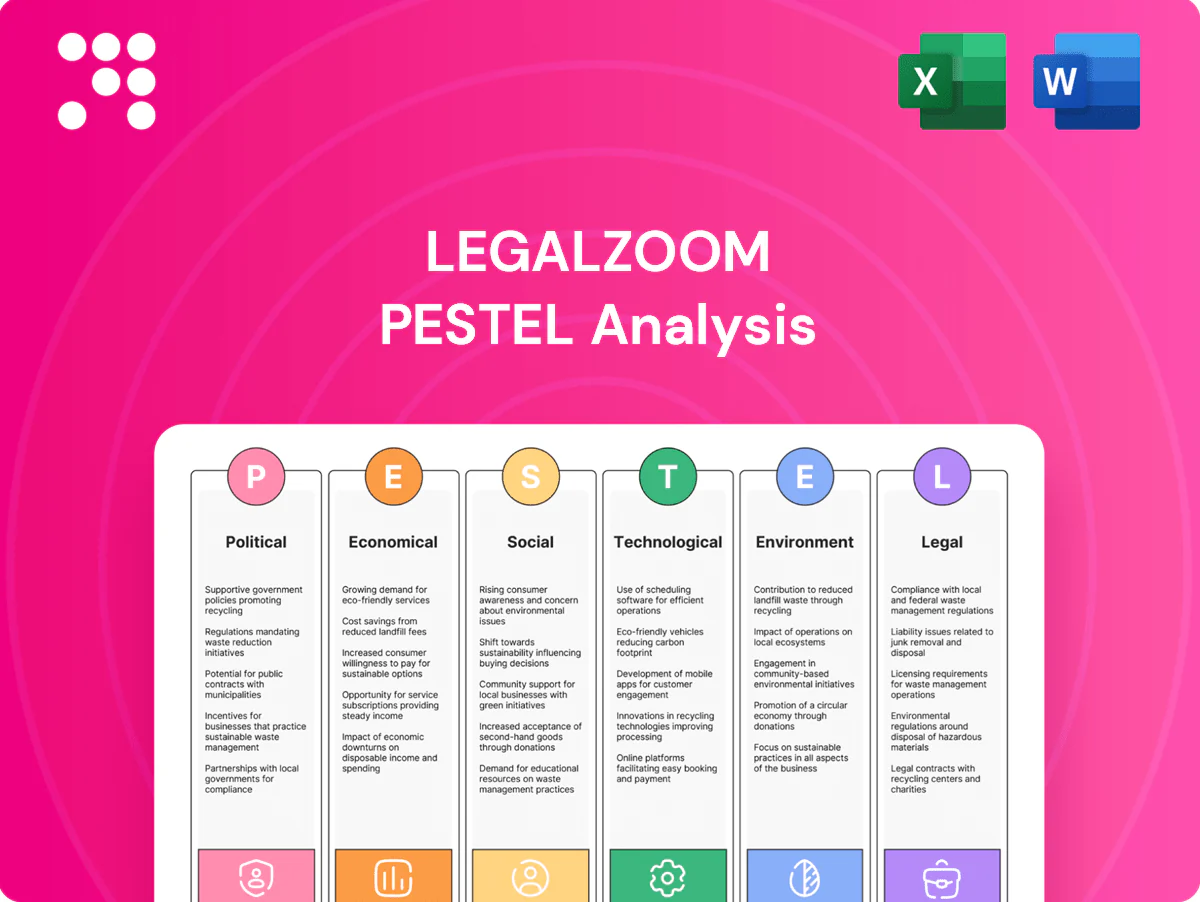
LegalZoom PESTLE Analysis

Make Smarter Strategic Decisions with a Complete PESTEL View
Discover how political, economic, social, technological, legal, and environmental forces are reshaping LegalZoom’s prospects with our concise PESTLE snapshot. Ideal for investors and strategists, it highlights risks and growth levers you can act on today. Purchase the full PESTLE for the complete, actionable analysis and ready-to-use charts.
Political factors

State-by-state regulation of legal services
LegalZoom operates across 50 states and the District of Columbia, serving millions of customers and spanning 51 regulatory jurisdictions. Variability in state bar positions—with several states issuing restrictive opinions on nonlawyer legal service delivery—can expand or constrain product scope and revenue streams. Continuous monitoring of shifting state policies and coordinated government relations are critical to maintain compliance and preempt adverse rulings.
Small business and entrepreneurship policy
Pro-business agendas that simplify formation and reduce fees bolster demand for LegalZoom services, particularly in the US where there are roughly 33.2 million small businesses.
Expanded grants, tax credits and procurement access can spur startup creation—new business applications reached about 5.4 million in 2023—driving higher demand for entity formation and compliance tools.
Policy headwinds that increase compliance burdens elevate need for affordable legal help, while changes in SBA programs materially shift application volumes and LegalZoom’s product mix.

Data localization and digital governance
As of 2024 over 60 countries maintain some form of data localization, forcing LegalZoom to weigh local data centers versus centralized U.S. infrastructure. Cross-border transfer limits after Schrems II and evolving EU digital rules add operational complexity and latency. Government cloud-sovereignty stances drive vendor selection toward regionally certified providers. Compliance can raise IT and operating costs by double-digit percentages (10–20%), pressuring pricing and margins.

Healthcare, labor, and benefits initiatives
Healthcare, labor, and benefits mandates in 2024 drive demand for HR and compliance documents as employers update policies; shifts in benefits or worker classification (e.g., gig status) increase one-off and recurring documentation needs, pushing small employers toward cost-effective LegalZoom-style solutions. Regulatory volatility raises subscription stickiness during transitions; about 33 million U.S. small businesses (SBA est.) create a large addressable market.
- Demand: employer mandates → more HR/docs
- Impact: classification/policy changes raise doc volume
- Customer: small employers seek low-cost legal support
- Retention: regulatory volatility increases subscription stickiness
Judicial and administrative backlogs
Judicial and USPTO resource constraints lengthen processing: USPTO first-action pendency is roughly 14 months and total pendency about 24 months (2024), while federal civil dockets showed a ~20% rise in pending cases vs 2019, exceeding 450,000 filings in 2024. Political funding choices for courts and USPTO can materially speed or slow IP and business filings, raising customer support volume and costs when timelines stretch; predictable throughput improves satisfaction and retention.
- USPTO pendency: first-action ~14 months; total ~24 months (2024)
- Federal backlog: ~450,000 pending cases (2024), +20% vs 2019
- Longer timelines = higher support burden and churn risk
- Stable funding → predictable throughput → better retention
Regulatory patchwork and data rules raise costs, reshaping business formation services
LegalZoom faces divergent state bar rules across 51 jurisdictions that can expand or restrict nonlawyer services, affecting revenue. Pro-business reforms and ~33.2M US small businesses plus 5.4M new business applications in 2023 drive demand for formation and compliance products. Data localization (60+ countries) and post‑Schrems II transfer limits raise IT costs ~10–20% and operational complexity; USPTO pendency (~14/24 months) lengthens customer timelines.
| Metric | Value |
|---|---|
| Jurisdictions | 51 |
| US small businesses | 33.2M |
| New business apps (2023) | 5.4M |
| USPTO pendency | First ~14m / Total ~24m (2024) |
| Data localization | 60+ countries |
| IT/ops cost uplift | ~10–20% |
What is included in the product
 Detailed Word Document
Explores how Political, Economic, Social, Technological, Environmental and Legal factors uniquely affect LegalZoom, with data-backed insights and trend analysis to identify risks and opportunities; designed for executives, investors and advisors and includes forward-looking implications for strategy and scenario planning.

 Customizable Excel Spreadsheet
Condenses the LegalZoom PESTLE into a clear, shareable summary that can be dropped into presentations, annotated with region- or practice-specific notes, and used to quickly align teams on regulatory, technological, and market risks during planning sessions.
Economic factors

New business formation cycles
U.S. business applications surged to roughly 5 million during the 2020–2021 boom and stayed above pre‑pandemic averages through 2023, according to Census Business Formation Statistics, so company formations rise with confidence and liquidity. Economic downturns compress new filings but increase restructuring and service needs, shifting demand toward amendments, dissolutions and bankruptcy support. LegalZoom’s formation volumes closely track these entrepreneurship trends—its SEC filings show formation services remain a core volume driver. Diversification into trademarks, tax and advisory products has moderated revenue cyclicality for LegalZoom in 2023–2024.
Interest rates and capital access
Higher interest rates—Federal funds near 5.25–5.50% in mid‑2025—dampen startup activity and expansions, reducing demand for formation and transaction documents. Tighter credit delays legal spending and IP filings as firms conserve cash. When rates fall, entity formation and fundraising legal work rebounds. Pricing sensitivity intensifies when capital is scarce, pressuring LegalZoom margins.

Inflation and cost structure
Rising inflation (US CPI 2024: 3.4%) pushes LegalZoom's wage base, cloud and marketing costs higher, while global public cloud spend topped about $600B in 2023, lifting vendor bills. Passing price increases risks churn in a largely price-sensitive small-business segment (small firms = 99.9% of US businesses). Process automation and RPA (often cutting processing costs up to ~30%) can offset margin pressure. Value bundles help defend ARPU by boosting perceived ROI.

Labor market dynamics
Rising gig work and freelancing (Upwork reported 36% of US workforce freelanced in 2023) drives higher demand for sole-proprietor and LLC filings; 2024 unemployment near 3.7% has pushed side-hustles toward formal legal setups. Tight labor markets with roughly 8.8M job openings (JOLTS mid-2024) increase demand for HR compliance services, while an attorney pool of ~1.36M (ABA 2023) influences marketplace pricing and margins.
- Gig growth: +36% freelance penetration (2023)
- Unemployment 2024: ~3.7% → more legal entity formations
- Job openings: ~8.8M (JOLTS mid-2024) → HR compliance demand
- Attorney supply: ~1.36M (ABA 2023) → pricing pressure
Customer acquisition economics
Digital ad auctions drive CAC volatility — Google Ads CPC rose about 10% YoY in 2024, increasing paid acquisition costs for legal-tech platforms. Strong brand and referrals cut paid reliance; LegalZoom reported roughly 25% of inbound leads from organic/referral channels in 2024 filings. LTV rises as cross-sell into subscriptions and IP services pushes average customer lifetime value up ~35% versus single-service buyers, while cohort retention rates determine whether unit economics scale.
- CAC volatility: Google Ads CPC +10% (2024)
- Referral share: ~25% of leads (LegalZoom 2024)
- LTV uplift: +35% with cross-sell
- Cohort retention: key to sustainable unit economics
Regulatory patchwork and data rules raise costs, reshaping business formation services
Economic cycles drive formation volumes and demand mix—5M business applications (2020–21) and elevated 2021–2023 levels; high rates (FFR ~5.25–5.50% mid‑2025) suppress startups and tighten pricing; inflation (CPI 2024: 3.4%) raises costs while automation and cross‑sell lift LTV ~35% vs single purchases.
| Metric | Value |
|---|---|
| Business apps peak | ~5M (2020–21) |
| Fed funds | 5.25–5.50% (mid‑2025) |
| CPI 2024 | 3.4% |
| LTV uplift | +35% |
Full Version Awaits
LegalZoom PESTLE Analysis
The preview shown here is the exact LegalZoom PESTLE Analysis you’ll receive after purchase—fully formatted and ready to use. This is the real, finished document with no placeholders or teasers. After checkout you’ll instantly download the same file displayed here. The layout, content, and structure are delivered exactly as seen.

Make Smarter Strategic Decisions with a Complete PESTEL View
Discover how political, economic, social, technological, legal, and environmental forces are reshaping LegalZoom’s prospects with our concise PESTLE snapshot. Ideal for investors and strategists, it highlights risks and growth levers you can act on today. Purchase the full PESTLE for the complete, actionable analysis and ready-to-use charts.
Political factors
State-by-state regulation of legal services
LegalZoom operates across 50 states and the District of Columbia, serving millions of customers and spanning 51 regulatory jurisdictions. Variability in state bar positions—with several states issuing restrictive opinions on nonlawyer legal service delivery—can expand or constrain product scope and revenue streams. Continuous monitoring of shifting state policies and coordinated government relations are critical to maintain compliance and preempt adverse rulings.
Small business and entrepreneurship policy
Pro-business agendas that simplify formation and reduce fees bolster demand for LegalZoom services, particularly in the US where there are roughly 33.2 million small businesses.
Expanded grants, tax credits and procurement access can spur startup creation—new business applications reached about 5.4 million in 2023—driving higher demand for entity formation and compliance tools.
Policy headwinds that increase compliance burdens elevate need for affordable legal help, while changes in SBA programs materially shift application volumes and LegalZoom’s product mix.
Data localization and digital governance
As of 2024 over 60 countries maintain some form of data localization, forcing LegalZoom to weigh local data centers versus centralized U.S. infrastructure. Cross-border transfer limits after Schrems II and evolving EU digital rules add operational complexity and latency. Government cloud-sovereignty stances drive vendor selection toward regionally certified providers. Compliance can raise IT and operating costs by double-digit percentages (10–20%), pressuring pricing and margins.
Healthcare, labor, and benefits initiatives
Healthcare, labor, and benefits mandates in 2024 drive demand for HR and compliance documents as employers update policies; shifts in benefits or worker classification (e.g., gig status) increase one-off and recurring documentation needs, pushing small employers toward cost-effective LegalZoom-style solutions. Regulatory volatility raises subscription stickiness during transitions; about 33 million U.S. small businesses (SBA est.) create a large addressable market.
- Demand: employer mandates → more HR/docs
- Impact: classification/policy changes raise doc volume
- Customer: small employers seek low-cost legal support
- Retention: regulatory volatility increases subscription stickiness
Judicial and administrative backlogs
Judicial and USPTO resource constraints lengthen processing: USPTO first-action pendency is roughly 14 months and total pendency about 24 months (2024), while federal civil dockets showed a ~20% rise in pending cases vs 2019, exceeding 450,000 filings in 2024. Political funding choices for courts and USPTO can materially speed or slow IP and business filings, raising customer support volume and costs when timelines stretch; predictable throughput improves satisfaction and retention.
- USPTO pendency: first-action ~14 months; total ~24 months (2024)
- Federal backlog: ~450,000 pending cases (2024), +20% vs 2019
- Longer timelines = higher support burden and churn risk
- Stable funding → predictable throughput → better retention
Regulatory patchwork and data rules raise costs, reshaping business formation services
LegalZoom faces divergent state bar rules across 51 jurisdictions that can expand or restrict nonlawyer services, affecting revenue. Pro-business reforms and ~33.2M US small businesses plus 5.4M new business applications in 2023 drive demand for formation and compliance products. Data localization (60+ countries) and post‑Schrems II transfer limits raise IT costs ~10–20% and operational complexity; USPTO pendency (~14/24 months) lengthens customer timelines.
| Metric | Value |
|---|---|
| Jurisdictions | 51 |
| US small businesses | 33.2M |
| New business apps (2023) | 5.4M |
| USPTO pendency | First ~14m / Total ~24m (2024) |
| Data localization | 60+ countries |
| IT/ops cost uplift | ~10–20% |
What is included in the product
Detailed Word Document
Explores how Political, Economic, Social, Technological, Environmental and Legal factors uniquely affect LegalZoom, with data-backed insights and trend analysis to identify risks and opportunities; designed for executives, investors and advisors and includes forward-looking implications for strategy and scenario planning.
Customizable Excel Spreadsheet
Condenses the LegalZoom PESTLE into a clear, shareable summary that can be dropped into presentations, annotated with region- or practice-specific notes, and used to quickly align teams on regulatory, technological, and market risks during planning sessions.
Economic factors
New business formation cycles
U.S. business applications surged to roughly 5 million during the 2020–2021 boom and stayed above pre‑pandemic averages through 2023, according to Census Business Formation Statistics, so company formations rise with confidence and liquidity. Economic downturns compress new filings but increase restructuring and service needs, shifting demand toward amendments, dissolutions and bankruptcy support. LegalZoom’s formation volumes closely track these entrepreneurship trends—its SEC filings show formation services remain a core volume driver. Diversification into trademarks, tax and advisory products has moderated revenue cyclicality for LegalZoom in 2023–2024.
Interest rates and capital access
Higher interest rates—Federal funds near 5.25–5.50% in mid‑2025—dampen startup activity and expansions, reducing demand for formation and transaction documents. Tighter credit delays legal spending and IP filings as firms conserve cash. When rates fall, entity formation and fundraising legal work rebounds. Pricing sensitivity intensifies when capital is scarce, pressuring LegalZoom margins.
Inflation and cost structure
Rising inflation (US CPI 2024: 3.4%) pushes LegalZoom's wage base, cloud and marketing costs higher, while global public cloud spend topped about $600B in 2023, lifting vendor bills. Passing price increases risks churn in a largely price-sensitive small-business segment (small firms = 99.9% of US businesses). Process automation and RPA (often cutting processing costs up to ~30%) can offset margin pressure. Value bundles help defend ARPU by boosting perceived ROI.
Labor market dynamics
Rising gig work and freelancing (Upwork reported 36% of US workforce freelanced in 2023) drives higher demand for sole-proprietor and LLC filings; 2024 unemployment near 3.7% has pushed side-hustles toward formal legal setups. Tight labor markets with roughly 8.8M job openings (JOLTS mid-2024) increase demand for HR compliance services, while an attorney pool of ~1.36M (ABA 2023) influences marketplace pricing and margins.
- Gig growth: +36% freelance penetration (2023)
- Unemployment 2024: ~3.7% → more legal entity formations
- Job openings: ~8.8M (JOLTS mid-2024) → HR compliance demand
- Attorney supply: ~1.36M (ABA 2023) → pricing pressure
Customer acquisition economics
Digital ad auctions drive CAC volatility — Google Ads CPC rose about 10% YoY in 2024, increasing paid acquisition costs for legal-tech platforms. Strong brand and referrals cut paid reliance; LegalZoom reported roughly 25% of inbound leads from organic/referral channels in 2024 filings. LTV rises as cross-sell into subscriptions and IP services pushes average customer lifetime value up ~35% versus single-service buyers, while cohort retention rates determine whether unit economics scale.
- CAC volatility: Google Ads CPC +10% (2024)
- Referral share: ~25% of leads (LegalZoom 2024)
- LTV uplift: +35% with cross-sell
- Cohort retention: key to sustainable unit economics
Regulatory patchwork and data rules raise costs, reshaping business formation services
Economic cycles drive formation volumes and demand mix—5M business applications (2020–21) and elevated 2021–2023 levels; high rates (FFR ~5.25–5.50% mid‑2025) suppress startups and tighten pricing; inflation (CPI 2024: 3.4%) raises costs while automation and cross‑sell lift LTV ~35% vs single purchases.
| Metric | Value |
|---|---|
| Business apps peak | ~5M (2020–21) |
| Fed funds | 5.25–5.50% (mid‑2025) |
| CPI 2024 | 3.4% |
| LTV uplift | +35% |
Full Version Awaits
LegalZoom PESTLE Analysis
The preview shown here is the exact LegalZoom PESTLE Analysis you’ll receive after purchase—fully formatted and ready to use. This is the real, finished document with no placeholders or teasers. After checkout you’ll instantly download the same file displayed here. The layout, content, and structure are delivered exactly as seen.
Description
Make Smarter Strategic Decisions with a Complete PESTEL View
Discover how political, economic, social, technological, legal, and environmental forces are reshaping LegalZoom’s prospects with our concise PESTLE snapshot. Ideal for investors and strategists, it highlights risks and growth levers you can act on today. Purchase the full PESTLE for the complete, actionable analysis and ready-to-use charts.
Political factors
State-by-state regulation of legal services
LegalZoom operates across 50 states and the District of Columbia, serving millions of customers and spanning 51 regulatory jurisdictions. Variability in state bar positions—with several states issuing restrictive opinions on nonlawyer legal service delivery—can expand or constrain product scope and revenue streams. Continuous monitoring of shifting state policies and coordinated government relations are critical to maintain compliance and preempt adverse rulings.
Small business and entrepreneurship policy
Pro-business agendas that simplify formation and reduce fees bolster demand for LegalZoom services, particularly in the US where there are roughly 33.2 million small businesses.
Expanded grants, tax credits and procurement access can spur startup creation—new business applications reached about 5.4 million in 2023—driving higher demand for entity formation and compliance tools.
Policy headwinds that increase compliance burdens elevate need for affordable legal help, while changes in SBA programs materially shift application volumes and LegalZoom’s product mix.
Data localization and digital governance
As of 2024 over 60 countries maintain some form of data localization, forcing LegalZoom to weigh local data centers versus centralized U.S. infrastructure. Cross-border transfer limits after Schrems II and evolving EU digital rules add operational complexity and latency. Government cloud-sovereignty stances drive vendor selection toward regionally certified providers. Compliance can raise IT and operating costs by double-digit percentages (10–20%), pressuring pricing and margins.
Healthcare, labor, and benefits initiatives
Healthcare, labor, and benefits mandates in 2024 drive demand for HR and compliance documents as employers update policies; shifts in benefits or worker classification (e.g., gig status) increase one-off and recurring documentation needs, pushing small employers toward cost-effective LegalZoom-style solutions. Regulatory volatility raises subscription stickiness during transitions; about 33 million U.S. small businesses (SBA est.) create a large addressable market.
- Demand: employer mandates → more HR/docs
- Impact: classification/policy changes raise doc volume
- Customer: small employers seek low-cost legal support
- Retention: regulatory volatility increases subscription stickiness
Judicial and administrative backlogs
Judicial and USPTO resource constraints lengthen processing: USPTO first-action pendency is roughly 14 months and total pendency about 24 months (2024), while federal civil dockets showed a ~20% rise in pending cases vs 2019, exceeding 450,000 filings in 2024. Political funding choices for courts and USPTO can materially speed or slow IP and business filings, raising customer support volume and costs when timelines stretch; predictable throughput improves satisfaction and retention.
- USPTO pendency: first-action ~14 months; total ~24 months (2024)
- Federal backlog: ~450,000 pending cases (2024), +20% vs 2019
- Longer timelines = higher support burden and churn risk
- Stable funding → predictable throughput → better retention
Regulatory patchwork and data rules raise costs, reshaping business formation services
LegalZoom faces divergent state bar rules across 51 jurisdictions that can expand or restrict nonlawyer services, affecting revenue. Pro-business reforms and ~33.2M US small businesses plus 5.4M new business applications in 2023 drive demand for formation and compliance products. Data localization (60+ countries) and post‑Schrems II transfer limits raise IT costs ~10–20% and operational complexity; USPTO pendency (~14/24 months) lengthens customer timelines.
| Metric | Value |
|---|---|
| Jurisdictions | 51 |
| US small businesses | 33.2M |
| New business apps (2023) | 5.4M |
| USPTO pendency | First ~14m / Total ~24m (2024) |
| Data localization | 60+ countries |
| IT/ops cost uplift | ~10–20% |
What is included in the product
Detailed Word Document
Explores how Political, Economic, Social, Technological, Environmental and Legal factors uniquely affect LegalZoom, with data-backed insights and trend analysis to identify risks and opportunities; designed for executives, investors and advisors and includes forward-looking implications for strategy and scenario planning.
Customizable Excel Spreadsheet
Condenses the LegalZoom PESTLE into a clear, shareable summary that can be dropped into presentations, annotated with region- or practice-specific notes, and used to quickly align teams on regulatory, technological, and market risks during planning sessions.
Economic factors
New business formation cycles
U.S. business applications surged to roughly 5 million during the 2020–2021 boom and stayed above pre‑pandemic averages through 2023, according to Census Business Formation Statistics, so company formations rise with confidence and liquidity. Economic downturns compress new filings but increase restructuring and service needs, shifting demand toward amendments, dissolutions and bankruptcy support. LegalZoom’s formation volumes closely track these entrepreneurship trends—its SEC filings show formation services remain a core volume driver. Diversification into trademarks, tax and advisory products has moderated revenue cyclicality for LegalZoom in 2023–2024.
Interest rates and capital access
Higher interest rates—Federal funds near 5.25–5.50% in mid‑2025—dampen startup activity and expansions, reducing demand for formation and transaction documents. Tighter credit delays legal spending and IP filings as firms conserve cash. When rates fall, entity formation and fundraising legal work rebounds. Pricing sensitivity intensifies when capital is scarce, pressuring LegalZoom margins.
Inflation and cost structure
Rising inflation (US CPI 2024: 3.4%) pushes LegalZoom's wage base, cloud and marketing costs higher, while global public cloud spend topped about $600B in 2023, lifting vendor bills. Passing price increases risks churn in a largely price-sensitive small-business segment (small firms = 99.9% of US businesses). Process automation and RPA (often cutting processing costs up to ~30%) can offset margin pressure. Value bundles help defend ARPU by boosting perceived ROI.
Labor market dynamics
Rising gig work and freelancing (Upwork reported 36% of US workforce freelanced in 2023) drives higher demand for sole-proprietor and LLC filings; 2024 unemployment near 3.7% has pushed side-hustles toward formal legal setups. Tight labor markets with roughly 8.8M job openings (JOLTS mid-2024) increase demand for HR compliance services, while an attorney pool of ~1.36M (ABA 2023) influences marketplace pricing and margins.
- Gig growth: +36% freelance penetration (2023)
- Unemployment 2024: ~3.7% → more legal entity formations
- Job openings: ~8.8M (JOLTS mid-2024) → HR compliance demand
- Attorney supply: ~1.36M (ABA 2023) → pricing pressure
Customer acquisition economics
Digital ad auctions drive CAC volatility — Google Ads CPC rose about 10% YoY in 2024, increasing paid acquisition costs for legal-tech platforms. Strong brand and referrals cut paid reliance; LegalZoom reported roughly 25% of inbound leads from organic/referral channels in 2024 filings. LTV rises as cross-sell into subscriptions and IP services pushes average customer lifetime value up ~35% versus single-service buyers, while cohort retention rates determine whether unit economics scale.
- CAC volatility: Google Ads CPC +10% (2024)
- Referral share: ~25% of leads (LegalZoom 2024)
- LTV uplift: +35% with cross-sell
- Cohort retention: key to sustainable unit economics
Regulatory patchwork and data rules raise costs, reshaping business formation services
Economic cycles drive formation volumes and demand mix—5M business applications (2020–21) and elevated 2021–2023 levels; high rates (FFR ~5.25–5.50% mid‑2025) suppress startups and tighten pricing; inflation (CPI 2024: 3.4%) raises costs while automation and cross‑sell lift LTV ~35% vs single purchases.
| Metric | Value |
|---|---|
| Business apps peak | ~5M (2020–21) |
| Fed funds | 5.25–5.50% (mid‑2025) |
| CPI 2024 | 3.4% |
| LTV uplift | +35% |
Full Version Awaits
LegalZoom PESTLE Analysis
The preview shown here is the exact LegalZoom PESTLE Analysis you’ll receive after purchase—fully formatted and ready to use. This is the real, finished document with no placeholders or teasers. After checkout you’ll instantly download the same file displayed here. The layout, content, and structure are delivered exactly as seen.











