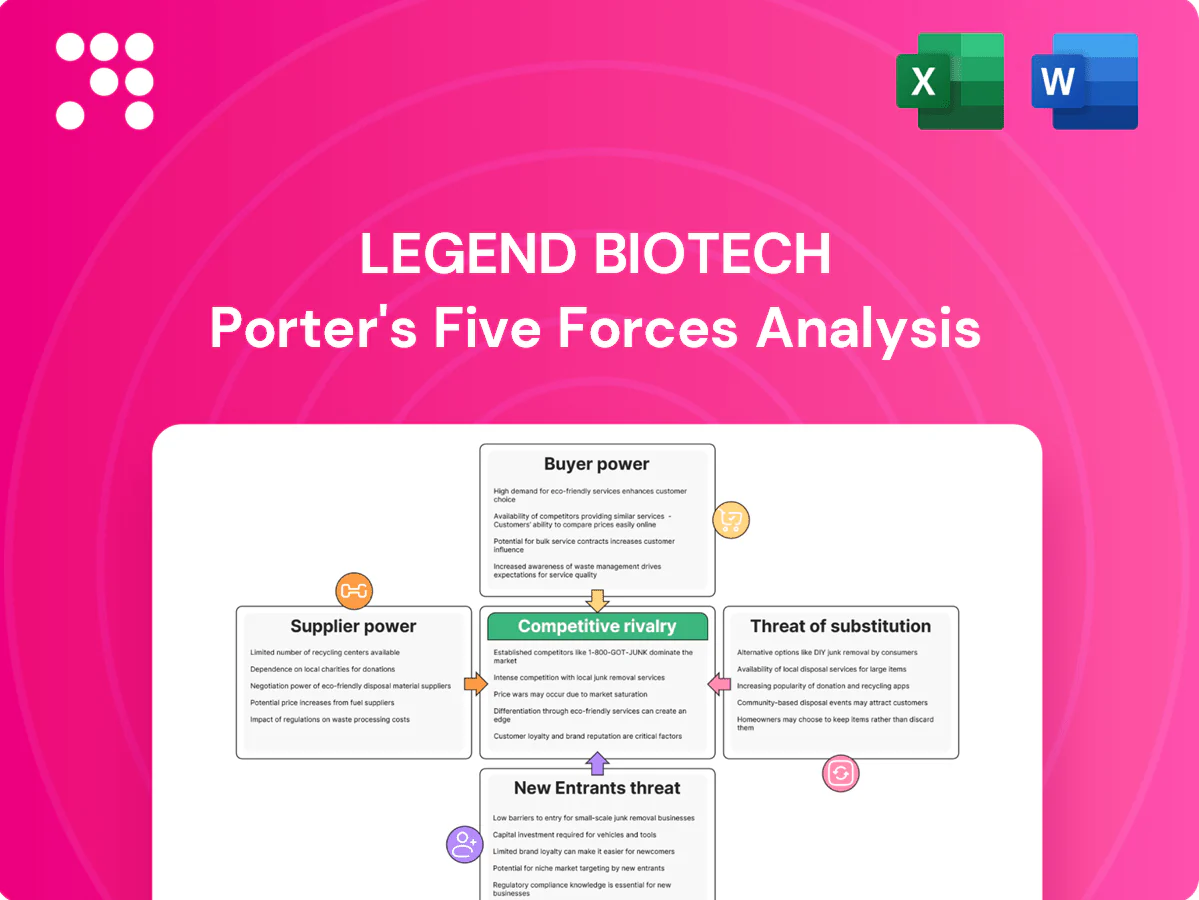
Legend Biotech Porter's Five Forces Analysis

Elevate Your Analysis with the Complete Porter's Five Forces Analysis
Legend Biotech faces intense competitive dynamics driven by high R&D costs, selective supplier relationships, and significant regulatory and substitute threats; buyer power is moderate given specialty therapy demand. This snapshot highlights key pressures but omits force-by-force ratings and strategic implications. Unlock the full Porter's Five Forces Analysis to access detailed ratings, visuals, and actionable recommendations tailored to Legend Biotech.
Suppliers Bargaining Power

Concentrated critical inputs
High-grade viral vectors, plasmids and clinical-grade cytokines for Legend Biotech come from a limited number of qualified GMP suppliers, creating a concentrated input base. Capacity constraints and lead times commonly extend 6+ months in 2024, raising switching costs and inventory needs. Any supplier disruption can bottleneck clinical and commercial supply chains. This concentration gives suppliers clear leverage over price and contract terms.
Specialized equipment reliance
Legend Biotech relies on closed-system bioreactors, cell processors and single-use kits that in 2024 comprised roughly 60% of bioprocessing disposables, many single-sourced. Vendor swaps carry heavy validation burdens—commonly 6–12 months with industry validation costs cited between $0.5–2M. Suppliers thus dictate upgrade cycles and service pricing (service contracts often 10–20% of equipment cost annually), and downtime (24–72 hours) can cut throughput and yields by 5–15%.

GMP logistics and cryochain
Cryogenic shippers, validated couriers and chain-of-identity systems are niche and scarce, with the global pharmaceutical cold‑chain market estimated at about $230 billion in 2024, concentrating pricing power. Regulatory (FDA/EMA) validation requirements limit alternative providers, allowing premium pricing and priority allocation to suppliers. Supplier failure elevates batch‑loss risk and regulatory exposure, potentially costing sponsors millions per lost cell therapy batch.

Leukapheresis site access
Leukapheresis site access is a strong supplier force for Legend Biotech: hospital apheresis centers are capacity constrained and unevenly distributed, creating regional bottlenecks that lengthen patient turnaround and complicate scheduling windows; centers impose stringent operational requirements and preferred-site agreements often include higher per-procedure fees and volume commitments in 2024.
- Capacity-constrained centers
- Uneven geographic distribution
- Scheduling/slot competition
- Stringent operational requirements
- Preferred-site fees and commitments
Talent and know-how scarcity
Experienced cell therapy CMC and QC personnel remain scarce; 2024 industry surveys report over 60% of developers face hiring gaps, forcing Legend Biotech to pay 15–25% higher salaries and benefits to retain experts. Reliance on external consultants and specialized CDMOs commands premiums often 30–50% above standard biologics rates, raising operating costs and dependency; knowledge leakage concerns increase need for tightly vetted partners.
- Shortage: >60% firms report hiring gaps (2024)
- Retention cost: +15–25% OPEX
- CDMO premium: +30–50%
- Raises dependency, IP leakage risk
Supply squeeze: 6+ month lead times, $230B cold-chain, labor/CDMO +15–50%
Suppliers hold strong leverage: GMP vectors, disposables and cold‑chain providers are concentrated with 6+ month lead times and premium pricing; equipment validation costs $0.5–2M and vendor swaps take 6–12 months. Cryogenic/logistics market ~$230B (2024) concentrates pricing power. Skilled CMC/QC scarcity raises labor costs 15–25% and CDMO premiums 30–50%.
| Input | 2024 metric | Impact |
|---|---|---|
| Vectors/disposables | 6+ month lead | High switching cost |
| Cold‑chain | $230B market | Premium pricing |
| Labor/CDMO | +15–50% cost | Higher OPEX |
What is included in the product
 Detailed Word Document
Tailored Porter's Five Forces analysis for Legend Biotech that uncovers key competitive drivers, customer and supplier power, entry barriers, substitutes, and rivalry; identifies disruptive threats and strategic levers to protect market share and support investor or management decision-making.

 Customizable Excel Spreadsheet
A clear, one-sheet Porter's Five Forces for Legend Biotech—condenses competitive, supplier, buyer, substitute and entry pressures into a biotech-focused snapshot for fast, boardroom-ready decisions.
Customers Bargaining Power

Payers demand value
Payers scrutinize outcomes and cost offsets for high-cost cell therapies, with CAR-T one-time prices typically above $400,000 and Carvykti listed near $465,000 in the US. High upfront prices drive utilization management and greater use of outcomes-based and risk-sharing contracts. Health technology assessments can delay or restrict access, and buyers demand evidence of durability and real-world benefit.
Provider concentration
Treatment with Legend Biotech/Janssen CAR-T is concentrated at roughly 200 accredited centers globally in 2024, which aggregate patient volume and leverage this scale to negotiate service, scheduling and care-coordination fees. Those centers’ bed, staffing and OR constraints directly influence slot allocation and time-to-infusion, commonly driving vein-to-vein windows of several weeks. Increasing standardization demands tighter manufacturing controls and faster turnaround, pressuring margins and capacity planning.

Patient-specific product
Autologous, patient-specific therapies like cilta-cel are effectively non-substitutable at the individual patient level, reducing switching; CARTITUDE-1 reported an ORR of about 97%, underscoring clinical uniqueness. Payers and limited certified treatment sites, however, can steer patient access via coverage and referral policies. Urgent, time-sensitive disease status raises demand intensity but does not automatically translate into pricing power. Buyers still leverage alternative regimens by line of therapy.

Information transparency
Clinical outcomes from REMS and registry data increasingly drive comparative choices for cilta-cel; competing labels enable cross-product benchmarking, while buyers monitor manufacturing reliability and out-of-spec rates—list prices around 465,000 per infusion in 2024 amplify formulary leverage when outcomes and OOS metrics are transparent.
- REMS and registries inform comparative efficacy/safety
- Labels enable cross-product benchmarking
- Buyers track manufacturing OOS rates and uptime
- Transparent data strengthens formulary negotiations
Budget impact constraints
One-time, high-cost CAR-T therapies like those from Legend Biotech create outsized budget impact—US list prices for advanced cell therapies averaged roughly $400,000–$500,000 in 2024, stressing annual hospital and payer budgets despite significant lifetime value. Buyers increasingly demand installment, outcomes- or risk-sharing contracts and use prior authorization and step-therapy rules to limit volume and extract concessions.
- Price range: $400k–$500k (2024 industry avg)
- Installment/outcomes contracts: adoption ~30–40% of deals (2024)
- Prior auth/step therapy: common tools to restrict uptake
Payers wield leverage: US list $465,000, outcomes deals and prior auth curtail access
Payers exert strong leverage: US list price for cilta-cel ~465,000 in 2024 drives utilization management and outcomes/risk-share deals (adoption ~30–40%). Treatment centralized at ~200 accredited centers concentrates negotiating power over scheduling and fees. High ORR (~97% in CARTITUDE-1) limits clinical substitutes but buyers use prior auth, HTA and real-world durability data to constrain access.
| Metric | 2024 |
|---|---|
| List price (US) | $465,000 |
| Accredited centers | ~200 |
| Outcomes/risk-share deal adoption | 30–40% |
| ORR (CARTITUDE-1) | ~97% |
What You See Is What You Get
Legend Biotech Porter's Five Forces Analysis
This preview shows the exact Legend Biotech Porter’s Five Forces analysis you'll receive immediately after purchase—fully formatted and ready to use. It provides a professional assessment of supplier power, buyer power, competitive rivalry, threat of substitutes, and barriers to entry with actionable insights. No samples or placeholders; what you see is the final deliverable available for instant download upon payment.

Elevate Your Analysis with the Complete Porter's Five Forces Analysis
Legend Biotech faces intense competitive dynamics driven by high R&D costs, selective supplier relationships, and significant regulatory and substitute threats; buyer power is moderate given specialty therapy demand. This snapshot highlights key pressures but omits force-by-force ratings and strategic implications. Unlock the full Porter's Five Forces Analysis to access detailed ratings, visuals, and actionable recommendations tailored to Legend Biotech.
Suppliers Bargaining Power
Concentrated critical inputs
High-grade viral vectors, plasmids and clinical-grade cytokines for Legend Biotech come from a limited number of qualified GMP suppliers, creating a concentrated input base. Capacity constraints and lead times commonly extend 6+ months in 2024, raising switching costs and inventory needs. Any supplier disruption can bottleneck clinical and commercial supply chains. This concentration gives suppliers clear leverage over price and contract terms.
Specialized equipment reliance
Legend Biotech relies on closed-system bioreactors, cell processors and single-use kits that in 2024 comprised roughly 60% of bioprocessing disposables, many single-sourced. Vendor swaps carry heavy validation burdens—commonly 6–12 months with industry validation costs cited between $0.5–2M. Suppliers thus dictate upgrade cycles and service pricing (service contracts often 10–20% of equipment cost annually), and downtime (24–72 hours) can cut throughput and yields by 5–15%.
GMP logistics and cryochain
Cryogenic shippers, validated couriers and chain-of-identity systems are niche and scarce, with the global pharmaceutical cold‑chain market estimated at about $230 billion in 2024, concentrating pricing power. Regulatory (FDA/EMA) validation requirements limit alternative providers, allowing premium pricing and priority allocation to suppliers. Supplier failure elevates batch‑loss risk and regulatory exposure, potentially costing sponsors millions per lost cell therapy batch.
Leukapheresis site access
Leukapheresis site access is a strong supplier force for Legend Biotech: hospital apheresis centers are capacity constrained and unevenly distributed, creating regional bottlenecks that lengthen patient turnaround and complicate scheduling windows; centers impose stringent operational requirements and preferred-site agreements often include higher per-procedure fees and volume commitments in 2024.
- Capacity-constrained centers
- Uneven geographic distribution
- Scheduling/slot competition
- Stringent operational requirements
- Preferred-site fees and commitments
Talent and know-how scarcity
Experienced cell therapy CMC and QC personnel remain scarce; 2024 industry surveys report over 60% of developers face hiring gaps, forcing Legend Biotech to pay 15–25% higher salaries and benefits to retain experts. Reliance on external consultants and specialized CDMOs commands premiums often 30–50% above standard biologics rates, raising operating costs and dependency; knowledge leakage concerns increase need for tightly vetted partners.
- Shortage: >60% firms report hiring gaps (2024)
- Retention cost: +15–25% OPEX
- CDMO premium: +30–50%
- Raises dependency, IP leakage risk
Supply squeeze: 6+ month lead times, $230B cold-chain, labor/CDMO +15–50%
Suppliers hold strong leverage: GMP vectors, disposables and cold‑chain providers are concentrated with 6+ month lead times and premium pricing; equipment validation costs $0.5–2M and vendor swaps take 6–12 months. Cryogenic/logistics market ~$230B (2024) concentrates pricing power. Skilled CMC/QC scarcity raises labor costs 15–25% and CDMO premiums 30–50%.
| Input | 2024 metric | Impact |
|---|---|---|
| Vectors/disposables | 6+ month lead | High switching cost |
| Cold‑chain | $230B market | Premium pricing |
| Labor/CDMO | +15–50% cost | Higher OPEX |
What is included in the product
Detailed Word Document
Tailored Porter's Five Forces analysis for Legend Biotech that uncovers key competitive drivers, customer and supplier power, entry barriers, substitutes, and rivalry; identifies disruptive threats and strategic levers to protect market share and support investor or management decision-making.
Customizable Excel Spreadsheet
A clear, one-sheet Porter's Five Forces for Legend Biotech—condenses competitive, supplier, buyer, substitute and entry pressures into a biotech-focused snapshot for fast, boardroom-ready decisions.
Customers Bargaining Power
Payers demand value
Payers scrutinize outcomes and cost offsets for high-cost cell therapies, with CAR-T one-time prices typically above $400,000 and Carvykti listed near $465,000 in the US. High upfront prices drive utilization management and greater use of outcomes-based and risk-sharing contracts. Health technology assessments can delay or restrict access, and buyers demand evidence of durability and real-world benefit.
Provider concentration
Treatment with Legend Biotech/Janssen CAR-T is concentrated at roughly 200 accredited centers globally in 2024, which aggregate patient volume and leverage this scale to negotiate service, scheduling and care-coordination fees. Those centers’ bed, staffing and OR constraints directly influence slot allocation and time-to-infusion, commonly driving vein-to-vein windows of several weeks. Increasing standardization demands tighter manufacturing controls and faster turnaround, pressuring margins and capacity planning.
Patient-specific product
Autologous, patient-specific therapies like cilta-cel are effectively non-substitutable at the individual patient level, reducing switching; CARTITUDE-1 reported an ORR of about 97%, underscoring clinical uniqueness. Payers and limited certified treatment sites, however, can steer patient access via coverage and referral policies. Urgent, time-sensitive disease status raises demand intensity but does not automatically translate into pricing power. Buyers still leverage alternative regimens by line of therapy.
Information transparency
Clinical outcomes from REMS and registry data increasingly drive comparative choices for cilta-cel; competing labels enable cross-product benchmarking, while buyers monitor manufacturing reliability and out-of-spec rates—list prices around 465,000 per infusion in 2024 amplify formulary leverage when outcomes and OOS metrics are transparent.
- REMS and registries inform comparative efficacy/safety
- Labels enable cross-product benchmarking
- Buyers track manufacturing OOS rates and uptime
- Transparent data strengthens formulary negotiations
Budget impact constraints
One-time, high-cost CAR-T therapies like those from Legend Biotech create outsized budget impact—US list prices for advanced cell therapies averaged roughly $400,000–$500,000 in 2024, stressing annual hospital and payer budgets despite significant lifetime value. Buyers increasingly demand installment, outcomes- or risk-sharing contracts and use prior authorization and step-therapy rules to limit volume and extract concessions.
- Price range: $400k–$500k (2024 industry avg)
- Installment/outcomes contracts: adoption ~30–40% of deals (2024)
- Prior auth/step therapy: common tools to restrict uptake
Payers wield leverage: US list $465,000, outcomes deals and prior auth curtail access
Payers exert strong leverage: US list price for cilta-cel ~465,000 in 2024 drives utilization management and outcomes/risk-share deals (adoption ~30–40%). Treatment centralized at ~200 accredited centers concentrates negotiating power over scheduling and fees. High ORR (~97% in CARTITUDE-1) limits clinical substitutes but buyers use prior auth, HTA and real-world durability data to constrain access.
| Metric | 2024 |
|---|---|
| List price (US) | $465,000 |
| Accredited centers | ~200 |
| Outcomes/risk-share deal adoption | 30–40% |
| ORR (CARTITUDE-1) | ~97% |
What You See Is What You Get
Legend Biotech Porter's Five Forces Analysis
This preview shows the exact Legend Biotech Porter’s Five Forces analysis you'll receive immediately after purchase—fully formatted and ready to use. It provides a professional assessment of supplier power, buyer power, competitive rivalry, threat of substitutes, and barriers to entry with actionable insights. No samples or placeholders; what you see is the final deliverable available for instant download upon payment.
Description
Elevate Your Analysis with the Complete Porter's Five Forces Analysis
Legend Biotech faces intense competitive dynamics driven by high R&D costs, selective supplier relationships, and significant regulatory and substitute threats; buyer power is moderate given specialty therapy demand. This snapshot highlights key pressures but omits force-by-force ratings and strategic implications. Unlock the full Porter's Five Forces Analysis to access detailed ratings, visuals, and actionable recommendations tailored to Legend Biotech.
Suppliers Bargaining Power
Concentrated critical inputs
High-grade viral vectors, plasmids and clinical-grade cytokines for Legend Biotech come from a limited number of qualified GMP suppliers, creating a concentrated input base. Capacity constraints and lead times commonly extend 6+ months in 2024, raising switching costs and inventory needs. Any supplier disruption can bottleneck clinical and commercial supply chains. This concentration gives suppliers clear leverage over price and contract terms.
Specialized equipment reliance
Legend Biotech relies on closed-system bioreactors, cell processors and single-use kits that in 2024 comprised roughly 60% of bioprocessing disposables, many single-sourced. Vendor swaps carry heavy validation burdens—commonly 6–12 months with industry validation costs cited between $0.5–2M. Suppliers thus dictate upgrade cycles and service pricing (service contracts often 10–20% of equipment cost annually), and downtime (24–72 hours) can cut throughput and yields by 5–15%.
GMP logistics and cryochain
Cryogenic shippers, validated couriers and chain-of-identity systems are niche and scarce, with the global pharmaceutical cold‑chain market estimated at about $230 billion in 2024, concentrating pricing power. Regulatory (FDA/EMA) validation requirements limit alternative providers, allowing premium pricing and priority allocation to suppliers. Supplier failure elevates batch‑loss risk and regulatory exposure, potentially costing sponsors millions per lost cell therapy batch.
Leukapheresis site access
Leukapheresis site access is a strong supplier force for Legend Biotech: hospital apheresis centers are capacity constrained and unevenly distributed, creating regional bottlenecks that lengthen patient turnaround and complicate scheduling windows; centers impose stringent operational requirements and preferred-site agreements often include higher per-procedure fees and volume commitments in 2024.
- Capacity-constrained centers
- Uneven geographic distribution
- Scheduling/slot competition
- Stringent operational requirements
- Preferred-site fees and commitments
Talent and know-how scarcity
Experienced cell therapy CMC and QC personnel remain scarce; 2024 industry surveys report over 60% of developers face hiring gaps, forcing Legend Biotech to pay 15–25% higher salaries and benefits to retain experts. Reliance on external consultants and specialized CDMOs commands premiums often 30–50% above standard biologics rates, raising operating costs and dependency; knowledge leakage concerns increase need for tightly vetted partners.
- Shortage: >60% firms report hiring gaps (2024)
- Retention cost: +15–25% OPEX
- CDMO premium: +30–50%
- Raises dependency, IP leakage risk
Supply squeeze: 6+ month lead times, $230B cold-chain, labor/CDMO +15–50%
Suppliers hold strong leverage: GMP vectors, disposables and cold‑chain providers are concentrated with 6+ month lead times and premium pricing; equipment validation costs $0.5–2M and vendor swaps take 6–12 months. Cryogenic/logistics market ~$230B (2024) concentrates pricing power. Skilled CMC/QC scarcity raises labor costs 15–25% and CDMO premiums 30–50%.
| Input | 2024 metric | Impact |
|---|---|---|
| Vectors/disposables | 6+ month lead | High switching cost |
| Cold‑chain | $230B market | Premium pricing |
| Labor/CDMO | +15–50% cost | Higher OPEX |
What is included in the product
Detailed Word Document
Tailored Porter's Five Forces analysis for Legend Biotech that uncovers key competitive drivers, customer and supplier power, entry barriers, substitutes, and rivalry; identifies disruptive threats and strategic levers to protect market share and support investor or management decision-making.
Customizable Excel Spreadsheet
A clear, one-sheet Porter's Five Forces for Legend Biotech—condenses competitive, supplier, buyer, substitute and entry pressures into a biotech-focused snapshot for fast, boardroom-ready decisions.
Customers Bargaining Power
Payers demand value
Payers scrutinize outcomes and cost offsets for high-cost cell therapies, with CAR-T one-time prices typically above $400,000 and Carvykti listed near $465,000 in the US. High upfront prices drive utilization management and greater use of outcomes-based and risk-sharing contracts. Health technology assessments can delay or restrict access, and buyers demand evidence of durability and real-world benefit.
Provider concentration
Treatment with Legend Biotech/Janssen CAR-T is concentrated at roughly 200 accredited centers globally in 2024, which aggregate patient volume and leverage this scale to negotiate service, scheduling and care-coordination fees. Those centers’ bed, staffing and OR constraints directly influence slot allocation and time-to-infusion, commonly driving vein-to-vein windows of several weeks. Increasing standardization demands tighter manufacturing controls and faster turnaround, pressuring margins and capacity planning.
Patient-specific product
Autologous, patient-specific therapies like cilta-cel are effectively non-substitutable at the individual patient level, reducing switching; CARTITUDE-1 reported an ORR of about 97%, underscoring clinical uniqueness. Payers and limited certified treatment sites, however, can steer patient access via coverage and referral policies. Urgent, time-sensitive disease status raises demand intensity but does not automatically translate into pricing power. Buyers still leverage alternative regimens by line of therapy.
Information transparency
Clinical outcomes from REMS and registry data increasingly drive comparative choices for cilta-cel; competing labels enable cross-product benchmarking, while buyers monitor manufacturing reliability and out-of-spec rates—list prices around 465,000 per infusion in 2024 amplify formulary leverage when outcomes and OOS metrics are transparent.
- REMS and registries inform comparative efficacy/safety
- Labels enable cross-product benchmarking
- Buyers track manufacturing OOS rates and uptime
- Transparent data strengthens formulary negotiations
Budget impact constraints
One-time, high-cost CAR-T therapies like those from Legend Biotech create outsized budget impact—US list prices for advanced cell therapies averaged roughly $400,000–$500,000 in 2024, stressing annual hospital and payer budgets despite significant lifetime value. Buyers increasingly demand installment, outcomes- or risk-sharing contracts and use prior authorization and step-therapy rules to limit volume and extract concessions.
- Price range: $400k–$500k (2024 industry avg)
- Installment/outcomes contracts: adoption ~30–40% of deals (2024)
- Prior auth/step therapy: common tools to restrict uptake
Payers wield leverage: US list $465,000, outcomes deals and prior auth curtail access
Payers exert strong leverage: US list price for cilta-cel ~465,000 in 2024 drives utilization management and outcomes/risk-share deals (adoption ~30–40%). Treatment centralized at ~200 accredited centers concentrates negotiating power over scheduling and fees. High ORR (~97% in CARTITUDE-1) limits clinical substitutes but buyers use prior auth, HTA and real-world durability data to constrain access.
| Metric | 2024 |
|---|---|
| List price (US) | $465,000 |
| Accredited centers | ~200 |
| Outcomes/risk-share deal adoption | 30–40% |
| ORR (CARTITUDE-1) | ~97% |
What You See Is What You Get
Legend Biotech Porter's Five Forces Analysis
This preview shows the exact Legend Biotech Porter’s Five Forces analysis you'll receive immediately after purchase—fully formatted and ready to use. It provides a professional assessment of supplier power, buyer power, competitive rivalry, threat of substitutes, and barriers to entry with actionable insights. No samples or placeholders; what you see is the final deliverable available for instant download upon payment.











