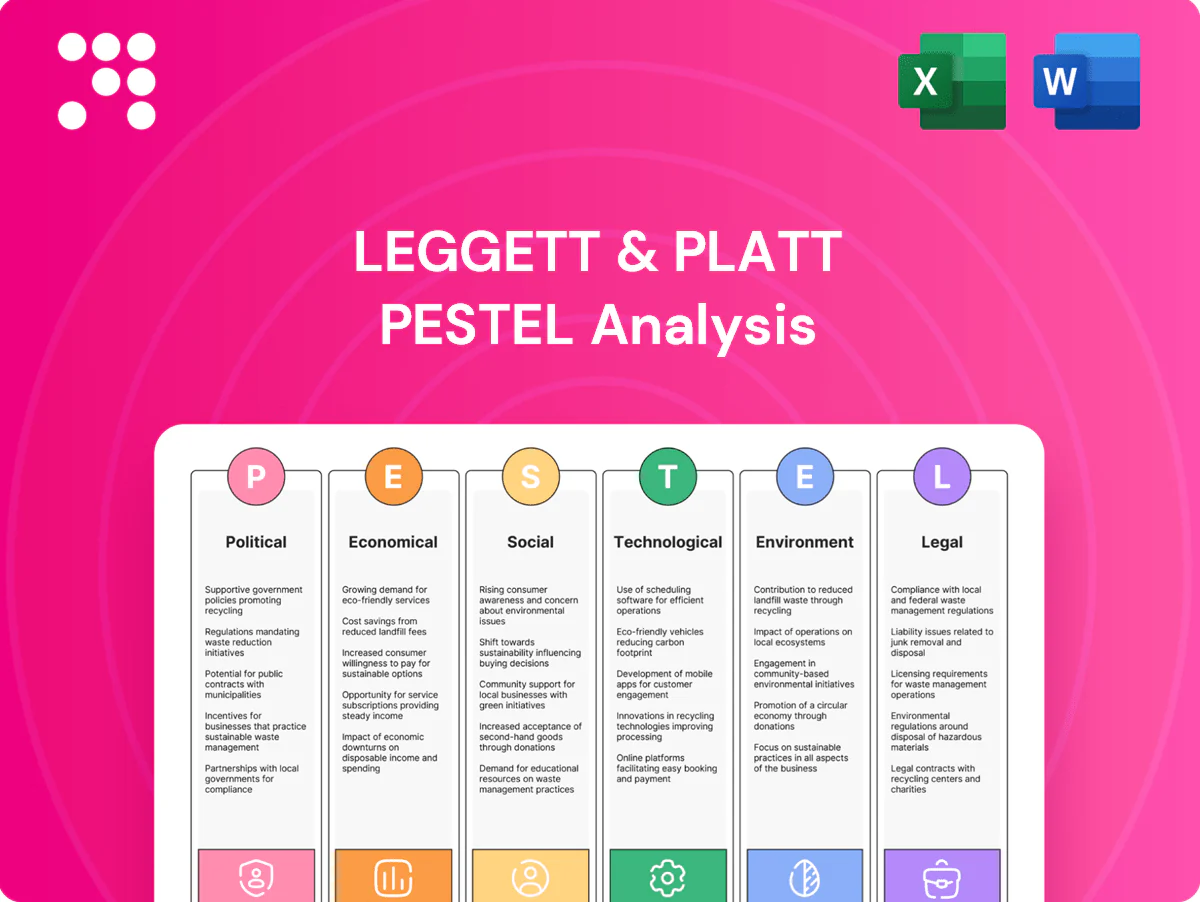
Leggett & Platt PESTLE Analysis

Your Shortcut to Market Insight Starts Here
Our PESTLE Analysis for Leggett & Platt reveals how political regulation, economic cycles, social trends, technological innovation, environmental pressures, and legal shifts shape strategy and risk. Actionable insights highlight opportunities and vulnerabilities for investors and strategists. Buy the full report to access the complete, editable breakdown and make informed decisions.
Political factors

Tariffs and trade policies
Changes in tariffs—notably the 25% US Section 232 steel duty and up to 25% tariffs on certain China-sourced components—directly raise Leggett & Platt’s input costs and pressure pricing power. Escalating global trade tensions drive supplier diversification and nearshoring, while preferential deals like USMCA can lower duties and expand margin opportunities. Persistent tariff volatility forces use of hedges, multi‑year supply contracts and flexible sourcing to protect margins.
Industrial policy incentives
US reshoring incentives — notably the Inflation Reduction Act's roughly $369 billion clean-energy package and the CHIPS Act's ~$52 billion — plus manufacturing tax credits can underwrite automation and materials capex; Buy America provisions for federal projects favor domestic content in some product lines, while subsidy races raise competitive investment; Leggett & Platt can capture value by aligning footprint and supply chain to targeted incentives.

Geopolitical supply risks
Conflicts and sanctions can disrupt chemical precursors, steel, and specialty-foam inputs, raising raw-material scarcity and price volatility. Shipping-lane congestion and energy market constraints elevate lead times and freight costs, pressuring margins. Multiregion production — Leggett & Platt operates roughly 130 manufacturing facilities in 19 countries — mitigates single-point failures. Strategic inventory and dual-sourcing remain key political-risk buffers.

Public procurement standards
Government standards for furnishings and transportation components drive product specifications and sourcing decisions. Meeting public-sector requirements can unlock stable contracts but increases compliance costs and testing. Political shifts may tighten or relax thresholds (Simplified Acquisition Threshold $250,000; Buy American Act impacts federal spend). Proactive certification keeps bids competitive; Leggett & Platt reported 2024 net sales $3.28 billion.
- Standards shape specs and sourcing
- Public contracts = stability + higher compliance costs
- SAT $250,000; Buy American affects federal tenders
- Certification improves win rate
Labor and workforce policies
Labor policies—federal minimum wage at $7.25/hr and higher state rates, plus immigration limits such as the H-2B cap (~66,000 visas)—shape Leggett & Platt staffing costs across roughly 120 plants and about 20,000 employees. Policy-driven labor shortages in 2024 pressured wages and productivity, increasing operating labor risk. Active engagement with local apprenticeship and training programs improves resilience while stable labor relations sustain consistent output.
- federal minimum wage: $7.25/hr
- H-2B cap: ~66,000 visas
- Leggett & Platt: ~120 plants, ~20,000 employees
- apprenticeships improve staffing resilience
Tariffs, shipping and labor pressure drive nearshoring; IRA $369B boosts reshoring
Political risks—tariffs (US Section 232 steel 25%), trade tensions, sanctions and shipping disruptions raise input costs and lead times, prompting nearshoring and multi‑year contracts. US incentives (IRA ~$369B, CHIPS ~$52B) plus Buy America support reshoring; Leggett & Platt reported 2024 net sales $3.28B and operates ~130 facilities in 19 countries. Labor rules (federal min wage $7.25; H-2B cap ~66,000) affect staffing.
| Factor | Key data | Impact |
|---|---|---|
| Tariffs | 25% steel | ↑input costs |
| Incentives | IRA ~$369B; CHIPS ~$52B | ↑reshoring capex |
| Labor | Min $7.25; H‑2B ~66,000 | ↑wages/staffing |
What is included in the product
 Detailed Word Document
Explores how Political, Economic, Social, Technological, Environmental and Legal forces uniquely impact Leggett & Platt, with data-backed trends and forward-looking insights to help executives, investors and strategists identify risks, opportunities and actionable scenarios.

 Customizable Excel Spreadsheet
Concise, visually segmented PESTLE summary for Leggett & Platt that’s editable for local context, easily dropped into presentations, and ideal for cross-team alignment.
Economic factors

Housing and bedding cycles
Residential construction and replacement cycles drive Leggett & Platt mattress and bedding component demand; U.S. housing starts were about 1.3M annualized in early 2025 while 30‑year mortgage rates averaged ~6.8% in H1 2025 (Freddie Mac), which can delay new purchases even as refurb cycles create a demand floor. Promotional retail dynamics compress mix and margins, and strict inventory discipline smooths volatility across quarters.
Automotive production volumes
Seat support systems track global light-vehicle builds—roughly 72 million units in 2024—so OEM schedule shifts directly alter Leggett & Platt capacity utilization and lead times. Rapid EV platform growth (≈16 million BEV sales in 2024, ~22% share) is changing material specs and pricing pressure. Winning multi-year platforms provides stable volume visibility and margin planning.

Raw material cost swings
Raw material inputs like steel, polyurethane chemicals and fibers are highly sensitive to energy and commodity cycles, exposing Leggett & Platt to cyclical cost swings that can compress margins during upward price moves.
The company relies on contractual cost pass-through and repricing mechanisms that protect margins but introduce lag effects, so margin volatility persists during abrupt price shifts.
Active strategic sourcing, supplier hedges and inventory management reduce short-term volatility, while product redesign and material substitution are employed to offset sustained input inflation.

FX and global demand
Currency moves materially affect translated revenues and import costs for Leggett & Platt, with USD strength in 2024 reducing reported international sales while raising input costs for imported components.
Diversified end-markets across bedding, automotive and furniture buffer regional slowdowns; price localization and natural hedges (local sourcing, local pricing) have reduced FX volatility impact in 2024.
Monitoring emerging market demand—notably in Asia and Latin America—helps reallocate production and inventory to capture growth as global volumes normalize post-2023 disruptions.
- FX impact: USD strength pressed reported international revenues in 2024
- Diversification: multiple end-markets reduce regional risk
- Mitigants: price localization, local sourcing create natural hedges
- Action: track Asia/LatAm demand for allocation decisions
Interest rates and credit
Higher interest rates (US federal funds ~5.25% mid‑2025) temper consumer durables demand and slow retailer inventory builds, pressuring Leggett & Platt end markets. Elevated financing costs influence capex and M&A timing. Strong cash conversion and lean working capital support resilience and flexibility through cycles.
- rate: ~5.25%
- impact: lower demand, slower inventories
- strategy: conserve cash, delay M&A
Tariffs, shipping and labor pressure drive nearshoring; IRA $369B boosts reshoring
Housing starts ~1.3M (early 2025) and 30‑yr mortgage ~6.8% (H1 2025) slow new mattress demand while replacement cycles provide baseline sales. Global light‑vehicle builds ~72M (2024) and BEV sales ~16M (~22% share) shift auto content and pricing. Steel, polyurethanes and fiber cost swings plus USD strength in 2024 drive margin volatility; fed funds ~5.25% (mid‑2025) pressures consumer durables spend.
| Metric | Value |
|---|---|
| Housing starts | ~1.3M |
| 30‑yr mortgage | ~6.8% |
| Global auto builds | ~72M (2024) |
| BEV sales | ~16M (2024) |
| Fed funds | ~5.25% |
What You See Is What You Get
Leggett & Platt PESTLE Analysis
The preview shown here is the exact document you’ll receive after purchase—fully formatted and ready to use. This Leggett & Platt PESTLE Analysis covers political, economic, social, technological, legal and environmental factors in the same structured layout shown. No placeholders or teasers—download the final file instantly upon payment.

Your Shortcut to Market Insight Starts Here
Our PESTLE Analysis for Leggett & Platt reveals how political regulation, economic cycles, social trends, technological innovation, environmental pressures, and legal shifts shape strategy and risk. Actionable insights highlight opportunities and vulnerabilities for investors and strategists. Buy the full report to access the complete, editable breakdown and make informed decisions.
Political factors
Tariffs and trade policies
Changes in tariffs—notably the 25% US Section 232 steel duty and up to 25% tariffs on certain China-sourced components—directly raise Leggett & Platt’s input costs and pressure pricing power. Escalating global trade tensions drive supplier diversification and nearshoring, while preferential deals like USMCA can lower duties and expand margin opportunities. Persistent tariff volatility forces use of hedges, multi‑year supply contracts and flexible sourcing to protect margins.
Industrial policy incentives
US reshoring incentives — notably the Inflation Reduction Act's roughly $369 billion clean-energy package and the CHIPS Act's ~$52 billion — plus manufacturing tax credits can underwrite automation and materials capex; Buy America provisions for federal projects favor domestic content in some product lines, while subsidy races raise competitive investment; Leggett & Platt can capture value by aligning footprint and supply chain to targeted incentives.
Geopolitical supply risks
Conflicts and sanctions can disrupt chemical precursors, steel, and specialty-foam inputs, raising raw-material scarcity and price volatility. Shipping-lane congestion and energy market constraints elevate lead times and freight costs, pressuring margins. Multiregion production — Leggett & Platt operates roughly 130 manufacturing facilities in 19 countries — mitigates single-point failures. Strategic inventory and dual-sourcing remain key political-risk buffers.
Public procurement standards
Government standards for furnishings and transportation components drive product specifications and sourcing decisions. Meeting public-sector requirements can unlock stable contracts but increases compliance costs and testing. Political shifts may tighten or relax thresholds (Simplified Acquisition Threshold $250,000; Buy American Act impacts federal spend). Proactive certification keeps bids competitive; Leggett & Platt reported 2024 net sales $3.28 billion.
- Standards shape specs and sourcing
- Public contracts = stability + higher compliance costs
- SAT $250,000; Buy American affects federal tenders
- Certification improves win rate
Labor and workforce policies
Labor policies—federal minimum wage at $7.25/hr and higher state rates, plus immigration limits such as the H-2B cap (~66,000 visas)—shape Leggett & Platt staffing costs across roughly 120 plants and about 20,000 employees. Policy-driven labor shortages in 2024 pressured wages and productivity, increasing operating labor risk. Active engagement with local apprenticeship and training programs improves resilience while stable labor relations sustain consistent output.
- federal minimum wage: $7.25/hr
- H-2B cap: ~66,000 visas
- Leggett & Platt: ~120 plants, ~20,000 employees
- apprenticeships improve staffing resilience
Tariffs, shipping and labor pressure drive nearshoring; IRA $369B boosts reshoring
Political risks—tariffs (US Section 232 steel 25%), trade tensions, sanctions and shipping disruptions raise input costs and lead times, prompting nearshoring and multi‑year contracts. US incentives (IRA ~$369B, CHIPS ~$52B) plus Buy America support reshoring; Leggett & Platt reported 2024 net sales $3.28B and operates ~130 facilities in 19 countries. Labor rules (federal min wage $7.25; H-2B cap ~66,000) affect staffing.
| Factor | Key data | Impact |
|---|---|---|
| Tariffs | 25% steel | ↑input costs |
| Incentives | IRA ~$369B; CHIPS ~$52B | ↑reshoring capex |
| Labor | Min $7.25; H‑2B ~66,000 | ↑wages/staffing |
What is included in the product
Detailed Word Document
Explores how Political, Economic, Social, Technological, Environmental and Legal forces uniquely impact Leggett & Platt, with data-backed trends and forward-looking insights to help executives, investors and strategists identify risks, opportunities and actionable scenarios.
Customizable Excel Spreadsheet
Concise, visually segmented PESTLE summary for Leggett & Platt that’s editable for local context, easily dropped into presentations, and ideal for cross-team alignment.
Economic factors
Housing and bedding cycles
Residential construction and replacement cycles drive Leggett & Platt mattress and bedding component demand; U.S. housing starts were about 1.3M annualized in early 2025 while 30‑year mortgage rates averaged ~6.8% in H1 2025 (Freddie Mac), which can delay new purchases even as refurb cycles create a demand floor. Promotional retail dynamics compress mix and margins, and strict inventory discipline smooths volatility across quarters.
Automotive production volumes
Seat support systems track global light-vehicle builds—roughly 72 million units in 2024—so OEM schedule shifts directly alter Leggett & Platt capacity utilization and lead times. Rapid EV platform growth (≈16 million BEV sales in 2024, ~22% share) is changing material specs and pricing pressure. Winning multi-year platforms provides stable volume visibility and margin planning.
Raw material cost swings
Raw material inputs like steel, polyurethane chemicals and fibers are highly sensitive to energy and commodity cycles, exposing Leggett & Platt to cyclical cost swings that can compress margins during upward price moves.
The company relies on contractual cost pass-through and repricing mechanisms that protect margins but introduce lag effects, so margin volatility persists during abrupt price shifts.
Active strategic sourcing, supplier hedges and inventory management reduce short-term volatility, while product redesign and material substitution are employed to offset sustained input inflation.
FX and global demand
Currency moves materially affect translated revenues and import costs for Leggett & Platt, with USD strength in 2024 reducing reported international sales while raising input costs for imported components.
Diversified end-markets across bedding, automotive and furniture buffer regional slowdowns; price localization and natural hedges (local sourcing, local pricing) have reduced FX volatility impact in 2024.
Monitoring emerging market demand—notably in Asia and Latin America—helps reallocate production and inventory to capture growth as global volumes normalize post-2023 disruptions.
- FX impact: USD strength pressed reported international revenues in 2024
- Diversification: multiple end-markets reduce regional risk
- Mitigants: price localization, local sourcing create natural hedges
- Action: track Asia/LatAm demand for allocation decisions
Interest rates and credit
Higher interest rates (US federal funds ~5.25% mid‑2025) temper consumer durables demand and slow retailer inventory builds, pressuring Leggett & Platt end markets. Elevated financing costs influence capex and M&A timing. Strong cash conversion and lean working capital support resilience and flexibility through cycles.
- rate: ~5.25%
- impact: lower demand, slower inventories
- strategy: conserve cash, delay M&A
Tariffs, shipping and labor pressure drive nearshoring; IRA $369B boosts reshoring
Housing starts ~1.3M (early 2025) and 30‑yr mortgage ~6.8% (H1 2025) slow new mattress demand while replacement cycles provide baseline sales. Global light‑vehicle builds ~72M (2024) and BEV sales ~16M (~22% share) shift auto content and pricing. Steel, polyurethanes and fiber cost swings plus USD strength in 2024 drive margin volatility; fed funds ~5.25% (mid‑2025) pressures consumer durables spend.
| Metric | Value |
|---|---|
| Housing starts | ~1.3M |
| 30‑yr mortgage | ~6.8% |
| Global auto builds | ~72M (2024) |
| BEV sales | ~16M (2024) |
| Fed funds | ~5.25% |
What You See Is What You Get
Leggett & Platt PESTLE Analysis
The preview shown here is the exact document you’ll receive after purchase—fully formatted and ready to use. This Leggett & Platt PESTLE Analysis covers political, economic, social, technological, legal and environmental factors in the same structured layout shown. No placeholders or teasers—download the final file instantly upon payment.
Original: $10.00
-65%$10.00
$3.50Description
Your Shortcut to Market Insight Starts Here
Our PESTLE Analysis for Leggett & Platt reveals how political regulation, economic cycles, social trends, technological innovation, environmental pressures, and legal shifts shape strategy and risk. Actionable insights highlight opportunities and vulnerabilities for investors and strategists. Buy the full report to access the complete, editable breakdown and make informed decisions.
Political factors
Tariffs and trade policies
Changes in tariffs—notably the 25% US Section 232 steel duty and up to 25% tariffs on certain China-sourced components—directly raise Leggett & Platt’s input costs and pressure pricing power. Escalating global trade tensions drive supplier diversification and nearshoring, while preferential deals like USMCA can lower duties and expand margin opportunities. Persistent tariff volatility forces use of hedges, multi‑year supply contracts and flexible sourcing to protect margins.
Industrial policy incentives
US reshoring incentives — notably the Inflation Reduction Act's roughly $369 billion clean-energy package and the CHIPS Act's ~$52 billion — plus manufacturing tax credits can underwrite automation and materials capex; Buy America provisions for federal projects favor domestic content in some product lines, while subsidy races raise competitive investment; Leggett & Platt can capture value by aligning footprint and supply chain to targeted incentives.
Geopolitical supply risks
Conflicts and sanctions can disrupt chemical precursors, steel, and specialty-foam inputs, raising raw-material scarcity and price volatility. Shipping-lane congestion and energy market constraints elevate lead times and freight costs, pressuring margins. Multiregion production — Leggett & Platt operates roughly 130 manufacturing facilities in 19 countries — mitigates single-point failures. Strategic inventory and dual-sourcing remain key political-risk buffers.
Public procurement standards
Government standards for furnishings and transportation components drive product specifications and sourcing decisions. Meeting public-sector requirements can unlock stable contracts but increases compliance costs and testing. Political shifts may tighten or relax thresholds (Simplified Acquisition Threshold $250,000; Buy American Act impacts federal spend). Proactive certification keeps bids competitive; Leggett & Platt reported 2024 net sales $3.28 billion.
- Standards shape specs and sourcing
- Public contracts = stability + higher compliance costs
- SAT $250,000; Buy American affects federal tenders
- Certification improves win rate
Labor and workforce policies
Labor policies—federal minimum wage at $7.25/hr and higher state rates, plus immigration limits such as the H-2B cap (~66,000 visas)—shape Leggett & Platt staffing costs across roughly 120 plants and about 20,000 employees. Policy-driven labor shortages in 2024 pressured wages and productivity, increasing operating labor risk. Active engagement with local apprenticeship and training programs improves resilience while stable labor relations sustain consistent output.
- federal minimum wage: $7.25/hr
- H-2B cap: ~66,000 visas
- Leggett & Platt: ~120 plants, ~20,000 employees
- apprenticeships improve staffing resilience
Tariffs, shipping and labor pressure drive nearshoring; IRA $369B boosts reshoring
Political risks—tariffs (US Section 232 steel 25%), trade tensions, sanctions and shipping disruptions raise input costs and lead times, prompting nearshoring and multi‑year contracts. US incentives (IRA ~$369B, CHIPS ~$52B) plus Buy America support reshoring; Leggett & Platt reported 2024 net sales $3.28B and operates ~130 facilities in 19 countries. Labor rules (federal min wage $7.25; H-2B cap ~66,000) affect staffing.
| Factor | Key data | Impact |
|---|---|---|
| Tariffs | 25% steel | ↑input costs |
| Incentives | IRA ~$369B; CHIPS ~$52B | ↑reshoring capex |
| Labor | Min $7.25; H‑2B ~66,000 | ↑wages/staffing |
What is included in the product
Detailed Word Document
Explores how Political, Economic, Social, Technological, Environmental and Legal forces uniquely impact Leggett & Platt, with data-backed trends and forward-looking insights to help executives, investors and strategists identify risks, opportunities and actionable scenarios.
Customizable Excel Spreadsheet
Concise, visually segmented PESTLE summary for Leggett & Platt that’s editable for local context, easily dropped into presentations, and ideal for cross-team alignment.
Economic factors
Housing and bedding cycles
Residential construction and replacement cycles drive Leggett & Platt mattress and bedding component demand; U.S. housing starts were about 1.3M annualized in early 2025 while 30‑year mortgage rates averaged ~6.8% in H1 2025 (Freddie Mac), which can delay new purchases even as refurb cycles create a demand floor. Promotional retail dynamics compress mix and margins, and strict inventory discipline smooths volatility across quarters.
Automotive production volumes
Seat support systems track global light-vehicle builds—roughly 72 million units in 2024—so OEM schedule shifts directly alter Leggett & Platt capacity utilization and lead times. Rapid EV platform growth (≈16 million BEV sales in 2024, ~22% share) is changing material specs and pricing pressure. Winning multi-year platforms provides stable volume visibility and margin planning.
Raw material cost swings
Raw material inputs like steel, polyurethane chemicals and fibers are highly sensitive to energy and commodity cycles, exposing Leggett & Platt to cyclical cost swings that can compress margins during upward price moves.
The company relies on contractual cost pass-through and repricing mechanisms that protect margins but introduce lag effects, so margin volatility persists during abrupt price shifts.
Active strategic sourcing, supplier hedges and inventory management reduce short-term volatility, while product redesign and material substitution are employed to offset sustained input inflation.
FX and global demand
Currency moves materially affect translated revenues and import costs for Leggett & Platt, with USD strength in 2024 reducing reported international sales while raising input costs for imported components.
Diversified end-markets across bedding, automotive and furniture buffer regional slowdowns; price localization and natural hedges (local sourcing, local pricing) have reduced FX volatility impact in 2024.
Monitoring emerging market demand—notably in Asia and Latin America—helps reallocate production and inventory to capture growth as global volumes normalize post-2023 disruptions.
- FX impact: USD strength pressed reported international revenues in 2024
- Diversification: multiple end-markets reduce regional risk
- Mitigants: price localization, local sourcing create natural hedges
- Action: track Asia/LatAm demand for allocation decisions
Interest rates and credit
Higher interest rates (US federal funds ~5.25% mid‑2025) temper consumer durables demand and slow retailer inventory builds, pressuring Leggett & Platt end markets. Elevated financing costs influence capex and M&A timing. Strong cash conversion and lean working capital support resilience and flexibility through cycles.
- rate: ~5.25%
- impact: lower demand, slower inventories
- strategy: conserve cash, delay M&A
Tariffs, shipping and labor pressure drive nearshoring; IRA $369B boosts reshoring
Housing starts ~1.3M (early 2025) and 30‑yr mortgage ~6.8% (H1 2025) slow new mattress demand while replacement cycles provide baseline sales. Global light‑vehicle builds ~72M (2024) and BEV sales ~16M (~22% share) shift auto content and pricing. Steel, polyurethanes and fiber cost swings plus USD strength in 2024 drive margin volatility; fed funds ~5.25% (mid‑2025) pressures consumer durables spend.
| Metric | Value |
|---|---|
| Housing starts | ~1.3M |
| 30‑yr mortgage | ~6.8% |
| Global auto builds | ~72M (2024) |
| BEV sales | ~16M (2024) |
| Fed funds | ~5.25% |
What You See Is What You Get
Leggett & Platt PESTLE Analysis
The preview shown here is the exact document you’ll receive after purchase—fully formatted and ready to use. This Leggett & Platt PESTLE Analysis covers political, economic, social, technological, legal and environmental factors in the same structured layout shown. No placeholders or teasers—download the final file instantly upon payment.











