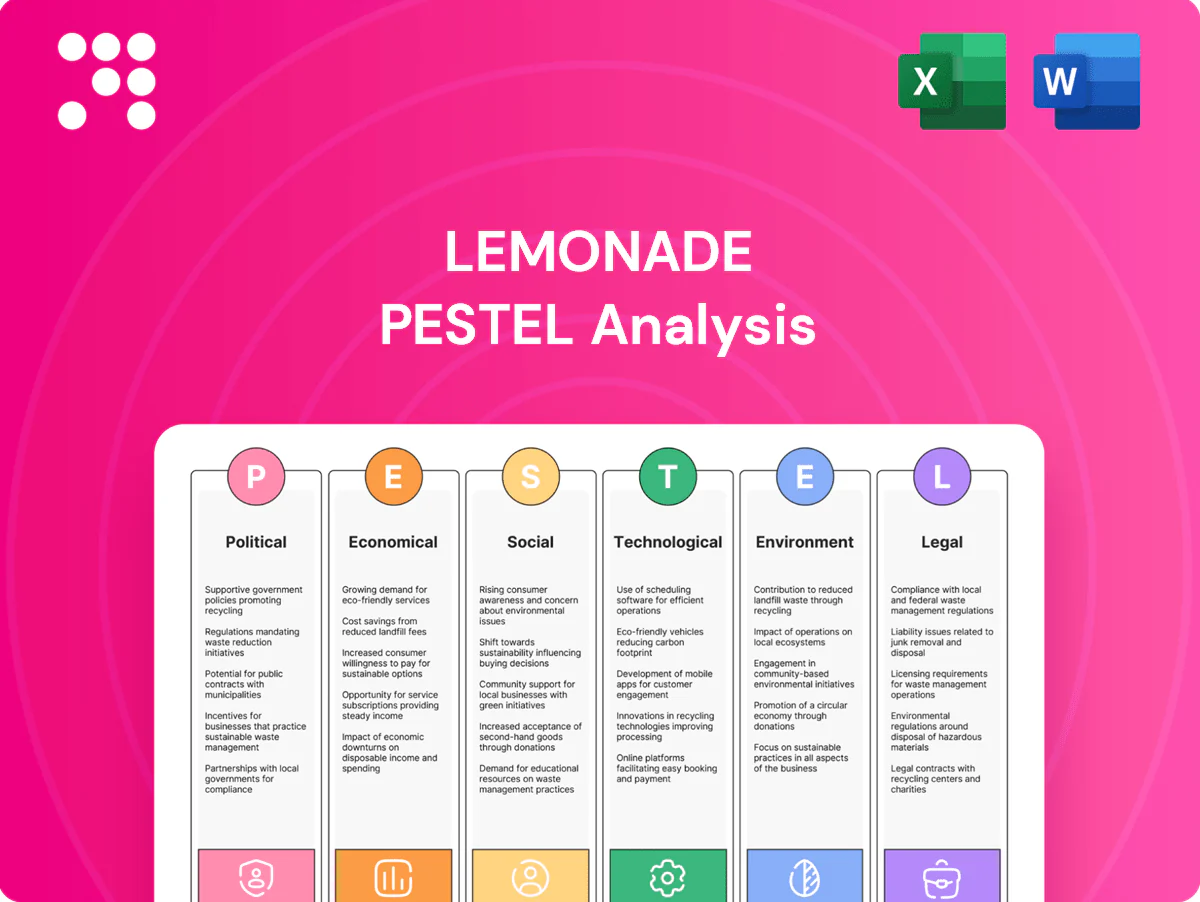
Lemonade PESTLE Analysis

Plan Smarter. Present Sharper. Compete Stronger.
Unlock strategic clarity with our concise PESTLE Analysis of Lemonade—three to five pages of actionable insight on political, economic, social, technological, legal, and environmental forces shaping growth. Perfect for investors and strategists. Purchase the full report to get the complete, editable analysis instantly.
Political factors

Regulatory fragmentation
Insurance oversight is decentralized across the 50 US states and 27 EU member countries, shaping product approvals, pricing and filing regimes affecting Lemonade. The company must navigate varying state commissioners, NAIC guidance and differing political cycles that alter priorities. Policy shifts—from state capital requirements to EU Solvency II interpretations—can rapidly change filing and reporting obligations. These variations raise coordination costs and lengthen time-to-market.
Consumer protection agenda
Populist and pro-consumer platforms have amplified scrutiny of pricing, claim denials and AI use, increasing regulatory focus after the EU AI Act provisional agreement in Dec 2023 and ahead of enforcement phases in 2025–26. Political pressure is pushing tighter rules on algorithmic transparency and appeals processes. Lemonade’s digital claims flows, built around AI, must align with evolving fairness standards to avoid fines and reputational hits. Proactive engagement with regulators can mitigate headline risk.

Data localization policies
Governments in jurisdictions including India, China, Russia and several EU members increasingly mandate local data storage and processing, challenging Lemonade’s cloud-first architecture. Divergent rules across these markets complicate cross-border scaling and analytics and force region-specific data partitions. Compliance influences infrastructure and vendor selection and breaches risk heavy penalties under rules like GDPR (up to €20 million or 4% of global turnover) and operational disruption.

Public funding and insurtech support
Innovation grants, regulatory sandboxes and digital ID schemes accelerate Lemonade product rollout; the UK FCA sandbox has hosted over 100 firms since 2016 and India’s Aadhaar exceeds 1.3 billion enrolments, showing scale for digital onboarding. Political support for fintech competitiveness unlocks public-private partnerships, while withdrawal of funding raises regulatory friction and slows market entry. Lemonade can use pilots and sandbox proofs to demonstrate consumer benefit and speed adoption.
- grants: enable R&D pilots
- sandboxes: >100 firms (FCA)
- digital ID: Aadhaar 1.3B+
- risk: withdrawal → higher friction
Climate resilience priorities
Policymakers steer catastrophe pools, building codes and risk zoning, with FEMA's NFIP covering roughly 5 million policies, shaping exposure and reinsurance demand. Political responses to disasters rapidly reshape homeowner availability and pricing; subsidies or rate caps can blunt actuarial signals. Lemonade must align with resilience initiatives to protect loss ratios and sustainable underwriting.
- Catastrophe pools & zoning drive exposure
- Subsidies/caps constrain actuarial pricing
- Alignment with resilience reduces loss ratios
Regulatory fragmentation, AI rules and data mandates raise insurers' costs and slow market entry
Decentralized insurance oversight across 50 US states and 27 EU members raises filing, capital and time-to-market costs for Lemonade.
Post-2023 EU AI Act momentum and pro-consumer politics increase scrutiny on pricing, claim denials and algorithmic transparency ahead of 2025–26 enforcement.
Local data rules (GDPR fines up to €20M or 4% turnover) and mandates in markets like India (Aadhaar 1.3B) force region-specific infrastructure.
Catastrophe policy shifts (FEMA NFIP ~5M policies) and sandboxes (UK FCA >100 firms) alter exposure, pricing and rollout speed.
| Factor | Key data |
|---|---|
| Regulation scope | 50 US states; 27 EU members |
| AI & data | EU AI Act 2023; GDPR fines €20M/4% |
| Market enablers | FCA sandbox >100; Aadhaar 1.3B |
| Catastrophe | NFIP ~5M policies |
What is included in the product
 Detailed Word Document
Explores how macro-environmental forces affect Lemonade across Political, Economic, Social, Technological, Environmental and Legal dimensions, with each section backed by current data and trend analysis. Designed for executives, advisors and investors, the analysis highlights region- and industry-specific risks and opportunities in clean, presentation-ready format.

 Customizable Excel Spreadsheet
A concise, visually segmented PESTLE of Lemonade that highlights external risks and opportunities for quick inclusion in presentations or strategy sessions, easily annotated for region- or product-specific context to speed decision-making and align teams.
Economic factors

Interest rate cycle
Rising interest rates have boosted insurer investment yields—US 10-year Treasury near 4.1% (June 2025) increased carry, supporting solvency and underwriting buffers for firms like Lemonade. Higher yields improve float returns but compress equity valuations for growth insurers; Lemonade’s stock remains sensitive to this trade-off. Rate cuts would lower carry and could revive premium growth; Lemonade’s profitability roadmap depends materially on investment income.
Inflation and claims severity
Auto repair (~+8% YoY in 2024), construction materials (~+6% PPI) and vet care (~+5% CPI) have lifted Lemonade’s claims severity, while lagged state rate approvals squeeze margins; accurate trend forecasting is critical to set pricing refresh cadence. Reinsurance markets hardened in 2024 with reported rate-on-line increases roughly 10–20%, further pressuring loss cost recovery.

Consumer spending and churn
Macro slowdowns and 2024 US inflation moderating to about 3.4% have heightened price sensitivity and shifted shopping behavior toward value and comparison shopping. Bundled products and usage-based car pricing can retain value-conscious customers by lowering effective premiums and reducing churn. Customer-acquisition cost must flex with auction dynamics and channel mix as digital ad costs rose roughly 15% YoY in 2024. Rigorous LTV/CAC discipline remains the linchpin of sustainable growth.

Catastrophe exposure and reinsurance
Labor and tech costs
Talent markets for data science and security drive unit costs—US data scientist median base pay ≈ $120,000 (Glassdoor 2024), raising underwriting tech headcount expenses. Cloud and AI compute pricing shape margins as the public cloud market reached about $597 billion in 2024 (Gartner). Automation and MLOps reduce staffing needs, while vendor lock-in risk can raise long-term switching costs.
- Data science pay: ≈ $120,000 (Glassdoor 2024)
- Public cloud market: ≈ $597B (Gartner 2024)
- Automation lowers marginal staffing costs
- Vendor lock-in increases future switching expenses
Regulatory fragmentation, AI rules and data mandates raise insurers' costs and slow market entry
Higher rates (US 10yr ≈4.1% Jun 2025) lift investment yield and solvency but compress growth valuations for Lemonade. Rising claim severity and a ~20% reinsurance price rise (2023–24) squeeze underwriting margins amid ~120bn USD insured CAT losses (2023). Price-sensitive customers and +15% digital ad costs (2024) force tighter LTV/CAC. Talent and cloud costs (data scientist ≈120k; cloud ≈597B 2024) raise operating expense.
| Metric | Value |
|---|---|
| US 10yr yield (Jun 2025) | 4.1% |
| US inflation (2024) | 3.4% |
| Insured CAT losses (2023) | 120bn USD |
| Reinsurance price change (2023–24) | +~20% |
| Data scientist median pay (2024) | ≈120,000 USD |
| Public cloud market (2024) | ≈597B USD |
Preview the Actual Deliverable
Lemonade PESTLE Analysis
The preview shown here is the exact document you’ll receive after purchase—fully formatted and ready to use. This Lemonade PESTLE Analysis examines political, economic, social, technological, legal, and environmental factors affecting the company, providing concise, actionable insights for investors and strategists. No placeholders—what you see is the final, downloadable file.

Plan Smarter. Present Sharper. Compete Stronger.
Unlock strategic clarity with our concise PESTLE Analysis of Lemonade—three to five pages of actionable insight on political, economic, social, technological, legal, and environmental forces shaping growth. Perfect for investors and strategists. Purchase the full report to get the complete, editable analysis instantly.
Political factors
Regulatory fragmentation
Insurance oversight is decentralized across the 50 US states and 27 EU member countries, shaping product approvals, pricing and filing regimes affecting Lemonade. The company must navigate varying state commissioners, NAIC guidance and differing political cycles that alter priorities. Policy shifts—from state capital requirements to EU Solvency II interpretations—can rapidly change filing and reporting obligations. These variations raise coordination costs and lengthen time-to-market.
Consumer protection agenda
Populist and pro-consumer platforms have amplified scrutiny of pricing, claim denials and AI use, increasing regulatory focus after the EU AI Act provisional agreement in Dec 2023 and ahead of enforcement phases in 2025–26. Political pressure is pushing tighter rules on algorithmic transparency and appeals processes. Lemonade’s digital claims flows, built around AI, must align with evolving fairness standards to avoid fines and reputational hits. Proactive engagement with regulators can mitigate headline risk.
Data localization policies
Governments in jurisdictions including India, China, Russia and several EU members increasingly mandate local data storage and processing, challenging Lemonade’s cloud-first architecture. Divergent rules across these markets complicate cross-border scaling and analytics and force region-specific data partitions. Compliance influences infrastructure and vendor selection and breaches risk heavy penalties under rules like GDPR (up to €20 million or 4% of global turnover) and operational disruption.
Public funding and insurtech support
Innovation grants, regulatory sandboxes and digital ID schemes accelerate Lemonade product rollout; the UK FCA sandbox has hosted over 100 firms since 2016 and India’s Aadhaar exceeds 1.3 billion enrolments, showing scale for digital onboarding. Political support for fintech competitiveness unlocks public-private partnerships, while withdrawal of funding raises regulatory friction and slows market entry. Lemonade can use pilots and sandbox proofs to demonstrate consumer benefit and speed adoption.
- grants: enable R&D pilots
- sandboxes: >100 firms (FCA)
- digital ID: Aadhaar 1.3B+
- risk: withdrawal → higher friction
Climate resilience priorities
Policymakers steer catastrophe pools, building codes and risk zoning, with FEMA's NFIP covering roughly 5 million policies, shaping exposure and reinsurance demand. Political responses to disasters rapidly reshape homeowner availability and pricing; subsidies or rate caps can blunt actuarial signals. Lemonade must align with resilience initiatives to protect loss ratios and sustainable underwriting.
- Catastrophe pools & zoning drive exposure
- Subsidies/caps constrain actuarial pricing
- Alignment with resilience reduces loss ratios
Regulatory fragmentation, AI rules and data mandates raise insurers' costs and slow market entry
Decentralized insurance oversight across 50 US states and 27 EU members raises filing, capital and time-to-market costs for Lemonade.
Post-2023 EU AI Act momentum and pro-consumer politics increase scrutiny on pricing, claim denials and algorithmic transparency ahead of 2025–26 enforcement.
Local data rules (GDPR fines up to €20M or 4% turnover) and mandates in markets like India (Aadhaar 1.3B) force region-specific infrastructure.
Catastrophe policy shifts (FEMA NFIP ~5M policies) and sandboxes (UK FCA >100 firms) alter exposure, pricing and rollout speed.
| Factor | Key data |
|---|---|
| Regulation scope | 50 US states; 27 EU members |
| AI & data | EU AI Act 2023; GDPR fines €20M/4% |
| Market enablers | FCA sandbox >100; Aadhaar 1.3B |
| Catastrophe | NFIP ~5M policies |
What is included in the product
Detailed Word Document
Explores how macro-environmental forces affect Lemonade across Political, Economic, Social, Technological, Environmental and Legal dimensions, with each section backed by current data and trend analysis. Designed for executives, advisors and investors, the analysis highlights region- and industry-specific risks and opportunities in clean, presentation-ready format.
Customizable Excel Spreadsheet
A concise, visually segmented PESTLE of Lemonade that highlights external risks and opportunities for quick inclusion in presentations or strategy sessions, easily annotated for region- or product-specific context to speed decision-making and align teams.
Economic factors
Interest rate cycle
Rising interest rates have boosted insurer investment yields—US 10-year Treasury near 4.1% (June 2025) increased carry, supporting solvency and underwriting buffers for firms like Lemonade. Higher yields improve float returns but compress equity valuations for growth insurers; Lemonade’s stock remains sensitive to this trade-off. Rate cuts would lower carry and could revive premium growth; Lemonade’s profitability roadmap depends materially on investment income.
Inflation and claims severity
Auto repair (~+8% YoY in 2024), construction materials (~+6% PPI) and vet care (~+5% CPI) have lifted Lemonade’s claims severity, while lagged state rate approvals squeeze margins; accurate trend forecasting is critical to set pricing refresh cadence. Reinsurance markets hardened in 2024 with reported rate-on-line increases roughly 10–20%, further pressuring loss cost recovery.
Consumer spending and churn
Macro slowdowns and 2024 US inflation moderating to about 3.4% have heightened price sensitivity and shifted shopping behavior toward value and comparison shopping. Bundled products and usage-based car pricing can retain value-conscious customers by lowering effective premiums and reducing churn. Customer-acquisition cost must flex with auction dynamics and channel mix as digital ad costs rose roughly 15% YoY in 2024. Rigorous LTV/CAC discipline remains the linchpin of sustainable growth.
Catastrophe exposure and reinsurance
Labor and tech costs
Talent markets for data science and security drive unit costs—US data scientist median base pay ≈ $120,000 (Glassdoor 2024), raising underwriting tech headcount expenses. Cloud and AI compute pricing shape margins as the public cloud market reached about $597 billion in 2024 (Gartner). Automation and MLOps reduce staffing needs, while vendor lock-in risk can raise long-term switching costs.
- Data science pay: ≈ $120,000 (Glassdoor 2024)
- Public cloud market: ≈ $597B (Gartner 2024)
- Automation lowers marginal staffing costs
- Vendor lock-in increases future switching expenses
Regulatory fragmentation, AI rules and data mandates raise insurers' costs and slow market entry
Higher rates (US 10yr ≈4.1% Jun 2025) lift investment yield and solvency but compress growth valuations for Lemonade. Rising claim severity and a ~20% reinsurance price rise (2023–24) squeeze underwriting margins amid ~120bn USD insured CAT losses (2023). Price-sensitive customers and +15% digital ad costs (2024) force tighter LTV/CAC. Talent and cloud costs (data scientist ≈120k; cloud ≈597B 2024) raise operating expense.
| Metric | Value |
|---|---|
| US 10yr yield (Jun 2025) | 4.1% |
| US inflation (2024) | 3.4% |
| Insured CAT losses (2023) | 120bn USD |
| Reinsurance price change (2023–24) | +~20% |
| Data scientist median pay (2024) | ≈120,000 USD |
| Public cloud market (2024) | ≈597B USD |
Preview the Actual Deliverable
Lemonade PESTLE Analysis
The preview shown here is the exact document you’ll receive after purchase—fully formatted and ready to use. This Lemonade PESTLE Analysis examines political, economic, social, technological, legal, and environmental factors affecting the company, providing concise, actionable insights for investors and strategists. No placeholders—what you see is the final, downloadable file.
Original: $10.00
-65%$10.00
$3.50Description
Plan Smarter. Present Sharper. Compete Stronger.
Unlock strategic clarity with our concise PESTLE Analysis of Lemonade—three to five pages of actionable insight on political, economic, social, technological, legal, and environmental forces shaping growth. Perfect for investors and strategists. Purchase the full report to get the complete, editable analysis instantly.
Political factors
Regulatory fragmentation
Insurance oversight is decentralized across the 50 US states and 27 EU member countries, shaping product approvals, pricing and filing regimes affecting Lemonade. The company must navigate varying state commissioners, NAIC guidance and differing political cycles that alter priorities. Policy shifts—from state capital requirements to EU Solvency II interpretations—can rapidly change filing and reporting obligations. These variations raise coordination costs and lengthen time-to-market.
Consumer protection agenda
Populist and pro-consumer platforms have amplified scrutiny of pricing, claim denials and AI use, increasing regulatory focus after the EU AI Act provisional agreement in Dec 2023 and ahead of enforcement phases in 2025–26. Political pressure is pushing tighter rules on algorithmic transparency and appeals processes. Lemonade’s digital claims flows, built around AI, must align with evolving fairness standards to avoid fines and reputational hits. Proactive engagement with regulators can mitigate headline risk.
Data localization policies
Governments in jurisdictions including India, China, Russia and several EU members increasingly mandate local data storage and processing, challenging Lemonade’s cloud-first architecture. Divergent rules across these markets complicate cross-border scaling and analytics and force region-specific data partitions. Compliance influences infrastructure and vendor selection and breaches risk heavy penalties under rules like GDPR (up to €20 million or 4% of global turnover) and operational disruption.
Public funding and insurtech support
Innovation grants, regulatory sandboxes and digital ID schemes accelerate Lemonade product rollout; the UK FCA sandbox has hosted over 100 firms since 2016 and India’s Aadhaar exceeds 1.3 billion enrolments, showing scale for digital onboarding. Political support for fintech competitiveness unlocks public-private partnerships, while withdrawal of funding raises regulatory friction and slows market entry. Lemonade can use pilots and sandbox proofs to demonstrate consumer benefit and speed adoption.
- grants: enable R&D pilots
- sandboxes: >100 firms (FCA)
- digital ID: Aadhaar 1.3B+
- risk: withdrawal → higher friction
Climate resilience priorities
Policymakers steer catastrophe pools, building codes and risk zoning, with FEMA's NFIP covering roughly 5 million policies, shaping exposure and reinsurance demand. Political responses to disasters rapidly reshape homeowner availability and pricing; subsidies or rate caps can blunt actuarial signals. Lemonade must align with resilience initiatives to protect loss ratios and sustainable underwriting.
- Catastrophe pools & zoning drive exposure
- Subsidies/caps constrain actuarial pricing
- Alignment with resilience reduces loss ratios
Regulatory fragmentation, AI rules and data mandates raise insurers' costs and slow market entry
Decentralized insurance oversight across 50 US states and 27 EU members raises filing, capital and time-to-market costs for Lemonade.
Post-2023 EU AI Act momentum and pro-consumer politics increase scrutiny on pricing, claim denials and algorithmic transparency ahead of 2025–26 enforcement.
Local data rules (GDPR fines up to €20M or 4% turnover) and mandates in markets like India (Aadhaar 1.3B) force region-specific infrastructure.
Catastrophe policy shifts (FEMA NFIP ~5M policies) and sandboxes (UK FCA >100 firms) alter exposure, pricing and rollout speed.
| Factor | Key data |
|---|---|
| Regulation scope | 50 US states; 27 EU members |
| AI & data | EU AI Act 2023; GDPR fines €20M/4% |
| Market enablers | FCA sandbox >100; Aadhaar 1.3B |
| Catastrophe | NFIP ~5M policies |
What is included in the product
Detailed Word Document
Explores how macro-environmental forces affect Lemonade across Political, Economic, Social, Technological, Environmental and Legal dimensions, with each section backed by current data and trend analysis. Designed for executives, advisors and investors, the analysis highlights region- and industry-specific risks and opportunities in clean, presentation-ready format.
Customizable Excel Spreadsheet
A concise, visually segmented PESTLE of Lemonade that highlights external risks and opportunities for quick inclusion in presentations or strategy sessions, easily annotated for region- or product-specific context to speed decision-making and align teams.
Economic factors
Interest rate cycle
Rising interest rates have boosted insurer investment yields—US 10-year Treasury near 4.1% (June 2025) increased carry, supporting solvency and underwriting buffers for firms like Lemonade. Higher yields improve float returns but compress equity valuations for growth insurers; Lemonade’s stock remains sensitive to this trade-off. Rate cuts would lower carry and could revive premium growth; Lemonade’s profitability roadmap depends materially on investment income.
Inflation and claims severity
Auto repair (~+8% YoY in 2024), construction materials (~+6% PPI) and vet care (~+5% CPI) have lifted Lemonade’s claims severity, while lagged state rate approvals squeeze margins; accurate trend forecasting is critical to set pricing refresh cadence. Reinsurance markets hardened in 2024 with reported rate-on-line increases roughly 10–20%, further pressuring loss cost recovery.
Consumer spending and churn
Macro slowdowns and 2024 US inflation moderating to about 3.4% have heightened price sensitivity and shifted shopping behavior toward value and comparison shopping. Bundled products and usage-based car pricing can retain value-conscious customers by lowering effective premiums and reducing churn. Customer-acquisition cost must flex with auction dynamics and channel mix as digital ad costs rose roughly 15% YoY in 2024. Rigorous LTV/CAC discipline remains the linchpin of sustainable growth.
Catastrophe exposure and reinsurance
Labor and tech costs
Talent markets for data science and security drive unit costs—US data scientist median base pay ≈ $120,000 (Glassdoor 2024), raising underwriting tech headcount expenses. Cloud and AI compute pricing shape margins as the public cloud market reached about $597 billion in 2024 (Gartner). Automation and MLOps reduce staffing needs, while vendor lock-in risk can raise long-term switching costs.
- Data science pay: ≈ $120,000 (Glassdoor 2024)
- Public cloud market: ≈ $597B (Gartner 2024)
- Automation lowers marginal staffing costs
- Vendor lock-in increases future switching expenses
Regulatory fragmentation, AI rules and data mandates raise insurers' costs and slow market entry
Higher rates (US 10yr ≈4.1% Jun 2025) lift investment yield and solvency but compress growth valuations for Lemonade. Rising claim severity and a ~20% reinsurance price rise (2023–24) squeeze underwriting margins amid ~120bn USD insured CAT losses (2023). Price-sensitive customers and +15% digital ad costs (2024) force tighter LTV/CAC. Talent and cloud costs (data scientist ≈120k; cloud ≈597B 2024) raise operating expense.
| Metric | Value |
|---|---|
| US 10yr yield (Jun 2025) | 4.1% |
| US inflation (2024) | 3.4% |
| Insured CAT losses (2023) | 120bn USD |
| Reinsurance price change (2023–24) | +~20% |
| Data scientist median pay (2024) | ≈120,000 USD |
| Public cloud market (2024) | ≈597B USD |
Preview the Actual Deliverable
Lemonade PESTLE Analysis
The preview shown here is the exact document you’ll receive after purchase—fully formatted and ready to use. This Lemonade PESTLE Analysis examines political, economic, social, technological, legal, and environmental factors affecting the company, providing concise, actionable insights for investors and strategists. No placeholders—what you see is the final, downloadable file.











