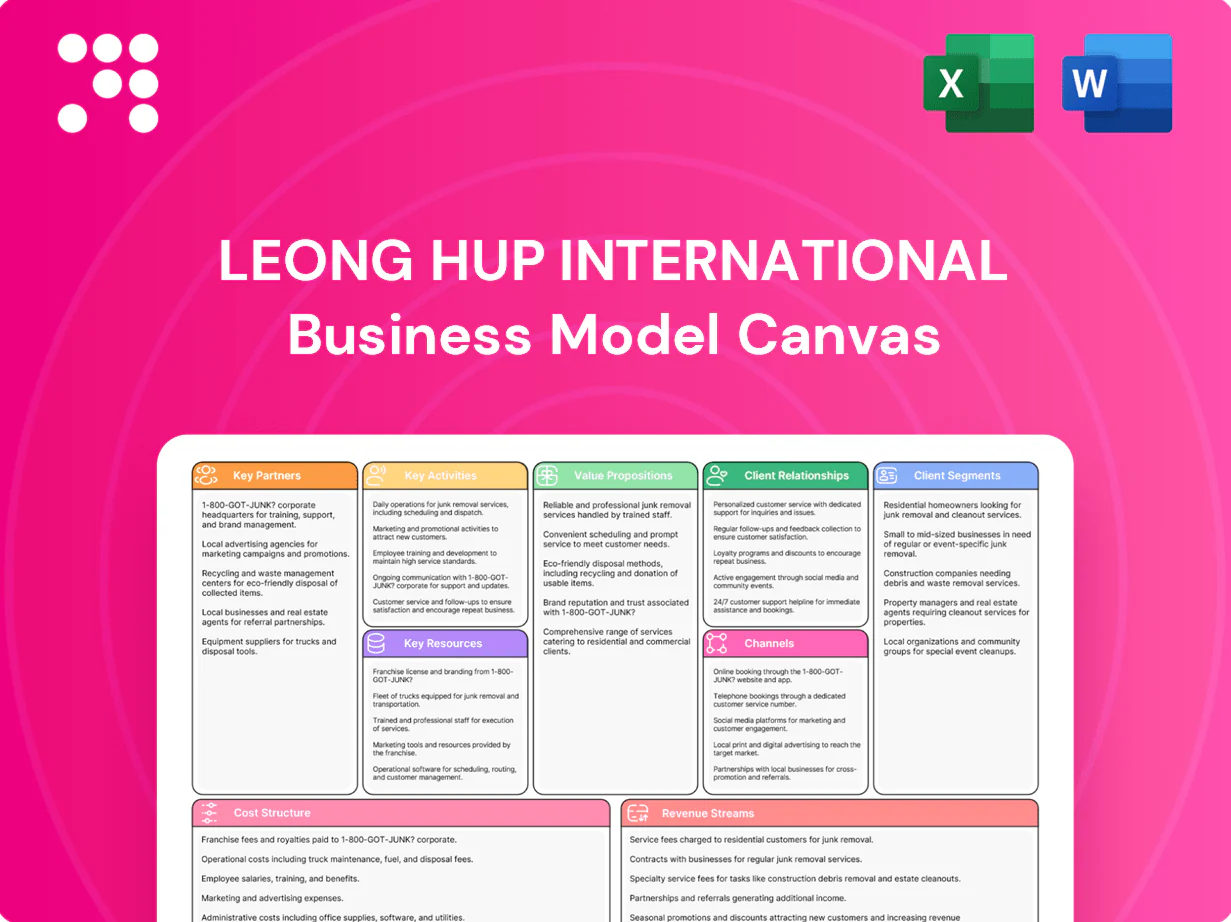
Leong Hup International Business Model Canvas

Unlock a strategic playbook with a full Business Model Canvas for poultry and agri-business leaders
Unlock Leong Hup International’s strategic playbook with our full Business Model Canvas—an actionable, sector-tailored breakdown of value propositions, revenue streams, partnerships and cost drivers. Perfect for investors, consultants and founders, download the editable Word & Excel files to benchmark, adapt and scale your own poultry and agri-business strategy now.
Partnerships

Grain and additive suppliers
Securing corn, soy, wheat and micronutrients under multi-year contracts stabilizes feed costs, crucial given feed typically represents about 70% of poultry production costs in 2024. Strategic sourcing from regional and global traders reduces price volatility and import disruptions. Joint forecasting and vendor-managed inventory boost mill uptime and lower emergency procurement. Quality-assurance partnerships maintain consistent formulation and performance.
Breeding stock and genetics firms
Alliances with primary breeders supply Leong Hup with high-performance broiler and layer genetics that target best-in-class broiler FCRs near 1.5 and layer yields around 300 eggs/hen/year. Access to superior lines shortens growth cycles and improves feed conversion and uniformity. Co-development of biosecurity and vaccination protocols lowers flock mortality, while structured data-sharing enables KPI benchmarking and continuous performance gains across farms.

Cold chain and logistics providers
Refrigerated transport partners maintain 2–4°C cold chains to safeguard product integrity across tropical climates, reducing spoilage for poultry and feed ingredients. Cross-border 3PLs streamline regional distribution and customs clearance, cutting lead times by up to 30%. Route optimization can lower fuel costs by up to 15% and improve on-time delivery. Contingency networks with multi-node depots preserve continuity during disruptions.

Retail, foodservice, and QSR chains
Contracted offtake with modern trade and QSRs covered over 40% of Leong Hup’s 2024 poultry volume, stabilizing demand and supporting pricing discipline; joint category management with key retailers drives assortment and promotions; co-created specifications align cut sizes and packaging formats for QSR efficiency; collaborative planning with partners smooths seasonal volume swings across the year.
- Offtake coverage: 40%+ (2024)
- Category mgmt: joint promotions & assortment
- Specs: aligned cut sizes & pack formats
- Planning: seasonal smoothing via collaboration
Government, vets, and compliance bodies
Partnerships with government, vets and compliance bodies ensure Leong Hup meets food safety, halal certification and animal welfare standards, underpinning market access and traceability.
Veterinary networks provide surveillance, vaccination programs and audit readiness, reducing disease risk and supply disruptions.
Active participation in industry and biosecurity bodies informs policy alignment and unlocks grants and permits that accelerate capacity expansion.
- Standards: food safety, halal, animal welfare
- Vets: surveillance, vaccination, audit readiness
- Industry bodies: policy, biosecurity best practices
- Grants/permits: enable faster capacity growth
Multi-year feed deals (70%) + breeders FCR 1.5, chilled logistics cut lead time 30%
Multi-year feed contracts stabilize costs (feed ≈70% of production) and reduce volatility; breeder alliances drive FCR ≈1.5 and layer yield ≈300 eggs/hen/yr; refrigerated 2–4°C logistics and 3PLs cut lead times up to 30% and fuel costs ~15%; offtake with modern trade/QSRs covers 40%+ of volume; vet/government ties ensure halal, safety and permits for expansion.
| Partnership | KPI | 2024 |
|---|---|---|
| Feed suppliers | Cost share | 70% |
| Breeders | FCR / eggs | 1.5 / 300 |
| Logistics | Lead time / fuel | -30% / -15% |
| Offtake | Volume covered | 40%+ |
What is included in the product
 Detailed Word Document
A comprehensive, pre-written Business Model Canvas for Leong Hup International covering customer segments, channels, value propositions and the nine classic BMC blocks with operational detail and competitive advantages. Ideal for presentations, investor or bank discussions, it includes SWOT-linked insights and supports validation of strategies using real company data.

 Customizable Excel Spreadsheet
High-level view of Leong Hup International’s business model with editable cells, condensing poultry-to-feed operations into a one-page snapshot for quick strategic review and team collaboration.
Activities

Feed milling and formulation
Procure, store and process grains into species-specific feed using automated batching and extrusion to meet targeted nutrient profiles and performance; mills target >95% uptime to control cost per tonne. Optimize formulations by balancing ingredient cost and nutrient density, leveraging least-cost formulation against market soybean meal and corn prices. Maintain strict quality controls, monitor aflatoxin at EU limit 20 µg/kg and full ingredient traceability.
Breeding, hatching, and grow-out
Manage GP/PS flocks, hatcheries, and broiler/layer farms with hatchability of 80–85% and staged broiler cycles to match market demand. Control stocking density at 30–38 kg/m2, enforce welfare and strict biosecurity. Track KPIs: FCR 1.5–1.8, mortality targets <4%, and EPEF 300–450 to optimize feed and throughput. Schedule production cycles and placement cadence to align supply with daily market signals.

Processing and further value-add
Operate integrated slaughtering, deboning and cut-up lines under strict hygiene protocols to produce chilled, frozen and marinated poultry for retail and HORECA, standardizing SKUs to streamline distribution and inventory management. Maintain HACCP and halal certification across facilities to ensure food safety and market access. Continuous process audits and cold-chain controls support product consistency and regulatory compliance.

Sales, merchandising, and key account management
- Negotiate contracts with retailers, distributors, QSRs
- Manage pricing, promotions, shelf execution
- Forecast demand and align supply
- Provide technical support and category insights
Quality assurance and biosecurity
Leong Hup runs routine lab testing of feed, water and product to verify safety and compliance, enforces strict farm entry controls and vaccination schedules, and conducts regular audits and traceability drills to ensure chain integrity. Protocols are updated continuously to mitigate emerging disease risks and align with regulatory standards.
- Lab testing: feed, water, product
- Biosecurity: farm entry controls, vaccination schedules
- Verification: audits, traceability drills
- Continuous improvement: protocols vs emerging diseases
>95% uptime, 20µg/kg aflatoxin, aflatoxin, FCR 1.5–1.8
Operate feed mills (uptime >95%) to produce species-specific rations via least-cost formulation; enforce aflatoxin limit 20 µg/kg and full traceability. Manage GP/PS, hatcheries and broilers with hatchability 80–85%, FCR 1.5–1.8, mortality <4% and EPEF 300–450. Run integrated slaughter, HACCP/halal-certified processing, cold-chain and sales to align supply with retail/HORECA demand.
| Metric | Target/Value |
|---|---|
| Mill uptime | >95% |
| Aflatoxin limit | 20 µg/kg (EU) |
| Hatchability | 80–85% |
| FCR | 1.5–1.8 |
| Mortality | <4% |
| EPEF | 300–450 |
Preview Before You Purchase
Business Model Canvas
The document previewed here is the actual Leong Hup International Business Model Canvas, not a mockup or sample. When you purchase, you’ll receive this exact file—complete and editable—formatted as the same professional deliverable. Instantly download the full version ready for presentation, editing, and sharing.

Unlock a strategic playbook with a full Business Model Canvas for poultry and agri-business leaders
Unlock Leong Hup International’s strategic playbook with our full Business Model Canvas—an actionable, sector-tailored breakdown of value propositions, revenue streams, partnerships and cost drivers. Perfect for investors, consultants and founders, download the editable Word & Excel files to benchmark, adapt and scale your own poultry and agri-business strategy now.
Partnerships
Grain and additive suppliers
Securing corn, soy, wheat and micronutrients under multi-year contracts stabilizes feed costs, crucial given feed typically represents about 70% of poultry production costs in 2024. Strategic sourcing from regional and global traders reduces price volatility and import disruptions. Joint forecasting and vendor-managed inventory boost mill uptime and lower emergency procurement. Quality-assurance partnerships maintain consistent formulation and performance.
Breeding stock and genetics firms
Alliances with primary breeders supply Leong Hup with high-performance broiler and layer genetics that target best-in-class broiler FCRs near 1.5 and layer yields around 300 eggs/hen/year. Access to superior lines shortens growth cycles and improves feed conversion and uniformity. Co-development of biosecurity and vaccination protocols lowers flock mortality, while structured data-sharing enables KPI benchmarking and continuous performance gains across farms.
Cold chain and logistics providers
Refrigerated transport partners maintain 2–4°C cold chains to safeguard product integrity across tropical climates, reducing spoilage for poultry and feed ingredients. Cross-border 3PLs streamline regional distribution and customs clearance, cutting lead times by up to 30%. Route optimization can lower fuel costs by up to 15% and improve on-time delivery. Contingency networks with multi-node depots preserve continuity during disruptions.
Retail, foodservice, and QSR chains
Contracted offtake with modern trade and QSRs covered over 40% of Leong Hup’s 2024 poultry volume, stabilizing demand and supporting pricing discipline; joint category management with key retailers drives assortment and promotions; co-created specifications align cut sizes and packaging formats for QSR efficiency; collaborative planning with partners smooths seasonal volume swings across the year.
- Offtake coverage: 40%+ (2024)
- Category mgmt: joint promotions & assortment
- Specs: aligned cut sizes & pack formats
- Planning: seasonal smoothing via collaboration
Government, vets, and compliance bodies
Partnerships with government, vets and compliance bodies ensure Leong Hup meets food safety, halal certification and animal welfare standards, underpinning market access and traceability.
Veterinary networks provide surveillance, vaccination programs and audit readiness, reducing disease risk and supply disruptions.
Active participation in industry and biosecurity bodies informs policy alignment and unlocks grants and permits that accelerate capacity expansion.
- Standards: food safety, halal, animal welfare
- Vets: surveillance, vaccination, audit readiness
- Industry bodies: policy, biosecurity best practices
- Grants/permits: enable faster capacity growth
Multi-year feed deals (70%) + breeders FCR 1.5, chilled logistics cut lead time 30%
Multi-year feed contracts stabilize costs (feed ≈70% of production) and reduce volatility; breeder alliances drive FCR ≈1.5 and layer yield ≈300 eggs/hen/yr; refrigerated 2–4°C logistics and 3PLs cut lead times up to 30% and fuel costs ~15%; offtake with modern trade/QSRs covers 40%+ of volume; vet/government ties ensure halal, safety and permits for expansion.
| Partnership | KPI | 2024 |
|---|---|---|
| Feed suppliers | Cost share | 70% |
| Breeders | FCR / eggs | 1.5 / 300 |
| Logistics | Lead time / fuel | -30% / -15% |
| Offtake | Volume covered | 40%+ |
What is included in the product
Detailed Word Document
A comprehensive, pre-written Business Model Canvas for Leong Hup International covering customer segments, channels, value propositions and the nine classic BMC blocks with operational detail and competitive advantages. Ideal for presentations, investor or bank discussions, it includes SWOT-linked insights and supports validation of strategies using real company data.
Customizable Excel Spreadsheet
High-level view of Leong Hup International’s business model with editable cells, condensing poultry-to-feed operations into a one-page snapshot for quick strategic review and team collaboration.
Activities
Feed milling and formulation
Procure, store and process grains into species-specific feed using automated batching and extrusion to meet targeted nutrient profiles and performance; mills target >95% uptime to control cost per tonne. Optimize formulations by balancing ingredient cost and nutrient density, leveraging least-cost formulation against market soybean meal and corn prices. Maintain strict quality controls, monitor aflatoxin at EU limit 20 µg/kg and full ingredient traceability.
Breeding, hatching, and grow-out
Manage GP/PS flocks, hatcheries, and broiler/layer farms with hatchability of 80–85% and staged broiler cycles to match market demand. Control stocking density at 30–38 kg/m2, enforce welfare and strict biosecurity. Track KPIs: FCR 1.5–1.8, mortality targets <4%, and EPEF 300–450 to optimize feed and throughput. Schedule production cycles and placement cadence to align supply with daily market signals.
Processing and further value-add
Operate integrated slaughtering, deboning and cut-up lines under strict hygiene protocols to produce chilled, frozen and marinated poultry for retail and HORECA, standardizing SKUs to streamline distribution and inventory management. Maintain HACCP and halal certification across facilities to ensure food safety and market access. Continuous process audits and cold-chain controls support product consistency and regulatory compliance.
Sales, merchandising, and key account management
- Negotiate contracts with retailers, distributors, QSRs
- Manage pricing, promotions, shelf execution
- Forecast demand and align supply
- Provide technical support and category insights
Quality assurance and biosecurity
Leong Hup runs routine lab testing of feed, water and product to verify safety and compliance, enforces strict farm entry controls and vaccination schedules, and conducts regular audits and traceability drills to ensure chain integrity. Protocols are updated continuously to mitigate emerging disease risks and align with regulatory standards.
- Lab testing: feed, water, product
- Biosecurity: farm entry controls, vaccination schedules
- Verification: audits, traceability drills
- Continuous improvement: protocols vs emerging diseases
>95% uptime, 20µg/kg aflatoxin, aflatoxin, FCR 1.5–1.8
Operate feed mills (uptime >95%) to produce species-specific rations via least-cost formulation; enforce aflatoxin limit 20 µg/kg and full traceability. Manage GP/PS, hatcheries and broilers with hatchability 80–85%, FCR 1.5–1.8, mortality <4% and EPEF 300–450. Run integrated slaughter, HACCP/halal-certified processing, cold-chain and sales to align supply with retail/HORECA demand.
| Metric | Target/Value |
|---|---|
| Mill uptime | >95% |
| Aflatoxin limit | 20 µg/kg (EU) |
| Hatchability | 80–85% |
| FCR | 1.5–1.8 |
| Mortality | <4% |
| EPEF | 300–450 |
Preview Before You Purchase
Business Model Canvas
The document previewed here is the actual Leong Hup International Business Model Canvas, not a mockup or sample. When you purchase, you’ll receive this exact file—complete and editable—formatted as the same professional deliverable. Instantly download the full version ready for presentation, editing, and sharing.
Description
Unlock a strategic playbook with a full Business Model Canvas for poultry and agri-business leaders
Unlock Leong Hup International’s strategic playbook with our full Business Model Canvas—an actionable, sector-tailored breakdown of value propositions, revenue streams, partnerships and cost drivers. Perfect for investors, consultants and founders, download the editable Word & Excel files to benchmark, adapt and scale your own poultry and agri-business strategy now.
Partnerships
Grain and additive suppliers
Securing corn, soy, wheat and micronutrients under multi-year contracts stabilizes feed costs, crucial given feed typically represents about 70% of poultry production costs in 2024. Strategic sourcing from regional and global traders reduces price volatility and import disruptions. Joint forecasting and vendor-managed inventory boost mill uptime and lower emergency procurement. Quality-assurance partnerships maintain consistent formulation and performance.
Breeding stock and genetics firms
Alliances with primary breeders supply Leong Hup with high-performance broiler and layer genetics that target best-in-class broiler FCRs near 1.5 and layer yields around 300 eggs/hen/year. Access to superior lines shortens growth cycles and improves feed conversion and uniformity. Co-development of biosecurity and vaccination protocols lowers flock mortality, while structured data-sharing enables KPI benchmarking and continuous performance gains across farms.
Cold chain and logistics providers
Refrigerated transport partners maintain 2–4°C cold chains to safeguard product integrity across tropical climates, reducing spoilage for poultry and feed ingredients. Cross-border 3PLs streamline regional distribution and customs clearance, cutting lead times by up to 30%. Route optimization can lower fuel costs by up to 15% and improve on-time delivery. Contingency networks with multi-node depots preserve continuity during disruptions.
Retail, foodservice, and QSR chains
Contracted offtake with modern trade and QSRs covered over 40% of Leong Hup’s 2024 poultry volume, stabilizing demand and supporting pricing discipline; joint category management with key retailers drives assortment and promotions; co-created specifications align cut sizes and packaging formats for QSR efficiency; collaborative planning with partners smooths seasonal volume swings across the year.
- Offtake coverage: 40%+ (2024)
- Category mgmt: joint promotions & assortment
- Specs: aligned cut sizes & pack formats
- Planning: seasonal smoothing via collaboration
Government, vets, and compliance bodies
Partnerships with government, vets and compliance bodies ensure Leong Hup meets food safety, halal certification and animal welfare standards, underpinning market access and traceability.
Veterinary networks provide surveillance, vaccination programs and audit readiness, reducing disease risk and supply disruptions.
Active participation in industry and biosecurity bodies informs policy alignment and unlocks grants and permits that accelerate capacity expansion.
- Standards: food safety, halal, animal welfare
- Vets: surveillance, vaccination, audit readiness
- Industry bodies: policy, biosecurity best practices
- Grants/permits: enable faster capacity growth
Multi-year feed deals (70%) + breeders FCR 1.5, chilled logistics cut lead time 30%
Multi-year feed contracts stabilize costs (feed ≈70% of production) and reduce volatility; breeder alliances drive FCR ≈1.5 and layer yield ≈300 eggs/hen/yr; refrigerated 2–4°C logistics and 3PLs cut lead times up to 30% and fuel costs ~15%; offtake with modern trade/QSRs covers 40%+ of volume; vet/government ties ensure halal, safety and permits for expansion.
| Partnership | KPI | 2024 |
|---|---|---|
| Feed suppliers | Cost share | 70% |
| Breeders | FCR / eggs | 1.5 / 300 |
| Logistics | Lead time / fuel | -30% / -15% |
| Offtake | Volume covered | 40%+ |
What is included in the product
Detailed Word Document
A comprehensive, pre-written Business Model Canvas for Leong Hup International covering customer segments, channels, value propositions and the nine classic BMC blocks with operational detail and competitive advantages. Ideal for presentations, investor or bank discussions, it includes SWOT-linked insights and supports validation of strategies using real company data.
Customizable Excel Spreadsheet
High-level view of Leong Hup International’s business model with editable cells, condensing poultry-to-feed operations into a one-page snapshot for quick strategic review and team collaboration.
Activities
Feed milling and formulation
Procure, store and process grains into species-specific feed using automated batching and extrusion to meet targeted nutrient profiles and performance; mills target >95% uptime to control cost per tonne. Optimize formulations by balancing ingredient cost and nutrient density, leveraging least-cost formulation against market soybean meal and corn prices. Maintain strict quality controls, monitor aflatoxin at EU limit 20 µg/kg and full ingredient traceability.
Breeding, hatching, and grow-out
Manage GP/PS flocks, hatcheries, and broiler/layer farms with hatchability of 80–85% and staged broiler cycles to match market demand. Control stocking density at 30–38 kg/m2, enforce welfare and strict biosecurity. Track KPIs: FCR 1.5–1.8, mortality targets <4%, and EPEF 300–450 to optimize feed and throughput. Schedule production cycles and placement cadence to align supply with daily market signals.
Processing and further value-add
Operate integrated slaughtering, deboning and cut-up lines under strict hygiene protocols to produce chilled, frozen and marinated poultry for retail and HORECA, standardizing SKUs to streamline distribution and inventory management. Maintain HACCP and halal certification across facilities to ensure food safety and market access. Continuous process audits and cold-chain controls support product consistency and regulatory compliance.
Sales, merchandising, and key account management
- Negotiate contracts with retailers, distributors, QSRs
- Manage pricing, promotions, shelf execution
- Forecast demand and align supply
- Provide technical support and category insights
Quality assurance and biosecurity
Leong Hup runs routine lab testing of feed, water and product to verify safety and compliance, enforces strict farm entry controls and vaccination schedules, and conducts regular audits and traceability drills to ensure chain integrity. Protocols are updated continuously to mitigate emerging disease risks and align with regulatory standards.
- Lab testing: feed, water, product
- Biosecurity: farm entry controls, vaccination schedules
- Verification: audits, traceability drills
- Continuous improvement: protocols vs emerging diseases
>95% uptime, 20µg/kg aflatoxin, aflatoxin, FCR 1.5–1.8
Operate feed mills (uptime >95%) to produce species-specific rations via least-cost formulation; enforce aflatoxin limit 20 µg/kg and full traceability. Manage GP/PS, hatcheries and broilers with hatchability 80–85%, FCR 1.5–1.8, mortality <4% and EPEF 300–450. Run integrated slaughter, HACCP/halal-certified processing, cold-chain and sales to align supply with retail/HORECA demand.
| Metric | Target/Value |
|---|---|
| Mill uptime | >95% |
| Aflatoxin limit | 20 µg/kg (EU) |
| Hatchability | 80–85% |
| FCR | 1.5–1.8 |
| Mortality | <4% |
| EPEF | 300–450 |
Preview Before You Purchase
Business Model Canvas
The document previewed here is the actual Leong Hup International Business Model Canvas, not a mockup or sample. When you purchase, you’ll receive this exact file—complete and editable—formatted as the same professional deliverable. Instantly download the full version ready for presentation, editing, and sharing.











