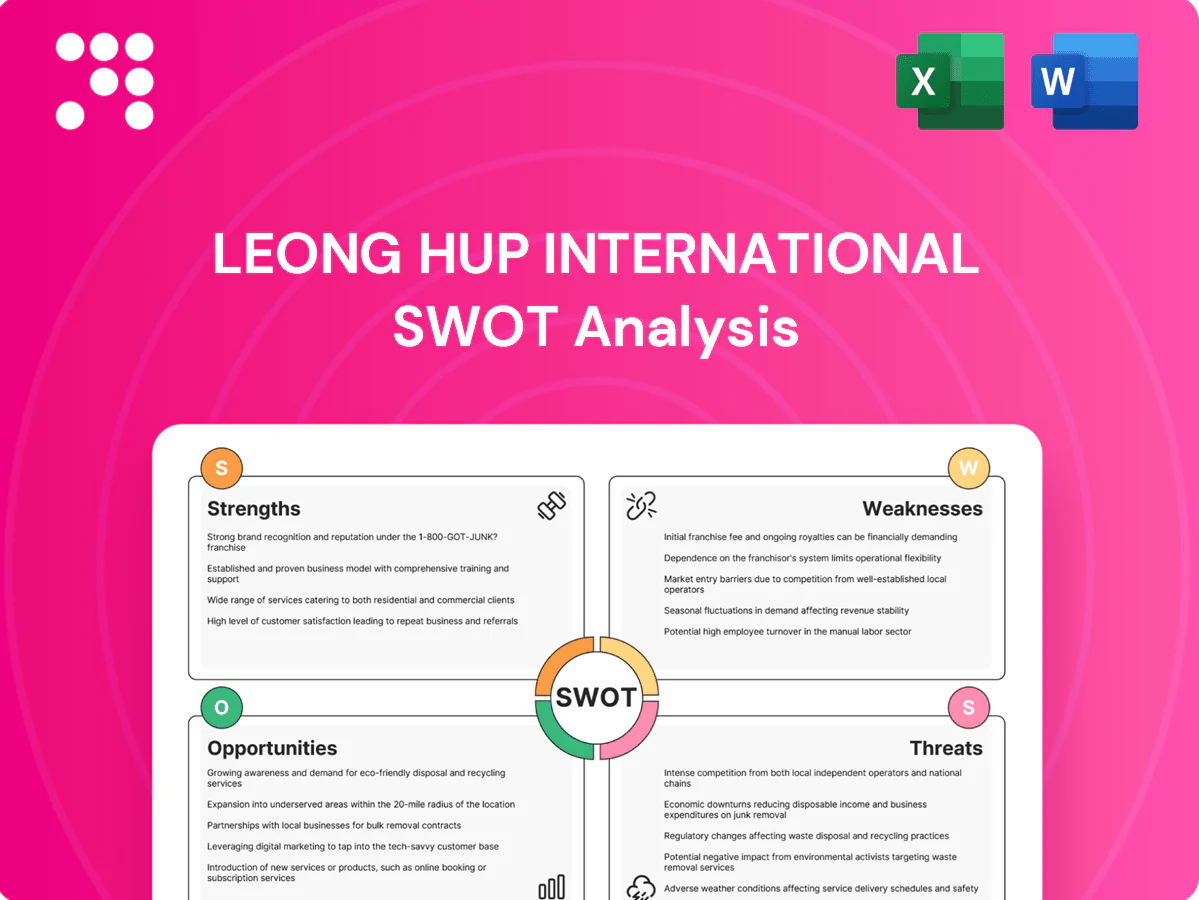
Leong Hup International SWOT Analysis

Make Insightful Decisions Backed by Expert Research
Leong Hup International’s SWOT highlights strong regional feed-to-farm integration, scale advantages, and growth in ASEAN protein demand, alongside supply-chain risks and regulatory exposure. Want the full story behind its strengths, risks, and growth drivers? Purchase the complete SWOT analysis to access a professionally written, fully editable Word report plus an Excel matrix for strategy and investment use.
Strengths

Fully integrated value chain
End-to-end control from feed milling to processing gives Leong Hup International robust quality assurance and traceability across its integrated operations, built over more than 30 years in the region. Vertical integration reduces reliance on third parties and helps stabilize input costs, supporting resilience during feed-price volatility. It enables rapid response to demand shifts and biosecurity incidents, while allowing margin capture across feed, farming and processing stages.
Regional scale in Southeast Asia
Leong Hup’s regional scale—operations across five Southeast Asian markets—diversifies revenue and dilutes country-specific operational risk, smoothing group-wide volumes during localized downturns. Scale boosts procurement leverage for grains, vaccines and equipment, lowering input costs per unit. A broader footprint supports cross-border customer relationships and export optionality, enabling better price negotiation and logistics optimization.

Diversified product portfolio
In 2024 Leong Hup’s integrated broilers, eggs and feed businesses provide multiple revenue streams, creating natural hedges across cycles. Feed sales historically smooth group earnings when live-bird prices weaken, stabilizing cashflow. The product breadth enables bundled supply packages to commercial farms and retail chains. This integration strengthens bargaining power with distributors and foodservice partners.

Established distribution and customer relationships
Leong Hup's longstanding ties with retailers, wet markets and foodservice operators secure steady offtake and improve demand visibility, enabling tighter production planning and higher capacity utilization. Deep route-to-market capabilities boost freshness and inventory turns, while these relationships raise switching costs for customers.
- Longstanding retail and foodservice ties
- Strong route-to-market; better freshness
- Demand visibility aids planning
- Higher switching costs for customers
Operational know-how and biosecurity protocols
Leong Hup leverages decades of breeding, hatchery and grow-out experience across varied climates to drive reliable execution and scale operations efficiently. Standardized SOPs and vaccination regimes lower mortality and variability, while integrated farm-to-feed data enables continuous performance improvement. This operational expertise underpins consistent yields and product quality.
- Integrated operations: operational data drives optimization
- SOPs & vaccination: reduced mortality/variability
- Breeding-to-market expertise: consistent yield & quality
Integrated feed-to-retail platform with regional scale across 5 SEA markets
End-to-end integration across feed-to-retail built over more than 30 years delivers strong traceability, cost control and margin capture. Regional scale across five Southeast Asian markets diversifies country risk and boosts procurement leverage. Multiple revenue streams—broilers, eggs, feed—stabilize cashflow and strengthen bargaining power with customers.
| Metric | Value |
|---|---|
| Markets | 5 |
| Operating history | >30 years |
| Core streams | Broilers, Eggs, Feed |
What is included in the product
 Detailed Word Document
Delivers a strategic overview of Leong Hup International’s internal and external business factors, outlining strengths, weaknesses, opportunities and threats to assess its competitive position, growth drivers, operational gaps and future risks.

 Customizable Excel Spreadsheet
Provides a concise SWOT matrix for Leong Hup International to quickly pinpoint strengths, weaknesses, opportunities and threats, enabling fast strategic alignment and clearer decision-making.
Weaknesses

High exposure to feed commodity volatility
High exposure to corn and soybean meal means swings in those commodity prices flow directly into Leong Hup’s cost of goods sold, making margins vulnerable during spikes. The company’s hedging programs mitigate but do not eliminate basis and logistics risk, leaving residual volatility. Price pass-through to consumers can lag in regulated or price-sensitive channels, compressing margins when commodity costs surge.
Thin margins in a price-sensitive category
Poultry and eggs are staple proteins with limited pricing power, leaving Leong Hup exposed to government price controls and retailer promotions that compress unit economics. Small feed-cost or logistics inefficiencies can materially erode already thin operating margins. Sustained margin expansion is difficult without meaningful product-mix upgrades into higher-value segments or branded processed foods.

Biosecurity and concentration risks
Disease incidents can force mass culling and disrupt live-bird logistics, with HPAI since 2021 affecting over 70 countries and causing the culling of millions of poultry worldwide. Clusters of farms concentrate contagion risk despite protocols, increasing the chance of regional spread. Outbreaks prompt temporary export/import bans and reputational damage, and recovery often requires weeks-to-months plus significant working capital to rebuild flocks.

Capital-intensive operations
Capital-intensive breeding, hatchery and processing assets force Leong Hup into continual capex cycles, raising fixed costs and operating leverage; integrated poultry payback periods commonly range 4–7 years, making returns sensitive to demand stability and feed cost swings.
During industry downcycles, cash flow and balance-sheet flexibility tighten as working capital and maintenance capex persist, increasing vulnerability to input-price volatility.
- High fixed costs
- 4–7 year payback
- Strong sensitivity to feed prices
ESG and environmental footprint
Leong Hup faces ESG weaknesses as manure management, intensive water use and farm emissions draw growing regulatory scrutiny and remediation costs. Stakeholders increasingly demand antibiotic stewardship and higher animal welfare standards, raising compliance complexity across its integrated operations. Failure to close gaps risks losing premium retail contracts and green financing opportunities.
- Manure, water and emissions: regulatory exposure
- Antibiotic stewardship & animal welfare: rising stakeholder focus
- Compliance: higher OPEX and operational complexity
- Gaps: reduced access to premium customers and sustainable financing
Feed-price volatility and disease risk squeeze margins; capex and ESG raise costs
High feed-price exposure leaves margins vulnerable despite hedging; price pass-through is slow in regulated or price-sensitive channels. Limited pricing power and thin unit economics increase downside from promotions and controls. Disease risk remains material (HPAI impacted 70+ countries since 2021) while integrated assets demand 4–7 year capex paybacks and rising ESG compliance costs.
| Weakness | Key metric |
|---|---|
| Feed-price sensitivity | High; residual volatility despite hedges |
| Disease outbreak risk | HPAI: 70+ countries affected since 2021 |
| Capex intensity | Payback 4–7 years |
| ESG/compliance | Rising OPEX; risk to premium contracts |
Preview Before You Purchase
Leong Hup International SWOT Analysis
This is the actual Leong Hup International SWOT analysis document you’ll receive upon purchase—no surprises, just professional quality. The preview below is taken directly from the full report you'll get, and the content is structured, editable, and ready to use. Purchase unlocks the entire in-depth version with full strengths, weaknesses, opportunities and threats. Buy now to download the complete file immediately after payment.

Make Insightful Decisions Backed by Expert Research
Leong Hup International’s SWOT highlights strong regional feed-to-farm integration, scale advantages, and growth in ASEAN protein demand, alongside supply-chain risks and regulatory exposure. Want the full story behind its strengths, risks, and growth drivers? Purchase the complete SWOT analysis to access a professionally written, fully editable Word report plus an Excel matrix for strategy and investment use.
Strengths
Fully integrated value chain
End-to-end control from feed milling to processing gives Leong Hup International robust quality assurance and traceability across its integrated operations, built over more than 30 years in the region. Vertical integration reduces reliance on third parties and helps stabilize input costs, supporting resilience during feed-price volatility. It enables rapid response to demand shifts and biosecurity incidents, while allowing margin capture across feed, farming and processing stages.
Regional scale in Southeast Asia
Leong Hup’s regional scale—operations across five Southeast Asian markets—diversifies revenue and dilutes country-specific operational risk, smoothing group-wide volumes during localized downturns. Scale boosts procurement leverage for grains, vaccines and equipment, lowering input costs per unit. A broader footprint supports cross-border customer relationships and export optionality, enabling better price negotiation and logistics optimization.
Diversified product portfolio
In 2024 Leong Hup’s integrated broilers, eggs and feed businesses provide multiple revenue streams, creating natural hedges across cycles. Feed sales historically smooth group earnings when live-bird prices weaken, stabilizing cashflow. The product breadth enables bundled supply packages to commercial farms and retail chains. This integration strengthens bargaining power with distributors and foodservice partners.
Established distribution and customer relationships
Leong Hup's longstanding ties with retailers, wet markets and foodservice operators secure steady offtake and improve demand visibility, enabling tighter production planning and higher capacity utilization. Deep route-to-market capabilities boost freshness and inventory turns, while these relationships raise switching costs for customers.
- Longstanding retail and foodservice ties
- Strong route-to-market; better freshness
- Demand visibility aids planning
- Higher switching costs for customers
Operational know-how and biosecurity protocols
Leong Hup leverages decades of breeding, hatchery and grow-out experience across varied climates to drive reliable execution and scale operations efficiently. Standardized SOPs and vaccination regimes lower mortality and variability, while integrated farm-to-feed data enables continuous performance improvement. This operational expertise underpins consistent yields and product quality.
- Integrated operations: operational data drives optimization
- SOPs & vaccination: reduced mortality/variability
- Breeding-to-market expertise: consistent yield & quality
Integrated feed-to-retail platform with regional scale across 5 SEA markets
End-to-end integration across feed-to-retail built over more than 30 years delivers strong traceability, cost control and margin capture. Regional scale across five Southeast Asian markets diversifies country risk and boosts procurement leverage. Multiple revenue streams—broilers, eggs, feed—stabilize cashflow and strengthen bargaining power with customers.
| Metric | Value |
|---|---|
| Markets | 5 |
| Operating history | >30 years |
| Core streams | Broilers, Eggs, Feed |
What is included in the product
Detailed Word Document
Delivers a strategic overview of Leong Hup International’s internal and external business factors, outlining strengths, weaknesses, opportunities and threats to assess its competitive position, growth drivers, operational gaps and future risks.
Customizable Excel Spreadsheet
Provides a concise SWOT matrix for Leong Hup International to quickly pinpoint strengths, weaknesses, opportunities and threats, enabling fast strategic alignment and clearer decision-making.
Weaknesses
High exposure to feed commodity volatility
High exposure to corn and soybean meal means swings in those commodity prices flow directly into Leong Hup’s cost of goods sold, making margins vulnerable during spikes. The company’s hedging programs mitigate but do not eliminate basis and logistics risk, leaving residual volatility. Price pass-through to consumers can lag in regulated or price-sensitive channels, compressing margins when commodity costs surge.
Thin margins in a price-sensitive category
Poultry and eggs are staple proteins with limited pricing power, leaving Leong Hup exposed to government price controls and retailer promotions that compress unit economics. Small feed-cost or logistics inefficiencies can materially erode already thin operating margins. Sustained margin expansion is difficult without meaningful product-mix upgrades into higher-value segments or branded processed foods.
Biosecurity and concentration risks
Disease incidents can force mass culling and disrupt live-bird logistics, with HPAI since 2021 affecting over 70 countries and causing the culling of millions of poultry worldwide. Clusters of farms concentrate contagion risk despite protocols, increasing the chance of regional spread. Outbreaks prompt temporary export/import bans and reputational damage, and recovery often requires weeks-to-months plus significant working capital to rebuild flocks.
Capital-intensive operations
Capital-intensive breeding, hatchery and processing assets force Leong Hup into continual capex cycles, raising fixed costs and operating leverage; integrated poultry payback periods commonly range 4–7 years, making returns sensitive to demand stability and feed cost swings.
During industry downcycles, cash flow and balance-sheet flexibility tighten as working capital and maintenance capex persist, increasing vulnerability to input-price volatility.
- High fixed costs
- 4–7 year payback
- Strong sensitivity to feed prices
ESG and environmental footprint
Leong Hup faces ESG weaknesses as manure management, intensive water use and farm emissions draw growing regulatory scrutiny and remediation costs. Stakeholders increasingly demand antibiotic stewardship and higher animal welfare standards, raising compliance complexity across its integrated operations. Failure to close gaps risks losing premium retail contracts and green financing opportunities.
- Manure, water and emissions: regulatory exposure
- Antibiotic stewardship & animal welfare: rising stakeholder focus
- Compliance: higher OPEX and operational complexity
- Gaps: reduced access to premium customers and sustainable financing
Feed-price volatility and disease risk squeeze margins; capex and ESG raise costs
High feed-price exposure leaves margins vulnerable despite hedging; price pass-through is slow in regulated or price-sensitive channels. Limited pricing power and thin unit economics increase downside from promotions and controls. Disease risk remains material (HPAI impacted 70+ countries since 2021) while integrated assets demand 4–7 year capex paybacks and rising ESG compliance costs.
| Weakness | Key metric |
|---|---|
| Feed-price sensitivity | High; residual volatility despite hedges |
| Disease outbreak risk | HPAI: 70+ countries affected since 2021 |
| Capex intensity | Payback 4–7 years |
| ESG/compliance | Rising OPEX; risk to premium contracts |
Preview Before You Purchase
Leong Hup International SWOT Analysis
This is the actual Leong Hup International SWOT analysis document you’ll receive upon purchase—no surprises, just professional quality. The preview below is taken directly from the full report you'll get, and the content is structured, editable, and ready to use. Purchase unlocks the entire in-depth version with full strengths, weaknesses, opportunities and threats. Buy now to download the complete file immediately after payment.
Description
Make Insightful Decisions Backed by Expert Research
Leong Hup International’s SWOT highlights strong regional feed-to-farm integration, scale advantages, and growth in ASEAN protein demand, alongside supply-chain risks and regulatory exposure. Want the full story behind its strengths, risks, and growth drivers? Purchase the complete SWOT analysis to access a professionally written, fully editable Word report plus an Excel matrix for strategy and investment use.
Strengths
Fully integrated value chain
End-to-end control from feed milling to processing gives Leong Hup International robust quality assurance and traceability across its integrated operations, built over more than 30 years in the region. Vertical integration reduces reliance on third parties and helps stabilize input costs, supporting resilience during feed-price volatility. It enables rapid response to demand shifts and biosecurity incidents, while allowing margin capture across feed, farming and processing stages.
Regional scale in Southeast Asia
Leong Hup’s regional scale—operations across five Southeast Asian markets—diversifies revenue and dilutes country-specific operational risk, smoothing group-wide volumes during localized downturns. Scale boosts procurement leverage for grains, vaccines and equipment, lowering input costs per unit. A broader footprint supports cross-border customer relationships and export optionality, enabling better price negotiation and logistics optimization.
Diversified product portfolio
In 2024 Leong Hup’s integrated broilers, eggs and feed businesses provide multiple revenue streams, creating natural hedges across cycles. Feed sales historically smooth group earnings when live-bird prices weaken, stabilizing cashflow. The product breadth enables bundled supply packages to commercial farms and retail chains. This integration strengthens bargaining power with distributors and foodservice partners.
Established distribution and customer relationships
Leong Hup's longstanding ties with retailers, wet markets and foodservice operators secure steady offtake and improve demand visibility, enabling tighter production planning and higher capacity utilization. Deep route-to-market capabilities boost freshness and inventory turns, while these relationships raise switching costs for customers.
- Longstanding retail and foodservice ties
- Strong route-to-market; better freshness
- Demand visibility aids planning
- Higher switching costs for customers
Operational know-how and biosecurity protocols
Leong Hup leverages decades of breeding, hatchery and grow-out experience across varied climates to drive reliable execution and scale operations efficiently. Standardized SOPs and vaccination regimes lower mortality and variability, while integrated farm-to-feed data enables continuous performance improvement. This operational expertise underpins consistent yields and product quality.
- Integrated operations: operational data drives optimization
- SOPs & vaccination: reduced mortality/variability
- Breeding-to-market expertise: consistent yield & quality
Integrated feed-to-retail platform with regional scale across 5 SEA markets
End-to-end integration across feed-to-retail built over more than 30 years delivers strong traceability, cost control and margin capture. Regional scale across five Southeast Asian markets diversifies country risk and boosts procurement leverage. Multiple revenue streams—broilers, eggs, feed—stabilize cashflow and strengthen bargaining power with customers.
| Metric | Value |
|---|---|
| Markets | 5 |
| Operating history | >30 years |
| Core streams | Broilers, Eggs, Feed |
What is included in the product
Detailed Word Document
Delivers a strategic overview of Leong Hup International’s internal and external business factors, outlining strengths, weaknesses, opportunities and threats to assess its competitive position, growth drivers, operational gaps and future risks.
Customizable Excel Spreadsheet
Provides a concise SWOT matrix for Leong Hup International to quickly pinpoint strengths, weaknesses, opportunities and threats, enabling fast strategic alignment and clearer decision-making.
Weaknesses
High exposure to feed commodity volatility
High exposure to corn and soybean meal means swings in those commodity prices flow directly into Leong Hup’s cost of goods sold, making margins vulnerable during spikes. The company’s hedging programs mitigate but do not eliminate basis and logistics risk, leaving residual volatility. Price pass-through to consumers can lag in regulated or price-sensitive channels, compressing margins when commodity costs surge.
Thin margins in a price-sensitive category
Poultry and eggs are staple proteins with limited pricing power, leaving Leong Hup exposed to government price controls and retailer promotions that compress unit economics. Small feed-cost or logistics inefficiencies can materially erode already thin operating margins. Sustained margin expansion is difficult without meaningful product-mix upgrades into higher-value segments or branded processed foods.
Biosecurity and concentration risks
Disease incidents can force mass culling and disrupt live-bird logistics, with HPAI since 2021 affecting over 70 countries and causing the culling of millions of poultry worldwide. Clusters of farms concentrate contagion risk despite protocols, increasing the chance of regional spread. Outbreaks prompt temporary export/import bans and reputational damage, and recovery often requires weeks-to-months plus significant working capital to rebuild flocks.
Capital-intensive operations
Capital-intensive breeding, hatchery and processing assets force Leong Hup into continual capex cycles, raising fixed costs and operating leverage; integrated poultry payback periods commonly range 4–7 years, making returns sensitive to demand stability and feed cost swings.
During industry downcycles, cash flow and balance-sheet flexibility tighten as working capital and maintenance capex persist, increasing vulnerability to input-price volatility.
- High fixed costs
- 4–7 year payback
- Strong sensitivity to feed prices
ESG and environmental footprint
Leong Hup faces ESG weaknesses as manure management, intensive water use and farm emissions draw growing regulatory scrutiny and remediation costs. Stakeholders increasingly demand antibiotic stewardship and higher animal welfare standards, raising compliance complexity across its integrated operations. Failure to close gaps risks losing premium retail contracts and green financing opportunities.
- Manure, water and emissions: regulatory exposure
- Antibiotic stewardship & animal welfare: rising stakeholder focus
- Compliance: higher OPEX and operational complexity
- Gaps: reduced access to premium customers and sustainable financing
Feed-price volatility and disease risk squeeze margins; capex and ESG raise costs
High feed-price exposure leaves margins vulnerable despite hedging; price pass-through is slow in regulated or price-sensitive channels. Limited pricing power and thin unit economics increase downside from promotions and controls. Disease risk remains material (HPAI impacted 70+ countries since 2021) while integrated assets demand 4–7 year capex paybacks and rising ESG compliance costs.
| Weakness | Key metric |
|---|---|
| Feed-price sensitivity | High; residual volatility despite hedges |
| Disease outbreak risk | HPAI: 70+ countries affected since 2021 |
| Capex intensity | Payback 4–7 years |
| ESG/compliance | Rising OPEX; risk to premium contracts |
Preview Before You Purchase
Leong Hup International SWOT Analysis
This is the actual Leong Hup International SWOT analysis document you’ll receive upon purchase—no surprises, just professional quality. The preview below is taken directly from the full report you'll get, and the content is structured, editable, and ready to use. Purchase unlocks the entire in-depth version with full strengths, weaknesses, opportunities and threats. Buy now to download the complete file immediately after payment.











