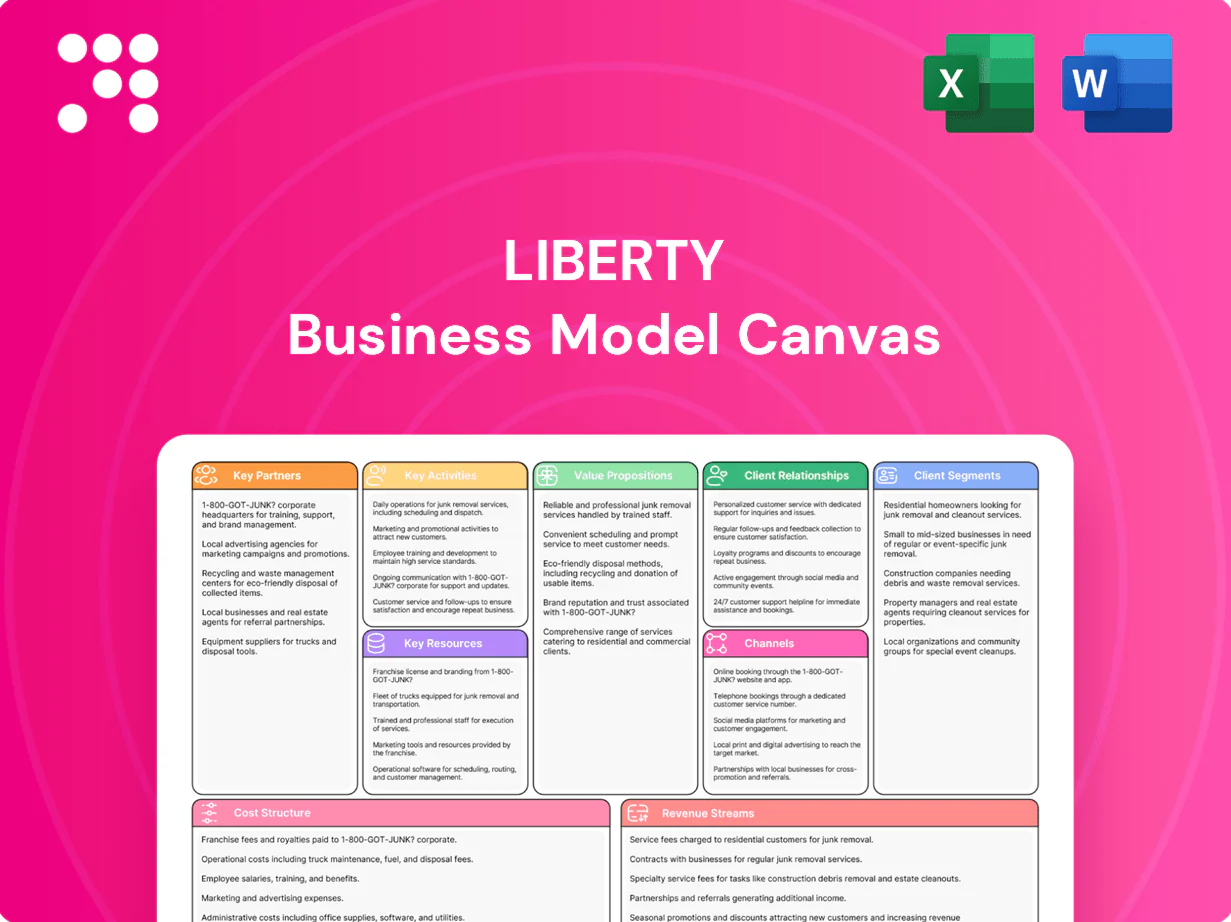
Liberty Business Model Canvas

Unlock the strategic Business Model Canvas: customers, revenue, partnerships, growth.
Unlock Liberty’s strategic playbook with our concise Business Model Canvas summary—three to five clear sentences that reveal how the company creates and captures value. Dive into customer segments, revenue streams, and key partnerships to see what fuels growth. Want the full, editable Canvas in Word and Excel for benchmarking or presentations? Purchase now to access the complete nine-block analysis and actionable insights.
Partnerships

E&P operator alliances
Collaborative planning with onshore producers aligns frac designs to reservoir goals, supporting optimization as U.S. oil production reached about 13 million barrels per day in 2024. Multi-basin master service agreements secure steady utilization and predictable revenue streams across cycles. Regular joint performance reviews drive continuous improvement in job efficiency and cost per stage. Co-development of pilot programs accelerates adoption of new frac technologies and de-risks scale-up.
Equipment OEMs and power systems
Partnerships with pump, turbine, and electric-frac OEMs secure reliable, efficient fleets and enable access to next-generation pumps and digital controls that industry pilots in 2024 reported can cut downtime and fuel consumption significantly. Joint maintenance programs with OEMs typically target lifecycle cost reductions in the 15–30% range through predictive servicing. Co-innovation roadmaps accelerate electrification and lower-noise solutions, supporting regulatory compliance and fleet decarbonization goals.

Proppant, chemicals, and water providers
Strategic sourcing with sand mines, chemical suppliers, and water firms stabilizes input quality and price and aligns with a US proppant market of ~150 million tons in 2024. Integrated logistics cut non-productive time by as much as 20–30% on-site. Access to specialty chemistries can lift frac effectiveness (5–15% EUR uplift reported). Water recycling partners can reduce freshwater use by up to 70%, aiding ESG and permitting.

Logistics and last-mile specialists
Haulers and transloaders ensure timely delivery of sand, water and equipment to wellsites, while coordinated scheduling cuts wellsite congestion and limits demurrage exposure, which often reaches four- to five-figure hourly rates. Telematics provide real-time visibility and safety alerts, reducing idle time and incidents. Regional partners enable rapid mobilization across Permian, Bakken, Eagle Ford and Haynesville basins.
- Operational reach: Permian, Bakken, Eagle Ford, Haynesville
- Cost control: coordinated scheduling lowers demurrage (four- to five-figure/hr)
- Safety & efficiency: telematics reduce idle time and incident risk
Digital, data, and emissions tech partners
Digital, data, and emissions tech partners give Liberty real-time sensor analytics and optimization, supporting ISSB-aligned emissions measurement in 2024 and accelerating field decisions via cloud and edge architectures; secure API integrations push KPI dashboards to clients for transparent ESG reporting.
- Real-time sensors + analytics
- ISSB-aligned emissions reporting (2024)
- Cloud & edge for faster field decisions
- Secure KPI integrations for clients
Partnerships cut lifecycle costs 15–30%, secure supply, boost recovery and real-time emissions KPIs
Partnerships align frac designs with producer goals as US oil output ~13 million bpd in 2024, improving recovery and uptime. OEM deals cut lifecycle costs 15–30% and enable electrification pilots. Proppant, water and hauler ties stabilize supply in a ~150M ton US proppant market and cut freshwater use up to 70%. Digital partners enable ISSB-aligned emissions reporting and real-time KPI delivery.
| Metric | 2024 Value |
|---|---|
| US oil production | ~13M bpd |
| Proppant market | ~150M tons |
| Water recycle | up to 70% |
| OEM lifecycle savings | 15–30% |
What is included in the product
 Detailed Word Document
A comprehensive, pre-written Business Model Canvas for Liberty that maps nine BMC blocks with detailed customer segments, value propositions, channels and revenue streams, plus SWOT-linked insights and competitive advantages for presentations and funding discussions.

 Customizable Excel Spreadsheet
High-level customizable canvas that saves hours of formatting and surfaces strategic gaps for faster decisions. Shareable and editable for team alignment, rapid comparison, and quick deliverables.
Activities

Frac design and engineering
Designing stage-by-stage treatments tailored to reservoir characteristics integrates proppant, fluid chemistry and pump schedules to maximize production; in 2024 Permian wells often exceeded 6 million pounds of proppant per lateral. Simulation and offset-well analysis inform recipes and placement strategies, while pre-job modeling reduces operational risk and helps contain frac costs. Continuous tuning of stage designs improves EUR and shortens time to first oil.
Pumping and wellsite execution
Deploying fleets to perform high-intensity hydraulic fracturing safely and efficiently, often fielding up to 20 pumps per multi-well pad to maintain fleet utilization above 80% and throughput targets. Coordinating crews, equipment, and materials across multi-well pads to enable continuous operations and minimize moves. Managing pressure control with real-time telemetry and adjustments to cut non-productive time to under 8% between stages.

Fleet maintenance and upgrades
Proactive servicing of pumps, power units and control systems targets uptime above 95%, with 2024 field programs reporting mean uptime improvements of 6–10 percentage points. Retrofitting for dual-fuel and electric-frac capability cut diesel consumption by ~30–40% in 2024 pilots and reduces fuel OPEX. Condition-based maintenance extended asset life by about 20% in 2024 trials. Rapid parts and service response reduced schedule delays by roughly 50%.

Supply chain and logistics orchestration
Sourcing and moving proppant, water, and chemicals to the right place and time focuses on pipeline scheduling, rail/truck loadouts, and staged storage to meet fracturing timelines while targeting a 10–20% reduction in last-mile delivery cost through route optimization and bulk staging (2024 industry logistics benchmarks). Coordinating with carriers and service partners prevents bottlenecks and maintains inventory visibility so operations run continuously with minimal downtime.
- Supply timing
- Last-mile optimization
- Partner coordination
- Real-time inventory
HSE, compliance, and performance analytics
Liberty enforces rigorous HSE standards across all sites, targeting incident reduction and regulatory compliance, with operational analytics driving a reported 15% drop in recordable incidents year-on-year and an 8% reduction in Scope 1 emissions in 2024.
- Sites covered: 120+
- Incident reduction: 15% YoY (2024)
- Scope 1 emissions: −8% (2024)
- Uptime/monitoring: 95% operational telemetry
Stage-by-stage fracs with 6.0M lb+ proppant lift EUR and speed first oil
Designing stage-by-stage treatments (often >6.0M lb proppant/lateral) with modeling and offset analysis improves EUR and reduces time-to-first-oil; fleet ops sustain >80% utilization with NPT <8%; maintenance and retrofits drove >95% uptime and ~30–40% diesel saving in pilots; HSE and analytics yielded −15% recordables YoY and −8% Scope 1 emissions across 120+ sites (2024).
| Metric | 2024 Value |
|---|---|
| Proppant per lateral | ≈6.0M lb |
| Fleet utilization | >80% |
| NPT between stages | <8% |
| Uptime | >95% |
| Diesel reduction (pilots) | 30–40% |
| Recordable incidents YoY | −15% |
| Scope 1 emissions | −8% |
| Sites covered | 120+ |
Preview Before You Purchase
Business Model Canvas
The preview you see of the Liberty Business Model Canvas is the actual deliverable, not a mockup. When you purchase, you'll receive this exact document—complete and editable—ready for presentation and use. Files are provided in Word and Excel formats for immediate download and customization.

Unlock the strategic Business Model Canvas: customers, revenue, partnerships, growth.
Unlock Liberty’s strategic playbook with our concise Business Model Canvas summary—three to five clear sentences that reveal how the company creates and captures value. Dive into customer segments, revenue streams, and key partnerships to see what fuels growth. Want the full, editable Canvas in Word and Excel for benchmarking or presentations? Purchase now to access the complete nine-block analysis and actionable insights.
Partnerships
E&P operator alliances
Collaborative planning with onshore producers aligns frac designs to reservoir goals, supporting optimization as U.S. oil production reached about 13 million barrels per day in 2024. Multi-basin master service agreements secure steady utilization and predictable revenue streams across cycles. Regular joint performance reviews drive continuous improvement in job efficiency and cost per stage. Co-development of pilot programs accelerates adoption of new frac technologies and de-risks scale-up.
Equipment OEMs and power systems
Partnerships with pump, turbine, and electric-frac OEMs secure reliable, efficient fleets and enable access to next-generation pumps and digital controls that industry pilots in 2024 reported can cut downtime and fuel consumption significantly. Joint maintenance programs with OEMs typically target lifecycle cost reductions in the 15–30% range through predictive servicing. Co-innovation roadmaps accelerate electrification and lower-noise solutions, supporting regulatory compliance and fleet decarbonization goals.
Proppant, chemicals, and water providers
Strategic sourcing with sand mines, chemical suppliers, and water firms stabilizes input quality and price and aligns with a US proppant market of ~150 million tons in 2024. Integrated logistics cut non-productive time by as much as 20–30% on-site. Access to specialty chemistries can lift frac effectiveness (5–15% EUR uplift reported). Water recycling partners can reduce freshwater use by up to 70%, aiding ESG and permitting.
Logistics and last-mile specialists
Haulers and transloaders ensure timely delivery of sand, water and equipment to wellsites, while coordinated scheduling cuts wellsite congestion and limits demurrage exposure, which often reaches four- to five-figure hourly rates. Telematics provide real-time visibility and safety alerts, reducing idle time and incidents. Regional partners enable rapid mobilization across Permian, Bakken, Eagle Ford and Haynesville basins.
- Operational reach: Permian, Bakken, Eagle Ford, Haynesville
- Cost control: coordinated scheduling lowers demurrage (four- to five-figure/hr)
- Safety & efficiency: telematics reduce idle time and incident risk
Digital, data, and emissions tech partners
Digital, data, and emissions tech partners give Liberty real-time sensor analytics and optimization, supporting ISSB-aligned emissions measurement in 2024 and accelerating field decisions via cloud and edge architectures; secure API integrations push KPI dashboards to clients for transparent ESG reporting.
- Real-time sensors + analytics
- ISSB-aligned emissions reporting (2024)
- Cloud & edge for faster field decisions
- Secure KPI integrations for clients
Partnerships cut lifecycle costs 15–30%, secure supply, boost recovery and real-time emissions KPIs
Partnerships align frac designs with producer goals as US oil output ~13 million bpd in 2024, improving recovery and uptime. OEM deals cut lifecycle costs 15–30% and enable electrification pilots. Proppant, water and hauler ties stabilize supply in a ~150M ton US proppant market and cut freshwater use up to 70%. Digital partners enable ISSB-aligned emissions reporting and real-time KPI delivery.
| Metric | 2024 Value |
|---|---|
| US oil production | ~13M bpd |
| Proppant market | ~150M tons |
| Water recycle | up to 70% |
| OEM lifecycle savings | 15–30% |
What is included in the product
Detailed Word Document
A comprehensive, pre-written Business Model Canvas for Liberty that maps nine BMC blocks with detailed customer segments, value propositions, channels and revenue streams, plus SWOT-linked insights and competitive advantages for presentations and funding discussions.
Customizable Excel Spreadsheet
High-level customizable canvas that saves hours of formatting and surfaces strategic gaps for faster decisions. Shareable and editable for team alignment, rapid comparison, and quick deliverables.
Activities
Frac design and engineering
Designing stage-by-stage treatments tailored to reservoir characteristics integrates proppant, fluid chemistry and pump schedules to maximize production; in 2024 Permian wells often exceeded 6 million pounds of proppant per lateral. Simulation and offset-well analysis inform recipes and placement strategies, while pre-job modeling reduces operational risk and helps contain frac costs. Continuous tuning of stage designs improves EUR and shortens time to first oil.
Pumping and wellsite execution
Deploying fleets to perform high-intensity hydraulic fracturing safely and efficiently, often fielding up to 20 pumps per multi-well pad to maintain fleet utilization above 80% and throughput targets. Coordinating crews, equipment, and materials across multi-well pads to enable continuous operations and minimize moves. Managing pressure control with real-time telemetry and adjustments to cut non-productive time to under 8% between stages.
Fleet maintenance and upgrades
Proactive servicing of pumps, power units and control systems targets uptime above 95%, with 2024 field programs reporting mean uptime improvements of 6–10 percentage points. Retrofitting for dual-fuel and electric-frac capability cut diesel consumption by ~30–40% in 2024 pilots and reduces fuel OPEX. Condition-based maintenance extended asset life by about 20% in 2024 trials. Rapid parts and service response reduced schedule delays by roughly 50%.
Supply chain and logistics orchestration
Sourcing and moving proppant, water, and chemicals to the right place and time focuses on pipeline scheduling, rail/truck loadouts, and staged storage to meet fracturing timelines while targeting a 10–20% reduction in last-mile delivery cost through route optimization and bulk staging (2024 industry logistics benchmarks). Coordinating with carriers and service partners prevents bottlenecks and maintains inventory visibility so operations run continuously with minimal downtime.
- Supply timing
- Last-mile optimization
- Partner coordination
- Real-time inventory
HSE, compliance, and performance analytics
Liberty enforces rigorous HSE standards across all sites, targeting incident reduction and regulatory compliance, with operational analytics driving a reported 15% drop in recordable incidents year-on-year and an 8% reduction in Scope 1 emissions in 2024.
- Sites covered: 120+
- Incident reduction: 15% YoY (2024)
- Scope 1 emissions: −8% (2024)
- Uptime/monitoring: 95% operational telemetry
Stage-by-stage fracs with 6.0M lb+ proppant lift EUR and speed first oil
Designing stage-by-stage treatments (often >6.0M lb proppant/lateral) with modeling and offset analysis improves EUR and reduces time-to-first-oil; fleet ops sustain >80% utilization with NPT <8%; maintenance and retrofits drove >95% uptime and ~30–40% diesel saving in pilots; HSE and analytics yielded −15% recordables YoY and −8% Scope 1 emissions across 120+ sites (2024).
| Metric | 2024 Value |
|---|---|
| Proppant per lateral | ≈6.0M lb |
| Fleet utilization | >80% |
| NPT between stages | <8% |
| Uptime | >95% |
| Diesel reduction (pilots) | 30–40% |
| Recordable incidents YoY | −15% |
| Scope 1 emissions | −8% |
| Sites covered | 120+ |
Preview Before You Purchase
Business Model Canvas
The preview you see of the Liberty Business Model Canvas is the actual deliverable, not a mockup. When you purchase, you'll receive this exact document—complete and editable—ready for presentation and use. Files are provided in Word and Excel formats for immediate download and customization.
Original: $10.00
-65%$10.00
$3.50Description
Unlock the strategic Business Model Canvas: customers, revenue, partnerships, growth.
Unlock Liberty’s strategic playbook with our concise Business Model Canvas summary—three to five clear sentences that reveal how the company creates and captures value. Dive into customer segments, revenue streams, and key partnerships to see what fuels growth. Want the full, editable Canvas in Word and Excel for benchmarking or presentations? Purchase now to access the complete nine-block analysis and actionable insights.
Partnerships
E&P operator alliances
Collaborative planning with onshore producers aligns frac designs to reservoir goals, supporting optimization as U.S. oil production reached about 13 million barrels per day in 2024. Multi-basin master service agreements secure steady utilization and predictable revenue streams across cycles. Regular joint performance reviews drive continuous improvement in job efficiency and cost per stage. Co-development of pilot programs accelerates adoption of new frac technologies and de-risks scale-up.
Equipment OEMs and power systems
Partnerships with pump, turbine, and electric-frac OEMs secure reliable, efficient fleets and enable access to next-generation pumps and digital controls that industry pilots in 2024 reported can cut downtime and fuel consumption significantly. Joint maintenance programs with OEMs typically target lifecycle cost reductions in the 15–30% range through predictive servicing. Co-innovation roadmaps accelerate electrification and lower-noise solutions, supporting regulatory compliance and fleet decarbonization goals.
Proppant, chemicals, and water providers
Strategic sourcing with sand mines, chemical suppliers, and water firms stabilizes input quality and price and aligns with a US proppant market of ~150 million tons in 2024. Integrated logistics cut non-productive time by as much as 20–30% on-site. Access to specialty chemistries can lift frac effectiveness (5–15% EUR uplift reported). Water recycling partners can reduce freshwater use by up to 70%, aiding ESG and permitting.
Logistics and last-mile specialists
Haulers and transloaders ensure timely delivery of sand, water and equipment to wellsites, while coordinated scheduling cuts wellsite congestion and limits demurrage exposure, which often reaches four- to five-figure hourly rates. Telematics provide real-time visibility and safety alerts, reducing idle time and incidents. Regional partners enable rapid mobilization across Permian, Bakken, Eagle Ford and Haynesville basins.
- Operational reach: Permian, Bakken, Eagle Ford, Haynesville
- Cost control: coordinated scheduling lowers demurrage (four- to five-figure/hr)
- Safety & efficiency: telematics reduce idle time and incident risk
Digital, data, and emissions tech partners
Digital, data, and emissions tech partners give Liberty real-time sensor analytics and optimization, supporting ISSB-aligned emissions measurement in 2024 and accelerating field decisions via cloud and edge architectures; secure API integrations push KPI dashboards to clients for transparent ESG reporting.
- Real-time sensors + analytics
- ISSB-aligned emissions reporting (2024)
- Cloud & edge for faster field decisions
- Secure KPI integrations for clients
Partnerships cut lifecycle costs 15–30%, secure supply, boost recovery and real-time emissions KPIs
Partnerships align frac designs with producer goals as US oil output ~13 million bpd in 2024, improving recovery and uptime. OEM deals cut lifecycle costs 15–30% and enable electrification pilots. Proppant, water and hauler ties stabilize supply in a ~150M ton US proppant market and cut freshwater use up to 70%. Digital partners enable ISSB-aligned emissions reporting and real-time KPI delivery.
| Metric | 2024 Value |
|---|---|
| US oil production | ~13M bpd |
| Proppant market | ~150M tons |
| Water recycle | up to 70% |
| OEM lifecycle savings | 15–30% |
What is included in the product
Detailed Word Document
A comprehensive, pre-written Business Model Canvas for Liberty that maps nine BMC blocks with detailed customer segments, value propositions, channels and revenue streams, plus SWOT-linked insights and competitive advantages for presentations and funding discussions.
Customizable Excel Spreadsheet
High-level customizable canvas that saves hours of formatting and surfaces strategic gaps for faster decisions. Shareable and editable for team alignment, rapid comparison, and quick deliverables.
Activities
Frac design and engineering
Designing stage-by-stage treatments tailored to reservoir characteristics integrates proppant, fluid chemistry and pump schedules to maximize production; in 2024 Permian wells often exceeded 6 million pounds of proppant per lateral. Simulation and offset-well analysis inform recipes and placement strategies, while pre-job modeling reduces operational risk and helps contain frac costs. Continuous tuning of stage designs improves EUR and shortens time to first oil.
Pumping and wellsite execution
Deploying fleets to perform high-intensity hydraulic fracturing safely and efficiently, often fielding up to 20 pumps per multi-well pad to maintain fleet utilization above 80% and throughput targets. Coordinating crews, equipment, and materials across multi-well pads to enable continuous operations and minimize moves. Managing pressure control with real-time telemetry and adjustments to cut non-productive time to under 8% between stages.
Fleet maintenance and upgrades
Proactive servicing of pumps, power units and control systems targets uptime above 95%, with 2024 field programs reporting mean uptime improvements of 6–10 percentage points. Retrofitting for dual-fuel and electric-frac capability cut diesel consumption by ~30–40% in 2024 pilots and reduces fuel OPEX. Condition-based maintenance extended asset life by about 20% in 2024 trials. Rapid parts and service response reduced schedule delays by roughly 50%.
Supply chain and logistics orchestration
Sourcing and moving proppant, water, and chemicals to the right place and time focuses on pipeline scheduling, rail/truck loadouts, and staged storage to meet fracturing timelines while targeting a 10–20% reduction in last-mile delivery cost through route optimization and bulk staging (2024 industry logistics benchmarks). Coordinating with carriers and service partners prevents bottlenecks and maintains inventory visibility so operations run continuously with minimal downtime.
- Supply timing
- Last-mile optimization
- Partner coordination
- Real-time inventory
HSE, compliance, and performance analytics
Liberty enforces rigorous HSE standards across all sites, targeting incident reduction and regulatory compliance, with operational analytics driving a reported 15% drop in recordable incidents year-on-year and an 8% reduction in Scope 1 emissions in 2024.
- Sites covered: 120+
- Incident reduction: 15% YoY (2024)
- Scope 1 emissions: −8% (2024)
- Uptime/monitoring: 95% operational telemetry
Stage-by-stage fracs with 6.0M lb+ proppant lift EUR and speed first oil
Designing stage-by-stage treatments (often >6.0M lb proppant/lateral) with modeling and offset analysis improves EUR and reduces time-to-first-oil; fleet ops sustain >80% utilization with NPT <8%; maintenance and retrofits drove >95% uptime and ~30–40% diesel saving in pilots; HSE and analytics yielded −15% recordables YoY and −8% Scope 1 emissions across 120+ sites (2024).
| Metric | 2024 Value |
|---|---|
| Proppant per lateral | ≈6.0M lb |
| Fleet utilization | >80% |
| NPT between stages | <8% |
| Uptime | >95% |
| Diesel reduction (pilots) | 30–40% |
| Recordable incidents YoY | −15% |
| Scope 1 emissions | −8% |
| Sites covered | 120+ |
Preview Before You Purchase
Business Model Canvas
The preview you see of the Liberty Business Model Canvas is the actual deliverable, not a mockup. When you purchase, you'll receive this exact document—complete and editable—ready for presentation and use. Files are provided in Word and Excel formats for immediate download and customization.











