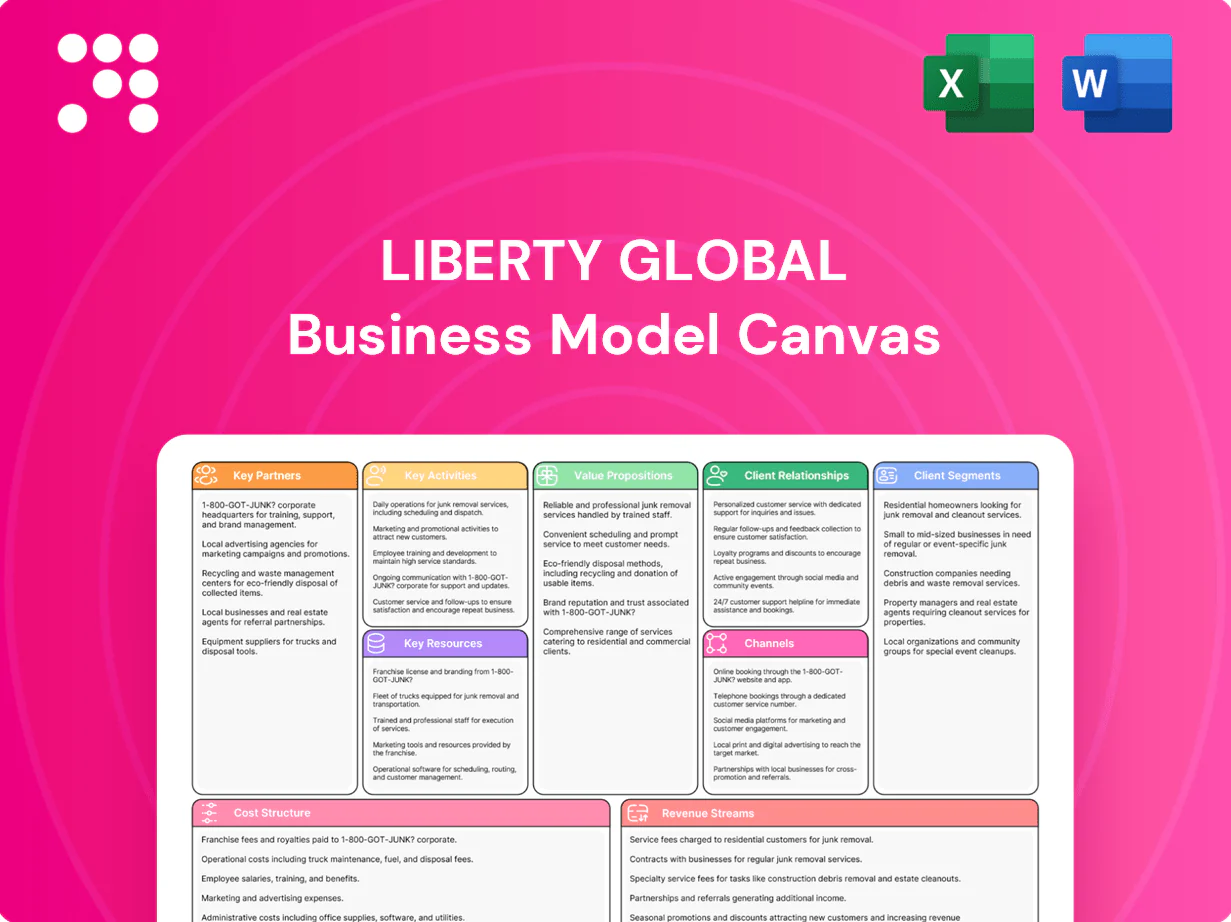
Liberty Global Business Model Canvas

Unlock the strategic Business Model Canvas: customer segments, value props & revenue
Unlock the full strategic blueprint behind Liberty Global with our Business Model Canvas, detailing customer segments, value propositions, and revenue streams. Learn how partnerships, cost structure, and channels fuel scale and profitability. Ideal for investors, consultants, and founders seeking actionable insights. Purchase the complete, editable canvas to benchmark and implement winning strategies.
Partnerships

Network equipment and technology vendors
Strategic alliances with equipment makers give Liberty Global timely access to next‑gen DOCSIS, FTTH, 5G and core network solutions, supporting network upgrades and competitive service tiers. Co‑development and roadmap alignment with vendors lower deployment risk and total cost of ownership through joint testing and integration. Vendor financing and managed‑services models improve cash flow and accelerate time‑to‑market for new broadband and mobile offerings.
Content and streaming rights providers
Licensing deals with studios, sports leagues and OTT platforms underpin Liberty Global’s premium TV bundles, enabling curated rights for live sports and exclusive content. Aggregation into tiered packages drives customer stickiness and historically lifts ARPU (industry analyses cite ~15% uplift for enhanced tiers). Co-marketing and integrated billing streamline user experience and correlate with materially lower churn (bundles ~20% lower churn vs standalone services).

Mobile network and roaming partners
Agreements with MNOs and MVNEs extend Liberty Globals reach into mobile, enabling converged fixed-mobile offers to its multi-million fixed-customer base and improving ARPU through bundled services in 2024.
Roaming partnerships secure competitive traveler rates and sustained QoS, leveraging wholesale agreements that in industry studies reduced retail roaming costs by up to 30% in 2024.
Shared RAN and spectrum-sharing arrangements help optimize capex and performance, with vendor analyses in 2024 showing network-sharing can lower deployment costs and OPEX by roughly 20–40%.

Infrastructure and wholesale fiber or tower companies
Access to dark fiber, ducts and towers from infrastructure and wholesale partners accelerates rollout and densification while lowering Liberty Global’s capital intensity per home passed; IRUs and long‑term leases (commonly 20–30 years) balance capex versus opex. Co‑investment and shared‑build structures de‑risk deployments in new or rural areas and preserve cash for service innovation.
- Access: dark fiber, ducts, towers
- IRUs: 20–30 years
- Benefit: lower capex per home passed
- Risk: co‑investment de‑risks rural builds
Local joint ventures and market partners
Local joint ventures and market partners enable Liberty Global to enter and scale in target countries with regulatory alignment, leveraging JV structures that span 14 countries and roughly 25 million subscribers as of 2024. Shared governance and pooled assets cut capital intensity and improve ROIC by concentrating CapEx and spectrum investments. Partner brands and distribution broaden reach, adding retail footprints and channel credibility that accelerate subscriber acquisition.
- JV structures: market entry, regulatory fit
- Shared governance: capital efficiency, pooled assets
- Partner brands: wider distribution, credibility
Vendor alliances cut capex, lift ARPU 15%, lower churn 20%, support 25M subs
Strategic vendor alliances speed DOCSIS/FTTH/5G upgrades and lower TCO via co‑development and vendor financing. Content licensing and OTT deals lift ARPU (~15% for enhanced tiers) and cut churn (~20%). Shared RAN, IRUs (20–30y) and JV structures (14 countries, ~25M subs in 2024) reduce capex and improve ROIC.
| Metric | 2024 |
|---|---|
| Subscribers (JV) | ~25M |
| JV countries | 14 |
| ARPU uplift | ~15% |
| Churn vs standalone | ~20% lower |
| Cost savings (share) | 20–40% |
| IRU term | 20–30 yrs |
What is included in the product
 Detailed Word Document
A ready-to-use Business Model Canvas for Liberty Global mapping customer segments, value propositions, channels, revenue streams, key partners, activities, resources, cost structure and governance—reflecting the company’s multi‑market cable, broadband and content strategy. Ideal for presentations and investor discussions, it includes competitive advantage analysis, SWOT-linked insights and practical validation using real-world data.

 Customizable Excel Spreadsheet
High-level, shareable Business Model Canvas for Liberty Global that condenses strategy into a digestible, editable one-page snapshot—ideal for quickly identifying core components, saving hours of formatting, and enabling fast team collaboration and executive review.
Activities

Network deployment and operations
Building, upgrading, and maintaining HFC, FTTH, and mobile networks ensure capacity and reliability through continuous rollouts and targeted upgrades to last-mile and core assets. Proactive monitoring and automated fault management protect NPS by reducing incident times and improving service uptime. Energy optimization, site consolidation, and virtualization cut operational costs and power use, supporting margin resilience and sustainable operations.
Product bundling and pricing management
Designing converged broadband, TV and mobile packages drives ARPU—industry data in 2024 shows bundling can lift ARPU 20–40% and reduce churn 30–50% versus single‑play customers. Dynamic pricing and targeted promotions improved conversion by 10–15% in 2024 trials. Device financing and add‑ons raised attachment rates 15–25% in 2024 deployments.

Customer acquisition and retention
Multi-channel marketing, direct sales and streamlined digital onboarding drive efficient base growth across Liberty Global’s footprint in 14 countries, supporting its multi‑brand subscriber mix. Loyalty programs and proactive save actions focus on reducing churn — telecom industry benchmarks in 2024 show targeted retention can cut voluntary churn by double‑digit percentages. Data‑driven targeting refines offer design and timing using usage and network telemetry to boost conversion and lifetime value.

Regulatory and spectrum management
Digital platform development
Enhancing apps, self-care portals and TV UIs improves customer experience and can cut support costs — 2024 industry studies estimate self-service reduces contact volumes by up to 30%. Automation in OSS/BSS accelerates provisioning and improves billing accuracy, with automated workflows reducing lead times by as much as 50% in 2024 pilots. Data analytics drive retention, upsell and network planning across the customer lifecycle.
- Customer experience: self-care adoption ↓support costs (~30% in 2024)
- Operations: OSS/BSS automation → faster provisioning (~50% time reduction)
- Insights: analytics → churn reduction and targeted upsell
Network upgrades and automation lift ARPU 20-40% and cut churn
Building and upgrading HFC/FTTH and mobile networks with proactive monitoring preserves uptime and NPS; energy & virtualization cut Opex. Converged bundles, dynamic pricing and device financing drove ARPU uplifts (2024: 20–40%) and lower churn; digital sales, loyalty and targeted retention reduce voluntary churn. OSS/BSS automation and self‑service reduce provisioning times (~50%) and contacts (~30% in 2024).
| Metric | 2024 |
|---|---|
| ARPU uplift from bundling | 20–40% |
| Self‑service contact reduction | ~30% |
| OSS/BSS lead‑time cut | ~50% |
| Operating countries | 14 |
Full Version Awaits
Business Model Canvas
The document you're previewing is the exact Liberty Global Business Model Canvas you'll receive after purchase. This is not a sample—it's a direct extract from the final deliverable, formatted for immediate use. Upon ordering you'll get the full editable file (Word and Excel) with all sections included.

Unlock the strategic Business Model Canvas: customer segments, value props & revenue
Unlock the full strategic blueprint behind Liberty Global with our Business Model Canvas, detailing customer segments, value propositions, and revenue streams. Learn how partnerships, cost structure, and channels fuel scale and profitability. Ideal for investors, consultants, and founders seeking actionable insights. Purchase the complete, editable canvas to benchmark and implement winning strategies.
Partnerships
Network equipment and technology vendors
Strategic alliances with equipment makers give Liberty Global timely access to next‑gen DOCSIS, FTTH, 5G and core network solutions, supporting network upgrades and competitive service tiers. Co‑development and roadmap alignment with vendors lower deployment risk and total cost of ownership through joint testing and integration. Vendor financing and managed‑services models improve cash flow and accelerate time‑to‑market for new broadband and mobile offerings.
Content and streaming rights providers
Licensing deals with studios, sports leagues and OTT platforms underpin Liberty Global’s premium TV bundles, enabling curated rights for live sports and exclusive content. Aggregation into tiered packages drives customer stickiness and historically lifts ARPU (industry analyses cite ~15% uplift for enhanced tiers). Co-marketing and integrated billing streamline user experience and correlate with materially lower churn (bundles ~20% lower churn vs standalone services).
Mobile network and roaming partners
Agreements with MNOs and MVNEs extend Liberty Globals reach into mobile, enabling converged fixed-mobile offers to its multi-million fixed-customer base and improving ARPU through bundled services in 2024.
Roaming partnerships secure competitive traveler rates and sustained QoS, leveraging wholesale agreements that in industry studies reduced retail roaming costs by up to 30% in 2024.
Shared RAN and spectrum-sharing arrangements help optimize capex and performance, with vendor analyses in 2024 showing network-sharing can lower deployment costs and OPEX by roughly 20–40%.
Infrastructure and wholesale fiber or tower companies
Access to dark fiber, ducts and towers from infrastructure and wholesale partners accelerates rollout and densification while lowering Liberty Global’s capital intensity per home passed; IRUs and long‑term leases (commonly 20–30 years) balance capex versus opex. Co‑investment and shared‑build structures de‑risk deployments in new or rural areas and preserve cash for service innovation.
- Access: dark fiber, ducts, towers
- IRUs: 20–30 years
- Benefit: lower capex per home passed
- Risk: co‑investment de‑risks rural builds
Local joint ventures and market partners
Local joint ventures and market partners enable Liberty Global to enter and scale in target countries with regulatory alignment, leveraging JV structures that span 14 countries and roughly 25 million subscribers as of 2024. Shared governance and pooled assets cut capital intensity and improve ROIC by concentrating CapEx and spectrum investments. Partner brands and distribution broaden reach, adding retail footprints and channel credibility that accelerate subscriber acquisition.
- JV structures: market entry, regulatory fit
- Shared governance: capital efficiency, pooled assets
- Partner brands: wider distribution, credibility
Vendor alliances cut capex, lift ARPU 15%, lower churn 20%, support 25M subs
Strategic vendor alliances speed DOCSIS/FTTH/5G upgrades and lower TCO via co‑development and vendor financing. Content licensing and OTT deals lift ARPU (~15% for enhanced tiers) and cut churn (~20%). Shared RAN, IRUs (20–30y) and JV structures (14 countries, ~25M subs in 2024) reduce capex and improve ROIC.
| Metric | 2024 |
|---|---|
| Subscribers (JV) | ~25M |
| JV countries | 14 |
| ARPU uplift | ~15% |
| Churn vs standalone | ~20% lower |
| Cost savings (share) | 20–40% |
| IRU term | 20–30 yrs |
What is included in the product
Detailed Word Document
A ready-to-use Business Model Canvas for Liberty Global mapping customer segments, value propositions, channels, revenue streams, key partners, activities, resources, cost structure and governance—reflecting the company’s multi‑market cable, broadband and content strategy. Ideal for presentations and investor discussions, it includes competitive advantage analysis, SWOT-linked insights and practical validation using real-world data.
Customizable Excel Spreadsheet
High-level, shareable Business Model Canvas for Liberty Global that condenses strategy into a digestible, editable one-page snapshot—ideal for quickly identifying core components, saving hours of formatting, and enabling fast team collaboration and executive review.
Activities
Network deployment and operations
Building, upgrading, and maintaining HFC, FTTH, and mobile networks ensure capacity and reliability through continuous rollouts and targeted upgrades to last-mile and core assets. Proactive monitoring and automated fault management protect NPS by reducing incident times and improving service uptime. Energy optimization, site consolidation, and virtualization cut operational costs and power use, supporting margin resilience and sustainable operations.
Product bundling and pricing management
Designing converged broadband, TV and mobile packages drives ARPU—industry data in 2024 shows bundling can lift ARPU 20–40% and reduce churn 30–50% versus single‑play customers. Dynamic pricing and targeted promotions improved conversion by 10–15% in 2024 trials. Device financing and add‑ons raised attachment rates 15–25% in 2024 deployments.
Customer acquisition and retention
Multi-channel marketing, direct sales and streamlined digital onboarding drive efficient base growth across Liberty Global’s footprint in 14 countries, supporting its multi‑brand subscriber mix. Loyalty programs and proactive save actions focus on reducing churn — telecom industry benchmarks in 2024 show targeted retention can cut voluntary churn by double‑digit percentages. Data‑driven targeting refines offer design and timing using usage and network telemetry to boost conversion and lifetime value.
Regulatory and spectrum management
Digital platform development
Enhancing apps, self-care portals and TV UIs improves customer experience and can cut support costs — 2024 industry studies estimate self-service reduces contact volumes by up to 30%. Automation in OSS/BSS accelerates provisioning and improves billing accuracy, with automated workflows reducing lead times by as much as 50% in 2024 pilots. Data analytics drive retention, upsell and network planning across the customer lifecycle.
- Customer experience: self-care adoption ↓support costs (~30% in 2024)
- Operations: OSS/BSS automation → faster provisioning (~50% time reduction)
- Insights: analytics → churn reduction and targeted upsell
Network upgrades and automation lift ARPU 20-40% and cut churn
Building and upgrading HFC/FTTH and mobile networks with proactive monitoring preserves uptime and NPS; energy & virtualization cut Opex. Converged bundles, dynamic pricing and device financing drove ARPU uplifts (2024: 20–40%) and lower churn; digital sales, loyalty and targeted retention reduce voluntary churn. OSS/BSS automation and self‑service reduce provisioning times (~50%) and contacts (~30% in 2024).
| Metric | 2024 |
|---|---|
| ARPU uplift from bundling | 20–40% |
| Self‑service contact reduction | ~30% |
| OSS/BSS lead‑time cut | ~50% |
| Operating countries | 14 |
Full Version Awaits
Business Model Canvas
The document you're previewing is the exact Liberty Global Business Model Canvas you'll receive after purchase. This is not a sample—it's a direct extract from the final deliverable, formatted for immediate use. Upon ordering you'll get the full editable file (Word and Excel) with all sections included.
Description
Unlock the strategic Business Model Canvas: customer segments, value props & revenue
Unlock the full strategic blueprint behind Liberty Global with our Business Model Canvas, detailing customer segments, value propositions, and revenue streams. Learn how partnerships, cost structure, and channels fuel scale and profitability. Ideal for investors, consultants, and founders seeking actionable insights. Purchase the complete, editable canvas to benchmark and implement winning strategies.
Partnerships
Network equipment and technology vendors
Strategic alliances with equipment makers give Liberty Global timely access to next‑gen DOCSIS, FTTH, 5G and core network solutions, supporting network upgrades and competitive service tiers. Co‑development and roadmap alignment with vendors lower deployment risk and total cost of ownership through joint testing and integration. Vendor financing and managed‑services models improve cash flow and accelerate time‑to‑market for new broadband and mobile offerings.
Content and streaming rights providers
Licensing deals with studios, sports leagues and OTT platforms underpin Liberty Global’s premium TV bundles, enabling curated rights for live sports and exclusive content. Aggregation into tiered packages drives customer stickiness and historically lifts ARPU (industry analyses cite ~15% uplift for enhanced tiers). Co-marketing and integrated billing streamline user experience and correlate with materially lower churn (bundles ~20% lower churn vs standalone services).
Mobile network and roaming partners
Agreements with MNOs and MVNEs extend Liberty Globals reach into mobile, enabling converged fixed-mobile offers to its multi-million fixed-customer base and improving ARPU through bundled services in 2024.
Roaming partnerships secure competitive traveler rates and sustained QoS, leveraging wholesale agreements that in industry studies reduced retail roaming costs by up to 30% in 2024.
Shared RAN and spectrum-sharing arrangements help optimize capex and performance, with vendor analyses in 2024 showing network-sharing can lower deployment costs and OPEX by roughly 20–40%.
Infrastructure and wholesale fiber or tower companies
Access to dark fiber, ducts and towers from infrastructure and wholesale partners accelerates rollout and densification while lowering Liberty Global’s capital intensity per home passed; IRUs and long‑term leases (commonly 20–30 years) balance capex versus opex. Co‑investment and shared‑build structures de‑risk deployments in new or rural areas and preserve cash for service innovation.
- Access: dark fiber, ducts, towers
- IRUs: 20–30 years
- Benefit: lower capex per home passed
- Risk: co‑investment de‑risks rural builds
Local joint ventures and market partners
Local joint ventures and market partners enable Liberty Global to enter and scale in target countries with regulatory alignment, leveraging JV structures that span 14 countries and roughly 25 million subscribers as of 2024. Shared governance and pooled assets cut capital intensity and improve ROIC by concentrating CapEx and spectrum investments. Partner brands and distribution broaden reach, adding retail footprints and channel credibility that accelerate subscriber acquisition.
- JV structures: market entry, regulatory fit
- Shared governance: capital efficiency, pooled assets
- Partner brands: wider distribution, credibility
Vendor alliances cut capex, lift ARPU 15%, lower churn 20%, support 25M subs
Strategic vendor alliances speed DOCSIS/FTTH/5G upgrades and lower TCO via co‑development and vendor financing. Content licensing and OTT deals lift ARPU (~15% for enhanced tiers) and cut churn (~20%). Shared RAN, IRUs (20–30y) and JV structures (14 countries, ~25M subs in 2024) reduce capex and improve ROIC.
| Metric | 2024 |
|---|---|
| Subscribers (JV) | ~25M |
| JV countries | 14 |
| ARPU uplift | ~15% |
| Churn vs standalone | ~20% lower |
| Cost savings (share) | 20–40% |
| IRU term | 20–30 yrs |
What is included in the product
Detailed Word Document
A ready-to-use Business Model Canvas for Liberty Global mapping customer segments, value propositions, channels, revenue streams, key partners, activities, resources, cost structure and governance—reflecting the company’s multi‑market cable, broadband and content strategy. Ideal for presentations and investor discussions, it includes competitive advantage analysis, SWOT-linked insights and practical validation using real-world data.
Customizable Excel Spreadsheet
High-level, shareable Business Model Canvas for Liberty Global that condenses strategy into a digestible, editable one-page snapshot—ideal for quickly identifying core components, saving hours of formatting, and enabling fast team collaboration and executive review.
Activities
Network deployment and operations
Building, upgrading, and maintaining HFC, FTTH, and mobile networks ensure capacity and reliability through continuous rollouts and targeted upgrades to last-mile and core assets. Proactive monitoring and automated fault management protect NPS by reducing incident times and improving service uptime. Energy optimization, site consolidation, and virtualization cut operational costs and power use, supporting margin resilience and sustainable operations.
Product bundling and pricing management
Designing converged broadband, TV and mobile packages drives ARPU—industry data in 2024 shows bundling can lift ARPU 20–40% and reduce churn 30–50% versus single‑play customers. Dynamic pricing and targeted promotions improved conversion by 10–15% in 2024 trials. Device financing and add‑ons raised attachment rates 15–25% in 2024 deployments.
Customer acquisition and retention
Multi-channel marketing, direct sales and streamlined digital onboarding drive efficient base growth across Liberty Global’s footprint in 14 countries, supporting its multi‑brand subscriber mix. Loyalty programs and proactive save actions focus on reducing churn — telecom industry benchmarks in 2024 show targeted retention can cut voluntary churn by double‑digit percentages. Data‑driven targeting refines offer design and timing using usage and network telemetry to boost conversion and lifetime value.
Regulatory and spectrum management
Digital platform development
Enhancing apps, self-care portals and TV UIs improves customer experience and can cut support costs — 2024 industry studies estimate self-service reduces contact volumes by up to 30%. Automation in OSS/BSS accelerates provisioning and improves billing accuracy, with automated workflows reducing lead times by as much as 50% in 2024 pilots. Data analytics drive retention, upsell and network planning across the customer lifecycle.
- Customer experience: self-care adoption ↓support costs (~30% in 2024)
- Operations: OSS/BSS automation → faster provisioning (~50% time reduction)
- Insights: analytics → churn reduction and targeted upsell
Network upgrades and automation lift ARPU 20-40% and cut churn
Building and upgrading HFC/FTTH and mobile networks with proactive monitoring preserves uptime and NPS; energy & virtualization cut Opex. Converged bundles, dynamic pricing and device financing drove ARPU uplifts (2024: 20–40%) and lower churn; digital sales, loyalty and targeted retention reduce voluntary churn. OSS/BSS automation and self‑service reduce provisioning times (~50%) and contacts (~30% in 2024).
| Metric | 2024 |
|---|---|
| ARPU uplift from bundling | 20–40% |
| Self‑service contact reduction | ~30% |
| OSS/BSS lead‑time cut | ~50% |
| Operating countries | 14 |
Full Version Awaits
Business Model Canvas
The document you're previewing is the exact Liberty Global Business Model Canvas you'll receive after purchase. This is not a sample—it's a direct extract from the final deliverable, formatted for immediate use. Upon ordering you'll get the full editable file (Word and Excel) with all sections included.











