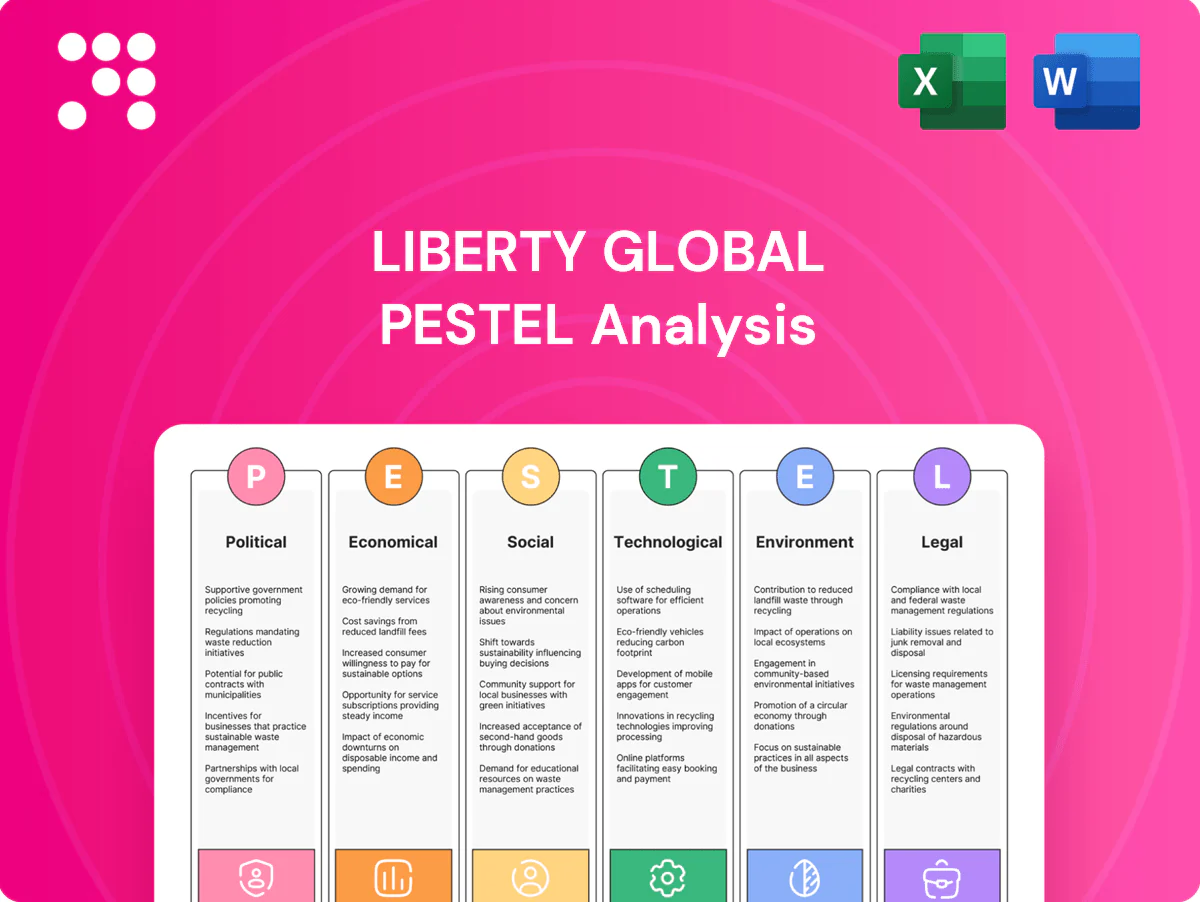
Liberty Global PESTLE Analysis

Your Shortcut to Market Insight Starts Here
Our PESTLE analysis of Liberty Global reveals how political regulation, shifting consumer economics, rapid tech innovation, social trends, and environmental rules converge to shape growth and risk—insights that investors and strategists need. Purchase the full report to access the complete, actionable breakdown and ready-to-use recommendations.
Political factors

EU digital policy
EU Digital Decade sets 2030 targets of gigabit connectivity for all households and 5G coverage in all populated areas, driving Liberty Global to prioritize fiber and 5G builds. Funding streams like the Digital Europe Programme (€7.5bn 2021–27) and the Recovery and Resilience Facility (€723.8bn) can support rural rollouts, but strict reporting and compliance increase project overhead. Post-2024 election policy shifts may change timelines and incentive mixes.
Spectrum allocation
Spectrum auctions (notably 3.4–3.8 GHz and 700 MHz for 5G) set mobile economics and binding coverage obligations that shape Liberty Global’s mobile ROI. Reserve prices and license terms differ widely—auctions can raise multi‑billion euros (Germany 2019: €6.55bn), changing payback horizons. EU policy (roam‑like‑at‑home since 2017) plus Digital Compass goal of 5G in all populated areas by 2030 forces cross‑border coordination, affecting roaming quality and costs.

Industrial strategy
National industrial strategies prioritize strategic connectivity, benefiting infrastructure investors as governments channel funds toward broadband rollout; the EU targets gigabit connectivity for all households by 2030. Government-backed open-access wholesale models can compress operator ARPUs and reshape wholesale revenues. Political backing often requires local job creation and binding capex commitments from operators.

Geopolitical risk
Geopolitical risk can delay delivery of network gear for Liberty Global as sanctions and export controls since 2022 have narrowed vendor pools and extended lead times for telecom components; procurement cycles now factor in alternate-supplier qualification and inventory buffers. Energy security policies across Europe and Latin America after 2022 have forced updated operating-continuity plans and capex timing to hedge power disruptions and price volatility. Ongoing trade controls drive tighter vendor selection and higher working-capital needs.
- Sanctions since 2022 constrain supplier choice
- Extended lead times for telecom components
- Energy-security rules require continuity planning
Public–private partnerships
Public–private partnerships can lower Liberty Globals build costs in underserved areas by sharing capital and risk, aligning with the EU Digital Decade 2030 objective of gigabit connectivity for all; contracts increasingly tie payments to measurable KPIs such as coverage and latency.
Contracts demand transparent, regular KPI delivery and auditability, with commercial partners typically reporting quarterly performance metrics. Political turnover in host markets can prompt renegotiation of PPP terms or re-prioritization, affecting timelines and ROI.
- PPP benefit: shared capex and risk
- KPI focus: coverage, latency, quarterly reporting
- Regulatory risk: renegotiation on political change
- Context: aligns with EU Digital Decade 2030 goals
EU €731.3bn funding spurs fiber/5G; spectrum costs and sanctions delay ROI
EU Digital Decade and Digital Europe (€7.5bn 2021–27) plus Recovery and Resilience Facility (€723.8bn) drive fiber/5G rollouts and PPPs, but add compliance overhead. Spectrum auction prices (e.g., Germany 2019: €6.55bn) and binding coverage obligations shape mobile ROI and payback timelines. Sanctions since 2022 and energy‑security rules lengthen vendor lead times and raise working‑capital needs.
| Tag | Value | Impact |
|---|---|---|
| Funding | €731.3bn | Build subsidy/conditionality |
What is included in the product
 Detailed Word Document
Explores how macro-environmental forces uniquely affect Liberty Global across Political, Economic, Social, Technological, Environmental and Legal dimensions, with data-backed trends and region-specific regulatory context; designed to help executives, investors and strategists identify risks, opportunities and actionable, forward-looking responses.

 Customizable Excel Spreadsheet
Concise, visually segmented Liberty Global PESTLE that distills regulatory, economic, social, technological, environmental and legal insights for quick decision-making, editable for local context and easily dropped into presentations or shared across teams to align strategy and mitigate external risks.
Economic factors

Consumer spending
Inflation and weak real wages—Euro area inflation slowed to about 2.9% in 2024 (Eurostat)—compress ARPU and can lift churn as households trade down. In downturns many customers shift to lower tiers or prepaid options, reducing average revenue per user. Bundled offers and multi‑service discounts historically defend perceived value and lower price sensitivity, stabilizing retention and cross‑sell rates.
Interest rates
Higher interest rates—Fed funds 5.25–5.50% and ECB deposit rate ~4.25% in mid‑2024—raise debt servicing costs and compress telecom valuation multiples, directly lowering Liberty Global’s enterprise value per EBITDA. They push management to time fiber and 5G capex more conservatively. Refinancing windows and leverage covenants become strategic constraints on deal and capex timing.

Competition intensity
Convergence pits telcos, cable and MVNOs head-to-head, with Liberty Global competing for roughly 25 million customers; intense bundling and MVNO growth drove UK/EU price-based churn up, pushing industry retention costs higher. Price wars have compressed margins—Liberty Global reported adjusted EBITDA margin near 34% in 2024—forcing greater spend on content and network upgrades. Market share now hinges on superior network quality and differentiated bundled content.

Wholesale dynamics
Regulated access and VULA price caps set by national regulators materially squeeze wholesale broadband margins for Liberty Global, forcing resale and structural separation strategies across its European markets. Monetizing dark fiber and tower assets through IRUs or leases offers upfront cash and recurring revenue, while JV arrangements spread capex and accelerate network rollout but create shared-margin dynamics and complex profit allocation.
- Regulation: VULA/bitstream caps affect ARPU and margins
- Monetization: dark fiber/towers unlock capex via IRUs/leases
- JV tradeoff: lower capex burden vs. diluted profits and governance complexity
FX exposure
Liberty Global's multi-country revenues face EUR, GBP and CHF swings; these currencies moved roughly 5–10% year‑on‑year through 2024. Hedging mitigates volatility but typically costs around 0.5–1.5% of revenue. Accounting translation can reduce reported organic growth by several percentage points.
- Currencies: EUR/GBP/CHF ±5–10% (2024)
- Hedging cost: ~0.5–1.5% of revenue
- Translation impact: -several p.p. on reported growth
EU €731.3bn funding spurs fiber/5G; spectrum costs and sanctions delay ROI
Euro area inflation eased to ~2.9% in 2024, squeezing real wages and ARPU. Higher rates (Fed 5.25–5.50%, ECB deposit ~4.25% mid‑2024) raise debt service and constrain capex timing. Competitive bundling and MVNO growth pushed adjusted EBITDA margin near 34% in 2024 while FX swings (EUR/GBP/CHF ±5–10%) and hedging (~0.5–1.5% revenue) affect reported growth.
| Metric | 2024/24–25 |
|---|---|
| Euro inflation | ~2.9% |
| Key rates | Fed 5.25–5.50%, ECB ~4.25% |
| Adj. EBITDA margin | ~34% |
| FX moves | ±5–10% |
| Hedging cost | ~0.5–1.5% rev |
Full Version Awaits
Liberty Global PESTLE Analysis
The preview shown here is the exact Liberty Global PESTLE analysis you’ll receive after purchase—fully formatted and ready to use. It contains the same Political, Economic, Social, Technological, Legal and Environmental assessments with concise implications for strategy and risk. No placeholders or teasers — this is the final, professional file delivered immediately after payment.

Your Shortcut to Market Insight Starts Here
Our PESTLE analysis of Liberty Global reveals how political regulation, shifting consumer economics, rapid tech innovation, social trends, and environmental rules converge to shape growth and risk—insights that investors and strategists need. Purchase the full report to access the complete, actionable breakdown and ready-to-use recommendations.
Political factors
EU digital policy
EU Digital Decade sets 2030 targets of gigabit connectivity for all households and 5G coverage in all populated areas, driving Liberty Global to prioritize fiber and 5G builds. Funding streams like the Digital Europe Programme (€7.5bn 2021–27) and the Recovery and Resilience Facility (€723.8bn) can support rural rollouts, but strict reporting and compliance increase project overhead. Post-2024 election policy shifts may change timelines and incentive mixes.
Spectrum allocation
Spectrum auctions (notably 3.4–3.8 GHz and 700 MHz for 5G) set mobile economics and binding coverage obligations that shape Liberty Global’s mobile ROI. Reserve prices and license terms differ widely—auctions can raise multi‑billion euros (Germany 2019: €6.55bn), changing payback horizons. EU policy (roam‑like‑at‑home since 2017) plus Digital Compass goal of 5G in all populated areas by 2030 forces cross‑border coordination, affecting roaming quality and costs.
Industrial strategy
National industrial strategies prioritize strategic connectivity, benefiting infrastructure investors as governments channel funds toward broadband rollout; the EU targets gigabit connectivity for all households by 2030. Government-backed open-access wholesale models can compress operator ARPUs and reshape wholesale revenues. Political backing often requires local job creation and binding capex commitments from operators.
Geopolitical risk
Geopolitical risk can delay delivery of network gear for Liberty Global as sanctions and export controls since 2022 have narrowed vendor pools and extended lead times for telecom components; procurement cycles now factor in alternate-supplier qualification and inventory buffers. Energy security policies across Europe and Latin America after 2022 have forced updated operating-continuity plans and capex timing to hedge power disruptions and price volatility. Ongoing trade controls drive tighter vendor selection and higher working-capital needs.
- Sanctions since 2022 constrain supplier choice
- Extended lead times for telecom components
- Energy-security rules require continuity planning
Public–private partnerships
Public–private partnerships can lower Liberty Globals build costs in underserved areas by sharing capital and risk, aligning with the EU Digital Decade 2030 objective of gigabit connectivity for all; contracts increasingly tie payments to measurable KPIs such as coverage and latency.
Contracts demand transparent, regular KPI delivery and auditability, with commercial partners typically reporting quarterly performance metrics. Political turnover in host markets can prompt renegotiation of PPP terms or re-prioritization, affecting timelines and ROI.
- PPP benefit: shared capex and risk
- KPI focus: coverage, latency, quarterly reporting
- Regulatory risk: renegotiation on political change
- Context: aligns with EU Digital Decade 2030 goals
EU €731.3bn funding spurs fiber/5G; spectrum costs and sanctions delay ROI
EU Digital Decade and Digital Europe (€7.5bn 2021–27) plus Recovery and Resilience Facility (€723.8bn) drive fiber/5G rollouts and PPPs, but add compliance overhead. Spectrum auction prices (e.g., Germany 2019: €6.55bn) and binding coverage obligations shape mobile ROI and payback timelines. Sanctions since 2022 and energy‑security rules lengthen vendor lead times and raise working‑capital needs.
| Tag | Value | Impact |
|---|---|---|
| Funding | €731.3bn | Build subsidy/conditionality |
What is included in the product
Detailed Word Document
Explores how macro-environmental forces uniquely affect Liberty Global across Political, Economic, Social, Technological, Environmental and Legal dimensions, with data-backed trends and region-specific regulatory context; designed to help executives, investors and strategists identify risks, opportunities and actionable, forward-looking responses.
Customizable Excel Spreadsheet
Concise, visually segmented Liberty Global PESTLE that distills regulatory, economic, social, technological, environmental and legal insights for quick decision-making, editable for local context and easily dropped into presentations or shared across teams to align strategy and mitigate external risks.
Economic factors
Consumer spending
Inflation and weak real wages—Euro area inflation slowed to about 2.9% in 2024 (Eurostat)—compress ARPU and can lift churn as households trade down. In downturns many customers shift to lower tiers or prepaid options, reducing average revenue per user. Bundled offers and multi‑service discounts historically defend perceived value and lower price sensitivity, stabilizing retention and cross‑sell rates.
Interest rates
Higher interest rates—Fed funds 5.25–5.50% and ECB deposit rate ~4.25% in mid‑2024—raise debt servicing costs and compress telecom valuation multiples, directly lowering Liberty Global’s enterprise value per EBITDA. They push management to time fiber and 5G capex more conservatively. Refinancing windows and leverage covenants become strategic constraints on deal and capex timing.
Competition intensity
Convergence pits telcos, cable and MVNOs head-to-head, with Liberty Global competing for roughly 25 million customers; intense bundling and MVNO growth drove UK/EU price-based churn up, pushing industry retention costs higher. Price wars have compressed margins—Liberty Global reported adjusted EBITDA margin near 34% in 2024—forcing greater spend on content and network upgrades. Market share now hinges on superior network quality and differentiated bundled content.
Wholesale dynamics
Regulated access and VULA price caps set by national regulators materially squeeze wholesale broadband margins for Liberty Global, forcing resale and structural separation strategies across its European markets. Monetizing dark fiber and tower assets through IRUs or leases offers upfront cash and recurring revenue, while JV arrangements spread capex and accelerate network rollout but create shared-margin dynamics and complex profit allocation.
- Regulation: VULA/bitstream caps affect ARPU and margins
- Monetization: dark fiber/towers unlock capex via IRUs/leases
- JV tradeoff: lower capex burden vs. diluted profits and governance complexity
FX exposure
Liberty Global's multi-country revenues face EUR, GBP and CHF swings; these currencies moved roughly 5–10% year‑on‑year through 2024. Hedging mitigates volatility but typically costs around 0.5–1.5% of revenue. Accounting translation can reduce reported organic growth by several percentage points.
- Currencies: EUR/GBP/CHF ±5–10% (2024)
- Hedging cost: ~0.5–1.5% of revenue
- Translation impact: -several p.p. on reported growth
EU €731.3bn funding spurs fiber/5G; spectrum costs and sanctions delay ROI
Euro area inflation eased to ~2.9% in 2024, squeezing real wages and ARPU. Higher rates (Fed 5.25–5.50%, ECB deposit ~4.25% mid‑2024) raise debt service and constrain capex timing. Competitive bundling and MVNO growth pushed adjusted EBITDA margin near 34% in 2024 while FX swings (EUR/GBP/CHF ±5–10%) and hedging (~0.5–1.5% revenue) affect reported growth.
| Metric | 2024/24–25 |
|---|---|
| Euro inflation | ~2.9% |
| Key rates | Fed 5.25–5.50%, ECB ~4.25% |
| Adj. EBITDA margin | ~34% |
| FX moves | ±5–10% |
| Hedging cost | ~0.5–1.5% rev |
Full Version Awaits
Liberty Global PESTLE Analysis
The preview shown here is the exact Liberty Global PESTLE analysis you’ll receive after purchase—fully formatted and ready to use. It contains the same Political, Economic, Social, Technological, Legal and Environmental assessments with concise implications for strategy and risk. No placeholders or teasers — this is the final, professional file delivered immediately after payment.
Original: $10.00
-65%$10.00
$3.50Description
Your Shortcut to Market Insight Starts Here
Our PESTLE analysis of Liberty Global reveals how political regulation, shifting consumer economics, rapid tech innovation, social trends, and environmental rules converge to shape growth and risk—insights that investors and strategists need. Purchase the full report to access the complete, actionable breakdown and ready-to-use recommendations.
Political factors
EU digital policy
EU Digital Decade sets 2030 targets of gigabit connectivity for all households and 5G coverage in all populated areas, driving Liberty Global to prioritize fiber and 5G builds. Funding streams like the Digital Europe Programme (€7.5bn 2021–27) and the Recovery and Resilience Facility (€723.8bn) can support rural rollouts, but strict reporting and compliance increase project overhead. Post-2024 election policy shifts may change timelines and incentive mixes.
Spectrum allocation
Spectrum auctions (notably 3.4–3.8 GHz and 700 MHz for 5G) set mobile economics and binding coverage obligations that shape Liberty Global’s mobile ROI. Reserve prices and license terms differ widely—auctions can raise multi‑billion euros (Germany 2019: €6.55bn), changing payback horizons. EU policy (roam‑like‑at‑home since 2017) plus Digital Compass goal of 5G in all populated areas by 2030 forces cross‑border coordination, affecting roaming quality and costs.
Industrial strategy
National industrial strategies prioritize strategic connectivity, benefiting infrastructure investors as governments channel funds toward broadband rollout; the EU targets gigabit connectivity for all households by 2030. Government-backed open-access wholesale models can compress operator ARPUs and reshape wholesale revenues. Political backing often requires local job creation and binding capex commitments from operators.
Geopolitical risk
Geopolitical risk can delay delivery of network gear for Liberty Global as sanctions and export controls since 2022 have narrowed vendor pools and extended lead times for telecom components; procurement cycles now factor in alternate-supplier qualification and inventory buffers. Energy security policies across Europe and Latin America after 2022 have forced updated operating-continuity plans and capex timing to hedge power disruptions and price volatility. Ongoing trade controls drive tighter vendor selection and higher working-capital needs.
- Sanctions since 2022 constrain supplier choice
- Extended lead times for telecom components
- Energy-security rules require continuity planning
Public–private partnerships
Public–private partnerships can lower Liberty Globals build costs in underserved areas by sharing capital and risk, aligning with the EU Digital Decade 2030 objective of gigabit connectivity for all; contracts increasingly tie payments to measurable KPIs such as coverage and latency.
Contracts demand transparent, regular KPI delivery and auditability, with commercial partners typically reporting quarterly performance metrics. Political turnover in host markets can prompt renegotiation of PPP terms or re-prioritization, affecting timelines and ROI.
- PPP benefit: shared capex and risk
- KPI focus: coverage, latency, quarterly reporting
- Regulatory risk: renegotiation on political change
- Context: aligns with EU Digital Decade 2030 goals
EU €731.3bn funding spurs fiber/5G; spectrum costs and sanctions delay ROI
EU Digital Decade and Digital Europe (€7.5bn 2021–27) plus Recovery and Resilience Facility (€723.8bn) drive fiber/5G rollouts and PPPs, but add compliance overhead. Spectrum auction prices (e.g., Germany 2019: €6.55bn) and binding coverage obligations shape mobile ROI and payback timelines. Sanctions since 2022 and energy‑security rules lengthen vendor lead times and raise working‑capital needs.
| Tag | Value | Impact |
|---|---|---|
| Funding | €731.3bn | Build subsidy/conditionality |
What is included in the product
Detailed Word Document
Explores how macro-environmental forces uniquely affect Liberty Global across Political, Economic, Social, Technological, Environmental and Legal dimensions, with data-backed trends and region-specific regulatory context; designed to help executives, investors and strategists identify risks, opportunities and actionable, forward-looking responses.
Customizable Excel Spreadsheet
Concise, visually segmented Liberty Global PESTLE that distills regulatory, economic, social, technological, environmental and legal insights for quick decision-making, editable for local context and easily dropped into presentations or shared across teams to align strategy and mitigate external risks.
Economic factors
Consumer spending
Inflation and weak real wages—Euro area inflation slowed to about 2.9% in 2024 (Eurostat)—compress ARPU and can lift churn as households trade down. In downturns many customers shift to lower tiers or prepaid options, reducing average revenue per user. Bundled offers and multi‑service discounts historically defend perceived value and lower price sensitivity, stabilizing retention and cross‑sell rates.
Interest rates
Higher interest rates—Fed funds 5.25–5.50% and ECB deposit rate ~4.25% in mid‑2024—raise debt servicing costs and compress telecom valuation multiples, directly lowering Liberty Global’s enterprise value per EBITDA. They push management to time fiber and 5G capex more conservatively. Refinancing windows and leverage covenants become strategic constraints on deal and capex timing.
Competition intensity
Convergence pits telcos, cable and MVNOs head-to-head, with Liberty Global competing for roughly 25 million customers; intense bundling and MVNO growth drove UK/EU price-based churn up, pushing industry retention costs higher. Price wars have compressed margins—Liberty Global reported adjusted EBITDA margin near 34% in 2024—forcing greater spend on content and network upgrades. Market share now hinges on superior network quality and differentiated bundled content.
Wholesale dynamics
Regulated access and VULA price caps set by national regulators materially squeeze wholesale broadband margins for Liberty Global, forcing resale and structural separation strategies across its European markets. Monetizing dark fiber and tower assets through IRUs or leases offers upfront cash and recurring revenue, while JV arrangements spread capex and accelerate network rollout but create shared-margin dynamics and complex profit allocation.
- Regulation: VULA/bitstream caps affect ARPU and margins
- Monetization: dark fiber/towers unlock capex via IRUs/leases
- JV tradeoff: lower capex burden vs. diluted profits and governance complexity
FX exposure
Liberty Global's multi-country revenues face EUR, GBP and CHF swings; these currencies moved roughly 5–10% year‑on‑year through 2024. Hedging mitigates volatility but typically costs around 0.5–1.5% of revenue. Accounting translation can reduce reported organic growth by several percentage points.
- Currencies: EUR/GBP/CHF ±5–10% (2024)
- Hedging cost: ~0.5–1.5% of revenue
- Translation impact: -several p.p. on reported growth
EU €731.3bn funding spurs fiber/5G; spectrum costs and sanctions delay ROI
Euro area inflation eased to ~2.9% in 2024, squeezing real wages and ARPU. Higher rates (Fed 5.25–5.50%, ECB deposit ~4.25% mid‑2024) raise debt service and constrain capex timing. Competitive bundling and MVNO growth pushed adjusted EBITDA margin near 34% in 2024 while FX swings (EUR/GBP/CHF ±5–10%) and hedging (~0.5–1.5% revenue) affect reported growth.
| Metric | 2024/24–25 |
|---|---|
| Euro inflation | ~2.9% |
| Key rates | Fed 5.25–5.50%, ECB ~4.25% |
| Adj. EBITDA margin | ~34% |
| FX moves | ±5–10% |
| Hedging cost | ~0.5–1.5% rev |
Full Version Awaits
Liberty Global PESTLE Analysis
The preview shown here is the exact Liberty Global PESTLE analysis you’ll receive after purchase—fully formatted and ready to use. It contains the same Political, Economic, Social, Technological, Legal and Environmental assessments with concise implications for strategy and risk. No placeholders or teasers — this is the final, professional file delivered immediately after payment.











