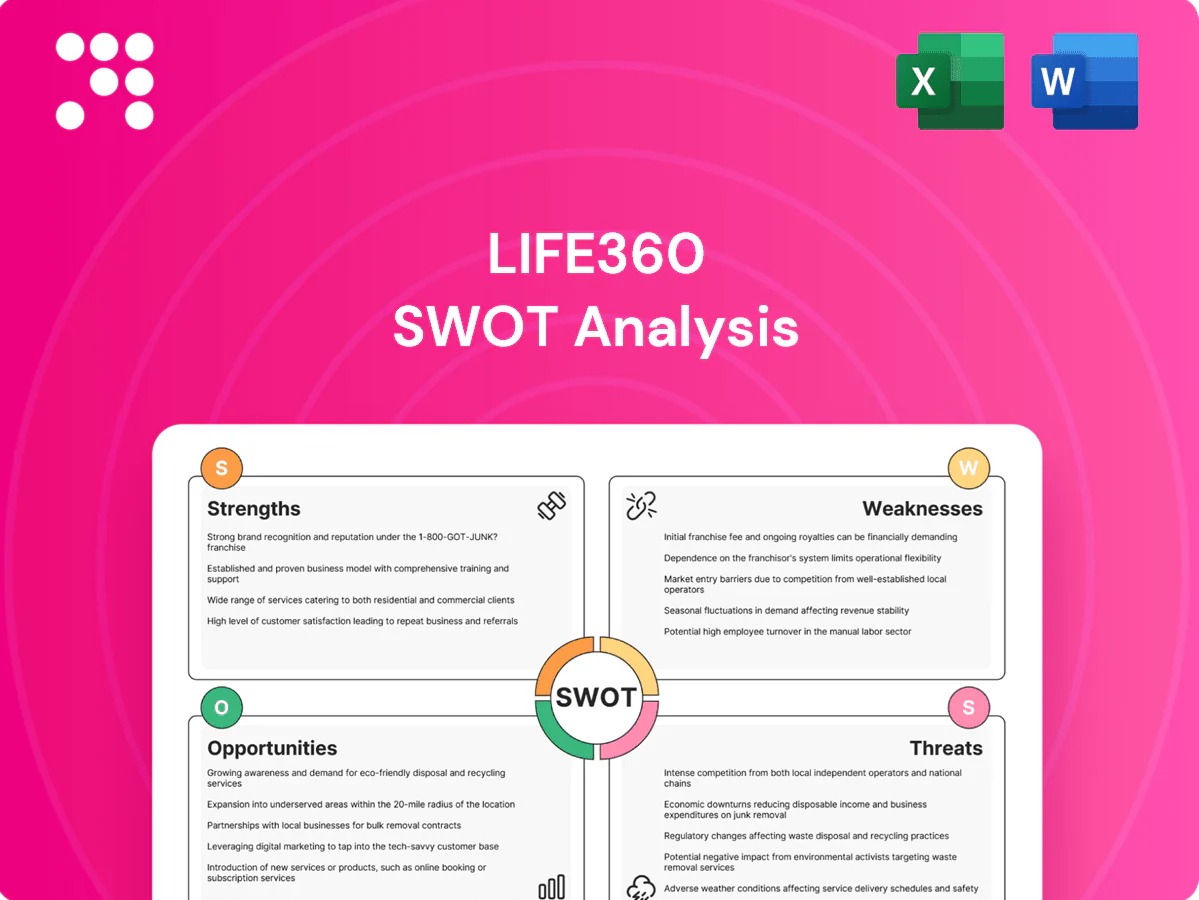
Life360 SWOT Analysis

Make Insightful Decisions Backed by Expert Research
Life360’s SWOT analysis highlights strong brand and network effects, monetization challenges, privacy risks, and expansion opportunities in safety tech. Our full report unpacks financial context, competitive threats, and strategic levers. Ideal for investors and planners, it’s fully editable. Purchase the complete SWOT for Word and Excel deliverables and actionable insights.
Strengths

Large engaged family user base
Life360 benefits from a tens-of-millions family user base that drives daily, sticky engagement through frequent check-ins, arrival alerts and driving reports, boosting retention. High-frequency use by multiple family members per circle raises switching costs—more members reduce churn and increase lifetime value. This network effect supports predictable subscription revenue from a multi-million paid subscriber base and steady ARPU growth.
Feature-rich safety suite
Life360 bundles location sharing, geofencing, crash detection, driving analytics and emergency assistance into one platform, creating stronger value versus single‑purpose apps and clear upsell paths through free and tiered subscriptions; the company is a public firm (NASDAQ: LICY) since its 2021 IPO, and ongoing feature expansion (including Tile integration) strengthens its defensibility.

Subscription-led recurring revenue
Tiered plans convert free users to paying subscribers, lifting ARPU while Life360 leverages a global base of ~34 million monthly active users (2023) to scale conversions.
Recurring subscriptions enhance revenue visibility and cash-flow predictability, supporting multi-quarter forecastability for the business.
Pricing levers enable testing of bundles and family seats to raise wallet share.
Churn mitigation tactics—improved retention, re-engagement and upsell—compound LTV over time.

Cross-platform and ecosystem integrations
Life360 is available on iOS and Android, reaching over 30 million monthly active users (company disclosures, 2024) and reducing platform concentration risk. Integrations with device sensors enable crash detection and driving features that boost safety and engagement. Public APIs and partner hooks extend into cars, wearables and smart home ecosystems, enhancing cross-context use cases and ARPU potential.
- Platforms: iOS, Android — broad reach
- Sensor integrations: crash, driving analytics
- APIs/partners: cars, wearables, smart home
Strong brand in family safety niche
Life360 (NASDAQ: LIFE; IPO 2019) is widely recognized for family location and safety, which drives strong organic adoption. The app's trust signals in emergencies and driving oversight differentiate it from general map apps. Word-of-mouth among parents amplifies growth and clarifies product priorities.
- Brand focus aligns roadmap to family-safety features
- Parent-to-parent referrals boost acquisition
- Tile acquisition 2021 expanded tracking capabilities
34M+ family MAU, multi‑million paid subs: strong network effects, recurring revenue
Large, sticky family network (~34M MAU in 2023; >30M MAU in 2024) drives high engagement, network effects and switching costs; multi-million paid subscribers provide recurring revenue and rising ARPU. Bundled safety, driving analytics, Tile and partner integrations create strong defensibility and upsell paths. Cross‑platform reach and sensor/API integrations expand ecosystem monetization.
| Metric | Value | Source/Year |
|---|---|---|
| Monthly active users | ~34M | Company disclosures/2023 |
| Paid subscribers | Multi‑million | Company disclosures/2024 |
| Platforms | iOS, Android | Company disclosures/2024 |
What is included in the product
 Detailed Word Document
Provides a strategic overview of Life360’s internal strengths and weaknesses and external opportunities and threats, mapping competitive position, growth drivers, operational gaps, and market risks to inform strategic decisions.

 Customizable Excel Spreadsheet
Provides a focused SWOT summary of Life360 to quickly identify strengths, weaknesses, opportunities, and threats, helping teams prioritize product, safety, and privacy fixes for faster roadmap decisions.
Weaknesses

Privacy sensitivity and trust risk
Location tracking and driving-behavior analytics heighten privacy concerns for Life360, especially given its scale of over 30 million users and the 2021 Tile acquisition for about 205 million USD. Any data incident or even perceived misuse could sharply damage the brand and user retention. Strict consent flows add onboarding friction, and ongoing investment in security, compliance, and transparency is required to maintain trust.
Dependence on mobile OS policies
Changes by Apple or Google to background location, notification behavior, or app-store rules can directly impair core tracking and safety features. Limits on background battery and sensor access may degrade location accuracy or crash detection. Featured placement or policy disputes can sharply raise user-acquisition costs. Apple and Android together account for over 99% of global mobile OS share, making platform risk only partially hedgeable.

Free-to-paid conversion and churn
The freemium model depends on steady upgrades, yet industry freemium conversion rates were 1–5% in 2024 (Statista/App Annie), leaving Life360 vulnerable if upgrades slow. Families often churn after life-stage shifts or due to price sensitivity, while seasonal install spikes (eg back-to-school) can dilute cohorts and lower ARPU. Ongoing value communication is essential to protect LTV/CAC and margin.

Accuracy, false positives, and battery drain
Location jitter, network gaps, and sensor noise can trigger false alerts in Life360, causing unnecessary notifications; with over 30 million users even a small false-positive rate scales into many incidents. Crash detection must balance sensitivity and specificity to avoid alarm fatigue and emergency dispatches. Continuous background tracking can increase battery drain on some devices, prompting negative reviews and churn.
- Location jitter & network gaps
- Crash detection trade-offs
- Battery drain drives negative reviews
Narrow vertical concentration
Life360's reliance on the family-safety niche—despite being a publicly traded company (NASDAQ: LIFE) and acquiring Tile for $205 million in 2021—limits diversification and leaves revenue tied to a single consumer segment. Limited penetration into enterprise or adjacent markets constrains TAM expansion, while dependence on one core use case raises growth cyclicality and requires new capabilities and messaging to broaden adoption.
- Narrow consumer focus limits diversification
- Weak enterprise/adjacent penetration caps TAM
- Single-use exposure increases cyclicality
- Expansion needs new capabilities and messaging
Location-tracking privacy, platform-policy shocks and low freemium conversion threaten 30M+ users
Location tracking and driving analytics raise privacy risk for 30M+ users and the 2021 Tile acquisition (~205 million USD), so breaches or misuse could hit retention and brand. Platform-policy changes by Apple/Google (iOS+Android >99% share) can degrade core features. Freemium conversion was 1–5% in 2024, making revenue growth vulnerable to churn and upgrade slowdown. Tracking false-positives and battery drain also scale negative reviews.
| Metric | Value |
|---|---|
| Users | 30M+ |
| Tile acquisition | ~205M USD (2021) |
| Freemium conversion (2024) | 1–5% (Statista/App Annie) |
| Mobile OS share | iOS+Android >99% |
What You See Is What You Get
Life360 SWOT Analysis
This is the actual SWOT analysis document you’ll receive upon purchase—no surprises, just professional quality. The preview below is taken directly from the full SWOT report you'll get; purchase unlocks the entire in-depth version. The file shown is the real, editable SWOT analysis you'll download post-purchase, ready for use.

Make Insightful Decisions Backed by Expert Research
Life360’s SWOT analysis highlights strong brand and network effects, monetization challenges, privacy risks, and expansion opportunities in safety tech. Our full report unpacks financial context, competitive threats, and strategic levers. Ideal for investors and planners, it’s fully editable. Purchase the complete SWOT for Word and Excel deliverables and actionable insights.
Strengths
Large engaged family user base
Life360 benefits from a tens-of-millions family user base that drives daily, sticky engagement through frequent check-ins, arrival alerts and driving reports, boosting retention. High-frequency use by multiple family members per circle raises switching costs—more members reduce churn and increase lifetime value. This network effect supports predictable subscription revenue from a multi-million paid subscriber base and steady ARPU growth.
Feature-rich safety suite
Life360 bundles location sharing, geofencing, crash detection, driving analytics and emergency assistance into one platform, creating stronger value versus single‑purpose apps and clear upsell paths through free and tiered subscriptions; the company is a public firm (NASDAQ: LICY) since its 2021 IPO, and ongoing feature expansion (including Tile integration) strengthens its defensibility.
Subscription-led recurring revenue
Tiered plans convert free users to paying subscribers, lifting ARPU while Life360 leverages a global base of ~34 million monthly active users (2023) to scale conversions.
Recurring subscriptions enhance revenue visibility and cash-flow predictability, supporting multi-quarter forecastability for the business.
Pricing levers enable testing of bundles and family seats to raise wallet share.
Churn mitigation tactics—improved retention, re-engagement and upsell—compound LTV over time.
Cross-platform and ecosystem integrations
Life360 is available on iOS and Android, reaching over 30 million monthly active users (company disclosures, 2024) and reducing platform concentration risk. Integrations with device sensors enable crash detection and driving features that boost safety and engagement. Public APIs and partner hooks extend into cars, wearables and smart home ecosystems, enhancing cross-context use cases and ARPU potential.
- Platforms: iOS, Android — broad reach
- Sensor integrations: crash, driving analytics
- APIs/partners: cars, wearables, smart home
Strong brand in family safety niche
Life360 (NASDAQ: LIFE; IPO 2019) is widely recognized for family location and safety, which drives strong organic adoption. The app's trust signals in emergencies and driving oversight differentiate it from general map apps. Word-of-mouth among parents amplifies growth and clarifies product priorities.
- Brand focus aligns roadmap to family-safety features
- Parent-to-parent referrals boost acquisition
- Tile acquisition 2021 expanded tracking capabilities
34M+ family MAU, multi‑million paid subs: strong network effects, recurring revenue
Large, sticky family network (~34M MAU in 2023; >30M MAU in 2024) drives high engagement, network effects and switching costs; multi-million paid subscribers provide recurring revenue and rising ARPU. Bundled safety, driving analytics, Tile and partner integrations create strong defensibility and upsell paths. Cross‑platform reach and sensor/API integrations expand ecosystem monetization.
| Metric | Value | Source/Year |
|---|---|---|
| Monthly active users | ~34M | Company disclosures/2023 |
| Paid subscribers | Multi‑million | Company disclosures/2024 |
| Platforms | iOS, Android | Company disclosures/2024 |
What is included in the product
Detailed Word Document
Provides a strategic overview of Life360’s internal strengths and weaknesses and external opportunities and threats, mapping competitive position, growth drivers, operational gaps, and market risks to inform strategic decisions.
Customizable Excel Spreadsheet
Provides a focused SWOT summary of Life360 to quickly identify strengths, weaknesses, opportunities, and threats, helping teams prioritize product, safety, and privacy fixes for faster roadmap decisions.
Weaknesses
Privacy sensitivity and trust risk
Location tracking and driving-behavior analytics heighten privacy concerns for Life360, especially given its scale of over 30 million users and the 2021 Tile acquisition for about 205 million USD. Any data incident or even perceived misuse could sharply damage the brand and user retention. Strict consent flows add onboarding friction, and ongoing investment in security, compliance, and transparency is required to maintain trust.
Dependence on mobile OS policies
Changes by Apple or Google to background location, notification behavior, or app-store rules can directly impair core tracking and safety features. Limits on background battery and sensor access may degrade location accuracy or crash detection. Featured placement or policy disputes can sharply raise user-acquisition costs. Apple and Android together account for over 99% of global mobile OS share, making platform risk only partially hedgeable.
Free-to-paid conversion and churn
The freemium model depends on steady upgrades, yet industry freemium conversion rates were 1–5% in 2024 (Statista/App Annie), leaving Life360 vulnerable if upgrades slow. Families often churn after life-stage shifts or due to price sensitivity, while seasonal install spikes (eg back-to-school) can dilute cohorts and lower ARPU. Ongoing value communication is essential to protect LTV/CAC and margin.
Accuracy, false positives, and battery drain
Location jitter, network gaps, and sensor noise can trigger false alerts in Life360, causing unnecessary notifications; with over 30 million users even a small false-positive rate scales into many incidents. Crash detection must balance sensitivity and specificity to avoid alarm fatigue and emergency dispatches. Continuous background tracking can increase battery drain on some devices, prompting negative reviews and churn.
- Location jitter & network gaps
- Crash detection trade-offs
- Battery drain drives negative reviews
Narrow vertical concentration
Life360's reliance on the family-safety niche—despite being a publicly traded company (NASDAQ: LIFE) and acquiring Tile for $205 million in 2021—limits diversification and leaves revenue tied to a single consumer segment. Limited penetration into enterprise or adjacent markets constrains TAM expansion, while dependence on one core use case raises growth cyclicality and requires new capabilities and messaging to broaden adoption.
- Narrow consumer focus limits diversification
- Weak enterprise/adjacent penetration caps TAM
- Single-use exposure increases cyclicality
- Expansion needs new capabilities and messaging
Location-tracking privacy, platform-policy shocks and low freemium conversion threaten 30M+ users
Location tracking and driving analytics raise privacy risk for 30M+ users and the 2021 Tile acquisition (~205 million USD), so breaches or misuse could hit retention and brand. Platform-policy changes by Apple/Google (iOS+Android >99% share) can degrade core features. Freemium conversion was 1–5% in 2024, making revenue growth vulnerable to churn and upgrade slowdown. Tracking false-positives and battery drain also scale negative reviews.
| Metric | Value |
|---|---|
| Users | 30M+ |
| Tile acquisition | ~205M USD (2021) |
| Freemium conversion (2024) | 1–5% (Statista/App Annie) |
| Mobile OS share | iOS+Android >99% |
What You See Is What You Get
Life360 SWOT Analysis
This is the actual SWOT analysis document you’ll receive upon purchase—no surprises, just professional quality. The preview below is taken directly from the full SWOT report you'll get; purchase unlocks the entire in-depth version. The file shown is the real, editable SWOT analysis you'll download post-purchase, ready for use.
Original: $10.00
-65%$10.00
$3.50Description
Make Insightful Decisions Backed by Expert Research
Life360’s SWOT analysis highlights strong brand and network effects, monetization challenges, privacy risks, and expansion opportunities in safety tech. Our full report unpacks financial context, competitive threats, and strategic levers. Ideal for investors and planners, it’s fully editable. Purchase the complete SWOT for Word and Excel deliverables and actionable insights.
Strengths
Large engaged family user base
Life360 benefits from a tens-of-millions family user base that drives daily, sticky engagement through frequent check-ins, arrival alerts and driving reports, boosting retention. High-frequency use by multiple family members per circle raises switching costs—more members reduce churn and increase lifetime value. This network effect supports predictable subscription revenue from a multi-million paid subscriber base and steady ARPU growth.
Feature-rich safety suite
Life360 bundles location sharing, geofencing, crash detection, driving analytics and emergency assistance into one platform, creating stronger value versus single‑purpose apps and clear upsell paths through free and tiered subscriptions; the company is a public firm (NASDAQ: LICY) since its 2021 IPO, and ongoing feature expansion (including Tile integration) strengthens its defensibility.
Subscription-led recurring revenue
Tiered plans convert free users to paying subscribers, lifting ARPU while Life360 leverages a global base of ~34 million monthly active users (2023) to scale conversions.
Recurring subscriptions enhance revenue visibility and cash-flow predictability, supporting multi-quarter forecastability for the business.
Pricing levers enable testing of bundles and family seats to raise wallet share.
Churn mitigation tactics—improved retention, re-engagement and upsell—compound LTV over time.
Cross-platform and ecosystem integrations
Life360 is available on iOS and Android, reaching over 30 million monthly active users (company disclosures, 2024) and reducing platform concentration risk. Integrations with device sensors enable crash detection and driving features that boost safety and engagement. Public APIs and partner hooks extend into cars, wearables and smart home ecosystems, enhancing cross-context use cases and ARPU potential.
- Platforms: iOS, Android — broad reach
- Sensor integrations: crash, driving analytics
- APIs/partners: cars, wearables, smart home
Strong brand in family safety niche
Life360 (NASDAQ: LIFE; IPO 2019) is widely recognized for family location and safety, which drives strong organic adoption. The app's trust signals in emergencies and driving oversight differentiate it from general map apps. Word-of-mouth among parents amplifies growth and clarifies product priorities.
- Brand focus aligns roadmap to family-safety features
- Parent-to-parent referrals boost acquisition
- Tile acquisition 2021 expanded tracking capabilities
34M+ family MAU, multi‑million paid subs: strong network effects, recurring revenue
Large, sticky family network (~34M MAU in 2023; >30M MAU in 2024) drives high engagement, network effects and switching costs; multi-million paid subscribers provide recurring revenue and rising ARPU. Bundled safety, driving analytics, Tile and partner integrations create strong defensibility and upsell paths. Cross‑platform reach and sensor/API integrations expand ecosystem monetization.
| Metric | Value | Source/Year |
|---|---|---|
| Monthly active users | ~34M | Company disclosures/2023 |
| Paid subscribers | Multi‑million | Company disclosures/2024 |
| Platforms | iOS, Android | Company disclosures/2024 |
What is included in the product
Detailed Word Document
Provides a strategic overview of Life360’s internal strengths and weaknesses and external opportunities and threats, mapping competitive position, growth drivers, operational gaps, and market risks to inform strategic decisions.
Customizable Excel Spreadsheet
Provides a focused SWOT summary of Life360 to quickly identify strengths, weaknesses, opportunities, and threats, helping teams prioritize product, safety, and privacy fixes for faster roadmap decisions.
Weaknesses
Privacy sensitivity and trust risk
Location tracking and driving-behavior analytics heighten privacy concerns for Life360, especially given its scale of over 30 million users and the 2021 Tile acquisition for about 205 million USD. Any data incident or even perceived misuse could sharply damage the brand and user retention. Strict consent flows add onboarding friction, and ongoing investment in security, compliance, and transparency is required to maintain trust.
Dependence on mobile OS policies
Changes by Apple or Google to background location, notification behavior, or app-store rules can directly impair core tracking and safety features. Limits on background battery and sensor access may degrade location accuracy or crash detection. Featured placement or policy disputes can sharply raise user-acquisition costs. Apple and Android together account for over 99% of global mobile OS share, making platform risk only partially hedgeable.
Free-to-paid conversion and churn
The freemium model depends on steady upgrades, yet industry freemium conversion rates were 1–5% in 2024 (Statista/App Annie), leaving Life360 vulnerable if upgrades slow. Families often churn after life-stage shifts or due to price sensitivity, while seasonal install spikes (eg back-to-school) can dilute cohorts and lower ARPU. Ongoing value communication is essential to protect LTV/CAC and margin.
Accuracy, false positives, and battery drain
Location jitter, network gaps, and sensor noise can trigger false alerts in Life360, causing unnecessary notifications; with over 30 million users even a small false-positive rate scales into many incidents. Crash detection must balance sensitivity and specificity to avoid alarm fatigue and emergency dispatches. Continuous background tracking can increase battery drain on some devices, prompting negative reviews and churn.
- Location jitter & network gaps
- Crash detection trade-offs
- Battery drain drives negative reviews
Narrow vertical concentration
Life360's reliance on the family-safety niche—despite being a publicly traded company (NASDAQ: LIFE) and acquiring Tile for $205 million in 2021—limits diversification and leaves revenue tied to a single consumer segment. Limited penetration into enterprise or adjacent markets constrains TAM expansion, while dependence on one core use case raises growth cyclicality and requires new capabilities and messaging to broaden adoption.
- Narrow consumer focus limits diversification
- Weak enterprise/adjacent penetration caps TAM
- Single-use exposure increases cyclicality
- Expansion needs new capabilities and messaging
Location-tracking privacy, platform-policy shocks and low freemium conversion threaten 30M+ users
Location tracking and driving analytics raise privacy risk for 30M+ users and the 2021 Tile acquisition (~205 million USD), so breaches or misuse could hit retention and brand. Platform-policy changes by Apple/Google (iOS+Android >99% share) can degrade core features. Freemium conversion was 1–5% in 2024, making revenue growth vulnerable to churn and upgrade slowdown. Tracking false-positives and battery drain also scale negative reviews.
| Metric | Value |
|---|---|
| Users | 30M+ |
| Tile acquisition | ~205M USD (2021) |
| Freemium conversion (2024) | 1–5% (Statista/App Annie) |
| Mobile OS share | iOS+Android >99% |
What You See Is What You Get
Life360 SWOT Analysis
This is the actual SWOT analysis document you’ll receive upon purchase—no surprises, just professional quality. The preview below is taken directly from the full SWOT report you'll get; purchase unlocks the entire in-depth version. The file shown is the real, editable SWOT analysis you'll download post-purchase, ready for use.











