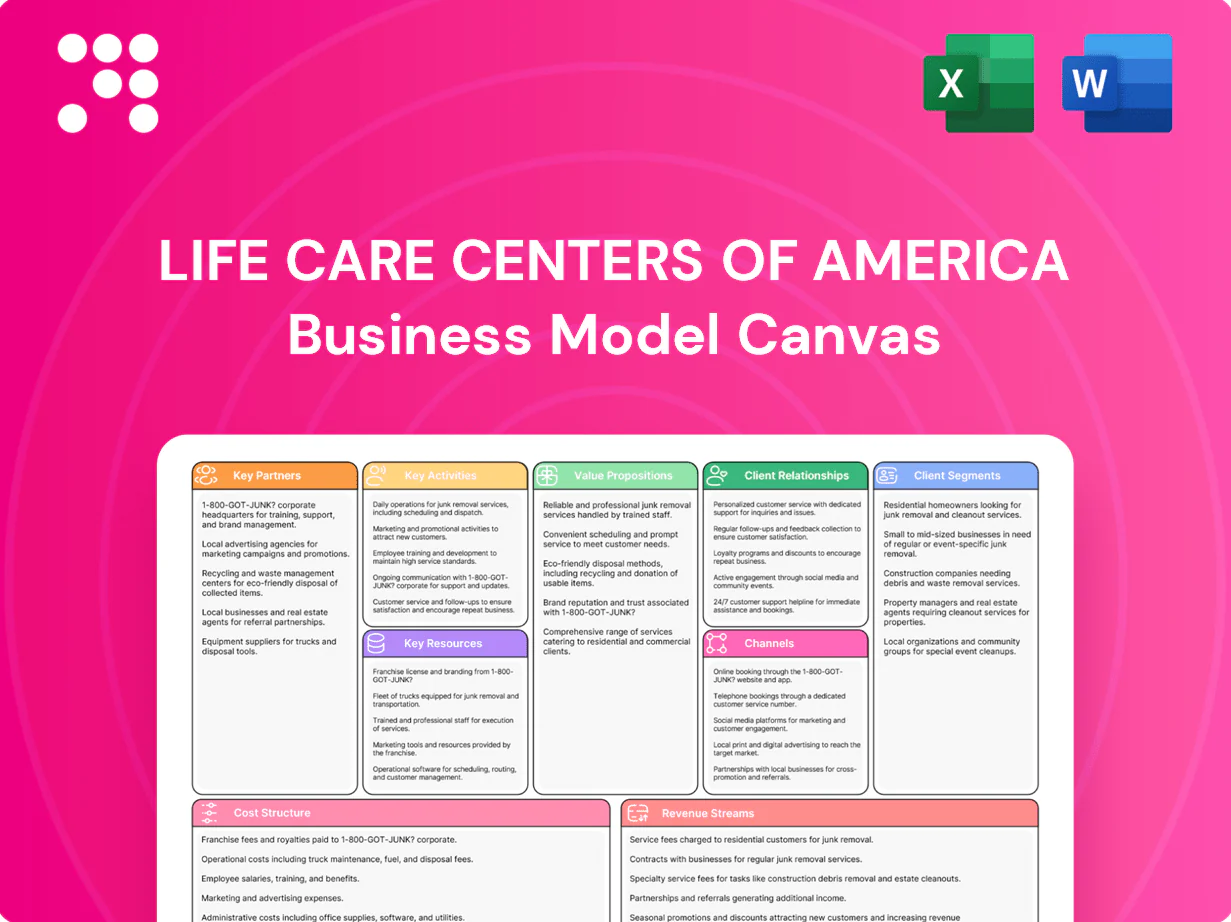
Life Care Centers of America Business Model Canvas

Unlock the strategic blueprint of leading senior care provider with concise Business Model Canvas
Unlock the strategic blueprint behind Life Care Centers of America with our concise Business Model Canvas summary. See how its value propositions, partnerships, and revenue streams drive sustainable growth and competitive advantage. Purchase the full editable Canvas for detailed, section-by-section insights and ready-to-use templates.
Partnerships

Hospital and health system referrals
Acute-care hospitals and IDNs are primary sources of post-acute referrals, with Medicare data showing roughly 1 in 5 hospitalized beneficiaries discharged to skilled nursing facilities. Preferred network status with hospitals stabilizes census and case mix by securing steady admissions and higher-acuity referrals. Collaborative care pathways and shared discharge protocols have been shown to shorten length of stay and lower readmissions. Joint quality initiatives and CMS-aligned data sharing align incentives and performance metrics.
Physician groups and ACOs
Life Care Centers operates over 200 skilled nursing centers across 27 states; primary care, hospitalists, and specialists drive the majority of admissions and ongoing care. Partnerships with 400+ ACOs in 2024 support value-based care targets, with ACOs reporting aggregate Medicare savings exceeding $1.2 billion. Medical director relationships enhance clinical oversight and protocol adherence. Shared protocols have been shown to reduce 30-day readmissions by up to 20% and improve documentation.

Payers: Medicare, Medicaid, MA plans
Coverage and reimbursement depend on federal, state and managed care contracts, with Medicare payments tied to federal rates and Medicaid varying by state; Medicare covered about 67 million beneficiaries in 2024. Medicare Advantage (MA) enrollment reached roughly 52% in 2024 and, along with SNPs, heavily influences patient steerage and rates. Participation in MA/MCO networks (Medicaid MCOs cover ~70% of beneficiaries) ensures access to members, while prior authorization and utilization management require tight coordination with payers.

Therapy, pharmacy, and equipment vendors
Therapy (PT/OT/SLP), long-term care pharmacies, and DME suppliers enable Life Care Centers to deliver full continuum services; integrated partners improve timeliness and clinical outcomes, with 2024 industry reports linking coordinated post-acute networks to reduced readmissions and faster discharges.
- PT/OT/SLP enable rehab-driven revenue and shorter LOS
- LTC pharmacies improve formulary adherence and reduce med errors
- DME suppliers ensure timely durable equipment delivery
- Contracts cut costs and integrated systems streamline ordering/documentation
Community orgs and regulators
Community partners—senior centers, faith groups, and nonprofits—drive outreach and referrals, boosting local admissions and trust while expanding service access.
State survey agencies and CMS regulate standards across 15,000+ US nursing homes, and workforce pipelines from schools and training programs supply 200,000+ annual nursing graduates to support staffing needs.
- referrals: senior centers, faith groups, nonprofits
- regulation: CMS + state agencies over 15,000+ homes
- workforce: 200,000+ nursing grads annually
- benefit: local partnerships increase trust and access
Hospitals drive ~20% of SNF discharges as MA reaches 52% and ACOs save $1.2B
Hospitals/IDNs supply ~20% of hospitalized Medicare beneficiaries to skilled nursing, stabilizing admissions and acuity. Life Care Centers operates ~200 facilities in 27 states with clinical ties to 400+ ACOs that reported ~$1.2B aggregate Medicare savings in 2024. Medicare covered ~67M beneficiaries in 2024 and Medicare Advantage enrollment reached ~52%, driving network participation. Workforce pipelines produce ~200,000 nursing grads annually.
| Metric | 2024 Value |
|---|---|
| Hospital→SNF discharges | ~20% |
| Life Care centers | ~200 |
| States | 27 |
| ACOs partnered | 400+ |
| ACO Medicare savings | $1.2B |
| Medicare beneficiaries | ~67M |
| MA enrollment | ~52% |
| Annual nursing grads | ~200,000 |
What is included in the product
 Detailed Word Document
A comprehensive, pre-written Business Model Canvas for Life Care Centers of America detailing customer segments, channels, value propositions, key activities, partners, resources, cost structure and revenue streams across the nine BMC blocks; reflects real-world skilled nursing, rehabilitation and long-term care operations, includes linked SWOT and competitive-advantage analysis, and is ideal for presentations, investor discussions and strategic decision-making.

 Customizable Excel Spreadsheet
Streamlines Life Care Centers of America’s complex long-term care model into an editable one-page canvas, relieving pain points around regulatory compliance, staffing allocation, and care-cost transparency. Ideal for fast team alignment, board reviews, and side-by-side comparisons to accelerate decision-making and reduce planning time.
Activities

Skilled nursing and clinical care
Provide 24/7 nursing, wound care, IV therapy and chronic disease management across Life Care Centers of America’s network of over 200 skilled nursing and rehabilitation centers in 28 states, ensuring continuity of care for post-acute patients. Coordinate physician and specialist visits, monitor vitals, medications and individualized care plans daily, and maintain documentation to meet CMS and state regulatory requirements. Staff use electronic health records and standardized protocols to support compliance and clinical outcomes reporting.
Rehabilitation services delivery
Deliver PT, OT and SLP to short‑term and long‑term residents, with individualized plans and measurable targets for gait, transfers and ADLs. Goals and documented functional gains drive care pathways and discharge planning; Medicare covers up to 100 days of SNF care per benefit period. Therapy intensity and coding align with CMS PDPM (implemented Oct 2019) and payer rules to optimize reimbursement and outcomes.

Care coordination and discharge planning
Care coordination aligns hospitals, families, and payers to smooth transitions and curb 30-day readmissions (Medicare SNF readmission ~15% in 2023). The team arranges home health, hospice, durable medical equipment and manages authorizations to optimize discharge timing (median SNF stay ~26 days, CMS 2023). Patient and caregiver education targets continuity of care and reduces avoidable returns.

Quality, compliance, and risk management
Workforce management and training
Recruit, credential, and schedule clinical and non-clinical staff with centralized hiring platforms and credentialing checks while running structured onboarding and competency validation programs to ensure regulatory compliance and consistent care quality.
- Optimize staffing ratios to acuity
- Ongoing competencies and re-credentialing
- Retention programs to reduce turnover
24/7 Skilled Nursing Across 200+ Centers: PDPM Rehab, 26-Day Median Stay, Lower Readmissions
Operate 24/7 skilled nursing, wound/IV/chronic care across 200+ centers in 28 states; coordinate physicians, EHRs and CMS-compliant documentation. Deliver PT/OT/SLP under PDPM to drive discharge (median SNF stay 26 days; Medicare covers up to 100 days). Run care coordination to reduce readmissions (~15% Medicare 2023) and QAPI targets (2024: infections <1.5, falls <3.5, pressure injuries <2%).
| Metric | 2023/2024 |
|---|---|
| Centers / States | 200+ / 28 |
| Median SNF stay | 26 days (CMS 2023) |
| Readmission rate | ~15% (Medicare 2023) |
| QAPI targets | Infections <1.5; Falls <3.5; Pressure injuries <2% (2024) |
Delivered as Displayed
Business Model Canvas
This preview shows the actual Life Care Centers of America Business Model Canvas—not a mockup or sample—and contains the same structured content you’ll receive after purchase. When you complete your order, you’ll get this exact, ready-to-edit document in the delivered file formats. Use it immediately for presentations, planning, or customization with no surprises.

Unlock the strategic blueprint of leading senior care provider with concise Business Model Canvas
Unlock the strategic blueprint behind Life Care Centers of America with our concise Business Model Canvas summary. See how its value propositions, partnerships, and revenue streams drive sustainable growth and competitive advantage. Purchase the full editable Canvas for detailed, section-by-section insights and ready-to-use templates.
Partnerships
Hospital and health system referrals
Acute-care hospitals and IDNs are primary sources of post-acute referrals, with Medicare data showing roughly 1 in 5 hospitalized beneficiaries discharged to skilled nursing facilities. Preferred network status with hospitals stabilizes census and case mix by securing steady admissions and higher-acuity referrals. Collaborative care pathways and shared discharge protocols have been shown to shorten length of stay and lower readmissions. Joint quality initiatives and CMS-aligned data sharing align incentives and performance metrics.
Physician groups and ACOs
Life Care Centers operates over 200 skilled nursing centers across 27 states; primary care, hospitalists, and specialists drive the majority of admissions and ongoing care. Partnerships with 400+ ACOs in 2024 support value-based care targets, with ACOs reporting aggregate Medicare savings exceeding $1.2 billion. Medical director relationships enhance clinical oversight and protocol adherence. Shared protocols have been shown to reduce 30-day readmissions by up to 20% and improve documentation.
Payers: Medicare, Medicaid, MA plans
Coverage and reimbursement depend on federal, state and managed care contracts, with Medicare payments tied to federal rates and Medicaid varying by state; Medicare covered about 67 million beneficiaries in 2024. Medicare Advantage (MA) enrollment reached roughly 52% in 2024 and, along with SNPs, heavily influences patient steerage and rates. Participation in MA/MCO networks (Medicaid MCOs cover ~70% of beneficiaries) ensures access to members, while prior authorization and utilization management require tight coordination with payers.
Therapy, pharmacy, and equipment vendors
Therapy (PT/OT/SLP), long-term care pharmacies, and DME suppliers enable Life Care Centers to deliver full continuum services; integrated partners improve timeliness and clinical outcomes, with 2024 industry reports linking coordinated post-acute networks to reduced readmissions and faster discharges.
- PT/OT/SLP enable rehab-driven revenue and shorter LOS
- LTC pharmacies improve formulary adherence and reduce med errors
- DME suppliers ensure timely durable equipment delivery
- Contracts cut costs and integrated systems streamline ordering/documentation
Community orgs and regulators
Community partners—senior centers, faith groups, and nonprofits—drive outreach and referrals, boosting local admissions and trust while expanding service access.
State survey agencies and CMS regulate standards across 15,000+ US nursing homes, and workforce pipelines from schools and training programs supply 200,000+ annual nursing graduates to support staffing needs.
- referrals: senior centers, faith groups, nonprofits
- regulation: CMS + state agencies over 15,000+ homes
- workforce: 200,000+ nursing grads annually
- benefit: local partnerships increase trust and access
Hospitals drive ~20% of SNF discharges as MA reaches 52% and ACOs save $1.2B
Hospitals/IDNs supply ~20% of hospitalized Medicare beneficiaries to skilled nursing, stabilizing admissions and acuity. Life Care Centers operates ~200 facilities in 27 states with clinical ties to 400+ ACOs that reported ~$1.2B aggregate Medicare savings in 2024. Medicare covered ~67M beneficiaries in 2024 and Medicare Advantage enrollment reached ~52%, driving network participation. Workforce pipelines produce ~200,000 nursing grads annually.
| Metric | 2024 Value |
|---|---|
| Hospital→SNF discharges | ~20% |
| Life Care centers | ~200 |
| States | 27 |
| ACOs partnered | 400+ |
| ACO Medicare savings | $1.2B |
| Medicare beneficiaries | ~67M |
| MA enrollment | ~52% |
| Annual nursing grads | ~200,000 |
What is included in the product
Detailed Word Document
A comprehensive, pre-written Business Model Canvas for Life Care Centers of America detailing customer segments, channels, value propositions, key activities, partners, resources, cost structure and revenue streams across the nine BMC blocks; reflects real-world skilled nursing, rehabilitation and long-term care operations, includes linked SWOT and competitive-advantage analysis, and is ideal for presentations, investor discussions and strategic decision-making.
Customizable Excel Spreadsheet
Streamlines Life Care Centers of America’s complex long-term care model into an editable one-page canvas, relieving pain points around regulatory compliance, staffing allocation, and care-cost transparency. Ideal for fast team alignment, board reviews, and side-by-side comparisons to accelerate decision-making and reduce planning time.
Activities
Skilled nursing and clinical care
Provide 24/7 nursing, wound care, IV therapy and chronic disease management across Life Care Centers of America’s network of over 200 skilled nursing and rehabilitation centers in 28 states, ensuring continuity of care for post-acute patients. Coordinate physician and specialist visits, monitor vitals, medications and individualized care plans daily, and maintain documentation to meet CMS and state regulatory requirements. Staff use electronic health records and standardized protocols to support compliance and clinical outcomes reporting.
Rehabilitation services delivery
Deliver PT, OT and SLP to short‑term and long‑term residents, with individualized plans and measurable targets for gait, transfers and ADLs. Goals and documented functional gains drive care pathways and discharge planning; Medicare covers up to 100 days of SNF care per benefit period. Therapy intensity and coding align with CMS PDPM (implemented Oct 2019) and payer rules to optimize reimbursement and outcomes.
Care coordination and discharge planning
Care coordination aligns hospitals, families, and payers to smooth transitions and curb 30-day readmissions (Medicare SNF readmission ~15% in 2023). The team arranges home health, hospice, durable medical equipment and manages authorizations to optimize discharge timing (median SNF stay ~26 days, CMS 2023). Patient and caregiver education targets continuity of care and reduces avoidable returns.
Quality, compliance, and risk management
Workforce management and training
Recruit, credential, and schedule clinical and non-clinical staff with centralized hiring platforms and credentialing checks while running structured onboarding and competency validation programs to ensure regulatory compliance and consistent care quality.
- Optimize staffing ratios to acuity
- Ongoing competencies and re-credentialing
- Retention programs to reduce turnover
24/7 Skilled Nursing Across 200+ Centers: PDPM Rehab, 26-Day Median Stay, Lower Readmissions
Operate 24/7 skilled nursing, wound/IV/chronic care across 200+ centers in 28 states; coordinate physicians, EHRs and CMS-compliant documentation. Deliver PT/OT/SLP under PDPM to drive discharge (median SNF stay 26 days; Medicare covers up to 100 days). Run care coordination to reduce readmissions (~15% Medicare 2023) and QAPI targets (2024: infections <1.5, falls <3.5, pressure injuries <2%).
| Metric | 2023/2024 |
|---|---|
| Centers / States | 200+ / 28 |
| Median SNF stay | 26 days (CMS 2023) |
| Readmission rate | ~15% (Medicare 2023) |
| QAPI targets | Infections <1.5; Falls <3.5; Pressure injuries <2% (2024) |
Delivered as Displayed
Business Model Canvas
This preview shows the actual Life Care Centers of America Business Model Canvas—not a mockup or sample—and contains the same structured content you’ll receive after purchase. When you complete your order, you’ll get this exact, ready-to-edit document in the delivered file formats. Use it immediately for presentations, planning, or customization with no surprises.
Description
Unlock the strategic blueprint of leading senior care provider with concise Business Model Canvas
Unlock the strategic blueprint behind Life Care Centers of America with our concise Business Model Canvas summary. See how its value propositions, partnerships, and revenue streams drive sustainable growth and competitive advantage. Purchase the full editable Canvas for detailed, section-by-section insights and ready-to-use templates.
Partnerships
Hospital and health system referrals
Acute-care hospitals and IDNs are primary sources of post-acute referrals, with Medicare data showing roughly 1 in 5 hospitalized beneficiaries discharged to skilled nursing facilities. Preferred network status with hospitals stabilizes census and case mix by securing steady admissions and higher-acuity referrals. Collaborative care pathways and shared discharge protocols have been shown to shorten length of stay and lower readmissions. Joint quality initiatives and CMS-aligned data sharing align incentives and performance metrics.
Physician groups and ACOs
Life Care Centers operates over 200 skilled nursing centers across 27 states; primary care, hospitalists, and specialists drive the majority of admissions and ongoing care. Partnerships with 400+ ACOs in 2024 support value-based care targets, with ACOs reporting aggregate Medicare savings exceeding $1.2 billion. Medical director relationships enhance clinical oversight and protocol adherence. Shared protocols have been shown to reduce 30-day readmissions by up to 20% and improve documentation.
Payers: Medicare, Medicaid, MA plans
Coverage and reimbursement depend on federal, state and managed care contracts, with Medicare payments tied to federal rates and Medicaid varying by state; Medicare covered about 67 million beneficiaries in 2024. Medicare Advantage (MA) enrollment reached roughly 52% in 2024 and, along with SNPs, heavily influences patient steerage and rates. Participation in MA/MCO networks (Medicaid MCOs cover ~70% of beneficiaries) ensures access to members, while prior authorization and utilization management require tight coordination with payers.
Therapy, pharmacy, and equipment vendors
Therapy (PT/OT/SLP), long-term care pharmacies, and DME suppliers enable Life Care Centers to deliver full continuum services; integrated partners improve timeliness and clinical outcomes, with 2024 industry reports linking coordinated post-acute networks to reduced readmissions and faster discharges.
- PT/OT/SLP enable rehab-driven revenue and shorter LOS
- LTC pharmacies improve formulary adherence and reduce med errors
- DME suppliers ensure timely durable equipment delivery
- Contracts cut costs and integrated systems streamline ordering/documentation
Community orgs and regulators
Community partners—senior centers, faith groups, and nonprofits—drive outreach and referrals, boosting local admissions and trust while expanding service access.
State survey agencies and CMS regulate standards across 15,000+ US nursing homes, and workforce pipelines from schools and training programs supply 200,000+ annual nursing graduates to support staffing needs.
- referrals: senior centers, faith groups, nonprofits
- regulation: CMS + state agencies over 15,000+ homes
- workforce: 200,000+ nursing grads annually
- benefit: local partnerships increase trust and access
Hospitals drive ~20% of SNF discharges as MA reaches 52% and ACOs save $1.2B
Hospitals/IDNs supply ~20% of hospitalized Medicare beneficiaries to skilled nursing, stabilizing admissions and acuity. Life Care Centers operates ~200 facilities in 27 states with clinical ties to 400+ ACOs that reported ~$1.2B aggregate Medicare savings in 2024. Medicare covered ~67M beneficiaries in 2024 and Medicare Advantage enrollment reached ~52%, driving network participation. Workforce pipelines produce ~200,000 nursing grads annually.
| Metric | 2024 Value |
|---|---|
| Hospital→SNF discharges | ~20% |
| Life Care centers | ~200 |
| States | 27 |
| ACOs partnered | 400+ |
| ACO Medicare savings | $1.2B |
| Medicare beneficiaries | ~67M |
| MA enrollment | ~52% |
| Annual nursing grads | ~200,000 |
What is included in the product
Detailed Word Document
A comprehensive, pre-written Business Model Canvas for Life Care Centers of America detailing customer segments, channels, value propositions, key activities, partners, resources, cost structure and revenue streams across the nine BMC blocks; reflects real-world skilled nursing, rehabilitation and long-term care operations, includes linked SWOT and competitive-advantage analysis, and is ideal for presentations, investor discussions and strategic decision-making.
Customizable Excel Spreadsheet
Streamlines Life Care Centers of America’s complex long-term care model into an editable one-page canvas, relieving pain points around regulatory compliance, staffing allocation, and care-cost transparency. Ideal for fast team alignment, board reviews, and side-by-side comparisons to accelerate decision-making and reduce planning time.
Activities
Skilled nursing and clinical care
Provide 24/7 nursing, wound care, IV therapy and chronic disease management across Life Care Centers of America’s network of over 200 skilled nursing and rehabilitation centers in 28 states, ensuring continuity of care for post-acute patients. Coordinate physician and specialist visits, monitor vitals, medications and individualized care plans daily, and maintain documentation to meet CMS and state regulatory requirements. Staff use electronic health records and standardized protocols to support compliance and clinical outcomes reporting.
Rehabilitation services delivery
Deliver PT, OT and SLP to short‑term and long‑term residents, with individualized plans and measurable targets for gait, transfers and ADLs. Goals and documented functional gains drive care pathways and discharge planning; Medicare covers up to 100 days of SNF care per benefit period. Therapy intensity and coding align with CMS PDPM (implemented Oct 2019) and payer rules to optimize reimbursement and outcomes.
Care coordination and discharge planning
Care coordination aligns hospitals, families, and payers to smooth transitions and curb 30-day readmissions (Medicare SNF readmission ~15% in 2023). The team arranges home health, hospice, durable medical equipment and manages authorizations to optimize discharge timing (median SNF stay ~26 days, CMS 2023). Patient and caregiver education targets continuity of care and reduces avoidable returns.
Quality, compliance, and risk management
Workforce management and training
Recruit, credential, and schedule clinical and non-clinical staff with centralized hiring platforms and credentialing checks while running structured onboarding and competency validation programs to ensure regulatory compliance and consistent care quality.
- Optimize staffing ratios to acuity
- Ongoing competencies and re-credentialing
- Retention programs to reduce turnover
24/7 Skilled Nursing Across 200+ Centers: PDPM Rehab, 26-Day Median Stay, Lower Readmissions
Operate 24/7 skilled nursing, wound/IV/chronic care across 200+ centers in 28 states; coordinate physicians, EHRs and CMS-compliant documentation. Deliver PT/OT/SLP under PDPM to drive discharge (median SNF stay 26 days; Medicare covers up to 100 days). Run care coordination to reduce readmissions (~15% Medicare 2023) and QAPI targets (2024: infections <1.5, falls <3.5, pressure injuries <2%).
| Metric | 2023/2024 |
|---|---|
| Centers / States | 200+ / 28 |
| Median SNF stay | 26 days (CMS 2023) |
| Readmission rate | ~15% (Medicare 2023) |
| QAPI targets | Infections <1.5; Falls <3.5; Pressure injuries <2% (2024) |
Delivered as Displayed
Business Model Canvas
This preview shows the actual Life Care Centers of America Business Model Canvas—not a mockup or sample—and contains the same structured content you’ll receive after purchase. When you complete your order, you’ll get this exact, ready-to-edit document in the delivered file formats. Use it immediately for presentations, planning, or customization with no surprises.











