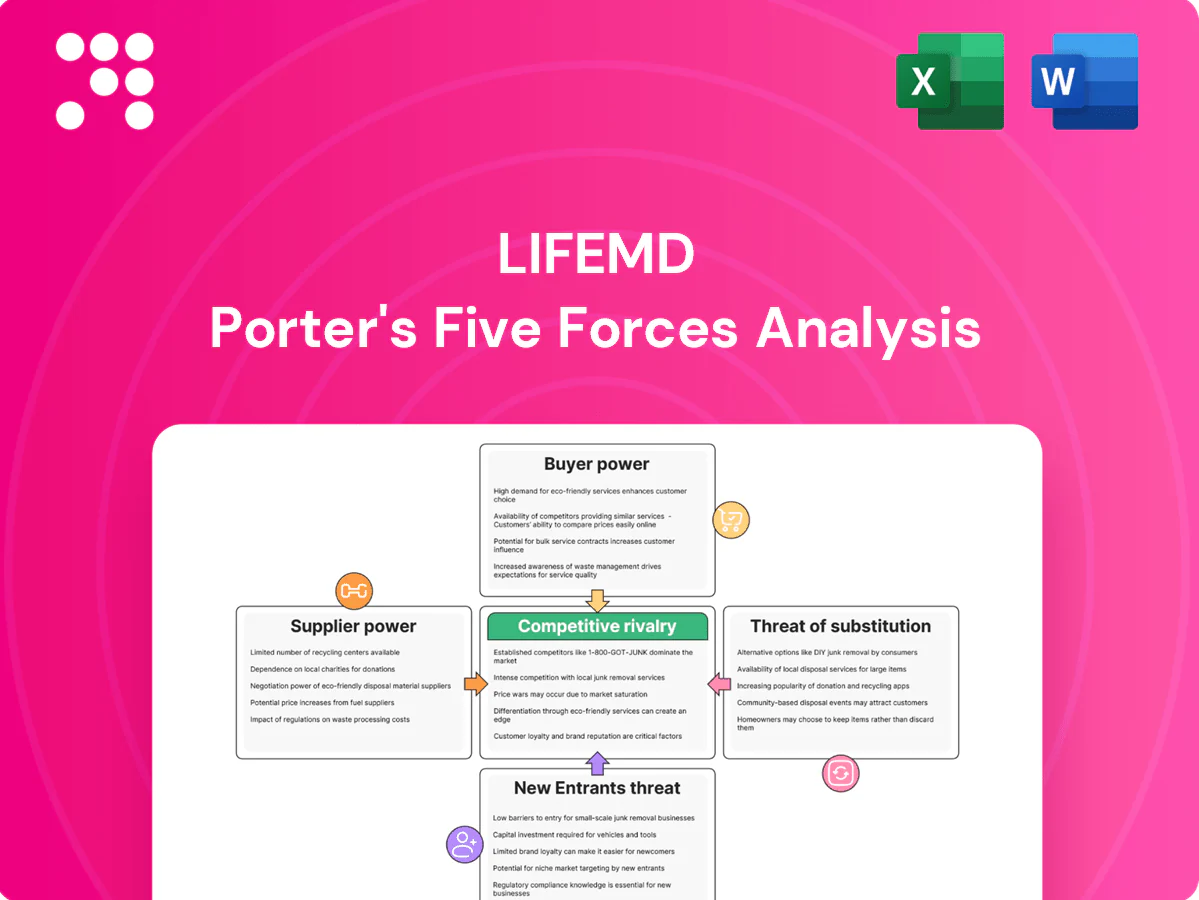
LifeMD Porter's Five Forces Analysis

A Must-Have Tool for Decision-Makers
LifeMD faces evolving competitive pressures from telehealth rivals, supplier and payer dynamics, and shifting consumer preferences, each shaping its margin and growth prospects. This snapshot highlights key tensions but omits force-by-force ratings and scenario analysis. Unlock the full Porter's Five Forces Analysis for detailed ratings, visuals, and strategic implications. Purchase the complete report to inform investment or strategic decisions.
Suppliers Bargaining Power

Licensed clinicians as key inputs
LifeMD depends on licensed physicians, NPs and PAs as critical suppliers — roughly 1.1M physicians, ~350k NPs and ~150k PAs in the US (2024), so specialty scarcity and state-by-state licensure raise supplier leverage. Interstate compacts (IMLC: 38 states + DC in 2024) plus multi-state telehealth, flexible scheduling and clinician engagement programs mitigate risk. Competitive compensation and workflow tools reduce switching and help preserve margins.
Pharmacy and fulfillment partners
Third-party pharmacies compound and ship prescriptions, directly shaping pricing, SLAs and patient experience; specialty drugs now drive roughly 50% of US drug spend (~$358B in 2023), amplifying supplier leverage. Limited compounding capacity and specialty supply bottlenecks raise dependency on select providers. Diversifying pharmacy partners, adopting e-prescribe standards and building in‑house pharmacy or preferred networks can materially curb concentration risk.

Platform infrastructure and data vendors
Platform infrastructure and data vendors (cloud providers, EHR modules, e-prescribe gateways, ID verification, payments) are critical inputs; top cloud players (AWS ~32%, Azure ~23%, GCP ~11% in 2024) and dominant e-prescribe networks (Surescripts ~90% coverage) wield pricing and compliance leverage. Vendor lock-in and built-in HIPAA/HITRUST (>10,000 orgs certified by 2024) features increase supplier bargaining power. Multi-cloud, modular integrations and open APIs reduce single-vendor dependency, while volume commitments secure lower fees and stronger uptime SLAs.

Drug manufacturers and compounding sources
Access to branded, generic, and compounded therapies directly alters LifeMD care-bundle costs, while FDA drug shortages and heightened compounding oversight can sharply constrain supply and raise prices. Strategic sourcing, therapeutic substitution protocols, long-term supplier agreements, and inventory buffers are used to reduce exposure and stabilize availability and pricing.
- Supply influence: branded vs generic vs compounded
- Risk: FDA drug shortages and compounding scrutiny
- Mitigation: sourcing, substitution
- Stability: contracts and inventory buffers
Marketing channels and ad networks
LifeMD’s DTC model relies heavily on paid search, social ads, affiliates and influencers, leaving it exposed to auction-based pricing and policy shifts by platforms that together hold roughly 50% of US digital ad spend; channel diversification and organic content reduce dependence, while data-driven LTV optimization improves ROAS and bargaining leverage.
- Platform concentration ≈50%
- Diversify channels to cut platform risk
- Improve LTV to raise ROAS
Supplier leverage: clinicians 1.6M, specialty $358B
LifeMD faces supplier leverage from clinicians (1.1M MDs, ~350k NPs, ~150k PAs in US, 2024) and pharmacy/specialty drug concentration (specialty ≈$358B of US drug spend, 2023). Cloud/e-prescribe vendors (AWS 32%, Azure 23%, Surescripts ~90%) and ad platforms (~50% US digital spend) add pricing power; diversification and contracts reduce risk.
| Supplier | Key stat | Leverage |
|---|---|---|
| Clinicians | 1.6M total (2024) | High |
| Pharmacies | Specialty $358B (2023) | High |
| Infra vendors | AWS32%/Azure23%/Surescripts90% | Medium-High |
What is included in the product
 Detailed Word Document
Uncovers competitive drivers, buyer and supplier influence, entry barriers, substitutes, and rivalry specific to LifeMD—highlighting disruptive threats, strategic levers to protect market share, and editable insights for investor or strategy decks.

 Customizable Excel Spreadsheet
A one-sheet Porter's Five Forces summary tailored to LifeMD—clarifies competitive pressures and relieves strategic uncertainty for faster, confident decision-making. Swap in your own metrics or scenario tabs to model impacts of regulation, new entrants, or telehealth trends.
Customers Bargaining Power

Price-sensitive DTC patients
Patients shop telehealth primarily on price, convenience and outcomes, which raises buyer power and forces LifeMD to match competitors on cost and UX. Easy subscription cancellation elevates churn risk, pressuring retention metrics and LTV. Bundled care plans and transparent pricing reduce churn by increasing perceived value. Clear, demonstrable clinical outcomes increase willingness to pay and support premium tiers.
Low switching costs online
Low switching costs online let patients move across telehealth sites quickly—virtual care accounted for about 18% of US outpatient visits in 2024, easing churn. Intro discounts and free consults intensify comparison shopping and lower acquisition costs. Frictionless onboarding and rapid refills defend share by reducing churn, while loyalty perks and seamless refill flows increase patient stickiness and lifetime value.

Information-rich buyers
Information-rich buyers use reviews, Reddit (about 73 million daily users reported in 2023), and price aggregators to compare telehealth options, and negative sentiment can quickly suppress demand. Proactive reputation management and clinician-led education restore confidence. Publishing outcomes and safety data measurably counters skepticism and supports retention.

Employer and payer subsets
If LifeMD sells through employers or payers, institutional buyers wield strong leverage—top five US insurers cover roughly 70% of commercially insured lives in 2024 and drive aggressive rate negotiation and outcomes-based terms. RFPs and performance guarantees shift pricing power to buyers, while value-based contracts (about 30% of payments in 2024) can realign incentives. Integration with benefits platforms increases stickiness and reduces churn.
- Buyers: large insurers/employers (~70% market share)
- Pressure: RFPs, guarantees
- Opportunity: ~30% value-based payments
- Defense: embed in benefits ecosystems
Demand for privacy and access
Customers in sensitive categories such as sexual health and weight demand high privacy and discretion; 2024 telehealth surveys show roughly 70% of users rate privacy as a primary selection factor, and any perceived lapse prompts rapid switching and complaints. Strong privacy-focused UX, HIPAA compliance and third-party certifications materially blunt buyer leverage by reducing perceived risk. 24/7 access plus same-day or fast shipping meets convenience expectations and lowers churn.
- Privacy sensitivity: sexual health, weight
- Switching risk: rapid after lapses
- Mitigants: privacy UX, HIPAA, certifications
- Convenience: 24/7 access, fast shipping
Patients drive virtual care: price, privacy, and payers reshape market
Patients prioritize price, convenience and outcomes, giving buyers high leverage—virtual care was ~18% of US outpatient visits in 2024, increasing churn risk. Top five insurers cover ~70% of commercially insured lives, shifting negotiation power; value-based payments ~30% offer partnership routes. Privacy matters: ~70% cite privacy as primary factor, so compliance and UX reduce switching.
| Metric | 2024 Value | Implication |
|---|---|---|
| Virtual care share | ~18% | Higher price sensitivity, easier switching |
| Top-5 insurers reach | ~70% | Strong institutional buyer leverage |
| Value-based payments | ~30% | Opportunity to align incentives |
| Privacy importance | ~70% | Critical for retention |
Preview Before You Purchase
LifeMD Porter's Five Forces Analysis
This preview shows the exact LifeMD Porter's Five Forces Analysis you'll receive immediately after purchase—no surprises or placeholders; it's the fully formatted, professionally written file ready for download. The document displayed is the complete analysis you’ll get the moment you buy, with instant access and no additional setup required. Use it right away for strategic planning or investment decisions.

A Must-Have Tool for Decision-Makers
LifeMD faces evolving competitive pressures from telehealth rivals, supplier and payer dynamics, and shifting consumer preferences, each shaping its margin and growth prospects. This snapshot highlights key tensions but omits force-by-force ratings and scenario analysis. Unlock the full Porter's Five Forces Analysis for detailed ratings, visuals, and strategic implications. Purchase the complete report to inform investment or strategic decisions.
Suppliers Bargaining Power
Licensed clinicians as key inputs
LifeMD depends on licensed physicians, NPs and PAs as critical suppliers — roughly 1.1M physicians, ~350k NPs and ~150k PAs in the US (2024), so specialty scarcity and state-by-state licensure raise supplier leverage. Interstate compacts (IMLC: 38 states + DC in 2024) plus multi-state telehealth, flexible scheduling and clinician engagement programs mitigate risk. Competitive compensation and workflow tools reduce switching and help preserve margins.
Pharmacy and fulfillment partners
Third-party pharmacies compound and ship prescriptions, directly shaping pricing, SLAs and patient experience; specialty drugs now drive roughly 50% of US drug spend (~$358B in 2023), amplifying supplier leverage. Limited compounding capacity and specialty supply bottlenecks raise dependency on select providers. Diversifying pharmacy partners, adopting e-prescribe standards and building in‑house pharmacy or preferred networks can materially curb concentration risk.
Platform infrastructure and data vendors
Platform infrastructure and data vendors (cloud providers, EHR modules, e-prescribe gateways, ID verification, payments) are critical inputs; top cloud players (AWS ~32%, Azure ~23%, GCP ~11% in 2024) and dominant e-prescribe networks (Surescripts ~90% coverage) wield pricing and compliance leverage. Vendor lock-in and built-in HIPAA/HITRUST (>10,000 orgs certified by 2024) features increase supplier bargaining power. Multi-cloud, modular integrations and open APIs reduce single-vendor dependency, while volume commitments secure lower fees and stronger uptime SLAs.
Drug manufacturers and compounding sources
Access to branded, generic, and compounded therapies directly alters LifeMD care-bundle costs, while FDA drug shortages and heightened compounding oversight can sharply constrain supply and raise prices. Strategic sourcing, therapeutic substitution protocols, long-term supplier agreements, and inventory buffers are used to reduce exposure and stabilize availability and pricing.
- Supply influence: branded vs generic vs compounded
- Risk: FDA drug shortages and compounding scrutiny
- Mitigation: sourcing, substitution
- Stability: contracts and inventory buffers
Marketing channels and ad networks
LifeMD’s DTC model relies heavily on paid search, social ads, affiliates and influencers, leaving it exposed to auction-based pricing and policy shifts by platforms that together hold roughly 50% of US digital ad spend; channel diversification and organic content reduce dependence, while data-driven LTV optimization improves ROAS and bargaining leverage.
- Platform concentration ≈50%
- Diversify channels to cut platform risk
- Improve LTV to raise ROAS
Supplier leverage: clinicians 1.6M, specialty $358B
LifeMD faces supplier leverage from clinicians (1.1M MDs, ~350k NPs, ~150k PAs in US, 2024) and pharmacy/specialty drug concentration (specialty ≈$358B of US drug spend, 2023). Cloud/e-prescribe vendors (AWS 32%, Azure 23%, Surescripts ~90%) and ad platforms (~50% US digital spend) add pricing power; diversification and contracts reduce risk.
| Supplier | Key stat | Leverage |
|---|---|---|
| Clinicians | 1.6M total (2024) | High |
| Pharmacies | Specialty $358B (2023) | High |
| Infra vendors | AWS32%/Azure23%/Surescripts90% | Medium-High |
What is included in the product
Detailed Word Document
Uncovers competitive drivers, buyer and supplier influence, entry barriers, substitutes, and rivalry specific to LifeMD—highlighting disruptive threats, strategic levers to protect market share, and editable insights for investor or strategy decks.
Customizable Excel Spreadsheet
A one-sheet Porter's Five Forces summary tailored to LifeMD—clarifies competitive pressures and relieves strategic uncertainty for faster, confident decision-making. Swap in your own metrics or scenario tabs to model impacts of regulation, new entrants, or telehealth trends.
Customers Bargaining Power
Price-sensitive DTC patients
Patients shop telehealth primarily on price, convenience and outcomes, which raises buyer power and forces LifeMD to match competitors on cost and UX. Easy subscription cancellation elevates churn risk, pressuring retention metrics and LTV. Bundled care plans and transparent pricing reduce churn by increasing perceived value. Clear, demonstrable clinical outcomes increase willingness to pay and support premium tiers.
Low switching costs online
Low switching costs online let patients move across telehealth sites quickly—virtual care accounted for about 18% of US outpatient visits in 2024, easing churn. Intro discounts and free consults intensify comparison shopping and lower acquisition costs. Frictionless onboarding and rapid refills defend share by reducing churn, while loyalty perks and seamless refill flows increase patient stickiness and lifetime value.
Information-rich buyers
Information-rich buyers use reviews, Reddit (about 73 million daily users reported in 2023), and price aggregators to compare telehealth options, and negative sentiment can quickly suppress demand. Proactive reputation management and clinician-led education restore confidence. Publishing outcomes and safety data measurably counters skepticism and supports retention.
Employer and payer subsets
If LifeMD sells through employers or payers, institutional buyers wield strong leverage—top five US insurers cover roughly 70% of commercially insured lives in 2024 and drive aggressive rate negotiation and outcomes-based terms. RFPs and performance guarantees shift pricing power to buyers, while value-based contracts (about 30% of payments in 2024) can realign incentives. Integration with benefits platforms increases stickiness and reduces churn.
- Buyers: large insurers/employers (~70% market share)
- Pressure: RFPs, guarantees
- Opportunity: ~30% value-based payments
- Defense: embed in benefits ecosystems
Demand for privacy and access
Customers in sensitive categories such as sexual health and weight demand high privacy and discretion; 2024 telehealth surveys show roughly 70% of users rate privacy as a primary selection factor, and any perceived lapse prompts rapid switching and complaints. Strong privacy-focused UX, HIPAA compliance and third-party certifications materially blunt buyer leverage by reducing perceived risk. 24/7 access plus same-day or fast shipping meets convenience expectations and lowers churn.
- Privacy sensitivity: sexual health, weight
- Switching risk: rapid after lapses
- Mitigants: privacy UX, HIPAA, certifications
- Convenience: 24/7 access, fast shipping
Patients drive virtual care: price, privacy, and payers reshape market
Patients prioritize price, convenience and outcomes, giving buyers high leverage—virtual care was ~18% of US outpatient visits in 2024, increasing churn risk. Top five insurers cover ~70% of commercially insured lives, shifting negotiation power; value-based payments ~30% offer partnership routes. Privacy matters: ~70% cite privacy as primary factor, so compliance and UX reduce switching.
| Metric | 2024 Value | Implication |
|---|---|---|
| Virtual care share | ~18% | Higher price sensitivity, easier switching |
| Top-5 insurers reach | ~70% | Strong institutional buyer leverage |
| Value-based payments | ~30% | Opportunity to align incentives |
| Privacy importance | ~70% | Critical for retention |
Preview Before You Purchase
LifeMD Porter's Five Forces Analysis
This preview shows the exact LifeMD Porter's Five Forces Analysis you'll receive immediately after purchase—no surprises or placeholders; it's the fully formatted, professionally written file ready for download. The document displayed is the complete analysis you’ll get the moment you buy, with instant access and no additional setup required. Use it right away for strategic planning or investment decisions.
Description
A Must-Have Tool for Decision-Makers
LifeMD faces evolving competitive pressures from telehealth rivals, supplier and payer dynamics, and shifting consumer preferences, each shaping its margin and growth prospects. This snapshot highlights key tensions but omits force-by-force ratings and scenario analysis. Unlock the full Porter's Five Forces Analysis for detailed ratings, visuals, and strategic implications. Purchase the complete report to inform investment or strategic decisions.
Suppliers Bargaining Power
Licensed clinicians as key inputs
LifeMD depends on licensed physicians, NPs and PAs as critical suppliers — roughly 1.1M physicians, ~350k NPs and ~150k PAs in the US (2024), so specialty scarcity and state-by-state licensure raise supplier leverage. Interstate compacts (IMLC: 38 states + DC in 2024) plus multi-state telehealth, flexible scheduling and clinician engagement programs mitigate risk. Competitive compensation and workflow tools reduce switching and help preserve margins.
Pharmacy and fulfillment partners
Third-party pharmacies compound and ship prescriptions, directly shaping pricing, SLAs and patient experience; specialty drugs now drive roughly 50% of US drug spend (~$358B in 2023), amplifying supplier leverage. Limited compounding capacity and specialty supply bottlenecks raise dependency on select providers. Diversifying pharmacy partners, adopting e-prescribe standards and building in‑house pharmacy or preferred networks can materially curb concentration risk.
Platform infrastructure and data vendors
Platform infrastructure and data vendors (cloud providers, EHR modules, e-prescribe gateways, ID verification, payments) are critical inputs; top cloud players (AWS ~32%, Azure ~23%, GCP ~11% in 2024) and dominant e-prescribe networks (Surescripts ~90% coverage) wield pricing and compliance leverage. Vendor lock-in and built-in HIPAA/HITRUST (>10,000 orgs certified by 2024) features increase supplier bargaining power. Multi-cloud, modular integrations and open APIs reduce single-vendor dependency, while volume commitments secure lower fees and stronger uptime SLAs.
Drug manufacturers and compounding sources
Access to branded, generic, and compounded therapies directly alters LifeMD care-bundle costs, while FDA drug shortages and heightened compounding oversight can sharply constrain supply and raise prices. Strategic sourcing, therapeutic substitution protocols, long-term supplier agreements, and inventory buffers are used to reduce exposure and stabilize availability and pricing.
- Supply influence: branded vs generic vs compounded
- Risk: FDA drug shortages and compounding scrutiny
- Mitigation: sourcing, substitution
- Stability: contracts and inventory buffers
Marketing channels and ad networks
LifeMD’s DTC model relies heavily on paid search, social ads, affiliates and influencers, leaving it exposed to auction-based pricing and policy shifts by platforms that together hold roughly 50% of US digital ad spend; channel diversification and organic content reduce dependence, while data-driven LTV optimization improves ROAS and bargaining leverage.
- Platform concentration ≈50%
- Diversify channels to cut platform risk
- Improve LTV to raise ROAS
Supplier leverage: clinicians 1.6M, specialty $358B
LifeMD faces supplier leverage from clinicians (1.1M MDs, ~350k NPs, ~150k PAs in US, 2024) and pharmacy/specialty drug concentration (specialty ≈$358B of US drug spend, 2023). Cloud/e-prescribe vendors (AWS 32%, Azure 23%, Surescripts ~90%) and ad platforms (~50% US digital spend) add pricing power; diversification and contracts reduce risk.
| Supplier | Key stat | Leverage |
|---|---|---|
| Clinicians | 1.6M total (2024) | High |
| Pharmacies | Specialty $358B (2023) | High |
| Infra vendors | AWS32%/Azure23%/Surescripts90% | Medium-High |
What is included in the product
Detailed Word Document
Uncovers competitive drivers, buyer and supplier influence, entry barriers, substitutes, and rivalry specific to LifeMD—highlighting disruptive threats, strategic levers to protect market share, and editable insights for investor or strategy decks.
Customizable Excel Spreadsheet
A one-sheet Porter's Five Forces summary tailored to LifeMD—clarifies competitive pressures and relieves strategic uncertainty for faster, confident decision-making. Swap in your own metrics or scenario tabs to model impacts of regulation, new entrants, or telehealth trends.
Customers Bargaining Power
Price-sensitive DTC patients
Patients shop telehealth primarily on price, convenience and outcomes, which raises buyer power and forces LifeMD to match competitors on cost and UX. Easy subscription cancellation elevates churn risk, pressuring retention metrics and LTV. Bundled care plans and transparent pricing reduce churn by increasing perceived value. Clear, demonstrable clinical outcomes increase willingness to pay and support premium tiers.
Low switching costs online
Low switching costs online let patients move across telehealth sites quickly—virtual care accounted for about 18% of US outpatient visits in 2024, easing churn. Intro discounts and free consults intensify comparison shopping and lower acquisition costs. Frictionless onboarding and rapid refills defend share by reducing churn, while loyalty perks and seamless refill flows increase patient stickiness and lifetime value.
Information-rich buyers
Information-rich buyers use reviews, Reddit (about 73 million daily users reported in 2023), and price aggregators to compare telehealth options, and negative sentiment can quickly suppress demand. Proactive reputation management and clinician-led education restore confidence. Publishing outcomes and safety data measurably counters skepticism and supports retention.
Employer and payer subsets
If LifeMD sells through employers or payers, institutional buyers wield strong leverage—top five US insurers cover roughly 70% of commercially insured lives in 2024 and drive aggressive rate negotiation and outcomes-based terms. RFPs and performance guarantees shift pricing power to buyers, while value-based contracts (about 30% of payments in 2024) can realign incentives. Integration with benefits platforms increases stickiness and reduces churn.
- Buyers: large insurers/employers (~70% market share)
- Pressure: RFPs, guarantees
- Opportunity: ~30% value-based payments
- Defense: embed in benefits ecosystems
Demand for privacy and access
Customers in sensitive categories such as sexual health and weight demand high privacy and discretion; 2024 telehealth surveys show roughly 70% of users rate privacy as a primary selection factor, and any perceived lapse prompts rapid switching and complaints. Strong privacy-focused UX, HIPAA compliance and third-party certifications materially blunt buyer leverage by reducing perceived risk. 24/7 access plus same-day or fast shipping meets convenience expectations and lowers churn.
- Privacy sensitivity: sexual health, weight
- Switching risk: rapid after lapses
- Mitigants: privacy UX, HIPAA, certifications
- Convenience: 24/7 access, fast shipping
Patients drive virtual care: price, privacy, and payers reshape market
Patients prioritize price, convenience and outcomes, giving buyers high leverage—virtual care was ~18% of US outpatient visits in 2024, increasing churn risk. Top five insurers cover ~70% of commercially insured lives, shifting negotiation power; value-based payments ~30% offer partnership routes. Privacy matters: ~70% cite privacy as primary factor, so compliance and UX reduce switching.
| Metric | 2024 Value | Implication |
|---|---|---|
| Virtual care share | ~18% | Higher price sensitivity, easier switching |
| Top-5 insurers reach | ~70% | Strong institutional buyer leverage |
| Value-based payments | ~30% | Opportunity to align incentives |
| Privacy importance | ~70% | Critical for retention |
Preview Before You Purchase
LifeMD Porter's Five Forces Analysis
This preview shows the exact LifeMD Porter's Five Forces Analysis you'll receive immediately after purchase—no surprises or placeholders; it's the fully formatted, professionally written file ready for download. The document displayed is the complete analysis you’ll get the moment you buy, with instant access and no additional setup required. Use it right away for strategic planning or investment decisions.











