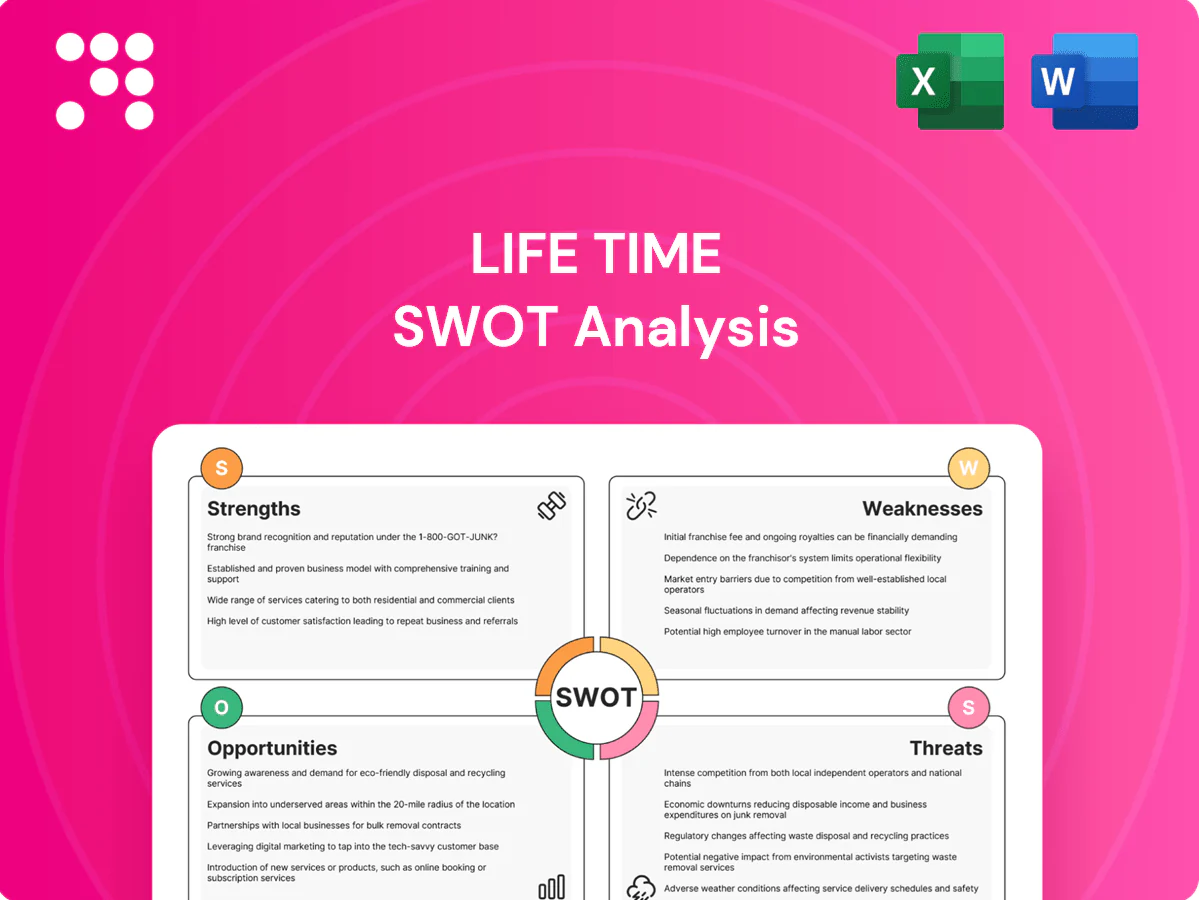
Life Time SWOT Analysis

Go Beyond the Preview—Access the Full Strategic Report
Discover Life Time’s strategic edge with our full SWOT analysis—research-backed insights into strengths, risks, and growth drivers. Purchase the complete, investor-ready report (Word + Excel) to unlock editable, actionable intelligence for strategy, pitches, or investment decisions.
Strengths

Premium lifestyle brand
Life Time's positioning as a luxury, holistic wellness destination — with 160+ clubs as of 2024 — enables pricing power and loyalty, delivering a country-club feel and curated experiences that distinguish it from mass-market gyms. This brand equity underpins stable memberships, meaningful upsell potential, and strong appeal to affluent demographics and corporate partners.
Diversified revenue mix
Life Time's revenue extends beyond memberships to personal training, group programs, spa, cafes, childcare and events, reducing reliance on dues and expanding average revenue per member; as of mid-2024 Life Time operated over 150 clubs serving roughly 850,000 members. Cross-selling services—personal training, spa and childcare—raises lifetime value and supports higher retention. Non-dues channels help buffer seasonal fitness usage and smooth revenue across quarters.

Large-format, experiential clubs
Expansive facilities provide pools, courts and studios that small gyms cannot replicate, enabling diverse programming and longer member stays. The scale fosters community and family usage, driving higher visit frequency. This differentiation supports premium pricing and loyalty. Life Time operates over 160 clubs across North America as of 2024, reinforcing its high-quality brand positioning.

Integrated member ecosystem
Life Time's integrated member ecosystem (over 160 clubs and ~1.0 million members as of 2024) delivers end-to-end wellness—fitness, classes, childcare, recovery—creating a one-stop experience that saves members time. Unified scheduling, on-site childcare, and recovery services increase convenience and usage frequency. The ecosystem drives engagement, habit formation, retention and generates rich member data to personalize offerings and promotions.
- Scale: 160+ clubs
- Membership: ~1.0M (2024)
- Benefits: time savings, convenience
- Outcomes: higher engagement, tailored promotions
North American network effects
Life Time's North American network — over 150 clubs and 1M+ members as of 2024 — enables multi-club access, consistent brand experience, and high awareness; dense markets lower customer-acquisition costs and attract national partners; operational learnings scale across clubs to raise utilization and margins; procurement and tech rollouts benefit from economies of scale.
- Multi-club access: >150 clubs
- Membership scale: 1M+ members
- Marketing efficiency: lower CAC via density
- Scale benefits: procurement & tech deployment
Luxury club ecosystem: 160+ venues, ~1.0M members bolstering ARPU
Life Time's luxury, holistic positioning with 160+ clubs (2024) creates pricing power and strong member loyalty. Diversified revenue—personal training, classes, spa, cafes, childcare—plus ~1.0M members (2024) raises ARPU and reduces dues reliance. Large facilities and integrated ecosystem drive engagement, cross-sell, multi-club access and scale efficiencies.
| Metric | Value (2024) |
|---|---|
| Clubs | 160+ |
| Members | ~1.0M |
| Non-dues channels | Training, spa, F&B, childcare |
What is included in the product
 Detailed Word Document
Provides a concise SWOT analysis of Life Time, outlining core strengths and operational weaknesses, identifying growth opportunities in premium wellness and digital fitness expansion, and highlighting external threats such as intensified competition, economic sensitivity, and changing consumer preferences.

 Customizable Excel Spreadsheet
Delivers a focused SWOT matrix tailored to Life Time, enabling rapid identification and remediation of membership, retention, and operational pain points for faster strategic action.
Weaknesses

High fixed cost structure
Large clubs require significant real estate, build-out, and maintenance expenses—typical new flagship clubs cost $5–20M to develop as of 2024. High operating leverage means downturns or 10% demand shocks can erode profitability rapidly. Underutilization below ~60% quickly pressures margins and cash flow, and capital intensity limits expansion flexibility.
Premium price sensitivity
Premium pricing leaves Life Time exposed: affluent members can still trade down in downturns (Planet Fitness grew to ~2,200 US clubs with $10–25/month tiers by 2024), narrowing Life Time’s addressable market versus mid‑tier options; heavy discounting risks eroding its premium positioning and, if perceived value falls, membership churn can rise rapidly.

Geographic concentration
Reliance on North American markets—with roughly 170+ clubs concentrated in the US and Canada and over 90% of revenue tied to the region—exposes Life Time to regional economic cycles and consumer spending swings. Local regulatory differences across states and provinces affect labor, health and safety, and permitting costs, creating margin variability. Heavy exposure to urban/suburban real estate markets drives profitability and growth pacing, while limited international diversification constrains risk spreading.

Labor-intensive service delivery
Life Time’s model relies on skilled staff for personal training, spa, childcare and classes, and sustaining quality across 160+ clubs and roughly 13,000 employees (2024) raises labor intensity risks. Wage inflation and turnover pressure margins; leisure/hospitality turnover trends remained elevated into 2024. Ongoing training, certification and compliance add recurring costs that compress operating leverage.
- Skilled staff needs
- 160+ clubs, ~13,000 employees (2024)
- Wage inflation & turnover pressure
- Training/compliance costs
Utilization volatility
Utilization volatility: peak/off-peak swings create underused space and staffing inefficiencies; New Year spikes often boost visits ~20–25% in January, complicating staffing and revenue smoothing; seasonality and weather/local events can cut attendance abruptly; managing capacity across Life Time’s large footprints raises fixed-cost strain and forecasting complexity.
- Peak/off-peak inefficiencies
- Jan visits +20–25%
- Weather/events impact attendance
- Complex capacity management
Flagship clubs: high capex, labor and NA concentration make margins fragile below 60% utilization
Capital‑intensive flagship clubs (development $5–20M) and high fixed costs make profitability sensitive to demand shocks; under 60% utilization pressures margins. Premium pricing narrows addressable market versus low‑cost chains; discounting risks churn. Heavy North American concentration (≈170+ clubs, >90% revenue) and labor intensity (~13,000 employees, 2024) raise regional and wage risks.
| Metric | Value |
|---|---|
| Clubs | ≈170+ |
| Employees | ≈13,000 (2024) |
| Dev cost | $5–20M |
| NA revenue | >90% |
| Jan visits | +20–25% |
Preview the Actual Deliverable
Life Time SWOT Analysis
This is the actual Life Time SWOT analysis document you’ll receive upon purchase—no surprises, just professional quality. The preview below is taken directly from the full report you'll get, with strengths, weaknesses, opportunities and threats clearly laid out. Buy now to unlock the complete, editable version and use it immediately for strategic planning or investment decisions.

Go Beyond the Preview—Access the Full Strategic Report
Discover Life Time’s strategic edge with our full SWOT analysis—research-backed insights into strengths, risks, and growth drivers. Purchase the complete, investor-ready report (Word + Excel) to unlock editable, actionable intelligence for strategy, pitches, or investment decisions.
Strengths
Premium lifestyle brand
Life Time's positioning as a luxury, holistic wellness destination — with 160+ clubs as of 2024 — enables pricing power and loyalty, delivering a country-club feel and curated experiences that distinguish it from mass-market gyms. This brand equity underpins stable memberships, meaningful upsell potential, and strong appeal to affluent demographics and corporate partners.
Diversified revenue mix
Life Time's revenue extends beyond memberships to personal training, group programs, spa, cafes, childcare and events, reducing reliance on dues and expanding average revenue per member; as of mid-2024 Life Time operated over 150 clubs serving roughly 850,000 members. Cross-selling services—personal training, spa and childcare—raises lifetime value and supports higher retention. Non-dues channels help buffer seasonal fitness usage and smooth revenue across quarters.
Large-format, experiential clubs
Expansive facilities provide pools, courts and studios that small gyms cannot replicate, enabling diverse programming and longer member stays. The scale fosters community and family usage, driving higher visit frequency. This differentiation supports premium pricing and loyalty. Life Time operates over 160 clubs across North America as of 2024, reinforcing its high-quality brand positioning.
Integrated member ecosystem
Life Time's integrated member ecosystem (over 160 clubs and ~1.0 million members as of 2024) delivers end-to-end wellness—fitness, classes, childcare, recovery—creating a one-stop experience that saves members time. Unified scheduling, on-site childcare, and recovery services increase convenience and usage frequency. The ecosystem drives engagement, habit formation, retention and generates rich member data to personalize offerings and promotions.
- Scale: 160+ clubs
- Membership: ~1.0M (2024)
- Benefits: time savings, convenience
- Outcomes: higher engagement, tailored promotions
North American network effects
Life Time's North American network — over 150 clubs and 1M+ members as of 2024 — enables multi-club access, consistent brand experience, and high awareness; dense markets lower customer-acquisition costs and attract national partners; operational learnings scale across clubs to raise utilization and margins; procurement and tech rollouts benefit from economies of scale.
- Multi-club access: >150 clubs
- Membership scale: 1M+ members
- Marketing efficiency: lower CAC via density
- Scale benefits: procurement & tech deployment
Luxury club ecosystem: 160+ venues, ~1.0M members bolstering ARPU
Life Time's luxury, holistic positioning with 160+ clubs (2024) creates pricing power and strong member loyalty. Diversified revenue—personal training, classes, spa, cafes, childcare—plus ~1.0M members (2024) raises ARPU and reduces dues reliance. Large facilities and integrated ecosystem drive engagement, cross-sell, multi-club access and scale efficiencies.
| Metric | Value (2024) |
|---|---|
| Clubs | 160+ |
| Members | ~1.0M |
| Non-dues channels | Training, spa, F&B, childcare |
What is included in the product
Detailed Word Document
Provides a concise SWOT analysis of Life Time, outlining core strengths and operational weaknesses, identifying growth opportunities in premium wellness and digital fitness expansion, and highlighting external threats such as intensified competition, economic sensitivity, and changing consumer preferences.
Customizable Excel Spreadsheet
Delivers a focused SWOT matrix tailored to Life Time, enabling rapid identification and remediation of membership, retention, and operational pain points for faster strategic action.
Weaknesses
High fixed cost structure
Large clubs require significant real estate, build-out, and maintenance expenses—typical new flagship clubs cost $5–20M to develop as of 2024. High operating leverage means downturns or 10% demand shocks can erode profitability rapidly. Underutilization below ~60% quickly pressures margins and cash flow, and capital intensity limits expansion flexibility.
Premium price sensitivity
Premium pricing leaves Life Time exposed: affluent members can still trade down in downturns (Planet Fitness grew to ~2,200 US clubs with $10–25/month tiers by 2024), narrowing Life Time’s addressable market versus mid‑tier options; heavy discounting risks eroding its premium positioning and, if perceived value falls, membership churn can rise rapidly.
Geographic concentration
Reliance on North American markets—with roughly 170+ clubs concentrated in the US and Canada and over 90% of revenue tied to the region—exposes Life Time to regional economic cycles and consumer spending swings. Local regulatory differences across states and provinces affect labor, health and safety, and permitting costs, creating margin variability. Heavy exposure to urban/suburban real estate markets drives profitability and growth pacing, while limited international diversification constrains risk spreading.
Labor-intensive service delivery
Life Time’s model relies on skilled staff for personal training, spa, childcare and classes, and sustaining quality across 160+ clubs and roughly 13,000 employees (2024) raises labor intensity risks. Wage inflation and turnover pressure margins; leisure/hospitality turnover trends remained elevated into 2024. Ongoing training, certification and compliance add recurring costs that compress operating leverage.
- Skilled staff needs
- 160+ clubs, ~13,000 employees (2024)
- Wage inflation & turnover pressure
- Training/compliance costs
Utilization volatility
Utilization volatility: peak/off-peak swings create underused space and staffing inefficiencies; New Year spikes often boost visits ~20–25% in January, complicating staffing and revenue smoothing; seasonality and weather/local events can cut attendance abruptly; managing capacity across Life Time’s large footprints raises fixed-cost strain and forecasting complexity.
- Peak/off-peak inefficiencies
- Jan visits +20–25%
- Weather/events impact attendance
- Complex capacity management
Flagship clubs: high capex, labor and NA concentration make margins fragile below 60% utilization
Capital‑intensive flagship clubs (development $5–20M) and high fixed costs make profitability sensitive to demand shocks; under 60% utilization pressures margins. Premium pricing narrows addressable market versus low‑cost chains; discounting risks churn. Heavy North American concentration (≈170+ clubs, >90% revenue) and labor intensity (~13,000 employees, 2024) raise regional and wage risks.
| Metric | Value |
|---|---|
| Clubs | ≈170+ |
| Employees | ≈13,000 (2024) |
| Dev cost | $5–20M |
| NA revenue | >90% |
| Jan visits | +20–25% |
Preview the Actual Deliverable
Life Time SWOT Analysis
This is the actual Life Time SWOT analysis document you’ll receive upon purchase—no surprises, just professional quality. The preview below is taken directly from the full report you'll get, with strengths, weaknesses, opportunities and threats clearly laid out. Buy now to unlock the complete, editable version and use it immediately for strategic planning or investment decisions.
Original: $10.00
-65%$10.00
$3.50Description
Go Beyond the Preview—Access the Full Strategic Report
Discover Life Time’s strategic edge with our full SWOT analysis—research-backed insights into strengths, risks, and growth drivers. Purchase the complete, investor-ready report (Word + Excel) to unlock editable, actionable intelligence for strategy, pitches, or investment decisions.
Strengths
Premium lifestyle brand
Life Time's positioning as a luxury, holistic wellness destination — with 160+ clubs as of 2024 — enables pricing power and loyalty, delivering a country-club feel and curated experiences that distinguish it from mass-market gyms. This brand equity underpins stable memberships, meaningful upsell potential, and strong appeal to affluent demographics and corporate partners.
Diversified revenue mix
Life Time's revenue extends beyond memberships to personal training, group programs, spa, cafes, childcare and events, reducing reliance on dues and expanding average revenue per member; as of mid-2024 Life Time operated over 150 clubs serving roughly 850,000 members. Cross-selling services—personal training, spa and childcare—raises lifetime value and supports higher retention. Non-dues channels help buffer seasonal fitness usage and smooth revenue across quarters.
Large-format, experiential clubs
Expansive facilities provide pools, courts and studios that small gyms cannot replicate, enabling diverse programming and longer member stays. The scale fosters community and family usage, driving higher visit frequency. This differentiation supports premium pricing and loyalty. Life Time operates over 160 clubs across North America as of 2024, reinforcing its high-quality brand positioning.
Integrated member ecosystem
Life Time's integrated member ecosystem (over 160 clubs and ~1.0 million members as of 2024) delivers end-to-end wellness—fitness, classes, childcare, recovery—creating a one-stop experience that saves members time. Unified scheduling, on-site childcare, and recovery services increase convenience and usage frequency. The ecosystem drives engagement, habit formation, retention and generates rich member data to personalize offerings and promotions.
- Scale: 160+ clubs
- Membership: ~1.0M (2024)
- Benefits: time savings, convenience
- Outcomes: higher engagement, tailored promotions
North American network effects
Life Time's North American network — over 150 clubs and 1M+ members as of 2024 — enables multi-club access, consistent brand experience, and high awareness; dense markets lower customer-acquisition costs and attract national partners; operational learnings scale across clubs to raise utilization and margins; procurement and tech rollouts benefit from economies of scale.
- Multi-club access: >150 clubs
- Membership scale: 1M+ members
- Marketing efficiency: lower CAC via density
- Scale benefits: procurement & tech deployment
Luxury club ecosystem: 160+ venues, ~1.0M members bolstering ARPU
Life Time's luxury, holistic positioning with 160+ clubs (2024) creates pricing power and strong member loyalty. Diversified revenue—personal training, classes, spa, cafes, childcare—plus ~1.0M members (2024) raises ARPU and reduces dues reliance. Large facilities and integrated ecosystem drive engagement, cross-sell, multi-club access and scale efficiencies.
| Metric | Value (2024) |
|---|---|
| Clubs | 160+ |
| Members | ~1.0M |
| Non-dues channels | Training, spa, F&B, childcare |
What is included in the product
Detailed Word Document
Provides a concise SWOT analysis of Life Time, outlining core strengths and operational weaknesses, identifying growth opportunities in premium wellness and digital fitness expansion, and highlighting external threats such as intensified competition, economic sensitivity, and changing consumer preferences.
Customizable Excel Spreadsheet
Delivers a focused SWOT matrix tailored to Life Time, enabling rapid identification and remediation of membership, retention, and operational pain points for faster strategic action.
Weaknesses
High fixed cost structure
Large clubs require significant real estate, build-out, and maintenance expenses—typical new flagship clubs cost $5–20M to develop as of 2024. High operating leverage means downturns or 10% demand shocks can erode profitability rapidly. Underutilization below ~60% quickly pressures margins and cash flow, and capital intensity limits expansion flexibility.
Premium price sensitivity
Premium pricing leaves Life Time exposed: affluent members can still trade down in downturns (Planet Fitness grew to ~2,200 US clubs with $10–25/month tiers by 2024), narrowing Life Time’s addressable market versus mid‑tier options; heavy discounting risks eroding its premium positioning and, if perceived value falls, membership churn can rise rapidly.
Geographic concentration
Reliance on North American markets—with roughly 170+ clubs concentrated in the US and Canada and over 90% of revenue tied to the region—exposes Life Time to regional economic cycles and consumer spending swings. Local regulatory differences across states and provinces affect labor, health and safety, and permitting costs, creating margin variability. Heavy exposure to urban/suburban real estate markets drives profitability and growth pacing, while limited international diversification constrains risk spreading.
Labor-intensive service delivery
Life Time’s model relies on skilled staff for personal training, spa, childcare and classes, and sustaining quality across 160+ clubs and roughly 13,000 employees (2024) raises labor intensity risks. Wage inflation and turnover pressure margins; leisure/hospitality turnover trends remained elevated into 2024. Ongoing training, certification and compliance add recurring costs that compress operating leverage.
- Skilled staff needs
- 160+ clubs, ~13,000 employees (2024)
- Wage inflation & turnover pressure
- Training/compliance costs
Utilization volatility
Utilization volatility: peak/off-peak swings create underused space and staffing inefficiencies; New Year spikes often boost visits ~20–25% in January, complicating staffing and revenue smoothing; seasonality and weather/local events can cut attendance abruptly; managing capacity across Life Time’s large footprints raises fixed-cost strain and forecasting complexity.
- Peak/off-peak inefficiencies
- Jan visits +20–25%
- Weather/events impact attendance
- Complex capacity management
Flagship clubs: high capex, labor and NA concentration make margins fragile below 60% utilization
Capital‑intensive flagship clubs (development $5–20M) and high fixed costs make profitability sensitive to demand shocks; under 60% utilization pressures margins. Premium pricing narrows addressable market versus low‑cost chains; discounting risks churn. Heavy North American concentration (≈170+ clubs, >90% revenue) and labor intensity (~13,000 employees, 2024) raise regional and wage risks.
| Metric | Value |
|---|---|
| Clubs | ≈170+ |
| Employees | ≈13,000 (2024) |
| Dev cost | $5–20M |
| NA revenue | >90% |
| Jan visits | +20–25% |
Preview the Actual Deliverable
Life Time SWOT Analysis
This is the actual Life Time SWOT analysis document you’ll receive upon purchase—no surprises, just professional quality. The preview below is taken directly from the full report you'll get, with strengths, weaknesses, opportunities and threats clearly laid out. Buy now to unlock the complete, editable version and use it immediately for strategic planning or investment decisions.











