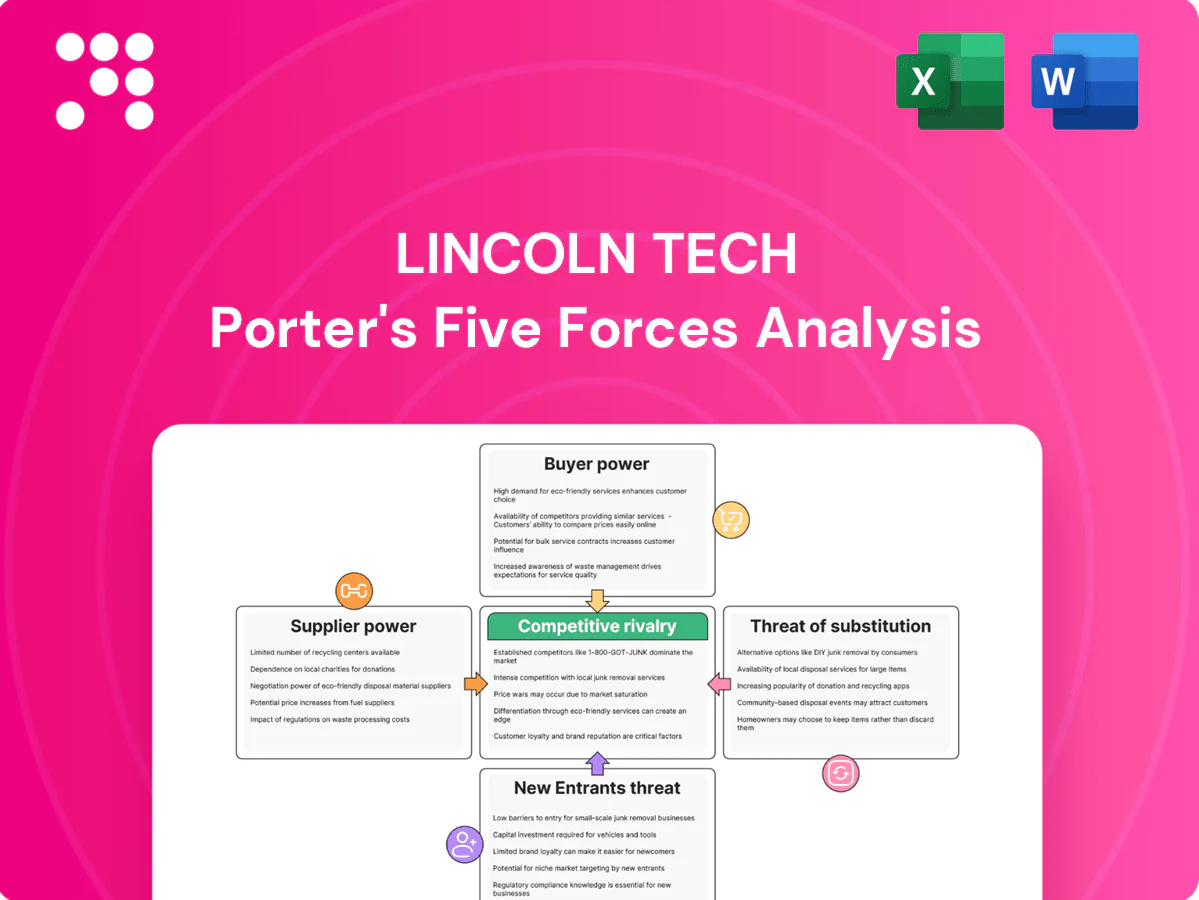
Lincoln Tech Porter's Five Forces Analysis

A Must-Have Tool for Decision-Makers
Lincoln Tech faces concentrated buyer power, moderate supplier leverage, steady threat from online and alternative training providers, and regulatory and reputational pressures that shape margins and growth prospects. This brief snapshot only scratches the surface. Unlock the full Porter's Five Forces Analysis to explore Lincoln Tech’s competitive dynamics, market pressures, and strategic advantages in detail.
Suppliers Bargaining Power

Specialized equipment vendors
In 2024 automotive diagnostics, welding rigs, CNCs and healthcare simulators remain concentrated among a few OEMs, giving vendors leverage over pricing, service contracts and delivery timelines. ASE-aligned tool requirements further narrow options and raise switching costs for Lincoln Tech programs. Multi-campus standardization deepens brand dependence while enabling bulk-purchase discounts. Ongoing supply-chain delays continue to disrupt program throughput and cohort start dates.
Accreditors and certifying bodies
Institutional and programmatic accreditors plus industry certifying bodies act as gatekeepers to legitimacy and Title IV access, with roughly 60 recognized U.S. accreditors in 2024 and Title IV federal student aid exceeding $100 billion annually. Compliance mandates force costly curriculum revisions, facilities upgrades and faculty-ratio changes that can run into millions for multi-campus operators. Loss or probation of accreditation directly threatens enrollments and pricing power, concentrating regulatory leverage over program design and timing.

Clinical and employer externship sites
Clinical and employer externship sites hold substantial supplier power for Lincoln Tech because healthcare and trades programs face scarce clinical and shop slots; 2024 surveys report over 60% of programs experiencing placement shortages. Local capacity constraints and fixed scheduling windows give sites leverage over placement terms and requirements. Competition from community colleges and other providers raises the implicit cost via added compliance and support requirements, though strong employer relationships can partially offset this power.

Skilled instructor labor
Skilled instructor labor—experienced master technicians, licensed healthcare instructors, and certified chefs—is scarce and commands premium wages; BLS 2024 reports median annual pay for postsecondary teachers near $79,640, reflecting upward pressure. Industry wage competition and cyclical demand raise turnover and recruitment costs, while credentialing (ASE, state nursing/licensing) narrows the candidate pool and lengthens time-to-hire. Heavy reliance on adjuncts adds scheduling flexibility but increases delivery risk and variability in program continuity.
- High wage pressure: median pay ~79,640 (BLS 2024)
- Credential barriers: licensure/certification delays hiring
- Turnover risk: cyclical demand raises recruitment costs
- Adjunct dependence: flexible yet increases scheduling risk
Facilities, tech, and content platforms
Campuses rely on landlords, lab build-out contractors, LMS platforms, and digital content licensors; in 2024 commercial education leases commonly span 5–15 years and specialized lab fit-outs often cost $500k–$2M, elevating exit barriers and switching costs.
Vendor lock-in for LMS or simulation software embeds recurring fees often equal to 5–15% of annual operating expenses, while multi-year, multi-campus contracts can reduce unit costs by roughly 10–25% but raise concentration and counterparty risk.
- Lease length: 5–15 years (2024)
- Build-out cost: $500k–$2M per campus
- Recurring software fees: 5–15% of Opex
- Multi-year contract savings: ~10–25% vs spot pricing
Suppliers hold high leverage: lab fit-outs $500k–$2M, LMS 5–15% Opex, placements >60%
Suppliers of specialized equipment, LMS and clinical sites exert high bargaining power due to OEM concentration, long lead times and accreditation specs; 2024 data: lab fit-outs $500k–$2M, LMS fees 5–15% of Opex, clinical placement shortages >60%. Multi-campus contracts lower unit cost ~10–25% but increase lock-in and counterparty risk.
| Supplier | Metric | 2024 |
|---|---|---|
| Lab build-outs | Cost | $500k–$2M |
| LMS/software | Opex% | 5–15% |
| Clinical sites | Placement shortage | >60% |
What is included in the product
 Detailed Word Document
Uncovers key competitive drivers, supplier and buyer power, entry and substitute risks specific to Lincoln Tech, and provides strategic commentary with actionable implications for market positioning.

 Customizable Excel Spreadsheet
A concise one-sheet Porter's Five Forces for Lincoln Tech that highlights competitive pressures and regulatory risks, ready to drop into decks; customizable ratings and radar-chart visuals let teams quickly identify pain points and prioritize strategic relief actions.
Customers Bargaining Power

Price-sensitive students
Prospective students compare tuition, program length, placement rates and total debt load; heightened transparency in outcomes and 2024 U.S. inflation near 3.4% increase living-cost pressure and demand for scholarships. Flexible scheduling and accelerated paths reduce time-to-earnings and mitigate price sensitivity, while programs with high perceived ROI sustain stronger willingness to pay despite cost concerns.
Financial aid dependency
Title IV funding and private lenders function as de facto payers for Lincoln Tech, enforcing compliance and satisfactory academic progress rules that directly shape admissions and retention; policy shifts in 2024 (federal rule reviews and lender underwriting changes) can quickly change program economics. Adverse audit findings have previously paused disbursements and constrained enrollment, elevating funders’ buyer-like power beyond individual students.

Employer expectations
Hiring partners shape Lincoln Tech curriculum by dictating credentials and soft-skill emphasis; in 2024 Lincoln Educational Services reported a graduate placement rate near 62%, underscoring employer influence on program design. Employers can pivot to in-house training or endorse niche certifications, forcing rapid program updates. Strong placement pipelines reduce buyer power by signaling clear ROI; weak employer feedback raises risk of misaligned programs.

Switching and alternatives
Students can opt for community colleges, apprenticeships, online certs or immediate work, boosting bargaining power; Lincoln Tech programs (often 12–18 weeks) make early switching cheaper. Limited transferability of credits to 4‑year schools reduces stickiness, while frequent start dates (weekly/monthly) and common prorated refund windows (30–60 days) increase churn.
- Alternatives: community college, apprenticeships, online certs, work
- Program length: 12–18 weeks
- Credits: often non-transferable
- Policies: start-dates frequent; refunds 30–60 days
Reputation and reviews
Online reviews and social media drive demand for Lincoln Tech—98% of prospective students consult reviews, making cohorts’ outcomes and placement stats decisive in enrollment decisions.
Negative publicity or employer dissatisfaction quickly increases buyer power, with studies showing conversion drops around 15% after widely shared complaints.
Transparent placement and earnings data reduce skepticism, while strong alumni advocacy can cut student acquisition costs by roughly 25–30% and blunt price pressure.
- 98% consult online reviews
- ~15% potential conversion drop after negative publicity
- 25–30% lower acquisition cost via alumni advocacy
- Transparent placement/earnings boost trust
Students weigh tuition, placement and debt as inflation 3.4% bites
Students compare tuition, length, placement and debt; 2024 US inflation ~3.4% raises cost pressure, boosting demand for scholarships. Title IV/private lenders act as de facto payers, affecting admissions and cash flow. Employers (placement ~62%) and 98% review consultation drive perceived ROI and bargaining leverage.
| Metric | Value |
|---|---|
| 2024 US inflation | ~3.4% |
| Placement rate (Lincoln EDU 2024) | ~62% |
| Consult online reviews | 98% |
| Conversion drop after negative PR | ~15% |
| Alumni advocacy cut CAC | 25–30% |
What You See Is What You Get
Lincoln Tech Porter's Five Forces Analysis
This preview shows the exact Lincoln Tech Porter's Five Forces Analysis you'll receive immediately after purchase—comprehensive, professionally formatted, and sourceable.
No mockups or excerpts: the file displayed here is the full deliverable, ready to download and use the moment you buy.
You'll get instant access to this identical document with all analysis, charts, and conclusions included—no placeholders or further setup required.

A Must-Have Tool for Decision-Makers
Lincoln Tech faces concentrated buyer power, moderate supplier leverage, steady threat from online and alternative training providers, and regulatory and reputational pressures that shape margins and growth prospects. This brief snapshot only scratches the surface. Unlock the full Porter's Five Forces Analysis to explore Lincoln Tech’s competitive dynamics, market pressures, and strategic advantages in detail.
Suppliers Bargaining Power
Specialized equipment vendors
In 2024 automotive diagnostics, welding rigs, CNCs and healthcare simulators remain concentrated among a few OEMs, giving vendors leverage over pricing, service contracts and delivery timelines. ASE-aligned tool requirements further narrow options and raise switching costs for Lincoln Tech programs. Multi-campus standardization deepens brand dependence while enabling bulk-purchase discounts. Ongoing supply-chain delays continue to disrupt program throughput and cohort start dates.
Accreditors and certifying bodies
Institutional and programmatic accreditors plus industry certifying bodies act as gatekeepers to legitimacy and Title IV access, with roughly 60 recognized U.S. accreditors in 2024 and Title IV federal student aid exceeding $100 billion annually. Compliance mandates force costly curriculum revisions, facilities upgrades and faculty-ratio changes that can run into millions for multi-campus operators. Loss or probation of accreditation directly threatens enrollments and pricing power, concentrating regulatory leverage over program design and timing.
Clinical and employer externship sites
Clinical and employer externship sites hold substantial supplier power for Lincoln Tech because healthcare and trades programs face scarce clinical and shop slots; 2024 surveys report over 60% of programs experiencing placement shortages. Local capacity constraints and fixed scheduling windows give sites leverage over placement terms and requirements. Competition from community colleges and other providers raises the implicit cost via added compliance and support requirements, though strong employer relationships can partially offset this power.
Skilled instructor labor
Skilled instructor labor—experienced master technicians, licensed healthcare instructors, and certified chefs—is scarce and commands premium wages; BLS 2024 reports median annual pay for postsecondary teachers near $79,640, reflecting upward pressure. Industry wage competition and cyclical demand raise turnover and recruitment costs, while credentialing (ASE, state nursing/licensing) narrows the candidate pool and lengthens time-to-hire. Heavy reliance on adjuncts adds scheduling flexibility but increases delivery risk and variability in program continuity.
- High wage pressure: median pay ~79,640 (BLS 2024)
- Credential barriers: licensure/certification delays hiring
- Turnover risk: cyclical demand raises recruitment costs
- Adjunct dependence: flexible yet increases scheduling risk
Facilities, tech, and content platforms
Campuses rely on landlords, lab build-out contractors, LMS platforms, and digital content licensors; in 2024 commercial education leases commonly span 5–15 years and specialized lab fit-outs often cost $500k–$2M, elevating exit barriers and switching costs.
Vendor lock-in for LMS or simulation software embeds recurring fees often equal to 5–15% of annual operating expenses, while multi-year, multi-campus contracts can reduce unit costs by roughly 10–25% but raise concentration and counterparty risk.
- Lease length: 5–15 years (2024)
- Build-out cost: $500k–$2M per campus
- Recurring software fees: 5–15% of Opex
- Multi-year contract savings: ~10–25% vs spot pricing
Suppliers hold high leverage: lab fit-outs $500k–$2M, LMS 5–15% Opex, placements >60%
Suppliers of specialized equipment, LMS and clinical sites exert high bargaining power due to OEM concentration, long lead times and accreditation specs; 2024 data: lab fit-outs $500k–$2M, LMS fees 5–15% of Opex, clinical placement shortages >60%. Multi-campus contracts lower unit cost ~10–25% but increase lock-in and counterparty risk.
| Supplier | Metric | 2024 |
|---|---|---|
| Lab build-outs | Cost | $500k–$2M |
| LMS/software | Opex% | 5–15% |
| Clinical sites | Placement shortage | >60% |
What is included in the product
Detailed Word Document
Uncovers key competitive drivers, supplier and buyer power, entry and substitute risks specific to Lincoln Tech, and provides strategic commentary with actionable implications for market positioning.
Customizable Excel Spreadsheet
A concise one-sheet Porter's Five Forces for Lincoln Tech that highlights competitive pressures and regulatory risks, ready to drop into decks; customizable ratings and radar-chart visuals let teams quickly identify pain points and prioritize strategic relief actions.
Customers Bargaining Power
Price-sensitive students
Prospective students compare tuition, program length, placement rates and total debt load; heightened transparency in outcomes and 2024 U.S. inflation near 3.4% increase living-cost pressure and demand for scholarships. Flexible scheduling and accelerated paths reduce time-to-earnings and mitigate price sensitivity, while programs with high perceived ROI sustain stronger willingness to pay despite cost concerns.
Financial aid dependency
Title IV funding and private lenders function as de facto payers for Lincoln Tech, enforcing compliance and satisfactory academic progress rules that directly shape admissions and retention; policy shifts in 2024 (federal rule reviews and lender underwriting changes) can quickly change program economics. Adverse audit findings have previously paused disbursements and constrained enrollment, elevating funders’ buyer-like power beyond individual students.
Employer expectations
Hiring partners shape Lincoln Tech curriculum by dictating credentials and soft-skill emphasis; in 2024 Lincoln Educational Services reported a graduate placement rate near 62%, underscoring employer influence on program design. Employers can pivot to in-house training or endorse niche certifications, forcing rapid program updates. Strong placement pipelines reduce buyer power by signaling clear ROI; weak employer feedback raises risk of misaligned programs.
Switching and alternatives
Students can opt for community colleges, apprenticeships, online certs or immediate work, boosting bargaining power; Lincoln Tech programs (often 12–18 weeks) make early switching cheaper. Limited transferability of credits to 4‑year schools reduces stickiness, while frequent start dates (weekly/monthly) and common prorated refund windows (30–60 days) increase churn.
- Alternatives: community college, apprenticeships, online certs, work
- Program length: 12–18 weeks
- Credits: often non-transferable
- Policies: start-dates frequent; refunds 30–60 days
Reputation and reviews
Online reviews and social media drive demand for Lincoln Tech—98% of prospective students consult reviews, making cohorts’ outcomes and placement stats decisive in enrollment decisions.
Negative publicity or employer dissatisfaction quickly increases buyer power, with studies showing conversion drops around 15% after widely shared complaints.
Transparent placement and earnings data reduce skepticism, while strong alumni advocacy can cut student acquisition costs by roughly 25–30% and blunt price pressure.
- 98% consult online reviews
- ~15% potential conversion drop after negative publicity
- 25–30% lower acquisition cost via alumni advocacy
- Transparent placement/earnings boost trust
Students weigh tuition, placement and debt as inflation 3.4% bites
Students compare tuition, length, placement and debt; 2024 US inflation ~3.4% raises cost pressure, boosting demand for scholarships. Title IV/private lenders act as de facto payers, affecting admissions and cash flow. Employers (placement ~62%) and 98% review consultation drive perceived ROI and bargaining leverage.
| Metric | Value |
|---|---|
| 2024 US inflation | ~3.4% |
| Placement rate (Lincoln EDU 2024) | ~62% |
| Consult online reviews | 98% |
| Conversion drop after negative PR | ~15% |
| Alumni advocacy cut CAC | 25–30% |
What You See Is What You Get
Lincoln Tech Porter's Five Forces Analysis
This preview shows the exact Lincoln Tech Porter's Five Forces Analysis you'll receive immediately after purchase—comprehensive, professionally formatted, and sourceable.
No mockups or excerpts: the file displayed here is the full deliverable, ready to download and use the moment you buy.
You'll get instant access to this identical document with all analysis, charts, and conclusions included—no placeholders or further setup required.
Original: $10.00
-65%$10.00
$3.50Description
A Must-Have Tool for Decision-Makers
Lincoln Tech faces concentrated buyer power, moderate supplier leverage, steady threat from online and alternative training providers, and regulatory and reputational pressures that shape margins and growth prospects. This brief snapshot only scratches the surface. Unlock the full Porter's Five Forces Analysis to explore Lincoln Tech’s competitive dynamics, market pressures, and strategic advantages in detail.
Suppliers Bargaining Power
Specialized equipment vendors
In 2024 automotive diagnostics, welding rigs, CNCs and healthcare simulators remain concentrated among a few OEMs, giving vendors leverage over pricing, service contracts and delivery timelines. ASE-aligned tool requirements further narrow options and raise switching costs for Lincoln Tech programs. Multi-campus standardization deepens brand dependence while enabling bulk-purchase discounts. Ongoing supply-chain delays continue to disrupt program throughput and cohort start dates.
Accreditors and certifying bodies
Institutional and programmatic accreditors plus industry certifying bodies act as gatekeepers to legitimacy and Title IV access, with roughly 60 recognized U.S. accreditors in 2024 and Title IV federal student aid exceeding $100 billion annually. Compliance mandates force costly curriculum revisions, facilities upgrades and faculty-ratio changes that can run into millions for multi-campus operators. Loss or probation of accreditation directly threatens enrollments and pricing power, concentrating regulatory leverage over program design and timing.
Clinical and employer externship sites
Clinical and employer externship sites hold substantial supplier power for Lincoln Tech because healthcare and trades programs face scarce clinical and shop slots; 2024 surveys report over 60% of programs experiencing placement shortages. Local capacity constraints and fixed scheduling windows give sites leverage over placement terms and requirements. Competition from community colleges and other providers raises the implicit cost via added compliance and support requirements, though strong employer relationships can partially offset this power.
Skilled instructor labor
Skilled instructor labor—experienced master technicians, licensed healthcare instructors, and certified chefs—is scarce and commands premium wages; BLS 2024 reports median annual pay for postsecondary teachers near $79,640, reflecting upward pressure. Industry wage competition and cyclical demand raise turnover and recruitment costs, while credentialing (ASE, state nursing/licensing) narrows the candidate pool and lengthens time-to-hire. Heavy reliance on adjuncts adds scheduling flexibility but increases delivery risk and variability in program continuity.
- High wage pressure: median pay ~79,640 (BLS 2024)
- Credential barriers: licensure/certification delays hiring
- Turnover risk: cyclical demand raises recruitment costs
- Adjunct dependence: flexible yet increases scheduling risk
Facilities, tech, and content platforms
Campuses rely on landlords, lab build-out contractors, LMS platforms, and digital content licensors; in 2024 commercial education leases commonly span 5–15 years and specialized lab fit-outs often cost $500k–$2M, elevating exit barriers and switching costs.
Vendor lock-in for LMS or simulation software embeds recurring fees often equal to 5–15% of annual operating expenses, while multi-year, multi-campus contracts can reduce unit costs by roughly 10–25% but raise concentration and counterparty risk.
- Lease length: 5–15 years (2024)
- Build-out cost: $500k–$2M per campus
- Recurring software fees: 5–15% of Opex
- Multi-year contract savings: ~10–25% vs spot pricing
Suppliers hold high leverage: lab fit-outs $500k–$2M, LMS 5–15% Opex, placements >60%
Suppliers of specialized equipment, LMS and clinical sites exert high bargaining power due to OEM concentration, long lead times and accreditation specs; 2024 data: lab fit-outs $500k–$2M, LMS fees 5–15% of Opex, clinical placement shortages >60%. Multi-campus contracts lower unit cost ~10–25% but increase lock-in and counterparty risk.
| Supplier | Metric | 2024 |
|---|---|---|
| Lab build-outs | Cost | $500k–$2M |
| LMS/software | Opex% | 5–15% |
| Clinical sites | Placement shortage | >60% |
What is included in the product
Detailed Word Document
Uncovers key competitive drivers, supplier and buyer power, entry and substitute risks specific to Lincoln Tech, and provides strategic commentary with actionable implications for market positioning.
Customizable Excel Spreadsheet
A concise one-sheet Porter's Five Forces for Lincoln Tech that highlights competitive pressures and regulatory risks, ready to drop into decks; customizable ratings and radar-chart visuals let teams quickly identify pain points and prioritize strategic relief actions.
Customers Bargaining Power
Price-sensitive students
Prospective students compare tuition, program length, placement rates and total debt load; heightened transparency in outcomes and 2024 U.S. inflation near 3.4% increase living-cost pressure and demand for scholarships. Flexible scheduling and accelerated paths reduce time-to-earnings and mitigate price sensitivity, while programs with high perceived ROI sustain stronger willingness to pay despite cost concerns.
Financial aid dependency
Title IV funding and private lenders function as de facto payers for Lincoln Tech, enforcing compliance and satisfactory academic progress rules that directly shape admissions and retention; policy shifts in 2024 (federal rule reviews and lender underwriting changes) can quickly change program economics. Adverse audit findings have previously paused disbursements and constrained enrollment, elevating funders’ buyer-like power beyond individual students.
Employer expectations
Hiring partners shape Lincoln Tech curriculum by dictating credentials and soft-skill emphasis; in 2024 Lincoln Educational Services reported a graduate placement rate near 62%, underscoring employer influence on program design. Employers can pivot to in-house training or endorse niche certifications, forcing rapid program updates. Strong placement pipelines reduce buyer power by signaling clear ROI; weak employer feedback raises risk of misaligned programs.
Switching and alternatives
Students can opt for community colleges, apprenticeships, online certs or immediate work, boosting bargaining power; Lincoln Tech programs (often 12–18 weeks) make early switching cheaper. Limited transferability of credits to 4‑year schools reduces stickiness, while frequent start dates (weekly/monthly) and common prorated refund windows (30–60 days) increase churn.
- Alternatives: community college, apprenticeships, online certs, work
- Program length: 12–18 weeks
- Credits: often non-transferable
- Policies: start-dates frequent; refunds 30–60 days
Reputation and reviews
Online reviews and social media drive demand for Lincoln Tech—98% of prospective students consult reviews, making cohorts’ outcomes and placement stats decisive in enrollment decisions.
Negative publicity or employer dissatisfaction quickly increases buyer power, with studies showing conversion drops around 15% after widely shared complaints.
Transparent placement and earnings data reduce skepticism, while strong alumni advocacy can cut student acquisition costs by roughly 25–30% and blunt price pressure.
- 98% consult online reviews
- ~15% potential conversion drop after negative publicity
- 25–30% lower acquisition cost via alumni advocacy
- Transparent placement/earnings boost trust
Students weigh tuition, placement and debt as inflation 3.4% bites
Students compare tuition, length, placement and debt; 2024 US inflation ~3.4% raises cost pressure, boosting demand for scholarships. Title IV/private lenders act as de facto payers, affecting admissions and cash flow. Employers (placement ~62%) and 98% review consultation drive perceived ROI and bargaining leverage.
| Metric | Value |
|---|---|
| 2024 US inflation | ~3.4% |
| Placement rate (Lincoln EDU 2024) | ~62% |
| Consult online reviews | 98% |
| Conversion drop after negative PR | ~15% |
| Alumni advocacy cut CAC | 25–30% |
What You See Is What You Get
Lincoln Tech Porter's Five Forces Analysis
This preview shows the exact Lincoln Tech Porter's Five Forces Analysis you'll receive immediately after purchase—comprehensive, professionally formatted, and sourceable.
No mockups or excerpts: the file displayed here is the full deliverable, ready to download and use the moment you buy.
You'll get instant access to this identical document with all analysis, charts, and conclusions included—no placeholders or further setup required.











