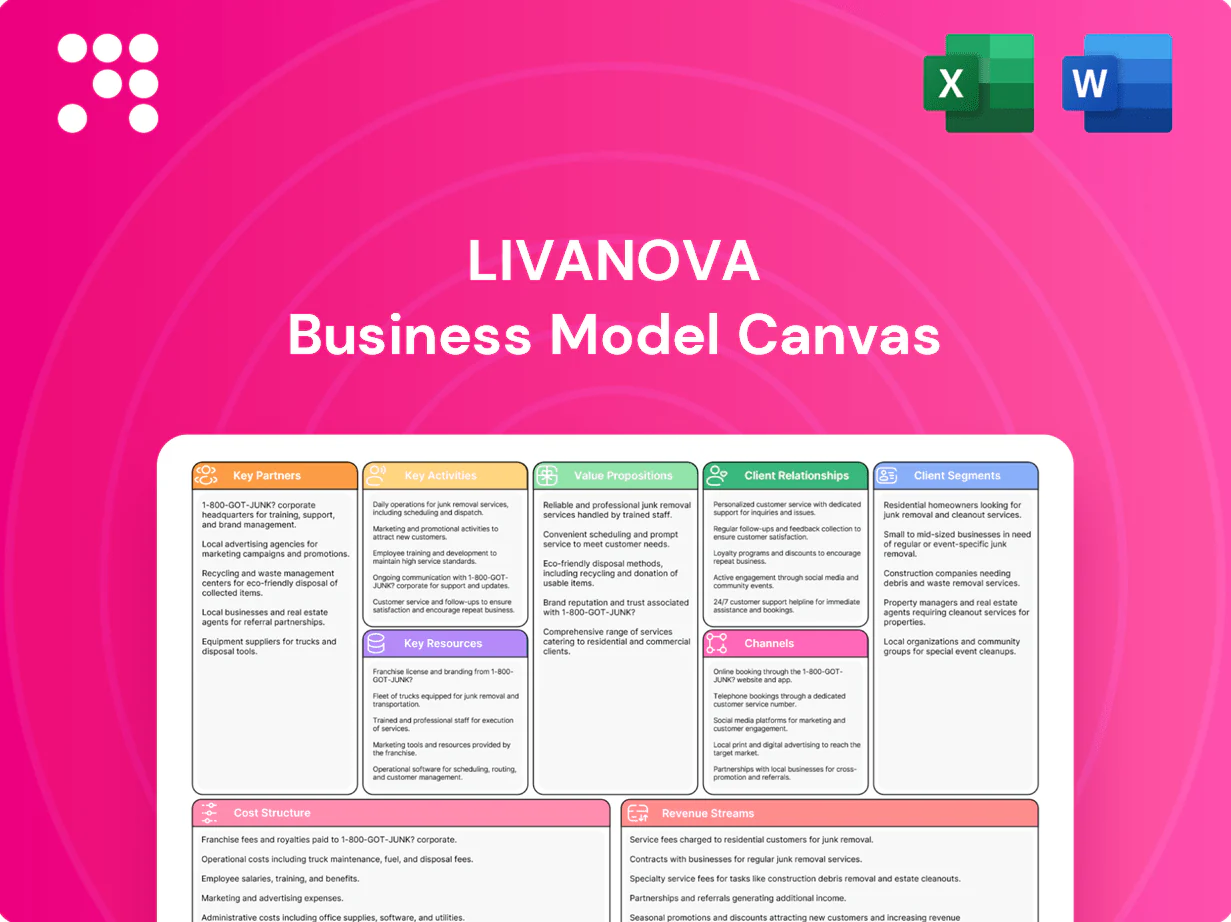
LivaNova Business Model Canvas

Business Model Canvas for a high-value medical-device company: strategic snapshot
Unlock the strategic blueprint behind LivaNova with a concise Business Model Canvas that maps value propositions, key partnerships, and revenue drivers. This snapshot reveals how the company competes in high-value medical-device markets and where growth levers lie. For a section-by-section, editable Word and Excel version with actionable insights, purchase the full Business Model Canvas today.
Partnerships

Tertiary hospitals and surgical centers
Partnering with tertiary hospitals and surgical centers enables co-development of clinical workflows and collection of real-world evidence for cardiopulmonary and neuromodulation therapies, supplying sites for clinical trials and hands-on surgeon training.
These centers serve as reference accounts that accelerate adoption in new geographies and support health-economic studies to demonstrate cost-effectiveness to payers and hospital systems.
Academic and research institutions
Partnering with academic and research institutions accelerates development of novel biomaterials, device algorithms and stimulation protocols through shared expertise and co-development projects. Access to leading investigators and NIH-funded programs (NIH FY2024 budget $49.5B) strengthens study design, publication and clinical trial pipelines. Shared preclinical facilities cut translational timelines and allow securing early IP options on breakthrough technologies.

Regulators and notified bodies
Engage proactively with FDA (use the Q-Submission program) and with EU notified bodies under EU MDR, effective 26 May 2021, to align pivotal trial endpoints and post-market commitments. Maintain routine quality system audits and vigilance reporting to meet regulatory requirements and support CE marking and PMA/510(k) pathways. Leverage pre-submission guidance to shorten time-to-market and de-risk regulatory review.

Strategic suppliers and manufacturing partners
Strategic suppliers and manufacturing partners secure continuity for pumps, sensors and biocompatible polymers, supporting LivaNova’s FY2024 revenue of about $1.03 billion by protecting critical supply lines.
Co-engineering reduces COGS and improves reliability through joint design-for-manufacture efforts, while qualifying dual sources mitigates single‑supplier risk.
Partners must scale capacity ±20–30% for procedure seasonality and new product launches to avoid stockouts.
- dual‑sourcing
- co‑engineering
- ±20–30% scaling
- protect pumps/sensors/polymers
Payers and health technology assessors
Partner with payers and HTA bodies to secure reimbursement pathways for neuromodulation and surgical devices, providing outcomes and budget-impact dossiers to support coverage; in 2024 payers intensified real-world evidence requirements for device reimbursement. Pilot value-based agreements where feasible to align payment with outcomes and expand coverage indications to grow addressable markets.
- 2024 trend: increased RWE demand by payers
- Deliver outcomes and budget-impact dossiers
- Pilot value-based agreements
- Expand coverage indications
Hospitals, academia and suppliers accelerate biomaterials, trials and reimbursement
Tertiary hospitals enable co-development, trials and surgeon training, accelerating adoption across geographies.
Academic partners speed biomaterials and algorithm R&D; NIH FY2024 budget $49.5B supports trial pipelines.
Strategic suppliers secure pumps/sensors/polymers, dual‑sourcing and co‑engineering cut COGS; LivaNova FY2024 revenue ~$1.03B.
Payers demand more RWE in 2024; value-based pilots and HTA dossiers expand reimbursement.
| Partner | Metric | 2024 |
|---|---|---|
| Hospitals | Trial sites/reference accounts | — |
| Academia | NIH budget | $49.5B |
| Suppliers | Revenue protection | $1.03B |
| Payers | RWE demand | Increased |
What is included in the product
 Detailed Word Document
A concise, investor-ready Business Model Canvas for LivaNova detailing its nine blocks—customer segments (cardiac, neuromodulation, hospitals), value propositions, channels, key partners, revenue streams and cost structure. Includes competitive advantages and SWOT-linked insights for strategy, funding or presentation use.

 Customizable Excel Spreadsheet
High-level view of LivaNova’s business model with editable cells, quickly identifying core components to relieve stakeholder misalignment and streamline strategic decision-making.
Activities

Therapy-focused R&D and clinical development
Design next-gen heart-lung systems, oxygenators and neuromodulation devices with focused R&D and engineering, targeting reduced priming volumes and improved biocompatibility. Run feasibility through pivotal trials typically enrolling 200–800 patients over 12–36 months to prove safety and efficacy. Generate robust evidence for new indications and labeling to satisfy FDA/CE requirements. Iterate product cycles quarterly based on clinician feedback and outcomes data.
Regulatory, quality, and compliance operations
Maintain ISO 13485-compliant QMS across 10 global sites, supporting LivaNova’s 2024 operations and ~$1.0B revenue scale; prepare regulatory submissions, respond to queries, and manage audits with documented timelines. Conduct continuous post-market surveillance and risk management, analyzing real-world data to detect trends. Ensure mandatory vigilance reporting and execute field corrective actions (RCAs, FSNs) when required to protect patients and market access.

Advanced manufacturing and supply chain
Produce capital equipment, implants, and disposables at scale under ISO 13485 quality systems and FDA 21 CFR part 820 controls to ensure manufacturing consistency and regulatory compliance. Validate processes for sterility and biocompatibility per ISO 11137 and ISO 10993 and maintain full traceability via UDI and lot-level serialization. Optimize inventory to align with OR schedules and implantable device demand using JIT and demand-signal integration with hospital ERP. Manage supplier qualification and continuity through documented audits, dual-sourcing, and corrective action plans.

Commercialization and market access
Commercialization and market access focuses on educating surgeons, neurologists and sleep specialists on clinical value through targeted KOL-led programs and hands-on training to drive hospital adoption.
The team negotiates with hospital procurement, GPOs and payers while supporting reimbursement coding, coverage submissions and evidence dossiers to secure payment pathways.
Product launches are executed with KOL advocacy, structured training curricula and post-launch outcomes tracking to accelerate uptake and optimize hospital utilization.
- Educate clinicians via KOL-led training and proctoring
- Negotiate with procurement, GPOs and payers
- Support coding, coverage and reimbursement submissions
- Execute launches with advocacy, training and outcomes tracking
Customer training and service support
Provide in‑theater support for perfusion teams and implants, plus device programming, remote monitoring setup and troubleshooting; deliver CME‑accredited education and certification and sustain installed base through service contracts and upgrades to maximize uptime and clinical outcomes.
- In‑theater support
- Device programming & remote monitoring
- CME education & certification
- Service contracts & upgrades
Medtech: heart-lung systems, oxygenators & neuromodulation — $1.0B 2024
Design and commercialize heart‑lung systems, oxygenators and neuromodulation devices with quarterly iterations; 2024 revenue ~ $1.0B and pivotal trials (200–800 pts). Maintain ISO 13485 QMS across 10 global sites, FDA/CE compliance, post‑market surveillance and 21 CFR manufacturing controls. Drive adoption via KOL training, GPO negotiations, reimbursement support, service contracts and in‑theater support.
| Activity | Metric | 2024 |
|---|---|---|
| Revenue | FY | ~$1.0B |
| QMS sites | Count | 10 |
| Pivotal trials | Enrollment | 200–800 pts |
Full Version Awaits
Business Model Canvas
The document you're previewing is the actual LivaNova Business Model Canvas, not a mockup. It’s the exact file you’ll receive after purchase, with full content and structure intact. Upon payment you’ll get the complete, editable document ready for presentation and editing. No placeholders, no surprises.

Business Model Canvas for a high-value medical-device company: strategic snapshot
Unlock the strategic blueprint behind LivaNova with a concise Business Model Canvas that maps value propositions, key partnerships, and revenue drivers. This snapshot reveals how the company competes in high-value medical-device markets and where growth levers lie. For a section-by-section, editable Word and Excel version with actionable insights, purchase the full Business Model Canvas today.
Partnerships
Tertiary hospitals and surgical centers
Partnering with tertiary hospitals and surgical centers enables co-development of clinical workflows and collection of real-world evidence for cardiopulmonary and neuromodulation therapies, supplying sites for clinical trials and hands-on surgeon training.
These centers serve as reference accounts that accelerate adoption in new geographies and support health-economic studies to demonstrate cost-effectiveness to payers and hospital systems.
Academic and research institutions
Partnering with academic and research institutions accelerates development of novel biomaterials, device algorithms and stimulation protocols through shared expertise and co-development projects. Access to leading investigators and NIH-funded programs (NIH FY2024 budget $49.5B) strengthens study design, publication and clinical trial pipelines. Shared preclinical facilities cut translational timelines and allow securing early IP options on breakthrough technologies.
Regulators and notified bodies
Engage proactively with FDA (use the Q-Submission program) and with EU notified bodies under EU MDR, effective 26 May 2021, to align pivotal trial endpoints and post-market commitments. Maintain routine quality system audits and vigilance reporting to meet regulatory requirements and support CE marking and PMA/510(k) pathways. Leverage pre-submission guidance to shorten time-to-market and de-risk regulatory review.
Strategic suppliers and manufacturing partners
Strategic suppliers and manufacturing partners secure continuity for pumps, sensors and biocompatible polymers, supporting LivaNova’s FY2024 revenue of about $1.03 billion by protecting critical supply lines.
Co-engineering reduces COGS and improves reliability through joint design-for-manufacture efforts, while qualifying dual sources mitigates single‑supplier risk.
Partners must scale capacity ±20–30% for procedure seasonality and new product launches to avoid stockouts.
- dual‑sourcing
- co‑engineering
- ±20–30% scaling
- protect pumps/sensors/polymers
Payers and health technology assessors
Partner with payers and HTA bodies to secure reimbursement pathways for neuromodulation and surgical devices, providing outcomes and budget-impact dossiers to support coverage; in 2024 payers intensified real-world evidence requirements for device reimbursement. Pilot value-based agreements where feasible to align payment with outcomes and expand coverage indications to grow addressable markets.
- 2024 trend: increased RWE demand by payers
- Deliver outcomes and budget-impact dossiers
- Pilot value-based agreements
- Expand coverage indications
Hospitals, academia and suppliers accelerate biomaterials, trials and reimbursement
Tertiary hospitals enable co-development, trials and surgeon training, accelerating adoption across geographies.
Academic partners speed biomaterials and algorithm R&D; NIH FY2024 budget $49.5B supports trial pipelines.
Strategic suppliers secure pumps/sensors/polymers, dual‑sourcing and co‑engineering cut COGS; LivaNova FY2024 revenue ~$1.03B.
Payers demand more RWE in 2024; value-based pilots and HTA dossiers expand reimbursement.
| Partner | Metric | 2024 |
|---|---|---|
| Hospitals | Trial sites/reference accounts | — |
| Academia | NIH budget | $49.5B |
| Suppliers | Revenue protection | $1.03B |
| Payers | RWE demand | Increased |
What is included in the product
Detailed Word Document
A concise, investor-ready Business Model Canvas for LivaNova detailing its nine blocks—customer segments (cardiac, neuromodulation, hospitals), value propositions, channels, key partners, revenue streams and cost structure. Includes competitive advantages and SWOT-linked insights for strategy, funding or presentation use.
Customizable Excel Spreadsheet
High-level view of LivaNova’s business model with editable cells, quickly identifying core components to relieve stakeholder misalignment and streamline strategic decision-making.
Activities
Therapy-focused R&D and clinical development
Design next-gen heart-lung systems, oxygenators and neuromodulation devices with focused R&D and engineering, targeting reduced priming volumes and improved biocompatibility. Run feasibility through pivotal trials typically enrolling 200–800 patients over 12–36 months to prove safety and efficacy. Generate robust evidence for new indications and labeling to satisfy FDA/CE requirements. Iterate product cycles quarterly based on clinician feedback and outcomes data.
Regulatory, quality, and compliance operations
Maintain ISO 13485-compliant QMS across 10 global sites, supporting LivaNova’s 2024 operations and ~$1.0B revenue scale; prepare regulatory submissions, respond to queries, and manage audits with documented timelines. Conduct continuous post-market surveillance and risk management, analyzing real-world data to detect trends. Ensure mandatory vigilance reporting and execute field corrective actions (RCAs, FSNs) when required to protect patients and market access.
Advanced manufacturing and supply chain
Produce capital equipment, implants, and disposables at scale under ISO 13485 quality systems and FDA 21 CFR part 820 controls to ensure manufacturing consistency and regulatory compliance. Validate processes for sterility and biocompatibility per ISO 11137 and ISO 10993 and maintain full traceability via UDI and lot-level serialization. Optimize inventory to align with OR schedules and implantable device demand using JIT and demand-signal integration with hospital ERP. Manage supplier qualification and continuity through documented audits, dual-sourcing, and corrective action plans.
Commercialization and market access
Commercialization and market access focuses on educating surgeons, neurologists and sleep specialists on clinical value through targeted KOL-led programs and hands-on training to drive hospital adoption.
The team negotiates with hospital procurement, GPOs and payers while supporting reimbursement coding, coverage submissions and evidence dossiers to secure payment pathways.
Product launches are executed with KOL advocacy, structured training curricula and post-launch outcomes tracking to accelerate uptake and optimize hospital utilization.
- Educate clinicians via KOL-led training and proctoring
- Negotiate with procurement, GPOs and payers
- Support coding, coverage and reimbursement submissions
- Execute launches with advocacy, training and outcomes tracking
Customer training and service support
Provide in‑theater support for perfusion teams and implants, plus device programming, remote monitoring setup and troubleshooting; deliver CME‑accredited education and certification and sustain installed base through service contracts and upgrades to maximize uptime and clinical outcomes.
- In‑theater support
- Device programming & remote monitoring
- CME education & certification
- Service contracts & upgrades
Medtech: heart-lung systems, oxygenators & neuromodulation — $1.0B 2024
Design and commercialize heart‑lung systems, oxygenators and neuromodulation devices with quarterly iterations; 2024 revenue ~ $1.0B and pivotal trials (200–800 pts). Maintain ISO 13485 QMS across 10 global sites, FDA/CE compliance, post‑market surveillance and 21 CFR manufacturing controls. Drive adoption via KOL training, GPO negotiations, reimbursement support, service contracts and in‑theater support.
| Activity | Metric | 2024 |
|---|---|---|
| Revenue | FY | ~$1.0B |
| QMS sites | Count | 10 |
| Pivotal trials | Enrollment | 200–800 pts |
Full Version Awaits
Business Model Canvas
The document you're previewing is the actual LivaNova Business Model Canvas, not a mockup. It’s the exact file you’ll receive after purchase, with full content and structure intact. Upon payment you’ll get the complete, editable document ready for presentation and editing. No placeholders, no surprises.
Description
Business Model Canvas for a high-value medical-device company: strategic snapshot
Unlock the strategic blueprint behind LivaNova with a concise Business Model Canvas that maps value propositions, key partnerships, and revenue drivers. This snapshot reveals how the company competes in high-value medical-device markets and where growth levers lie. For a section-by-section, editable Word and Excel version with actionable insights, purchase the full Business Model Canvas today.
Partnerships
Tertiary hospitals and surgical centers
Partnering with tertiary hospitals and surgical centers enables co-development of clinical workflows and collection of real-world evidence for cardiopulmonary and neuromodulation therapies, supplying sites for clinical trials and hands-on surgeon training.
These centers serve as reference accounts that accelerate adoption in new geographies and support health-economic studies to demonstrate cost-effectiveness to payers and hospital systems.
Academic and research institutions
Partnering with academic and research institutions accelerates development of novel biomaterials, device algorithms and stimulation protocols through shared expertise and co-development projects. Access to leading investigators and NIH-funded programs (NIH FY2024 budget $49.5B) strengthens study design, publication and clinical trial pipelines. Shared preclinical facilities cut translational timelines and allow securing early IP options on breakthrough technologies.
Regulators and notified bodies
Engage proactively with FDA (use the Q-Submission program) and with EU notified bodies under EU MDR, effective 26 May 2021, to align pivotal trial endpoints and post-market commitments. Maintain routine quality system audits and vigilance reporting to meet regulatory requirements and support CE marking and PMA/510(k) pathways. Leverage pre-submission guidance to shorten time-to-market and de-risk regulatory review.
Strategic suppliers and manufacturing partners
Strategic suppliers and manufacturing partners secure continuity for pumps, sensors and biocompatible polymers, supporting LivaNova’s FY2024 revenue of about $1.03 billion by protecting critical supply lines.
Co-engineering reduces COGS and improves reliability through joint design-for-manufacture efforts, while qualifying dual sources mitigates single‑supplier risk.
Partners must scale capacity ±20–30% for procedure seasonality and new product launches to avoid stockouts.
- dual‑sourcing
- co‑engineering
- ±20–30% scaling
- protect pumps/sensors/polymers
Payers and health technology assessors
Partner with payers and HTA bodies to secure reimbursement pathways for neuromodulation and surgical devices, providing outcomes and budget-impact dossiers to support coverage; in 2024 payers intensified real-world evidence requirements for device reimbursement. Pilot value-based agreements where feasible to align payment with outcomes and expand coverage indications to grow addressable markets.
- 2024 trend: increased RWE demand by payers
- Deliver outcomes and budget-impact dossiers
- Pilot value-based agreements
- Expand coverage indications
Hospitals, academia and suppliers accelerate biomaterials, trials and reimbursement
Tertiary hospitals enable co-development, trials and surgeon training, accelerating adoption across geographies.
Academic partners speed biomaterials and algorithm R&D; NIH FY2024 budget $49.5B supports trial pipelines.
Strategic suppliers secure pumps/sensors/polymers, dual‑sourcing and co‑engineering cut COGS; LivaNova FY2024 revenue ~$1.03B.
Payers demand more RWE in 2024; value-based pilots and HTA dossiers expand reimbursement.
| Partner | Metric | 2024 |
|---|---|---|
| Hospitals | Trial sites/reference accounts | — |
| Academia | NIH budget | $49.5B |
| Suppliers | Revenue protection | $1.03B |
| Payers | RWE demand | Increased |
What is included in the product
Detailed Word Document
A concise, investor-ready Business Model Canvas for LivaNova detailing its nine blocks—customer segments (cardiac, neuromodulation, hospitals), value propositions, channels, key partners, revenue streams and cost structure. Includes competitive advantages and SWOT-linked insights for strategy, funding or presentation use.
Customizable Excel Spreadsheet
High-level view of LivaNova’s business model with editable cells, quickly identifying core components to relieve stakeholder misalignment and streamline strategic decision-making.
Activities
Therapy-focused R&D and clinical development
Design next-gen heart-lung systems, oxygenators and neuromodulation devices with focused R&D and engineering, targeting reduced priming volumes and improved biocompatibility. Run feasibility through pivotal trials typically enrolling 200–800 patients over 12–36 months to prove safety and efficacy. Generate robust evidence for new indications and labeling to satisfy FDA/CE requirements. Iterate product cycles quarterly based on clinician feedback and outcomes data.
Regulatory, quality, and compliance operations
Maintain ISO 13485-compliant QMS across 10 global sites, supporting LivaNova’s 2024 operations and ~$1.0B revenue scale; prepare regulatory submissions, respond to queries, and manage audits with documented timelines. Conduct continuous post-market surveillance and risk management, analyzing real-world data to detect trends. Ensure mandatory vigilance reporting and execute field corrective actions (RCAs, FSNs) when required to protect patients and market access.
Advanced manufacturing and supply chain
Produce capital equipment, implants, and disposables at scale under ISO 13485 quality systems and FDA 21 CFR part 820 controls to ensure manufacturing consistency and regulatory compliance. Validate processes for sterility and biocompatibility per ISO 11137 and ISO 10993 and maintain full traceability via UDI and lot-level serialization. Optimize inventory to align with OR schedules and implantable device demand using JIT and demand-signal integration with hospital ERP. Manage supplier qualification and continuity through documented audits, dual-sourcing, and corrective action plans.
Commercialization and market access
Commercialization and market access focuses on educating surgeons, neurologists and sleep specialists on clinical value through targeted KOL-led programs and hands-on training to drive hospital adoption.
The team negotiates with hospital procurement, GPOs and payers while supporting reimbursement coding, coverage submissions and evidence dossiers to secure payment pathways.
Product launches are executed with KOL advocacy, structured training curricula and post-launch outcomes tracking to accelerate uptake and optimize hospital utilization.
- Educate clinicians via KOL-led training and proctoring
- Negotiate with procurement, GPOs and payers
- Support coding, coverage and reimbursement submissions
- Execute launches with advocacy, training and outcomes tracking
Customer training and service support
Provide in‑theater support for perfusion teams and implants, plus device programming, remote monitoring setup and troubleshooting; deliver CME‑accredited education and certification and sustain installed base through service contracts and upgrades to maximize uptime and clinical outcomes.
- In‑theater support
- Device programming & remote monitoring
- CME education & certification
- Service contracts & upgrades
Medtech: heart-lung systems, oxygenators & neuromodulation — $1.0B 2024
Design and commercialize heart‑lung systems, oxygenators and neuromodulation devices with quarterly iterations; 2024 revenue ~ $1.0B and pivotal trials (200–800 pts). Maintain ISO 13485 QMS across 10 global sites, FDA/CE compliance, post‑market surveillance and 21 CFR manufacturing controls. Drive adoption via KOL training, GPO negotiations, reimbursement support, service contracts and in‑theater support.
| Activity | Metric | 2024 |
|---|---|---|
| Revenue | FY | ~$1.0B |
| QMS sites | Count | 10 |
| Pivotal trials | Enrollment | 200–800 pts |
Full Version Awaits
Business Model Canvas
The document you're previewing is the actual LivaNova Business Model Canvas, not a mockup. It’s the exact file you’ll receive after purchase, with full content and structure intact. Upon payment you’ll get the complete, editable document ready for presentation and editing. No placeholders, no surprises.











