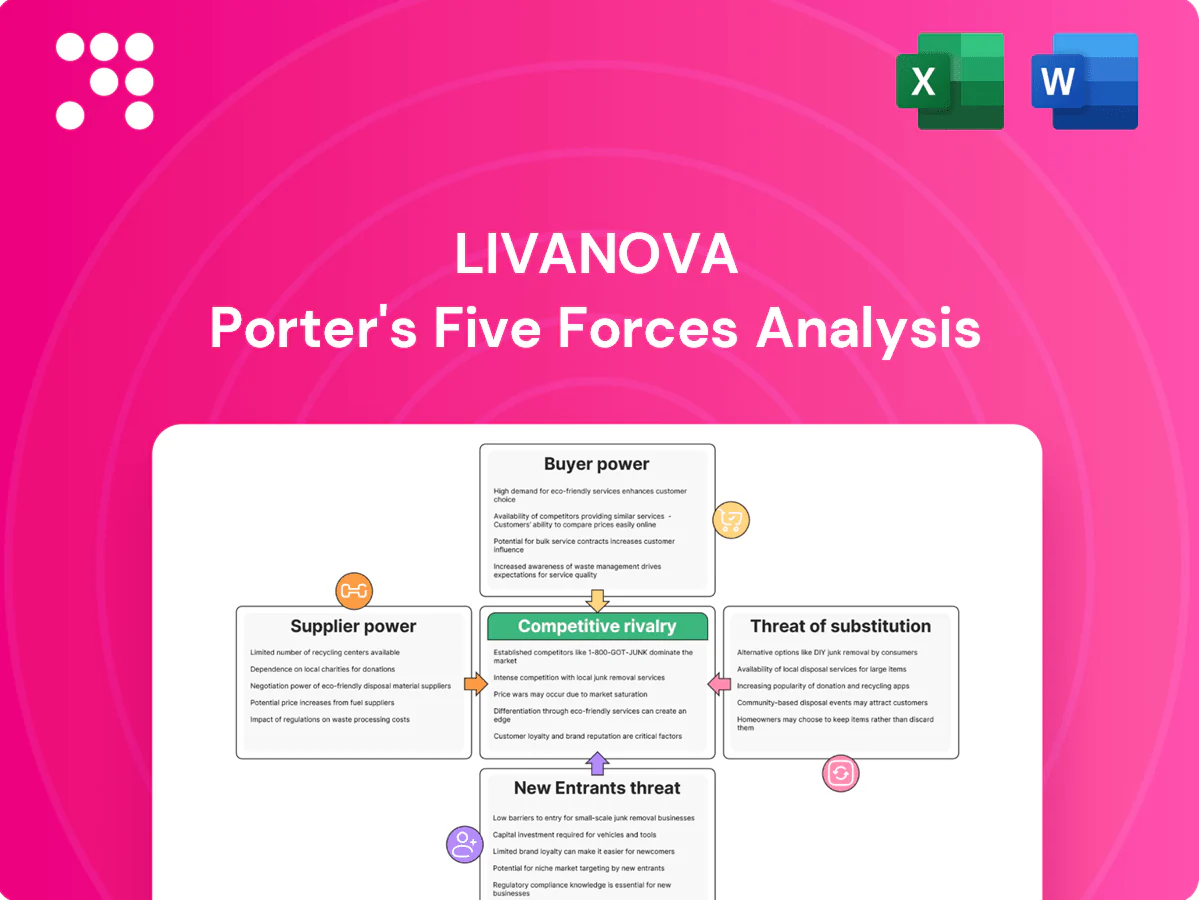
LivaNova Porter's Five Forces Analysis

Don't Miss the Bigger Picture
LivaNova’s Porter’s Five Forces snapshot highlights strong supplier relationships, moderate buyer pressure, high regulatory barriers, and evolving substitute threats shaping its cardiac and neuromodulation markets. This brief shows competitive intensity and key risks but leaves out force-by-force ratings and visual analytics. Unlock the full Porter’s Five Forces Analysis to explore LivaNova’s market pressures, strategic levers, and actionable insights in detail.
Suppliers Bargaining Power

Regulatory-grade inputs
Regulatory-grade inputs for LivaNova must comply with ISO 13485 and FDA QSR (21 CFR 820), narrowing qualified suppliers to a small, specialized pool. Biocompatible polymers, implantable-grade metals and sterile disposables limit easy switching and increase supplier leverage. Qualification and validation commonly require 6–18 months and can cost hundreds of thousands of dollars. Dual-sourcing is feasible but each new source typically needs 9–12 months for certification.
Advanced electronics
Neuromodulation depends on chips, batteries and sensors produced to tight tolerances, giving advanced-electronics suppliers meaningful leverage. Semiconductor cycles and shortages have driven price and lead-time volatility; as of 2024 supply tightness has eased but episodic spikes persist. Design-in components create multi-year lock-in across device lifecycles. Long-term supply agreements partially mitigate but do not eliminate supplier power.

Precision manufacturing
Heart-lung machines and oxygenators demand micron-level machining and specialist coatings, and in 2024 tooling/QA investments often exceed $100,000, raising switching costs; only a handful of suppliers meet strict cleanliness and traceability standards. Supplier audits and PPAP-like qualification processes typically add 6–12 weeks to lead times, concentrating bargaining power with qualified precision manufacturers.

Sterilization capacity
Dependence on ethylene oxide and gamma sterilization creates capacity and regulatory bottlenecks for LivaNova, concentrating leverage with a few contract sterilizers. Outages or increased regulatory scrutiny can abruptly reduce availability and push up sterilization pricing and lead times. Licensing limits and narrow scheduling windows further restrict geographic diversification and constrain product flow to market.
- Concentration of suppliers increases supplier bargaining power
- Regulatory outages → supply disruptions and higher pricing
- Licensing limits geographic alternatives
- Fixed scheduling windows constrain throughput
Logistics and disposables
Surgical disposables require just-in-time delivery to high-acuity theaters, and cold-chain or humidity controls add handling complexity and cost; the global cold-chain logistics market was estimated at about US$300 billion in 2024, amplifying supplier leverage. Carriers and 3PLs can exert pricing and capacity pressure during disruptions; holding buffer inventories reduces stockouts but increases working capital needs.
- Just-in-time dependence raises supplier leverage
- Cold-chain complexity increases logistics costs (≈US$300B market, 2024)
- Carriers/3PLs gain power during disruptions
- Buffer stock mitigates risk but ties up capital
Concentrated supplier base raises switching costs: >$100k, 6–18 months; cold-chain ≈ US$300B
Supplier pool for LivaNova is concentrated due to ISO 13485/FDA QSR needs, raising switching costs; qualification often 6–18 months and costs >US$100k. Semiconductor and sterilization bottlenecks cause episodic lead-time spikes; cold-chain logistics market ≈US$300B (2024). Dual-sourcing and long-term contracts mitigate but do not eliminate supplier leverage.
| Category | Impact | 2024 metric |
|---|---|---|
| Qualification cost/time | High switching cost | >$100k; 6–18 months |
| Cold-chain | Logistics leverage | ≈US$300B market |
| Sterilization | Capacity bottleneck | Few contract sterilizers; episodic outages |
What is included in the product
 Detailed Word Document
Uncovers key drivers of competition, customer influence, and market entry risks tailored to LivaNova, analyzing supplier and buyer power, competitive rivalry, substitutes, and barriers to entry to identify disruptive threats and strategic opportunities.

 Customizable Excel Spreadsheet
A concise Porter's Five Forces one-sheet for LivaNova that clearly maps competitive pressure, supplier/buyer leverage and regulatory risks to speed strategic decision-making. Customizable pressure levels and a slide-ready layout make it easy to update for new data and drop into investor decks or board materials.
Customers Bargaining Power

Consolidated hospital buyers
IDNs, GPOs and national tenders, with GPOs serving over 90% of US hospitals and IDNs controlling roughly 70% of acute-care beds, aggregate demand and negotiate aggressively. Price benchmarking and multi-year contracts, commonly 3–5 years, compress supplier margins significantly. Value analysis committees increasingly demand robust clinical and economic outcomes data to secure formulary placement. Strategic bundling across product lines can offset purchasing pressure by increasing stickiness and share-of-wallet.
Clinical switching costs
Training, protocols, and installed capital for perfusion and neuromodulation create high clinical switching costs, with device setup and team workflows often requiring weeks of onboarding; cross-credentialed staff can, however, adapt to rival systems over months. Service quality and uptime (often cited as decisive over list price) drive stickiness, while evidence updates or pivotal 2024 clinical studies can trigger reevaluations.

Reimbursement sensitivity
Payers and HTA bodies determine adoption through coverage decisions and reimbursement rates, with NICE using an explicit cost‑effectiveness range of £20,000–£30,000 per QALY in 2024. Budget‑impact models increasingly drive demand for discounts and risk‑sharing agreements. Patient out‑of‑pocket exposure reduces uptake, and marked regional variability compels tailored pricing strategies.

Outcome proof demands
Buyers now demand comparative effectiveness and real-world data, forcing LivaNova to prioritize robust clinical dossiers and registries to win tenders; absent head-to-head trials, pricing power erodes and discounts rise. Post-market commitments such as registry expansions or outcome guarantees are routinely used as negotiation levers by procurement teams.
- Comparative effectiveness required
- Registries influence procurement
- No head-to-head lowers price leverage
- Post-market commitments = negotiation tool
Alternative sourcing
Hospitals commonly qualify two to three vendors for critical categories, and with roughly 6,090 US community hospitals (AHA 2023) alternative sourcing is routine; commodity-like disposables face higher substitution risk while capital purchases trigger competitive tenders at refresh cycles, compressing margins; service and training packages frequently win tenders by differentiating beyond price.
- Two-to-three vendors
- Commodity substitution risk
- Capital tenders at refresh
- Service/training differentiates
IDNs/GPOs enforce 3–5yr discounted contracts; registries and outcome guarantees
IDNs and GPOs (>90% US hospitals; IDNs ≈70% acute‑care beds) concentrate purchasing, enforcing 3–5 year contracts and heavy discounts. High switching costs for perfusion/neuromodulation and service uptime increase stickiness, but gaps in head‑to‑head evidence erode price leverage. Payers/HTA (NICE £20k–30k/QALY) and 6,090 US hospitals (AHA 2023) demand registries and outcome guarantees.
| Metric | Value |
|---|---|
| GPO coverage | >90% |
| IDN acute beds | ~70% |
| US hospitals (AHA 2023) | 6,090 |
| NICE threshold 2024 | £20k–£30k/QALY |
Full Version Awaits
LivaNova Porter's Five Forces Analysis
This preview shows the exact LivaNova Porter’s Five Forces analysis you'll receive immediately after purchase—no samples or placeholders. The full, professionally formatted document is ready for download and use the moment you buy, covering competitive rivalry, supplier and buyer power, threats of entry and substitution, and strategic implications. What you see is what you get.

Don't Miss the Bigger Picture
LivaNova’s Porter’s Five Forces snapshot highlights strong supplier relationships, moderate buyer pressure, high regulatory barriers, and evolving substitute threats shaping its cardiac and neuromodulation markets. This brief shows competitive intensity and key risks but leaves out force-by-force ratings and visual analytics. Unlock the full Porter’s Five Forces Analysis to explore LivaNova’s market pressures, strategic levers, and actionable insights in detail.
Suppliers Bargaining Power
Regulatory-grade inputs
Regulatory-grade inputs for LivaNova must comply with ISO 13485 and FDA QSR (21 CFR 820), narrowing qualified suppliers to a small, specialized pool. Biocompatible polymers, implantable-grade metals and sterile disposables limit easy switching and increase supplier leverage. Qualification and validation commonly require 6–18 months and can cost hundreds of thousands of dollars. Dual-sourcing is feasible but each new source typically needs 9–12 months for certification.
Advanced electronics
Neuromodulation depends on chips, batteries and sensors produced to tight tolerances, giving advanced-electronics suppliers meaningful leverage. Semiconductor cycles and shortages have driven price and lead-time volatility; as of 2024 supply tightness has eased but episodic spikes persist. Design-in components create multi-year lock-in across device lifecycles. Long-term supply agreements partially mitigate but do not eliminate supplier power.
Precision manufacturing
Heart-lung machines and oxygenators demand micron-level machining and specialist coatings, and in 2024 tooling/QA investments often exceed $100,000, raising switching costs; only a handful of suppliers meet strict cleanliness and traceability standards. Supplier audits and PPAP-like qualification processes typically add 6–12 weeks to lead times, concentrating bargaining power with qualified precision manufacturers.
Sterilization capacity
Dependence on ethylene oxide and gamma sterilization creates capacity and regulatory bottlenecks for LivaNova, concentrating leverage with a few contract sterilizers. Outages or increased regulatory scrutiny can abruptly reduce availability and push up sterilization pricing and lead times. Licensing limits and narrow scheduling windows further restrict geographic diversification and constrain product flow to market.
- Concentration of suppliers increases supplier bargaining power
- Regulatory outages → supply disruptions and higher pricing
- Licensing limits geographic alternatives
- Fixed scheduling windows constrain throughput
Logistics and disposables
Surgical disposables require just-in-time delivery to high-acuity theaters, and cold-chain or humidity controls add handling complexity and cost; the global cold-chain logistics market was estimated at about US$300 billion in 2024, amplifying supplier leverage. Carriers and 3PLs can exert pricing and capacity pressure during disruptions; holding buffer inventories reduces stockouts but increases working capital needs.
- Just-in-time dependence raises supplier leverage
- Cold-chain complexity increases logistics costs (≈US$300B market, 2024)
- Carriers/3PLs gain power during disruptions
- Buffer stock mitigates risk but ties up capital
Concentrated supplier base raises switching costs: >$100k, 6–18 months; cold-chain ≈ US$300B
Supplier pool for LivaNova is concentrated due to ISO 13485/FDA QSR needs, raising switching costs; qualification often 6–18 months and costs >US$100k. Semiconductor and sterilization bottlenecks cause episodic lead-time spikes; cold-chain logistics market ≈US$300B (2024). Dual-sourcing and long-term contracts mitigate but do not eliminate supplier leverage.
| Category | Impact | 2024 metric |
|---|---|---|
| Qualification cost/time | High switching cost | >$100k; 6–18 months |
| Cold-chain | Logistics leverage | ≈US$300B market |
| Sterilization | Capacity bottleneck | Few contract sterilizers; episodic outages |
What is included in the product
Detailed Word Document
Uncovers key drivers of competition, customer influence, and market entry risks tailored to LivaNova, analyzing supplier and buyer power, competitive rivalry, substitutes, and barriers to entry to identify disruptive threats and strategic opportunities.
Customizable Excel Spreadsheet
A concise Porter's Five Forces one-sheet for LivaNova that clearly maps competitive pressure, supplier/buyer leverage and regulatory risks to speed strategic decision-making. Customizable pressure levels and a slide-ready layout make it easy to update for new data and drop into investor decks or board materials.
Customers Bargaining Power
Consolidated hospital buyers
IDNs, GPOs and national tenders, with GPOs serving over 90% of US hospitals and IDNs controlling roughly 70% of acute-care beds, aggregate demand and negotiate aggressively. Price benchmarking and multi-year contracts, commonly 3–5 years, compress supplier margins significantly. Value analysis committees increasingly demand robust clinical and economic outcomes data to secure formulary placement. Strategic bundling across product lines can offset purchasing pressure by increasing stickiness and share-of-wallet.
Clinical switching costs
Training, protocols, and installed capital for perfusion and neuromodulation create high clinical switching costs, with device setup and team workflows often requiring weeks of onboarding; cross-credentialed staff can, however, adapt to rival systems over months. Service quality and uptime (often cited as decisive over list price) drive stickiness, while evidence updates or pivotal 2024 clinical studies can trigger reevaluations.
Reimbursement sensitivity
Payers and HTA bodies determine adoption through coverage decisions and reimbursement rates, with NICE using an explicit cost‑effectiveness range of £20,000–£30,000 per QALY in 2024. Budget‑impact models increasingly drive demand for discounts and risk‑sharing agreements. Patient out‑of‑pocket exposure reduces uptake, and marked regional variability compels tailored pricing strategies.
Outcome proof demands
Buyers now demand comparative effectiveness and real-world data, forcing LivaNova to prioritize robust clinical dossiers and registries to win tenders; absent head-to-head trials, pricing power erodes and discounts rise. Post-market commitments such as registry expansions or outcome guarantees are routinely used as negotiation levers by procurement teams.
- Comparative effectiveness required
- Registries influence procurement
- No head-to-head lowers price leverage
- Post-market commitments = negotiation tool
Alternative sourcing
Hospitals commonly qualify two to three vendors for critical categories, and with roughly 6,090 US community hospitals (AHA 2023) alternative sourcing is routine; commodity-like disposables face higher substitution risk while capital purchases trigger competitive tenders at refresh cycles, compressing margins; service and training packages frequently win tenders by differentiating beyond price.
- Two-to-three vendors
- Commodity substitution risk
- Capital tenders at refresh
- Service/training differentiates
IDNs/GPOs enforce 3–5yr discounted contracts; registries and outcome guarantees
IDNs and GPOs (>90% US hospitals; IDNs ≈70% acute‑care beds) concentrate purchasing, enforcing 3–5 year contracts and heavy discounts. High switching costs for perfusion/neuromodulation and service uptime increase stickiness, but gaps in head‑to‑head evidence erode price leverage. Payers/HTA (NICE £20k–30k/QALY) and 6,090 US hospitals (AHA 2023) demand registries and outcome guarantees.
| Metric | Value |
|---|---|
| GPO coverage | >90% |
| IDN acute beds | ~70% |
| US hospitals (AHA 2023) | 6,090 |
| NICE threshold 2024 | £20k–£30k/QALY |
Full Version Awaits
LivaNova Porter's Five Forces Analysis
This preview shows the exact LivaNova Porter’s Five Forces analysis you'll receive immediately after purchase—no samples or placeholders. The full, professionally formatted document is ready for download and use the moment you buy, covering competitive rivalry, supplier and buyer power, threats of entry and substitution, and strategic implications. What you see is what you get.
Original: $10.00
-65%$10.00
$3.50Description
Don't Miss the Bigger Picture
LivaNova’s Porter’s Five Forces snapshot highlights strong supplier relationships, moderate buyer pressure, high regulatory barriers, and evolving substitute threats shaping its cardiac and neuromodulation markets. This brief shows competitive intensity and key risks but leaves out force-by-force ratings and visual analytics. Unlock the full Porter’s Five Forces Analysis to explore LivaNova’s market pressures, strategic levers, and actionable insights in detail.
Suppliers Bargaining Power
Regulatory-grade inputs
Regulatory-grade inputs for LivaNova must comply with ISO 13485 and FDA QSR (21 CFR 820), narrowing qualified suppliers to a small, specialized pool. Biocompatible polymers, implantable-grade metals and sterile disposables limit easy switching and increase supplier leverage. Qualification and validation commonly require 6–18 months and can cost hundreds of thousands of dollars. Dual-sourcing is feasible but each new source typically needs 9–12 months for certification.
Advanced electronics
Neuromodulation depends on chips, batteries and sensors produced to tight tolerances, giving advanced-electronics suppliers meaningful leverage. Semiconductor cycles and shortages have driven price and lead-time volatility; as of 2024 supply tightness has eased but episodic spikes persist. Design-in components create multi-year lock-in across device lifecycles. Long-term supply agreements partially mitigate but do not eliminate supplier power.
Precision manufacturing
Heart-lung machines and oxygenators demand micron-level machining and specialist coatings, and in 2024 tooling/QA investments often exceed $100,000, raising switching costs; only a handful of suppliers meet strict cleanliness and traceability standards. Supplier audits and PPAP-like qualification processes typically add 6–12 weeks to lead times, concentrating bargaining power with qualified precision manufacturers.
Sterilization capacity
Dependence on ethylene oxide and gamma sterilization creates capacity and regulatory bottlenecks for LivaNova, concentrating leverage with a few contract sterilizers. Outages or increased regulatory scrutiny can abruptly reduce availability and push up sterilization pricing and lead times. Licensing limits and narrow scheduling windows further restrict geographic diversification and constrain product flow to market.
- Concentration of suppliers increases supplier bargaining power
- Regulatory outages → supply disruptions and higher pricing
- Licensing limits geographic alternatives
- Fixed scheduling windows constrain throughput
Logistics and disposables
Surgical disposables require just-in-time delivery to high-acuity theaters, and cold-chain or humidity controls add handling complexity and cost; the global cold-chain logistics market was estimated at about US$300 billion in 2024, amplifying supplier leverage. Carriers and 3PLs can exert pricing and capacity pressure during disruptions; holding buffer inventories reduces stockouts but increases working capital needs.
- Just-in-time dependence raises supplier leverage
- Cold-chain complexity increases logistics costs (≈US$300B market, 2024)
- Carriers/3PLs gain power during disruptions
- Buffer stock mitigates risk but ties up capital
Concentrated supplier base raises switching costs: >$100k, 6–18 months; cold-chain ≈ US$300B
Supplier pool for LivaNova is concentrated due to ISO 13485/FDA QSR needs, raising switching costs; qualification often 6–18 months and costs >US$100k. Semiconductor and sterilization bottlenecks cause episodic lead-time spikes; cold-chain logistics market ≈US$300B (2024). Dual-sourcing and long-term contracts mitigate but do not eliminate supplier leverage.
| Category | Impact | 2024 metric |
|---|---|---|
| Qualification cost/time | High switching cost | >$100k; 6–18 months |
| Cold-chain | Logistics leverage | ≈US$300B market |
| Sterilization | Capacity bottleneck | Few contract sterilizers; episodic outages |
What is included in the product
Detailed Word Document
Uncovers key drivers of competition, customer influence, and market entry risks tailored to LivaNova, analyzing supplier and buyer power, competitive rivalry, substitutes, and barriers to entry to identify disruptive threats and strategic opportunities.
Customizable Excel Spreadsheet
A concise Porter's Five Forces one-sheet for LivaNova that clearly maps competitive pressure, supplier/buyer leverage and regulatory risks to speed strategic decision-making. Customizable pressure levels and a slide-ready layout make it easy to update for new data and drop into investor decks or board materials.
Customers Bargaining Power
Consolidated hospital buyers
IDNs, GPOs and national tenders, with GPOs serving over 90% of US hospitals and IDNs controlling roughly 70% of acute-care beds, aggregate demand and negotiate aggressively. Price benchmarking and multi-year contracts, commonly 3–5 years, compress supplier margins significantly. Value analysis committees increasingly demand robust clinical and economic outcomes data to secure formulary placement. Strategic bundling across product lines can offset purchasing pressure by increasing stickiness and share-of-wallet.
Clinical switching costs
Training, protocols, and installed capital for perfusion and neuromodulation create high clinical switching costs, with device setup and team workflows often requiring weeks of onboarding; cross-credentialed staff can, however, adapt to rival systems over months. Service quality and uptime (often cited as decisive over list price) drive stickiness, while evidence updates or pivotal 2024 clinical studies can trigger reevaluations.
Reimbursement sensitivity
Payers and HTA bodies determine adoption through coverage decisions and reimbursement rates, with NICE using an explicit cost‑effectiveness range of £20,000–£30,000 per QALY in 2024. Budget‑impact models increasingly drive demand for discounts and risk‑sharing agreements. Patient out‑of‑pocket exposure reduces uptake, and marked regional variability compels tailored pricing strategies.
Outcome proof demands
Buyers now demand comparative effectiveness and real-world data, forcing LivaNova to prioritize robust clinical dossiers and registries to win tenders; absent head-to-head trials, pricing power erodes and discounts rise. Post-market commitments such as registry expansions or outcome guarantees are routinely used as negotiation levers by procurement teams.
- Comparative effectiveness required
- Registries influence procurement
- No head-to-head lowers price leverage
- Post-market commitments = negotiation tool
Alternative sourcing
Hospitals commonly qualify two to three vendors for critical categories, and with roughly 6,090 US community hospitals (AHA 2023) alternative sourcing is routine; commodity-like disposables face higher substitution risk while capital purchases trigger competitive tenders at refresh cycles, compressing margins; service and training packages frequently win tenders by differentiating beyond price.
- Two-to-three vendors
- Commodity substitution risk
- Capital tenders at refresh
- Service/training differentiates
IDNs/GPOs enforce 3–5yr discounted contracts; registries and outcome guarantees
IDNs and GPOs (>90% US hospitals; IDNs ≈70% acute‑care beds) concentrate purchasing, enforcing 3–5 year contracts and heavy discounts. High switching costs for perfusion/neuromodulation and service uptime increase stickiness, but gaps in head‑to‑head evidence erode price leverage. Payers/HTA (NICE £20k–30k/QALY) and 6,090 US hospitals (AHA 2023) demand registries and outcome guarantees.
| Metric | Value |
|---|---|
| GPO coverage | >90% |
| IDN acute beds | ~70% |
| US hospitals (AHA 2023) | 6,090 |
| NICE threshold 2024 | £20k–£30k/QALY |
Full Version Awaits
LivaNova Porter's Five Forces Analysis
This preview shows the exact LivaNova Porter’s Five Forces analysis you'll receive immediately after purchase—no samples or placeholders. The full, professionally formatted document is ready for download and use the moment you buy, covering competitive rivalry, supplier and buyer power, threats of entry and substitution, and strategic implications. What you see is what you get.











