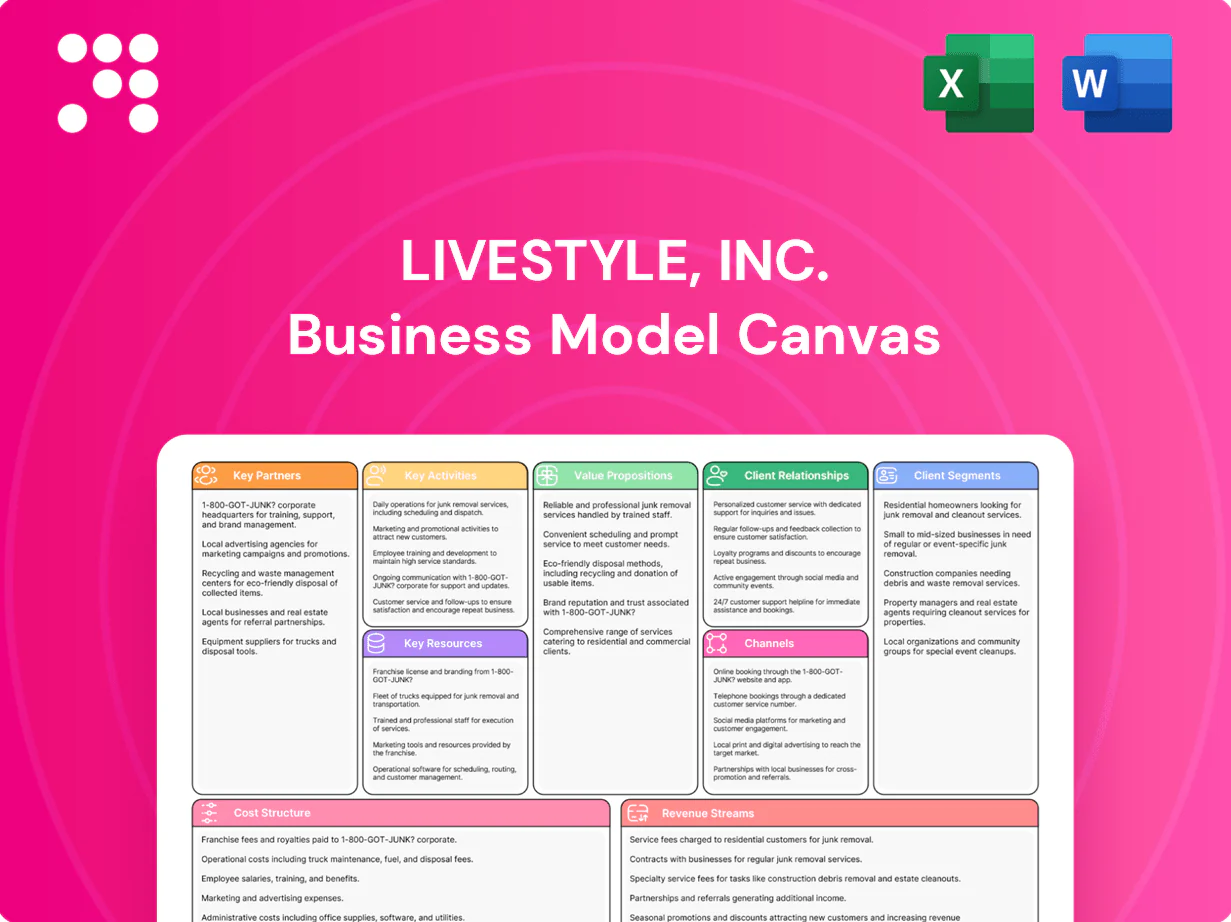
LiveStyle, Inc. Business Model Canvas

Concise Business Model Canvas: Value Propositions, Customers, and Revenue Snapshot
Unlock the full strategic blueprint behind LiveStyle, Inc.’s business model with our concise Business Model Canvas overview. This snapshot highlights core value propositions, customer segments, and revenue streams in plain terms. Purchase the complete, editable canvas to access detailed insights, financial implications, and practical steps for benchmarking or investment decisions.
Partnerships

Global artist agencies
Strategic relationships with top DJ and producer agencies secure headliners and rising acts, enabling LiveStyle to book talent across its festival portfolio and capitalize on a live-music market that rebounded to over $30 billion by 2024. Preferred-booking terms and reciprocity improve lineup diversity and align tours with festival schedules, reducing single-event booking risk. Co-marketing with agents amplifies reach, lowering discovery spend and driving higher advance ticket sale velocity. Multi-show packages optimize talent spend by spreading fees across multiple events and markets.
Brand sponsors and beverages
Alliances with alcohol, energy drink, fashion, and tech brands fund LiveStyle experiences and content, with sponsorships typically covering 30–40% of festival revenue and multi-year contracts of 2–5 years stabilizing cash flow. Sponsors gain targeted youth reach and data-driven activation via attendee analytics and CRM integrations. Co-created stages and branded lounges elevate attendee value and extend activation hours. Multi-year deals reduce demand volatility and enable forward programming investments.

Venues, cities, and public agencies
Permitting, policing, EMS, and transit partners coordinate to ensure safe execution and crowd management; multi-agency plans and on-site EMS units are standard for events hosting 10,000+ attendees. Long-term site access via 3–5 year agreements minimizes relocation risk and capex rework. Community and tourism boards typically report event-driven hotel occupancy uplifts up to 30%, driving local revenue. Clear stakeholder alignment preserves brand reputation and regulatory compliance.

Ticketing, payments, and streaming
Ticketing partners (primary and secondary) broaden distribution and deliver richer box-office and resale analytics for LiveStyle, while cashless/RFID providers—adopted by over 70% of major festivals in 2024—increase on-site spend and capture granular attendee data. Streaming platform integrations expand remote reach and monetization, and seamless API integrations reduce friction across purchase, entry, and engagement.
- Distribution + analytics: primary/secondary ticketing
- On-site revenue: cashless/RFID (>70% festival adoption 2024)
- Remote monetization: streaming platforms
- Reduced friction: integrated purchase-entry-engagement APIs
Production and logistics vendors
Stage, sound, lighting and special effects partners deliver immersive shows across peak season (May–September), with coordinated crews enabling standard build windows of 24–72 hours for arena and festival setups.
Trusted logistics vendors ensure timely builds and teardown and reduce routing risks, while sustainability vendors target Scope 1 and 2 reductions to meet ESG goals.
Framework agreements commonly lock pricing and priority service for 6–12 months to secure capacity during high-demand windows.
- Peak season: May–September
- Build windows: 24–72 hours
- Agreements: 6–12 months
- ESG focus: Scope 1/2 reductions
Agencies tap $30B live music, sponsors cover 30–40%
LiveStyle leverages agency partnerships to secure talent across festivals in a $30B live-music market (2024), using multi-show packages to lower per-event fees. Brand sponsors cover 30–40% of festival revenue via 2–5 year deals, while cashless/RFID (>70% festival adoption in 2024) and ticketing APIs boost on-site spend and data capture. Permits, EMS, logistics and production partners lock 6–12 month rates to secure peak-season capacity.
| Partner | Role | 2024 Metric |
|---|---|---|
| Agencies | Talent booking | $30B market |
| Sponsors | Revenue & activation | 30–40% rev |
| Cashless/RFID | On-site spend/data | >70% adoption |
What is included in the product
 Detailed Word Document
A comprehensive Business Model Canvas for LiveStyle, Inc. detailing customer segments (fans, artists, promoters), value propositions (immersive live experiences, artist development, turnkey event production), channels (ticketing platforms, venues, digital & social), revenue streams (tickets, sponsorships, merchandise, licensing) and key partners, operations, cost structure and metrics. Ideal for presentations, investor discussions and strategic planning with SWOT-linked insights per block.

 Customizable Excel Spreadsheet
High-level view of LiveStyle, Inc.’s business model with editable cells, simplifying identification of revenue streams, key partners, cost drivers and customer segments to relieve strategic planning pain points.
Activities

Festival design and production
In 2024 LiveStyle’s festival design and production begins in multi-stage concepting and thematic development where attendee flow modeling creates distinct identities; end-to-end production budgets typically run $500k–$3M per event covering site build, talent scheduling and show control with crews of 40–120; post-mortems in 2024 drove SOP and cost efficiencies of ~8–12%; safety and guest experience KPIs target incident rates below 1% and NPS above 50.
Talent booking and curation
Data-led lineup curation balances proven headliners with discovery acts to optimize ticketing yield and streaming-driven demand; Coachella reported roughly 125,000 daily attendees in 2024, illustrating scale from mixed bills. Routing coordination secures regional exclusives and bulk routing that lower per-act fees. Broad genre diversity expands reach across demographics, while surprise sets and high-profile collabs amplify social buzz and drive ticket urgency.

Marketing and community growth
Always-on content sustains fandom between events, with consistent channels driving repeat engagement; performance media lifts drop-to-ticket conversion (industry cases show paid socials can boost conversions by 2–3x). Ambassador and influencer programs amplify authentic reach, often delivering higher engagement rates than brand channels. CRM journeys — segmented emails, SMS and push — increase loyalty and LTV, with email marketing ROI commonly reported in the tens of dollars per dollar spent (2024 benchmarks).

Partnership sales and activation
Partnership sales and activation create custom brand solutions that integrate into stages, content pillars and on-site experiences to drive measurable outcomes; 2024 sponsorship spend grew ~12% YoY, fueling demand for bespoke integrations. Measurement frameworks track reach, engagement and sales lift to prove ROI while on-site ops deliver premium hospitality and seamless execution. Post-event reporting focuses on renewals and upsells into multi-year deals, with average deal tenures extending to 2–3 years in 2024.
- Custom integrations into stages, content, on-site experiences
- ROI measurement: reach, engagement, sales lift
- Premium on-site hospitality and operations
- Post-event reporting to renew and upsell 2–3 year deals
Risk, compliance, and safety
Permitting, insurance (typical festival liability limits $5–20M), and robust contract frameworks mitigate operational and financial risk; weather, crowd and medical plans protect attendees and staff and reduce incident rates; cashflow hedging targeting 3–6 months of operating expenses plus negotiated vendor terms stabilize working capital; adherence to 2024 ESG and accessibility standards broadens market acceptance.
- Permits & insurance: $5–20M cover
- Emergency plans: weather, crowd, medical
- Cashflow: 3–6 months hedge
- Vendor terms: net-30 to net-90
- ESG/accessibility: 2024 compliance focus
Data-led festival ops: $500k–$3M, incidents 1%
LiveStyle 2024 runs festival design/production with per-event budgets $500k–$3M, crews 40–120 and SOP gains ~8–12% driving incident rates <1% and NPS >50. Data-led lineup mixes headliners/discovery to maximize ticket/stream yield; routing exclusives lower act fees. Sponsorship activations (sponsorship spend +12% YoY) support renewals (avg tenure 2–3 yrs) and 3–6 month cash hedges.
| Metric | 2024 |
|---|---|
| Per-event budget | $500k–$3M |
| Crews | 40–120 |
| SOP efficiency | 8–12% |
| Incident rate | <1% |
| NPS | >50 |
| Sponsor growth | +12% YoY |
| Liability | $5–20M |
| Cash hedge | 3–6 months |
| Avg deal tenure | 2–3 yrs |
Preview Before You Purchase
Business Model Canvas
The LiveStyle, Inc. Business Model Canvas shown here is the actual deliverable, not a mockup; it contains the real content and structure you’ll receive after purchase. Once ordered, you’ll instantly download this exact file in editable Word and Excel formats—complete, formatted, and ready to present or modify.

Concise Business Model Canvas: Value Propositions, Customers, and Revenue Snapshot
Unlock the full strategic blueprint behind LiveStyle, Inc.’s business model with our concise Business Model Canvas overview. This snapshot highlights core value propositions, customer segments, and revenue streams in plain terms. Purchase the complete, editable canvas to access detailed insights, financial implications, and practical steps for benchmarking or investment decisions.
Partnerships
Global artist agencies
Strategic relationships with top DJ and producer agencies secure headliners and rising acts, enabling LiveStyle to book talent across its festival portfolio and capitalize on a live-music market that rebounded to over $30 billion by 2024. Preferred-booking terms and reciprocity improve lineup diversity and align tours with festival schedules, reducing single-event booking risk. Co-marketing with agents amplifies reach, lowering discovery spend and driving higher advance ticket sale velocity. Multi-show packages optimize talent spend by spreading fees across multiple events and markets.
Brand sponsors and beverages
Alliances with alcohol, energy drink, fashion, and tech brands fund LiveStyle experiences and content, with sponsorships typically covering 30–40% of festival revenue and multi-year contracts of 2–5 years stabilizing cash flow. Sponsors gain targeted youth reach and data-driven activation via attendee analytics and CRM integrations. Co-created stages and branded lounges elevate attendee value and extend activation hours. Multi-year deals reduce demand volatility and enable forward programming investments.
Venues, cities, and public agencies
Permitting, policing, EMS, and transit partners coordinate to ensure safe execution and crowd management; multi-agency plans and on-site EMS units are standard for events hosting 10,000+ attendees. Long-term site access via 3–5 year agreements minimizes relocation risk and capex rework. Community and tourism boards typically report event-driven hotel occupancy uplifts up to 30%, driving local revenue. Clear stakeholder alignment preserves brand reputation and regulatory compliance.
Ticketing, payments, and streaming
Ticketing partners (primary and secondary) broaden distribution and deliver richer box-office and resale analytics for LiveStyle, while cashless/RFID providers—adopted by over 70% of major festivals in 2024—increase on-site spend and capture granular attendee data. Streaming platform integrations expand remote reach and monetization, and seamless API integrations reduce friction across purchase, entry, and engagement.
- Distribution + analytics: primary/secondary ticketing
- On-site revenue: cashless/RFID (>70% festival adoption 2024)
- Remote monetization: streaming platforms
- Reduced friction: integrated purchase-entry-engagement APIs
Production and logistics vendors
Stage, sound, lighting and special effects partners deliver immersive shows across peak season (May–September), with coordinated crews enabling standard build windows of 24–72 hours for arena and festival setups.
Trusted logistics vendors ensure timely builds and teardown and reduce routing risks, while sustainability vendors target Scope 1 and 2 reductions to meet ESG goals.
Framework agreements commonly lock pricing and priority service for 6–12 months to secure capacity during high-demand windows.
- Peak season: May–September
- Build windows: 24–72 hours
- Agreements: 6–12 months
- ESG focus: Scope 1/2 reductions
Agencies tap $30B live music, sponsors cover 30–40%
LiveStyle leverages agency partnerships to secure talent across festivals in a $30B live-music market (2024), using multi-show packages to lower per-event fees. Brand sponsors cover 30–40% of festival revenue via 2–5 year deals, while cashless/RFID (>70% festival adoption in 2024) and ticketing APIs boost on-site spend and data capture. Permits, EMS, logistics and production partners lock 6–12 month rates to secure peak-season capacity.
| Partner | Role | 2024 Metric |
|---|---|---|
| Agencies | Talent booking | $30B market |
| Sponsors | Revenue & activation | 30–40% rev |
| Cashless/RFID | On-site spend/data | >70% adoption |
What is included in the product
Detailed Word Document
A comprehensive Business Model Canvas for LiveStyle, Inc. detailing customer segments (fans, artists, promoters), value propositions (immersive live experiences, artist development, turnkey event production), channels (ticketing platforms, venues, digital & social), revenue streams (tickets, sponsorships, merchandise, licensing) and key partners, operations, cost structure and metrics. Ideal for presentations, investor discussions and strategic planning with SWOT-linked insights per block.
Customizable Excel Spreadsheet
High-level view of LiveStyle, Inc.’s business model with editable cells, simplifying identification of revenue streams, key partners, cost drivers and customer segments to relieve strategic planning pain points.
Activities
Festival design and production
In 2024 LiveStyle’s festival design and production begins in multi-stage concepting and thematic development where attendee flow modeling creates distinct identities; end-to-end production budgets typically run $500k–$3M per event covering site build, talent scheduling and show control with crews of 40–120; post-mortems in 2024 drove SOP and cost efficiencies of ~8–12%; safety and guest experience KPIs target incident rates below 1% and NPS above 50.
Talent booking and curation
Data-led lineup curation balances proven headliners with discovery acts to optimize ticketing yield and streaming-driven demand; Coachella reported roughly 125,000 daily attendees in 2024, illustrating scale from mixed bills. Routing coordination secures regional exclusives and bulk routing that lower per-act fees. Broad genre diversity expands reach across demographics, while surprise sets and high-profile collabs amplify social buzz and drive ticket urgency.
Marketing and community growth
Always-on content sustains fandom between events, with consistent channels driving repeat engagement; performance media lifts drop-to-ticket conversion (industry cases show paid socials can boost conversions by 2–3x). Ambassador and influencer programs amplify authentic reach, often delivering higher engagement rates than brand channels. CRM journeys — segmented emails, SMS and push — increase loyalty and LTV, with email marketing ROI commonly reported in the tens of dollars per dollar spent (2024 benchmarks).
Partnership sales and activation
Partnership sales and activation create custom brand solutions that integrate into stages, content pillars and on-site experiences to drive measurable outcomes; 2024 sponsorship spend grew ~12% YoY, fueling demand for bespoke integrations. Measurement frameworks track reach, engagement and sales lift to prove ROI while on-site ops deliver premium hospitality and seamless execution. Post-event reporting focuses on renewals and upsells into multi-year deals, with average deal tenures extending to 2–3 years in 2024.
- Custom integrations into stages, content, on-site experiences
- ROI measurement: reach, engagement, sales lift
- Premium on-site hospitality and operations
- Post-event reporting to renew and upsell 2–3 year deals
Risk, compliance, and safety
Permitting, insurance (typical festival liability limits $5–20M), and robust contract frameworks mitigate operational and financial risk; weather, crowd and medical plans protect attendees and staff and reduce incident rates; cashflow hedging targeting 3–6 months of operating expenses plus negotiated vendor terms stabilize working capital; adherence to 2024 ESG and accessibility standards broadens market acceptance.
- Permits & insurance: $5–20M cover
- Emergency plans: weather, crowd, medical
- Cashflow: 3–6 months hedge
- Vendor terms: net-30 to net-90
- ESG/accessibility: 2024 compliance focus
Data-led festival ops: $500k–$3M, incidents 1%
LiveStyle 2024 runs festival design/production with per-event budgets $500k–$3M, crews 40–120 and SOP gains ~8–12% driving incident rates <1% and NPS >50. Data-led lineup mixes headliners/discovery to maximize ticket/stream yield; routing exclusives lower act fees. Sponsorship activations (sponsorship spend +12% YoY) support renewals (avg tenure 2–3 yrs) and 3–6 month cash hedges.
| Metric | 2024 |
|---|---|
| Per-event budget | $500k–$3M |
| Crews | 40–120 |
| SOP efficiency | 8–12% |
| Incident rate | <1% |
| NPS | >50 |
| Sponsor growth | +12% YoY |
| Liability | $5–20M |
| Cash hedge | 3–6 months |
| Avg deal tenure | 2–3 yrs |
Preview Before You Purchase
Business Model Canvas
The LiveStyle, Inc. Business Model Canvas shown here is the actual deliverable, not a mockup; it contains the real content and structure you’ll receive after purchase. Once ordered, you’ll instantly download this exact file in editable Word and Excel formats—complete, formatted, and ready to present or modify.
Original: $10.00
-65%$10.00
$3.50Description
Concise Business Model Canvas: Value Propositions, Customers, and Revenue Snapshot
Unlock the full strategic blueprint behind LiveStyle, Inc.’s business model with our concise Business Model Canvas overview. This snapshot highlights core value propositions, customer segments, and revenue streams in plain terms. Purchase the complete, editable canvas to access detailed insights, financial implications, and practical steps for benchmarking or investment decisions.
Partnerships
Global artist agencies
Strategic relationships with top DJ and producer agencies secure headliners and rising acts, enabling LiveStyle to book talent across its festival portfolio and capitalize on a live-music market that rebounded to over $30 billion by 2024. Preferred-booking terms and reciprocity improve lineup diversity and align tours with festival schedules, reducing single-event booking risk. Co-marketing with agents amplifies reach, lowering discovery spend and driving higher advance ticket sale velocity. Multi-show packages optimize talent spend by spreading fees across multiple events and markets.
Brand sponsors and beverages
Alliances with alcohol, energy drink, fashion, and tech brands fund LiveStyle experiences and content, with sponsorships typically covering 30–40% of festival revenue and multi-year contracts of 2–5 years stabilizing cash flow. Sponsors gain targeted youth reach and data-driven activation via attendee analytics and CRM integrations. Co-created stages and branded lounges elevate attendee value and extend activation hours. Multi-year deals reduce demand volatility and enable forward programming investments.
Venues, cities, and public agencies
Permitting, policing, EMS, and transit partners coordinate to ensure safe execution and crowd management; multi-agency plans and on-site EMS units are standard for events hosting 10,000+ attendees. Long-term site access via 3–5 year agreements minimizes relocation risk and capex rework. Community and tourism boards typically report event-driven hotel occupancy uplifts up to 30%, driving local revenue. Clear stakeholder alignment preserves brand reputation and regulatory compliance.
Ticketing, payments, and streaming
Ticketing partners (primary and secondary) broaden distribution and deliver richer box-office and resale analytics for LiveStyle, while cashless/RFID providers—adopted by over 70% of major festivals in 2024—increase on-site spend and capture granular attendee data. Streaming platform integrations expand remote reach and monetization, and seamless API integrations reduce friction across purchase, entry, and engagement.
- Distribution + analytics: primary/secondary ticketing
- On-site revenue: cashless/RFID (>70% festival adoption 2024)
- Remote monetization: streaming platforms
- Reduced friction: integrated purchase-entry-engagement APIs
Production and logistics vendors
Stage, sound, lighting and special effects partners deliver immersive shows across peak season (May–September), with coordinated crews enabling standard build windows of 24–72 hours for arena and festival setups.
Trusted logistics vendors ensure timely builds and teardown and reduce routing risks, while sustainability vendors target Scope 1 and 2 reductions to meet ESG goals.
Framework agreements commonly lock pricing and priority service for 6–12 months to secure capacity during high-demand windows.
- Peak season: May–September
- Build windows: 24–72 hours
- Agreements: 6–12 months
- ESG focus: Scope 1/2 reductions
Agencies tap $30B live music, sponsors cover 30–40%
LiveStyle leverages agency partnerships to secure talent across festivals in a $30B live-music market (2024), using multi-show packages to lower per-event fees. Brand sponsors cover 30–40% of festival revenue via 2–5 year deals, while cashless/RFID (>70% festival adoption in 2024) and ticketing APIs boost on-site spend and data capture. Permits, EMS, logistics and production partners lock 6–12 month rates to secure peak-season capacity.
| Partner | Role | 2024 Metric |
|---|---|---|
| Agencies | Talent booking | $30B market |
| Sponsors | Revenue & activation | 30–40% rev |
| Cashless/RFID | On-site spend/data | >70% adoption |
What is included in the product
Detailed Word Document
A comprehensive Business Model Canvas for LiveStyle, Inc. detailing customer segments (fans, artists, promoters), value propositions (immersive live experiences, artist development, turnkey event production), channels (ticketing platforms, venues, digital & social), revenue streams (tickets, sponsorships, merchandise, licensing) and key partners, operations, cost structure and metrics. Ideal for presentations, investor discussions and strategic planning with SWOT-linked insights per block.
Customizable Excel Spreadsheet
High-level view of LiveStyle, Inc.’s business model with editable cells, simplifying identification of revenue streams, key partners, cost drivers and customer segments to relieve strategic planning pain points.
Activities
Festival design and production
In 2024 LiveStyle’s festival design and production begins in multi-stage concepting and thematic development where attendee flow modeling creates distinct identities; end-to-end production budgets typically run $500k–$3M per event covering site build, talent scheduling and show control with crews of 40–120; post-mortems in 2024 drove SOP and cost efficiencies of ~8–12%; safety and guest experience KPIs target incident rates below 1% and NPS above 50.
Talent booking and curation
Data-led lineup curation balances proven headliners with discovery acts to optimize ticketing yield and streaming-driven demand; Coachella reported roughly 125,000 daily attendees in 2024, illustrating scale from mixed bills. Routing coordination secures regional exclusives and bulk routing that lower per-act fees. Broad genre diversity expands reach across demographics, while surprise sets and high-profile collabs amplify social buzz and drive ticket urgency.
Marketing and community growth
Always-on content sustains fandom between events, with consistent channels driving repeat engagement; performance media lifts drop-to-ticket conversion (industry cases show paid socials can boost conversions by 2–3x). Ambassador and influencer programs amplify authentic reach, often delivering higher engagement rates than brand channels. CRM journeys — segmented emails, SMS and push — increase loyalty and LTV, with email marketing ROI commonly reported in the tens of dollars per dollar spent (2024 benchmarks).
Partnership sales and activation
Partnership sales and activation create custom brand solutions that integrate into stages, content pillars and on-site experiences to drive measurable outcomes; 2024 sponsorship spend grew ~12% YoY, fueling demand for bespoke integrations. Measurement frameworks track reach, engagement and sales lift to prove ROI while on-site ops deliver premium hospitality and seamless execution. Post-event reporting focuses on renewals and upsells into multi-year deals, with average deal tenures extending to 2–3 years in 2024.
- Custom integrations into stages, content, on-site experiences
- ROI measurement: reach, engagement, sales lift
- Premium on-site hospitality and operations
- Post-event reporting to renew and upsell 2–3 year deals
Risk, compliance, and safety
Permitting, insurance (typical festival liability limits $5–20M), and robust contract frameworks mitigate operational and financial risk; weather, crowd and medical plans protect attendees and staff and reduce incident rates; cashflow hedging targeting 3–6 months of operating expenses plus negotiated vendor terms stabilize working capital; adherence to 2024 ESG and accessibility standards broadens market acceptance.
- Permits & insurance: $5–20M cover
- Emergency plans: weather, crowd, medical
- Cashflow: 3–6 months hedge
- Vendor terms: net-30 to net-90
- ESG/accessibility: 2024 compliance focus
Data-led festival ops: $500k–$3M, incidents 1%
LiveStyle 2024 runs festival design/production with per-event budgets $500k–$3M, crews 40–120 and SOP gains ~8–12% driving incident rates <1% and NPS >50. Data-led lineup mixes headliners/discovery to maximize ticket/stream yield; routing exclusives lower act fees. Sponsorship activations (sponsorship spend +12% YoY) support renewals (avg tenure 2–3 yrs) and 3–6 month cash hedges.
| Metric | 2024 |
|---|---|
| Per-event budget | $500k–$3M |
| Crews | 40–120 |
| SOP efficiency | 8–12% |
| Incident rate | <1% |
| NPS | >50 |
| Sponsor growth | +12% YoY |
| Liability | $5–20M |
| Cash hedge | 3–6 months |
| Avg deal tenure | 2–3 yrs |
Preview Before You Purchase
Business Model Canvas
The LiveStyle, Inc. Business Model Canvas shown here is the actual deliverable, not a mockup; it contains the real content and structure you’ll receive after purchase. Once ordered, you’ll instantly download this exact file in editable Word and Excel formats—complete, formatted, and ready to present or modify.











