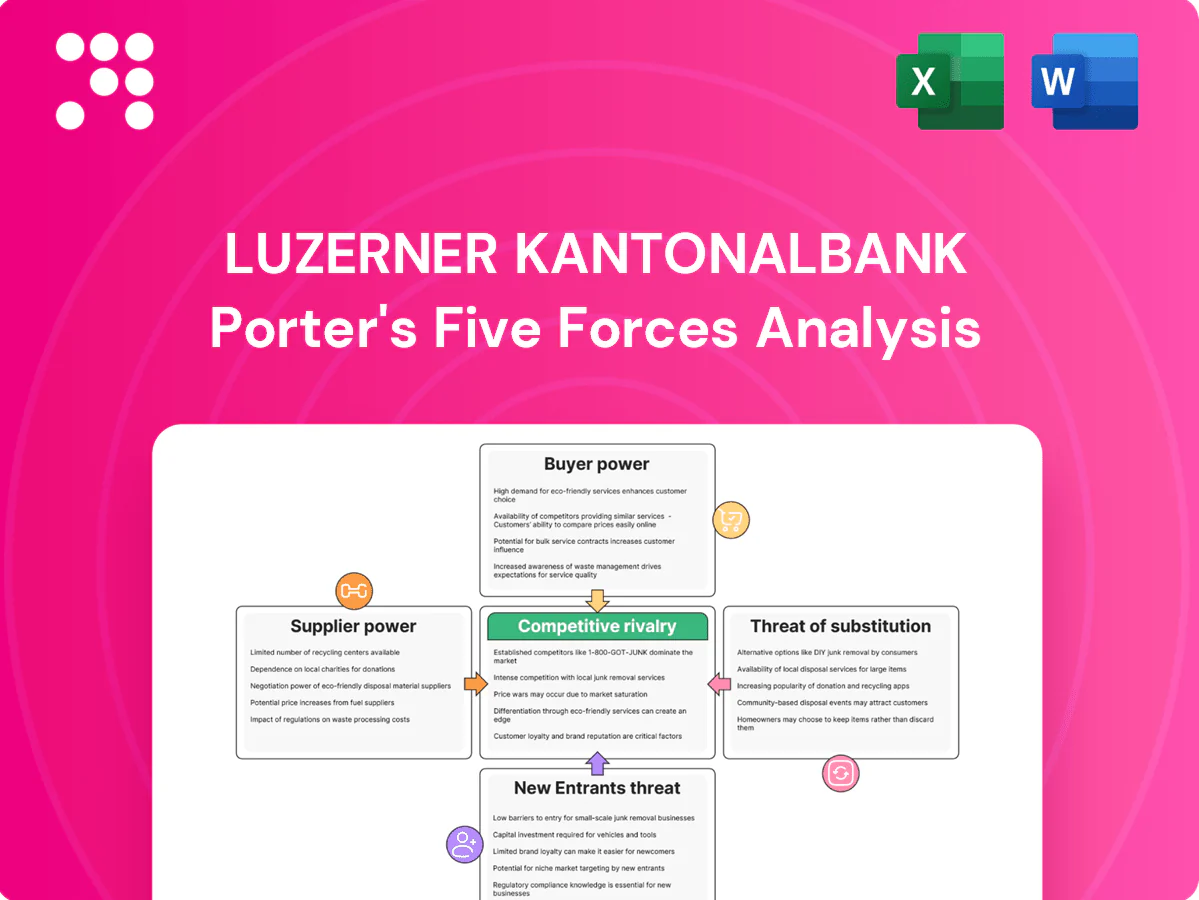
Luzerner Kantonalbank Porter's Five Forces Analysis

From Overview to Strategy Blueprint
Luzerner Kantonalbank faces moderate competitive intensity—strong regional brand and high regulatory barriers limit new entrants, while digital challengers and concentrated corporate clients increase pressure on margins. This snapshot highlights key tensions; unlock the full Porter's Five Forces Analysis for force-by-force ratings, visuals, and actionable strategy.
Suppliers Bargaining Power

Concentrated core-IT vendors
Swiss banks depend on a small set of core banking and payments providers, giving vendors significant leverage over pricing and roadmaps. Switching core systems is costly, risky and time-consuming, so Luzerner Kantonalbank pursues multi-year contracts and modular add-ons to spread implementation risk. Standardization lowers customization power for the bank but increases lock-in to vendors' product roadmaps. This dynamic amplifies supplier bargaining power in Luzerner Kantonalbank's IT sourcing.
Skilled talent scarcity
Competition for compliance, risk, IT and wealth-advisors is acute in Switzerland, where 2024 sector wage growth reached about 3% and unemployment stayed low (~2.2%), boosting supplier power of skilled labor. Regulatory expertise requirements and wage inflation raise hiring costs for LUKB. LUKB counters with a strong regional employer brand and internal training pipelines; wider remote work expands the talent pool but also the bidder set.

Wholesale funding and interbank
In stressed markets wholesale funders can demand wider spreads and tighter covenants, pressuring LUKB despite its strong retail deposit franchise; LUKB reports limited reliance on interbank markets relative to peers. SNB policy shifts (policy rate 1.75% as of mid-2024) directly affect upstream pricing power. Maintaining high liquidity buffers reduces exposure to cyclical wholesale squeezes.

Payment and market infrastructure
Dependence on SIX, SWIFT and global custodians gives infrastructure operators clear negotiating leverage; SWIFT connects over 11,000 institutions worldwide (2024). Fee schedules and mandatory platform upgrades can compress LUKB margins. LUKB can mitigate by bundling volumes or joining industry alliances, but regulatory mandates and settlement rules limit exit options, sustaining supplier power.
- Concentration risk: high
- Upgrade costs: recurring
- Bargaining levers: volume pooling
- Exit barriers: regulatory
Regulatory and compliance demands
Regulatory agencies function as a quasi-supplier for LUKB by controlling licenses and operating permissions, and expanding FINMA/AML rules increase bargaining power of compliance tech and advisory firms. LUKB’s mature compliance frameworks and in-house teams lower marginal compliance costs versus smaller peers, yet continuous regulatory updates force recurring spend and strict implementation timetables.
- Regulation-as-supplier
- Compliance vendors gain leverage
- LUKB: lower marginal compliance costs
- Recurring spend and timetable constraints
Vendor lock-in lifts bank costs as SNB rate 1.75%
Vendors of core banking, SIX/SWIFT infrastructure and compliance tech exert high leverage over Luzerner Kantonalbank due to costly switching, regulatory mandates and recurring upgrade fees. Skilled-labour pressure (2024 wage growth ~3%, unemployment ~2.2%) raises hiring costs. SNB policy rate 1.75% (mid-2024) and market stress amplify wholesale supplier power; LUKB offsets via long contracts and internal teams.
| Metric | 2024 value |
|---|---|
| Sector wage growth | ~3% |
| Unemployment (CH) | ~2.2% |
| SNB policy rate | 1.75% |
| SWIFT reach | ~11,000 institutions |
What is included in the product
 Detailed Word Document
Tailored Porter's Five Forces analysis for Luzerner Kantonalbank uncovering key drivers of competition, customer influence, and market entry risks, with evaluation of suppliers, buyers, substitutes and emerging threats to market share. Ready to edit for reports, investor materials, or internal strategy decks.

 Customizable Excel Spreadsheet
A concise one-sheet Porter's Five Forces for Luzerner Kantonalbank—customize pressure levels, swap in your data, and visualize strategic intensity with a built-in spider chart ready for pitch decks; no macros, easy to integrate with Excel dashboards and the companion Word report.
Customers Bargaining Power

Rate-sensitive retail depositors
Swiss savers easily compare rates via online portals and aggregators, and in 2024 digital channels drove over 50% of new retail account openings, increasing price transparency and rate sensitivity. This elevates bargaining power as transfers become frictionless, though LUKB leverages bundled services, strong regional trust and loyalty programs plus advisory relationships to reduce churn and protect deposit margins.
Mortgage borrowers with options
Mortgage offers (fixed and SARON) are highly standardized and easily comparable, while SARON-based products accounted for over 50% of new variable-linked mortgages in 2024; this transparency boosts borrower bargaining power against margins. Brokers and digital platforms intensify price and fee pressure. LUKB defends spreads with superior local appraisal knowledge and faster decisions, and cross-selling of insurance and investment products increases customer stickiness.

SMEs demanding tailored credit
SMEs frequently negotiate covenants, collateral and pricing across multiple banks to secure tailored credit, leveraging that Swiss SMEs make up 99.7% of enterprises and employ roughly 70% of the workforce. Deep relationships and sector expertise often outweigh pure pricing, favoring banks that offer advisory and flexible terms. LUKB’s regional network and cantonal ties boost responsiveness and public-sector confidence, though SMEs still multi-bank to preserve negotiating leverage.

Affluent and wealth clients
Affluent and wealth clients benchmark LUKB fees against global and digital competitors; 2024 industry surveys show digital multi-asset model fees often sit around 20–60 basis points while traditional advisory fees frequently range 60–120 bps. Performance reporting and open-architecture funds increase transparency, forcing LUKB to justify advisory alpha and holistic planning value. Tiered pricing and discretionary mandates can align incentives and reduce churn.
- fee-benchmark: 20–120 bps (2024 surveys)
- transparency: open-architecture + reporting ↑ client scrutiny
- value-capture: tiered pricing & discretionary mandates align incentives
Public sector and institutions
Public sector tenders compress fees and standardize RFP criteria, while large low-risk mandates in 2024 commonly drew 6–10 bidders, raising buyer power; LUKB’s cantonal status (total assets CHF 28.3bn at end-2024) boosts credibility but does not secure awards, so tight service-level commitments and demonstrable ESG alignment are key differentiators.
- Public tenders compress margins
- 6–10 bidders on large mandates
- LUKB assets CHF 28.3bn (end-2024)
- Cantonal role aids credibility, not guaranteed wins
- Service levels and ESG drive selection
Digital >50%; SARON >50%; tenders 6–10
Digital channels drove >50% of new retail accounts in 2024, raising price transparency and deposit churn risk; LUKB counters with bundled services and regional trust. SARON-linked mortgages were >50% of new variable mortgages in 2024, boosting borrower leverage. SMEs negotiate covenants across banks despite LUKB’s cantonal ties. Public tenders drew 6–10 bidders, compressing margins.
| Metric | 2024 |
|---|---|
| LUKB assets | CHF 28.3bn |
| Retail digital share | >50% |
| SARON mortgages | >50% |
| Public tender bidders | 6–10 |
| Fee benchmark | 20–120 bps |
Same Document Delivered
Luzerner Kantonalbank Porter's Five Forces Analysis
This Luzerner Kantonalbank Porter's Five Forces Analysis preview shows the exact document you'll receive immediately after purchase—fully formed and professionally formatted. There are no placeholders or mockups; the content, charts and insights visible here are identical to the downloadable file. Buy with confidence: instant access to this exact, ready-to-use analysis upon payment.

From Overview to Strategy Blueprint
Luzerner Kantonalbank faces moderate competitive intensity—strong regional brand and high regulatory barriers limit new entrants, while digital challengers and concentrated corporate clients increase pressure on margins. This snapshot highlights key tensions; unlock the full Porter's Five Forces Analysis for force-by-force ratings, visuals, and actionable strategy.
Suppliers Bargaining Power
Concentrated core-IT vendors
Swiss banks depend on a small set of core banking and payments providers, giving vendors significant leverage over pricing and roadmaps. Switching core systems is costly, risky and time-consuming, so Luzerner Kantonalbank pursues multi-year contracts and modular add-ons to spread implementation risk. Standardization lowers customization power for the bank but increases lock-in to vendors' product roadmaps. This dynamic amplifies supplier bargaining power in Luzerner Kantonalbank's IT sourcing.
Skilled talent scarcity
Competition for compliance, risk, IT and wealth-advisors is acute in Switzerland, where 2024 sector wage growth reached about 3% and unemployment stayed low (~2.2%), boosting supplier power of skilled labor. Regulatory expertise requirements and wage inflation raise hiring costs for LUKB. LUKB counters with a strong regional employer brand and internal training pipelines; wider remote work expands the talent pool but also the bidder set.
Wholesale funding and interbank
In stressed markets wholesale funders can demand wider spreads and tighter covenants, pressuring LUKB despite its strong retail deposit franchise; LUKB reports limited reliance on interbank markets relative to peers. SNB policy shifts (policy rate 1.75% as of mid-2024) directly affect upstream pricing power. Maintaining high liquidity buffers reduces exposure to cyclical wholesale squeezes.
Payment and market infrastructure
Dependence on SIX, SWIFT and global custodians gives infrastructure operators clear negotiating leverage; SWIFT connects over 11,000 institutions worldwide (2024). Fee schedules and mandatory platform upgrades can compress LUKB margins. LUKB can mitigate by bundling volumes or joining industry alliances, but regulatory mandates and settlement rules limit exit options, sustaining supplier power.
- Concentration risk: high
- Upgrade costs: recurring
- Bargaining levers: volume pooling
- Exit barriers: regulatory
Regulatory and compliance demands
Regulatory agencies function as a quasi-supplier for LUKB by controlling licenses and operating permissions, and expanding FINMA/AML rules increase bargaining power of compliance tech and advisory firms. LUKB’s mature compliance frameworks and in-house teams lower marginal compliance costs versus smaller peers, yet continuous regulatory updates force recurring spend and strict implementation timetables.
- Regulation-as-supplier
- Compliance vendors gain leverage
- LUKB: lower marginal compliance costs
- Recurring spend and timetable constraints
Vendor lock-in lifts bank costs as SNB rate 1.75%
Vendors of core banking, SIX/SWIFT infrastructure and compliance tech exert high leverage over Luzerner Kantonalbank due to costly switching, regulatory mandates and recurring upgrade fees. Skilled-labour pressure (2024 wage growth ~3%, unemployment ~2.2%) raises hiring costs. SNB policy rate 1.75% (mid-2024) and market stress amplify wholesale supplier power; LUKB offsets via long contracts and internal teams.
| Metric | 2024 value |
|---|---|
| Sector wage growth | ~3% |
| Unemployment (CH) | ~2.2% |
| SNB policy rate | 1.75% |
| SWIFT reach | ~11,000 institutions |
What is included in the product
Detailed Word Document
Tailored Porter's Five Forces analysis for Luzerner Kantonalbank uncovering key drivers of competition, customer influence, and market entry risks, with evaluation of suppliers, buyers, substitutes and emerging threats to market share. Ready to edit for reports, investor materials, or internal strategy decks.
Customizable Excel Spreadsheet
A concise one-sheet Porter's Five Forces for Luzerner Kantonalbank—customize pressure levels, swap in your data, and visualize strategic intensity with a built-in spider chart ready for pitch decks; no macros, easy to integrate with Excel dashboards and the companion Word report.
Customers Bargaining Power
Rate-sensitive retail depositors
Swiss savers easily compare rates via online portals and aggregators, and in 2024 digital channels drove over 50% of new retail account openings, increasing price transparency and rate sensitivity. This elevates bargaining power as transfers become frictionless, though LUKB leverages bundled services, strong regional trust and loyalty programs plus advisory relationships to reduce churn and protect deposit margins.
Mortgage borrowers with options
Mortgage offers (fixed and SARON) are highly standardized and easily comparable, while SARON-based products accounted for over 50% of new variable-linked mortgages in 2024; this transparency boosts borrower bargaining power against margins. Brokers and digital platforms intensify price and fee pressure. LUKB defends spreads with superior local appraisal knowledge and faster decisions, and cross-selling of insurance and investment products increases customer stickiness.
SMEs demanding tailored credit
SMEs frequently negotiate covenants, collateral and pricing across multiple banks to secure tailored credit, leveraging that Swiss SMEs make up 99.7% of enterprises and employ roughly 70% of the workforce. Deep relationships and sector expertise often outweigh pure pricing, favoring banks that offer advisory and flexible terms. LUKB’s regional network and cantonal ties boost responsiveness and public-sector confidence, though SMEs still multi-bank to preserve negotiating leverage.
Affluent and wealth clients
Affluent and wealth clients benchmark LUKB fees against global and digital competitors; 2024 industry surveys show digital multi-asset model fees often sit around 20–60 basis points while traditional advisory fees frequently range 60–120 bps. Performance reporting and open-architecture funds increase transparency, forcing LUKB to justify advisory alpha and holistic planning value. Tiered pricing and discretionary mandates can align incentives and reduce churn.
- fee-benchmark: 20–120 bps (2024 surveys)
- transparency: open-architecture + reporting ↑ client scrutiny
- value-capture: tiered pricing & discretionary mandates align incentives
Public sector and institutions
Public sector tenders compress fees and standardize RFP criteria, while large low-risk mandates in 2024 commonly drew 6–10 bidders, raising buyer power; LUKB’s cantonal status (total assets CHF 28.3bn at end-2024) boosts credibility but does not secure awards, so tight service-level commitments and demonstrable ESG alignment are key differentiators.
- Public tenders compress margins
- 6–10 bidders on large mandates
- LUKB assets CHF 28.3bn (end-2024)
- Cantonal role aids credibility, not guaranteed wins
- Service levels and ESG drive selection
Digital >50%; SARON >50%; tenders 6–10
Digital channels drove >50% of new retail accounts in 2024, raising price transparency and deposit churn risk; LUKB counters with bundled services and regional trust. SARON-linked mortgages were >50% of new variable mortgages in 2024, boosting borrower leverage. SMEs negotiate covenants across banks despite LUKB’s cantonal ties. Public tenders drew 6–10 bidders, compressing margins.
| Metric | 2024 |
|---|---|
| LUKB assets | CHF 28.3bn |
| Retail digital share | >50% |
| SARON mortgages | >50% |
| Public tender bidders | 6–10 |
| Fee benchmark | 20–120 bps |
Same Document Delivered
Luzerner Kantonalbank Porter's Five Forces Analysis
This Luzerner Kantonalbank Porter's Five Forces Analysis preview shows the exact document you'll receive immediately after purchase—fully formed and professionally formatted. There are no placeholders or mockups; the content, charts and insights visible here are identical to the downloadable file. Buy with confidence: instant access to this exact, ready-to-use analysis upon payment.
Original: $10.00
-65%$10.00
$3.50Description
From Overview to Strategy Blueprint
Luzerner Kantonalbank faces moderate competitive intensity—strong regional brand and high regulatory barriers limit new entrants, while digital challengers and concentrated corporate clients increase pressure on margins. This snapshot highlights key tensions; unlock the full Porter's Five Forces Analysis for force-by-force ratings, visuals, and actionable strategy.
Suppliers Bargaining Power
Concentrated core-IT vendors
Swiss banks depend on a small set of core banking and payments providers, giving vendors significant leverage over pricing and roadmaps. Switching core systems is costly, risky and time-consuming, so Luzerner Kantonalbank pursues multi-year contracts and modular add-ons to spread implementation risk. Standardization lowers customization power for the bank but increases lock-in to vendors' product roadmaps. This dynamic amplifies supplier bargaining power in Luzerner Kantonalbank's IT sourcing.
Skilled talent scarcity
Competition for compliance, risk, IT and wealth-advisors is acute in Switzerland, where 2024 sector wage growth reached about 3% and unemployment stayed low (~2.2%), boosting supplier power of skilled labor. Regulatory expertise requirements and wage inflation raise hiring costs for LUKB. LUKB counters with a strong regional employer brand and internal training pipelines; wider remote work expands the talent pool but also the bidder set.
Wholesale funding and interbank
In stressed markets wholesale funders can demand wider spreads and tighter covenants, pressuring LUKB despite its strong retail deposit franchise; LUKB reports limited reliance on interbank markets relative to peers. SNB policy shifts (policy rate 1.75% as of mid-2024) directly affect upstream pricing power. Maintaining high liquidity buffers reduces exposure to cyclical wholesale squeezes.
Payment and market infrastructure
Dependence on SIX, SWIFT and global custodians gives infrastructure operators clear negotiating leverage; SWIFT connects over 11,000 institutions worldwide (2024). Fee schedules and mandatory platform upgrades can compress LUKB margins. LUKB can mitigate by bundling volumes or joining industry alliances, but regulatory mandates and settlement rules limit exit options, sustaining supplier power.
- Concentration risk: high
- Upgrade costs: recurring
- Bargaining levers: volume pooling
- Exit barriers: regulatory
Regulatory and compliance demands
Regulatory agencies function as a quasi-supplier for LUKB by controlling licenses and operating permissions, and expanding FINMA/AML rules increase bargaining power of compliance tech and advisory firms. LUKB’s mature compliance frameworks and in-house teams lower marginal compliance costs versus smaller peers, yet continuous regulatory updates force recurring spend and strict implementation timetables.
- Regulation-as-supplier
- Compliance vendors gain leverage
- LUKB: lower marginal compliance costs
- Recurring spend and timetable constraints
Vendor lock-in lifts bank costs as SNB rate 1.75%
Vendors of core banking, SIX/SWIFT infrastructure and compliance tech exert high leverage over Luzerner Kantonalbank due to costly switching, regulatory mandates and recurring upgrade fees. Skilled-labour pressure (2024 wage growth ~3%, unemployment ~2.2%) raises hiring costs. SNB policy rate 1.75% (mid-2024) and market stress amplify wholesale supplier power; LUKB offsets via long contracts and internal teams.
| Metric | 2024 value |
|---|---|
| Sector wage growth | ~3% |
| Unemployment (CH) | ~2.2% |
| SNB policy rate | 1.75% |
| SWIFT reach | ~11,000 institutions |
What is included in the product
Detailed Word Document
Tailored Porter's Five Forces analysis for Luzerner Kantonalbank uncovering key drivers of competition, customer influence, and market entry risks, with evaluation of suppliers, buyers, substitutes and emerging threats to market share. Ready to edit for reports, investor materials, or internal strategy decks.
Customizable Excel Spreadsheet
A concise one-sheet Porter's Five Forces for Luzerner Kantonalbank—customize pressure levels, swap in your data, and visualize strategic intensity with a built-in spider chart ready for pitch decks; no macros, easy to integrate with Excel dashboards and the companion Word report.
Customers Bargaining Power
Rate-sensitive retail depositors
Swiss savers easily compare rates via online portals and aggregators, and in 2024 digital channels drove over 50% of new retail account openings, increasing price transparency and rate sensitivity. This elevates bargaining power as transfers become frictionless, though LUKB leverages bundled services, strong regional trust and loyalty programs plus advisory relationships to reduce churn and protect deposit margins.
Mortgage borrowers with options
Mortgage offers (fixed and SARON) are highly standardized and easily comparable, while SARON-based products accounted for over 50% of new variable-linked mortgages in 2024; this transparency boosts borrower bargaining power against margins. Brokers and digital platforms intensify price and fee pressure. LUKB defends spreads with superior local appraisal knowledge and faster decisions, and cross-selling of insurance and investment products increases customer stickiness.
SMEs demanding tailored credit
SMEs frequently negotiate covenants, collateral and pricing across multiple banks to secure tailored credit, leveraging that Swiss SMEs make up 99.7% of enterprises and employ roughly 70% of the workforce. Deep relationships and sector expertise often outweigh pure pricing, favoring banks that offer advisory and flexible terms. LUKB’s regional network and cantonal ties boost responsiveness and public-sector confidence, though SMEs still multi-bank to preserve negotiating leverage.
Affluent and wealth clients
Affluent and wealth clients benchmark LUKB fees against global and digital competitors; 2024 industry surveys show digital multi-asset model fees often sit around 20–60 basis points while traditional advisory fees frequently range 60–120 bps. Performance reporting and open-architecture funds increase transparency, forcing LUKB to justify advisory alpha and holistic planning value. Tiered pricing and discretionary mandates can align incentives and reduce churn.
- fee-benchmark: 20–120 bps (2024 surveys)
- transparency: open-architecture + reporting ↑ client scrutiny
- value-capture: tiered pricing & discretionary mandates align incentives
Public sector and institutions
Public sector tenders compress fees and standardize RFP criteria, while large low-risk mandates in 2024 commonly drew 6–10 bidders, raising buyer power; LUKB’s cantonal status (total assets CHF 28.3bn at end-2024) boosts credibility but does not secure awards, so tight service-level commitments and demonstrable ESG alignment are key differentiators.
- Public tenders compress margins
- 6–10 bidders on large mandates
- LUKB assets CHF 28.3bn (end-2024)
- Cantonal role aids credibility, not guaranteed wins
- Service levels and ESG drive selection
Digital >50%; SARON >50%; tenders 6–10
Digital channels drove >50% of new retail accounts in 2024, raising price transparency and deposit churn risk; LUKB counters with bundled services and regional trust. SARON-linked mortgages were >50% of new variable mortgages in 2024, boosting borrower leverage. SMEs negotiate covenants across banks despite LUKB’s cantonal ties. Public tenders drew 6–10 bidders, compressing margins.
| Metric | 2024 |
|---|---|
| LUKB assets | CHF 28.3bn |
| Retail digital share | >50% |
| SARON mortgages | >50% |
| Public tender bidders | 6–10 |
| Fee benchmark | 20–120 bps |
Same Document Delivered
Luzerner Kantonalbank Porter's Five Forces Analysis
This Luzerner Kantonalbank Porter's Five Forces Analysis preview shows the exact document you'll receive immediately after purchase—fully formed and professionally formatted. There are no placeholders or mockups; the content, charts and insights visible here are identical to the downloadable file. Buy with confidence: instant access to this exact, ready-to-use analysis upon payment.











