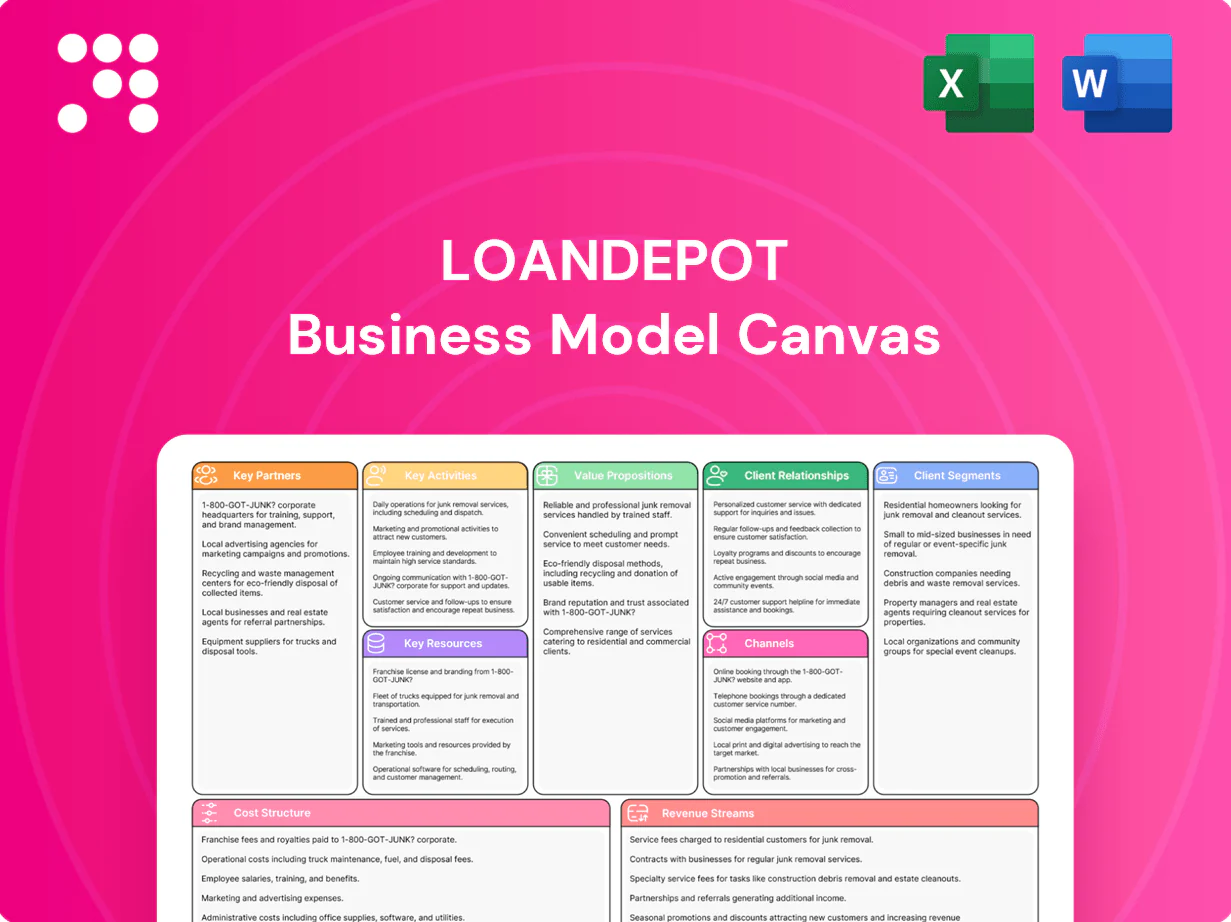
loanDepot Business Model Canvas

Unlock the strategic blueprint of a leading mortgage fintech Business Model Canvas
Unlock the strategic blueprint behind loanDepot with our concise Business Model Canvas. This in-depth snapshot reveals how the firm creates value, scales channels, and monetizes loans across customer segments. Ideal for investors, advisors, and founders seeking actionable intelligence. Purchase the full Word/Excel canvas to dissect every building block and apply it to your strategy.
Partnerships

Secondary market investors
Partnerships with Fannie Mae, Freddie Mac and Ginnie Mae enable loanDepot to sell conforming and government loans into liquid markets, tapping the three agencies that collectively back roughly 70% of U.S. single‑family mortgages in 2024. These outlets provide standardized execution and deep liquidity, improving pull‑through and pricing. Strong investor ties expand product eligibility and lock options, supporting scalable origination volume.
Warehouse lenders
Short-term warehouse credit lines, with typical advance rates up to 97% and maturities of 30–90 days, fund loans between closing and sale to investors. Competitive warehouse pricing lowers carry costs and raises funded capacity, improving ROE. Diversified lender panels reduce funding concentration risk and liquidity stress. Facility covenants and triggers directly shape pipeline limits, hedging frequency and duration risk management.

Real estate and builder networks
Agent and builder referrals deliver the bulk of qualified purchase leads, often accounting for 50–70% of purchase pipelines in lender channel mixes in 2024. Co-marketing with agents and builders drives earlier borrower engagement, improving conversion rates and reducing time-to-contract. In-model sales offices accelerate pre-approvals and capture early-stage buyers, while these partners smooth timelines and boost appraisal readiness, cutting closing delays reported industry-wide in 2024.

Fintech, data, and vendor ecosystems
Fintech, data, and vendor ecosystems—credit bureaus (Equifax, Experian, TransUnion) covering ~330 million US consumers, AUS engines, appraisal management companies, VOE/VOI providers and eClose vendors streamline underwriting; API integrations cut cycle time and errors; cybersecurity and IDV partners reduce fraud; CRM and marketing tech optimize lead nurturing.
- Credit bureaus: 3 majors, ~330M consumers
- AUS/eClose: API-driven cycle reductions
- Appraisals/VOE/VOI: faster verification
- Cybersecurity/IDV: lowered fraud risk
- CRM/marketing: improved lead nurturing
Hedging, servicing, and compliance partners
Hedge advisors and broker-dealers manage pipeline interest-rate risk amid a 2024 environment where the 30-year fixed averaged about 7%, protecting margins and hedging costs. Subservicers and insurance partners sustain post-close performance and claims handling, preserving servicing cash flows. Legal and regulatory consultants ensure multi-state compliance; QC vendors improve loan salability and defect remediation.
- Hedging: pipeline rate management
- Servicing: subservicers & insurance
- Compliance: multi-state legal advisors
- QC: salability & defect remediation
GSE backing, 97% warehouse advances and agent pipelines power mortgage scale
Partnerships with Fannie Mae, Freddie Mac and Ginnie Mae (backing ~70% of US single‑family mortgages in 2024) provide liquidity and standardized execution. Warehouse lenders (advance rates up to 97%, 30–90 day terms) fund originations. Agent/builder referrals supply 50–70% of purchase pipelines. Fintech, bureaus (~330M consumers) and hedging partners cut cycle time and protect margins (30yr ~7% avg 2024).
| Partner | Key Metric |
|---|---|
| GSEs | ~70% market share |
| Warehouses | 97% advance, 30–90d |
| Agents | 50–70% leads |
What is included in the product
 Detailed Word Document
A ready-to-use Business Model Canvas for loanDepot that maps customer segments, channels, value propositions, revenue streams, key activities, resources, partners, cost structure and customer relationships with real-world operational insights. Ideal for presentations, investor discussions and strategic planning, it highlights competitive advantages, risks and tactical recommendations to support data-driven decision making.

 Customizable Excel Spreadsheet
High-level one-page snapshot that isolates loanDepot’s value propositions, channels, cost and revenue drivers to quickly pinpoint borrower and origination pain points; editable and shareable for teams to collaborate on targeted fixes and fast strategic iterations.
Activities

Loan origination
Lead capture, application intake, and timely disclosures anchor loanDepot’s funnel, converting digital leads into completed files; industry data in 2024 showed pre-approval holders close at about 20% higher rates. Pre-approvals validate borrower readiness and streamline underwriting. Rate locks synchronize pricing with market moves to protect margins. Closing coordination targets on-time fundings to minimize fallout and repurchase risk.
Underwriting and credit risk
Income, asset, and collateral verification determine borrower eligibility and loan pricing, using bank statements, paystubs, and appraisals to flag risk early. AUS automation plus targeted manual reviews balance speed and underwriting quality, accelerating approvals while catching complex issues. Rigorous conditions clearing before funding reduces repurchase exposure from investors. Ongoing QC and post-close audits protect salability and support secondary market confidence.

Digital platform development
Optimizing loanDepot’s online application and borrower portal reduces friction and improves completion rates, reflecting 2024’s shift to digital-first mortgage journeys. Integrations with data vendors enable instant verifications, cutting manual checks and turn times. eSignature and eClose workflows accelerate throughput from weeks to days. Analytics guide UX tweaks and conversion lifts across the funnel in 2024.

Marketing and lead generation
Marketing and lead generation at loanDepot leverages performance media, SEO, and partnerships to drive high-intent traffic; digital channels supported a large share of originations as consumers reacted to 2024 average 30-year mortgage rates near 6.8%. CRM segmentation personalizes outreach, while automated rate alerts and content nurture intent and boost conversion velocity. Ongoing brand building raises trust and referral rates, improving lifetime value.
- Performance media
- SEO & partnerships
- CRM segmentation
- Rate alerts & content
- Brand trust → referrals
Capital markets and servicing
Hedging locks and mandatory deliveries drive gain-on-sale by reducing pipeline volatility; with 30-year fixed averaging about 6.8% in 2024 (Freddie Mac) these tools preserved margins. Best-ex execution routes loans to aggregators or securitization to capture market spreads. MSR strategy balances near-term cash vs lifetime value through selective MSR retention/sales. Customer care reduces churn and enables cross-sell.
- Hedging: reduces pipeline mark-to-market
- Mandatory deliveries: secures gain-on-sale
- Best-ex: aggregator vs securitization choice
- MSR: short cash vs long LTV
- Customer care: retention + cross-sell
Digital lead-to-funding lifts closes 20% amid 6.8% rates
Lead capture, verification, AUS + manual underwriting, eClose/eSign and hedging/mandatory deliveries form loanDepot’s core activities, converting digital leads into fundings; pre-approvals close ~20% higher. 30-year rates averaged ~6.8% in 2024 (Freddie Mac), driving hedging and delivery strategies. QC, post-close audits and MSR decisions protect gain-on-sale and lifetime value.
| Activity | Metric | 2024 Value |
|---|---|---|
| Pre-approvals | Close lift | +20% |
| Market rate | 30-yr fixed | 6.8% |
| eClose | Turn time | Days vs weeks |
Delivered as Displayed
Business Model Canvas
The document you're previewing is the exact loanDepot Business Model Canvas you'll receive after purchase; it's not a mockup or sample. When you buy, you'll download the complete, editable file formatted the same way for immediate use in presentations, analysis, or planning. No hidden pages or placeholders—what you see is the full deliverable ready to edit and apply.

Unlock the strategic blueprint of a leading mortgage fintech Business Model Canvas
Unlock the strategic blueprint behind loanDepot with our concise Business Model Canvas. This in-depth snapshot reveals how the firm creates value, scales channels, and monetizes loans across customer segments. Ideal for investors, advisors, and founders seeking actionable intelligence. Purchase the full Word/Excel canvas to dissect every building block and apply it to your strategy.
Partnerships
Secondary market investors
Partnerships with Fannie Mae, Freddie Mac and Ginnie Mae enable loanDepot to sell conforming and government loans into liquid markets, tapping the three agencies that collectively back roughly 70% of U.S. single‑family mortgages in 2024. These outlets provide standardized execution and deep liquidity, improving pull‑through and pricing. Strong investor ties expand product eligibility and lock options, supporting scalable origination volume.
Warehouse lenders
Short-term warehouse credit lines, with typical advance rates up to 97% and maturities of 30–90 days, fund loans between closing and sale to investors. Competitive warehouse pricing lowers carry costs and raises funded capacity, improving ROE. Diversified lender panels reduce funding concentration risk and liquidity stress. Facility covenants and triggers directly shape pipeline limits, hedging frequency and duration risk management.
Real estate and builder networks
Agent and builder referrals deliver the bulk of qualified purchase leads, often accounting for 50–70% of purchase pipelines in lender channel mixes in 2024. Co-marketing with agents and builders drives earlier borrower engagement, improving conversion rates and reducing time-to-contract. In-model sales offices accelerate pre-approvals and capture early-stage buyers, while these partners smooth timelines and boost appraisal readiness, cutting closing delays reported industry-wide in 2024.
Fintech, data, and vendor ecosystems
Fintech, data, and vendor ecosystems—credit bureaus (Equifax, Experian, TransUnion) covering ~330 million US consumers, AUS engines, appraisal management companies, VOE/VOI providers and eClose vendors streamline underwriting; API integrations cut cycle time and errors; cybersecurity and IDV partners reduce fraud; CRM and marketing tech optimize lead nurturing.
- Credit bureaus: 3 majors, ~330M consumers
- AUS/eClose: API-driven cycle reductions
- Appraisals/VOE/VOI: faster verification
- Cybersecurity/IDV: lowered fraud risk
- CRM/marketing: improved lead nurturing
Hedging, servicing, and compliance partners
Hedge advisors and broker-dealers manage pipeline interest-rate risk amid a 2024 environment where the 30-year fixed averaged about 7%, protecting margins and hedging costs. Subservicers and insurance partners sustain post-close performance and claims handling, preserving servicing cash flows. Legal and regulatory consultants ensure multi-state compliance; QC vendors improve loan salability and defect remediation.
- Hedging: pipeline rate management
- Servicing: subservicers & insurance
- Compliance: multi-state legal advisors
- QC: salability & defect remediation
GSE backing, 97% warehouse advances and agent pipelines power mortgage scale
Partnerships with Fannie Mae, Freddie Mac and Ginnie Mae (backing ~70% of US single‑family mortgages in 2024) provide liquidity and standardized execution. Warehouse lenders (advance rates up to 97%, 30–90 day terms) fund originations. Agent/builder referrals supply 50–70% of purchase pipelines. Fintech, bureaus (~330M consumers) and hedging partners cut cycle time and protect margins (30yr ~7% avg 2024).
| Partner | Key Metric |
|---|---|
| GSEs | ~70% market share |
| Warehouses | 97% advance, 30–90d |
| Agents | 50–70% leads |
What is included in the product
Detailed Word Document
A ready-to-use Business Model Canvas for loanDepot that maps customer segments, channels, value propositions, revenue streams, key activities, resources, partners, cost structure and customer relationships with real-world operational insights. Ideal for presentations, investor discussions and strategic planning, it highlights competitive advantages, risks and tactical recommendations to support data-driven decision making.
Customizable Excel Spreadsheet
High-level one-page snapshot that isolates loanDepot’s value propositions, channels, cost and revenue drivers to quickly pinpoint borrower and origination pain points; editable and shareable for teams to collaborate on targeted fixes and fast strategic iterations.
Activities
Loan origination
Lead capture, application intake, and timely disclosures anchor loanDepot’s funnel, converting digital leads into completed files; industry data in 2024 showed pre-approval holders close at about 20% higher rates. Pre-approvals validate borrower readiness and streamline underwriting. Rate locks synchronize pricing with market moves to protect margins. Closing coordination targets on-time fundings to minimize fallout and repurchase risk.
Underwriting and credit risk
Income, asset, and collateral verification determine borrower eligibility and loan pricing, using bank statements, paystubs, and appraisals to flag risk early. AUS automation plus targeted manual reviews balance speed and underwriting quality, accelerating approvals while catching complex issues. Rigorous conditions clearing before funding reduces repurchase exposure from investors. Ongoing QC and post-close audits protect salability and support secondary market confidence.
Digital platform development
Optimizing loanDepot’s online application and borrower portal reduces friction and improves completion rates, reflecting 2024’s shift to digital-first mortgage journeys. Integrations with data vendors enable instant verifications, cutting manual checks and turn times. eSignature and eClose workflows accelerate throughput from weeks to days. Analytics guide UX tweaks and conversion lifts across the funnel in 2024.
Marketing and lead generation
Marketing and lead generation at loanDepot leverages performance media, SEO, and partnerships to drive high-intent traffic; digital channels supported a large share of originations as consumers reacted to 2024 average 30-year mortgage rates near 6.8%. CRM segmentation personalizes outreach, while automated rate alerts and content nurture intent and boost conversion velocity. Ongoing brand building raises trust and referral rates, improving lifetime value.
- Performance media
- SEO & partnerships
- CRM segmentation
- Rate alerts & content
- Brand trust → referrals
Capital markets and servicing
Hedging locks and mandatory deliveries drive gain-on-sale by reducing pipeline volatility; with 30-year fixed averaging about 6.8% in 2024 (Freddie Mac) these tools preserved margins. Best-ex execution routes loans to aggregators or securitization to capture market spreads. MSR strategy balances near-term cash vs lifetime value through selective MSR retention/sales. Customer care reduces churn and enables cross-sell.
- Hedging: reduces pipeline mark-to-market
- Mandatory deliveries: secures gain-on-sale
- Best-ex: aggregator vs securitization choice
- MSR: short cash vs long LTV
- Customer care: retention + cross-sell
Digital lead-to-funding lifts closes 20% amid 6.8% rates
Lead capture, verification, AUS + manual underwriting, eClose/eSign and hedging/mandatory deliveries form loanDepot’s core activities, converting digital leads into fundings; pre-approvals close ~20% higher. 30-year rates averaged ~6.8% in 2024 (Freddie Mac), driving hedging and delivery strategies. QC, post-close audits and MSR decisions protect gain-on-sale and lifetime value.
| Activity | Metric | 2024 Value |
|---|---|---|
| Pre-approvals | Close lift | +20% |
| Market rate | 30-yr fixed | 6.8% |
| eClose | Turn time | Days vs weeks |
Delivered as Displayed
Business Model Canvas
The document you're previewing is the exact loanDepot Business Model Canvas you'll receive after purchase; it's not a mockup or sample. When you buy, you'll download the complete, editable file formatted the same way for immediate use in presentations, analysis, or planning. No hidden pages or placeholders—what you see is the full deliverable ready to edit and apply.
Original: $10.00
-65%$10.00
$3.50Description
Unlock the strategic blueprint of a leading mortgage fintech Business Model Canvas
Unlock the strategic blueprint behind loanDepot with our concise Business Model Canvas. This in-depth snapshot reveals how the firm creates value, scales channels, and monetizes loans across customer segments. Ideal for investors, advisors, and founders seeking actionable intelligence. Purchase the full Word/Excel canvas to dissect every building block and apply it to your strategy.
Partnerships
Secondary market investors
Partnerships with Fannie Mae, Freddie Mac and Ginnie Mae enable loanDepot to sell conforming and government loans into liquid markets, tapping the three agencies that collectively back roughly 70% of U.S. single‑family mortgages in 2024. These outlets provide standardized execution and deep liquidity, improving pull‑through and pricing. Strong investor ties expand product eligibility and lock options, supporting scalable origination volume.
Warehouse lenders
Short-term warehouse credit lines, with typical advance rates up to 97% and maturities of 30–90 days, fund loans between closing and sale to investors. Competitive warehouse pricing lowers carry costs and raises funded capacity, improving ROE. Diversified lender panels reduce funding concentration risk and liquidity stress. Facility covenants and triggers directly shape pipeline limits, hedging frequency and duration risk management.
Real estate and builder networks
Agent and builder referrals deliver the bulk of qualified purchase leads, often accounting for 50–70% of purchase pipelines in lender channel mixes in 2024. Co-marketing with agents and builders drives earlier borrower engagement, improving conversion rates and reducing time-to-contract. In-model sales offices accelerate pre-approvals and capture early-stage buyers, while these partners smooth timelines and boost appraisal readiness, cutting closing delays reported industry-wide in 2024.
Fintech, data, and vendor ecosystems
Fintech, data, and vendor ecosystems—credit bureaus (Equifax, Experian, TransUnion) covering ~330 million US consumers, AUS engines, appraisal management companies, VOE/VOI providers and eClose vendors streamline underwriting; API integrations cut cycle time and errors; cybersecurity and IDV partners reduce fraud; CRM and marketing tech optimize lead nurturing.
- Credit bureaus: 3 majors, ~330M consumers
- AUS/eClose: API-driven cycle reductions
- Appraisals/VOE/VOI: faster verification
- Cybersecurity/IDV: lowered fraud risk
- CRM/marketing: improved lead nurturing
Hedging, servicing, and compliance partners
Hedge advisors and broker-dealers manage pipeline interest-rate risk amid a 2024 environment where the 30-year fixed averaged about 7%, protecting margins and hedging costs. Subservicers and insurance partners sustain post-close performance and claims handling, preserving servicing cash flows. Legal and regulatory consultants ensure multi-state compliance; QC vendors improve loan salability and defect remediation.
- Hedging: pipeline rate management
- Servicing: subservicers & insurance
- Compliance: multi-state legal advisors
- QC: salability & defect remediation
GSE backing, 97% warehouse advances and agent pipelines power mortgage scale
Partnerships with Fannie Mae, Freddie Mac and Ginnie Mae (backing ~70% of US single‑family mortgages in 2024) provide liquidity and standardized execution. Warehouse lenders (advance rates up to 97%, 30–90 day terms) fund originations. Agent/builder referrals supply 50–70% of purchase pipelines. Fintech, bureaus (~330M consumers) and hedging partners cut cycle time and protect margins (30yr ~7% avg 2024).
| Partner | Key Metric |
|---|---|
| GSEs | ~70% market share |
| Warehouses | 97% advance, 30–90d |
| Agents | 50–70% leads |
What is included in the product
Detailed Word Document
A ready-to-use Business Model Canvas for loanDepot that maps customer segments, channels, value propositions, revenue streams, key activities, resources, partners, cost structure and customer relationships with real-world operational insights. Ideal for presentations, investor discussions and strategic planning, it highlights competitive advantages, risks and tactical recommendations to support data-driven decision making.
Customizable Excel Spreadsheet
High-level one-page snapshot that isolates loanDepot’s value propositions, channels, cost and revenue drivers to quickly pinpoint borrower and origination pain points; editable and shareable for teams to collaborate on targeted fixes and fast strategic iterations.
Activities
Loan origination
Lead capture, application intake, and timely disclosures anchor loanDepot’s funnel, converting digital leads into completed files; industry data in 2024 showed pre-approval holders close at about 20% higher rates. Pre-approvals validate borrower readiness and streamline underwriting. Rate locks synchronize pricing with market moves to protect margins. Closing coordination targets on-time fundings to minimize fallout and repurchase risk.
Underwriting and credit risk
Income, asset, and collateral verification determine borrower eligibility and loan pricing, using bank statements, paystubs, and appraisals to flag risk early. AUS automation plus targeted manual reviews balance speed and underwriting quality, accelerating approvals while catching complex issues. Rigorous conditions clearing before funding reduces repurchase exposure from investors. Ongoing QC and post-close audits protect salability and support secondary market confidence.
Digital platform development
Optimizing loanDepot’s online application and borrower portal reduces friction and improves completion rates, reflecting 2024’s shift to digital-first mortgage journeys. Integrations with data vendors enable instant verifications, cutting manual checks and turn times. eSignature and eClose workflows accelerate throughput from weeks to days. Analytics guide UX tweaks and conversion lifts across the funnel in 2024.
Marketing and lead generation
Marketing and lead generation at loanDepot leverages performance media, SEO, and partnerships to drive high-intent traffic; digital channels supported a large share of originations as consumers reacted to 2024 average 30-year mortgage rates near 6.8%. CRM segmentation personalizes outreach, while automated rate alerts and content nurture intent and boost conversion velocity. Ongoing brand building raises trust and referral rates, improving lifetime value.
- Performance media
- SEO & partnerships
- CRM segmentation
- Rate alerts & content
- Brand trust → referrals
Capital markets and servicing
Hedging locks and mandatory deliveries drive gain-on-sale by reducing pipeline volatility; with 30-year fixed averaging about 6.8% in 2024 (Freddie Mac) these tools preserved margins. Best-ex execution routes loans to aggregators or securitization to capture market spreads. MSR strategy balances near-term cash vs lifetime value through selective MSR retention/sales. Customer care reduces churn and enables cross-sell.
- Hedging: reduces pipeline mark-to-market
- Mandatory deliveries: secures gain-on-sale
- Best-ex: aggregator vs securitization choice
- MSR: short cash vs long LTV
- Customer care: retention + cross-sell
Digital lead-to-funding lifts closes 20% amid 6.8% rates
Lead capture, verification, AUS + manual underwriting, eClose/eSign and hedging/mandatory deliveries form loanDepot’s core activities, converting digital leads into fundings; pre-approvals close ~20% higher. 30-year rates averaged ~6.8% in 2024 (Freddie Mac), driving hedging and delivery strategies. QC, post-close audits and MSR decisions protect gain-on-sale and lifetime value.
| Activity | Metric | 2024 Value |
|---|---|---|
| Pre-approvals | Close lift | +20% |
| Market rate | 30-yr fixed | 6.8% |
| eClose | Turn time | Days vs weeks |
Delivered as Displayed
Business Model Canvas
The document you're previewing is the exact loanDepot Business Model Canvas you'll receive after purchase; it's not a mockup or sample. When you buy, you'll download the complete, editable file formatted the same way for immediate use in presentations, analysis, or planning. No hidden pages or placeholders—what you see is the full deliverable ready to edit and apply.











