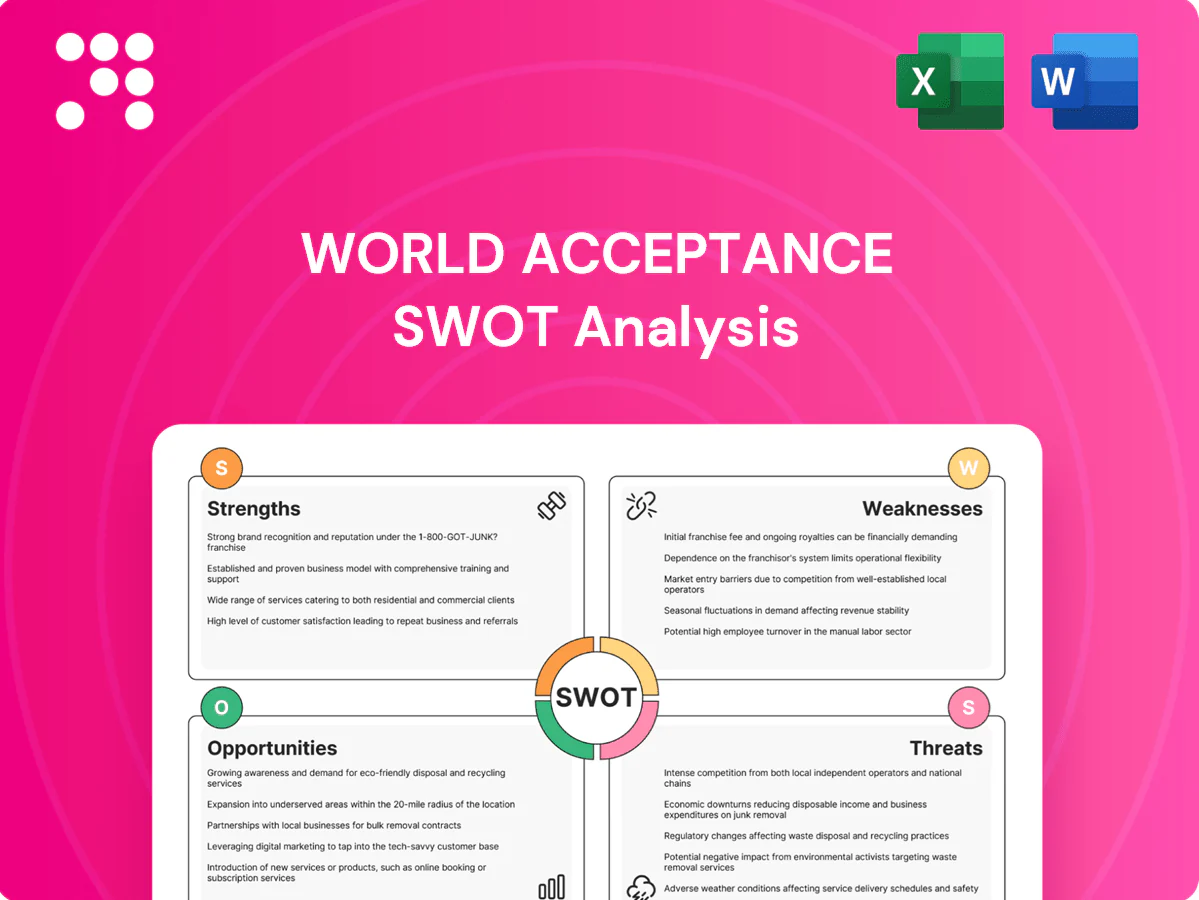
World Acceptance SWOT Analysis

Elevate Your Analysis with the Complete SWOT Report
World Acceptance faces resilient niche lending strengths, mixed credit-cycle exposure, and regulatory sensitivities that shape its near-term outlook; our preview highlights key drivers but omits actionable detail. Purchase the full SWOT analysis for a research-backed, editable Word + Excel package to plan, pitch, or invest with confidence.
Strengths

Deep reach into underserved credit segments
Serving borrowers excluded from traditional banks gives World Acceptance (founded 1962, ticker WRLD) resilient demand and pricing power, as limited alternatives reduce price elasticity and support stable yields. The niche focus fosters defensible customer relationships and recurring engagement. Proprietary performance data on non-prime behavior continually refines underwriting and loss forecasting.
Extensive branch network for high-touch service
With over 900 branches nationwide in 2024, World Acceptance leverages physical locations to enable trust-based originations, cash handling and in-person collections for customers preferring face-to-face service; local branches improve identity verification and reduce fraud, support tailored repayment plans, drive referrals and retention through community relationships, and provide a platform to cross-sell ancillary products and services.

Fixed-rate, structured installment products
Fixed-rate, structured installment products deliver predictable payments that align with customers’ budgeting needs and reduce payment shocks. Fixed rates simplify disclosures and regulatory compliance versus variable pricing. Structured schedules encourage disciplined repayment, lowering delinquency risk, while clear terms boost customer satisfaction and repeat usage.

Cross-sell of credit insurance and tax preparation
Ancillary products like credit insurance and tax preparation raise revenue per customer without proportionally increasing credit exposure; tax prep drives seasonal foot traffic and originations tied to refund-driven demand, while credit insurance smooths loss volatility and supports margin stability. Bundled offerings differentiate World Acceptance from single-product competitors and deepen customer relationships.
- Raises revenue per customer
- Tax prep fuels refund-season originations
- Credit insurance reduces loss volatility
- Bundling strengthens competitive differentiation
Underwriting and collections expertise in non-prime
World Acceptance leverages over 60 years of non-prime underwriting experience; proprietary local data and verification processes support credit performance and borrower targeting. Well-established collections workflows and loan-restructuring options demonstrably mitigate losses and recover balances. Extensive historical loss datasets refine loss models and pricing discipline; operational know-how and branch-level processes are hard for new entrants to replicate quickly.
- Experience: over 60 years in subprime underwriting
- Data: proprietary local verification improves credit decisions
- Loss control: collections + restructuring reduce net losses
- Moat: operational processes hard to copy
Non-prime lender with 900+ branches and 60+ years of local underwriting
World Acceptance (founded 1962, ticker WRLD) serves non-prime borrowers with limited alternatives, yielding resilient demand, pricing power and repeat business. Over 900 branches in 2024 enable trusted, in-person originations, cash handling and effective collections. Sixty-plus years of local underwriting data and structured installment products reduce delinquency and support stable margins.
| Metric | Value |
|---|---|
| Founded | 1962 |
| Branches (2024) | Over 900 |
| Experience | 60+ years |
What is included in the product
 Detailed Word Document
Provides a concise SWOT analysis outlining World Acceptance’s strengths, weaknesses, opportunities, and threats, mapping internal capabilities and market challenges to inform strategic decisions.

 Customizable Excel Spreadsheet
Provides a focused SWOT matrix to rapidly surface World Acceptance’s strengths, weaknesses, opportunities and threats, streamlining stakeholder alignment and accelerating strategic decision-making.
Weaknesses

Regulatory and reputational sensitivity
Non-prime lending draws heightened regulatory scrutiny on affordability, fees and sales practices; negative public perception can cut new customer acquisition and partner deals. Compliance and oversight—often running into multi-million-dollar budgets—reduce strategic flexibility, and any misstep can trigger enforcement, fines or mandated remediation that materially affect earnings.
High APR perception versus mainstream credit
Even with fixed rates, World Acceptance's pricing can read as expensive versus banks and the 2024 average credit card APR of about 20.4%, risking customer churn as lower-cost alternatives enter the market. Advocacy groups and CFPB scrutiny of high-cost lenders can amplify reputational and regulatory pressure. Marketing must intensify messaging on value, affordability and transparent fees to retain and attract customers.

Economic cyclicality and loss volatility
Non-prime borrowers served by World Acceptance are more exposed to job and income shocks, as seen when COVID-19 unemployment spiked to 14.7% in April 2020 and consumer delinquencies surged. Recessions can rapidly increase delinquencies and charge-offs, compressing net interest margins and forcing higher reserves. Heightened collections intensity raises operating costs, while credit tightening slows originations and erodes scale efficiency.

Branch-heavy cost structure
Branch-heavy cost structure—over 1,000 physical locations—means rents, staffing and in-branch processes drive higher unit costs than digital peers; scale gains are muted because fixed overhead persists in slower markets, and shifting to omni-channel needs measurable investment and change management, limiting rapid pricing or product experimentation.
- Over 1,000 branches: higher rent/staff burden
- Fixed overhead offsets scale in low-growth markets
- Omni-channel rollout requires capex and training
- Inefficiencies restrict quick pricing/product tests
Geographic and segment concentration
Geographic and segment concentration raises regulatory and economic risk for World Acceptance, with lending heavily centered in specific states so localized downturns can disproportionately affect revenues and asset quality; dependence on subprime borrowers concentrates credit losses and recovery volatility, while state licensing and operational capabilities limit rapid diversification.
- Geographic concentration: exposure to key states elevates state-specific risk
- Localized downturns: higher sensitivity to regional economic shocks
- Subprime dependence: concentrated credit risk and loss volatility
- Licensing/capability limits: barriers to quick diversification
Non-prime, branch-heavy lender: CFPB scrutiny, higher costs and loss volatility vs 20.4% APR
Non-prime focus and CFPB scrutiny raise regulatory, reputational and compliance costs; fixed pricing can seem expensive vs 2024 average credit card APR of 20.4%, risking churn. Branch-heavy model—over 1,000 locations—drives higher fixed costs; geographic concentration and subprime mix boost loss volatility during downturns (unemployment hit 14.7% Apr 2020).
| Metric | Value |
|---|---|
| Branches | >1,000 |
| 2024 avg credit card APR | 20.4% |
| Peak unemployment (Apr 2020) | 14.7% |
Same Document Delivered
World Acceptance SWOT Analysis
This is the actual SWOT analysis document you’ll receive upon purchase—no surprises, just professional quality. The preview below shows key strengths, weaknesses, opportunities and threats for World Acceptance, drawn from the complete, editable report. Purchase unlocks the full, structured analysis ready for use.

Elevate Your Analysis with the Complete SWOT Report
World Acceptance faces resilient niche lending strengths, mixed credit-cycle exposure, and regulatory sensitivities that shape its near-term outlook; our preview highlights key drivers but omits actionable detail. Purchase the full SWOT analysis for a research-backed, editable Word + Excel package to plan, pitch, or invest with confidence.
Strengths
Deep reach into underserved credit segments
Serving borrowers excluded from traditional banks gives World Acceptance (founded 1962, ticker WRLD) resilient demand and pricing power, as limited alternatives reduce price elasticity and support stable yields. The niche focus fosters defensible customer relationships and recurring engagement. Proprietary performance data on non-prime behavior continually refines underwriting and loss forecasting.
Extensive branch network for high-touch service
With over 900 branches nationwide in 2024, World Acceptance leverages physical locations to enable trust-based originations, cash handling and in-person collections for customers preferring face-to-face service; local branches improve identity verification and reduce fraud, support tailored repayment plans, drive referrals and retention through community relationships, and provide a platform to cross-sell ancillary products and services.
Fixed-rate, structured installment products
Fixed-rate, structured installment products deliver predictable payments that align with customers’ budgeting needs and reduce payment shocks. Fixed rates simplify disclosures and regulatory compliance versus variable pricing. Structured schedules encourage disciplined repayment, lowering delinquency risk, while clear terms boost customer satisfaction and repeat usage.
Cross-sell of credit insurance and tax preparation
Ancillary products like credit insurance and tax preparation raise revenue per customer without proportionally increasing credit exposure; tax prep drives seasonal foot traffic and originations tied to refund-driven demand, while credit insurance smooths loss volatility and supports margin stability. Bundled offerings differentiate World Acceptance from single-product competitors and deepen customer relationships.
- Raises revenue per customer
- Tax prep fuels refund-season originations
- Credit insurance reduces loss volatility
- Bundling strengthens competitive differentiation
Underwriting and collections expertise in non-prime
World Acceptance leverages over 60 years of non-prime underwriting experience; proprietary local data and verification processes support credit performance and borrower targeting. Well-established collections workflows and loan-restructuring options demonstrably mitigate losses and recover balances. Extensive historical loss datasets refine loss models and pricing discipline; operational know-how and branch-level processes are hard for new entrants to replicate quickly.
- Experience: over 60 years in subprime underwriting
- Data: proprietary local verification improves credit decisions
- Loss control: collections + restructuring reduce net losses
- Moat: operational processes hard to copy
Non-prime lender with 900+ branches and 60+ years of local underwriting
World Acceptance (founded 1962, ticker WRLD) serves non-prime borrowers with limited alternatives, yielding resilient demand, pricing power and repeat business. Over 900 branches in 2024 enable trusted, in-person originations, cash handling and effective collections. Sixty-plus years of local underwriting data and structured installment products reduce delinquency and support stable margins.
| Metric | Value |
|---|---|
| Founded | 1962 |
| Branches (2024) | Over 900 |
| Experience | 60+ years |
What is included in the product
Detailed Word Document
Provides a concise SWOT analysis outlining World Acceptance’s strengths, weaknesses, opportunities, and threats, mapping internal capabilities and market challenges to inform strategic decisions.
Customizable Excel Spreadsheet
Provides a focused SWOT matrix to rapidly surface World Acceptance’s strengths, weaknesses, opportunities and threats, streamlining stakeholder alignment and accelerating strategic decision-making.
Weaknesses
Regulatory and reputational sensitivity
Non-prime lending draws heightened regulatory scrutiny on affordability, fees and sales practices; negative public perception can cut new customer acquisition and partner deals. Compliance and oversight—often running into multi-million-dollar budgets—reduce strategic flexibility, and any misstep can trigger enforcement, fines or mandated remediation that materially affect earnings.
High APR perception versus mainstream credit
Even with fixed rates, World Acceptance's pricing can read as expensive versus banks and the 2024 average credit card APR of about 20.4%, risking customer churn as lower-cost alternatives enter the market. Advocacy groups and CFPB scrutiny of high-cost lenders can amplify reputational and regulatory pressure. Marketing must intensify messaging on value, affordability and transparent fees to retain and attract customers.
Economic cyclicality and loss volatility
Non-prime borrowers served by World Acceptance are more exposed to job and income shocks, as seen when COVID-19 unemployment spiked to 14.7% in April 2020 and consumer delinquencies surged. Recessions can rapidly increase delinquencies and charge-offs, compressing net interest margins and forcing higher reserves. Heightened collections intensity raises operating costs, while credit tightening slows originations and erodes scale efficiency.
Branch-heavy cost structure
Branch-heavy cost structure—over 1,000 physical locations—means rents, staffing and in-branch processes drive higher unit costs than digital peers; scale gains are muted because fixed overhead persists in slower markets, and shifting to omni-channel needs measurable investment and change management, limiting rapid pricing or product experimentation.
- Over 1,000 branches: higher rent/staff burden
- Fixed overhead offsets scale in low-growth markets
- Omni-channel rollout requires capex and training
- Inefficiencies restrict quick pricing/product tests
Geographic and segment concentration
Geographic and segment concentration raises regulatory and economic risk for World Acceptance, with lending heavily centered in specific states so localized downturns can disproportionately affect revenues and asset quality; dependence on subprime borrowers concentrates credit losses and recovery volatility, while state licensing and operational capabilities limit rapid diversification.
- Geographic concentration: exposure to key states elevates state-specific risk
- Localized downturns: higher sensitivity to regional economic shocks
- Subprime dependence: concentrated credit risk and loss volatility
- Licensing/capability limits: barriers to quick diversification
Non-prime, branch-heavy lender: CFPB scrutiny, higher costs and loss volatility vs 20.4% APR
Non-prime focus and CFPB scrutiny raise regulatory, reputational and compliance costs; fixed pricing can seem expensive vs 2024 average credit card APR of 20.4%, risking churn. Branch-heavy model—over 1,000 locations—drives higher fixed costs; geographic concentration and subprime mix boost loss volatility during downturns (unemployment hit 14.7% Apr 2020).
| Metric | Value |
|---|---|
| Branches | >1,000 |
| 2024 avg credit card APR | 20.4% |
| Peak unemployment (Apr 2020) | 14.7% |
Same Document Delivered
World Acceptance SWOT Analysis
This is the actual SWOT analysis document you’ll receive upon purchase—no surprises, just professional quality. The preview below shows key strengths, weaknesses, opportunities and threats for World Acceptance, drawn from the complete, editable report. Purchase unlocks the full, structured analysis ready for use.
Original: $10.00
-65%$10.00
$3.50Description
Elevate Your Analysis with the Complete SWOT Report
World Acceptance faces resilient niche lending strengths, mixed credit-cycle exposure, and regulatory sensitivities that shape its near-term outlook; our preview highlights key drivers but omits actionable detail. Purchase the full SWOT analysis for a research-backed, editable Word + Excel package to plan, pitch, or invest with confidence.
Strengths
Deep reach into underserved credit segments
Serving borrowers excluded from traditional banks gives World Acceptance (founded 1962, ticker WRLD) resilient demand and pricing power, as limited alternatives reduce price elasticity and support stable yields. The niche focus fosters defensible customer relationships and recurring engagement. Proprietary performance data on non-prime behavior continually refines underwriting and loss forecasting.
Extensive branch network for high-touch service
With over 900 branches nationwide in 2024, World Acceptance leverages physical locations to enable trust-based originations, cash handling and in-person collections for customers preferring face-to-face service; local branches improve identity verification and reduce fraud, support tailored repayment plans, drive referrals and retention through community relationships, and provide a platform to cross-sell ancillary products and services.
Fixed-rate, structured installment products
Fixed-rate, structured installment products deliver predictable payments that align with customers’ budgeting needs and reduce payment shocks. Fixed rates simplify disclosures and regulatory compliance versus variable pricing. Structured schedules encourage disciplined repayment, lowering delinquency risk, while clear terms boost customer satisfaction and repeat usage.
Cross-sell of credit insurance and tax preparation
Ancillary products like credit insurance and tax preparation raise revenue per customer without proportionally increasing credit exposure; tax prep drives seasonal foot traffic and originations tied to refund-driven demand, while credit insurance smooths loss volatility and supports margin stability. Bundled offerings differentiate World Acceptance from single-product competitors and deepen customer relationships.
- Raises revenue per customer
- Tax prep fuels refund-season originations
- Credit insurance reduces loss volatility
- Bundling strengthens competitive differentiation
Underwriting and collections expertise in non-prime
World Acceptance leverages over 60 years of non-prime underwriting experience; proprietary local data and verification processes support credit performance and borrower targeting. Well-established collections workflows and loan-restructuring options demonstrably mitigate losses and recover balances. Extensive historical loss datasets refine loss models and pricing discipline; operational know-how and branch-level processes are hard for new entrants to replicate quickly.
- Experience: over 60 years in subprime underwriting
- Data: proprietary local verification improves credit decisions
- Loss control: collections + restructuring reduce net losses
- Moat: operational processes hard to copy
Non-prime lender with 900+ branches and 60+ years of local underwriting
World Acceptance (founded 1962, ticker WRLD) serves non-prime borrowers with limited alternatives, yielding resilient demand, pricing power and repeat business. Over 900 branches in 2024 enable trusted, in-person originations, cash handling and effective collections. Sixty-plus years of local underwriting data and structured installment products reduce delinquency and support stable margins.
| Metric | Value |
|---|---|
| Founded | 1962 |
| Branches (2024) | Over 900 |
| Experience | 60+ years |
What is included in the product
Detailed Word Document
Provides a concise SWOT analysis outlining World Acceptance’s strengths, weaknesses, opportunities, and threats, mapping internal capabilities and market challenges to inform strategic decisions.
Customizable Excel Spreadsheet
Provides a focused SWOT matrix to rapidly surface World Acceptance’s strengths, weaknesses, opportunities and threats, streamlining stakeholder alignment and accelerating strategic decision-making.
Weaknesses
Regulatory and reputational sensitivity
Non-prime lending draws heightened regulatory scrutiny on affordability, fees and sales practices; negative public perception can cut new customer acquisition and partner deals. Compliance and oversight—often running into multi-million-dollar budgets—reduce strategic flexibility, and any misstep can trigger enforcement, fines or mandated remediation that materially affect earnings.
High APR perception versus mainstream credit
Even with fixed rates, World Acceptance's pricing can read as expensive versus banks and the 2024 average credit card APR of about 20.4%, risking customer churn as lower-cost alternatives enter the market. Advocacy groups and CFPB scrutiny of high-cost lenders can amplify reputational and regulatory pressure. Marketing must intensify messaging on value, affordability and transparent fees to retain and attract customers.
Economic cyclicality and loss volatility
Non-prime borrowers served by World Acceptance are more exposed to job and income shocks, as seen when COVID-19 unemployment spiked to 14.7% in April 2020 and consumer delinquencies surged. Recessions can rapidly increase delinquencies and charge-offs, compressing net interest margins and forcing higher reserves. Heightened collections intensity raises operating costs, while credit tightening slows originations and erodes scale efficiency.
Branch-heavy cost structure
Branch-heavy cost structure—over 1,000 physical locations—means rents, staffing and in-branch processes drive higher unit costs than digital peers; scale gains are muted because fixed overhead persists in slower markets, and shifting to omni-channel needs measurable investment and change management, limiting rapid pricing or product experimentation.
- Over 1,000 branches: higher rent/staff burden
- Fixed overhead offsets scale in low-growth markets
- Omni-channel rollout requires capex and training
- Inefficiencies restrict quick pricing/product tests
Geographic and segment concentration
Geographic and segment concentration raises regulatory and economic risk for World Acceptance, with lending heavily centered in specific states so localized downturns can disproportionately affect revenues and asset quality; dependence on subprime borrowers concentrates credit losses and recovery volatility, while state licensing and operational capabilities limit rapid diversification.
- Geographic concentration: exposure to key states elevates state-specific risk
- Localized downturns: higher sensitivity to regional economic shocks
- Subprime dependence: concentrated credit risk and loss volatility
- Licensing/capability limits: barriers to quick diversification
Non-prime, branch-heavy lender: CFPB scrutiny, higher costs and loss volatility vs 20.4% APR
Non-prime focus and CFPB scrutiny raise regulatory, reputational and compliance costs; fixed pricing can seem expensive vs 2024 average credit card APR of 20.4%, risking churn. Branch-heavy model—over 1,000 locations—drives higher fixed costs; geographic concentration and subprime mix boost loss volatility during downturns (unemployment hit 14.7% Apr 2020).
| Metric | Value |
|---|---|
| Branches | >1,000 |
| 2024 avg credit card APR | 20.4% |
| Peak unemployment (Apr 2020) | 14.7% |
Same Document Delivered
World Acceptance SWOT Analysis
This is the actual SWOT analysis document you’ll receive upon purchase—no surprises, just professional quality. The preview below shows key strengths, weaknesses, opportunities and threats for World Acceptance, drawn from the complete, editable report. Purchase unlocks the full, structured analysis ready for use.











