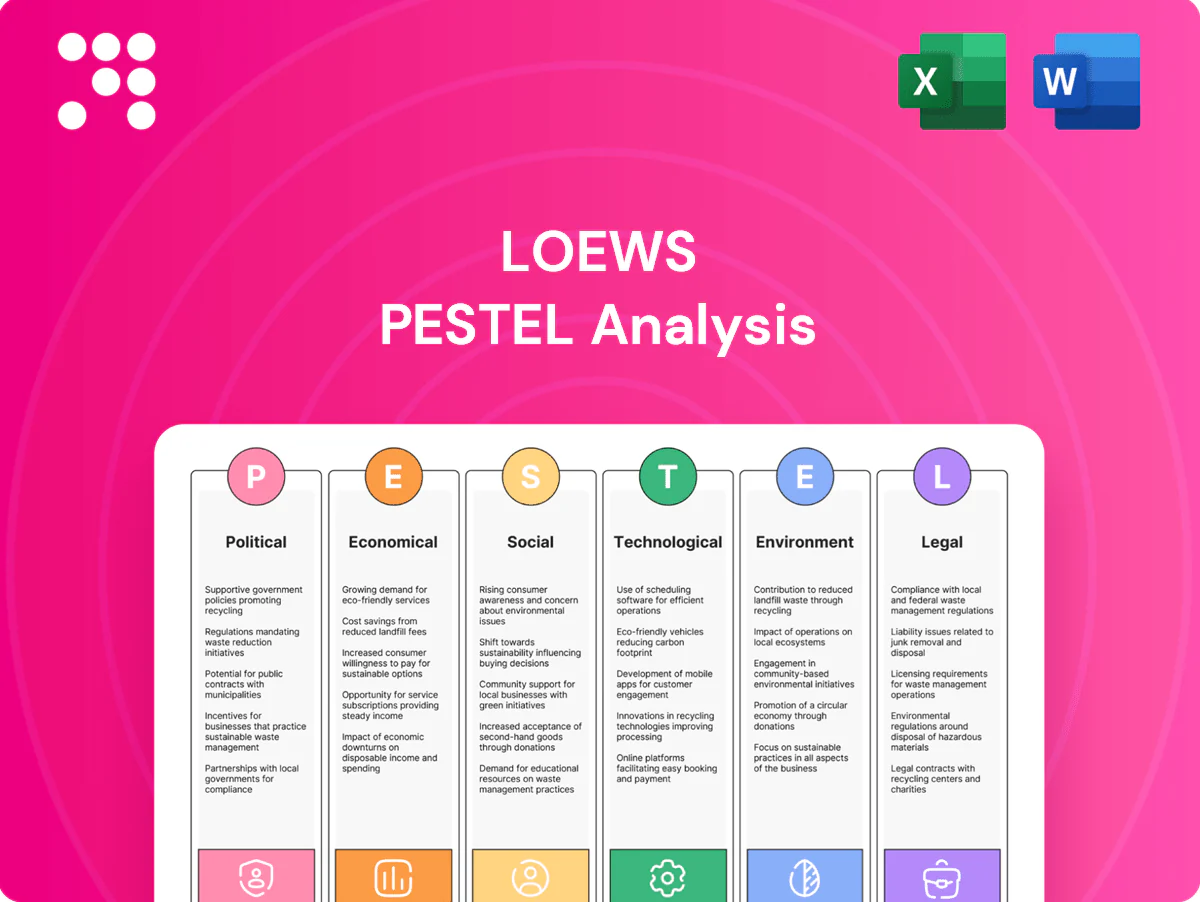
Loews PESTLE Analysis

Your Competitive Advantage Starts with This Report
Unlock strategic clarity with our PESTLE Analysis tailored to Loews. Learn how political shifts, economic cycles, and regulatory pressures affect its diversified holdings. Ideal for investors and strategists, this concise briefing highlights risks and opportunities. Purchase the full report for the complete, actionable breakdown and ready-to-use charts.
Political factors

Energy policy shifts
US federal and state energy policies directly affect Boardwalk’s permitting and utilization; US dry natural gas consumption averaged about 83 Bcf/d in 2023 and gas supplied roughly 38% of US power generation that year (EIA). Incentives for renewables and EPA methane rules raise compliance costs and can dampen long-term gas growth, even as bridge-fuel narratives support near- to mid-term demand. Loews should hedge exposure with flexible contracting and disciplined capex to manage regulatory and demand risk.
Insurance oversight
Insurance is politically sensitive, with state regulators and consumer-protection agendas shaping oversight and rate approvals; Loews-owned CNA faces constrained pricing and underwriting flexibility because residual market structures and approval lags limit adjustments. Political pressure after catastrophes often curbs premium increases, and active engagement with the NAIC (56 members) and 50 state departments of insurance is critical to influence rulemaking and filings.

Hospitality tourism policy
Visa restrictions, travel advisories and local tourism taxes directly affect Loews Hotels’ demand and margins; UNWTO reported international arrivals recovered to roughly 90% of 2019 levels by 2024, pressuring pricing and cross-border demand patterns. Urban policies on conventions and events drive occupancy spikes for Loews’ convention-oriented properties, while short-term rental regulation and platforms (Airbnb reported over 6 million active listings in 2024) reshape local competition. Close coordination with CVBs and municipalities sustains group pipeline and supports ADR management.

Trade and geopolitics
Global tensions lift energy costs (Brent averaged about $86/bbl in 2024), press reinsurance pricing (≈+25% y/y in 2024) and constrain corporate travel (business travel ~85% of 2019 levels in 2024), while sanctions reshape commodity flows and cut some pipeline volumes by roughly 30% versus pre-crisis levels.
- trade_geopolitics
- sanctions_pipeline_volumes
- reinsurance_compliance
- hotel_geopolitical_sensitivity
Infrastructure permitting
FERC, state siting boards and community activism drive pipeline lead times and can push projects into multi-year delays; Executive Order 14008 (2021) heightened environmental justice scrutiny that raises permitting risk. Political attention to eminent domain slows right-of-way acquisition and can increase financing costs, while predictable regulatory timelines enable better capital allocation. Loews reduces greenfield exposure by prioritizing brownfield optimizations, lowering permitting complexity and schedule risk.
- FERC/state boards: major source of multi-year delays
- Community activism: increases litigation and review
- Eminent domain/EJ scrutiny: raises financing and schedule risk
- Predictable timelines: improve capital allocation
- Loews: brownfield focus reduces permitting and execution risk
Energy, insurance and travel policy shifts tighten costs and demand for gas, insurers and hotels
Federal/state energy, insurance and travel policies materially affect Boardwalk, CNA and Loews Hotels via permitting, rate review and cross-border demand; renewables incentives and EPA methane rules raise compliance costs even as gas remains a near-term bridge. State insurance regulators and NAIC engagement constrain CNA pricing after catastrophe-driven political pressure. Urban convention policies and short-term rental rules materially shift hotel ADR and occupancy.
| Metric | 2024/25 |
|---|---|
| US gas demand | ~83 Bcf/d (2023) |
| Brent | $86/bbl (2024) |
| Reinsurance pricing | +25% y/y (2024) |
| Intl tourism | ~90% of 2019 (2024) |
What is included in the product
 Detailed Word Document
Explores how external macro-environmental factors uniquely affect Loews across Political, Economic, Social, Technological, Environmental and Legal dimensions, with data-backed trends and industry-specific examples. Designed for executives, investors and consultants, it aligns with current market and regulatory dynamics, offers forward-looking insights for scenario planning, and is formatted for direct use in plans and decks.

 Customizable Excel Spreadsheet
A concise, visually segmented PESTLE summary for Loews that highlights external risks and opportunities, easily dropped into presentations or shared across teams, and editable for regional or business-line notes.
Economic factors

Interest rate cycle
Higher policy rates — federal funds roughly 5.25–5.50% and the 10-year at about 4.3% in mid-2025 — lift CNA’s investment income and improve portfolio returns but can force larger loss reserve discounting and press book values; hotel financing costs also rise. For Boardwalk, higher yields increase cost of debt and can weaken customer credit quality. Strong duration management and ALM discipline are therefore critical.
GDP and travel demand
Global GDP growth (IMF: ~3.0% in 2024, 3.1% in 2025) supports corporate travel, group bookings and leisure spend, with US GDP ~2.4% in 2024 helping higher business travel demand and RevPAR gains (STR reported US RevPAR up mid-single digits in 2024). Recessions compress occupancy and ADR, squeezing hotel margins; global insurance premiums rose ~3.7% in 2023, tracking activity levels. Diversification across segments cushions cyclicality.

Energy demand elasticity
Industrial output and power generation remain primary drivers of pipeline gas throughput—US dry natural gas consumption was about 31.8 Tcf in 2023, with the power sector a major contributor. Mild winters or efficiency gains can soften volumes, though rising LNG exports (around 12–13 Bcf/d in 2024) and petrochemical demand can offset declines. Contract structures like take-or-pay limit near-term cashflow volatility; long-term volumes hinge on the pace of energy transition and electrification.

Inflation and claims
Claims severity for CNA rises with medical, auto and construction inflation; US CPI averaged about 3.4% in 2024 and medical-care CPI rose ~3.0%, amplifying loss costs. Wage and materials inflation also elevate Loews Hotels and Boardwalk pipeline O&M, forcing tighter pricing cadence and reinsurance alignment to track loss-cost trends. Productivity programs remain critical to defend underwriting and operating margins.
- Claims severity up — medical/auto/construction
- O&M costs higher — wages & materials
- Align pricing cadence & reinsurance
- Productivity programs protect margins
Capital market access
Capital market access is central to Loews holding-company flexibility, since affordable debt and equity spreads determine ability to fund subsidiaries and opportunistic M&A; market dislocations increase refinancing risk and raise required hurdle rates for new projects, while confidence in insurance reserves supports investor perception and lowers funding costs.
- Holding flexibility: access to debt/equity
- Risk: dislocations → higher refinancing risk
- Insurance reserves: underpin market confidence
- Strategy: maintain liquidity and strong ratings
Energy, insurance and travel policy shifts tighten costs and demand for gas, insurers and hotels
Higher Fed funds ~5.25–5.50% and 10y ~4.3% (mid-2025) boost CNA investment yield but raise funding costs for hotels and Boardwalk; US GDP ~2.4% (2024) supports travel demand while global GDP ~3.1% (2025 IMF) aids premium growth. US gas demand ~31.8 Tcf (2023) and LNG ~12–13 Bcf/d (2024) underpin pipeline volumes; US CPI ~3.4% (2024) lifts claims severity and O&M.
| Metric | Value |
|---|---|
| Fed funds | 5.25–5.50% (mid‑2025) |
| 10‑yr | ~4.3% (mid‑2025) |
| US GDP | ~2.4% (2024) |
| Global GDP | ~3.1% (2025 IMF) |
| US CPI | ~3.4% (2024) |
| US gas | 31.8 Tcf (2023) |
| LNG exports | 12–13 Bcf/d (2024) |
Preview Before You Purchase
Loews PESTLE Analysis
The Loews PESTLE Analysis preview shown here is the exact document you’ll receive after purchase—fully formatted and ready to use. It delivers the final, professionally structured assessment of political, economic, social, technological, legal, and environmental factors affecting Loews. No placeholders, no surprises—download the same file immediately after checkout.

Your Competitive Advantage Starts with This Report
Unlock strategic clarity with our PESTLE Analysis tailored to Loews. Learn how political shifts, economic cycles, and regulatory pressures affect its diversified holdings. Ideal for investors and strategists, this concise briefing highlights risks and opportunities. Purchase the full report for the complete, actionable breakdown and ready-to-use charts.
Political factors
Energy policy shifts
US federal and state energy policies directly affect Boardwalk’s permitting and utilization; US dry natural gas consumption averaged about 83 Bcf/d in 2023 and gas supplied roughly 38% of US power generation that year (EIA). Incentives for renewables and EPA methane rules raise compliance costs and can dampen long-term gas growth, even as bridge-fuel narratives support near- to mid-term demand. Loews should hedge exposure with flexible contracting and disciplined capex to manage regulatory and demand risk.
Insurance oversight
Insurance is politically sensitive, with state regulators and consumer-protection agendas shaping oversight and rate approvals; Loews-owned CNA faces constrained pricing and underwriting flexibility because residual market structures and approval lags limit adjustments. Political pressure after catastrophes often curbs premium increases, and active engagement with the NAIC (56 members) and 50 state departments of insurance is critical to influence rulemaking and filings.
Hospitality tourism policy
Visa restrictions, travel advisories and local tourism taxes directly affect Loews Hotels’ demand and margins; UNWTO reported international arrivals recovered to roughly 90% of 2019 levels by 2024, pressuring pricing and cross-border demand patterns. Urban policies on conventions and events drive occupancy spikes for Loews’ convention-oriented properties, while short-term rental regulation and platforms (Airbnb reported over 6 million active listings in 2024) reshape local competition. Close coordination with CVBs and municipalities sustains group pipeline and supports ADR management.
Trade and geopolitics
Global tensions lift energy costs (Brent averaged about $86/bbl in 2024), press reinsurance pricing (≈+25% y/y in 2024) and constrain corporate travel (business travel ~85% of 2019 levels in 2024), while sanctions reshape commodity flows and cut some pipeline volumes by roughly 30% versus pre-crisis levels.
- trade_geopolitics
- sanctions_pipeline_volumes
- reinsurance_compliance
- hotel_geopolitical_sensitivity
Infrastructure permitting
FERC, state siting boards and community activism drive pipeline lead times and can push projects into multi-year delays; Executive Order 14008 (2021) heightened environmental justice scrutiny that raises permitting risk. Political attention to eminent domain slows right-of-way acquisition and can increase financing costs, while predictable regulatory timelines enable better capital allocation. Loews reduces greenfield exposure by prioritizing brownfield optimizations, lowering permitting complexity and schedule risk.
- FERC/state boards: major source of multi-year delays
- Community activism: increases litigation and review
- Eminent domain/EJ scrutiny: raises financing and schedule risk
- Predictable timelines: improve capital allocation
- Loews: brownfield focus reduces permitting and execution risk
Energy, insurance and travel policy shifts tighten costs and demand for gas, insurers and hotels
Federal/state energy, insurance and travel policies materially affect Boardwalk, CNA and Loews Hotels via permitting, rate review and cross-border demand; renewables incentives and EPA methane rules raise compliance costs even as gas remains a near-term bridge. State insurance regulators and NAIC engagement constrain CNA pricing after catastrophe-driven political pressure. Urban convention policies and short-term rental rules materially shift hotel ADR and occupancy.
| Metric | 2024/25 |
|---|---|
| US gas demand | ~83 Bcf/d (2023) |
| Brent | $86/bbl (2024) |
| Reinsurance pricing | +25% y/y (2024) |
| Intl tourism | ~90% of 2019 (2024) |
What is included in the product
Detailed Word Document
Explores how external macro-environmental factors uniquely affect Loews across Political, Economic, Social, Technological, Environmental and Legal dimensions, with data-backed trends and industry-specific examples. Designed for executives, investors and consultants, it aligns with current market and regulatory dynamics, offers forward-looking insights for scenario planning, and is formatted for direct use in plans and decks.
Customizable Excel Spreadsheet
A concise, visually segmented PESTLE summary for Loews that highlights external risks and opportunities, easily dropped into presentations or shared across teams, and editable for regional or business-line notes.
Economic factors
Interest rate cycle
Higher policy rates — federal funds roughly 5.25–5.50% and the 10-year at about 4.3% in mid-2025 — lift CNA’s investment income and improve portfolio returns but can force larger loss reserve discounting and press book values; hotel financing costs also rise. For Boardwalk, higher yields increase cost of debt and can weaken customer credit quality. Strong duration management and ALM discipline are therefore critical.
GDP and travel demand
Global GDP growth (IMF: ~3.0% in 2024, 3.1% in 2025) supports corporate travel, group bookings and leisure spend, with US GDP ~2.4% in 2024 helping higher business travel demand and RevPAR gains (STR reported US RevPAR up mid-single digits in 2024). Recessions compress occupancy and ADR, squeezing hotel margins; global insurance premiums rose ~3.7% in 2023, tracking activity levels. Diversification across segments cushions cyclicality.
Energy demand elasticity
Industrial output and power generation remain primary drivers of pipeline gas throughput—US dry natural gas consumption was about 31.8 Tcf in 2023, with the power sector a major contributor. Mild winters or efficiency gains can soften volumes, though rising LNG exports (around 12–13 Bcf/d in 2024) and petrochemical demand can offset declines. Contract structures like take-or-pay limit near-term cashflow volatility; long-term volumes hinge on the pace of energy transition and electrification.
Inflation and claims
Claims severity for CNA rises with medical, auto and construction inflation; US CPI averaged about 3.4% in 2024 and medical-care CPI rose ~3.0%, amplifying loss costs. Wage and materials inflation also elevate Loews Hotels and Boardwalk pipeline O&M, forcing tighter pricing cadence and reinsurance alignment to track loss-cost trends. Productivity programs remain critical to defend underwriting and operating margins.
- Claims severity up — medical/auto/construction
- O&M costs higher — wages & materials
- Align pricing cadence & reinsurance
- Productivity programs protect margins
Capital market access
Capital market access is central to Loews holding-company flexibility, since affordable debt and equity spreads determine ability to fund subsidiaries and opportunistic M&A; market dislocations increase refinancing risk and raise required hurdle rates for new projects, while confidence in insurance reserves supports investor perception and lowers funding costs.
- Holding flexibility: access to debt/equity
- Risk: dislocations → higher refinancing risk
- Insurance reserves: underpin market confidence
- Strategy: maintain liquidity and strong ratings
Energy, insurance and travel policy shifts tighten costs and demand for gas, insurers and hotels
Higher Fed funds ~5.25–5.50% and 10y ~4.3% (mid-2025) boost CNA investment yield but raise funding costs for hotels and Boardwalk; US GDP ~2.4% (2024) supports travel demand while global GDP ~3.1% (2025 IMF) aids premium growth. US gas demand ~31.8 Tcf (2023) and LNG ~12–13 Bcf/d (2024) underpin pipeline volumes; US CPI ~3.4% (2024) lifts claims severity and O&M.
| Metric | Value |
|---|---|
| Fed funds | 5.25–5.50% (mid‑2025) |
| 10‑yr | ~4.3% (mid‑2025) |
| US GDP | ~2.4% (2024) |
| Global GDP | ~3.1% (2025 IMF) |
| US CPI | ~3.4% (2024) |
| US gas | 31.8 Tcf (2023) |
| LNG exports | 12–13 Bcf/d (2024) |
Preview Before You Purchase
Loews PESTLE Analysis
The Loews PESTLE Analysis preview shown here is the exact document you’ll receive after purchase—fully formatted and ready to use. It delivers the final, professionally structured assessment of political, economic, social, technological, legal, and environmental factors affecting Loews. No placeholders, no surprises—download the same file immediately after checkout.
Original: $10.00
-65%$10.00
$3.50Description
Your Competitive Advantage Starts with This Report
Unlock strategic clarity with our PESTLE Analysis tailored to Loews. Learn how political shifts, economic cycles, and regulatory pressures affect its diversified holdings. Ideal for investors and strategists, this concise briefing highlights risks and opportunities. Purchase the full report for the complete, actionable breakdown and ready-to-use charts.
Political factors
Energy policy shifts
US federal and state energy policies directly affect Boardwalk’s permitting and utilization; US dry natural gas consumption averaged about 83 Bcf/d in 2023 and gas supplied roughly 38% of US power generation that year (EIA). Incentives for renewables and EPA methane rules raise compliance costs and can dampen long-term gas growth, even as bridge-fuel narratives support near- to mid-term demand. Loews should hedge exposure with flexible contracting and disciplined capex to manage regulatory and demand risk.
Insurance oversight
Insurance is politically sensitive, with state regulators and consumer-protection agendas shaping oversight and rate approvals; Loews-owned CNA faces constrained pricing and underwriting flexibility because residual market structures and approval lags limit adjustments. Political pressure after catastrophes often curbs premium increases, and active engagement with the NAIC (56 members) and 50 state departments of insurance is critical to influence rulemaking and filings.
Hospitality tourism policy
Visa restrictions, travel advisories and local tourism taxes directly affect Loews Hotels’ demand and margins; UNWTO reported international arrivals recovered to roughly 90% of 2019 levels by 2024, pressuring pricing and cross-border demand patterns. Urban policies on conventions and events drive occupancy spikes for Loews’ convention-oriented properties, while short-term rental regulation and platforms (Airbnb reported over 6 million active listings in 2024) reshape local competition. Close coordination with CVBs and municipalities sustains group pipeline and supports ADR management.
Trade and geopolitics
Global tensions lift energy costs (Brent averaged about $86/bbl in 2024), press reinsurance pricing (≈+25% y/y in 2024) and constrain corporate travel (business travel ~85% of 2019 levels in 2024), while sanctions reshape commodity flows and cut some pipeline volumes by roughly 30% versus pre-crisis levels.
- trade_geopolitics
- sanctions_pipeline_volumes
- reinsurance_compliance
- hotel_geopolitical_sensitivity
Infrastructure permitting
FERC, state siting boards and community activism drive pipeline lead times and can push projects into multi-year delays; Executive Order 14008 (2021) heightened environmental justice scrutiny that raises permitting risk. Political attention to eminent domain slows right-of-way acquisition and can increase financing costs, while predictable regulatory timelines enable better capital allocation. Loews reduces greenfield exposure by prioritizing brownfield optimizations, lowering permitting complexity and schedule risk.
- FERC/state boards: major source of multi-year delays
- Community activism: increases litigation and review
- Eminent domain/EJ scrutiny: raises financing and schedule risk
- Predictable timelines: improve capital allocation
- Loews: brownfield focus reduces permitting and execution risk
Energy, insurance and travel policy shifts tighten costs and demand for gas, insurers and hotels
Federal/state energy, insurance and travel policies materially affect Boardwalk, CNA and Loews Hotels via permitting, rate review and cross-border demand; renewables incentives and EPA methane rules raise compliance costs even as gas remains a near-term bridge. State insurance regulators and NAIC engagement constrain CNA pricing after catastrophe-driven political pressure. Urban convention policies and short-term rental rules materially shift hotel ADR and occupancy.
| Metric | 2024/25 |
|---|---|
| US gas demand | ~83 Bcf/d (2023) |
| Brent | $86/bbl (2024) |
| Reinsurance pricing | +25% y/y (2024) |
| Intl tourism | ~90% of 2019 (2024) |
What is included in the product
Detailed Word Document
Explores how external macro-environmental factors uniquely affect Loews across Political, Economic, Social, Technological, Environmental and Legal dimensions, with data-backed trends and industry-specific examples. Designed for executives, investors and consultants, it aligns with current market and regulatory dynamics, offers forward-looking insights for scenario planning, and is formatted for direct use in plans and decks.
Customizable Excel Spreadsheet
A concise, visually segmented PESTLE summary for Loews that highlights external risks and opportunities, easily dropped into presentations or shared across teams, and editable for regional or business-line notes.
Economic factors
Interest rate cycle
Higher policy rates — federal funds roughly 5.25–5.50% and the 10-year at about 4.3% in mid-2025 — lift CNA’s investment income and improve portfolio returns but can force larger loss reserve discounting and press book values; hotel financing costs also rise. For Boardwalk, higher yields increase cost of debt and can weaken customer credit quality. Strong duration management and ALM discipline are therefore critical.
GDP and travel demand
Global GDP growth (IMF: ~3.0% in 2024, 3.1% in 2025) supports corporate travel, group bookings and leisure spend, with US GDP ~2.4% in 2024 helping higher business travel demand and RevPAR gains (STR reported US RevPAR up mid-single digits in 2024). Recessions compress occupancy and ADR, squeezing hotel margins; global insurance premiums rose ~3.7% in 2023, tracking activity levels. Diversification across segments cushions cyclicality.
Energy demand elasticity
Industrial output and power generation remain primary drivers of pipeline gas throughput—US dry natural gas consumption was about 31.8 Tcf in 2023, with the power sector a major contributor. Mild winters or efficiency gains can soften volumes, though rising LNG exports (around 12–13 Bcf/d in 2024) and petrochemical demand can offset declines. Contract structures like take-or-pay limit near-term cashflow volatility; long-term volumes hinge on the pace of energy transition and electrification.
Inflation and claims
Claims severity for CNA rises with medical, auto and construction inflation; US CPI averaged about 3.4% in 2024 and medical-care CPI rose ~3.0%, amplifying loss costs. Wage and materials inflation also elevate Loews Hotels and Boardwalk pipeline O&M, forcing tighter pricing cadence and reinsurance alignment to track loss-cost trends. Productivity programs remain critical to defend underwriting and operating margins.
- Claims severity up — medical/auto/construction
- O&M costs higher — wages & materials
- Align pricing cadence & reinsurance
- Productivity programs protect margins
Capital market access
Capital market access is central to Loews holding-company flexibility, since affordable debt and equity spreads determine ability to fund subsidiaries and opportunistic M&A; market dislocations increase refinancing risk and raise required hurdle rates for new projects, while confidence in insurance reserves supports investor perception and lowers funding costs.
- Holding flexibility: access to debt/equity
- Risk: dislocations → higher refinancing risk
- Insurance reserves: underpin market confidence
- Strategy: maintain liquidity and strong ratings
Energy, insurance and travel policy shifts tighten costs and demand for gas, insurers and hotels
Higher Fed funds ~5.25–5.50% and 10y ~4.3% (mid-2025) boost CNA investment yield but raise funding costs for hotels and Boardwalk; US GDP ~2.4% (2024) supports travel demand while global GDP ~3.1% (2025 IMF) aids premium growth. US gas demand ~31.8 Tcf (2023) and LNG ~12–13 Bcf/d (2024) underpin pipeline volumes; US CPI ~3.4% (2024) lifts claims severity and O&M.
| Metric | Value |
|---|---|
| Fed funds | 5.25–5.50% (mid‑2025) |
| 10‑yr | ~4.3% (mid‑2025) |
| US GDP | ~2.4% (2024) |
| Global GDP | ~3.1% (2025 IMF) |
| US CPI | ~3.4% (2024) |
| US gas | 31.8 Tcf (2023) |
| LNG exports | 12–13 Bcf/d (2024) |
Preview Before You Purchase
Loews PESTLE Analysis
The Loews PESTLE Analysis preview shown here is the exact document you’ll receive after purchase—fully formatted and ready to use. It delivers the final, professionally structured assessment of political, economic, social, technological, legal, and environmental factors affecting Loews. No placeholders, no surprises—download the same file immediately after checkout.











