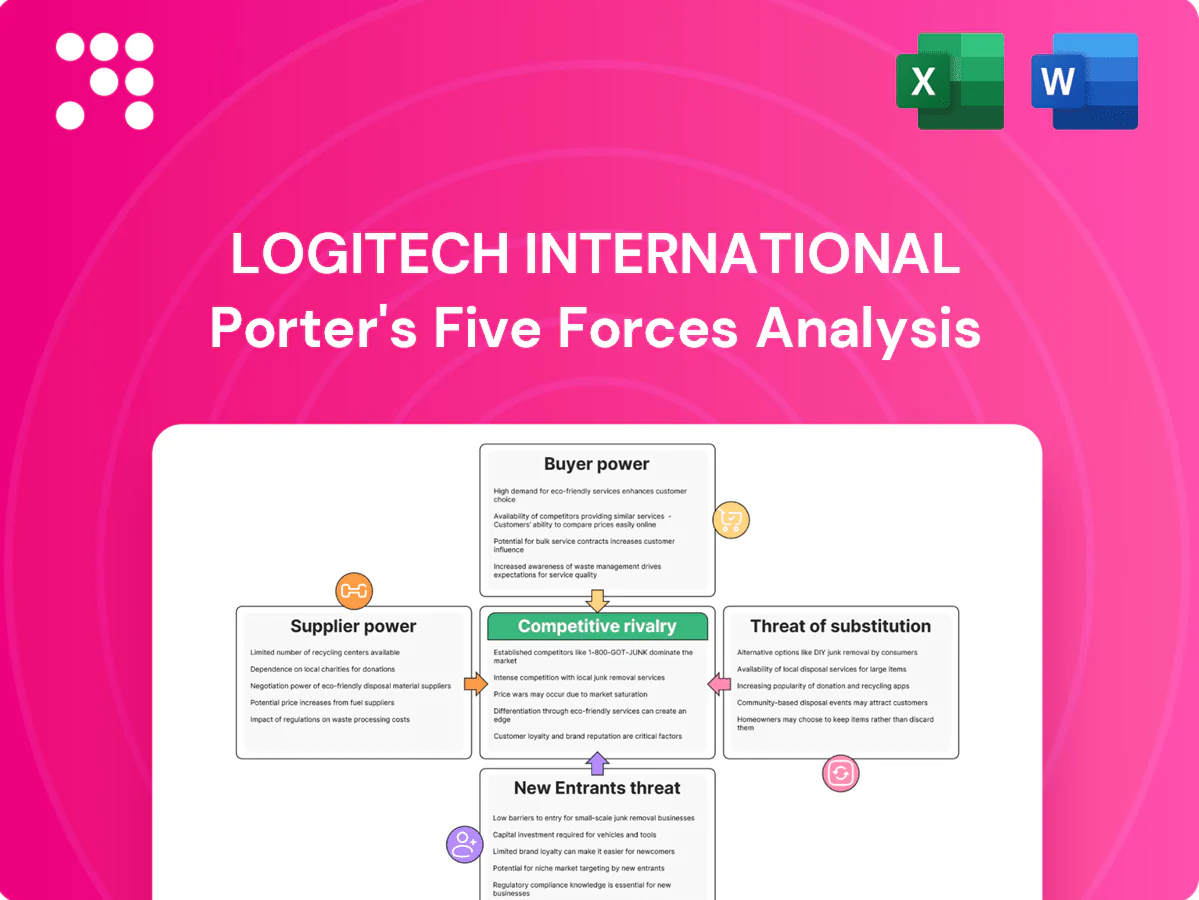
Logitech International Porter's Five Forces Analysis

From Overview to Strategy Blueprint
Logitech International faces intense rivalry from hardware rivals and fast-moving peripherals makers, while shifting buyer preferences and component supply risks shape margins. Weak threat of new entrants contrasts with growing substitute options from integrated devices. This snapshot teases key dynamics—unlock the full Porter's Five Forces Analysis for force-by-force ratings, visuals, and actionable strategy recommendations.
Suppliers Bargaining Power

Sensor and chipset concentration
High-performance optical sensors, wireless chipsets and image sensors are sourced from a narrow supplier pool—Sony holds roughly 45–50% of the CMOS image‑sensor market and top chipset vendors together control over 60% of high‑end Wi‑Fi/Bluetooth chips—raising switching costs and pricing leverage. Logitech offsets risk with multi‑sourcing, custom specs and long‑term volume agreements but remained exposed during recent shortages and allocation cycles.
EMS and ODM dependence
Logitech depends on Asia-based EMS and ODM partners for scale, cost efficiency and speed, and while multiple EMS relationships reduce single-source risk, capacity bottlenecks or geopolitical disruption can quickly amplify supplier leverage. Strict oversight is needed to maintain quality control and protect IP across contract manufacturers. Diversified manufacturing footprint and dual-sourcing of key SKUs help temper supplier power and supply interruptions.

Commodity vs specialized components
Plastics, standard ICs, batteries and packaging are commoditized and widely available, constraining supplier power for a company with ~USD 5.1 billion in FY2024 net sales. Specialized switches, microphones, sensors and lenses have far fewer qualified sources, raising leverage and risk. Supplier bargaining power therefore varies by component criticality and long qualification times. Design-for-multi-source strategies trade modest cost increases for greater resilience.

Logistics and compliance constraints
Global logistics providers and regulatory-certified suppliers such as Bluetooth SIG (over 40,000 member companies in 2024), USB-IF and environmental regulators can exert leverage over Logitech, since certification timelines and compliance testing create switching frictions that lengthen supplier lock-in. Freight disruptions and rate spikes historically pushed transport providers' bargaining power higher, threatening margins against Logitech’s FY2024 net sales of $4.57 billion. Strategic inventory buffers and forward freight contracts materially reduce exposure to spot-rate volatility and certification delays.
- Key certifiers: Bluetooth SIG, USB-IF, RoHS/WEEE
- 2024 membership: Bluetooth SIG >40,000
- Mitigants: buffer inventory, forward freight contracts
- Impact channel: certification + freight = switching friction
Sustainability and material requirements
Sustainability requirements for recycled plastics, low-carbon materials and ESG audits have narrowed Logitech’s approved supplier pool, raising compliance costs and potentially boosting supplier bargaining power when qualified vendors are limited; Logitech reported roughly $4.87B in FY2024 revenue, which helps it leverage scale for supplier investment. Co-development agreements and volume commitments spread CAPEX and strengthen partnerships, reducing long-term supplier leverage.
- Approved suppliers narrowed by ESG/material specs
- Compliance raises costs, can increase supplier power
- Logitech scale (FY2024 ~$4.87B) encourages supplier investment
- Co-development spreads costs, locks partnerships
Mixed supplier power: concentrated CMOS/chipset leverage vs multi-sourcing and inventory buffers
Supplier power is mixed: concentrated suppliers (Sony ~45–50% CMOS; top chipset vendors >60% of high‑end Wi‑Fi/Bluetooth) raise leverage, while commoditized parts limit it. Logitech’s FY2024 revenue ~$4.87B and multi‑sourcing, co‑development and inventory buffers reduce exposure. Certification bodies (Bluetooth SIG >40,000 members) and logistics add switching frictions.
| Metric | 2024 |
|---|---|
| Logitech revenue (FY2024) | $4.87B |
| Sony CMOS share | 45–50% |
| Top chipset vendors | >60% |
| Bluetooth SIG members | >40,000 |
What is included in the product
 Detailed Word Document
Comprehensive Porter's Five Forces assessment tailored to Logitech International, highlighting competitive rivalry, buyer and supplier bargaining power, threats from substitutes and new entrants, and strategic implications for pricing and profitability. Identifies disruptive technologies and market dynamics that influence Logitech’s market position and long-term resilience.

 Customizable Excel Spreadsheet
A concise one-sheet Porter's Five Forces for Logitech—instantly highlights competitive pressures, supplier and buyer dynamics, and threat vectors to speed strategic decisions and relieve analysis bottlenecks.
Customers Bargaining Power

Concentrated retail and e-commerce channels
Large retailers and marketplaces like Amazon (≈40% of US e-commerce in 2024), Best Buy and Walmart command shelf space, customer data and listings, increasing their bargaining power and pressuring Logitech for promotional funding, price-matching and favorable terms. Logitech’s strong brand and broad portfolio across mice, keyboards and video conferencing give counter-leverage, while expanding direct-to-consumer channels—about 20% of sales—diversifies channel risk.
Enterprise and education procurement
Large enterprise and education buyers drive volume in video collaboration, headsets and keyboards and push aggressive pricing—Logitech reported fiscal 2024 sales of about $4.59 billion, reflecting strong institutional demand that enables bulk negotiation. Standardized RFPs and certifications (Zoom, Teams) make products directly comparable, raising price sensitivity. Multi-year contracts often reduce margins but boost demand visibility and recurring revenue, while SLAs and integration support shift negotiations toward service and total cost of ownership.

Price transparency and low switching costs
Online comparison sites and frequent promotions amplify buyer power, with Logitech reporting approximately $3.17 billion in FY2024 revenue, making price and deals highly visible across channels. Functionally similar mice, keyboards and headsets lower switching costs and ease substitution. Logitech offsets this via differentiated software (G Hub, Logi Options+), an integrated ecosystem and recognized build quality, while multi-year warranties and global support networks curb churn.

Gaming enthusiast segmentation
Power users in the gaming-enthusiast segment demand high performance and feature depth, driving cross-shopping between Logitech G and rivals Razer, Corsair, and SteelSeries; Logitech reported FY2024 revenue of $5.61 billion with gaming about 25% (~$1.4B), so these buyers exert meaningful leverage.
- Informed buyers: performance-sensitive
- Cross-shop: Razer/Corsair/SteelSeries
- Moderators: exclusive collabs, creator endorsements
- Stickiness: firmware updates, ecosystem integration
Global reach and SKU breadth
Logitech's global SKU breadth enables buyers to demand bundled and tiered pricing, with cross-category deals shifting margin across mice, keyboards, headsets and webcams; the firm reported roughly $4.37 billion in FY2024 net sales, giving scale to absorb mix-driven margin pressure. Strategic segmentation and premium lines protect ASPs, while regional pricing and channel-mix optimization partially offset customer leverage.
- Bundles enable buyer leverage
- Cross-SKU deals dilute margins
- Premium segmentation preserves ASPs
- Regional pricing/channel mix offsets pressure
Brand + software scale: $4.59B, 25% gaming, 20% DTC
Large retailers (Amazon ≈40% of US e‑commerce in 2024) and institutional buyers exert strong price/promotional pressure; Logitech offsets with brand, software and ≈20% direct‑to‑consumer sales. FY2024 revenue ≈ $4.59B with gaming ≈25% (~$1.4B) gives scale for bargaining leverage and premium segmentation. Bundling and channel mix sustain margins despite visible pricing and low switching costs.
| Metric | 2024 |
|---|---|
| FY revenue | $4.59B |
| Gaming rev | $1.4B (25%) |
| DTC share | ≈20% |
| Amazon US e‑comm | ≈40% |
Preview Before You Purchase
Logitech International Porter's Five Forces Analysis
This Logitech International Porter's Five Forces analysis evaluates industry rivalry, supplier and buyer power, threat of substitutes and entry barriers, with actionable insights for strategic positioning. This preview is the exact, fully formatted document you'll receive immediately after purchase—no placeholders or changes.

From Overview to Strategy Blueprint
Logitech International faces intense rivalry from hardware rivals and fast-moving peripherals makers, while shifting buyer preferences and component supply risks shape margins. Weak threat of new entrants contrasts with growing substitute options from integrated devices. This snapshot teases key dynamics—unlock the full Porter's Five Forces Analysis for force-by-force ratings, visuals, and actionable strategy recommendations.
Suppliers Bargaining Power
Sensor and chipset concentration
High-performance optical sensors, wireless chipsets and image sensors are sourced from a narrow supplier pool—Sony holds roughly 45–50% of the CMOS image‑sensor market and top chipset vendors together control over 60% of high‑end Wi‑Fi/Bluetooth chips—raising switching costs and pricing leverage. Logitech offsets risk with multi‑sourcing, custom specs and long‑term volume agreements but remained exposed during recent shortages and allocation cycles.
EMS and ODM dependence
Logitech depends on Asia-based EMS and ODM partners for scale, cost efficiency and speed, and while multiple EMS relationships reduce single-source risk, capacity bottlenecks or geopolitical disruption can quickly amplify supplier leverage. Strict oversight is needed to maintain quality control and protect IP across contract manufacturers. Diversified manufacturing footprint and dual-sourcing of key SKUs help temper supplier power and supply interruptions.
Commodity vs specialized components
Plastics, standard ICs, batteries and packaging are commoditized and widely available, constraining supplier power for a company with ~USD 5.1 billion in FY2024 net sales. Specialized switches, microphones, sensors and lenses have far fewer qualified sources, raising leverage and risk. Supplier bargaining power therefore varies by component criticality and long qualification times. Design-for-multi-source strategies trade modest cost increases for greater resilience.
Logistics and compliance constraints
Global logistics providers and regulatory-certified suppliers such as Bluetooth SIG (over 40,000 member companies in 2024), USB-IF and environmental regulators can exert leverage over Logitech, since certification timelines and compliance testing create switching frictions that lengthen supplier lock-in. Freight disruptions and rate spikes historically pushed transport providers' bargaining power higher, threatening margins against Logitech’s FY2024 net sales of $4.57 billion. Strategic inventory buffers and forward freight contracts materially reduce exposure to spot-rate volatility and certification delays.
- Key certifiers: Bluetooth SIG, USB-IF, RoHS/WEEE
- 2024 membership: Bluetooth SIG >40,000
- Mitigants: buffer inventory, forward freight contracts
- Impact channel: certification + freight = switching friction
Sustainability and material requirements
Sustainability requirements for recycled plastics, low-carbon materials and ESG audits have narrowed Logitech’s approved supplier pool, raising compliance costs and potentially boosting supplier bargaining power when qualified vendors are limited; Logitech reported roughly $4.87B in FY2024 revenue, which helps it leverage scale for supplier investment. Co-development agreements and volume commitments spread CAPEX and strengthen partnerships, reducing long-term supplier leverage.
- Approved suppliers narrowed by ESG/material specs
- Compliance raises costs, can increase supplier power
- Logitech scale (FY2024 ~$4.87B) encourages supplier investment
- Co-development spreads costs, locks partnerships
Mixed supplier power: concentrated CMOS/chipset leverage vs multi-sourcing and inventory buffers
Supplier power is mixed: concentrated suppliers (Sony ~45–50% CMOS; top chipset vendors >60% of high‑end Wi‑Fi/Bluetooth) raise leverage, while commoditized parts limit it. Logitech’s FY2024 revenue ~$4.87B and multi‑sourcing, co‑development and inventory buffers reduce exposure. Certification bodies (Bluetooth SIG >40,000 members) and logistics add switching frictions.
| Metric | 2024 |
|---|---|
| Logitech revenue (FY2024) | $4.87B |
| Sony CMOS share | 45–50% |
| Top chipset vendors | >60% |
| Bluetooth SIG members | >40,000 |
What is included in the product
Detailed Word Document
Comprehensive Porter's Five Forces assessment tailored to Logitech International, highlighting competitive rivalry, buyer and supplier bargaining power, threats from substitutes and new entrants, and strategic implications for pricing and profitability. Identifies disruptive technologies and market dynamics that influence Logitech’s market position and long-term resilience.
Customizable Excel Spreadsheet
A concise one-sheet Porter's Five Forces for Logitech—instantly highlights competitive pressures, supplier and buyer dynamics, and threat vectors to speed strategic decisions and relieve analysis bottlenecks.
Customers Bargaining Power
Concentrated retail and e-commerce channels
Large retailers and marketplaces like Amazon (≈40% of US e-commerce in 2024), Best Buy and Walmart command shelf space, customer data and listings, increasing their bargaining power and pressuring Logitech for promotional funding, price-matching and favorable terms. Logitech’s strong brand and broad portfolio across mice, keyboards and video conferencing give counter-leverage, while expanding direct-to-consumer channels—about 20% of sales—diversifies channel risk.
Enterprise and education procurement
Large enterprise and education buyers drive volume in video collaboration, headsets and keyboards and push aggressive pricing—Logitech reported fiscal 2024 sales of about $4.59 billion, reflecting strong institutional demand that enables bulk negotiation. Standardized RFPs and certifications (Zoom, Teams) make products directly comparable, raising price sensitivity. Multi-year contracts often reduce margins but boost demand visibility and recurring revenue, while SLAs and integration support shift negotiations toward service and total cost of ownership.
Price transparency and low switching costs
Online comparison sites and frequent promotions amplify buyer power, with Logitech reporting approximately $3.17 billion in FY2024 revenue, making price and deals highly visible across channels. Functionally similar mice, keyboards and headsets lower switching costs and ease substitution. Logitech offsets this via differentiated software (G Hub, Logi Options+), an integrated ecosystem and recognized build quality, while multi-year warranties and global support networks curb churn.
Gaming enthusiast segmentation
Power users in the gaming-enthusiast segment demand high performance and feature depth, driving cross-shopping between Logitech G and rivals Razer, Corsair, and SteelSeries; Logitech reported FY2024 revenue of $5.61 billion with gaming about 25% (~$1.4B), so these buyers exert meaningful leverage.
- Informed buyers: performance-sensitive
- Cross-shop: Razer/Corsair/SteelSeries
- Moderators: exclusive collabs, creator endorsements
- Stickiness: firmware updates, ecosystem integration
Global reach and SKU breadth
Logitech's global SKU breadth enables buyers to demand bundled and tiered pricing, with cross-category deals shifting margin across mice, keyboards, headsets and webcams; the firm reported roughly $4.37 billion in FY2024 net sales, giving scale to absorb mix-driven margin pressure. Strategic segmentation and premium lines protect ASPs, while regional pricing and channel-mix optimization partially offset customer leverage.
- Bundles enable buyer leverage
- Cross-SKU deals dilute margins
- Premium segmentation preserves ASPs
- Regional pricing/channel mix offsets pressure
Brand + software scale: $4.59B, 25% gaming, 20% DTC
Large retailers (Amazon ≈40% of US e‑commerce in 2024) and institutional buyers exert strong price/promotional pressure; Logitech offsets with brand, software and ≈20% direct‑to‑consumer sales. FY2024 revenue ≈ $4.59B with gaming ≈25% (~$1.4B) gives scale for bargaining leverage and premium segmentation. Bundling and channel mix sustain margins despite visible pricing and low switching costs.
| Metric | 2024 |
|---|---|
| FY revenue | $4.59B |
| Gaming rev | $1.4B (25%) |
| DTC share | ≈20% |
| Amazon US e‑comm | ≈40% |
Preview Before You Purchase
Logitech International Porter's Five Forces Analysis
This Logitech International Porter's Five Forces analysis evaluates industry rivalry, supplier and buyer power, threat of substitutes and entry barriers, with actionable insights for strategic positioning. This preview is the exact, fully formatted document you'll receive immediately after purchase—no placeholders or changes.
Original: $10.00
-65%$10.00
$3.50Description
From Overview to Strategy Blueprint
Logitech International faces intense rivalry from hardware rivals and fast-moving peripherals makers, while shifting buyer preferences and component supply risks shape margins. Weak threat of new entrants contrasts with growing substitute options from integrated devices. This snapshot teases key dynamics—unlock the full Porter's Five Forces Analysis for force-by-force ratings, visuals, and actionable strategy recommendations.
Suppliers Bargaining Power
Sensor and chipset concentration
High-performance optical sensors, wireless chipsets and image sensors are sourced from a narrow supplier pool—Sony holds roughly 45–50% of the CMOS image‑sensor market and top chipset vendors together control over 60% of high‑end Wi‑Fi/Bluetooth chips—raising switching costs and pricing leverage. Logitech offsets risk with multi‑sourcing, custom specs and long‑term volume agreements but remained exposed during recent shortages and allocation cycles.
EMS and ODM dependence
Logitech depends on Asia-based EMS and ODM partners for scale, cost efficiency and speed, and while multiple EMS relationships reduce single-source risk, capacity bottlenecks or geopolitical disruption can quickly amplify supplier leverage. Strict oversight is needed to maintain quality control and protect IP across contract manufacturers. Diversified manufacturing footprint and dual-sourcing of key SKUs help temper supplier power and supply interruptions.
Commodity vs specialized components
Plastics, standard ICs, batteries and packaging are commoditized and widely available, constraining supplier power for a company with ~USD 5.1 billion in FY2024 net sales. Specialized switches, microphones, sensors and lenses have far fewer qualified sources, raising leverage and risk. Supplier bargaining power therefore varies by component criticality and long qualification times. Design-for-multi-source strategies trade modest cost increases for greater resilience.
Logistics and compliance constraints
Global logistics providers and regulatory-certified suppliers such as Bluetooth SIG (over 40,000 member companies in 2024), USB-IF and environmental regulators can exert leverage over Logitech, since certification timelines and compliance testing create switching frictions that lengthen supplier lock-in. Freight disruptions and rate spikes historically pushed transport providers' bargaining power higher, threatening margins against Logitech’s FY2024 net sales of $4.57 billion. Strategic inventory buffers and forward freight contracts materially reduce exposure to spot-rate volatility and certification delays.
- Key certifiers: Bluetooth SIG, USB-IF, RoHS/WEEE
- 2024 membership: Bluetooth SIG >40,000
- Mitigants: buffer inventory, forward freight contracts
- Impact channel: certification + freight = switching friction
Sustainability and material requirements
Sustainability requirements for recycled plastics, low-carbon materials and ESG audits have narrowed Logitech’s approved supplier pool, raising compliance costs and potentially boosting supplier bargaining power when qualified vendors are limited; Logitech reported roughly $4.87B in FY2024 revenue, which helps it leverage scale for supplier investment. Co-development agreements and volume commitments spread CAPEX and strengthen partnerships, reducing long-term supplier leverage.
- Approved suppliers narrowed by ESG/material specs
- Compliance raises costs, can increase supplier power
- Logitech scale (FY2024 ~$4.87B) encourages supplier investment
- Co-development spreads costs, locks partnerships
Mixed supplier power: concentrated CMOS/chipset leverage vs multi-sourcing and inventory buffers
Supplier power is mixed: concentrated suppliers (Sony ~45–50% CMOS; top chipset vendors >60% of high‑end Wi‑Fi/Bluetooth) raise leverage, while commoditized parts limit it. Logitech’s FY2024 revenue ~$4.87B and multi‑sourcing, co‑development and inventory buffers reduce exposure. Certification bodies (Bluetooth SIG >40,000 members) and logistics add switching frictions.
| Metric | 2024 |
|---|---|
| Logitech revenue (FY2024) | $4.87B |
| Sony CMOS share | 45–50% |
| Top chipset vendors | >60% |
| Bluetooth SIG members | >40,000 |
What is included in the product
Detailed Word Document
Comprehensive Porter's Five Forces assessment tailored to Logitech International, highlighting competitive rivalry, buyer and supplier bargaining power, threats from substitutes and new entrants, and strategic implications for pricing and profitability. Identifies disruptive technologies and market dynamics that influence Logitech’s market position and long-term resilience.
Customizable Excel Spreadsheet
A concise one-sheet Porter's Five Forces for Logitech—instantly highlights competitive pressures, supplier and buyer dynamics, and threat vectors to speed strategic decisions and relieve analysis bottlenecks.
Customers Bargaining Power
Concentrated retail and e-commerce channels
Large retailers and marketplaces like Amazon (≈40% of US e-commerce in 2024), Best Buy and Walmart command shelf space, customer data and listings, increasing their bargaining power and pressuring Logitech for promotional funding, price-matching and favorable terms. Logitech’s strong brand and broad portfolio across mice, keyboards and video conferencing give counter-leverage, while expanding direct-to-consumer channels—about 20% of sales—diversifies channel risk.
Enterprise and education procurement
Large enterprise and education buyers drive volume in video collaboration, headsets and keyboards and push aggressive pricing—Logitech reported fiscal 2024 sales of about $4.59 billion, reflecting strong institutional demand that enables bulk negotiation. Standardized RFPs and certifications (Zoom, Teams) make products directly comparable, raising price sensitivity. Multi-year contracts often reduce margins but boost demand visibility and recurring revenue, while SLAs and integration support shift negotiations toward service and total cost of ownership.
Price transparency and low switching costs
Online comparison sites and frequent promotions amplify buyer power, with Logitech reporting approximately $3.17 billion in FY2024 revenue, making price and deals highly visible across channels. Functionally similar mice, keyboards and headsets lower switching costs and ease substitution. Logitech offsets this via differentiated software (G Hub, Logi Options+), an integrated ecosystem and recognized build quality, while multi-year warranties and global support networks curb churn.
Gaming enthusiast segmentation
Power users in the gaming-enthusiast segment demand high performance and feature depth, driving cross-shopping between Logitech G and rivals Razer, Corsair, and SteelSeries; Logitech reported FY2024 revenue of $5.61 billion with gaming about 25% (~$1.4B), so these buyers exert meaningful leverage.
- Informed buyers: performance-sensitive
- Cross-shop: Razer/Corsair/SteelSeries
- Moderators: exclusive collabs, creator endorsements
- Stickiness: firmware updates, ecosystem integration
Global reach and SKU breadth
Logitech's global SKU breadth enables buyers to demand bundled and tiered pricing, with cross-category deals shifting margin across mice, keyboards, headsets and webcams; the firm reported roughly $4.37 billion in FY2024 net sales, giving scale to absorb mix-driven margin pressure. Strategic segmentation and premium lines protect ASPs, while regional pricing and channel-mix optimization partially offset customer leverage.
- Bundles enable buyer leverage
- Cross-SKU deals dilute margins
- Premium segmentation preserves ASPs
- Regional pricing/channel mix offsets pressure
Brand + software scale: $4.59B, 25% gaming, 20% DTC
Large retailers (Amazon ≈40% of US e‑commerce in 2024) and institutional buyers exert strong price/promotional pressure; Logitech offsets with brand, software and ≈20% direct‑to‑consumer sales. FY2024 revenue ≈ $4.59B with gaming ≈25% (~$1.4B) gives scale for bargaining leverage and premium segmentation. Bundling and channel mix sustain margins despite visible pricing and low switching costs.
| Metric | 2024 |
|---|---|
| FY revenue | $4.59B |
| Gaming rev | $1.4B (25%) |
| DTC share | ≈20% |
| Amazon US e‑comm | ≈40% |
Preview Before You Purchase
Logitech International Porter's Five Forces Analysis
This Logitech International Porter's Five Forces analysis evaluates industry rivalry, supplier and buyer power, threat of substitutes and entry barriers, with actionable insights for strategic positioning. This preview is the exact, fully formatted document you'll receive immediately after purchase—no placeholders or changes.











