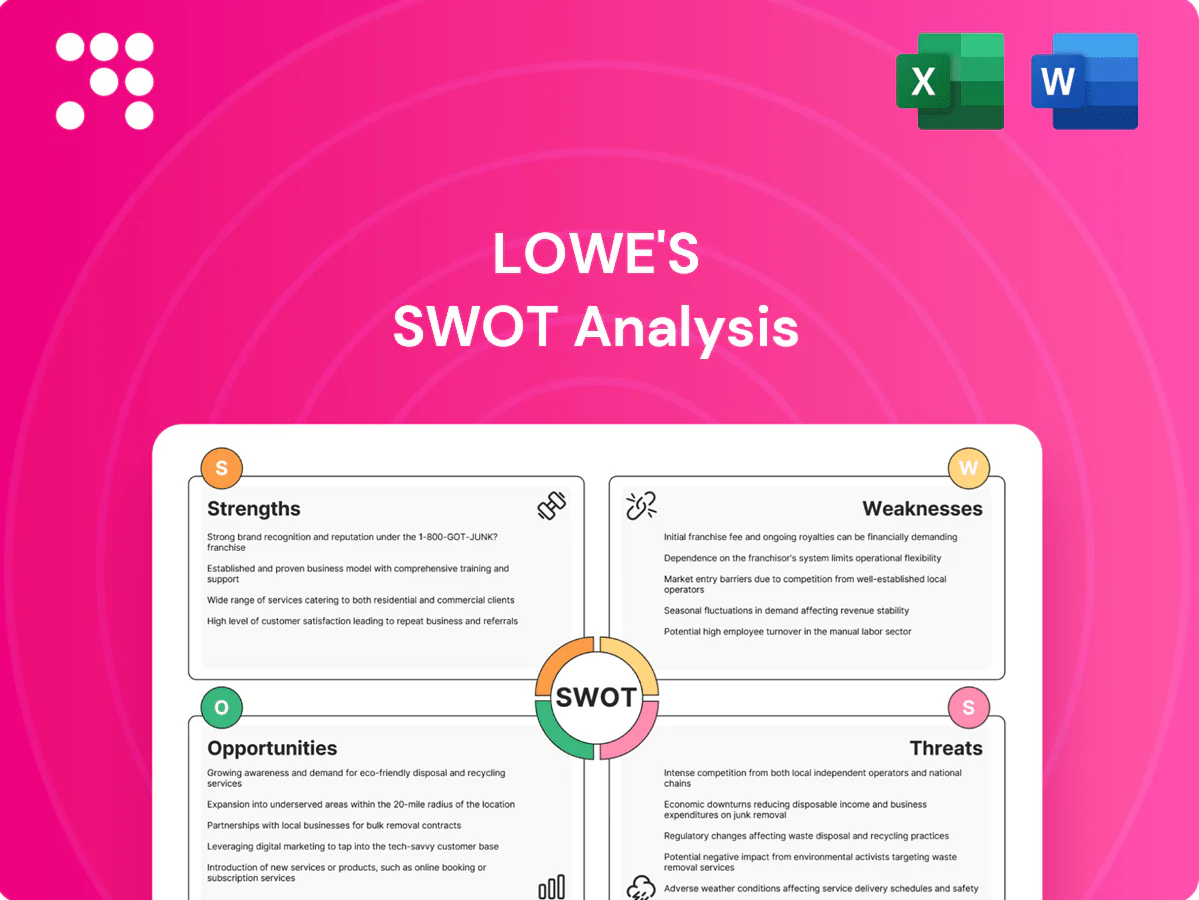
Lowe's SWOT Analysis

Go Beyond the Preview—Access the Full Strategic Report
Lowe's combines scale, strong supply chain, and DIY brand recognition but faces fierce competition and margin pressure. E‑commerce gains and pro-segment expansion drive growth amid macro sensitivity and inventory risks. Want the full strategic picture and financial implications? Purchase the complete SWOT for editable, investor-ready Word and Excel deliverables.
Strengths

National scale and brand
Lowe's national scale—about 1,973 stores across the US and Canada—plus strong brand recognition drives steady traffic across homeowners, renters and pro customers. Scale underpins favorable supplier terms and a broad assortment, supporting FY2024 revenue of $96.3 billion. Brand trust lowers switching costs and accelerates private‑label adoption, while national advertising and loyalty programs amplify reach and frequency.
One-stop product breadth
One-stop product breadth drives project completion across construction, repair, remodeling and decor, supporting Lowe’s fiscal 2024 net sales of $96.3 billion; pro customers represent roughly 40% of sales, boosting repeat business. Robust basket-building and cross-selling elevate average ticket size, while in-stock depth on core SKUs underpins pro reliability and DIY convenience; seasonal resets and planograms maintain regional relevance.

Omnichannel and fulfillment
Lowe's omnichannel suite—buy online pick up in store, curbside and delivery—addresses varied customer needs across merchandising and pro segments. Integrated inventory visibility across roughly 1,970 stores reduces friction and lost sales. The store-as-hub model shortens last-mile and lowers cost-to-serve for a retailer with $96.3B in FY2024 net sales. Mobile tools and project calculators improve conversion and attachment.

Pro customer focus
Pro customer focus: dedicated Pro Desks, volume pricing and job-site delivery drive loyalty and higher purchase frequency; pros accounted for a material share of Lowe’s sales as management noted pro demand remained resilient through 2024, supporting stable comps. Credit programs and account lines boost stickiness and repeat orders, while assortment tailored to trades increases share of wallet and margin per transaction.
- Dedicated Pro Desks
- Volume pricing & job-site delivery
- Credit & account programs
- Trade-focused assortment
Private brands and merchandising
Lowe's owned labels deliver value and margin lift while differentiating assortments from national brands, driving higher basket profitability and customer loyalty.
Exclusive vendor partnerships limit direct price comparability and support tailored promotions; strong end-cap placement and project bundles increase impulse buys and attachment rates.
Data-driven assortment localization aligns private-brand depth to regional demand, improving sell-through and inventory turns.
- Value + margin
- Exclusive vendors
- End-cap + bundles
- Data-localized assortments
Large-scale home-improvement retail: ~1,973 stores, $96.3B
Lowe’s scale (about 1,973 stores) and strong brand drove FY2024 net sales of $96.3B, supporting favorable supplier terms and wide assortment. Pro customers (~40% of sales) and dedicated Pro services boost repeat business and higher ticket sizes. Omnichannel fulfillment and private-label programs raise margins and reduce last-mile cost for large-footprint project demand.
| Metric | Value |
|---|---|
| Stores (US & Canada) | ~1,973 |
| FY2024 Net Sales | $96.3B |
| Pro share of sales | ~40% |
What is included in the product
 Detailed Word Document
Provides a concise SWOT analysis of Lowe's, highlighting its strong retail scale and supply‑chain capabilities, internal operational and digital weaknesses, growth opportunities in professional services and e‑commerce, and external threats from intense competition and economic cyclicality.

 Customizable Excel Spreadsheet
Provides a concise Lowe's SWOT matrix for fast, visual strategy alignment, highlighting strengths like private-label scale and omni-channel reach and weaknesses such as supply chain dependencies; ideal for executives to streamline prioritization and quick stakeholder presentations.
Weaknesses

Housing cycle sensitivity
Lowe's revenue (about $96 billion in fiscal 2024) closely tracks home turnover, homeowner equity and new construction. Higher mortgage rates (around 7% for a 30-year in 2024–25) and weak sentiment can slow big-ticket projects; discretionary categories like appliances and decor are especially vulnerable. Cycle-driven volatility complicates inventory and labor planning amid shifting pro vs DIY demand.
Service consistency in stores
Complex projects need highly knowledgeable associates, yet staffing varies across Lowe's ~1,970 stores and its ~300,000 employees (2024), causing inconsistent advice that can lower conversion and NPS. Elevated training and retention costs press margins, while professional contractors may defect to competitors if service reliability slips, risking lost repeat revenue and larger-ticket sales.

Inventory complexity and shrink
Wide SKU breadth across Lowe's ~1,970 stores ties up working capital and raises obsolescence risk, straining margins during low demand periods. Bulky appliances, building materials and power tools face higher damage and theft, contributing to industry-average shrink near 1.7% of sales. Seasonal peaks force markdowns and clearance pressure, while supply-chain disruptions can rapidly cascade into localized out-of-stocks.

Competitive price perception
Competitive price perception pressures Lowe's margins as head-to-head checks with peers and discount chains force tighter pricing; Lowe's reported roughly $96 billion in net sales for FY2024, limiting pricing flexibility. Online marketplaces increasingly set reference prices for commoditized SKUs, while discounters undercut on consumables and frequent promos train customers to delay purchases.
- Peer checks → margin squeeze
- Marketplaces set price anchors
- Discounters undercut consumables
- Promos train deal-seeking
Limited international diversification
Lowe's concentration in North America leaves it highly exposed to U.S./Canadian macro cycles, with fiscal 2024 net sales around $96.6 billion and roughly 1,970 stores concentrated in those markets. Currency and cross-border growth levers are limited given minimal operations outside North America, and the portfolio lacks counter-cyclical geographies to smooth regional downturns. Expansion risk rises if Lowe's enters unfamiliar international markets.
- High North America concentration — ~1,970 stores (2024)
- Fiscal 2024 net sales ≈ $96.6B — limited currency diversification
- No meaningful counter-cyclical geographies
- Execution risk for international expansion
Home-retailer risks: $96.6B sales tied to housing, staffing woes, 7% mortgage
Lowe's FY2024 net sales ≈ $96.6B and ~1,970 stores tie revenue to US/Canada housing cycles; 30-year mortgage ≈ 7% (2024–25) risks weaker big-ticket demand.
Staffing inconsistency across ~300,000 employees raises training/retention costs, hurting pro conversions and NPS.
Wide SKU breadth, shrink ≈ 1.7% of sales and online price anchors compress margins and force markdowns.
| Metric | Value |
|---|---|
| FY2024 net sales | $96.6B |
| Stores (2024) | ~1,970 |
| Employees (2024) | ~300,000 |
| 30yr mortgage (2024–25) | ~7% |
| Shrink | ~1.7% sales |
Full Version Awaits
Lowe's SWOT Analysis
This is the actual Lowe's SWOT analysis document you’ll receive upon purchase—no surprises, just professional quality. The preview below is taken directly from the full report you'll get. Once purchased, the complete, editable version is unlocked for immediate download.

Go Beyond the Preview—Access the Full Strategic Report
Lowe's combines scale, strong supply chain, and DIY brand recognition but faces fierce competition and margin pressure. E‑commerce gains and pro-segment expansion drive growth amid macro sensitivity and inventory risks. Want the full strategic picture and financial implications? Purchase the complete SWOT for editable, investor-ready Word and Excel deliverables.
Strengths
National scale and brand
Lowe's national scale—about 1,973 stores across the US and Canada—plus strong brand recognition drives steady traffic across homeowners, renters and pro customers. Scale underpins favorable supplier terms and a broad assortment, supporting FY2024 revenue of $96.3 billion. Brand trust lowers switching costs and accelerates private‑label adoption, while national advertising and loyalty programs amplify reach and frequency.
One-stop product breadth
One-stop product breadth drives project completion across construction, repair, remodeling and decor, supporting Lowe’s fiscal 2024 net sales of $96.3 billion; pro customers represent roughly 40% of sales, boosting repeat business. Robust basket-building and cross-selling elevate average ticket size, while in-stock depth on core SKUs underpins pro reliability and DIY convenience; seasonal resets and planograms maintain regional relevance.
Omnichannel and fulfillment
Lowe's omnichannel suite—buy online pick up in store, curbside and delivery—addresses varied customer needs across merchandising and pro segments. Integrated inventory visibility across roughly 1,970 stores reduces friction and lost sales. The store-as-hub model shortens last-mile and lowers cost-to-serve for a retailer with $96.3B in FY2024 net sales. Mobile tools and project calculators improve conversion and attachment.
Pro customer focus
Pro customer focus: dedicated Pro Desks, volume pricing and job-site delivery drive loyalty and higher purchase frequency; pros accounted for a material share of Lowe’s sales as management noted pro demand remained resilient through 2024, supporting stable comps. Credit programs and account lines boost stickiness and repeat orders, while assortment tailored to trades increases share of wallet and margin per transaction.
- Dedicated Pro Desks
- Volume pricing & job-site delivery
- Credit & account programs
- Trade-focused assortment
Private brands and merchandising
Lowe's owned labels deliver value and margin lift while differentiating assortments from national brands, driving higher basket profitability and customer loyalty.
Exclusive vendor partnerships limit direct price comparability and support tailored promotions; strong end-cap placement and project bundles increase impulse buys and attachment rates.
Data-driven assortment localization aligns private-brand depth to regional demand, improving sell-through and inventory turns.
- Value + margin
- Exclusive vendors
- End-cap + bundles
- Data-localized assortments
Large-scale home-improvement retail: ~1,973 stores, $96.3B
Lowe’s scale (about 1,973 stores) and strong brand drove FY2024 net sales of $96.3B, supporting favorable supplier terms and wide assortment. Pro customers (~40% of sales) and dedicated Pro services boost repeat business and higher ticket sizes. Omnichannel fulfillment and private-label programs raise margins and reduce last-mile cost for large-footprint project demand.
| Metric | Value |
|---|---|
| Stores (US & Canada) | ~1,973 |
| FY2024 Net Sales | $96.3B |
| Pro share of sales | ~40% |
What is included in the product
Detailed Word Document
Provides a concise SWOT analysis of Lowe's, highlighting its strong retail scale and supply‑chain capabilities, internal operational and digital weaknesses, growth opportunities in professional services and e‑commerce, and external threats from intense competition and economic cyclicality.
Customizable Excel Spreadsheet
Provides a concise Lowe's SWOT matrix for fast, visual strategy alignment, highlighting strengths like private-label scale and omni-channel reach and weaknesses such as supply chain dependencies; ideal for executives to streamline prioritization and quick stakeholder presentations.
Weaknesses
Housing cycle sensitivity
Lowe's revenue (about $96 billion in fiscal 2024) closely tracks home turnover, homeowner equity and new construction. Higher mortgage rates (around 7% for a 30-year in 2024–25) and weak sentiment can slow big-ticket projects; discretionary categories like appliances and decor are especially vulnerable. Cycle-driven volatility complicates inventory and labor planning amid shifting pro vs DIY demand.
Service consistency in stores
Complex projects need highly knowledgeable associates, yet staffing varies across Lowe's ~1,970 stores and its ~300,000 employees (2024), causing inconsistent advice that can lower conversion and NPS. Elevated training and retention costs press margins, while professional contractors may defect to competitors if service reliability slips, risking lost repeat revenue and larger-ticket sales.
Inventory complexity and shrink
Wide SKU breadth across Lowe's ~1,970 stores ties up working capital and raises obsolescence risk, straining margins during low demand periods. Bulky appliances, building materials and power tools face higher damage and theft, contributing to industry-average shrink near 1.7% of sales. Seasonal peaks force markdowns and clearance pressure, while supply-chain disruptions can rapidly cascade into localized out-of-stocks.
Competitive price perception
Competitive price perception pressures Lowe's margins as head-to-head checks with peers and discount chains force tighter pricing; Lowe's reported roughly $96 billion in net sales for FY2024, limiting pricing flexibility. Online marketplaces increasingly set reference prices for commoditized SKUs, while discounters undercut on consumables and frequent promos train customers to delay purchases.
- Peer checks → margin squeeze
- Marketplaces set price anchors
- Discounters undercut consumables
- Promos train deal-seeking
Limited international diversification
Lowe's concentration in North America leaves it highly exposed to U.S./Canadian macro cycles, with fiscal 2024 net sales around $96.6 billion and roughly 1,970 stores concentrated in those markets. Currency and cross-border growth levers are limited given minimal operations outside North America, and the portfolio lacks counter-cyclical geographies to smooth regional downturns. Expansion risk rises if Lowe's enters unfamiliar international markets.
- High North America concentration — ~1,970 stores (2024)
- Fiscal 2024 net sales ≈ $96.6B — limited currency diversification
- No meaningful counter-cyclical geographies
- Execution risk for international expansion
Home-retailer risks: $96.6B sales tied to housing, staffing woes, 7% mortgage
Lowe's FY2024 net sales ≈ $96.6B and ~1,970 stores tie revenue to US/Canada housing cycles; 30-year mortgage ≈ 7% (2024–25) risks weaker big-ticket demand.
Staffing inconsistency across ~300,000 employees raises training/retention costs, hurting pro conversions and NPS.
Wide SKU breadth, shrink ≈ 1.7% of sales and online price anchors compress margins and force markdowns.
| Metric | Value |
|---|---|
| FY2024 net sales | $96.6B |
| Stores (2024) | ~1,970 |
| Employees (2024) | ~300,000 |
| 30yr mortgage (2024–25) | ~7% |
| Shrink | ~1.7% sales |
Full Version Awaits
Lowe's SWOT Analysis
This is the actual Lowe's SWOT analysis document you’ll receive upon purchase—no surprises, just professional quality. The preview below is taken directly from the full report you'll get. Once purchased, the complete, editable version is unlocked for immediate download.
Original: $10.00
-65%$10.00
$3.50Description
Go Beyond the Preview—Access the Full Strategic Report
Lowe's combines scale, strong supply chain, and DIY brand recognition but faces fierce competition and margin pressure. E‑commerce gains and pro-segment expansion drive growth amid macro sensitivity and inventory risks. Want the full strategic picture and financial implications? Purchase the complete SWOT for editable, investor-ready Word and Excel deliverables.
Strengths
National scale and brand
Lowe's national scale—about 1,973 stores across the US and Canada—plus strong brand recognition drives steady traffic across homeowners, renters and pro customers. Scale underpins favorable supplier terms and a broad assortment, supporting FY2024 revenue of $96.3 billion. Brand trust lowers switching costs and accelerates private‑label adoption, while national advertising and loyalty programs amplify reach and frequency.
One-stop product breadth
One-stop product breadth drives project completion across construction, repair, remodeling and decor, supporting Lowe’s fiscal 2024 net sales of $96.3 billion; pro customers represent roughly 40% of sales, boosting repeat business. Robust basket-building and cross-selling elevate average ticket size, while in-stock depth on core SKUs underpins pro reliability and DIY convenience; seasonal resets and planograms maintain regional relevance.
Omnichannel and fulfillment
Lowe's omnichannel suite—buy online pick up in store, curbside and delivery—addresses varied customer needs across merchandising and pro segments. Integrated inventory visibility across roughly 1,970 stores reduces friction and lost sales. The store-as-hub model shortens last-mile and lowers cost-to-serve for a retailer with $96.3B in FY2024 net sales. Mobile tools and project calculators improve conversion and attachment.
Pro customer focus
Pro customer focus: dedicated Pro Desks, volume pricing and job-site delivery drive loyalty and higher purchase frequency; pros accounted for a material share of Lowe’s sales as management noted pro demand remained resilient through 2024, supporting stable comps. Credit programs and account lines boost stickiness and repeat orders, while assortment tailored to trades increases share of wallet and margin per transaction.
- Dedicated Pro Desks
- Volume pricing & job-site delivery
- Credit & account programs
- Trade-focused assortment
Private brands and merchandising
Lowe's owned labels deliver value and margin lift while differentiating assortments from national brands, driving higher basket profitability and customer loyalty.
Exclusive vendor partnerships limit direct price comparability and support tailored promotions; strong end-cap placement and project bundles increase impulse buys and attachment rates.
Data-driven assortment localization aligns private-brand depth to regional demand, improving sell-through and inventory turns.
- Value + margin
- Exclusive vendors
- End-cap + bundles
- Data-localized assortments
Large-scale home-improvement retail: ~1,973 stores, $96.3B
Lowe’s scale (about 1,973 stores) and strong brand drove FY2024 net sales of $96.3B, supporting favorable supplier terms and wide assortment. Pro customers (~40% of sales) and dedicated Pro services boost repeat business and higher ticket sizes. Omnichannel fulfillment and private-label programs raise margins and reduce last-mile cost for large-footprint project demand.
| Metric | Value |
|---|---|
| Stores (US & Canada) | ~1,973 |
| FY2024 Net Sales | $96.3B |
| Pro share of sales | ~40% |
What is included in the product
Detailed Word Document
Provides a concise SWOT analysis of Lowe's, highlighting its strong retail scale and supply‑chain capabilities, internal operational and digital weaknesses, growth opportunities in professional services and e‑commerce, and external threats from intense competition and economic cyclicality.
Customizable Excel Spreadsheet
Provides a concise Lowe's SWOT matrix for fast, visual strategy alignment, highlighting strengths like private-label scale and omni-channel reach and weaknesses such as supply chain dependencies; ideal for executives to streamline prioritization and quick stakeholder presentations.
Weaknesses
Housing cycle sensitivity
Lowe's revenue (about $96 billion in fiscal 2024) closely tracks home turnover, homeowner equity and new construction. Higher mortgage rates (around 7% for a 30-year in 2024–25) and weak sentiment can slow big-ticket projects; discretionary categories like appliances and decor are especially vulnerable. Cycle-driven volatility complicates inventory and labor planning amid shifting pro vs DIY demand.
Service consistency in stores
Complex projects need highly knowledgeable associates, yet staffing varies across Lowe's ~1,970 stores and its ~300,000 employees (2024), causing inconsistent advice that can lower conversion and NPS. Elevated training and retention costs press margins, while professional contractors may defect to competitors if service reliability slips, risking lost repeat revenue and larger-ticket sales.
Inventory complexity and shrink
Wide SKU breadth across Lowe's ~1,970 stores ties up working capital and raises obsolescence risk, straining margins during low demand periods. Bulky appliances, building materials and power tools face higher damage and theft, contributing to industry-average shrink near 1.7% of sales. Seasonal peaks force markdowns and clearance pressure, while supply-chain disruptions can rapidly cascade into localized out-of-stocks.
Competitive price perception
Competitive price perception pressures Lowe's margins as head-to-head checks with peers and discount chains force tighter pricing; Lowe's reported roughly $96 billion in net sales for FY2024, limiting pricing flexibility. Online marketplaces increasingly set reference prices for commoditized SKUs, while discounters undercut on consumables and frequent promos train customers to delay purchases.
- Peer checks → margin squeeze
- Marketplaces set price anchors
- Discounters undercut consumables
- Promos train deal-seeking
Limited international diversification
Lowe's concentration in North America leaves it highly exposed to U.S./Canadian macro cycles, with fiscal 2024 net sales around $96.6 billion and roughly 1,970 stores concentrated in those markets. Currency and cross-border growth levers are limited given minimal operations outside North America, and the portfolio lacks counter-cyclical geographies to smooth regional downturns. Expansion risk rises if Lowe's enters unfamiliar international markets.
- High North America concentration — ~1,970 stores (2024)
- Fiscal 2024 net sales ≈ $96.6B — limited currency diversification
- No meaningful counter-cyclical geographies
- Execution risk for international expansion
Home-retailer risks: $96.6B sales tied to housing, staffing woes, 7% mortgage
Lowe's FY2024 net sales ≈ $96.6B and ~1,970 stores tie revenue to US/Canada housing cycles; 30-year mortgage ≈ 7% (2024–25) risks weaker big-ticket demand.
Staffing inconsistency across ~300,000 employees raises training/retention costs, hurting pro conversions and NPS.
Wide SKU breadth, shrink ≈ 1.7% of sales and online price anchors compress margins and force markdowns.
| Metric | Value |
|---|---|
| FY2024 net sales | $96.6B |
| Stores (2024) | ~1,970 |
| Employees (2024) | ~300,000 |
| 30yr mortgage (2024–25) | ~7% |
| Shrink | ~1.7% sales |
Full Version Awaits
Lowe's SWOT Analysis
This is the actual Lowe's SWOT analysis document you’ll receive upon purchase—no surprises, just professional quality. The preview below is taken directly from the full report you'll get. Once purchased, the complete, editable version is unlocked for immediate download.











