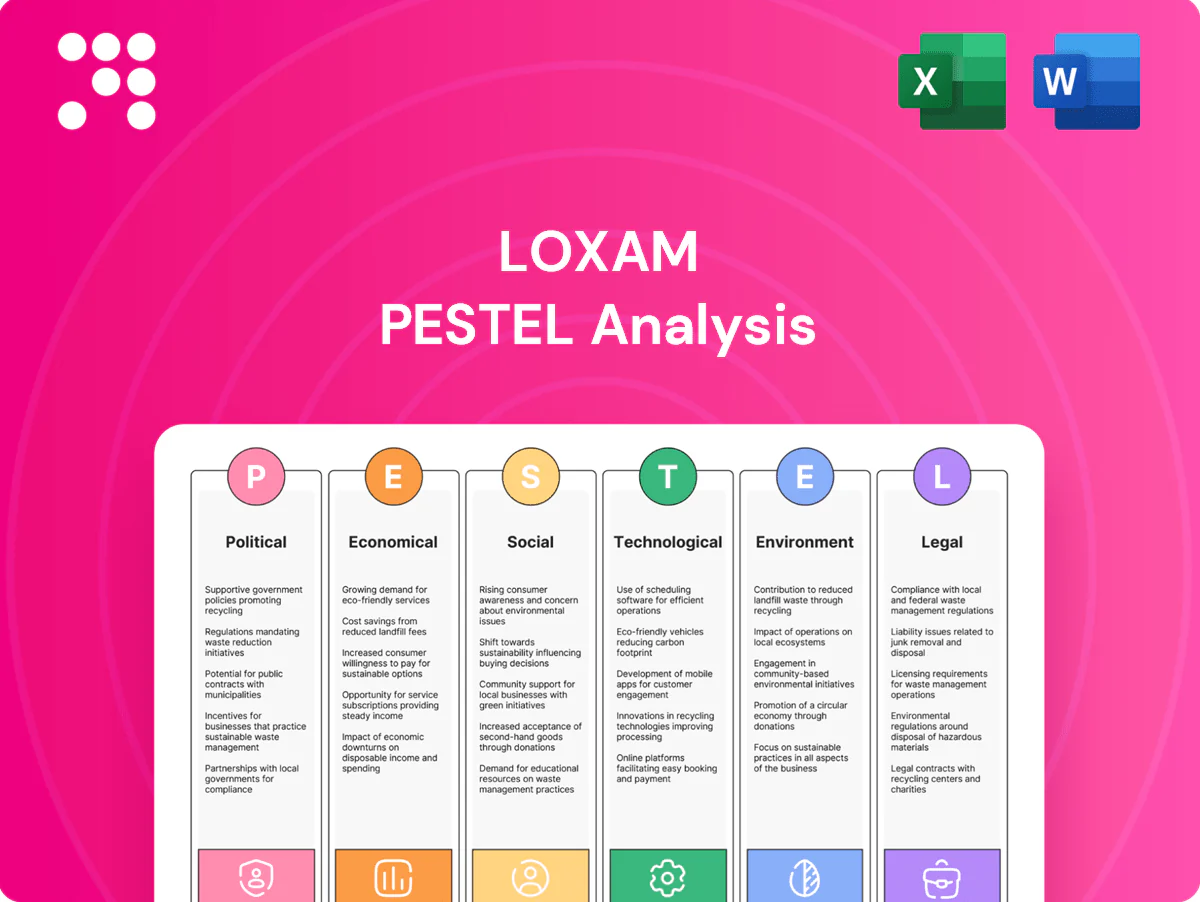
Loxam PESTLE Analysis

Skip the Research. Get the Strategy.
Discover how political shifts, economic cycles, and environmental trends are reshaping Loxam’s rental equipment strategy in our concise PESTLE overview—designed for investors and strategists. This snapshot reveals key external risks and opportunities; purchase the full PESTLE to access detailed, actionable analysis and forecasts.
Political factors

EU infrastructure spending
Public investment programs across EU member states, driven by the EU long-term budget of 1.074 trillion EUR (2021–2027) and NextGenerationEU/RRF instruments totaling about 806.9 billion EUR (RRF ~723.8 billion EUR), sustain equipment rental demand and can lift branch utilization. Multi-year recovery and cohesion funding boosts utilization rates over several years. Loxam must track national tender pipelines to align fleet availability, as policy delays or elections can shift timelines and cash flows.
Public procurement rules
Compliance with EU and national procurement standards determines Loxam’s eligibility for contracts within a roughly €2 trillion annual EU public procurement market; Directive 2014/24/EU allows framework agreements generally up to 48 months, securing recurring volumes. Sustainability and local content clauses from Green Public Procurement initiatives are increasingly common and can force shifts in fleet electrification and supplier partnerships. Potential reforms increasing documentation or environmental criteria would raise administrative burden and cost per bid.

Cross-border trade & sanctions
Sanctions and export controls can restrict Loxam’s equipment sourcing and resale markets, especially given its presence in over 30 countries. Political tensions may disrupt component supply chains for machinery, raising lead times and repair costs. Loxam therefore needs diversified vendors and contingency inventory plans. Rapid policy shifts demand agile contract clauses and flexible logistics management.

Brexit and UK divergence
Brexit-driven regulatory divergence between the UK and EU complicates certifications, customs procedures and labor mobility, with UK goods exports to the EU dropping about 15% in 2021 versus 2019 (ONS). Border frictions have increased delivery uncertainty and operating costs; Loxam must align inventory planning and compliance teams across jurisdictions while currency and policy shifts add forecasting complexity.
- Regulatory divergence: certifications, customs, labor
- Trade impact: UK→EU goods −15% (2021, ONS)
- Operational risk: longer deliveries, higher costs
- Action: unify inventory & compliance; hedge forecasting
Subsidies for green assets
- Benefits: faster electrification, improved ROI
- Sources: France 2030 €54bn; NextGenerationEU €806.9bn
- Risk: subsidy reversal → higher capex, lower utilization
EU funds and procurement boost rentals; Brexit, sanctions and subsidy cuts increase risk
EU public investment (EU budget €1.074tn 2021–27; NextGenerationEU €806.9bn) supports rental demand; public procurement ≈€2tn/y drives volumes. Brexit (UK→EU goods −15% 2021 vs 2019) and sanctions raise delivery risk and compliance costs. National schemes (France 2030 €54bn) accelerate electrification but subsidy cuts would raise Loxam capex and lower utilization.
| Metric | Value |
|---|---|
| EU budget | €1.074tn (2021–27) |
| NextGenerationEU | €806.9bn |
| Public procurement | ≈€2tn/yr |
| France 2030 | €54bn |
What is included in the product
 Detailed Word Document
Explores how Political, Economic, Social, Technological, Environmental, and Legal forces uniquely impact Loxam’s equipment rental business across its operating regions, combining data-driven trends and regulation analysis. Designed for executives and investors, it highlights risks, opportunities, and forward-looking scenario insights ready for strategic use.

 Customizable Excel Spreadsheet
A concise, visually segmented Loxam PESTLE that can be dropped into presentations, edited with contextual notes, and easily shared across teams to streamline external risk discussions and accelerate strategy alignment during planning sessions.
Economic factors

Interest rates & capex
Rising policy rates—ECB deposit rate around 4% in mid‑2025—make renting more attractive for clients prioritizing balance‑sheet flexibility, supporting demand for Loxam’s short‑term contracts. Higher rates increase Loxam’s cost of capital for fleet renewal, pressuring free cash flow and capex plans. Maintaining pricing discipline and optimizing contract terms, plus scenario planning on utilization and leverage, protects margins and liquidity.
Construction cycle sensitivity
Activity in residential, infrastructure and industrial projects drives rental demand volatility across cycles. Diversification across sectors and geographies, with Loxam present in 30 countries, helps smooth revenue swings. Counter-cyclical maintenance and shutdown work often offsets construction slowdowns. Dynamic fleet reallocation and cross-border transfers reduce idle time and improve utilization.

Inflation & input costs
Rising equipment purchase prices, spare parts and fuel have elevated Loxam’s operating expenses, compressing margins across fleets and projects.
Indexed rental pricing and fuel surcharges allow partial pass-through of cost inflation to customers, reducing direct margin erosion.
Procurement scale and long-term vendor agreements across Loxam’s European network secure better purchase terms and inventory availability.
Improved maintenance scheduling and predictive upkeep preserve utilization rates and margins by lowering downtime and costly emergency repairs.

FX exposure
Loxam, reporting in euros and operating in 30+ countries, faces currency risk on multinational revenues and USD/GBP-denominated fleet purchases; established hedging policies and natural offsets from local pricing reduce earnings volatility. FX swings affect cross-border transfers and used-equipment valuations, so transparent, currency-linked pricing is used to manage customer expectations.
- FX exposure
- 30+ countries
- Euro reporting
- Hedging & natural offsets
- Impact on used-equipment valuation
- Transparent pricing
Labor availability
Skilled operators and technicians remain scarce across Loxam markets, with the group reporting roughly 11,000 employees worldwide and industry recruitment difficulties intensifying in 2024; rising wage pressures are forcing productivity gains through telematics and automation investments. Targeted training and retention programs preserve service quality, while formal partnerships with vocational schools expand the talent pipeline and reduce hiring lead times.
- Skills scarcity: elevated vs pre‑pandemic
- Wage pressure: drives tech-led productivity
- Training/retention: protects service levels
- Vocational partnerships: widen candidate flow
EU funds and procurement boost rentals; Brexit, sanctions and subsidy cuts increase risk
Rising ECB rates (≈4% mid‑2025) raise cost of capital, favoring rentals but pressuring capex and FCF. Sectoral demand volatility mitigated by presence in 30+ countries. Parts, fuel and purchase inflation lift Opex; indexed pricing and procurement scale partially offset. Skills scarcity (≈11,000 staff) fuels wage inflation and tech-led productivity investment.
| Metric | Value |
|---|---|
| ECB rate | ≈4% |
| Countries | 30+ |
| Employees | ≈11,000 |
Full Version Awaits
Loxam PESTLE Analysis
The Loxam PESTLE analysis provides a concise, professionally structured review of political, economic, social, technological, legal and environmental factors affecting Loxam. The preview shown here is the exact document you’ll receive after purchase—fully formatted and ready to use.

Skip the Research. Get the Strategy.
Discover how political shifts, economic cycles, and environmental trends are reshaping Loxam’s rental equipment strategy in our concise PESTLE overview—designed for investors and strategists. This snapshot reveals key external risks and opportunities; purchase the full PESTLE to access detailed, actionable analysis and forecasts.
Political factors
EU infrastructure spending
Public investment programs across EU member states, driven by the EU long-term budget of 1.074 trillion EUR (2021–2027) and NextGenerationEU/RRF instruments totaling about 806.9 billion EUR (RRF ~723.8 billion EUR), sustain equipment rental demand and can lift branch utilization. Multi-year recovery and cohesion funding boosts utilization rates over several years. Loxam must track national tender pipelines to align fleet availability, as policy delays or elections can shift timelines and cash flows.
Public procurement rules
Compliance with EU and national procurement standards determines Loxam’s eligibility for contracts within a roughly €2 trillion annual EU public procurement market; Directive 2014/24/EU allows framework agreements generally up to 48 months, securing recurring volumes. Sustainability and local content clauses from Green Public Procurement initiatives are increasingly common and can force shifts in fleet electrification and supplier partnerships. Potential reforms increasing documentation or environmental criteria would raise administrative burden and cost per bid.
Cross-border trade & sanctions
Sanctions and export controls can restrict Loxam’s equipment sourcing and resale markets, especially given its presence in over 30 countries. Political tensions may disrupt component supply chains for machinery, raising lead times and repair costs. Loxam therefore needs diversified vendors and contingency inventory plans. Rapid policy shifts demand agile contract clauses and flexible logistics management.
Brexit and UK divergence
Brexit-driven regulatory divergence between the UK and EU complicates certifications, customs procedures and labor mobility, with UK goods exports to the EU dropping about 15% in 2021 versus 2019 (ONS). Border frictions have increased delivery uncertainty and operating costs; Loxam must align inventory planning and compliance teams across jurisdictions while currency and policy shifts add forecasting complexity.
- Regulatory divergence: certifications, customs, labor
- Trade impact: UK→EU goods −15% (2021, ONS)
- Operational risk: longer deliveries, higher costs
- Action: unify inventory & compliance; hedge forecasting
Subsidies for green assets
- Benefits: faster electrification, improved ROI
- Sources: France 2030 €54bn; NextGenerationEU €806.9bn
- Risk: subsidy reversal → higher capex, lower utilization
EU funds and procurement boost rentals; Brexit, sanctions and subsidy cuts increase risk
EU public investment (EU budget €1.074tn 2021–27; NextGenerationEU €806.9bn) supports rental demand; public procurement ≈€2tn/y drives volumes. Brexit (UK→EU goods −15% 2021 vs 2019) and sanctions raise delivery risk and compliance costs. National schemes (France 2030 €54bn) accelerate electrification but subsidy cuts would raise Loxam capex and lower utilization.
| Metric | Value |
|---|---|
| EU budget | €1.074tn (2021–27) |
| NextGenerationEU | €806.9bn |
| Public procurement | ≈€2tn/yr |
| France 2030 | €54bn |
What is included in the product
Detailed Word Document
Explores how Political, Economic, Social, Technological, Environmental, and Legal forces uniquely impact Loxam’s equipment rental business across its operating regions, combining data-driven trends and regulation analysis. Designed for executives and investors, it highlights risks, opportunities, and forward-looking scenario insights ready for strategic use.
Customizable Excel Spreadsheet
A concise, visually segmented Loxam PESTLE that can be dropped into presentations, edited with contextual notes, and easily shared across teams to streamline external risk discussions and accelerate strategy alignment during planning sessions.
Economic factors
Interest rates & capex
Rising policy rates—ECB deposit rate around 4% in mid‑2025—make renting more attractive for clients prioritizing balance‑sheet flexibility, supporting demand for Loxam’s short‑term contracts. Higher rates increase Loxam’s cost of capital for fleet renewal, pressuring free cash flow and capex plans. Maintaining pricing discipline and optimizing contract terms, plus scenario planning on utilization and leverage, protects margins and liquidity.
Construction cycle sensitivity
Activity in residential, infrastructure and industrial projects drives rental demand volatility across cycles. Diversification across sectors and geographies, with Loxam present in 30 countries, helps smooth revenue swings. Counter-cyclical maintenance and shutdown work often offsets construction slowdowns. Dynamic fleet reallocation and cross-border transfers reduce idle time and improve utilization.
Inflation & input costs
Rising equipment purchase prices, spare parts and fuel have elevated Loxam’s operating expenses, compressing margins across fleets and projects.
Indexed rental pricing and fuel surcharges allow partial pass-through of cost inflation to customers, reducing direct margin erosion.
Procurement scale and long-term vendor agreements across Loxam’s European network secure better purchase terms and inventory availability.
Improved maintenance scheduling and predictive upkeep preserve utilization rates and margins by lowering downtime and costly emergency repairs.
FX exposure
Loxam, reporting in euros and operating in 30+ countries, faces currency risk on multinational revenues and USD/GBP-denominated fleet purchases; established hedging policies and natural offsets from local pricing reduce earnings volatility. FX swings affect cross-border transfers and used-equipment valuations, so transparent, currency-linked pricing is used to manage customer expectations.
- FX exposure
- 30+ countries
- Euro reporting
- Hedging & natural offsets
- Impact on used-equipment valuation
- Transparent pricing
Labor availability
Skilled operators and technicians remain scarce across Loxam markets, with the group reporting roughly 11,000 employees worldwide and industry recruitment difficulties intensifying in 2024; rising wage pressures are forcing productivity gains through telematics and automation investments. Targeted training and retention programs preserve service quality, while formal partnerships with vocational schools expand the talent pipeline and reduce hiring lead times.
- Skills scarcity: elevated vs pre‑pandemic
- Wage pressure: drives tech-led productivity
- Training/retention: protects service levels
- Vocational partnerships: widen candidate flow
EU funds and procurement boost rentals; Brexit, sanctions and subsidy cuts increase risk
Rising ECB rates (≈4% mid‑2025) raise cost of capital, favoring rentals but pressuring capex and FCF. Sectoral demand volatility mitigated by presence in 30+ countries. Parts, fuel and purchase inflation lift Opex; indexed pricing and procurement scale partially offset. Skills scarcity (≈11,000 staff) fuels wage inflation and tech-led productivity investment.
| Metric | Value |
|---|---|
| ECB rate | ≈4% |
| Countries | 30+ |
| Employees | ≈11,000 |
Full Version Awaits
Loxam PESTLE Analysis
The Loxam PESTLE analysis provides a concise, professionally structured review of political, economic, social, technological, legal and environmental factors affecting Loxam. The preview shown here is the exact document you’ll receive after purchase—fully formatted and ready to use.
Original: $10.00
-65%$10.00
$3.50Description
Skip the Research. Get the Strategy.
Discover how political shifts, economic cycles, and environmental trends are reshaping Loxam’s rental equipment strategy in our concise PESTLE overview—designed for investors and strategists. This snapshot reveals key external risks and opportunities; purchase the full PESTLE to access detailed, actionable analysis and forecasts.
Political factors
EU infrastructure spending
Public investment programs across EU member states, driven by the EU long-term budget of 1.074 trillion EUR (2021–2027) and NextGenerationEU/RRF instruments totaling about 806.9 billion EUR (RRF ~723.8 billion EUR), sustain equipment rental demand and can lift branch utilization. Multi-year recovery and cohesion funding boosts utilization rates over several years. Loxam must track national tender pipelines to align fleet availability, as policy delays or elections can shift timelines and cash flows.
Public procurement rules
Compliance with EU and national procurement standards determines Loxam’s eligibility for contracts within a roughly €2 trillion annual EU public procurement market; Directive 2014/24/EU allows framework agreements generally up to 48 months, securing recurring volumes. Sustainability and local content clauses from Green Public Procurement initiatives are increasingly common and can force shifts in fleet electrification and supplier partnerships. Potential reforms increasing documentation or environmental criteria would raise administrative burden and cost per bid.
Cross-border trade & sanctions
Sanctions and export controls can restrict Loxam’s equipment sourcing and resale markets, especially given its presence in over 30 countries. Political tensions may disrupt component supply chains for machinery, raising lead times and repair costs. Loxam therefore needs diversified vendors and contingency inventory plans. Rapid policy shifts demand agile contract clauses and flexible logistics management.
Brexit and UK divergence
Brexit-driven regulatory divergence between the UK and EU complicates certifications, customs procedures and labor mobility, with UK goods exports to the EU dropping about 15% in 2021 versus 2019 (ONS). Border frictions have increased delivery uncertainty and operating costs; Loxam must align inventory planning and compliance teams across jurisdictions while currency and policy shifts add forecasting complexity.
- Regulatory divergence: certifications, customs, labor
- Trade impact: UK→EU goods −15% (2021, ONS)
- Operational risk: longer deliveries, higher costs
- Action: unify inventory & compliance; hedge forecasting
Subsidies for green assets
- Benefits: faster electrification, improved ROI
- Sources: France 2030 €54bn; NextGenerationEU €806.9bn
- Risk: subsidy reversal → higher capex, lower utilization
EU funds and procurement boost rentals; Brexit, sanctions and subsidy cuts increase risk
EU public investment (EU budget €1.074tn 2021–27; NextGenerationEU €806.9bn) supports rental demand; public procurement ≈€2tn/y drives volumes. Brexit (UK→EU goods −15% 2021 vs 2019) and sanctions raise delivery risk and compliance costs. National schemes (France 2030 €54bn) accelerate electrification but subsidy cuts would raise Loxam capex and lower utilization.
| Metric | Value |
|---|---|
| EU budget | €1.074tn (2021–27) |
| NextGenerationEU | €806.9bn |
| Public procurement | ≈€2tn/yr |
| France 2030 | €54bn |
What is included in the product
Detailed Word Document
Explores how Political, Economic, Social, Technological, Environmental, and Legal forces uniquely impact Loxam’s equipment rental business across its operating regions, combining data-driven trends and regulation analysis. Designed for executives and investors, it highlights risks, opportunities, and forward-looking scenario insights ready for strategic use.
Customizable Excel Spreadsheet
A concise, visually segmented Loxam PESTLE that can be dropped into presentations, edited with contextual notes, and easily shared across teams to streamline external risk discussions and accelerate strategy alignment during planning sessions.
Economic factors
Interest rates & capex
Rising policy rates—ECB deposit rate around 4% in mid‑2025—make renting more attractive for clients prioritizing balance‑sheet flexibility, supporting demand for Loxam’s short‑term contracts. Higher rates increase Loxam’s cost of capital for fleet renewal, pressuring free cash flow and capex plans. Maintaining pricing discipline and optimizing contract terms, plus scenario planning on utilization and leverage, protects margins and liquidity.
Construction cycle sensitivity
Activity in residential, infrastructure and industrial projects drives rental demand volatility across cycles. Diversification across sectors and geographies, with Loxam present in 30 countries, helps smooth revenue swings. Counter-cyclical maintenance and shutdown work often offsets construction slowdowns. Dynamic fleet reallocation and cross-border transfers reduce idle time and improve utilization.
Inflation & input costs
Rising equipment purchase prices, spare parts and fuel have elevated Loxam’s operating expenses, compressing margins across fleets and projects.
Indexed rental pricing and fuel surcharges allow partial pass-through of cost inflation to customers, reducing direct margin erosion.
Procurement scale and long-term vendor agreements across Loxam’s European network secure better purchase terms and inventory availability.
Improved maintenance scheduling and predictive upkeep preserve utilization rates and margins by lowering downtime and costly emergency repairs.
FX exposure
Loxam, reporting in euros and operating in 30+ countries, faces currency risk on multinational revenues and USD/GBP-denominated fleet purchases; established hedging policies and natural offsets from local pricing reduce earnings volatility. FX swings affect cross-border transfers and used-equipment valuations, so transparent, currency-linked pricing is used to manage customer expectations.
- FX exposure
- 30+ countries
- Euro reporting
- Hedging & natural offsets
- Impact on used-equipment valuation
- Transparent pricing
Labor availability
Skilled operators and technicians remain scarce across Loxam markets, with the group reporting roughly 11,000 employees worldwide and industry recruitment difficulties intensifying in 2024; rising wage pressures are forcing productivity gains through telematics and automation investments. Targeted training and retention programs preserve service quality, while formal partnerships with vocational schools expand the talent pipeline and reduce hiring lead times.
- Skills scarcity: elevated vs pre‑pandemic
- Wage pressure: drives tech-led productivity
- Training/retention: protects service levels
- Vocational partnerships: widen candidate flow
EU funds and procurement boost rentals; Brexit, sanctions and subsidy cuts increase risk
Rising ECB rates (≈4% mid‑2025) raise cost of capital, favoring rentals but pressuring capex and FCF. Sectoral demand volatility mitigated by presence in 30+ countries. Parts, fuel and purchase inflation lift Opex; indexed pricing and procurement scale partially offset. Skills scarcity (≈11,000 staff) fuels wage inflation and tech-led productivity investment.
| Metric | Value |
|---|---|
| ECB rate | ≈4% |
| Countries | 30+ |
| Employees | ≈11,000 |
Full Version Awaits
Loxam PESTLE Analysis
The Loxam PESTLE analysis provides a concise, professionally structured review of political, economic, social, technological, legal and environmental factors affecting Loxam. The preview shown here is the exact document you’ll receive after purchase—fully formatted and ready to use.











