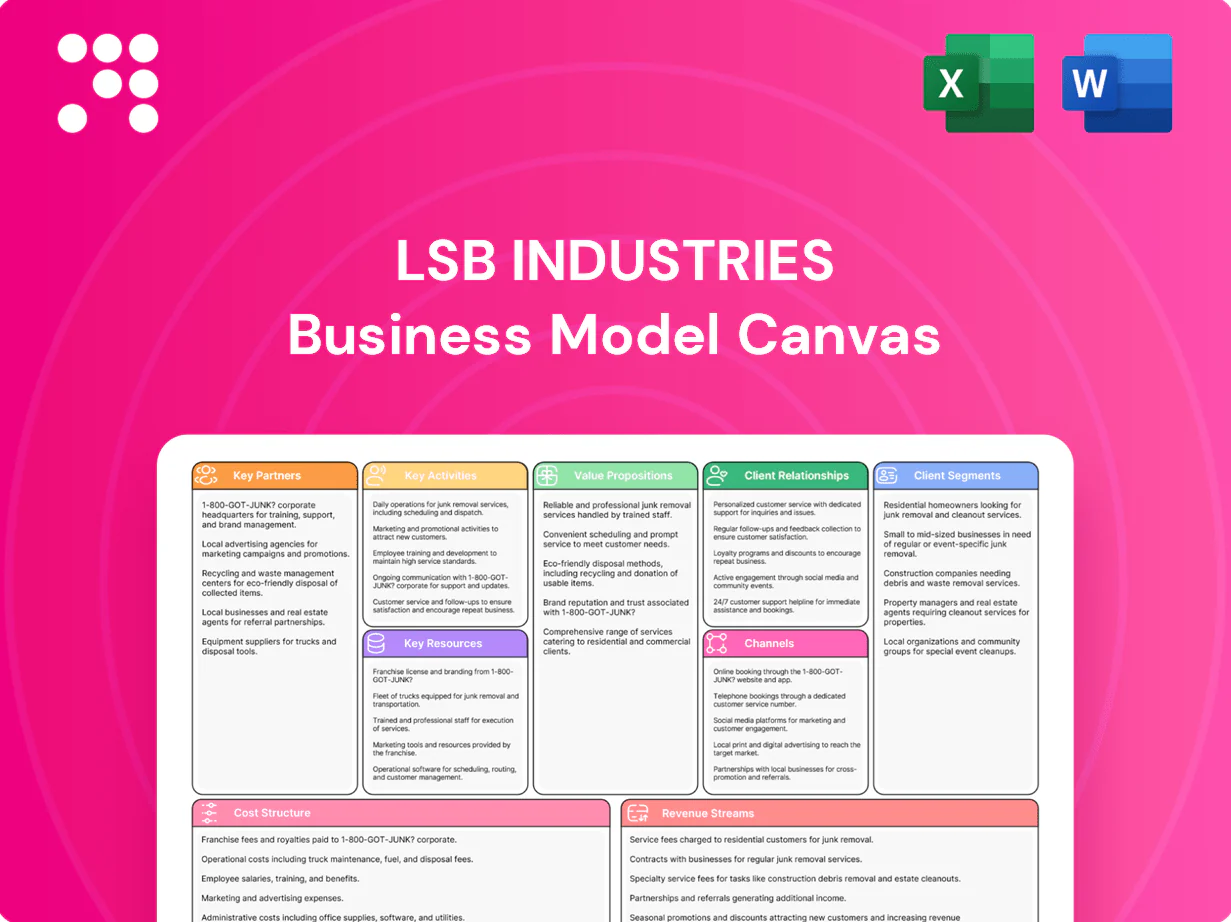
LSB Industries Business Model Canvas

Unlock the Strategic Business Model Canvas for a Leading Industrial Chemicals Company
Unlock the full strategic blueprint behind LSB Industries' business model. This concise Business Model Canvas maps value propositions, key partners, revenue streams and cost drivers to show how LSB scales and competes. Ideal for investors, consultants and founders seeking actionable, downloadable insights—get the full editable Canvas now.
Partnerships

Natural gas suppliers
Securing long-term gas contracts underpins LSB Industries ammonia economics and supply stability, with industry feedstock representing roughly 60–70% of variable production cost and Henry Hub averaging about $3.00/MMBtu in 2024. Deeper supplier partnerships enable price indexing, volume flexibility and seasonal reliability. Dual-sourcing reduces curtailment risk and supports hedging programs while coordinated scheduling aligns outages with supply profiles.
Rail, trucking, and terminal operators
Logistics partners move bulk ammonia, UAN, nitric acid and AN under PHMSA/HAZMAT protocols to meet plant shipping windows and customer delivery windows. Access to unit trains of 100–120 cars, transload sites and storage tanks exceeding 100,000 gallons expands reach across the central and southern U.S. Service-level agreements shorten cycle times and limit demurrage exposure, while joint safety and hazmat training reduces incident risk and regulatory fines.

Agricultural retailers and cooperatives
Agricultural retailers and cooperatives act as strategic distribution partners, aggregating farmer demand and delivering last-mile application services to ensure timely field placement. Co-marketing with retailers supports seasonal programs and prepay campaigns, boosting advance sales ahead of the 2024 planting season. Data sharing improves demand forecasting and inventory placement, reducing stockouts. Multi-year agreements (commonly 3–5 years) stabilize plant run rates and pricing.

Technology licensors and equipment OEMs
Technology licensors and OEMs keep LSBs ammonia, nitric acid and AN trains running with higher uptime; upgrades from OEMs in 2024 focused on energy-efficiency gains in a sector that consumes about 1–2% of global energy.
Access to advanced catalysts and digital monitoring improved yield and reliability while joint OEM trials de-risked debottlenecking and capacity projects, lowering operational risk and capital uncertainty.
- Uptime improvements via OEM service agreements
- Energy/emissions upgrades aligned with sector 1–2% energy footprint
- Catalysts + digital monitoring = better yield/reliability
- Joint trials de-risk debottlenecking/capacity adds
Environmental and safety consultants
Environmental and safety consultants support permitting, ESG reporting and compliance with EPA, OSHA and PHMSA rules, enabling LSB Industries to meet regulatory milestones and avoid costly shutdowns. Proactive third-party audits identify gaps early, reducing regulatory risk and operational downtime. Community engagement plans developed with consultants strengthen social license to operate while continuous improvement programs drive safer, cleaner operations.
- Permitting & ESG reporting support
- Proactive audits reduce risk/downtime
- Community engagement for social license
- Continuous improvement → safer, cleaner ops
Long-term gas hedges, dual-sourcing and logistics secure ammonia margins and uptime
Long-term gas contracts (Henry Hub ~$3.00/MMBtu in 2024) and dual-sourcing (feedstock 60–70% of variable cost) stabilize ammonia economics and hedging.
Logistics (100–120 car unit trains, >100,000 gal storage) and ag retailers (3–5 yr agreements) secure distribution and seasonal demand aggregation.
OEMs, catalysts, digital monitoring and ESG consultants reduce downtime, raise yields and cut regulatory risk.
| Partner | Role | 2024 metric |
|---|---|---|
| Gas suppliers | Feedstock & hedging | Henry Hub ~$3.00/MMBtu |
| Logistics | Transport & storage | 100–120 cars, >100k gal |
| Retailers | Demand aggregation | 3–5 yr contracts |
| OEMs/Consultants | Uptime & compliance | Energy ops ≤1–2% sector |
What is included in the product
 Detailed Word Document
A concise, investor-ready Business Model Canvas for LSB Industries mapping customer segments, channels, value propositions, revenue streams, key activities and partners, cost structure and competitive advantages, with SWOT-linked insights for strategic decision-making and funding discussions.

 Customizable Excel Spreadsheet
High-level view of LSB Industries’ business model with editable cells, reducing time spent mapping chemical supply chains and regulatory pain points into a clear, board-ready snapshot for fast decision-making and team alignment.
Activities

Ammonia and downstream production
Operate and optimize ammonia units feeding nitric acid, UAN, and AN lines to match seasonal agronomy peaks and industrial orders, adjusting product slate between spring planting and off-season industrial demand. Monitor yields, energy intensity, and catalyst life with real-time KPIs and coordinate turnarounds to protect peak production windows and minimize lost volumes.
Supply chain and logistics management
Plan rail and truck dispatch, storage and terminal flows for bulk ammonia and fertilizer using rail (freight rail moves ~40% of US ton-miles per AAR) to optimize turn times and terminal throughput. Secure railcar and intermodal equipment to minimize demurrage and ensure availability. Implement strict hazmat safety protocols (DOT/PHMSA standards) and align inventory with regional planting cycles, e.g., US corn planted area 88.4 million acres in 2024 (USDA).

Commercial sales and pricing
Manage contracts, spot sales and seasonal retailer and industrial programs to match crop-driven demand peaks and mitigate inventory swings. Index pricing to natural gas and market benchmarks—natural gas typically represents roughly 70–80% of nitrogen fertilizer production cost—to balance margin and commodity risk. Use prepay and volume incentives to stabilize offtake and cash flow while maintaining disciplined credit and AR management to limit counterparty exposure.

Risk management and hedging
LSB hedges natural gas and basis exposures to protect urea and ammonium nitrate margins, complementing forward sales and inventory strategies to smooth price-driven volatility; U.S. Henry Hub averaged about $2.8/MMBtu in 2024, guiding hedge levels and contract durations. Stress-tests model plant outages and logistics disruptions, and contingency plans enable rapid feedstock and product rerouting to alternative terminals and customers.
- Hedge natural gas/basis
- Forward sales & inventory smoothing
- Stress-test outages/logistics
- Contingency feedstock/product reroute
Maintenance, reliability, and HSE
Execute preventive and predictive maintenance programs to maximize plant uptime and asset availability, conduct regular regulatory inspections and safety training, and maintain process safety management and incident response readiness to protect people and operations. Track KPIs including MTBF, energy consumption per ton, and emissions intensity to drive continuous improvement.
- MTBF (hours)
- Energy use (kWh/ton)
- Emissions intensity (kg CO2e/ton)
Optimize ammonia/UAN operations, align inventory with planting cycles, hedge Henry Hub $2.8/MMBtu
Operate and optimize ammonia/nitric acid/UAN/AN lines to meet seasonal ag demand and industrial contracts, using real-time KPIs and scheduled turnarounds. Coordinate rail/truck logistics and hazmat-safe terminals to minimize demurrage and align inventory with planting cycles. Hedge natural gas (Henry Hub $2.8/MMBtu in 2024) and use forward sales, stress-tests, and contingency reroutes to protect margins.
| Metric | Value (2024) |
|---|---|
| US corn planted area | 88.4M acres |
| Henry Hub | $2.8/MMBtu |
| Rail share | ~40% ton-miles |
What You See Is What You Get
Business Model Canvas
The document you're previewing is the exact LSB Industries Business Model Canvas you'll receive after purchase. It's not a mockup—this live preview shows the actual structured, editable content. After buying you'll download the complete file in Word and Excel, formatted and ready to edit or present—no surprises.

Unlock the Strategic Business Model Canvas for a Leading Industrial Chemicals Company
Unlock the full strategic blueprint behind LSB Industries' business model. This concise Business Model Canvas maps value propositions, key partners, revenue streams and cost drivers to show how LSB scales and competes. Ideal for investors, consultants and founders seeking actionable, downloadable insights—get the full editable Canvas now.
Partnerships
Natural gas suppliers
Securing long-term gas contracts underpins LSB Industries ammonia economics and supply stability, with industry feedstock representing roughly 60–70% of variable production cost and Henry Hub averaging about $3.00/MMBtu in 2024. Deeper supplier partnerships enable price indexing, volume flexibility and seasonal reliability. Dual-sourcing reduces curtailment risk and supports hedging programs while coordinated scheduling aligns outages with supply profiles.
Rail, trucking, and terminal operators
Logistics partners move bulk ammonia, UAN, nitric acid and AN under PHMSA/HAZMAT protocols to meet plant shipping windows and customer delivery windows. Access to unit trains of 100–120 cars, transload sites and storage tanks exceeding 100,000 gallons expands reach across the central and southern U.S. Service-level agreements shorten cycle times and limit demurrage exposure, while joint safety and hazmat training reduces incident risk and regulatory fines.
Agricultural retailers and cooperatives
Agricultural retailers and cooperatives act as strategic distribution partners, aggregating farmer demand and delivering last-mile application services to ensure timely field placement. Co-marketing with retailers supports seasonal programs and prepay campaigns, boosting advance sales ahead of the 2024 planting season. Data sharing improves demand forecasting and inventory placement, reducing stockouts. Multi-year agreements (commonly 3–5 years) stabilize plant run rates and pricing.
Technology licensors and equipment OEMs
Technology licensors and OEMs keep LSBs ammonia, nitric acid and AN trains running with higher uptime; upgrades from OEMs in 2024 focused on energy-efficiency gains in a sector that consumes about 1–2% of global energy.
Access to advanced catalysts and digital monitoring improved yield and reliability while joint OEM trials de-risked debottlenecking and capacity projects, lowering operational risk and capital uncertainty.
- Uptime improvements via OEM service agreements
- Energy/emissions upgrades aligned with sector 1–2% energy footprint
- Catalysts + digital monitoring = better yield/reliability
- Joint trials de-risk debottlenecking/capacity adds
Environmental and safety consultants
Environmental and safety consultants support permitting, ESG reporting and compliance with EPA, OSHA and PHMSA rules, enabling LSB Industries to meet regulatory milestones and avoid costly shutdowns. Proactive third-party audits identify gaps early, reducing regulatory risk and operational downtime. Community engagement plans developed with consultants strengthen social license to operate while continuous improvement programs drive safer, cleaner operations.
- Permitting & ESG reporting support
- Proactive audits reduce risk/downtime
- Community engagement for social license
- Continuous improvement → safer, cleaner ops
Long-term gas hedges, dual-sourcing and logistics secure ammonia margins and uptime
Long-term gas contracts (Henry Hub ~$3.00/MMBtu in 2024) and dual-sourcing (feedstock 60–70% of variable cost) stabilize ammonia economics and hedging.
Logistics (100–120 car unit trains, >100,000 gal storage) and ag retailers (3–5 yr agreements) secure distribution and seasonal demand aggregation.
OEMs, catalysts, digital monitoring and ESG consultants reduce downtime, raise yields and cut regulatory risk.
| Partner | Role | 2024 metric |
|---|---|---|
| Gas suppliers | Feedstock & hedging | Henry Hub ~$3.00/MMBtu |
| Logistics | Transport & storage | 100–120 cars, >100k gal |
| Retailers | Demand aggregation | 3–5 yr contracts |
| OEMs/Consultants | Uptime & compliance | Energy ops ≤1–2% sector |
What is included in the product
Detailed Word Document
A concise, investor-ready Business Model Canvas for LSB Industries mapping customer segments, channels, value propositions, revenue streams, key activities and partners, cost structure and competitive advantages, with SWOT-linked insights for strategic decision-making and funding discussions.
Customizable Excel Spreadsheet
High-level view of LSB Industries’ business model with editable cells, reducing time spent mapping chemical supply chains and regulatory pain points into a clear, board-ready snapshot for fast decision-making and team alignment.
Activities
Ammonia and downstream production
Operate and optimize ammonia units feeding nitric acid, UAN, and AN lines to match seasonal agronomy peaks and industrial orders, adjusting product slate between spring planting and off-season industrial demand. Monitor yields, energy intensity, and catalyst life with real-time KPIs and coordinate turnarounds to protect peak production windows and minimize lost volumes.
Supply chain and logistics management
Plan rail and truck dispatch, storage and terminal flows for bulk ammonia and fertilizer using rail (freight rail moves ~40% of US ton-miles per AAR) to optimize turn times and terminal throughput. Secure railcar and intermodal equipment to minimize demurrage and ensure availability. Implement strict hazmat safety protocols (DOT/PHMSA standards) and align inventory with regional planting cycles, e.g., US corn planted area 88.4 million acres in 2024 (USDA).
Commercial sales and pricing
Manage contracts, spot sales and seasonal retailer and industrial programs to match crop-driven demand peaks and mitigate inventory swings. Index pricing to natural gas and market benchmarks—natural gas typically represents roughly 70–80% of nitrogen fertilizer production cost—to balance margin and commodity risk. Use prepay and volume incentives to stabilize offtake and cash flow while maintaining disciplined credit and AR management to limit counterparty exposure.
Risk management and hedging
LSB hedges natural gas and basis exposures to protect urea and ammonium nitrate margins, complementing forward sales and inventory strategies to smooth price-driven volatility; U.S. Henry Hub averaged about $2.8/MMBtu in 2024, guiding hedge levels and contract durations. Stress-tests model plant outages and logistics disruptions, and contingency plans enable rapid feedstock and product rerouting to alternative terminals and customers.
- Hedge natural gas/basis
- Forward sales & inventory smoothing
- Stress-test outages/logistics
- Contingency feedstock/product reroute
Maintenance, reliability, and HSE
Execute preventive and predictive maintenance programs to maximize plant uptime and asset availability, conduct regular regulatory inspections and safety training, and maintain process safety management and incident response readiness to protect people and operations. Track KPIs including MTBF, energy consumption per ton, and emissions intensity to drive continuous improvement.
- MTBF (hours)
- Energy use (kWh/ton)
- Emissions intensity (kg CO2e/ton)
Optimize ammonia/UAN operations, align inventory with planting cycles, hedge Henry Hub $2.8/MMBtu
Operate and optimize ammonia/nitric acid/UAN/AN lines to meet seasonal ag demand and industrial contracts, using real-time KPIs and scheduled turnarounds. Coordinate rail/truck logistics and hazmat-safe terminals to minimize demurrage and align inventory with planting cycles. Hedge natural gas (Henry Hub $2.8/MMBtu in 2024) and use forward sales, stress-tests, and contingency reroutes to protect margins.
| Metric | Value (2024) |
|---|---|
| US corn planted area | 88.4M acres |
| Henry Hub | $2.8/MMBtu |
| Rail share | ~40% ton-miles |
What You See Is What You Get
Business Model Canvas
The document you're previewing is the exact LSB Industries Business Model Canvas you'll receive after purchase. It's not a mockup—this live preview shows the actual structured, editable content. After buying you'll download the complete file in Word and Excel, formatted and ready to edit or present—no surprises.
Original: $10.00
-65%$10.00
$3.50Description
Unlock the Strategic Business Model Canvas for a Leading Industrial Chemicals Company
Unlock the full strategic blueprint behind LSB Industries' business model. This concise Business Model Canvas maps value propositions, key partners, revenue streams and cost drivers to show how LSB scales and competes. Ideal for investors, consultants and founders seeking actionable, downloadable insights—get the full editable Canvas now.
Partnerships
Natural gas suppliers
Securing long-term gas contracts underpins LSB Industries ammonia economics and supply stability, with industry feedstock representing roughly 60–70% of variable production cost and Henry Hub averaging about $3.00/MMBtu in 2024. Deeper supplier partnerships enable price indexing, volume flexibility and seasonal reliability. Dual-sourcing reduces curtailment risk and supports hedging programs while coordinated scheduling aligns outages with supply profiles.
Rail, trucking, and terminal operators
Logistics partners move bulk ammonia, UAN, nitric acid and AN under PHMSA/HAZMAT protocols to meet plant shipping windows and customer delivery windows. Access to unit trains of 100–120 cars, transload sites and storage tanks exceeding 100,000 gallons expands reach across the central and southern U.S. Service-level agreements shorten cycle times and limit demurrage exposure, while joint safety and hazmat training reduces incident risk and regulatory fines.
Agricultural retailers and cooperatives
Agricultural retailers and cooperatives act as strategic distribution partners, aggregating farmer demand and delivering last-mile application services to ensure timely field placement. Co-marketing with retailers supports seasonal programs and prepay campaigns, boosting advance sales ahead of the 2024 planting season. Data sharing improves demand forecasting and inventory placement, reducing stockouts. Multi-year agreements (commonly 3–5 years) stabilize plant run rates and pricing.
Technology licensors and equipment OEMs
Technology licensors and OEMs keep LSBs ammonia, nitric acid and AN trains running with higher uptime; upgrades from OEMs in 2024 focused on energy-efficiency gains in a sector that consumes about 1–2% of global energy.
Access to advanced catalysts and digital monitoring improved yield and reliability while joint OEM trials de-risked debottlenecking and capacity projects, lowering operational risk and capital uncertainty.
- Uptime improvements via OEM service agreements
- Energy/emissions upgrades aligned with sector 1–2% energy footprint
- Catalysts + digital monitoring = better yield/reliability
- Joint trials de-risk debottlenecking/capacity adds
Environmental and safety consultants
Environmental and safety consultants support permitting, ESG reporting and compliance with EPA, OSHA and PHMSA rules, enabling LSB Industries to meet regulatory milestones and avoid costly shutdowns. Proactive third-party audits identify gaps early, reducing regulatory risk and operational downtime. Community engagement plans developed with consultants strengthen social license to operate while continuous improvement programs drive safer, cleaner operations.
- Permitting & ESG reporting support
- Proactive audits reduce risk/downtime
- Community engagement for social license
- Continuous improvement → safer, cleaner ops
Long-term gas hedges, dual-sourcing and logistics secure ammonia margins and uptime
Long-term gas contracts (Henry Hub ~$3.00/MMBtu in 2024) and dual-sourcing (feedstock 60–70% of variable cost) stabilize ammonia economics and hedging.
Logistics (100–120 car unit trains, >100,000 gal storage) and ag retailers (3–5 yr agreements) secure distribution and seasonal demand aggregation.
OEMs, catalysts, digital monitoring and ESG consultants reduce downtime, raise yields and cut regulatory risk.
| Partner | Role | 2024 metric |
|---|---|---|
| Gas suppliers | Feedstock & hedging | Henry Hub ~$3.00/MMBtu |
| Logistics | Transport & storage | 100–120 cars, >100k gal |
| Retailers | Demand aggregation | 3–5 yr contracts |
| OEMs/Consultants | Uptime & compliance | Energy ops ≤1–2% sector |
What is included in the product
Detailed Word Document
A concise, investor-ready Business Model Canvas for LSB Industries mapping customer segments, channels, value propositions, revenue streams, key activities and partners, cost structure and competitive advantages, with SWOT-linked insights for strategic decision-making and funding discussions.
Customizable Excel Spreadsheet
High-level view of LSB Industries’ business model with editable cells, reducing time spent mapping chemical supply chains and regulatory pain points into a clear, board-ready snapshot for fast decision-making and team alignment.
Activities
Ammonia and downstream production
Operate and optimize ammonia units feeding nitric acid, UAN, and AN lines to match seasonal agronomy peaks and industrial orders, adjusting product slate between spring planting and off-season industrial demand. Monitor yields, energy intensity, and catalyst life with real-time KPIs and coordinate turnarounds to protect peak production windows and minimize lost volumes.
Supply chain and logistics management
Plan rail and truck dispatch, storage and terminal flows for bulk ammonia and fertilizer using rail (freight rail moves ~40% of US ton-miles per AAR) to optimize turn times and terminal throughput. Secure railcar and intermodal equipment to minimize demurrage and ensure availability. Implement strict hazmat safety protocols (DOT/PHMSA standards) and align inventory with regional planting cycles, e.g., US corn planted area 88.4 million acres in 2024 (USDA).
Commercial sales and pricing
Manage contracts, spot sales and seasonal retailer and industrial programs to match crop-driven demand peaks and mitigate inventory swings. Index pricing to natural gas and market benchmarks—natural gas typically represents roughly 70–80% of nitrogen fertilizer production cost—to balance margin and commodity risk. Use prepay and volume incentives to stabilize offtake and cash flow while maintaining disciplined credit and AR management to limit counterparty exposure.
Risk management and hedging
LSB hedges natural gas and basis exposures to protect urea and ammonium nitrate margins, complementing forward sales and inventory strategies to smooth price-driven volatility; U.S. Henry Hub averaged about $2.8/MMBtu in 2024, guiding hedge levels and contract durations. Stress-tests model plant outages and logistics disruptions, and contingency plans enable rapid feedstock and product rerouting to alternative terminals and customers.
- Hedge natural gas/basis
- Forward sales & inventory smoothing
- Stress-test outages/logistics
- Contingency feedstock/product reroute
Maintenance, reliability, and HSE
Execute preventive and predictive maintenance programs to maximize plant uptime and asset availability, conduct regular regulatory inspections and safety training, and maintain process safety management and incident response readiness to protect people and operations. Track KPIs including MTBF, energy consumption per ton, and emissions intensity to drive continuous improvement.
- MTBF (hours)
- Energy use (kWh/ton)
- Emissions intensity (kg CO2e/ton)
Optimize ammonia/UAN operations, align inventory with planting cycles, hedge Henry Hub $2.8/MMBtu
Operate and optimize ammonia/nitric acid/UAN/AN lines to meet seasonal ag demand and industrial contracts, using real-time KPIs and scheduled turnarounds. Coordinate rail/truck logistics and hazmat-safe terminals to minimize demurrage and align inventory with planting cycles. Hedge natural gas (Henry Hub $2.8/MMBtu in 2024) and use forward sales, stress-tests, and contingency reroutes to protect margins.
| Metric | Value (2024) |
|---|---|
| US corn planted area | 88.4M acres |
| Henry Hub | $2.8/MMBtu |
| Rail share | ~40% ton-miles |
What You See Is What You Get
Business Model Canvas
The document you're previewing is the exact LSB Industries Business Model Canvas you'll receive after purchase. It's not a mockup—this live preview shows the actual structured, editable content. After buying you'll download the complete file in Word and Excel, formatted and ready to edit or present—no surprises.











