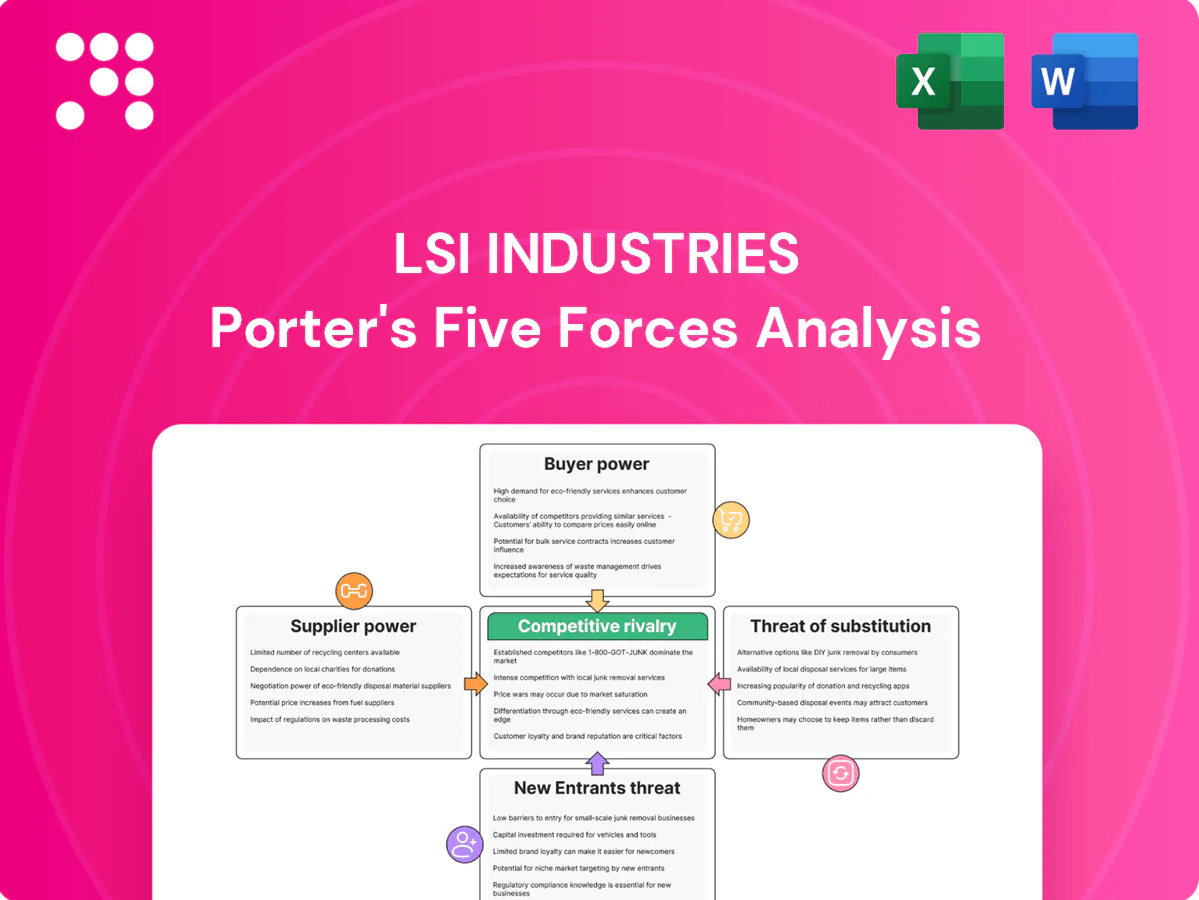
LSI Industries Porter's Five Forces Analysis

A Must-Have Tool for Decision-Makers
LSI Industries faces moderate supplier leverage, intense buyer price sensitivity in commercial lighting, and growing substitution pressure from LED integrators and smart lighting platforms. Competitive rivalry is high among niche manufacturers, while entry barriers remain moderate due to capital and regulatory needs. This brief snapshot only scratches the surface — unlock the full Porter's Five Forces Analysis to explore LSI’s competitive dynamics and strategic implications in detail.
Suppliers Bargaining Power

Diverse LED and driver sources
Global availability of LEDs and power drivers, with China/Taiwan accounting for an estimated 65% of supply, moderates supplier leverage for LSI. LSI routinely dual-sources components from 2+ vendors per SKU to cut dependency. Qualification and certification cycles typically run 3–9 months, creating switching friction. Multi-year purchase agreements and volume commitments (1–5 year contracts) further balance supplier power.
Commodity materials volatility
Aluminum, steel and plastics experienced double-digit price swings in 2024, pressuring LSI Industries' margins as suppliers frequently passed through cost increases. Suppliers' input power rose with tighter metal markets and polymer feedstock volatility, raising COGS and margin risk. Hedging, value-engineered designs and scale purchasing (centralized buys) reduced exposure and improved negotiation leverage.

Specialized components and lead times
Custom optics, specialized controls and printed-graphics substrates narrow supplier options, with lead times often extending 8–20 weeks and lengthening supplier leverage during tight cycles. Extended lead times increase bargaining power; robust forecasting and safety stock materially reduce risk. Maintaining approved-vendor lists preserves sourcing flexibility and negotiation leverage.

Logistics, tariffs, and geopolitics
Freight volatility (Drewry WCI ~1,800 USD/container average in 2024), US tariffs (steel 25%, aluminum 10%, Section 301 up to 25% on many Chinese electronics) and geopolitics shift bargaining power to suppliers; nearshoring and mixed sourcing reduce disruption risk, while LSI’s domestic plants cut exposure and logistics costs. Cost-sharing contract clauses further rebalance supplier terms.
- Freight: Drewry WCI ~1,800 USD (2024)
- Tariffs: steel 25%, Al 10%, Section 301 up to 25%
- Mitigants: nearshoring, mixed sourcing, LSI domestic plants, cost-sharing clauses
Quality and certification requirements
UL, DLC, and energy-code compliance (DLC lists >30,000 products in 2024) tightly constrain supplier substitution for LSI, raising technical and documentation barriers that favor prequalified vendors.
High reliability expectations increase qualification hurdles, giving vetted suppliers greater pricing and delivery influence, while robust QA and multi-supplier qualification programs reduce single-supplier concentration risk.
- Compliance: UL, DLC, code
- Scope: DLC >30,000 (2024)
- Impact: higher supplier leverage
- Mitigation: QA + multi-sourcing
Moderate supplier power: 65% China/Taiwan; freight, commodity swings pressure margins
Supplier power is moderate: China/Taiwan supply ~65% of LEDs/power drivers but LSI dual-sources and holds 1–5yr contracts to limit leverage. Commodity input volatility (metals/plastics double-digit swings in 2024) and freight (Drewry WCI ~1,800 USD/container) press margins; hedging and nearshoring mitigate. Certification (DLC >30,000 products) and long lead times raise switching costs.
| Factor | 2024 metric | Impact | Mitigant |
|---|---|---|---|
| Concentration | 65% China/Taiwan | Moderate | Dual-sourcing |
| Freight | WCI ~1,800 USD | Higher COGS | Nearshoring |
| Compliance | DLC >30,000 | Higher switching cost | Approved vendors |
What is included in the product
 Detailed Word Document
Tailored Porter's Five Forces analysis for LSI Industries uncovering competitive drivers, buyer and supplier bargaining power, threats from substitutes and new entrants, and emerging disruptive forces; includes strategic commentary to assess pricing power, profitability risks, and defensive barriers for use in investor decks, business plans, or editable Word reports.

 Customizable Excel Spreadsheet
One-sheet Porter's Five Forces for LSI Industries—quickly spot supplier, buyer, and competitor pressures to streamline strategy and reduce execution risk.
Customers Bargaining Power

Large chain accounts negotiate hard
QSR, petroleum and retail chains buy at scale and run competitive RFPs, using volume to push pricing and service levels and standardized specs that intensify price pressure; large accounts often demand centralized pricing, volume rebates and strict SLAs. LSI mitigates by offering turnkey, bundled lighting+controls solutions and value-added services that defend margins and shorten procurement cycles.
Total cost of ownership focus
Buyers prioritize total cost of ownership, emphasizing energy savings (LED retrofits commonly cut lighting energy use 50–70%), lower maintenance and extended warranty coverage. Strong ROI cases—often delivering payback in 1–3 years—reduce pure price haggling. Performance guarantees and utility or state rebates (commonly covering a meaningful portion of retrofit costs) improve buyer acceptance. Data-backed proposals increase switching to LSI by demonstrating measurable lifecycle savings.

Customization reduces comparability
Custom graphics and integrated signage make apples-to-apples comparisons difficult, as bespoke specifications and engineering vary widely across projects. Tailored designs raise switching costs and extend timelines, reducing buyer leverage. Dedicated program management and phased rollouts add further stickiness, dampening customer bargaining power and favoring supplier pricing stability.

Multiple alternatives available
Buyers can choose from numerous lighting and signage vendors, and in 2024 expanded imports and private-label offerings have increased customer leverage; LSI must compete beyond price. Differentiation through proven quality, faster lead times, and superior service is critical. Strong reference projects and warranties remain key tools to defend pricing and margins.
- Many vendor options
- Imports & private labels ↑ leverage
- Quality, lead time, service differentiate
- References & warranties defend price
Channel intermediaries influence specs
Distributors, ESCOs and specifiers strongly shape LSI Industries purchasing paths, with 2024 market interactions shifting leverage toward channel partners as spec-driven projects rose. Focused channel programs and training reduce this buyer power by aligning incentives and technical preferences. Co-marketing, targeted rebates and pull-through tactics proved effective in 2024 at restoring manufacturer influence.
- Channel-led specs increase buyer leverage
- Training aligns incentive and reduces churn
- Co-marketing and rebates boost pull-through
LED retrofits cut lighting energy 50–70%, typical payback 1–3 years
Large QSR, retail and fuel chains use volume RFPs and centralized pricing to pressure margins, but LSI’s bundled lighting+controls, service SLAs and warranties counteract this. Buyers focus on TCO—LED retrofits cut lighting energy 50–70% with typical payback 1–3 years—reducing pure price fights. Channel-led specs and rising imports in 2024 lifted buyer leverage, met by training, co-marketing and rebates.
| Metric | 2024 Value |
|---|---|
| LED energy savings | 50–70% |
| Typical payback | 1–3 years |
| Buyer leverage | Elevated (2024) |
Same Document Delivered
LSI Industries Porter's Five Forces Analysis
This preview shows the exact Porter's Five Forces analysis for LSI Industries you'll receive after purchase—no placeholders or edits. The document is fully formatted, actionable, and ready to download the moment you buy. Use this identical file for decision-making, reporting, or presentation without further setup.

A Must-Have Tool for Decision-Makers
LSI Industries faces moderate supplier leverage, intense buyer price sensitivity in commercial lighting, and growing substitution pressure from LED integrators and smart lighting platforms. Competitive rivalry is high among niche manufacturers, while entry barriers remain moderate due to capital and regulatory needs. This brief snapshot only scratches the surface — unlock the full Porter's Five Forces Analysis to explore LSI’s competitive dynamics and strategic implications in detail.
Suppliers Bargaining Power
Diverse LED and driver sources
Global availability of LEDs and power drivers, with China/Taiwan accounting for an estimated 65% of supply, moderates supplier leverage for LSI. LSI routinely dual-sources components from 2+ vendors per SKU to cut dependency. Qualification and certification cycles typically run 3–9 months, creating switching friction. Multi-year purchase agreements and volume commitments (1–5 year contracts) further balance supplier power.
Commodity materials volatility
Aluminum, steel and plastics experienced double-digit price swings in 2024, pressuring LSI Industries' margins as suppliers frequently passed through cost increases. Suppliers' input power rose with tighter metal markets and polymer feedstock volatility, raising COGS and margin risk. Hedging, value-engineered designs and scale purchasing (centralized buys) reduced exposure and improved negotiation leverage.
Specialized components and lead times
Custom optics, specialized controls and printed-graphics substrates narrow supplier options, with lead times often extending 8–20 weeks and lengthening supplier leverage during tight cycles. Extended lead times increase bargaining power; robust forecasting and safety stock materially reduce risk. Maintaining approved-vendor lists preserves sourcing flexibility and negotiation leverage.
Logistics, tariffs, and geopolitics
Freight volatility (Drewry WCI ~1,800 USD/container average in 2024), US tariffs (steel 25%, aluminum 10%, Section 301 up to 25% on many Chinese electronics) and geopolitics shift bargaining power to suppliers; nearshoring and mixed sourcing reduce disruption risk, while LSI’s domestic plants cut exposure and logistics costs. Cost-sharing contract clauses further rebalance supplier terms.
- Freight: Drewry WCI ~1,800 USD (2024)
- Tariffs: steel 25%, Al 10%, Section 301 up to 25%
- Mitigants: nearshoring, mixed sourcing, LSI domestic plants, cost-sharing clauses
Quality and certification requirements
UL, DLC, and energy-code compliance (DLC lists >30,000 products in 2024) tightly constrain supplier substitution for LSI, raising technical and documentation barriers that favor prequalified vendors.
High reliability expectations increase qualification hurdles, giving vetted suppliers greater pricing and delivery influence, while robust QA and multi-supplier qualification programs reduce single-supplier concentration risk.
- Compliance: UL, DLC, code
- Scope: DLC >30,000 (2024)
- Impact: higher supplier leverage
- Mitigation: QA + multi-sourcing
Moderate supplier power: 65% China/Taiwan; freight, commodity swings pressure margins
Supplier power is moderate: China/Taiwan supply ~65% of LEDs/power drivers but LSI dual-sources and holds 1–5yr contracts to limit leverage. Commodity input volatility (metals/plastics double-digit swings in 2024) and freight (Drewry WCI ~1,800 USD/container) press margins; hedging and nearshoring mitigate. Certification (DLC >30,000 products) and long lead times raise switching costs.
| Factor | 2024 metric | Impact | Mitigant |
|---|---|---|---|
| Concentration | 65% China/Taiwan | Moderate | Dual-sourcing |
| Freight | WCI ~1,800 USD | Higher COGS | Nearshoring |
| Compliance | DLC >30,000 | Higher switching cost | Approved vendors |
What is included in the product
Detailed Word Document
Tailored Porter's Five Forces analysis for LSI Industries uncovering competitive drivers, buyer and supplier bargaining power, threats from substitutes and new entrants, and emerging disruptive forces; includes strategic commentary to assess pricing power, profitability risks, and defensive barriers for use in investor decks, business plans, or editable Word reports.
Customizable Excel Spreadsheet
One-sheet Porter's Five Forces for LSI Industries—quickly spot supplier, buyer, and competitor pressures to streamline strategy and reduce execution risk.
Customers Bargaining Power
Large chain accounts negotiate hard
QSR, petroleum and retail chains buy at scale and run competitive RFPs, using volume to push pricing and service levels and standardized specs that intensify price pressure; large accounts often demand centralized pricing, volume rebates and strict SLAs. LSI mitigates by offering turnkey, bundled lighting+controls solutions and value-added services that defend margins and shorten procurement cycles.
Total cost of ownership focus
Buyers prioritize total cost of ownership, emphasizing energy savings (LED retrofits commonly cut lighting energy use 50–70%), lower maintenance and extended warranty coverage. Strong ROI cases—often delivering payback in 1–3 years—reduce pure price haggling. Performance guarantees and utility or state rebates (commonly covering a meaningful portion of retrofit costs) improve buyer acceptance. Data-backed proposals increase switching to LSI by demonstrating measurable lifecycle savings.
Customization reduces comparability
Custom graphics and integrated signage make apples-to-apples comparisons difficult, as bespoke specifications and engineering vary widely across projects. Tailored designs raise switching costs and extend timelines, reducing buyer leverage. Dedicated program management and phased rollouts add further stickiness, dampening customer bargaining power and favoring supplier pricing stability.
Multiple alternatives available
Buyers can choose from numerous lighting and signage vendors, and in 2024 expanded imports and private-label offerings have increased customer leverage; LSI must compete beyond price. Differentiation through proven quality, faster lead times, and superior service is critical. Strong reference projects and warranties remain key tools to defend pricing and margins.
- Many vendor options
- Imports & private labels ↑ leverage
- Quality, lead time, service differentiate
- References & warranties defend price
Channel intermediaries influence specs
Distributors, ESCOs and specifiers strongly shape LSI Industries purchasing paths, with 2024 market interactions shifting leverage toward channel partners as spec-driven projects rose. Focused channel programs and training reduce this buyer power by aligning incentives and technical preferences. Co-marketing, targeted rebates and pull-through tactics proved effective in 2024 at restoring manufacturer influence.
- Channel-led specs increase buyer leverage
- Training aligns incentive and reduces churn
- Co-marketing and rebates boost pull-through
LED retrofits cut lighting energy 50–70%, typical payback 1–3 years
Large QSR, retail and fuel chains use volume RFPs and centralized pricing to pressure margins, but LSI’s bundled lighting+controls, service SLAs and warranties counteract this. Buyers focus on TCO—LED retrofits cut lighting energy 50–70% with typical payback 1–3 years—reducing pure price fights. Channel-led specs and rising imports in 2024 lifted buyer leverage, met by training, co-marketing and rebates.
| Metric | 2024 Value |
|---|---|
| LED energy savings | 50–70% |
| Typical payback | 1–3 years |
| Buyer leverage | Elevated (2024) |
Same Document Delivered
LSI Industries Porter's Five Forces Analysis
This preview shows the exact Porter's Five Forces analysis for LSI Industries you'll receive after purchase—no placeholders or edits. The document is fully formatted, actionable, and ready to download the moment you buy. Use this identical file for decision-making, reporting, or presentation without further setup.
Description
A Must-Have Tool for Decision-Makers
LSI Industries faces moderate supplier leverage, intense buyer price sensitivity in commercial lighting, and growing substitution pressure from LED integrators and smart lighting platforms. Competitive rivalry is high among niche manufacturers, while entry barriers remain moderate due to capital and regulatory needs. This brief snapshot only scratches the surface — unlock the full Porter's Five Forces Analysis to explore LSI’s competitive dynamics and strategic implications in detail.
Suppliers Bargaining Power
Diverse LED and driver sources
Global availability of LEDs and power drivers, with China/Taiwan accounting for an estimated 65% of supply, moderates supplier leverage for LSI. LSI routinely dual-sources components from 2+ vendors per SKU to cut dependency. Qualification and certification cycles typically run 3–9 months, creating switching friction. Multi-year purchase agreements and volume commitments (1–5 year contracts) further balance supplier power.
Commodity materials volatility
Aluminum, steel and plastics experienced double-digit price swings in 2024, pressuring LSI Industries' margins as suppliers frequently passed through cost increases. Suppliers' input power rose with tighter metal markets and polymer feedstock volatility, raising COGS and margin risk. Hedging, value-engineered designs and scale purchasing (centralized buys) reduced exposure and improved negotiation leverage.
Specialized components and lead times
Custom optics, specialized controls and printed-graphics substrates narrow supplier options, with lead times often extending 8–20 weeks and lengthening supplier leverage during tight cycles. Extended lead times increase bargaining power; robust forecasting and safety stock materially reduce risk. Maintaining approved-vendor lists preserves sourcing flexibility and negotiation leverage.
Logistics, tariffs, and geopolitics
Freight volatility (Drewry WCI ~1,800 USD/container average in 2024), US tariffs (steel 25%, aluminum 10%, Section 301 up to 25% on many Chinese electronics) and geopolitics shift bargaining power to suppliers; nearshoring and mixed sourcing reduce disruption risk, while LSI’s domestic plants cut exposure and logistics costs. Cost-sharing contract clauses further rebalance supplier terms.
- Freight: Drewry WCI ~1,800 USD (2024)
- Tariffs: steel 25%, Al 10%, Section 301 up to 25%
- Mitigants: nearshoring, mixed sourcing, LSI domestic plants, cost-sharing clauses
Quality and certification requirements
UL, DLC, and energy-code compliance (DLC lists >30,000 products in 2024) tightly constrain supplier substitution for LSI, raising technical and documentation barriers that favor prequalified vendors.
High reliability expectations increase qualification hurdles, giving vetted suppliers greater pricing and delivery influence, while robust QA and multi-supplier qualification programs reduce single-supplier concentration risk.
- Compliance: UL, DLC, code
- Scope: DLC >30,000 (2024)
- Impact: higher supplier leverage
- Mitigation: QA + multi-sourcing
Moderate supplier power: 65% China/Taiwan; freight, commodity swings pressure margins
Supplier power is moderate: China/Taiwan supply ~65% of LEDs/power drivers but LSI dual-sources and holds 1–5yr contracts to limit leverage. Commodity input volatility (metals/plastics double-digit swings in 2024) and freight (Drewry WCI ~1,800 USD/container) press margins; hedging and nearshoring mitigate. Certification (DLC >30,000 products) and long lead times raise switching costs.
| Factor | 2024 metric | Impact | Mitigant |
|---|---|---|---|
| Concentration | 65% China/Taiwan | Moderate | Dual-sourcing |
| Freight | WCI ~1,800 USD | Higher COGS | Nearshoring |
| Compliance | DLC >30,000 | Higher switching cost | Approved vendors |
What is included in the product
Detailed Word Document
Tailored Porter's Five Forces analysis for LSI Industries uncovering competitive drivers, buyer and supplier bargaining power, threats from substitutes and new entrants, and emerging disruptive forces; includes strategic commentary to assess pricing power, profitability risks, and defensive barriers for use in investor decks, business plans, or editable Word reports.
Customizable Excel Spreadsheet
One-sheet Porter's Five Forces for LSI Industries—quickly spot supplier, buyer, and competitor pressures to streamline strategy and reduce execution risk.
Customers Bargaining Power
Large chain accounts negotiate hard
QSR, petroleum and retail chains buy at scale and run competitive RFPs, using volume to push pricing and service levels and standardized specs that intensify price pressure; large accounts often demand centralized pricing, volume rebates and strict SLAs. LSI mitigates by offering turnkey, bundled lighting+controls solutions and value-added services that defend margins and shorten procurement cycles.
Total cost of ownership focus
Buyers prioritize total cost of ownership, emphasizing energy savings (LED retrofits commonly cut lighting energy use 50–70%), lower maintenance and extended warranty coverage. Strong ROI cases—often delivering payback in 1–3 years—reduce pure price haggling. Performance guarantees and utility or state rebates (commonly covering a meaningful portion of retrofit costs) improve buyer acceptance. Data-backed proposals increase switching to LSI by demonstrating measurable lifecycle savings.
Customization reduces comparability
Custom graphics and integrated signage make apples-to-apples comparisons difficult, as bespoke specifications and engineering vary widely across projects. Tailored designs raise switching costs and extend timelines, reducing buyer leverage. Dedicated program management and phased rollouts add further stickiness, dampening customer bargaining power and favoring supplier pricing stability.
Multiple alternatives available
Buyers can choose from numerous lighting and signage vendors, and in 2024 expanded imports and private-label offerings have increased customer leverage; LSI must compete beyond price. Differentiation through proven quality, faster lead times, and superior service is critical. Strong reference projects and warranties remain key tools to defend pricing and margins.
- Many vendor options
- Imports & private labels ↑ leverage
- Quality, lead time, service differentiate
- References & warranties defend price
Channel intermediaries influence specs
Distributors, ESCOs and specifiers strongly shape LSI Industries purchasing paths, with 2024 market interactions shifting leverage toward channel partners as spec-driven projects rose. Focused channel programs and training reduce this buyer power by aligning incentives and technical preferences. Co-marketing, targeted rebates and pull-through tactics proved effective in 2024 at restoring manufacturer influence.
- Channel-led specs increase buyer leverage
- Training aligns incentive and reduces churn
- Co-marketing and rebates boost pull-through
LED retrofits cut lighting energy 50–70%, typical payback 1–3 years
Large QSR, retail and fuel chains use volume RFPs and centralized pricing to pressure margins, but LSI’s bundled lighting+controls, service SLAs and warranties counteract this. Buyers focus on TCO—LED retrofits cut lighting energy 50–70% with typical payback 1–3 years—reducing pure price fights. Channel-led specs and rising imports in 2024 lifted buyer leverage, met by training, co-marketing and rebates.
| Metric | 2024 Value |
|---|---|
| LED energy savings | 50–70% |
| Typical payback | 1–3 years |
| Buyer leverage | Elevated (2024) |
Same Document Delivered
LSI Industries Porter's Five Forces Analysis
This preview shows the exact Porter's Five Forces analysis for LSI Industries you'll receive after purchase—no placeholders or edits. The document is fully formatted, actionable, and ready to download the moment you buy. Use this identical file for decision-making, reporting, or presentation without further setup.











