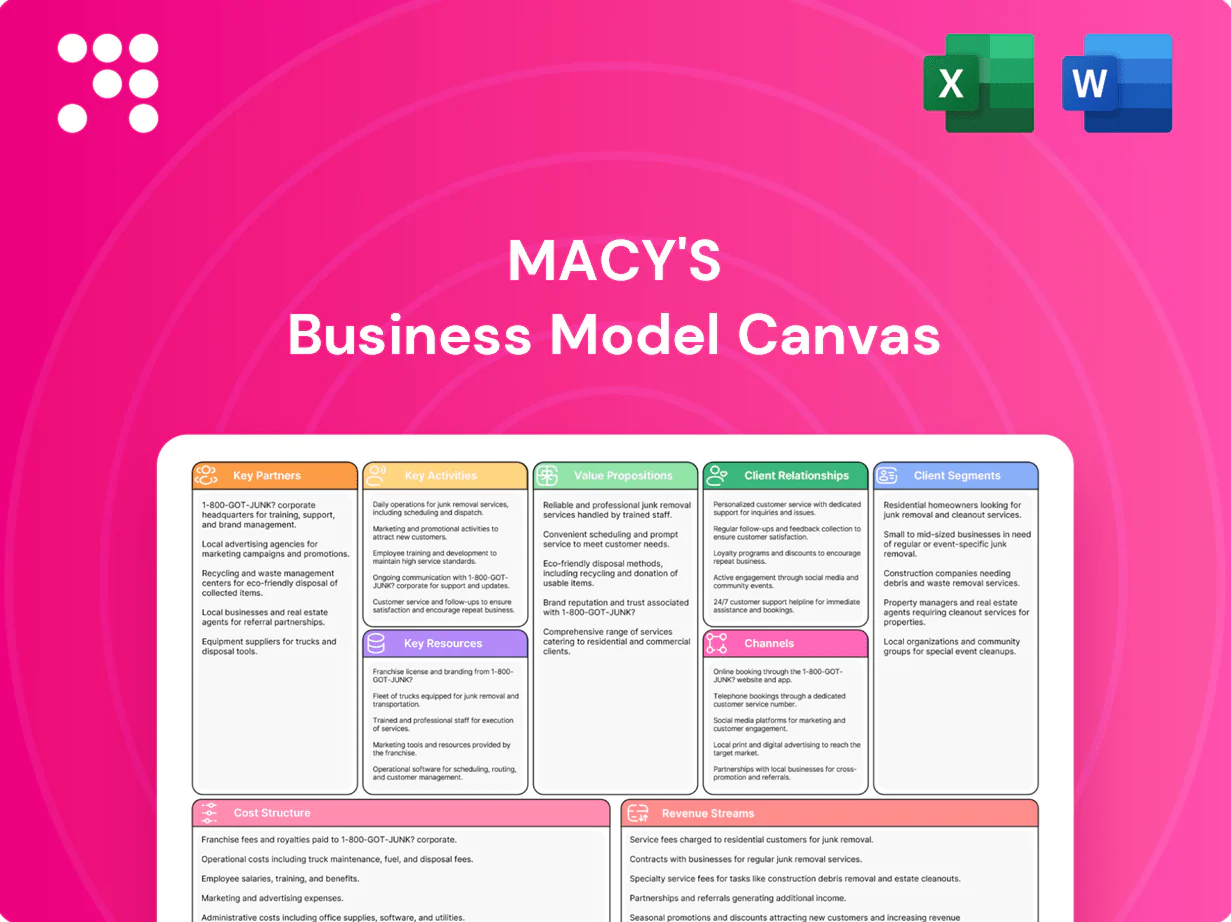
Macy's Business Model Canvas

Explore a leading department store's Business Model Canvas: omnichannel to revenue
Dive into Macy's Business Model Canvas: a clear map of its value propositions, customer segments, channels, revenue streams and cost structure. This concise snapshot unveils how Macy's scales omnichannel retail and leverages partnerships. Purchase the full Canvas for a section-by-section Word/Excel guide and strategic insights to benchmark or invest with confidence.
Partnerships

National brand and beauty suppliers
Relationships with apparel, accessories, cosmetics, and home vendors ensure assortment breadth and depth across Macy's omnichannel footprint of over 700 stores and macys.com, enabling consistent category coverage.
Exclusive and limited-time collections from national and beauty partners drive store and online traffic, while vendor-funded promotions and co-op marketing programs support promotional margins.
Reliable supplier agreements help maintain in-stock performance across seasons, improving sell-through and customer satisfaction.
Private label and exclusive brand manufacturers
OEMs and sourcing agents produce Macy’s, Bloomingdale’s and Bluemercury exclusives, supporting differentiated assortments that drive private‑brand appeal; Macy’s has expanded exclusive lines since the 2015 Bluemercury acquisition and continues to scale exclusives as of 2024.
These private‑label assortments help improve gross margin through higher contribution per SKU and reduced promotional pressure, while long‑term supplier agreements deliver flexibility on MOQs, speed to market and consistent quality.
Ethical sourcing partners are integrated into vendor programs to support Macy’s 2024 ESG commitments, supplier audits and traceability initiatives.

Logistics, carriers, and 3PL partners
Parcel, LTL and same‑day couriers power Macy's omnichannel delivery, enabling store‑as‑fulfillment for over 500 Macy's and Bloomingdale's locations. 3PL partners augment peak capacity and regional coverage, often increasing throughput by 20% during holiday spikes. Port, drayage and DC partners stabilize flow from origin to store and customer, while reverse logistics providers streamline returns and refurb for resale.

Technology and payments ecosystem
Technology and payments partners—e-commerce platforms, cloud providers, and martech vendors—enable Macy's site, app, and data personalization while POS and fraud tools secure checkout; payment networks and processors expand tender options and co-brand issuer Synchrony supports Macy's credit and loyalty economics, underpinning omnichannel sales that contributed to Macy's $24.6B net sales in FY2023.
- e-commerce/cloud/martech: personalization
- POS/fraud: secure checkout
- payment networks: broader tenders
- co-brand PLCC: Synchrony — credit + loyalty economics
Marketplace sellers and marketing collaborators
Curated third-party marketplace sellers broaden Macy's long-tail online assortment, driving incremental categories and higher conversion through exclusive and niche brands; influencers, media agencies and brand partners amplify campaigns across owned and paid channels; bridal, beauty and event partners expand in-store and virtual services; community and charitable partners strengthen local presence and customer loyalty.
- Marketplace: third-party assortment expansion
- Marketing: influencers & media agencies
- Services: bridal, beauty, events
- Community: local charity partnerships
Omnichannel partners drive assortment, margins and 700+ store fulfillment
Strategic vendor, private‑label, logistics, technology, payments and marketing partners sustain Macy’s omnichannel assortment, margins and fulfillment — supporting 700+ stores and store‑as‑fulfillment at 500+ locations and aligning with Macy’s 2024 ESG commitments. Exclusive lines and vendor co‑ops boost traffic and margins; 3PLs raise peak throughput ~20% during holidays; Synchrony underpins credit/loyalty economics after FY2023 $24.6B sales.
| Partnership Type | Role | 2024 Metric |
|---|---|---|
| Vendors/Exclusives | Assortment & margins | 700+ stores |
| Logistics/3PL | Fulfillment & peaks | 500+ store‑as‑fulfillment; +20% peak throughput |
| Payments | Credit & loyalty | Supports FY2023 $24.6B sales |
What is included in the product
 Detailed Word Document
Comprehensive Business Model Canvas for Macy’s covering all 9 blocks—customer segments (omnichannel shoppers, loyalty members, fashion-conscious and value buyers), channels (flagship stores, regional malls, e‑commerce), value propositions (wide assortment, private labels, curated brands, omnichannel convenience), revenue streams (merchandise, services, partnerships), key resources/advantages (scale, real estate, brand, supply chain)—designed for presentations and investor analysis.

 Customizable Excel Spreadsheet
High-level one-page Business Model Canvas for Macy’s that pinpoints pain points in omnichannel fulfillment, inventory allocation, and loyalty engagement—editable for teams to quickly brainstorm fixes and align priorities.
Activities

Merchandising and assortment planning
Merchandising at Macy's builds seasonal lines and manages vendor selection and product lifecycles to fashion calendars, supporting roughly 700 stores and a national omnichannel footprint. Pricing and promotional cadence balances traffic and margin, leveraging markdown windows that target peak shopping weeks. Allocation and localization tailor assortments by store and market to maximize sell-through, while trend scouting sustains relevance in fast-moving categories.
Omnichannel operations and fulfillment
Macy's omnichannel operations use BOPIS, curbside, ship-from-store and same-day orchestration to cut delivery time and meet rising consumer expectations. DC operations and real-time inventory visibility across roughly 660 stores in 2024 boost order fill rates and reduce markdowns. Streamlined returns and cross-channel exchanges improve recovery and customer retention. Peak planning and labor scheduling stabilize service levels during holiday spikes.

E-commerce and mobile product development
Macy's e-commerce and mobile product development focuses on site and app enhancements that streamline search, browse, and checkout flows to reduce friction and lift conversion. Rich content, customer ratings, and machine-driven personalization tailor assortments and promotions to increase basket size. Continuous optimization of performance, security, and accessibility maintains compliance and trust, while systematic A/B testing delivers measured incremental gains in key metrics.

Customer marketing and loyalty management
CRM and Star Rewards drive repeat visits and larger baskets through targeted offers and tiered benefits; email, push, social and Macy's retail media network efficiently convert traffic into sales. Clienteling technology and trained associates prioritize high-value customers in-store and online. Offer governance and markdown discipline protect gross margin while supporting loyalty promotions.
- Star Rewards: loyalty-led sales focus
- Omnichannel: email/push/social/retail media
- Clienteling: high-value client support
- Offer governance: margin protection
Supply chain, sourcing, and vendor management
Macy's supply-chain function balances forecasting and replenishment to optimize service while conserving working capital for a retailer with 2023 net sales of $22.2B and over 700 stores. Global sourcing coordinates lead times, supplier quality, and compliance across regions to meet seasonal demand. Negotiated terms and dynamic cost controls improve cash flow, while risk management programs and contingency sourcing mitigate disruptions.
- Forecasting/replenishment: service vs working capital
- Global sourcing: lead times, quality, compliance
- Cost negotiations: better cash flow
- Risk mgmt: supply disruption mitigation
Omnichannel merchandising fuels traffic & margin across 700 stores
Key activities center on merchandising, omnichannel fulfillment, e‑commerce/product optimization and CRM/loyalty to drive traffic, conversion and margin across roughly 700 stores. In 2024 Macy's operated inventory visibility across ~660 stores to support BOPIS/ship‑from‑store, peak planning and returns management. Supply‑chain sourcing and cost negotiation sustain seasonal assortments and working capital for a retailer with 2023 net sales of $22.2B.
| Metric | Value |
|---|---|
| Stores (approx.) | 700 |
| Stores w/ real‑time inventory (2024) | 660 |
| Net sales (2023) | $22.2B |
Delivered as Displayed
Business Model Canvas
The Business Model Canvas previewed here is the actual Macy’s deliverable—not a mockup—and reflects the full structure, content, and strategic insights you’ll receive upon purchase. When you complete your order, you’ll download this exact document ready for editing and presentation. No placeholders, no surprises—what you see is what you’ll own.

Explore a leading department store's Business Model Canvas: omnichannel to revenue
Dive into Macy's Business Model Canvas: a clear map of its value propositions, customer segments, channels, revenue streams and cost structure. This concise snapshot unveils how Macy's scales omnichannel retail and leverages partnerships. Purchase the full Canvas for a section-by-section Word/Excel guide and strategic insights to benchmark or invest with confidence.
Partnerships
National brand and beauty suppliers
Relationships with apparel, accessories, cosmetics, and home vendors ensure assortment breadth and depth across Macy's omnichannel footprint of over 700 stores and macys.com, enabling consistent category coverage.
Exclusive and limited-time collections from national and beauty partners drive store and online traffic, while vendor-funded promotions and co-op marketing programs support promotional margins.
Reliable supplier agreements help maintain in-stock performance across seasons, improving sell-through and customer satisfaction.
Private label and exclusive brand manufacturers
OEMs and sourcing agents produce Macy’s, Bloomingdale’s and Bluemercury exclusives, supporting differentiated assortments that drive private‑brand appeal; Macy’s has expanded exclusive lines since the 2015 Bluemercury acquisition and continues to scale exclusives as of 2024.
These private‑label assortments help improve gross margin through higher contribution per SKU and reduced promotional pressure, while long‑term supplier agreements deliver flexibility on MOQs, speed to market and consistent quality.
Ethical sourcing partners are integrated into vendor programs to support Macy’s 2024 ESG commitments, supplier audits and traceability initiatives.
Logistics, carriers, and 3PL partners
Parcel, LTL and same‑day couriers power Macy's omnichannel delivery, enabling store‑as‑fulfillment for over 500 Macy's and Bloomingdale's locations. 3PL partners augment peak capacity and regional coverage, often increasing throughput by 20% during holiday spikes. Port, drayage and DC partners stabilize flow from origin to store and customer, while reverse logistics providers streamline returns and refurb for resale.
Technology and payments ecosystem
Technology and payments partners—e-commerce platforms, cloud providers, and martech vendors—enable Macy's site, app, and data personalization while POS and fraud tools secure checkout; payment networks and processors expand tender options and co-brand issuer Synchrony supports Macy's credit and loyalty economics, underpinning omnichannel sales that contributed to Macy's $24.6B net sales in FY2023.
- e-commerce/cloud/martech: personalization
- POS/fraud: secure checkout
- payment networks: broader tenders
- co-brand PLCC: Synchrony — credit + loyalty economics
Marketplace sellers and marketing collaborators
Curated third-party marketplace sellers broaden Macy's long-tail online assortment, driving incremental categories and higher conversion through exclusive and niche brands; influencers, media agencies and brand partners amplify campaigns across owned and paid channels; bridal, beauty and event partners expand in-store and virtual services; community and charitable partners strengthen local presence and customer loyalty.
- Marketplace: third-party assortment expansion
- Marketing: influencers & media agencies
- Services: bridal, beauty, events
- Community: local charity partnerships
Omnichannel partners drive assortment, margins and 700+ store fulfillment
Strategic vendor, private‑label, logistics, technology, payments and marketing partners sustain Macy’s omnichannel assortment, margins and fulfillment — supporting 700+ stores and store‑as‑fulfillment at 500+ locations and aligning with Macy’s 2024 ESG commitments. Exclusive lines and vendor co‑ops boost traffic and margins; 3PLs raise peak throughput ~20% during holidays; Synchrony underpins credit/loyalty economics after FY2023 $24.6B sales.
| Partnership Type | Role | 2024 Metric |
|---|---|---|
| Vendors/Exclusives | Assortment & margins | 700+ stores |
| Logistics/3PL | Fulfillment & peaks | 500+ store‑as‑fulfillment; +20% peak throughput |
| Payments | Credit & loyalty | Supports FY2023 $24.6B sales |
What is included in the product
Detailed Word Document
Comprehensive Business Model Canvas for Macy’s covering all 9 blocks—customer segments (omnichannel shoppers, loyalty members, fashion-conscious and value buyers), channels (flagship stores, regional malls, e‑commerce), value propositions (wide assortment, private labels, curated brands, omnichannel convenience), revenue streams (merchandise, services, partnerships), key resources/advantages (scale, real estate, brand, supply chain)—designed for presentations and investor analysis.
Customizable Excel Spreadsheet
High-level one-page Business Model Canvas for Macy’s that pinpoints pain points in omnichannel fulfillment, inventory allocation, and loyalty engagement—editable for teams to quickly brainstorm fixes and align priorities.
Activities
Merchandising and assortment planning
Merchandising at Macy's builds seasonal lines and manages vendor selection and product lifecycles to fashion calendars, supporting roughly 700 stores and a national omnichannel footprint. Pricing and promotional cadence balances traffic and margin, leveraging markdown windows that target peak shopping weeks. Allocation and localization tailor assortments by store and market to maximize sell-through, while trend scouting sustains relevance in fast-moving categories.
Omnichannel operations and fulfillment
Macy's omnichannel operations use BOPIS, curbside, ship-from-store and same-day orchestration to cut delivery time and meet rising consumer expectations. DC operations and real-time inventory visibility across roughly 660 stores in 2024 boost order fill rates and reduce markdowns. Streamlined returns and cross-channel exchanges improve recovery and customer retention. Peak planning and labor scheduling stabilize service levels during holiday spikes.
E-commerce and mobile product development
Macy's e-commerce and mobile product development focuses on site and app enhancements that streamline search, browse, and checkout flows to reduce friction and lift conversion. Rich content, customer ratings, and machine-driven personalization tailor assortments and promotions to increase basket size. Continuous optimization of performance, security, and accessibility maintains compliance and trust, while systematic A/B testing delivers measured incremental gains in key metrics.
Customer marketing and loyalty management
CRM and Star Rewards drive repeat visits and larger baskets through targeted offers and tiered benefits; email, push, social and Macy's retail media network efficiently convert traffic into sales. Clienteling technology and trained associates prioritize high-value customers in-store and online. Offer governance and markdown discipline protect gross margin while supporting loyalty promotions.
- Star Rewards: loyalty-led sales focus
- Omnichannel: email/push/social/retail media
- Clienteling: high-value client support
- Offer governance: margin protection
Supply chain, sourcing, and vendor management
Macy's supply-chain function balances forecasting and replenishment to optimize service while conserving working capital for a retailer with 2023 net sales of $22.2B and over 700 stores. Global sourcing coordinates lead times, supplier quality, and compliance across regions to meet seasonal demand. Negotiated terms and dynamic cost controls improve cash flow, while risk management programs and contingency sourcing mitigate disruptions.
- Forecasting/replenishment: service vs working capital
- Global sourcing: lead times, quality, compliance
- Cost negotiations: better cash flow
- Risk mgmt: supply disruption mitigation
Omnichannel merchandising fuels traffic & margin across 700 stores
Key activities center on merchandising, omnichannel fulfillment, e‑commerce/product optimization and CRM/loyalty to drive traffic, conversion and margin across roughly 700 stores. In 2024 Macy's operated inventory visibility across ~660 stores to support BOPIS/ship‑from‑store, peak planning and returns management. Supply‑chain sourcing and cost negotiation sustain seasonal assortments and working capital for a retailer with 2023 net sales of $22.2B.
| Metric | Value |
|---|---|
| Stores (approx.) | 700 |
| Stores w/ real‑time inventory (2024) | 660 |
| Net sales (2023) | $22.2B |
Delivered as Displayed
Business Model Canvas
The Business Model Canvas previewed here is the actual Macy’s deliverable—not a mockup—and reflects the full structure, content, and strategic insights you’ll receive upon purchase. When you complete your order, you’ll download this exact document ready for editing and presentation. No placeholders, no surprises—what you see is what you’ll own.
Description
Explore a leading department store's Business Model Canvas: omnichannel to revenue
Dive into Macy's Business Model Canvas: a clear map of its value propositions, customer segments, channels, revenue streams and cost structure. This concise snapshot unveils how Macy's scales omnichannel retail and leverages partnerships. Purchase the full Canvas for a section-by-section Word/Excel guide and strategic insights to benchmark or invest with confidence.
Partnerships
National brand and beauty suppliers
Relationships with apparel, accessories, cosmetics, and home vendors ensure assortment breadth and depth across Macy's omnichannel footprint of over 700 stores and macys.com, enabling consistent category coverage.
Exclusive and limited-time collections from national and beauty partners drive store and online traffic, while vendor-funded promotions and co-op marketing programs support promotional margins.
Reliable supplier agreements help maintain in-stock performance across seasons, improving sell-through and customer satisfaction.
Private label and exclusive brand manufacturers
OEMs and sourcing agents produce Macy’s, Bloomingdale’s and Bluemercury exclusives, supporting differentiated assortments that drive private‑brand appeal; Macy’s has expanded exclusive lines since the 2015 Bluemercury acquisition and continues to scale exclusives as of 2024.
These private‑label assortments help improve gross margin through higher contribution per SKU and reduced promotional pressure, while long‑term supplier agreements deliver flexibility on MOQs, speed to market and consistent quality.
Ethical sourcing partners are integrated into vendor programs to support Macy’s 2024 ESG commitments, supplier audits and traceability initiatives.
Logistics, carriers, and 3PL partners
Parcel, LTL and same‑day couriers power Macy's omnichannel delivery, enabling store‑as‑fulfillment for over 500 Macy's and Bloomingdale's locations. 3PL partners augment peak capacity and regional coverage, often increasing throughput by 20% during holiday spikes. Port, drayage and DC partners stabilize flow from origin to store and customer, while reverse logistics providers streamline returns and refurb for resale.
Technology and payments ecosystem
Technology and payments partners—e-commerce platforms, cloud providers, and martech vendors—enable Macy's site, app, and data personalization while POS and fraud tools secure checkout; payment networks and processors expand tender options and co-brand issuer Synchrony supports Macy's credit and loyalty economics, underpinning omnichannel sales that contributed to Macy's $24.6B net sales in FY2023.
- e-commerce/cloud/martech: personalization
- POS/fraud: secure checkout
- payment networks: broader tenders
- co-brand PLCC: Synchrony — credit + loyalty economics
Marketplace sellers and marketing collaborators
Curated third-party marketplace sellers broaden Macy's long-tail online assortment, driving incremental categories and higher conversion through exclusive and niche brands; influencers, media agencies and brand partners amplify campaigns across owned and paid channels; bridal, beauty and event partners expand in-store and virtual services; community and charitable partners strengthen local presence and customer loyalty.
- Marketplace: third-party assortment expansion
- Marketing: influencers & media agencies
- Services: bridal, beauty, events
- Community: local charity partnerships
Omnichannel partners drive assortment, margins and 700+ store fulfillment
Strategic vendor, private‑label, logistics, technology, payments and marketing partners sustain Macy’s omnichannel assortment, margins and fulfillment — supporting 700+ stores and store‑as‑fulfillment at 500+ locations and aligning with Macy’s 2024 ESG commitments. Exclusive lines and vendor co‑ops boost traffic and margins; 3PLs raise peak throughput ~20% during holidays; Synchrony underpins credit/loyalty economics after FY2023 $24.6B sales.
| Partnership Type | Role | 2024 Metric |
|---|---|---|
| Vendors/Exclusives | Assortment & margins | 700+ stores |
| Logistics/3PL | Fulfillment & peaks | 500+ store‑as‑fulfillment; +20% peak throughput |
| Payments | Credit & loyalty | Supports FY2023 $24.6B sales |
What is included in the product
Detailed Word Document
Comprehensive Business Model Canvas for Macy’s covering all 9 blocks—customer segments (omnichannel shoppers, loyalty members, fashion-conscious and value buyers), channels (flagship stores, regional malls, e‑commerce), value propositions (wide assortment, private labels, curated brands, omnichannel convenience), revenue streams (merchandise, services, partnerships), key resources/advantages (scale, real estate, brand, supply chain)—designed for presentations and investor analysis.
Customizable Excel Spreadsheet
High-level one-page Business Model Canvas for Macy’s that pinpoints pain points in omnichannel fulfillment, inventory allocation, and loyalty engagement—editable for teams to quickly brainstorm fixes and align priorities.
Activities
Merchandising and assortment planning
Merchandising at Macy's builds seasonal lines and manages vendor selection and product lifecycles to fashion calendars, supporting roughly 700 stores and a national omnichannel footprint. Pricing and promotional cadence balances traffic and margin, leveraging markdown windows that target peak shopping weeks. Allocation and localization tailor assortments by store and market to maximize sell-through, while trend scouting sustains relevance in fast-moving categories.
Omnichannel operations and fulfillment
Macy's omnichannel operations use BOPIS, curbside, ship-from-store and same-day orchestration to cut delivery time and meet rising consumer expectations. DC operations and real-time inventory visibility across roughly 660 stores in 2024 boost order fill rates and reduce markdowns. Streamlined returns and cross-channel exchanges improve recovery and customer retention. Peak planning and labor scheduling stabilize service levels during holiday spikes.
E-commerce and mobile product development
Macy's e-commerce and mobile product development focuses on site and app enhancements that streamline search, browse, and checkout flows to reduce friction and lift conversion. Rich content, customer ratings, and machine-driven personalization tailor assortments and promotions to increase basket size. Continuous optimization of performance, security, and accessibility maintains compliance and trust, while systematic A/B testing delivers measured incremental gains in key metrics.
Customer marketing and loyalty management
CRM and Star Rewards drive repeat visits and larger baskets through targeted offers and tiered benefits; email, push, social and Macy's retail media network efficiently convert traffic into sales. Clienteling technology and trained associates prioritize high-value customers in-store and online. Offer governance and markdown discipline protect gross margin while supporting loyalty promotions.
- Star Rewards: loyalty-led sales focus
- Omnichannel: email/push/social/retail media
- Clienteling: high-value client support
- Offer governance: margin protection
Supply chain, sourcing, and vendor management
Macy's supply-chain function balances forecasting and replenishment to optimize service while conserving working capital for a retailer with 2023 net sales of $22.2B and over 700 stores. Global sourcing coordinates lead times, supplier quality, and compliance across regions to meet seasonal demand. Negotiated terms and dynamic cost controls improve cash flow, while risk management programs and contingency sourcing mitigate disruptions.
- Forecasting/replenishment: service vs working capital
- Global sourcing: lead times, quality, compliance
- Cost negotiations: better cash flow
- Risk mgmt: supply disruption mitigation
Omnichannel merchandising fuels traffic & margin across 700 stores
Key activities center on merchandising, omnichannel fulfillment, e‑commerce/product optimization and CRM/loyalty to drive traffic, conversion and margin across roughly 700 stores. In 2024 Macy's operated inventory visibility across ~660 stores to support BOPIS/ship‑from‑store, peak planning and returns management. Supply‑chain sourcing and cost negotiation sustain seasonal assortments and working capital for a retailer with 2023 net sales of $22.2B.
| Metric | Value |
|---|---|
| Stores (approx.) | 700 |
| Stores w/ real‑time inventory (2024) | 660 |
| Net sales (2023) | $22.2B |
Delivered as Displayed
Business Model Canvas
The Business Model Canvas previewed here is the actual Macy’s deliverable—not a mockup—and reflects the full structure, content, and strategic insights you’ll receive upon purchase. When you complete your order, you’ll download this exact document ready for editing and presentation. No placeholders, no surprises—what you see is what you’ll own.











