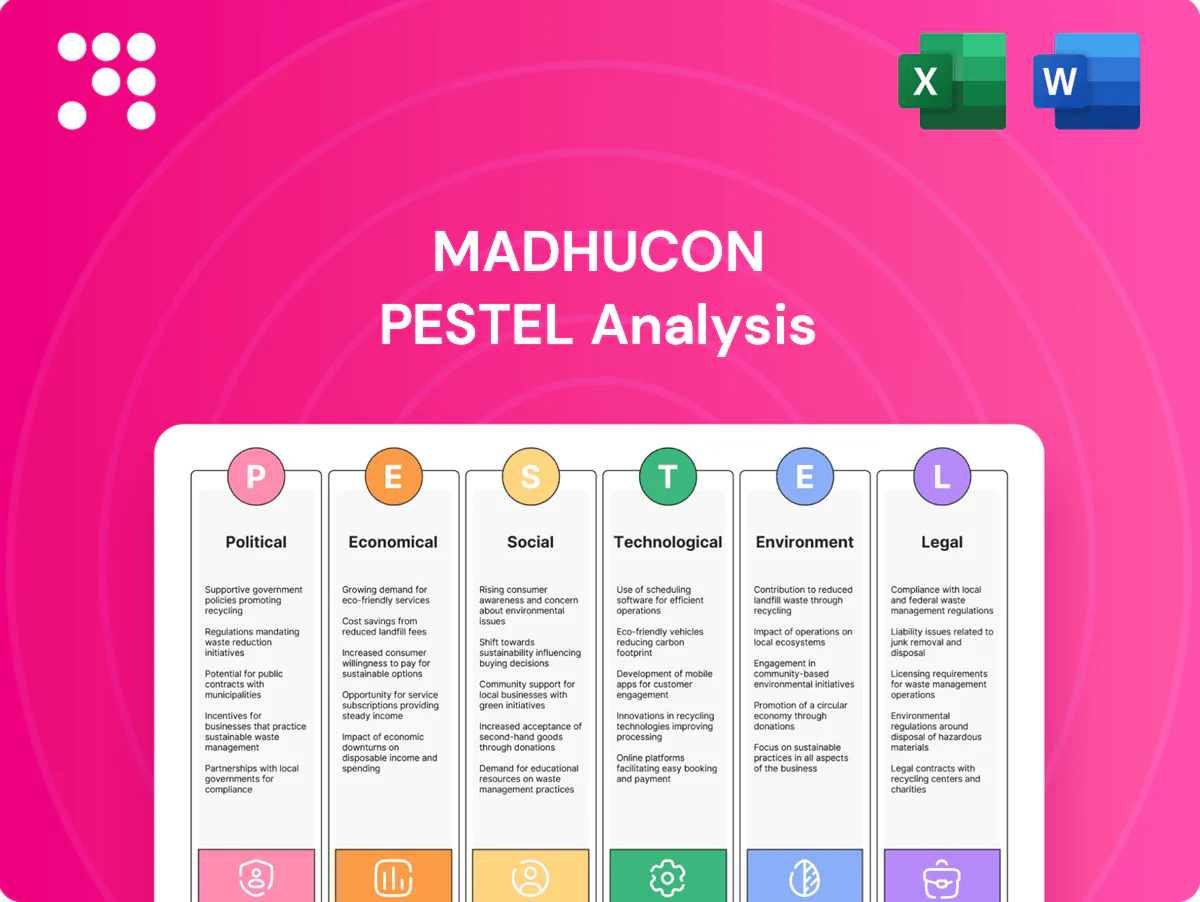
Madhucon PESTLE Analysis

Your Shortcut to Market Insight Starts Here
Unlock strategic clarity with our targeted PESTLE Analysis of Madhucon—three decades of industry forces distilled into actionable intelligence. Discover how political, economic, social, technological, legal, and environmental trends shape the company’s prospects. Purchase the full report to access deep-dive insights and ready-to-use recommendations for investors and strategists.
Political factors

Central infra push
PPP and concession models
Hybrid Annuity, BOT and EPC mixes determine Madhucon’s developer risk-reward: HAM gives predictable annuity cash flows that improve bankability, EPC shifts construction risk onto contractors reducing traffic/volume risk, while BOT retains long-term traffic exposure. Recent policy tweaks to concession clauses (indexation, force majeure wording) directly affect margins and arbitration claims. Choice of model materially changes working-capital intensity, especially under India’s 25 km/day highway push in 2024–25.

State-level politics
State elections affect award timing, land acquisition and payments for players like Madhucon as governments defer projects near polls; India's National Infrastructure Pipeline targets roughly 111 lakh crore INR of investment through 2025, so regional budget pivots between irrigation and roads can reallocate significant funds. Coalition shifts have forced re-tendering historically, making multi-state exposure essential to reduce geographic concentration risk.

Public procurement norms
Public procurement norms push Madhucon to prioritize Make-in-India compliance and L1-focused bid pricing, with government price-preference provisions offering up to 20% margin for eligible local suppliers; stringent pre-qualification thresholds and past-performance filters (turnover, completion records) materially constrain bid eligibility. Rapid e-procurement rollouts have raised tender transparency and typically increased bidder pools, while timely change-in-scope approvals remain essential for securing variation order revenue.
Geopolitics and inputs
Global tensions threaten steel, bitumen and fuel supply chains; Brent crude averaged about 85 USD/bbl in 2024, amplifying input costs for construction players like Madhucon. India maintained ~15% duties on certain steel imports, while INR traded near 82–83 per USD in 2024, altering equipment and material economics. Active FX hedging and supplier diversification reduce landed-cost shocks.
- Brent 2024 avg ~85 USD/bbl
- INR ~82–83/USD (2024)
- Steel import duty ~15%
- Hedging + supplier diversification = lower supply risk
Policy push boosts EPC pipeline; HAM/EPC/BOT shifts cashflow, elections alter awards
Policy push (Gati Shakti, 111 lakh crore INR NIP to 2025, Bharatmala ~5.35 lakh crore) expands Madhucon’s EPC pipeline while HAM/EPC/BOT mixes shift cashflow and risk profiles; state elections and coalition changes affect award timing and payments. Procurement rules (Make-in-India price preference up to 20%, strict PQQ) and global inputs (Brent ~85 USD/bbl, INR ~82–83/USD, steel duty ~15%) drive margins and working-capital needs.
| Item | Key figure |
|---|---|
| NIP (to 2025) | 111 lakh crore INR |
| Bharatmala | ~5.35 lakh crore INR |
| Make-in-India pref | up to 20% |
| Brent (2024) | ~85 USD/bbl |
| INR (2024) | ~82–83/USD |
| Steel import duty | ~15% |
What is included in the product
 Detailed Word Document
Explores how Political, Economic, Social, Technological, Environmental and Legal forces uniquely affect Madhucon, with data-backed, region- and industry-specific insights and forward-looking scenarios to identify risks and opportunities. Delivered in clean, report-ready format to support executives, consultants and investors.

 Customizable Excel Spreadsheet
A concise, visually segmented Madhucon PESTLE summary that’s easily drop‑in for presentations, shareable across teams, and customizable with notes to support quick risk discussions and strategic alignment.
Economic factors

Interest rate cycle
Madhucon’s EPC and concession financing are highly sensitive to RBI repo moves (repo at 6.50% as of July 2025) and 10-year G‑sec yields near 7.20%; higher rates compress NPV of HAM/BOT projects and tighten working capital. Recent softening in yields has eased bank guarantee pricing and refinancing spreads, improving liquidity. Aligning bid assumptions to the rate outlook preserves margins and bid competitiveness.
Commodity price swings
Commodity price swings in steel, cement and bitumen have shifted Madhucon project cost baselines materially, with steel prices moving about ±15% in 2023–24, cement retail up ~6% YoY in early 2024 and bitumen following crude oil volatility (±20% range). Price-escalation clauses provide partial protection but operate with implementation lag. Strategic procurement timing and framework contracts have stabilized margins by locking rates for key tranches. Targeted value engineering programs have offset residual inflation pressures.

Fiscal capacity
Government capex (Budget 2024-25 at INR 11.1 lakh crore) anchors Madhucon’s order inflows, cushioning private demand volatility. Elevated fiscal deficits can crowd out market funding or delay contractor payments, raising working-capital stress. Multilateral lenders and NIIF co-financing (NIIF AUM ~$4.5bn) can bridge gaps and de-risk projects. Cash-flow planning must assume staggered disbursements and longer receivable cycles.

Exchange rate risk
Imported equipment and specialized materials expose Madhucon to INR swings, with USD/INR trading roughly in the 82–84 range during 2024–25, tightening margins on fixed-price EPC contracts where FX pass-through is limited. Use of natural hedges and forward contracts has reduced realized volatility and cashflow risk. Increasing vendor localization has further dampened input-price swings and supply-chain exposure.
- Imported equipment exposure: high
- FX pass-through: limited in fixed-price EPC
- Risk mitigation: forwards and natural hedges
- Vendor localization: lowers volatility
Credit and liquidity
Bank guarantee limits and bonding capacity constrain Madhucon’s ability to scale large EPC bids, raising project concentration and counterparty risks. Tight liquidity in the sector amplifies the need for proactive claims recovery and effective working-capital management. Improved receivable cycles directly improve bid competitiveness, while strong banking relationships unlock higher guarantee lines and timely funding.
- Bank guarantees restrict bid size
- Liquidity pressure increases claims focus
- Faster receivables = stronger bids
- Robust bank ties expand growth runway
Policy push boosts EPC pipeline; HAM/EPC/BOT shifts cashflow, elections alter awards
Madhucon’s EPC/concession NPV and working capital are rate-sensitive: RBI repo 6.50% (Jul 2025) and 10yr G‑sec ~7.20% tighten spreads; yield softening eased BG pricing. Commodity swings (steel ±15% 2023–24; cement +6% YoY early 2024; bitumen ±20%) and USD/INR 82–84 hit fixed-price margins; hedges and localization mitigate. BG caps limit bid size; faster receivables and strong bank ties expand capacity.
| Metric | Value |
|---|---|
| RBI repo | 6.50% (Jul 2025) |
| 10yr G‑sec | ~7.20% |
| USD/INR | 82–84 |
| Budget capex | INR 11.1 lakh crore (2024‑25) |
| NIIF AUM | ~USD 4.5bn |
Preview the Actual Deliverable
Madhucon PESTLE Analysis
The Madhucon PESTLE Analysis preview shown here is the exact document you’ll receive after purchase—fully formatted and ready to use. The layout, content, and structure visible are identical to the downloadable file. No placeholders or teasers; this is the final, professionally structured report.

Your Shortcut to Market Insight Starts Here
Unlock strategic clarity with our targeted PESTLE Analysis of Madhucon—three decades of industry forces distilled into actionable intelligence. Discover how political, economic, social, technological, legal, and environmental trends shape the company’s prospects. Purchase the full report to access deep-dive insights and ready-to-use recommendations for investors and strategists.
Political factors
Central infra push
PPP and concession models
Hybrid Annuity, BOT and EPC mixes determine Madhucon’s developer risk-reward: HAM gives predictable annuity cash flows that improve bankability, EPC shifts construction risk onto contractors reducing traffic/volume risk, while BOT retains long-term traffic exposure. Recent policy tweaks to concession clauses (indexation, force majeure wording) directly affect margins and arbitration claims. Choice of model materially changes working-capital intensity, especially under India’s 25 km/day highway push in 2024–25.
State-level politics
State elections affect award timing, land acquisition and payments for players like Madhucon as governments defer projects near polls; India's National Infrastructure Pipeline targets roughly 111 lakh crore INR of investment through 2025, so regional budget pivots between irrigation and roads can reallocate significant funds. Coalition shifts have forced re-tendering historically, making multi-state exposure essential to reduce geographic concentration risk.
Public procurement norms
Public procurement norms push Madhucon to prioritize Make-in-India compliance and L1-focused bid pricing, with government price-preference provisions offering up to 20% margin for eligible local suppliers; stringent pre-qualification thresholds and past-performance filters (turnover, completion records) materially constrain bid eligibility. Rapid e-procurement rollouts have raised tender transparency and typically increased bidder pools, while timely change-in-scope approvals remain essential for securing variation order revenue.
Geopolitics and inputs
Global tensions threaten steel, bitumen and fuel supply chains; Brent crude averaged about 85 USD/bbl in 2024, amplifying input costs for construction players like Madhucon. India maintained ~15% duties on certain steel imports, while INR traded near 82–83 per USD in 2024, altering equipment and material economics. Active FX hedging and supplier diversification reduce landed-cost shocks.
- Brent 2024 avg ~85 USD/bbl
- INR ~82–83/USD (2024)
- Steel import duty ~15%
- Hedging + supplier diversification = lower supply risk
Policy push boosts EPC pipeline; HAM/EPC/BOT shifts cashflow, elections alter awards
Policy push (Gati Shakti, 111 lakh crore INR NIP to 2025, Bharatmala ~5.35 lakh crore) expands Madhucon’s EPC pipeline while HAM/EPC/BOT mixes shift cashflow and risk profiles; state elections and coalition changes affect award timing and payments. Procurement rules (Make-in-India price preference up to 20%, strict PQQ) and global inputs (Brent ~85 USD/bbl, INR ~82–83/USD, steel duty ~15%) drive margins and working-capital needs.
| Item | Key figure |
|---|---|
| NIP (to 2025) | 111 lakh crore INR |
| Bharatmala | ~5.35 lakh crore INR |
| Make-in-India pref | up to 20% |
| Brent (2024) | ~85 USD/bbl |
| INR (2024) | ~82–83/USD |
| Steel import duty | ~15% |
What is included in the product
Detailed Word Document
Explores how Political, Economic, Social, Technological, Environmental and Legal forces uniquely affect Madhucon, with data-backed, region- and industry-specific insights and forward-looking scenarios to identify risks and opportunities. Delivered in clean, report-ready format to support executives, consultants and investors.
Customizable Excel Spreadsheet
A concise, visually segmented Madhucon PESTLE summary that’s easily drop‑in for presentations, shareable across teams, and customizable with notes to support quick risk discussions and strategic alignment.
Economic factors
Interest rate cycle
Madhucon’s EPC and concession financing are highly sensitive to RBI repo moves (repo at 6.50% as of July 2025) and 10-year G‑sec yields near 7.20%; higher rates compress NPV of HAM/BOT projects and tighten working capital. Recent softening in yields has eased bank guarantee pricing and refinancing spreads, improving liquidity. Aligning bid assumptions to the rate outlook preserves margins and bid competitiveness.
Commodity price swings
Commodity price swings in steel, cement and bitumen have shifted Madhucon project cost baselines materially, with steel prices moving about ±15% in 2023–24, cement retail up ~6% YoY in early 2024 and bitumen following crude oil volatility (±20% range). Price-escalation clauses provide partial protection but operate with implementation lag. Strategic procurement timing and framework contracts have stabilized margins by locking rates for key tranches. Targeted value engineering programs have offset residual inflation pressures.
Fiscal capacity
Government capex (Budget 2024-25 at INR 11.1 lakh crore) anchors Madhucon’s order inflows, cushioning private demand volatility. Elevated fiscal deficits can crowd out market funding or delay contractor payments, raising working-capital stress. Multilateral lenders and NIIF co-financing (NIIF AUM ~$4.5bn) can bridge gaps and de-risk projects. Cash-flow planning must assume staggered disbursements and longer receivable cycles.
Exchange rate risk
Imported equipment and specialized materials expose Madhucon to INR swings, with USD/INR trading roughly in the 82–84 range during 2024–25, tightening margins on fixed-price EPC contracts where FX pass-through is limited. Use of natural hedges and forward contracts has reduced realized volatility and cashflow risk. Increasing vendor localization has further dampened input-price swings and supply-chain exposure.
- Imported equipment exposure: high
- FX pass-through: limited in fixed-price EPC
- Risk mitigation: forwards and natural hedges
- Vendor localization: lowers volatility
Credit and liquidity
Bank guarantee limits and bonding capacity constrain Madhucon’s ability to scale large EPC bids, raising project concentration and counterparty risks. Tight liquidity in the sector amplifies the need for proactive claims recovery and effective working-capital management. Improved receivable cycles directly improve bid competitiveness, while strong banking relationships unlock higher guarantee lines and timely funding.
- Bank guarantees restrict bid size
- Liquidity pressure increases claims focus
- Faster receivables = stronger bids
- Robust bank ties expand growth runway
Policy push boosts EPC pipeline; HAM/EPC/BOT shifts cashflow, elections alter awards
Madhucon’s EPC/concession NPV and working capital are rate-sensitive: RBI repo 6.50% (Jul 2025) and 10yr G‑sec ~7.20% tighten spreads; yield softening eased BG pricing. Commodity swings (steel ±15% 2023–24; cement +6% YoY early 2024; bitumen ±20%) and USD/INR 82–84 hit fixed-price margins; hedges and localization mitigate. BG caps limit bid size; faster receivables and strong bank ties expand capacity.
| Metric | Value |
|---|---|
| RBI repo | 6.50% (Jul 2025) |
| 10yr G‑sec | ~7.20% |
| USD/INR | 82–84 |
| Budget capex | INR 11.1 lakh crore (2024‑25) |
| NIIF AUM | ~USD 4.5bn |
Preview the Actual Deliverable
Madhucon PESTLE Analysis
The Madhucon PESTLE Analysis preview shown here is the exact document you’ll receive after purchase—fully formatted and ready to use. The layout, content, and structure visible are identical to the downloadable file. No placeholders or teasers; this is the final, professionally structured report.
Original: $10.00
-65%$10.00
$3.50Description
Your Shortcut to Market Insight Starts Here
Unlock strategic clarity with our targeted PESTLE Analysis of Madhucon—three decades of industry forces distilled into actionable intelligence. Discover how political, economic, social, technological, legal, and environmental trends shape the company’s prospects. Purchase the full report to access deep-dive insights and ready-to-use recommendations for investors and strategists.
Political factors
Central infra push
PPP and concession models
Hybrid Annuity, BOT and EPC mixes determine Madhucon’s developer risk-reward: HAM gives predictable annuity cash flows that improve bankability, EPC shifts construction risk onto contractors reducing traffic/volume risk, while BOT retains long-term traffic exposure. Recent policy tweaks to concession clauses (indexation, force majeure wording) directly affect margins and arbitration claims. Choice of model materially changes working-capital intensity, especially under India’s 25 km/day highway push in 2024–25.
State-level politics
State elections affect award timing, land acquisition and payments for players like Madhucon as governments defer projects near polls; India's National Infrastructure Pipeline targets roughly 111 lakh crore INR of investment through 2025, so regional budget pivots between irrigation and roads can reallocate significant funds. Coalition shifts have forced re-tendering historically, making multi-state exposure essential to reduce geographic concentration risk.
Public procurement norms
Public procurement norms push Madhucon to prioritize Make-in-India compliance and L1-focused bid pricing, with government price-preference provisions offering up to 20% margin for eligible local suppliers; stringent pre-qualification thresholds and past-performance filters (turnover, completion records) materially constrain bid eligibility. Rapid e-procurement rollouts have raised tender transparency and typically increased bidder pools, while timely change-in-scope approvals remain essential for securing variation order revenue.
Geopolitics and inputs
Global tensions threaten steel, bitumen and fuel supply chains; Brent crude averaged about 85 USD/bbl in 2024, amplifying input costs for construction players like Madhucon. India maintained ~15% duties on certain steel imports, while INR traded near 82–83 per USD in 2024, altering equipment and material economics. Active FX hedging and supplier diversification reduce landed-cost shocks.
- Brent 2024 avg ~85 USD/bbl
- INR ~82–83/USD (2024)
- Steel import duty ~15%
- Hedging + supplier diversification = lower supply risk
Policy push boosts EPC pipeline; HAM/EPC/BOT shifts cashflow, elections alter awards
Policy push (Gati Shakti, 111 lakh crore INR NIP to 2025, Bharatmala ~5.35 lakh crore) expands Madhucon’s EPC pipeline while HAM/EPC/BOT mixes shift cashflow and risk profiles; state elections and coalition changes affect award timing and payments. Procurement rules (Make-in-India price preference up to 20%, strict PQQ) and global inputs (Brent ~85 USD/bbl, INR ~82–83/USD, steel duty ~15%) drive margins and working-capital needs.
| Item | Key figure |
|---|---|
| NIP (to 2025) | 111 lakh crore INR |
| Bharatmala | ~5.35 lakh crore INR |
| Make-in-India pref | up to 20% |
| Brent (2024) | ~85 USD/bbl |
| INR (2024) | ~82–83/USD |
| Steel import duty | ~15% |
What is included in the product
Detailed Word Document
Explores how Political, Economic, Social, Technological, Environmental and Legal forces uniquely affect Madhucon, with data-backed, region- and industry-specific insights and forward-looking scenarios to identify risks and opportunities. Delivered in clean, report-ready format to support executives, consultants and investors.
Customizable Excel Spreadsheet
A concise, visually segmented Madhucon PESTLE summary that’s easily drop‑in for presentations, shareable across teams, and customizable with notes to support quick risk discussions and strategic alignment.
Economic factors
Interest rate cycle
Madhucon’s EPC and concession financing are highly sensitive to RBI repo moves (repo at 6.50% as of July 2025) and 10-year G‑sec yields near 7.20%; higher rates compress NPV of HAM/BOT projects and tighten working capital. Recent softening in yields has eased bank guarantee pricing and refinancing spreads, improving liquidity. Aligning bid assumptions to the rate outlook preserves margins and bid competitiveness.
Commodity price swings
Commodity price swings in steel, cement and bitumen have shifted Madhucon project cost baselines materially, with steel prices moving about ±15% in 2023–24, cement retail up ~6% YoY in early 2024 and bitumen following crude oil volatility (±20% range). Price-escalation clauses provide partial protection but operate with implementation lag. Strategic procurement timing and framework contracts have stabilized margins by locking rates for key tranches. Targeted value engineering programs have offset residual inflation pressures.
Fiscal capacity
Government capex (Budget 2024-25 at INR 11.1 lakh crore) anchors Madhucon’s order inflows, cushioning private demand volatility. Elevated fiscal deficits can crowd out market funding or delay contractor payments, raising working-capital stress. Multilateral lenders and NIIF co-financing (NIIF AUM ~$4.5bn) can bridge gaps and de-risk projects. Cash-flow planning must assume staggered disbursements and longer receivable cycles.
Exchange rate risk
Imported equipment and specialized materials expose Madhucon to INR swings, with USD/INR trading roughly in the 82–84 range during 2024–25, tightening margins on fixed-price EPC contracts where FX pass-through is limited. Use of natural hedges and forward contracts has reduced realized volatility and cashflow risk. Increasing vendor localization has further dampened input-price swings and supply-chain exposure.
- Imported equipment exposure: high
- FX pass-through: limited in fixed-price EPC
- Risk mitigation: forwards and natural hedges
- Vendor localization: lowers volatility
Credit and liquidity
Bank guarantee limits and bonding capacity constrain Madhucon’s ability to scale large EPC bids, raising project concentration and counterparty risks. Tight liquidity in the sector amplifies the need for proactive claims recovery and effective working-capital management. Improved receivable cycles directly improve bid competitiveness, while strong banking relationships unlock higher guarantee lines and timely funding.
- Bank guarantees restrict bid size
- Liquidity pressure increases claims focus
- Faster receivables = stronger bids
- Robust bank ties expand growth runway
Policy push boosts EPC pipeline; HAM/EPC/BOT shifts cashflow, elections alter awards
Madhucon’s EPC/concession NPV and working capital are rate-sensitive: RBI repo 6.50% (Jul 2025) and 10yr G‑sec ~7.20% tighten spreads; yield softening eased BG pricing. Commodity swings (steel ±15% 2023–24; cement +6% YoY early 2024; bitumen ±20%) and USD/INR 82–84 hit fixed-price margins; hedges and localization mitigate. BG caps limit bid size; faster receivables and strong bank ties expand capacity.
| Metric | Value |
|---|---|
| RBI repo | 6.50% (Jul 2025) |
| 10yr G‑sec | ~7.20% |
| USD/INR | 82–84 |
| Budget capex | INR 11.1 lakh crore (2024‑25) |
| NIIF AUM | ~USD 4.5bn |
Preview the Actual Deliverable
Madhucon PESTLE Analysis
The Madhucon PESTLE Analysis preview shown here is the exact document you’ll receive after purchase—fully formatted and ready to use. The layout, content, and structure visible are identical to the downloadable file. No placeholders or teasers; this is the final, professionally structured report.











