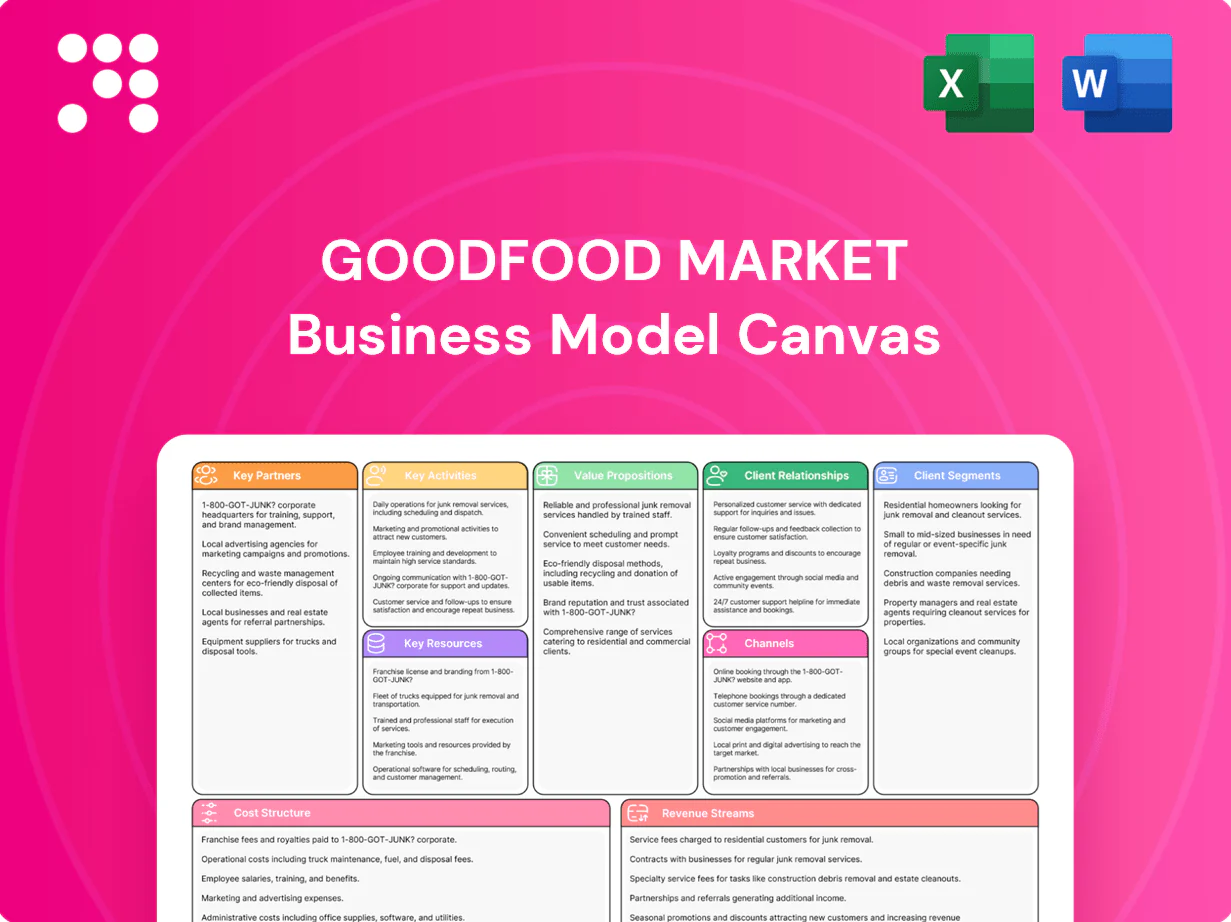
Goodfood Market Business Model Canvas

Unlock a concise Business Model Canvas mapping customers, value propositions and revenue drivers
Unlock Goodfood Market’s strategic blueprint with a concise Business Model Canvas that maps customer segments, value propositions, channels, and revenue drivers. This snapshot reveals growth levers and operational strengths. Purchase the full, editable Canvas (Word/Excel) for a section-by-section guide to replicate or benchmark their success.
Partnerships

Local farms and food suppliers
Strategic sourcing from Canadian farms ensures Goodfood supplies fresh, seasonal produce and proteins, leveraging a domestic agriculture sector that contributed about 1.6% of GDP in 2024. Long-term contracts stabilize pricing and supply, while co-developing quality and traceability standards with suppliers raises food safety and batch-level traceability. Diversifying suppliers reduces risk from regional disruptions and transportation bottlenecks.
Cold-chain logistics and last-mile carriers
Regional couriers and 3PLs preserve refrigerated integrity through validated temperature-controlled trailers and pallet-level monitoring, enabling Goodfood to meet perishable handling standards; industry cold-chain investments reached an estimated USD 300+ billion by 2024. Flexible capacity from partners absorbs weekly demand spikes—often rising ~30% on peak days—without service disruption. Route optimization lowers delivery time and variable costs by roughly 15–20%, while SLA monitoring (targeting ≥95% on-time, in-temperature delivery) protects the customer experience.

Packaging and sustainable materials vendors
Insulated, recyclable and compostable packaging preserves freshness and aligns with the global sustainable packaging market (~USD 280 billion in 2024), reducing temperature-related spoilage. Custom pack design for Goodfood lowers spoilage and can cut cost-per-order by streamlining fill rates and reducing returns. Joint R&D with vendors improved thermal performance in pilots, and sustainability credentials support Goodfood’s brand promise to eco-conscious consumers.

Technology and payments providers
Technology and payments partners power Goodfood Market’s e-commerce growth by providing routing, personalization, and secure payments; cloud providers (public SLAs often at 99.99%) enable high uptime and rapid deployments while fraud-prevention lowers leakage and chargebacks through tokenization and machine-learning rules.
- e-commerce routing
- personalization engines
- secure payments & fraud prevention
- data integrations
- cloud infra (99.99% SLA)
Marketing affiliates and content partners
Influencers, publishers and referral platforms drive efficient acquisition for Goodfood (TSX: FOOD), delivering higher intent traffic and measurable CPA; co-branded content increases trust and conversion, while performance-based deals (CPA/RevShare) align spend with outcomes and expand reach into niche segments like health-conscious and quick-meal consumers.
- Affiliates: performance-driven customer growth
- Co-branded content: higher conversion
- CPA/RevShare: aligns spend with ROI
- Niche reach: targeted segment expansion
Secures seasonal Canadian supply with traceability and cold-chain ≥95% in-temp
Goodfood secures seasonal Canadian supply (agri = 1.6% GDP in 2024) via long-term contracts and supplier traceability to reduce spoilage. Logistics partners maintain cold-chain (global cold-chain ~$300B in 2024), enabling ≥95% in-temp on-time targets and absorbing ~30% peak demand. Tech, payments and affiliates drive e-commerce (cloud SLA 99.99%, packaging market ~$280B).
| Partnership | KPI | 2024 |
|---|---|---|
| Suppliers | Traceability | 1.6% GDP |
| Logistics | In-temp on-time | ≥95% |
| Tech/Payments | Uptime | 99.99% SLA |
What is included in the product
 Detailed Word Document
A comprehensive Business Model Canvas for Goodfood Market detailing customer segments, value propositions, channels and revenue streams across the 9 BMC blocks, with linked SWOT, competitive advantages and practical insights for presentations and investor discussions.

 Customizable Excel Spreadsheet
High-level view of Goodfood Market’s business model with editable cells, quickly identifying core components to relieve operational, supply-chain, and customer-acquisition pain points for faster decision-making and strategy alignment.
Activities

Menu curation and recipe development
Menu curation and recipe development at Goodfood (2024) focuses on balanced, seasonal rotations to keep offerings fresh and drive repeat purchase. Rigorous testing standardizes cook times and difficulty for consistent customer experience. Nutritional profiling ensures meals meet common dietary needs, while detailed costing protects margins and preserves customer value.
Demand planning and procurement
Demand planning forecasts weekly SKUs to minimize waste and stockouts, supporting Goodfood Market’s FY2024 scale (reported revenue CAD 294.6M) while supplier negotiations lock in pricing and lead times to protect margins; QA checks at receipt and pre-pack ensure consistent quality, and higher inventory turns (targeting rapid weekly cycles) are optimized to maximize freshness and reduce spoilage.

Assembly, packing, and fulfillment
Portioning ingredients reduces household prep time and can cut food waste by up to 30% (WRAP), lowering customer churn. Batch picking and kitting accelerate throughput in fulfillment centers, enabling higher order velocity to serve a US$13.3 billion global meal-kit market in 2024. Cold-chain handling preserves food safety and shelf life, while QC at pack-out reduces customer complaints and returns.

Delivery orchestration and fleet management
Delivery orchestration uses dynamic routing to shorten delivery windows and concentrate stops, while time-slot management aligns capacity with customer availability to boost satisfaction.
Carrier performance is continuously tracked via KPIs and improved through incentives and audits, and exceptions are handled proactively with real-time rerouting and notifications to prevent churn.
- dynamic-routing
- time-slot-management
- carrier-kpis
- proactive-exceptions
Customer service and data analytics
Multi-channel support resolves issues quickly via phone, chat and app, reducing response lag and improving satisfaction; personalization engines tailor menus and promos—McKinsey 2024 reports personalization can lift revenue 10–15%—while cohort analytics guide retention tactics by identifying churn triggers and high-LTV segments; closed feedback loops drive product and process changes across sourcing, recipes and delivery.
- Support: omnichannel first-contact resolution
- Personalization: +10–15% revenue (McKinsey 2024)
- Analytics: cohort-driven retention
- Feedback: product/process iteration
Menu curation, weekly turns, fulfillment automation, 10-15% lift
Menu curation, portioning and QA drive consistent customer experience and margin protection. Demand planning, supplier contracts and high inventory turns (weekly cadence) minimize waste and stockouts. Fulfillment automation, cold-chain handling and dynamic routing boost order velocity and on‑time delivery. Omnichannel support, personalization (+10–15% McKinsey 2024) and cohort analytics reduce churn.
| Metric | 2024 value |
|---|---|
| Revenue | CAD 294.6M |
| Global meal‑kit market | US$13.3B |
| Personalization uplift | 10–15% |
| Waste reduction (portioning) | up to 30% |
| Inventory cadence | Weekly turns target |
Full Version Awaits
Business Model Canvas
The Goodfood Market Business Model Canvas shown here is the actual deliverable, not a mockup. It contains the same structured content and visual layout you’ll receive after purchase. Upon ordering, you’ll instantly download this exact file, ready to edit, present, and apply in Word and Excel formats.

Unlock a concise Business Model Canvas mapping customers, value propositions and revenue drivers
Unlock Goodfood Market’s strategic blueprint with a concise Business Model Canvas that maps customer segments, value propositions, channels, and revenue drivers. This snapshot reveals growth levers and operational strengths. Purchase the full, editable Canvas (Word/Excel) for a section-by-section guide to replicate or benchmark their success.
Partnerships
Local farms and food suppliers
Strategic sourcing from Canadian farms ensures Goodfood supplies fresh, seasonal produce and proteins, leveraging a domestic agriculture sector that contributed about 1.6% of GDP in 2024. Long-term contracts stabilize pricing and supply, while co-developing quality and traceability standards with suppliers raises food safety and batch-level traceability. Diversifying suppliers reduces risk from regional disruptions and transportation bottlenecks.
Cold-chain logistics and last-mile carriers
Regional couriers and 3PLs preserve refrigerated integrity through validated temperature-controlled trailers and pallet-level monitoring, enabling Goodfood to meet perishable handling standards; industry cold-chain investments reached an estimated USD 300+ billion by 2024. Flexible capacity from partners absorbs weekly demand spikes—often rising ~30% on peak days—without service disruption. Route optimization lowers delivery time and variable costs by roughly 15–20%, while SLA monitoring (targeting ≥95% on-time, in-temperature delivery) protects the customer experience.
Packaging and sustainable materials vendors
Insulated, recyclable and compostable packaging preserves freshness and aligns with the global sustainable packaging market (~USD 280 billion in 2024), reducing temperature-related spoilage. Custom pack design for Goodfood lowers spoilage and can cut cost-per-order by streamlining fill rates and reducing returns. Joint R&D with vendors improved thermal performance in pilots, and sustainability credentials support Goodfood’s brand promise to eco-conscious consumers.
Technology and payments providers
Technology and payments partners power Goodfood Market’s e-commerce growth by providing routing, personalization, and secure payments; cloud providers (public SLAs often at 99.99%) enable high uptime and rapid deployments while fraud-prevention lowers leakage and chargebacks through tokenization and machine-learning rules.
- e-commerce routing
- personalization engines
- secure payments & fraud prevention
- data integrations
- cloud infra (99.99% SLA)
Marketing affiliates and content partners
Influencers, publishers and referral platforms drive efficient acquisition for Goodfood (TSX: FOOD), delivering higher intent traffic and measurable CPA; co-branded content increases trust and conversion, while performance-based deals (CPA/RevShare) align spend with outcomes and expand reach into niche segments like health-conscious and quick-meal consumers.
- Affiliates: performance-driven customer growth
- Co-branded content: higher conversion
- CPA/RevShare: aligns spend with ROI
- Niche reach: targeted segment expansion
Secures seasonal Canadian supply with traceability and cold-chain ≥95% in-temp
Goodfood secures seasonal Canadian supply (agri = 1.6% GDP in 2024) via long-term contracts and supplier traceability to reduce spoilage. Logistics partners maintain cold-chain (global cold-chain ~$300B in 2024), enabling ≥95% in-temp on-time targets and absorbing ~30% peak demand. Tech, payments and affiliates drive e-commerce (cloud SLA 99.99%, packaging market ~$280B).
| Partnership | KPI | 2024 |
|---|---|---|
| Suppliers | Traceability | 1.6% GDP |
| Logistics | In-temp on-time | ≥95% |
| Tech/Payments | Uptime | 99.99% SLA |
What is included in the product
Detailed Word Document
A comprehensive Business Model Canvas for Goodfood Market detailing customer segments, value propositions, channels and revenue streams across the 9 BMC blocks, with linked SWOT, competitive advantages and practical insights for presentations and investor discussions.
Customizable Excel Spreadsheet
High-level view of Goodfood Market’s business model with editable cells, quickly identifying core components to relieve operational, supply-chain, and customer-acquisition pain points for faster decision-making and strategy alignment.
Activities
Menu curation and recipe development
Menu curation and recipe development at Goodfood (2024) focuses on balanced, seasonal rotations to keep offerings fresh and drive repeat purchase. Rigorous testing standardizes cook times and difficulty for consistent customer experience. Nutritional profiling ensures meals meet common dietary needs, while detailed costing protects margins and preserves customer value.
Demand planning and procurement
Demand planning forecasts weekly SKUs to minimize waste and stockouts, supporting Goodfood Market’s FY2024 scale (reported revenue CAD 294.6M) while supplier negotiations lock in pricing and lead times to protect margins; QA checks at receipt and pre-pack ensure consistent quality, and higher inventory turns (targeting rapid weekly cycles) are optimized to maximize freshness and reduce spoilage.
Assembly, packing, and fulfillment
Portioning ingredients reduces household prep time and can cut food waste by up to 30% (WRAP), lowering customer churn. Batch picking and kitting accelerate throughput in fulfillment centers, enabling higher order velocity to serve a US$13.3 billion global meal-kit market in 2024. Cold-chain handling preserves food safety and shelf life, while QC at pack-out reduces customer complaints and returns.
Delivery orchestration and fleet management
Delivery orchestration uses dynamic routing to shorten delivery windows and concentrate stops, while time-slot management aligns capacity with customer availability to boost satisfaction.
Carrier performance is continuously tracked via KPIs and improved through incentives and audits, and exceptions are handled proactively with real-time rerouting and notifications to prevent churn.
- dynamic-routing
- time-slot-management
- carrier-kpis
- proactive-exceptions
Customer service and data analytics
Multi-channel support resolves issues quickly via phone, chat and app, reducing response lag and improving satisfaction; personalization engines tailor menus and promos—McKinsey 2024 reports personalization can lift revenue 10–15%—while cohort analytics guide retention tactics by identifying churn triggers and high-LTV segments; closed feedback loops drive product and process changes across sourcing, recipes and delivery.
- Support: omnichannel first-contact resolution
- Personalization: +10–15% revenue (McKinsey 2024)
- Analytics: cohort-driven retention
- Feedback: product/process iteration
Menu curation, weekly turns, fulfillment automation, 10-15% lift
Menu curation, portioning and QA drive consistent customer experience and margin protection. Demand planning, supplier contracts and high inventory turns (weekly cadence) minimize waste and stockouts. Fulfillment automation, cold-chain handling and dynamic routing boost order velocity and on‑time delivery. Omnichannel support, personalization (+10–15% McKinsey 2024) and cohort analytics reduce churn.
| Metric | 2024 value |
|---|---|
| Revenue | CAD 294.6M |
| Global meal‑kit market | US$13.3B |
| Personalization uplift | 10–15% |
| Waste reduction (portioning) | up to 30% |
| Inventory cadence | Weekly turns target |
Full Version Awaits
Business Model Canvas
The Goodfood Market Business Model Canvas shown here is the actual deliverable, not a mockup. It contains the same structured content and visual layout you’ll receive after purchase. Upon ordering, you’ll instantly download this exact file, ready to edit, present, and apply in Word and Excel formats.
Description
Unlock a concise Business Model Canvas mapping customers, value propositions and revenue drivers
Unlock Goodfood Market’s strategic blueprint with a concise Business Model Canvas that maps customer segments, value propositions, channels, and revenue drivers. This snapshot reveals growth levers and operational strengths. Purchase the full, editable Canvas (Word/Excel) for a section-by-section guide to replicate or benchmark their success.
Partnerships
Local farms and food suppliers
Strategic sourcing from Canadian farms ensures Goodfood supplies fresh, seasonal produce and proteins, leveraging a domestic agriculture sector that contributed about 1.6% of GDP in 2024. Long-term contracts stabilize pricing and supply, while co-developing quality and traceability standards with suppliers raises food safety and batch-level traceability. Diversifying suppliers reduces risk from regional disruptions and transportation bottlenecks.
Cold-chain logistics and last-mile carriers
Regional couriers and 3PLs preserve refrigerated integrity through validated temperature-controlled trailers and pallet-level monitoring, enabling Goodfood to meet perishable handling standards; industry cold-chain investments reached an estimated USD 300+ billion by 2024. Flexible capacity from partners absorbs weekly demand spikes—often rising ~30% on peak days—without service disruption. Route optimization lowers delivery time and variable costs by roughly 15–20%, while SLA monitoring (targeting ≥95% on-time, in-temperature delivery) protects the customer experience.
Packaging and sustainable materials vendors
Insulated, recyclable and compostable packaging preserves freshness and aligns with the global sustainable packaging market (~USD 280 billion in 2024), reducing temperature-related spoilage. Custom pack design for Goodfood lowers spoilage and can cut cost-per-order by streamlining fill rates and reducing returns. Joint R&D with vendors improved thermal performance in pilots, and sustainability credentials support Goodfood’s brand promise to eco-conscious consumers.
Technology and payments providers
Technology and payments partners power Goodfood Market’s e-commerce growth by providing routing, personalization, and secure payments; cloud providers (public SLAs often at 99.99%) enable high uptime and rapid deployments while fraud-prevention lowers leakage and chargebacks through tokenization and machine-learning rules.
- e-commerce routing
- personalization engines
- secure payments & fraud prevention
- data integrations
- cloud infra (99.99% SLA)
Marketing affiliates and content partners
Influencers, publishers and referral platforms drive efficient acquisition for Goodfood (TSX: FOOD), delivering higher intent traffic and measurable CPA; co-branded content increases trust and conversion, while performance-based deals (CPA/RevShare) align spend with outcomes and expand reach into niche segments like health-conscious and quick-meal consumers.
- Affiliates: performance-driven customer growth
- Co-branded content: higher conversion
- CPA/RevShare: aligns spend with ROI
- Niche reach: targeted segment expansion
Secures seasonal Canadian supply with traceability and cold-chain ≥95% in-temp
Goodfood secures seasonal Canadian supply (agri = 1.6% GDP in 2024) via long-term contracts and supplier traceability to reduce spoilage. Logistics partners maintain cold-chain (global cold-chain ~$300B in 2024), enabling ≥95% in-temp on-time targets and absorbing ~30% peak demand. Tech, payments and affiliates drive e-commerce (cloud SLA 99.99%, packaging market ~$280B).
| Partnership | KPI | 2024 |
|---|---|---|
| Suppliers | Traceability | 1.6% GDP |
| Logistics | In-temp on-time | ≥95% |
| Tech/Payments | Uptime | 99.99% SLA |
What is included in the product
Detailed Word Document
A comprehensive Business Model Canvas for Goodfood Market detailing customer segments, value propositions, channels and revenue streams across the 9 BMC blocks, with linked SWOT, competitive advantages and practical insights for presentations and investor discussions.
Customizable Excel Spreadsheet
High-level view of Goodfood Market’s business model with editable cells, quickly identifying core components to relieve operational, supply-chain, and customer-acquisition pain points for faster decision-making and strategy alignment.
Activities
Menu curation and recipe development
Menu curation and recipe development at Goodfood (2024) focuses on balanced, seasonal rotations to keep offerings fresh and drive repeat purchase. Rigorous testing standardizes cook times and difficulty for consistent customer experience. Nutritional profiling ensures meals meet common dietary needs, while detailed costing protects margins and preserves customer value.
Demand planning and procurement
Demand planning forecasts weekly SKUs to minimize waste and stockouts, supporting Goodfood Market’s FY2024 scale (reported revenue CAD 294.6M) while supplier negotiations lock in pricing and lead times to protect margins; QA checks at receipt and pre-pack ensure consistent quality, and higher inventory turns (targeting rapid weekly cycles) are optimized to maximize freshness and reduce spoilage.
Assembly, packing, and fulfillment
Portioning ingredients reduces household prep time and can cut food waste by up to 30% (WRAP), lowering customer churn. Batch picking and kitting accelerate throughput in fulfillment centers, enabling higher order velocity to serve a US$13.3 billion global meal-kit market in 2024. Cold-chain handling preserves food safety and shelf life, while QC at pack-out reduces customer complaints and returns.
Delivery orchestration and fleet management
Delivery orchestration uses dynamic routing to shorten delivery windows and concentrate stops, while time-slot management aligns capacity with customer availability to boost satisfaction.
Carrier performance is continuously tracked via KPIs and improved through incentives and audits, and exceptions are handled proactively with real-time rerouting and notifications to prevent churn.
- dynamic-routing
- time-slot-management
- carrier-kpis
- proactive-exceptions
Customer service and data analytics
Multi-channel support resolves issues quickly via phone, chat and app, reducing response lag and improving satisfaction; personalization engines tailor menus and promos—McKinsey 2024 reports personalization can lift revenue 10–15%—while cohort analytics guide retention tactics by identifying churn triggers and high-LTV segments; closed feedback loops drive product and process changes across sourcing, recipes and delivery.
- Support: omnichannel first-contact resolution
- Personalization: +10–15% revenue (McKinsey 2024)
- Analytics: cohort-driven retention
- Feedback: product/process iteration
Menu curation, weekly turns, fulfillment automation, 10-15% lift
Menu curation, portioning and QA drive consistent customer experience and margin protection. Demand planning, supplier contracts and high inventory turns (weekly cadence) minimize waste and stockouts. Fulfillment automation, cold-chain handling and dynamic routing boost order velocity and on‑time delivery. Omnichannel support, personalization (+10–15% McKinsey 2024) and cohort analytics reduce churn.
| Metric | 2024 value |
|---|---|
| Revenue | CAD 294.6M |
| Global meal‑kit market | US$13.3B |
| Personalization uplift | 10–15% |
| Waste reduction (portioning) | up to 30% |
| Inventory cadence | Weekly turns target |
Full Version Awaits
Business Model Canvas
The Goodfood Market Business Model Canvas shown here is the actual deliverable, not a mockup. It contains the same structured content and visual layout you’ll receive after purchase. Upon ordering, you’ll instantly download this exact file, ready to edit, present, and apply in Word and Excel formats.











