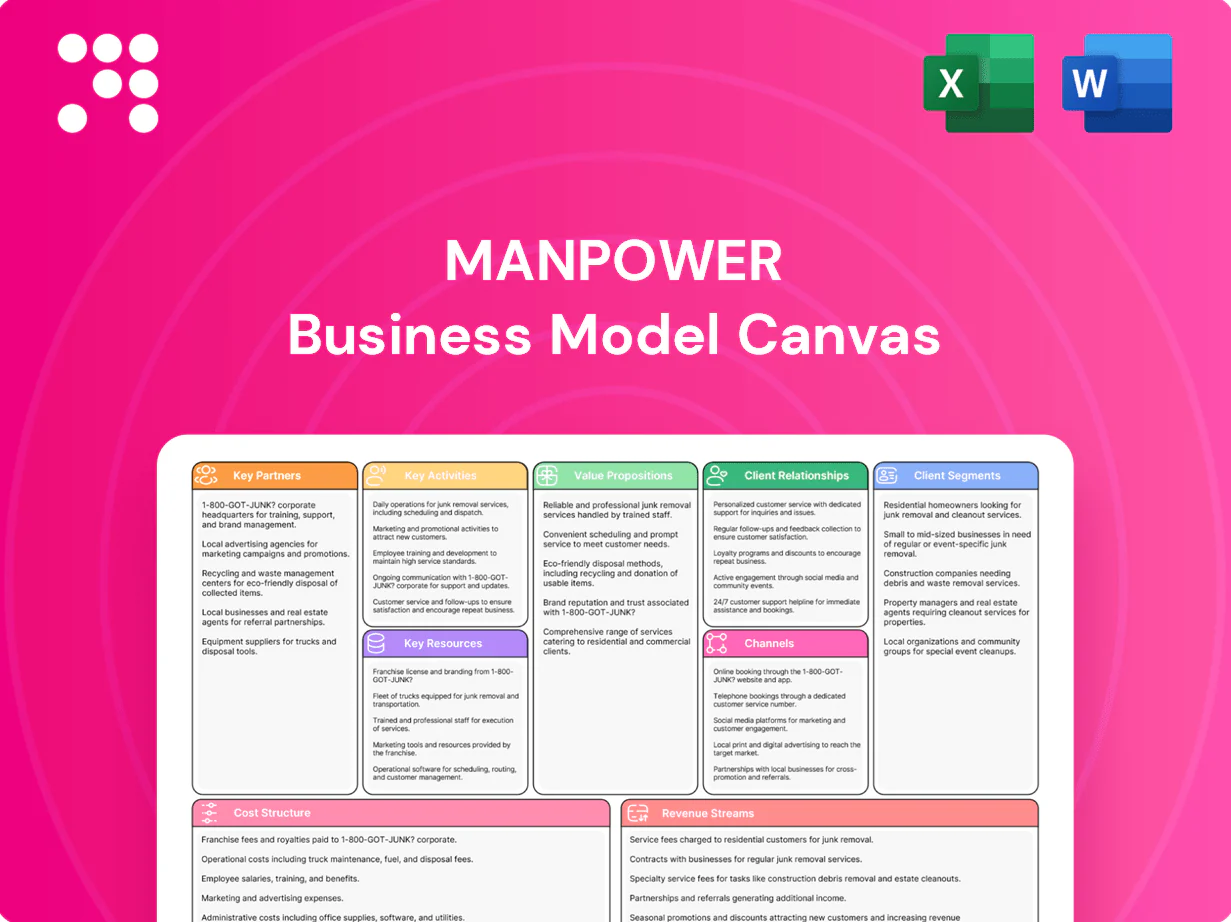
Manpower Business Model Canvas

Explore the Business Model Canvas and downloadable templates to map workforce strategies
Unlock the full strategic blueprint behind Manpower's business model. This in-depth Business Model Canvas reveals how the company creates and captures value across customer segments, key partners, and revenue streams. Download the editable Word & Excel files to benchmark, plan, or pitch with company-specific insights and ready-to-use analysis.
Partnerships

Enterprise clients alliances
Collaborations with multinational employers forecast talent needs and co-design workforce programs, supporting volume hiring, MSP/RPO scopes and multi-country frameworks. ManpowerGroup serves over 400,000 clients across 75 countries, enabling scale and cross-border compliance. Long-term agreements deliver recurring demand and real-time insight into evolving skills shifts in 2024.
Training & certification providers
Alliances with edtech platforms, universities, and credential bodies expand upskilling pathways and pipeline depth, with 2024 pilots showing co-delivered courses increased qualified candidate pools by 30%. Co-branded programs align curricula with employer demand, embedding employer-vetted competencies and recognized credentials that recruiters prioritize. This raises candidate employability and, in 2024 trials, shortened placement cycles by roughly 30%, improving time-to-hire and reducing vacancy costs.

Technology & assessment vendors
Technology and assessment vendor partnerships—ATS/CRM, AI matching, skills assessment and analytics—cut sourcing time and raise quality of hire, with 30–40% faster time-to-fill reported in 2024 industry studies; integrated stacks also lift predictive hiring accuracy and retention. Shared data and aligned innovation roadmaps sustain differentiation and supported Manpower digital offerings that grew double digits in 2024.

Government & workforce agencies
Government and workforce agencies cooperate on employment programs, reskilling initiatives, and compliance, enabling Manpower to scale placement and training; in 2024 public workforce programmes mobilized over $200 billion globally, reducing delivery costs and expanding reach through subsidies and labour-market data sharing.
- Subsidies cut delivery costs ~20%
- Labour-market data improves targeting
- Public-private models enable inclusion at scale
Specialist subcontractors
Specialist subcontractors—networks of niche recruiters, BPO partners and gig platforms—allow Manpower to flex capacity across geographies, covering hard-to-fill roles and peak volumes; in 2024 partners handled over 30% of peak hiring surges. SLA-governed models preserve quality while enabling rapid scale, with agreed KPIs and penalty/reward clauses driving delivery.
- Networks of niche recruiters
- BPO partners and gig platforms
- SLA-governed KPIs for quality and scale
Partnerships cut fills 30–40%, boost qualified pools +30%
Strategic employer, education, tech, public-sector and specialist subcontractor partnerships drive scale, pipeline depth and faster placements; ManpowerGroup serves over 400,000 clients in 75 countries. 2024 pilots showed co-delivered upskilling raised qualified pools ~30% and ATS/AI stacks cut time-to-fill 30–40%, while digital services grew double digits and partners handled >30% of peak surges.
| Metric | 2024 |
|---|---|
| Clients | 400,000+ |
| Countries | 75 |
| Upskilling lift | +30% |
| Time-to-fill | -30–40% |
| Peak surge share | >30% |
| Public funds | $200B |
What is included in the product
 Detailed Word Document
A comprehensive Business Model Canvas tailored to Manpower, detailing customer segments, channels, value propositions, revenue streams, and key resources. Includes SWOT-linked insights and operational realities for presentations, funding discussions, and strategic decision-making.

 Customizable Excel Spreadsheet
Condenses Manpower’s workforce strategy into a digestible one-page canvas, relieving pain by highlighting staffing bottlenecks, revenue streams, and cost drivers for fast decision-making and team collaboration.
Activities

Global talent sourcing
Proactive identification scans job boards, social media and internal talent pools to source candidates at scale; LinkedIn exceeded 1 billion members in 2024, expanding reach. Multi-channel campaigns—email, ads, social and referral programs—engage active and passive talent across platforms used by about 5.07 billion social media users in 2024. Diversity-focused sourcing increases quality pipelines and reduces time-to-hire by broadening candidate profiles.
Assessment & selection
Skills testing, structured interviews, and background checks validate candidate fit and compliance, with meta-analyses showing standardized selection methods raise predictive validity by roughly 25%. Standardized methodologies reduce bias and improve predictability across cohorts. In 2024, employers using data-driven shortlists reported time-to-fill reductions up to 40% and lower early turnover. These practices support repeatable, auditable hiring decisions.

Training & upskilling
Design and deliver role-aligned learning paths and certifications that blend online, classroom and on-the-job training to close skills gaps in priority sectors; World Economic Forum estimates 50% of workers will need reskilling by 2025, so targeted programs boost placement rates and tenure by tracking competency outcomes and placement KPIs in real time.

Workforce programs (MSP/RPO/BPO)
Manage end-to-end recruitment and contingent workforce delivery via MSP/RPO/BPO, centralizing vendor management, compliance, and performance analytics; industry studies show MSP/RPO can cut time-to-fill by up to 30% and reduce total talent cost materially through continuous improvement.
- Centralized vendor & compliance
- Performance analytics-driven
- Time-to-fill - up to 30% lower
- Continuous improvement reduces talent cost
Client advisory & analytics
Client advisory & analytics delivers labor market insights, salary benchmarking and workforce planning to align hiring and location decisions with business strategy; US unemployment averaged about 4% in 2024, tightening talent supply and raising benchmark value. Dashboards link SLA/KPI governance to hiring ROI, improving decision speed and cost control across markets.
- Labor market: US unemployment ~4% (2024)
- Benchmarking: targets pay parity and role competitiveness
- Dashboards: SLA/KPI-driven ROI visibility
Proactive sourcing and reskilling cut time-to-fill 30-40% and boost validity 25%
Proactive multi-channel sourcing (LinkedIn >1B members, 5.07B social users in 2024) and diversity-focused pipelines reduce time-to-hire. Standardized selection (skills tests, structured interviews) raises predictive validity ~25% and can cut time-to-fill up to 40%. Role-aligned reskilling (WEF: 50% need reskilling by 2025) and MSP/RPO delivery lower talent cost and improve compliance.
| Metric | 2024/est |
|---|---|
| LinkedIn members | 1B+ |
| Social users | 5.07B |
| US unemployment | ~4% |
| Time-to-fill reduction | 30-40% |
Full Document Unlocks After Purchase
Business Model Canvas
The Manpower Business Model Canvas shown here is the actual deliverable, not a mockup. When you purchase, you’ll receive this same document—complete, editable, and formatted—for immediate download. It includes all sections visible in the preview and is ready to use in Word and Excel.

Explore the Business Model Canvas and downloadable templates to map workforce strategies
Unlock the full strategic blueprint behind Manpower's business model. This in-depth Business Model Canvas reveals how the company creates and captures value across customer segments, key partners, and revenue streams. Download the editable Word & Excel files to benchmark, plan, or pitch with company-specific insights and ready-to-use analysis.
Partnerships
Enterprise clients alliances
Collaborations with multinational employers forecast talent needs and co-design workforce programs, supporting volume hiring, MSP/RPO scopes and multi-country frameworks. ManpowerGroup serves over 400,000 clients across 75 countries, enabling scale and cross-border compliance. Long-term agreements deliver recurring demand and real-time insight into evolving skills shifts in 2024.
Training & certification providers
Alliances with edtech platforms, universities, and credential bodies expand upskilling pathways and pipeline depth, with 2024 pilots showing co-delivered courses increased qualified candidate pools by 30%. Co-branded programs align curricula with employer demand, embedding employer-vetted competencies and recognized credentials that recruiters prioritize. This raises candidate employability and, in 2024 trials, shortened placement cycles by roughly 30%, improving time-to-hire and reducing vacancy costs.
Technology & assessment vendors
Technology and assessment vendor partnerships—ATS/CRM, AI matching, skills assessment and analytics—cut sourcing time and raise quality of hire, with 30–40% faster time-to-fill reported in 2024 industry studies; integrated stacks also lift predictive hiring accuracy and retention. Shared data and aligned innovation roadmaps sustain differentiation and supported Manpower digital offerings that grew double digits in 2024.
Government & workforce agencies
Government and workforce agencies cooperate on employment programs, reskilling initiatives, and compliance, enabling Manpower to scale placement and training; in 2024 public workforce programmes mobilized over $200 billion globally, reducing delivery costs and expanding reach through subsidies and labour-market data sharing.
- Subsidies cut delivery costs ~20%
- Labour-market data improves targeting
- Public-private models enable inclusion at scale
Specialist subcontractors
Specialist subcontractors—networks of niche recruiters, BPO partners and gig platforms—allow Manpower to flex capacity across geographies, covering hard-to-fill roles and peak volumes; in 2024 partners handled over 30% of peak hiring surges. SLA-governed models preserve quality while enabling rapid scale, with agreed KPIs and penalty/reward clauses driving delivery.
- Networks of niche recruiters
- BPO partners and gig platforms
- SLA-governed KPIs for quality and scale
Partnerships cut fills 30–40%, boost qualified pools +30%
Strategic employer, education, tech, public-sector and specialist subcontractor partnerships drive scale, pipeline depth and faster placements; ManpowerGroup serves over 400,000 clients in 75 countries. 2024 pilots showed co-delivered upskilling raised qualified pools ~30% and ATS/AI stacks cut time-to-fill 30–40%, while digital services grew double digits and partners handled >30% of peak surges.
| Metric | 2024 |
|---|---|
| Clients | 400,000+ |
| Countries | 75 |
| Upskilling lift | +30% |
| Time-to-fill | -30–40% |
| Peak surge share | >30% |
| Public funds | $200B |
What is included in the product
Detailed Word Document
A comprehensive Business Model Canvas tailored to Manpower, detailing customer segments, channels, value propositions, revenue streams, and key resources. Includes SWOT-linked insights and operational realities for presentations, funding discussions, and strategic decision-making.
Customizable Excel Spreadsheet
Condenses Manpower’s workforce strategy into a digestible one-page canvas, relieving pain by highlighting staffing bottlenecks, revenue streams, and cost drivers for fast decision-making and team collaboration.
Activities
Global talent sourcing
Proactive identification scans job boards, social media and internal talent pools to source candidates at scale; LinkedIn exceeded 1 billion members in 2024, expanding reach. Multi-channel campaigns—email, ads, social and referral programs—engage active and passive talent across platforms used by about 5.07 billion social media users in 2024. Diversity-focused sourcing increases quality pipelines and reduces time-to-hire by broadening candidate profiles.
Assessment & selection
Skills testing, structured interviews, and background checks validate candidate fit and compliance, with meta-analyses showing standardized selection methods raise predictive validity by roughly 25%. Standardized methodologies reduce bias and improve predictability across cohorts. In 2024, employers using data-driven shortlists reported time-to-fill reductions up to 40% and lower early turnover. These practices support repeatable, auditable hiring decisions.
Training & upskilling
Design and deliver role-aligned learning paths and certifications that blend online, classroom and on-the-job training to close skills gaps in priority sectors; World Economic Forum estimates 50% of workers will need reskilling by 2025, so targeted programs boost placement rates and tenure by tracking competency outcomes and placement KPIs in real time.
Workforce programs (MSP/RPO/BPO)
Manage end-to-end recruitment and contingent workforce delivery via MSP/RPO/BPO, centralizing vendor management, compliance, and performance analytics; industry studies show MSP/RPO can cut time-to-fill by up to 30% and reduce total talent cost materially through continuous improvement.
- Centralized vendor & compliance
- Performance analytics-driven
- Time-to-fill - up to 30% lower
- Continuous improvement reduces talent cost
Client advisory & analytics
Client advisory & analytics delivers labor market insights, salary benchmarking and workforce planning to align hiring and location decisions with business strategy; US unemployment averaged about 4% in 2024, tightening talent supply and raising benchmark value. Dashboards link SLA/KPI governance to hiring ROI, improving decision speed and cost control across markets.
- Labor market: US unemployment ~4% (2024)
- Benchmarking: targets pay parity and role competitiveness
- Dashboards: SLA/KPI-driven ROI visibility
Proactive sourcing and reskilling cut time-to-fill 30-40% and boost validity 25%
Proactive multi-channel sourcing (LinkedIn >1B members, 5.07B social users in 2024) and diversity-focused pipelines reduce time-to-hire. Standardized selection (skills tests, structured interviews) raises predictive validity ~25% and can cut time-to-fill up to 40%. Role-aligned reskilling (WEF: 50% need reskilling by 2025) and MSP/RPO delivery lower talent cost and improve compliance.
| Metric | 2024/est |
|---|---|
| LinkedIn members | 1B+ |
| Social users | 5.07B |
| US unemployment | ~4% |
| Time-to-fill reduction | 30-40% |
Full Document Unlocks After Purchase
Business Model Canvas
The Manpower Business Model Canvas shown here is the actual deliverable, not a mockup. When you purchase, you’ll receive this same document—complete, editable, and formatted—for immediate download. It includes all sections visible in the preview and is ready to use in Word and Excel.
Original: $10.00
-65%$10.00
$3.50Description
Explore the Business Model Canvas and downloadable templates to map workforce strategies
Unlock the full strategic blueprint behind Manpower's business model. This in-depth Business Model Canvas reveals how the company creates and captures value across customer segments, key partners, and revenue streams. Download the editable Word & Excel files to benchmark, plan, or pitch with company-specific insights and ready-to-use analysis.
Partnerships
Enterprise clients alliances
Collaborations with multinational employers forecast talent needs and co-design workforce programs, supporting volume hiring, MSP/RPO scopes and multi-country frameworks. ManpowerGroup serves over 400,000 clients across 75 countries, enabling scale and cross-border compliance. Long-term agreements deliver recurring demand and real-time insight into evolving skills shifts in 2024.
Training & certification providers
Alliances with edtech platforms, universities, and credential bodies expand upskilling pathways and pipeline depth, with 2024 pilots showing co-delivered courses increased qualified candidate pools by 30%. Co-branded programs align curricula with employer demand, embedding employer-vetted competencies and recognized credentials that recruiters prioritize. This raises candidate employability and, in 2024 trials, shortened placement cycles by roughly 30%, improving time-to-hire and reducing vacancy costs.
Technology & assessment vendors
Technology and assessment vendor partnerships—ATS/CRM, AI matching, skills assessment and analytics—cut sourcing time and raise quality of hire, with 30–40% faster time-to-fill reported in 2024 industry studies; integrated stacks also lift predictive hiring accuracy and retention. Shared data and aligned innovation roadmaps sustain differentiation and supported Manpower digital offerings that grew double digits in 2024.
Government & workforce agencies
Government and workforce agencies cooperate on employment programs, reskilling initiatives, and compliance, enabling Manpower to scale placement and training; in 2024 public workforce programmes mobilized over $200 billion globally, reducing delivery costs and expanding reach through subsidies and labour-market data sharing.
- Subsidies cut delivery costs ~20%
- Labour-market data improves targeting
- Public-private models enable inclusion at scale
Specialist subcontractors
Specialist subcontractors—networks of niche recruiters, BPO partners and gig platforms—allow Manpower to flex capacity across geographies, covering hard-to-fill roles and peak volumes; in 2024 partners handled over 30% of peak hiring surges. SLA-governed models preserve quality while enabling rapid scale, with agreed KPIs and penalty/reward clauses driving delivery.
- Networks of niche recruiters
- BPO partners and gig platforms
- SLA-governed KPIs for quality and scale
Partnerships cut fills 30–40%, boost qualified pools +30%
Strategic employer, education, tech, public-sector and specialist subcontractor partnerships drive scale, pipeline depth and faster placements; ManpowerGroup serves over 400,000 clients in 75 countries. 2024 pilots showed co-delivered upskilling raised qualified pools ~30% and ATS/AI stacks cut time-to-fill 30–40%, while digital services grew double digits and partners handled >30% of peak surges.
| Metric | 2024 |
|---|---|
| Clients | 400,000+ |
| Countries | 75 |
| Upskilling lift | +30% |
| Time-to-fill | -30–40% |
| Peak surge share | >30% |
| Public funds | $200B |
What is included in the product
Detailed Word Document
A comprehensive Business Model Canvas tailored to Manpower, detailing customer segments, channels, value propositions, revenue streams, and key resources. Includes SWOT-linked insights and operational realities for presentations, funding discussions, and strategic decision-making.
Customizable Excel Spreadsheet
Condenses Manpower’s workforce strategy into a digestible one-page canvas, relieving pain by highlighting staffing bottlenecks, revenue streams, and cost drivers for fast decision-making and team collaboration.
Activities
Global talent sourcing
Proactive identification scans job boards, social media and internal talent pools to source candidates at scale; LinkedIn exceeded 1 billion members in 2024, expanding reach. Multi-channel campaigns—email, ads, social and referral programs—engage active and passive talent across platforms used by about 5.07 billion social media users in 2024. Diversity-focused sourcing increases quality pipelines and reduces time-to-hire by broadening candidate profiles.
Assessment & selection
Skills testing, structured interviews, and background checks validate candidate fit and compliance, with meta-analyses showing standardized selection methods raise predictive validity by roughly 25%. Standardized methodologies reduce bias and improve predictability across cohorts. In 2024, employers using data-driven shortlists reported time-to-fill reductions up to 40% and lower early turnover. These practices support repeatable, auditable hiring decisions.
Training & upskilling
Design and deliver role-aligned learning paths and certifications that blend online, classroom and on-the-job training to close skills gaps in priority sectors; World Economic Forum estimates 50% of workers will need reskilling by 2025, so targeted programs boost placement rates and tenure by tracking competency outcomes and placement KPIs in real time.
Workforce programs (MSP/RPO/BPO)
Manage end-to-end recruitment and contingent workforce delivery via MSP/RPO/BPO, centralizing vendor management, compliance, and performance analytics; industry studies show MSP/RPO can cut time-to-fill by up to 30% and reduce total talent cost materially through continuous improvement.
- Centralized vendor & compliance
- Performance analytics-driven
- Time-to-fill - up to 30% lower
- Continuous improvement reduces talent cost
Client advisory & analytics
Client advisory & analytics delivers labor market insights, salary benchmarking and workforce planning to align hiring and location decisions with business strategy; US unemployment averaged about 4% in 2024, tightening talent supply and raising benchmark value. Dashboards link SLA/KPI governance to hiring ROI, improving decision speed and cost control across markets.
- Labor market: US unemployment ~4% (2024)
- Benchmarking: targets pay parity and role competitiveness
- Dashboards: SLA/KPI-driven ROI visibility
Proactive sourcing and reskilling cut time-to-fill 30-40% and boost validity 25%
Proactive multi-channel sourcing (LinkedIn >1B members, 5.07B social users in 2024) and diversity-focused pipelines reduce time-to-hire. Standardized selection (skills tests, structured interviews) raises predictive validity ~25% and can cut time-to-fill up to 40%. Role-aligned reskilling (WEF: 50% need reskilling by 2025) and MSP/RPO delivery lower talent cost and improve compliance.
| Metric | 2024/est |
|---|---|
| LinkedIn members | 1B+ |
| Social users | 5.07B |
| US unemployment | ~4% |
| Time-to-fill reduction | 30-40% |
Full Document Unlocks After Purchase
Business Model Canvas
The Manpower Business Model Canvas shown here is the actual deliverable, not a mockup. When you purchase, you’ll receive this same document—complete, editable, and formatted—for immediate download. It includes all sections visible in the preview and is ready to use in Word and Excel.











