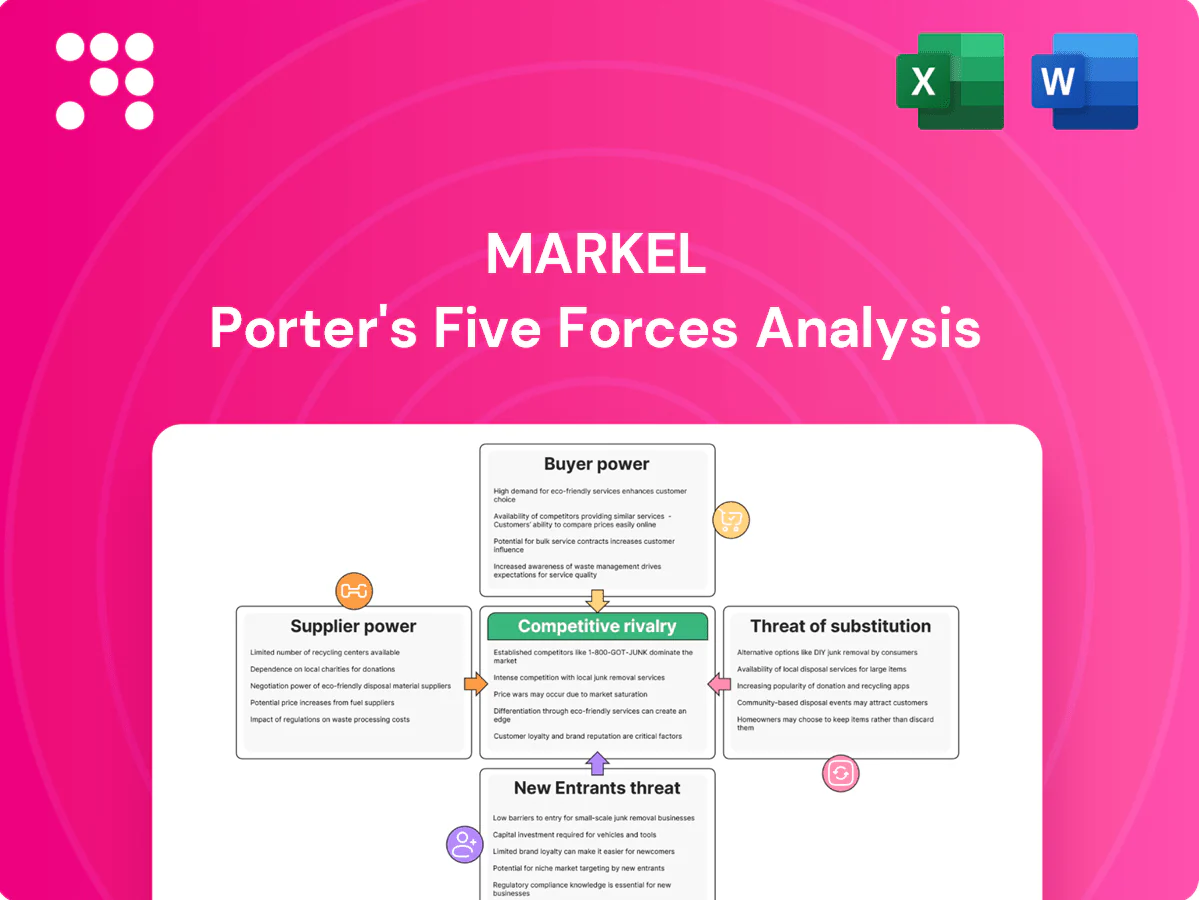
Markel Porter's Five Forces Analysis

Elevate Your Analysis with the Complete Porter's Five Forces Analysis
Markel's Five Forces snapshot highlights insurer-specific pressures—underwriting competition, capital intensity, and evolving regulatory risks—plus shifting buyer and supplier dynamics. It shows where Markel has durable advantages and where threats could erode margins. This brief only scratches the surface; unlock the full Porter’s Five Forces Analysis for force-by-force ratings, visuals, and actionable strategy.
Suppliers Bargaining Power

Constrained specialty reinsurance capacity
Retrocession and specialty reinsurance partners gain leverage in hard markets, with Aon reporting 2024 peak catastrophe treaty rate increases near 18–25%, so their pricing, terms and attachment willingness directly shape Markel’s capacity deployment and volatility. Concentration among top reinsurers (Swiss Re, Munich Re, Hannover Re, SCOR) — collectively controlling over half the market — amplifies this bargaining power; multi-year deals and diversified panels help temper it.
Human capital and underwriting talent
Experienced underwriters, actuaries and claims experts are scarce in niche lines, with BLS projecting actuary employment growth of about 24% from 2022–32, amplifying demand. Talent mobility and competitive bidding push compensation higher and increase supplier leverage. Markel’s culture and clear career pathways reduce churn but scarcity persists; non-competes and internal training pipelines can gradually moderate supplier power.

Data, models, and technology vendors
Catastrophe models, cyber analytics, and core platforms are concentrated among a few specialists—notably the top three catastrophe model providers RMS, AIR, and CoreLogic—giving suppliers leverage. High switching costs and integration complexity, often requiring 12–24 months and significant IT and actuarial effort, strengthen negotiating room. Vendor diversification and growing internal analytics capabilities reduce dependence. Regulatory model governance under Solvency II and NAIC frameworks constrains abrupt vendor changes.

Broker networks as access suppliers
Large broker networks (Marsh, Aon, WTW) act as gatekeepers in specialty markets, controlling deal flow and often determining placement priority and terms; industry concentration means the top three brokers account for roughly half of global commercial brokerage as of 2024.
Although Markel’s underwriting reputation and growing direct channels reduce dependency, broker concentration still constrains bypass options and pricing leverage.
Co-created products with brokers can align incentives, improving placement rates and margin capture.
- Broker concentration: top 3 ~50% (2024)
- Marks to counterbalance: underwriting strength + direct channels
- Opportunity: co-created products align incentives
Industrial inputs for Markel Ventures
Manufacturing subsidiaries rely on commodity, component and logistics suppliers, and cyclical shortages or tariffs (seen across 2022–24 in global supply chains) can shift bargaining power to vendors; multi-sourcing, tighter inventory management and long-term contracts reduce exposure, while portfolio-scale buying across Markel Ventures can secure better pricing and lead times.
- Suppliers: commodity, components, logistics
- Risks: shortages, tariffs raise vendor power
- Mitigants: multi-sourcing, inventory, contracts
- Advantage: scale buying across portfolio
Concentrated reinsurers and brokers squeeze pricing; top reinsurers >50% market
Markel faces high supplier power from concentrated reinsurers and global brokers (top reinsurers >50% market; top3 brokers ~50% in 2024), which shape pricing and capacity; multi-year deals and panels mitigate this. Scarce specialist talent and dominant model vendors (RMS, AIR, CoreLogic) increase switching costs, while internal analytics, direct channels and co‑created broker products reduce dependence.
| Supplier | Power | 2024 metric |
|---|---|---|
| Reinsurers | High | Top4 >50% market |
| Brokers | High | Top3 ~50% global |
| Model vendors | Moderate‑High | 3 dominant providers |
What is included in the product
 Detailed Word Document
Tailored Porter's Five Forces analysis of Markel uncovering competitive intensity, buyer and supplier power, threat of substitutes, and barriers to entry. Highlights disruptive forces, emerging threats, and strategic levers to protect margins and market share.

 Customizable Excel Spreadsheet
A concise, one-sheet Markel Porter’s Five Forces summary with adjustable pressure sliders and an instant spider chart—ideal for rapid strategic decisions, slide-ready formatting, and seamless integration into reports or dashboards.
Customers Bargaining Power

Broker-mediated corporate buyers
Global brokers like Aon, Marsh & McLennan and WTW aggregate demand and benchmark pricing, collectively controlling roughly 60% of global commercial brokerage (2023–24), enabling aggressive negotiation of coverage breadth, limits and SLAs. Brokers drive corporate buyers toward price-and-service plays, yet Markel’s specialty focus and claims reputation preserve underwriting margins on complex risks. Its differentiated appetite limits pure price shopping by segmenting capacity.
Niche insureds with limited alternatives
Niche specialty segments often have few qualified carriers, limiting buyer power; top carriers account for roughly 40% of specialty capacity in 2024, reinforcing concentration. Tailored coverage and specialist underwriting create stickiness beyond price, with multi-year policies common. In soft cycles niche buyers can still extract concessions, but multi-year agreements stabilize terms and renewals.

Reinsurance cedents’ cyclical leverage
Primary insurers gain bargaining power in oversupplied reinsurance markets, with Aon reporting global reinsurance pricing down about 12% year‑on‑year in 2024, pressuring cedents to demand lower rates and broader terms. In hard markets Markel can command stronger pricing and terms at renewals. Multi‑decade cedant relationships temper extremes on both sides. Transparent underwriting and claims performance keep Markel a preferred counterparty.

Price sensitivity vs. value of claims service
Some buyers are highly price sensitive while others pay premiums for reliable loss handling and underwriting stability; Markel’s specialty-claims reputation reduces elasticity for critical cover, keeping retention and pricing power. For commoditized layers, buyers shift to lowest-cost providers, increasing their bargaining power. Tiered offerings allow Markel to segment risk and retain accounts across price/value preferences.
- Price-sensitive buyers: commoditized layers
- Value-focused buyers: critical cover, lower elasticity
- Markel strength: specialty claims, retention
- Strategy: tiered offerings to segment and defend accounts
Industrial customers’ switching costs
For Markel Ventures, industrial B2B buyers face qualification, tooling, or certification costs that raise switching costs and reduce buyer bargaining power when specifications are tight, especially in regulated or engineered-product segments.
Where portfolio offerings are undifferentiated, RFQs and commoditization intensify price pressure; cross-selling across Markel Ventures’ businesses can deepen relationships and partially offset commoditization.
- High switching costs: qualification, tooling, certification
- Low-differentiation: RFQs drive price pressure
- Cross-selling mitigates churn, strengthens lock-in
Brokers ~60% boost buyer leverage; specialty focus preserves margins
Corporate buyers leverage global brokers (~60% market share, 2023–24) to compress price and demand SLAs, but Markel’s specialty focus and claims strength preserve margins on complex risks. Specialty carrier concentration (~40% of capacity, 2024) and high switching costs in engineered segments reduce buyer power. Soft reinsurance pricing (-12% y/y, 2024) increases buyer leverage on commoditized layers.
| Metric | 2024 |
|---|---|
| Brokers' share | ~60% |
| Specialty capacity (top carriers) | ~40% |
| Reinsurance price change | -12% y/y |
Full Version Awaits
Markel Porter's Five Forces Analysis
This preview shows the exact Markel Porter’s Five Forces analysis you'll receive immediately after purchase—no surprises, no placeholders. The document delivers a focused evaluation of competitive rivalry, supplier and buyer power, and threats of entry and substitution. Fully formatted and ready to download and use.

Elevate Your Analysis with the Complete Porter's Five Forces Analysis
Markel's Five Forces snapshot highlights insurer-specific pressures—underwriting competition, capital intensity, and evolving regulatory risks—plus shifting buyer and supplier dynamics. It shows where Markel has durable advantages and where threats could erode margins. This brief only scratches the surface; unlock the full Porter’s Five Forces Analysis for force-by-force ratings, visuals, and actionable strategy.
Suppliers Bargaining Power
Constrained specialty reinsurance capacity
Retrocession and specialty reinsurance partners gain leverage in hard markets, with Aon reporting 2024 peak catastrophe treaty rate increases near 18–25%, so their pricing, terms and attachment willingness directly shape Markel’s capacity deployment and volatility. Concentration among top reinsurers (Swiss Re, Munich Re, Hannover Re, SCOR) — collectively controlling over half the market — amplifies this bargaining power; multi-year deals and diversified panels help temper it.
Human capital and underwriting talent
Experienced underwriters, actuaries and claims experts are scarce in niche lines, with BLS projecting actuary employment growth of about 24% from 2022–32, amplifying demand. Talent mobility and competitive bidding push compensation higher and increase supplier leverage. Markel’s culture and clear career pathways reduce churn but scarcity persists; non-competes and internal training pipelines can gradually moderate supplier power.
Data, models, and technology vendors
Catastrophe models, cyber analytics, and core platforms are concentrated among a few specialists—notably the top three catastrophe model providers RMS, AIR, and CoreLogic—giving suppliers leverage. High switching costs and integration complexity, often requiring 12–24 months and significant IT and actuarial effort, strengthen negotiating room. Vendor diversification and growing internal analytics capabilities reduce dependence. Regulatory model governance under Solvency II and NAIC frameworks constrains abrupt vendor changes.
Broker networks as access suppliers
Large broker networks (Marsh, Aon, WTW) act as gatekeepers in specialty markets, controlling deal flow and often determining placement priority and terms; industry concentration means the top three brokers account for roughly half of global commercial brokerage as of 2024.
Although Markel’s underwriting reputation and growing direct channels reduce dependency, broker concentration still constrains bypass options and pricing leverage.
Co-created products with brokers can align incentives, improving placement rates and margin capture.
- Broker concentration: top 3 ~50% (2024)
- Marks to counterbalance: underwriting strength + direct channels
- Opportunity: co-created products align incentives
Industrial inputs for Markel Ventures
Manufacturing subsidiaries rely on commodity, component and logistics suppliers, and cyclical shortages or tariffs (seen across 2022–24 in global supply chains) can shift bargaining power to vendors; multi-sourcing, tighter inventory management and long-term contracts reduce exposure, while portfolio-scale buying across Markel Ventures can secure better pricing and lead times.
- Suppliers: commodity, components, logistics
- Risks: shortages, tariffs raise vendor power
- Mitigants: multi-sourcing, inventory, contracts
- Advantage: scale buying across portfolio
Concentrated reinsurers and brokers squeeze pricing; top reinsurers >50% market
Markel faces high supplier power from concentrated reinsurers and global brokers (top reinsurers >50% market; top3 brokers ~50% in 2024), which shape pricing and capacity; multi-year deals and panels mitigate this. Scarce specialist talent and dominant model vendors (RMS, AIR, CoreLogic) increase switching costs, while internal analytics, direct channels and co‑created broker products reduce dependence.
| Supplier | Power | 2024 metric |
|---|---|---|
| Reinsurers | High | Top4 >50% market |
| Brokers | High | Top3 ~50% global |
| Model vendors | Moderate‑High | 3 dominant providers |
What is included in the product
Detailed Word Document
Tailored Porter's Five Forces analysis of Markel uncovering competitive intensity, buyer and supplier power, threat of substitutes, and barriers to entry. Highlights disruptive forces, emerging threats, and strategic levers to protect margins and market share.
Customizable Excel Spreadsheet
A concise, one-sheet Markel Porter’s Five Forces summary with adjustable pressure sliders and an instant spider chart—ideal for rapid strategic decisions, slide-ready formatting, and seamless integration into reports or dashboards.
Customers Bargaining Power
Broker-mediated corporate buyers
Global brokers like Aon, Marsh & McLennan and WTW aggregate demand and benchmark pricing, collectively controlling roughly 60% of global commercial brokerage (2023–24), enabling aggressive negotiation of coverage breadth, limits and SLAs. Brokers drive corporate buyers toward price-and-service plays, yet Markel’s specialty focus and claims reputation preserve underwriting margins on complex risks. Its differentiated appetite limits pure price shopping by segmenting capacity.
Niche insureds with limited alternatives
Niche specialty segments often have few qualified carriers, limiting buyer power; top carriers account for roughly 40% of specialty capacity in 2024, reinforcing concentration. Tailored coverage and specialist underwriting create stickiness beyond price, with multi-year policies common. In soft cycles niche buyers can still extract concessions, but multi-year agreements stabilize terms and renewals.
Reinsurance cedents’ cyclical leverage
Primary insurers gain bargaining power in oversupplied reinsurance markets, with Aon reporting global reinsurance pricing down about 12% year‑on‑year in 2024, pressuring cedents to demand lower rates and broader terms. In hard markets Markel can command stronger pricing and terms at renewals. Multi‑decade cedant relationships temper extremes on both sides. Transparent underwriting and claims performance keep Markel a preferred counterparty.
Price sensitivity vs. value of claims service
Some buyers are highly price sensitive while others pay premiums for reliable loss handling and underwriting stability; Markel’s specialty-claims reputation reduces elasticity for critical cover, keeping retention and pricing power. For commoditized layers, buyers shift to lowest-cost providers, increasing their bargaining power. Tiered offerings allow Markel to segment risk and retain accounts across price/value preferences.
- Price-sensitive buyers: commoditized layers
- Value-focused buyers: critical cover, lower elasticity
- Markel strength: specialty claims, retention
- Strategy: tiered offerings to segment and defend accounts
Industrial customers’ switching costs
For Markel Ventures, industrial B2B buyers face qualification, tooling, or certification costs that raise switching costs and reduce buyer bargaining power when specifications are tight, especially in regulated or engineered-product segments.
Where portfolio offerings are undifferentiated, RFQs and commoditization intensify price pressure; cross-selling across Markel Ventures’ businesses can deepen relationships and partially offset commoditization.
- High switching costs: qualification, tooling, certification
- Low-differentiation: RFQs drive price pressure
- Cross-selling mitigates churn, strengthens lock-in
Brokers ~60% boost buyer leverage; specialty focus preserves margins
Corporate buyers leverage global brokers (~60% market share, 2023–24) to compress price and demand SLAs, but Markel’s specialty focus and claims strength preserve margins on complex risks. Specialty carrier concentration (~40% of capacity, 2024) and high switching costs in engineered segments reduce buyer power. Soft reinsurance pricing (-12% y/y, 2024) increases buyer leverage on commoditized layers.
| Metric | 2024 |
|---|---|
| Brokers' share | ~60% |
| Specialty capacity (top carriers) | ~40% |
| Reinsurance price change | -12% y/y |
Full Version Awaits
Markel Porter's Five Forces Analysis
This preview shows the exact Markel Porter’s Five Forces analysis you'll receive immediately after purchase—no surprises, no placeholders. The document delivers a focused evaluation of competitive rivalry, supplier and buyer power, and threats of entry and substitution. Fully formatted and ready to download and use.
Description
Elevate Your Analysis with the Complete Porter's Five Forces Analysis
Markel's Five Forces snapshot highlights insurer-specific pressures—underwriting competition, capital intensity, and evolving regulatory risks—plus shifting buyer and supplier dynamics. It shows where Markel has durable advantages and where threats could erode margins. This brief only scratches the surface; unlock the full Porter’s Five Forces Analysis for force-by-force ratings, visuals, and actionable strategy.
Suppliers Bargaining Power
Constrained specialty reinsurance capacity
Retrocession and specialty reinsurance partners gain leverage in hard markets, with Aon reporting 2024 peak catastrophe treaty rate increases near 18–25%, so their pricing, terms and attachment willingness directly shape Markel’s capacity deployment and volatility. Concentration among top reinsurers (Swiss Re, Munich Re, Hannover Re, SCOR) — collectively controlling over half the market — amplifies this bargaining power; multi-year deals and diversified panels help temper it.
Human capital and underwriting talent
Experienced underwriters, actuaries and claims experts are scarce in niche lines, with BLS projecting actuary employment growth of about 24% from 2022–32, amplifying demand. Talent mobility and competitive bidding push compensation higher and increase supplier leverage. Markel’s culture and clear career pathways reduce churn but scarcity persists; non-competes and internal training pipelines can gradually moderate supplier power.
Data, models, and technology vendors
Catastrophe models, cyber analytics, and core platforms are concentrated among a few specialists—notably the top three catastrophe model providers RMS, AIR, and CoreLogic—giving suppliers leverage. High switching costs and integration complexity, often requiring 12–24 months and significant IT and actuarial effort, strengthen negotiating room. Vendor diversification and growing internal analytics capabilities reduce dependence. Regulatory model governance under Solvency II and NAIC frameworks constrains abrupt vendor changes.
Broker networks as access suppliers
Large broker networks (Marsh, Aon, WTW) act as gatekeepers in specialty markets, controlling deal flow and often determining placement priority and terms; industry concentration means the top three brokers account for roughly half of global commercial brokerage as of 2024.
Although Markel’s underwriting reputation and growing direct channels reduce dependency, broker concentration still constrains bypass options and pricing leverage.
Co-created products with brokers can align incentives, improving placement rates and margin capture.
- Broker concentration: top 3 ~50% (2024)
- Marks to counterbalance: underwriting strength + direct channels
- Opportunity: co-created products align incentives
Industrial inputs for Markel Ventures
Manufacturing subsidiaries rely on commodity, component and logistics suppliers, and cyclical shortages or tariffs (seen across 2022–24 in global supply chains) can shift bargaining power to vendors; multi-sourcing, tighter inventory management and long-term contracts reduce exposure, while portfolio-scale buying across Markel Ventures can secure better pricing and lead times.
- Suppliers: commodity, components, logistics
- Risks: shortages, tariffs raise vendor power
- Mitigants: multi-sourcing, inventory, contracts
- Advantage: scale buying across portfolio
Concentrated reinsurers and brokers squeeze pricing; top reinsurers >50% market
Markel faces high supplier power from concentrated reinsurers and global brokers (top reinsurers >50% market; top3 brokers ~50% in 2024), which shape pricing and capacity; multi-year deals and panels mitigate this. Scarce specialist talent and dominant model vendors (RMS, AIR, CoreLogic) increase switching costs, while internal analytics, direct channels and co‑created broker products reduce dependence.
| Supplier | Power | 2024 metric |
|---|---|---|
| Reinsurers | High | Top4 >50% market |
| Brokers | High | Top3 ~50% global |
| Model vendors | Moderate‑High | 3 dominant providers |
What is included in the product
Detailed Word Document
Tailored Porter's Five Forces analysis of Markel uncovering competitive intensity, buyer and supplier power, threat of substitutes, and barriers to entry. Highlights disruptive forces, emerging threats, and strategic levers to protect margins and market share.
Customizable Excel Spreadsheet
A concise, one-sheet Markel Porter’s Five Forces summary with adjustable pressure sliders and an instant spider chart—ideal for rapid strategic decisions, slide-ready formatting, and seamless integration into reports or dashboards.
Customers Bargaining Power
Broker-mediated corporate buyers
Global brokers like Aon, Marsh & McLennan and WTW aggregate demand and benchmark pricing, collectively controlling roughly 60% of global commercial brokerage (2023–24), enabling aggressive negotiation of coverage breadth, limits and SLAs. Brokers drive corporate buyers toward price-and-service plays, yet Markel’s specialty focus and claims reputation preserve underwriting margins on complex risks. Its differentiated appetite limits pure price shopping by segmenting capacity.
Niche insureds with limited alternatives
Niche specialty segments often have few qualified carriers, limiting buyer power; top carriers account for roughly 40% of specialty capacity in 2024, reinforcing concentration. Tailored coverage and specialist underwriting create stickiness beyond price, with multi-year policies common. In soft cycles niche buyers can still extract concessions, but multi-year agreements stabilize terms and renewals.
Reinsurance cedents’ cyclical leverage
Primary insurers gain bargaining power in oversupplied reinsurance markets, with Aon reporting global reinsurance pricing down about 12% year‑on‑year in 2024, pressuring cedents to demand lower rates and broader terms. In hard markets Markel can command stronger pricing and terms at renewals. Multi‑decade cedant relationships temper extremes on both sides. Transparent underwriting and claims performance keep Markel a preferred counterparty.
Price sensitivity vs. value of claims service
Some buyers are highly price sensitive while others pay premiums for reliable loss handling and underwriting stability; Markel’s specialty-claims reputation reduces elasticity for critical cover, keeping retention and pricing power. For commoditized layers, buyers shift to lowest-cost providers, increasing their bargaining power. Tiered offerings allow Markel to segment risk and retain accounts across price/value preferences.
- Price-sensitive buyers: commoditized layers
- Value-focused buyers: critical cover, lower elasticity
- Markel strength: specialty claims, retention
- Strategy: tiered offerings to segment and defend accounts
Industrial customers’ switching costs
For Markel Ventures, industrial B2B buyers face qualification, tooling, or certification costs that raise switching costs and reduce buyer bargaining power when specifications are tight, especially in regulated or engineered-product segments.
Where portfolio offerings are undifferentiated, RFQs and commoditization intensify price pressure; cross-selling across Markel Ventures’ businesses can deepen relationships and partially offset commoditization.
- High switching costs: qualification, tooling, certification
- Low-differentiation: RFQs drive price pressure
- Cross-selling mitigates churn, strengthens lock-in
Brokers ~60% boost buyer leverage; specialty focus preserves margins
Corporate buyers leverage global brokers (~60% market share, 2023–24) to compress price and demand SLAs, but Markel’s specialty focus and claims strength preserve margins on complex risks. Specialty carrier concentration (~40% of capacity, 2024) and high switching costs in engineered segments reduce buyer power. Soft reinsurance pricing (-12% y/y, 2024) increases buyer leverage on commoditized layers.
| Metric | 2024 |
|---|---|
| Brokers' share | ~60% |
| Specialty capacity (top carriers) | ~40% |
| Reinsurance price change | -12% y/y |
Full Version Awaits
Markel Porter's Five Forces Analysis
This preview shows the exact Markel Porter’s Five Forces analysis you'll receive immediately after purchase—no surprises, no placeholders. The document delivers a focused evaluation of competitive rivalry, supplier and buyer power, and threats of entry and substitution. Fully formatted and ready to download and use.











