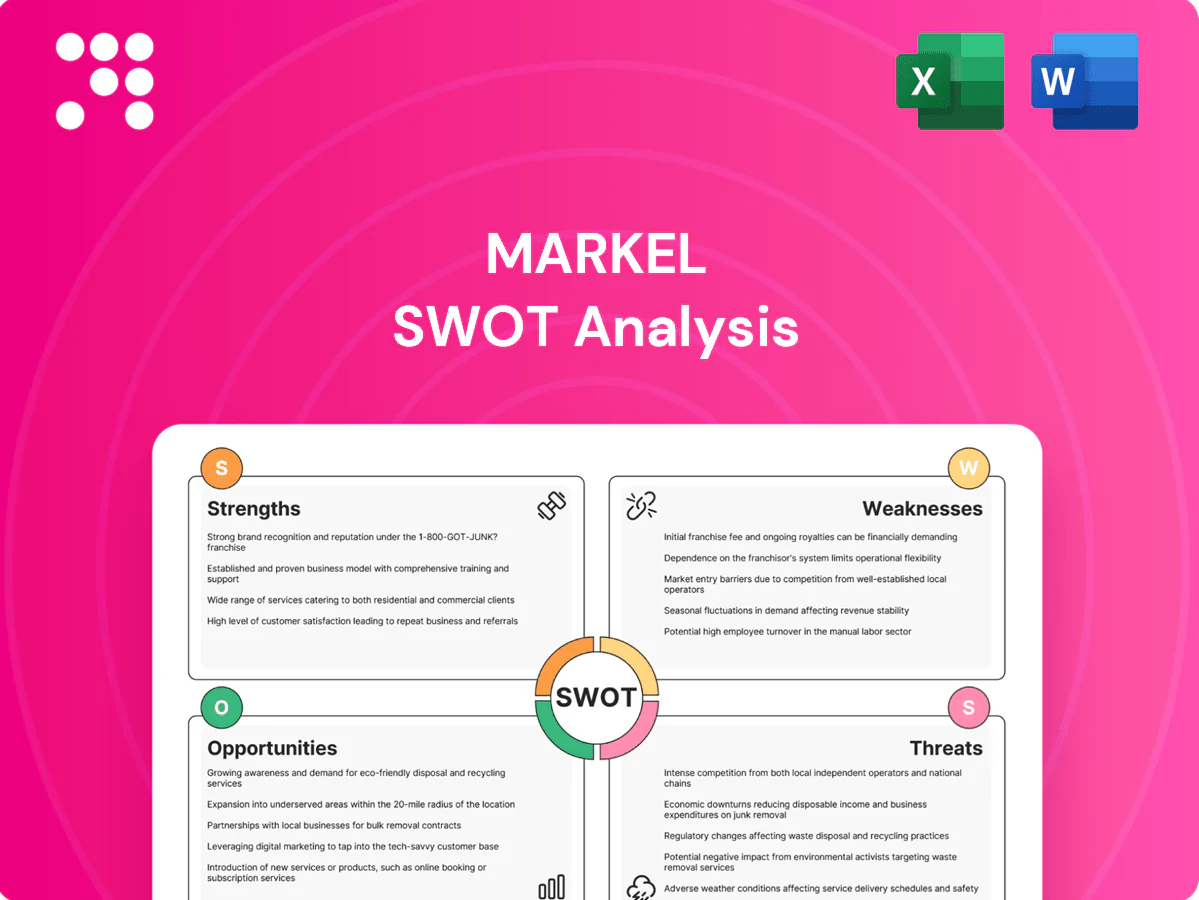
Markel SWOT Analysis

Elevate Your Analysis with the Complete SWOT Report
Markel blends specialty insurance expertise, strong underwriting discipline, and a resilient balance sheet, but faces underwriting cycles, investment risk, and competitive pressure; our full SWOT unpacks these dynamics, quantifies financial impacts, and outlines strategic options. Purchase the complete, editable SWOT to plan, pitch, or invest with confidence.
Strengths

Diversified revenue engines
Markel’s operations span specialty insurance, reinsurance and a portfolio of industrial and manufacturing businesses via Markel Ventures, creating diversified revenue engines. This mix smooths earnings across underwriting cycles and economic environments, providing multiple cash-flow sources and reducing reliance on any single line. The diversification broadens capital deployment options and enhances strategic flexibility for acquisitions, investments and underwriting shifts.
Underwriting discipline and niche focus
Specialty lines and niche markets give Markel pricing power and tailored coverage, while a culture of underwriting discipline supports durable favorable combined ratios; smaller, less-contested segments show stickier customer relationships and retention, and deep technical expertise drives superior risk selection and product customization, reinforcing margin resilience and long-term underwriting profit potential.

Investment prowess and float
Markel leverages an investment portfolio of about $26 billion alongside roughly $9 billion of insurance float to create an additional return engine. Long-term, equity-focused investing has supported book value compounding, with investment gains smoothing earnings across cycles. The structure enables opportunistic deployment in downturns and generates investment income that meaningfully diversifies returns beyond underwriting profits.

Markel Ventures operating moat
Markel Ventures' wholly owned non-insurance businesses supply durable, recurring operating earnings that dilute underwriting volatility and are often less correlated with catastrophe-driven insurance results, enhancing consolidated earnings stability.
- Durable recurring earnings from subsidiaries
- Lower correlation with catastrophe volatility
- Optionality for reinvestment and bolt-ons
- Deeper sector knowledge and networks
Strong capital and risk management
Strong capital and risk management: conservative reserving and robust reinsurance programs bolster balance-sheet resilience; prudent capital allocation across underwriting, investments and acquisitions supports long-term durability; geographic and product diversification reduces concentration risk; enterprise risk management frameworks guide preparedness for tail events.
- Robust reinsurance programs
- Prudent capital allocation
- Geographic/product diversification
- ERM frameworks; Markel Ventures owns 80+ businesses (2024)
Specialty insurer blends underwriting, $26B & $9B float
Markel’s diversified mix of specialty insurance, reinsurance and Markel Ventures (80+ businesses in 2024) smooths earnings and widens capital deployment options. Specialty niche underwriting and disciplined risk selection drive durable margins and customer stickiness. Investment portfolio (~$26B) plus insurance float (~$9B) creates a meaningful non-underwriting return engine and opportunistic liquidity for acquisitions.
| Metric | Value (2024) |
|---|---|
| Investment portfolio | $26B |
| Insurance float | $9B |
| Markel Ventures businesses | 80+ |
What is included in the product
 Detailed Word Document
Delivers a strategic overview of Markel’s internal and external business factors, outlining strengths, weaknesses, opportunities, and threats to assess its competitive position and future risks.

 Customizable Excel Spreadsheet
Provides a concise, visual SWOT matrix tailored to Markel for rapid strategic alignment and stakeholder-ready summaries, enabling quick edits to reflect changing insurance market priorities.
Weaknesses

Exposure to catastrophe volatility
Reinsurance and property lines expose Markel to lumpy natural catastrophe losses; even with retrocession, active CAT years can materially dent underwriting earnings and require reserve strengthening. Market hardening historically follows major CAT loss seasons but timing and premium recovery are uncertain. Episodic volatility weighs on investor sentiment and can compress valuation multiples during loss-impacted quarters.
Complex conglomerate structure
Markel (NYSE: MKL), founded in 1930, combines insurance underwriting with Markel Ventures operating companies, which complicates performance attribution and reduces transparency across segments. Investors often apply a conglomerate discount to MKL shares, while mingled underwriting and operating results make cross-cycle evaluation harder. Governance and communication requirements rise as diverse businesses demand distinct reporting and oversight.

Investment market sensitivity
Markel's equity-heavy investment mix can amplify book-value swings in down markets, with public-equity volatility historically driving quarterly mark-to-market impacts. Rising policy rates and wider credit spreads have reduced fixed-income marks and coupon reinvestment income across the industry. Procyclical market stress often coincides with underwriting losses, and mark-to-market noise can obscure underlying operating momentum.

Scaling specialty niches
Scaling specialty niches strains Markel because niche markets are capacity constrained and scaling often erodes margins, while overexpansion can weaken underwriting discipline and increase combined-ratio volatility.
Competition in attractive sublines compresses pricing and maintaining deep expertise across many sublines stretches technical resources and talent pipelines.
- Capacity limits
- Margin erosion
- Underwriting discipline risk
- Pricing compression
- Resource strain
Integration and execution risk
Integration and execution risk: Markel Ventures' expansion—owning over 60 businesses as of 2024—requires careful operational and cultural integration, and misalignment can erode synergies. Overpaying for high-quality bolt-ons or execution missteps can dilute returns and divert management focus and capital. Historical bolt-on integration timelines often exceed 12 months.
- Cultural fit uncertainty
- Capital absorption risk
- Potential return dilution
- Management distraction
Reinsurance CAT risk and conglomerate mix fuel volatile underwriting and valuation swings
Reinsurance and property CAT exposure drives lumpy underwriting losses and reserve volatility. Markel's insurance + Markel Ventures mix (owns over 60 businesses as of 2024) reduces transparency and invites a conglomerate discount. Equity-heavy investments amplify mark-to-market swings, while scaling niche lines risks margin erosion and talent/resource strain.
| Metric | Value |
|---|---|
| Markel Ventures businesses (2024) | 60+ |
| Ticker | MKL |
| Founded | 1930 |
Same Document Delivered
Markel SWOT Analysis
This is the actual Markel SWOT analysis document you’ll receive upon purchase—no surprises, just professional quality. The preview below is taken directly from the full report you'll get, and purchasing unlocks the complete, editable version. You’re viewing a live excerpt of the real file; buy now to download the entire, detailed analysis.

Elevate Your Analysis with the Complete SWOT Report
Markel blends specialty insurance expertise, strong underwriting discipline, and a resilient balance sheet, but faces underwriting cycles, investment risk, and competitive pressure; our full SWOT unpacks these dynamics, quantifies financial impacts, and outlines strategic options. Purchase the complete, editable SWOT to plan, pitch, or invest with confidence.
Strengths
Diversified revenue engines
Markel’s operations span specialty insurance, reinsurance and a portfolio of industrial and manufacturing businesses via Markel Ventures, creating diversified revenue engines. This mix smooths earnings across underwriting cycles and economic environments, providing multiple cash-flow sources and reducing reliance on any single line. The diversification broadens capital deployment options and enhances strategic flexibility for acquisitions, investments and underwriting shifts.
Underwriting discipline and niche focus
Specialty lines and niche markets give Markel pricing power and tailored coverage, while a culture of underwriting discipline supports durable favorable combined ratios; smaller, less-contested segments show stickier customer relationships and retention, and deep technical expertise drives superior risk selection and product customization, reinforcing margin resilience and long-term underwriting profit potential.
Investment prowess and float
Markel leverages an investment portfolio of about $26 billion alongside roughly $9 billion of insurance float to create an additional return engine. Long-term, equity-focused investing has supported book value compounding, with investment gains smoothing earnings across cycles. The structure enables opportunistic deployment in downturns and generates investment income that meaningfully diversifies returns beyond underwriting profits.
Markel Ventures operating moat
Markel Ventures' wholly owned non-insurance businesses supply durable, recurring operating earnings that dilute underwriting volatility and are often less correlated with catastrophe-driven insurance results, enhancing consolidated earnings stability.
- Durable recurring earnings from subsidiaries
- Lower correlation with catastrophe volatility
- Optionality for reinvestment and bolt-ons
- Deeper sector knowledge and networks
Strong capital and risk management
Strong capital and risk management: conservative reserving and robust reinsurance programs bolster balance-sheet resilience; prudent capital allocation across underwriting, investments and acquisitions supports long-term durability; geographic and product diversification reduces concentration risk; enterprise risk management frameworks guide preparedness for tail events.
- Robust reinsurance programs
- Prudent capital allocation
- Geographic/product diversification
- ERM frameworks; Markel Ventures owns 80+ businesses (2024)
Specialty insurer blends underwriting, $26B & $9B float
Markel’s diversified mix of specialty insurance, reinsurance and Markel Ventures (80+ businesses in 2024) smooths earnings and widens capital deployment options. Specialty niche underwriting and disciplined risk selection drive durable margins and customer stickiness. Investment portfolio (~$26B) plus insurance float (~$9B) creates a meaningful non-underwriting return engine and opportunistic liquidity for acquisitions.
| Metric | Value (2024) |
|---|---|
| Investment portfolio | $26B |
| Insurance float | $9B |
| Markel Ventures businesses | 80+ |
What is included in the product
Detailed Word Document
Delivers a strategic overview of Markel’s internal and external business factors, outlining strengths, weaknesses, opportunities, and threats to assess its competitive position and future risks.
Customizable Excel Spreadsheet
Provides a concise, visual SWOT matrix tailored to Markel for rapid strategic alignment and stakeholder-ready summaries, enabling quick edits to reflect changing insurance market priorities.
Weaknesses
Exposure to catastrophe volatility
Reinsurance and property lines expose Markel to lumpy natural catastrophe losses; even with retrocession, active CAT years can materially dent underwriting earnings and require reserve strengthening. Market hardening historically follows major CAT loss seasons but timing and premium recovery are uncertain. Episodic volatility weighs on investor sentiment and can compress valuation multiples during loss-impacted quarters.
Complex conglomerate structure
Markel (NYSE: MKL), founded in 1930, combines insurance underwriting with Markel Ventures operating companies, which complicates performance attribution and reduces transparency across segments. Investors often apply a conglomerate discount to MKL shares, while mingled underwriting and operating results make cross-cycle evaluation harder. Governance and communication requirements rise as diverse businesses demand distinct reporting and oversight.
Investment market sensitivity
Markel's equity-heavy investment mix can amplify book-value swings in down markets, with public-equity volatility historically driving quarterly mark-to-market impacts. Rising policy rates and wider credit spreads have reduced fixed-income marks and coupon reinvestment income across the industry. Procyclical market stress often coincides with underwriting losses, and mark-to-market noise can obscure underlying operating momentum.
Scaling specialty niches
Scaling specialty niches strains Markel because niche markets are capacity constrained and scaling often erodes margins, while overexpansion can weaken underwriting discipline and increase combined-ratio volatility.
Competition in attractive sublines compresses pricing and maintaining deep expertise across many sublines stretches technical resources and talent pipelines.
- Capacity limits
- Margin erosion
- Underwriting discipline risk
- Pricing compression
- Resource strain
Integration and execution risk
Integration and execution risk: Markel Ventures' expansion—owning over 60 businesses as of 2024—requires careful operational and cultural integration, and misalignment can erode synergies. Overpaying for high-quality bolt-ons or execution missteps can dilute returns and divert management focus and capital. Historical bolt-on integration timelines often exceed 12 months.
- Cultural fit uncertainty
- Capital absorption risk
- Potential return dilution
- Management distraction
Reinsurance CAT risk and conglomerate mix fuel volatile underwriting and valuation swings
Reinsurance and property CAT exposure drives lumpy underwriting losses and reserve volatility. Markel's insurance + Markel Ventures mix (owns over 60 businesses as of 2024) reduces transparency and invites a conglomerate discount. Equity-heavy investments amplify mark-to-market swings, while scaling niche lines risks margin erosion and talent/resource strain.
| Metric | Value |
|---|---|
| Markel Ventures businesses (2024) | 60+ |
| Ticker | MKL |
| Founded | 1930 |
Same Document Delivered
Markel SWOT Analysis
This is the actual Markel SWOT analysis document you’ll receive upon purchase—no surprises, just professional quality. The preview below is taken directly from the full report you'll get, and purchasing unlocks the complete, editable version. You’re viewing a live excerpt of the real file; buy now to download the entire, detailed analysis.
Original: $10.00
-65%$10.00
$3.50Description
Elevate Your Analysis with the Complete SWOT Report
Markel blends specialty insurance expertise, strong underwriting discipline, and a resilient balance sheet, but faces underwriting cycles, investment risk, and competitive pressure; our full SWOT unpacks these dynamics, quantifies financial impacts, and outlines strategic options. Purchase the complete, editable SWOT to plan, pitch, or invest with confidence.
Strengths
Diversified revenue engines
Markel’s operations span specialty insurance, reinsurance and a portfolio of industrial and manufacturing businesses via Markel Ventures, creating diversified revenue engines. This mix smooths earnings across underwriting cycles and economic environments, providing multiple cash-flow sources and reducing reliance on any single line. The diversification broadens capital deployment options and enhances strategic flexibility for acquisitions, investments and underwriting shifts.
Underwriting discipline and niche focus
Specialty lines and niche markets give Markel pricing power and tailored coverage, while a culture of underwriting discipline supports durable favorable combined ratios; smaller, less-contested segments show stickier customer relationships and retention, and deep technical expertise drives superior risk selection and product customization, reinforcing margin resilience and long-term underwriting profit potential.
Investment prowess and float
Markel leverages an investment portfolio of about $26 billion alongside roughly $9 billion of insurance float to create an additional return engine. Long-term, equity-focused investing has supported book value compounding, with investment gains smoothing earnings across cycles. The structure enables opportunistic deployment in downturns and generates investment income that meaningfully diversifies returns beyond underwriting profits.
Markel Ventures operating moat
Markel Ventures' wholly owned non-insurance businesses supply durable, recurring operating earnings that dilute underwriting volatility and are often less correlated with catastrophe-driven insurance results, enhancing consolidated earnings stability.
- Durable recurring earnings from subsidiaries
- Lower correlation with catastrophe volatility
- Optionality for reinvestment and bolt-ons
- Deeper sector knowledge and networks
Strong capital and risk management
Strong capital and risk management: conservative reserving and robust reinsurance programs bolster balance-sheet resilience; prudent capital allocation across underwriting, investments and acquisitions supports long-term durability; geographic and product diversification reduces concentration risk; enterprise risk management frameworks guide preparedness for tail events.
- Robust reinsurance programs
- Prudent capital allocation
- Geographic/product diversification
- ERM frameworks; Markel Ventures owns 80+ businesses (2024)
Specialty insurer blends underwriting, $26B & $9B float
Markel’s diversified mix of specialty insurance, reinsurance and Markel Ventures (80+ businesses in 2024) smooths earnings and widens capital deployment options. Specialty niche underwriting and disciplined risk selection drive durable margins and customer stickiness. Investment portfolio (~$26B) plus insurance float (~$9B) creates a meaningful non-underwriting return engine and opportunistic liquidity for acquisitions.
| Metric | Value (2024) |
|---|---|
| Investment portfolio | $26B |
| Insurance float | $9B |
| Markel Ventures businesses | 80+ |
What is included in the product
Detailed Word Document
Delivers a strategic overview of Markel’s internal and external business factors, outlining strengths, weaknesses, opportunities, and threats to assess its competitive position and future risks.
Customizable Excel Spreadsheet
Provides a concise, visual SWOT matrix tailored to Markel for rapid strategic alignment and stakeholder-ready summaries, enabling quick edits to reflect changing insurance market priorities.
Weaknesses
Exposure to catastrophe volatility
Reinsurance and property lines expose Markel to lumpy natural catastrophe losses; even with retrocession, active CAT years can materially dent underwriting earnings and require reserve strengthening. Market hardening historically follows major CAT loss seasons but timing and premium recovery are uncertain. Episodic volatility weighs on investor sentiment and can compress valuation multiples during loss-impacted quarters.
Complex conglomerate structure
Markel (NYSE: MKL), founded in 1930, combines insurance underwriting with Markel Ventures operating companies, which complicates performance attribution and reduces transparency across segments. Investors often apply a conglomerate discount to MKL shares, while mingled underwriting and operating results make cross-cycle evaluation harder. Governance and communication requirements rise as diverse businesses demand distinct reporting and oversight.
Investment market sensitivity
Markel's equity-heavy investment mix can amplify book-value swings in down markets, with public-equity volatility historically driving quarterly mark-to-market impacts. Rising policy rates and wider credit spreads have reduced fixed-income marks and coupon reinvestment income across the industry. Procyclical market stress often coincides with underwriting losses, and mark-to-market noise can obscure underlying operating momentum.
Scaling specialty niches
Scaling specialty niches strains Markel because niche markets are capacity constrained and scaling often erodes margins, while overexpansion can weaken underwriting discipline and increase combined-ratio volatility.
Competition in attractive sublines compresses pricing and maintaining deep expertise across many sublines stretches technical resources and talent pipelines.
- Capacity limits
- Margin erosion
- Underwriting discipline risk
- Pricing compression
- Resource strain
Integration and execution risk
Integration and execution risk: Markel Ventures' expansion—owning over 60 businesses as of 2024—requires careful operational and cultural integration, and misalignment can erode synergies. Overpaying for high-quality bolt-ons or execution missteps can dilute returns and divert management focus and capital. Historical bolt-on integration timelines often exceed 12 months.
- Cultural fit uncertainty
- Capital absorption risk
- Potential return dilution
- Management distraction
Reinsurance CAT risk and conglomerate mix fuel volatile underwriting and valuation swings
Reinsurance and property CAT exposure drives lumpy underwriting losses and reserve volatility. Markel's insurance + Markel Ventures mix (owns over 60 businesses as of 2024) reduces transparency and invites a conglomerate discount. Equity-heavy investments amplify mark-to-market swings, while scaling niche lines risks margin erosion and talent/resource strain.
| Metric | Value |
|---|---|
| Markel Ventures businesses (2024) | 60+ |
| Ticker | MKL |
| Founded | 1930 |
Same Document Delivered
Markel SWOT Analysis
This is the actual Markel SWOT analysis document you’ll receive upon purchase—no surprises, just professional quality. The preview below is taken directly from the full report you'll get, and purchasing unlocks the complete, editable version. You’re viewing a live excerpt of the real file; buy now to download the entire, detailed analysis.











