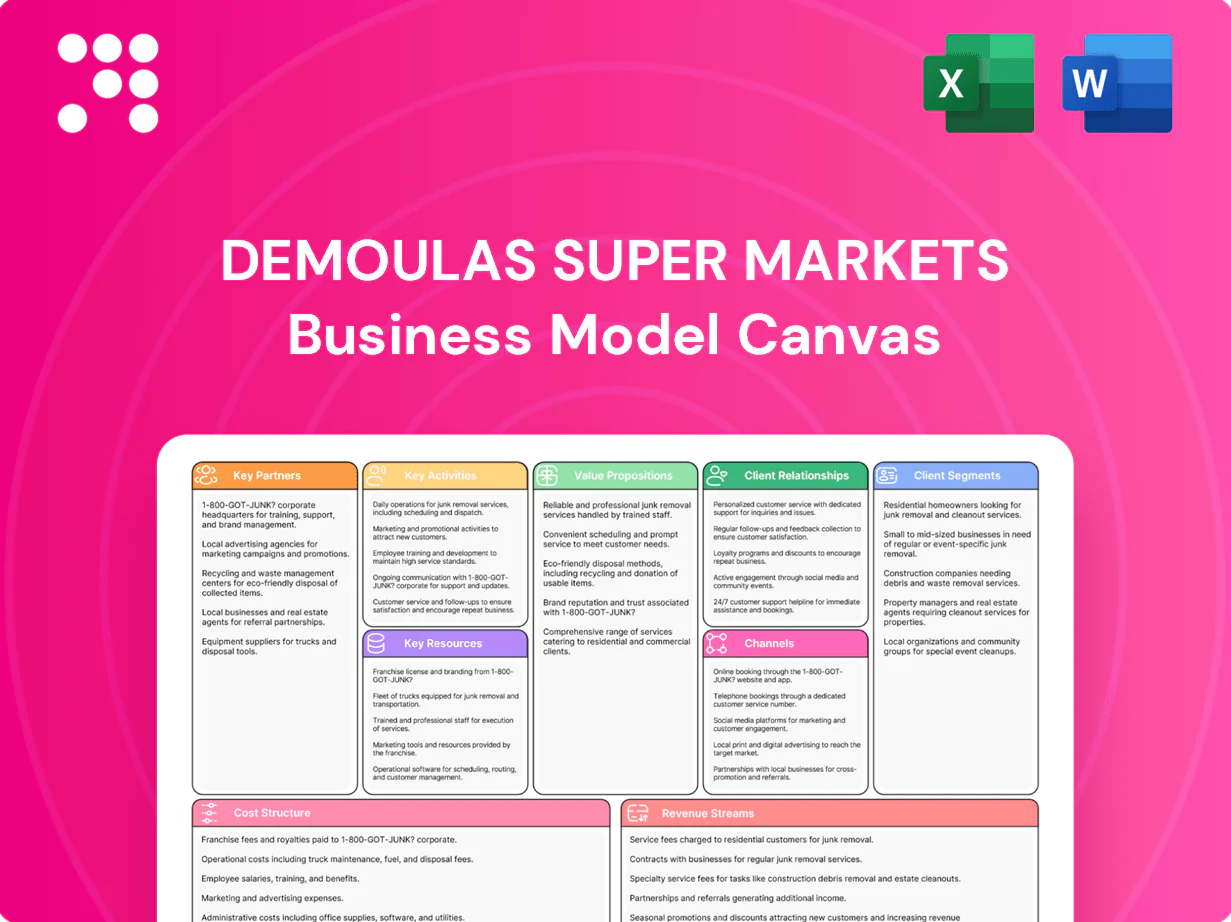
Demoulas Super Markets Business Model Canvas

Regional supermarket chain: low-cost operations, private labels, community stores driving margins
Discover how Demoulas Super Markets aligns low-cost operations, private-label depth, and community-focused stores to drive repeat traffic and margin expansion. This brief Business Model Canvas highlights customer segments, key activities, and revenue streams that fuel regional dominance. Purchase the full, editable Canvas in Word & Excel for a section-by-section strategic playbook you can use for benchmarking or investor decks.
Partnerships

Regional produce growers
Close ties with New England farms secure steady, seasonal supply at competitive costs for DeMoulas Super Markets, which operates 88 stores across the region (2024). Relationships emphasize freshness and short lead times, often 24–48 hours from harvest to shelf. Volume commitments and multi-year arrangements lock pricing and supply; co-marketing with growers highlights local sourcing to customers.
National CPG suppliers
National CPG suppliers supply core grocery brands that drive traffic and increase basket size across Demoulas Super Markets network of 88 stores (2024); negotiated trade promotions and slotting efficiencies lower shelf prices and protect margin. Joint demand planning with suppliers cuts stockouts and reduces lost sales. Data sharing on POS and loyalty lifts promo ROI, often improving incremental promo return by double digits.

Meat and seafood vendors
Trusted processors provide consistent quality and food safety for Market Basket’s network of over 100 stores (2024), enabling flexible cuts and specs that align with Market Basket merchandising. Large-volume buys deliver scale economies, allowing price savings passed to shoppers, while rapid replenishment cycles support daily freshness and reduce shrink across departments.

Logistics and warehousing partners
Regional carriers and 3PL partners smooth inbound and store deliveries for Demoulas, enabling quicker replenishment across New England stores. Cross-dock and backhaul arrangements deliver double-digit freight cost reductions and lower empty miles. Temperature-controlled capability preserves perishables and reduces shrink, while route optimization raises on-time fill rates and service consistency.
- Regional 3PLs
- Cross-dock/backhaul
- Temp-controlled trailers
- Route optimization
Community and municipal ties
Demoulas leverages community and municipal ties to secure permits, expansions and traffic planning support from local authorities, accelerating site approvals across its ~88 New England stores and supporting estimated $5B annual sales (2024). Community groups aid hiring and neighborhood integration; sponsorships and disaster-relief donations build sustained brand goodwill and trust.
- Local permits: municipal collaboration
- Hiring: community partnerships
- Sponsorships: brand goodwill
- Relief/donations: long-term trust
Regional grocer links with NE farms for 24–48h freshness, driving $5B sales
DeMoulas partners with New England farms for 24–48h fresh supply to its 88 stores (2024); national CPGs drive traffic via trade promotions (double-digit promo ROI) while processors enable scale pricing and daily freshness; regional 3PLs cut freight costs double digits and preserve perishables; municipal and community ties support site approvals and workforce for ~$5B sales (2024).
| Partner | Role | Impact (2024) |
|---|---|---|
| Farms | Fresh supply | 24–48h to shelf |
| CPGs | Promos/brands | Double-digit promo ROI |
| 3PLs | Logistics | Double-digit freight savings |
| Community | Permits/hiring | $5B sales support |
What is included in the product
 Detailed Word Document
A concise, pre-written Business Model Canvas for Demoulas Super Markets outlining customer segments, channels, value propositions, revenue streams and cost structure, reflecting real-world operations, competitive advantages and linked SWOT insights for investor-ready presentations and strategic decision-making.

 Customizable Excel Spreadsheet
High-level view of Demoulas Super Markets’ business model with editable cells, relieving the pain of scattered strategy documents by consolidating operations, merchandising, and community-focused value propositions into one clear canvas.
Activities

High-velocity merchandising
Daily price checks and end-cap resets keep value visible, with end-cap promotions typically delivering ~20% sales lifts in grocery channels in 2024. Fast turns on staples (industry-average inventory turns ~12–16/yr) maintain freshness and reduce spoilage. Tight SKU curation supports a no-frills floor set and improves gross margin by lowering carrying costs. Lean signage highlights weekly deals to drive traffic and basket size.
Efficient procurement
Centralized buying negotiates aggressive costs leveraging scale across 88 Market Basket stores (2024), driving supplier discounts and uniform assortment. Forward buys are synced to promo calendars to lock prices before seasonal spikes and protect margins. Vendor compliance programs cut shrink and chargebacks through stricter audits and delivery standards, while expanded private-label sourcing fills value gaps and supports margin resilience.

In-store operations
Scheduling, disciplined receiving and backroom processes keep shelves stocked across Demoulas Super Markets' 88 stores (2024), directly supporting shelf availability and shrink control. In-store meat cutting and produce prep provide fresh visual cues that support basket size and loyalty. Clean, simple layouts shorten average trip time, while optimized front-end throughput minimizes lines and speeds checkout for over 24,000 employees and customers.

Supply chain management
Demoulas aligns load planning and DC replenishment to hold fill rates above 98% while lowering transport cost, balancing next‑day service with pallet optimization. Cold chain monitoring and temperature logging cut spoilage risk—FAO cites post‑harvest losses up to 30% without refrigeration. Inventory turns are tracked at grocery norms (roughly 12–15x) to optimize cash and shelf availability. Exception handling workflows aim to reduce industry out‑of‑stock rates (industry ~8–10%) toward top‑retailer targets under 3%.
- DC fill rate >98%
- Cold chain reduces spoilage (FAO up to 30%)
- Inventory turns ~12–15x
- OOS industry ~8–10%; target <3%
Local marketing
Weekly circulars and sharp-price tags communicate value across Market Baskets 80+ stores, supporting about $4 billion in annual sales (2024); community events and sponsorships reinforce local loyalty while social and web updates amplify promos and traffic; consistent low-price positioning cultivates strong word-of-mouth and repeat trips.
- Weekly circulars: in-store + online
- 80+ stores (2024)
- ≈$4B annual sales (2024)
- Community events → loyalty
Price checks + end-cap promos ~20% lift; DC fill > 98%
Daily price checks, end-cap promos (~20% lift) and lean SKU sets drive value and margin across 88 Market Basket stores (2024). Central buying, forward buys and private label sustain gross margins and >98% DC fill rates. Tight replenishment, cold‑chain monitoring and in‑store prep yield ~12–15 inventory turns and aim OOS <3%.
| Metric | 2024 |
|---|---|
| Stores | 88 |
| Sales | $4B |
| DC fill rate | >98% |
| Inventory turns | 12–15x |
| OOS target | <3% |
What You See Is What You Get
Business Model Canvas
The Business Model Canvas for Demoulas Super Markets shown here is the exact, live section from the final deliverable and not a mockup. When you purchase, you’ll receive this same complete document—fully formatted and ready-to-edit in Word and Excel. No placeholders or surprises: what you preview is exactly what you’ll download and use.

Regional supermarket chain: low-cost operations, private labels, community stores driving margins
Discover how Demoulas Super Markets aligns low-cost operations, private-label depth, and community-focused stores to drive repeat traffic and margin expansion. This brief Business Model Canvas highlights customer segments, key activities, and revenue streams that fuel regional dominance. Purchase the full, editable Canvas in Word & Excel for a section-by-section strategic playbook you can use for benchmarking or investor decks.
Partnerships
Regional produce growers
Close ties with New England farms secure steady, seasonal supply at competitive costs for DeMoulas Super Markets, which operates 88 stores across the region (2024). Relationships emphasize freshness and short lead times, often 24–48 hours from harvest to shelf. Volume commitments and multi-year arrangements lock pricing and supply; co-marketing with growers highlights local sourcing to customers.
National CPG suppliers
National CPG suppliers supply core grocery brands that drive traffic and increase basket size across Demoulas Super Markets network of 88 stores (2024); negotiated trade promotions and slotting efficiencies lower shelf prices and protect margin. Joint demand planning with suppliers cuts stockouts and reduces lost sales. Data sharing on POS and loyalty lifts promo ROI, often improving incremental promo return by double digits.
Meat and seafood vendors
Trusted processors provide consistent quality and food safety for Market Basket’s network of over 100 stores (2024), enabling flexible cuts and specs that align with Market Basket merchandising. Large-volume buys deliver scale economies, allowing price savings passed to shoppers, while rapid replenishment cycles support daily freshness and reduce shrink across departments.
Logistics and warehousing partners
Regional carriers and 3PL partners smooth inbound and store deliveries for Demoulas, enabling quicker replenishment across New England stores. Cross-dock and backhaul arrangements deliver double-digit freight cost reductions and lower empty miles. Temperature-controlled capability preserves perishables and reduces shrink, while route optimization raises on-time fill rates and service consistency.
- Regional 3PLs
- Cross-dock/backhaul
- Temp-controlled trailers
- Route optimization
Community and municipal ties
Demoulas leverages community and municipal ties to secure permits, expansions and traffic planning support from local authorities, accelerating site approvals across its ~88 New England stores and supporting estimated $5B annual sales (2024). Community groups aid hiring and neighborhood integration; sponsorships and disaster-relief donations build sustained brand goodwill and trust.
- Local permits: municipal collaboration
- Hiring: community partnerships
- Sponsorships: brand goodwill
- Relief/donations: long-term trust
Regional grocer links with NE farms for 24–48h freshness, driving $5B sales
DeMoulas partners with New England farms for 24–48h fresh supply to its 88 stores (2024); national CPGs drive traffic via trade promotions (double-digit promo ROI) while processors enable scale pricing and daily freshness; regional 3PLs cut freight costs double digits and preserve perishables; municipal and community ties support site approvals and workforce for ~$5B sales (2024).
| Partner | Role | Impact (2024) |
|---|---|---|
| Farms | Fresh supply | 24–48h to shelf |
| CPGs | Promos/brands | Double-digit promo ROI |
| 3PLs | Logistics | Double-digit freight savings |
| Community | Permits/hiring | $5B sales support |
What is included in the product
Detailed Word Document
A concise, pre-written Business Model Canvas for Demoulas Super Markets outlining customer segments, channels, value propositions, revenue streams and cost structure, reflecting real-world operations, competitive advantages and linked SWOT insights for investor-ready presentations and strategic decision-making.
Customizable Excel Spreadsheet
High-level view of Demoulas Super Markets’ business model with editable cells, relieving the pain of scattered strategy documents by consolidating operations, merchandising, and community-focused value propositions into one clear canvas.
Activities
High-velocity merchandising
Daily price checks and end-cap resets keep value visible, with end-cap promotions typically delivering ~20% sales lifts in grocery channels in 2024. Fast turns on staples (industry-average inventory turns ~12–16/yr) maintain freshness and reduce spoilage. Tight SKU curation supports a no-frills floor set and improves gross margin by lowering carrying costs. Lean signage highlights weekly deals to drive traffic and basket size.
Efficient procurement
Centralized buying negotiates aggressive costs leveraging scale across 88 Market Basket stores (2024), driving supplier discounts and uniform assortment. Forward buys are synced to promo calendars to lock prices before seasonal spikes and protect margins. Vendor compliance programs cut shrink and chargebacks through stricter audits and delivery standards, while expanded private-label sourcing fills value gaps and supports margin resilience.
In-store operations
Scheduling, disciplined receiving and backroom processes keep shelves stocked across Demoulas Super Markets' 88 stores (2024), directly supporting shelf availability and shrink control. In-store meat cutting and produce prep provide fresh visual cues that support basket size and loyalty. Clean, simple layouts shorten average trip time, while optimized front-end throughput minimizes lines and speeds checkout for over 24,000 employees and customers.
Supply chain management
Demoulas aligns load planning and DC replenishment to hold fill rates above 98% while lowering transport cost, balancing next‑day service with pallet optimization. Cold chain monitoring and temperature logging cut spoilage risk—FAO cites post‑harvest losses up to 30% without refrigeration. Inventory turns are tracked at grocery norms (roughly 12–15x) to optimize cash and shelf availability. Exception handling workflows aim to reduce industry out‑of‑stock rates (industry ~8–10%) toward top‑retailer targets under 3%.
- DC fill rate >98%
- Cold chain reduces spoilage (FAO up to 30%)
- Inventory turns ~12–15x
- OOS industry ~8–10%; target <3%
Local marketing
Weekly circulars and sharp-price tags communicate value across Market Baskets 80+ stores, supporting about $4 billion in annual sales (2024); community events and sponsorships reinforce local loyalty while social and web updates amplify promos and traffic; consistent low-price positioning cultivates strong word-of-mouth and repeat trips.
- Weekly circulars: in-store + online
- 80+ stores (2024)
- ≈$4B annual sales (2024)
- Community events → loyalty
Price checks + end-cap promos ~20% lift; DC fill > 98%
Daily price checks, end-cap promos (~20% lift) and lean SKU sets drive value and margin across 88 Market Basket stores (2024). Central buying, forward buys and private label sustain gross margins and >98% DC fill rates. Tight replenishment, cold‑chain monitoring and in‑store prep yield ~12–15 inventory turns and aim OOS <3%.
| Metric | 2024 |
|---|---|
| Stores | 88 |
| Sales | $4B |
| DC fill rate | >98% |
| Inventory turns | 12–15x |
| OOS target | <3% |
What You See Is What You Get
Business Model Canvas
The Business Model Canvas for Demoulas Super Markets shown here is the exact, live section from the final deliverable and not a mockup. When you purchase, you’ll receive this same complete document—fully formatted and ready-to-edit in Word and Excel. No placeholders or surprises: what you preview is exactly what you’ll download and use.
Original: $10.00
-65%$10.00
$3.50Description
Regional supermarket chain: low-cost operations, private labels, community stores driving margins
Discover how Demoulas Super Markets aligns low-cost operations, private-label depth, and community-focused stores to drive repeat traffic and margin expansion. This brief Business Model Canvas highlights customer segments, key activities, and revenue streams that fuel regional dominance. Purchase the full, editable Canvas in Word & Excel for a section-by-section strategic playbook you can use for benchmarking or investor decks.
Partnerships
Regional produce growers
Close ties with New England farms secure steady, seasonal supply at competitive costs for DeMoulas Super Markets, which operates 88 stores across the region (2024). Relationships emphasize freshness and short lead times, often 24–48 hours from harvest to shelf. Volume commitments and multi-year arrangements lock pricing and supply; co-marketing with growers highlights local sourcing to customers.
National CPG suppliers
National CPG suppliers supply core grocery brands that drive traffic and increase basket size across Demoulas Super Markets network of 88 stores (2024); negotiated trade promotions and slotting efficiencies lower shelf prices and protect margin. Joint demand planning with suppliers cuts stockouts and reduces lost sales. Data sharing on POS and loyalty lifts promo ROI, often improving incremental promo return by double digits.
Meat and seafood vendors
Trusted processors provide consistent quality and food safety for Market Basket’s network of over 100 stores (2024), enabling flexible cuts and specs that align with Market Basket merchandising. Large-volume buys deliver scale economies, allowing price savings passed to shoppers, while rapid replenishment cycles support daily freshness and reduce shrink across departments.
Logistics and warehousing partners
Regional carriers and 3PL partners smooth inbound and store deliveries for Demoulas, enabling quicker replenishment across New England stores. Cross-dock and backhaul arrangements deliver double-digit freight cost reductions and lower empty miles. Temperature-controlled capability preserves perishables and reduces shrink, while route optimization raises on-time fill rates and service consistency.
- Regional 3PLs
- Cross-dock/backhaul
- Temp-controlled trailers
- Route optimization
Community and municipal ties
Demoulas leverages community and municipal ties to secure permits, expansions and traffic planning support from local authorities, accelerating site approvals across its ~88 New England stores and supporting estimated $5B annual sales (2024). Community groups aid hiring and neighborhood integration; sponsorships and disaster-relief donations build sustained brand goodwill and trust.
- Local permits: municipal collaboration
- Hiring: community partnerships
- Sponsorships: brand goodwill
- Relief/donations: long-term trust
Regional grocer links with NE farms for 24–48h freshness, driving $5B sales
DeMoulas partners with New England farms for 24–48h fresh supply to its 88 stores (2024); national CPGs drive traffic via trade promotions (double-digit promo ROI) while processors enable scale pricing and daily freshness; regional 3PLs cut freight costs double digits and preserve perishables; municipal and community ties support site approvals and workforce for ~$5B sales (2024).
| Partner | Role | Impact (2024) |
|---|---|---|
| Farms | Fresh supply | 24–48h to shelf |
| CPGs | Promos/brands | Double-digit promo ROI |
| 3PLs | Logistics | Double-digit freight savings |
| Community | Permits/hiring | $5B sales support |
What is included in the product
Detailed Word Document
A concise, pre-written Business Model Canvas for Demoulas Super Markets outlining customer segments, channels, value propositions, revenue streams and cost structure, reflecting real-world operations, competitive advantages and linked SWOT insights for investor-ready presentations and strategic decision-making.
Customizable Excel Spreadsheet
High-level view of Demoulas Super Markets’ business model with editable cells, relieving the pain of scattered strategy documents by consolidating operations, merchandising, and community-focused value propositions into one clear canvas.
Activities
High-velocity merchandising
Daily price checks and end-cap resets keep value visible, with end-cap promotions typically delivering ~20% sales lifts in grocery channels in 2024. Fast turns on staples (industry-average inventory turns ~12–16/yr) maintain freshness and reduce spoilage. Tight SKU curation supports a no-frills floor set and improves gross margin by lowering carrying costs. Lean signage highlights weekly deals to drive traffic and basket size.
Efficient procurement
Centralized buying negotiates aggressive costs leveraging scale across 88 Market Basket stores (2024), driving supplier discounts and uniform assortment. Forward buys are synced to promo calendars to lock prices before seasonal spikes and protect margins. Vendor compliance programs cut shrink and chargebacks through stricter audits and delivery standards, while expanded private-label sourcing fills value gaps and supports margin resilience.
In-store operations
Scheduling, disciplined receiving and backroom processes keep shelves stocked across Demoulas Super Markets' 88 stores (2024), directly supporting shelf availability and shrink control. In-store meat cutting and produce prep provide fresh visual cues that support basket size and loyalty. Clean, simple layouts shorten average trip time, while optimized front-end throughput minimizes lines and speeds checkout for over 24,000 employees and customers.
Supply chain management
Demoulas aligns load planning and DC replenishment to hold fill rates above 98% while lowering transport cost, balancing next‑day service with pallet optimization. Cold chain monitoring and temperature logging cut spoilage risk—FAO cites post‑harvest losses up to 30% without refrigeration. Inventory turns are tracked at grocery norms (roughly 12–15x) to optimize cash and shelf availability. Exception handling workflows aim to reduce industry out‑of‑stock rates (industry ~8–10%) toward top‑retailer targets under 3%.
- DC fill rate >98%
- Cold chain reduces spoilage (FAO up to 30%)
- Inventory turns ~12–15x
- OOS industry ~8–10%; target <3%
Local marketing
Weekly circulars and sharp-price tags communicate value across Market Baskets 80+ stores, supporting about $4 billion in annual sales (2024); community events and sponsorships reinforce local loyalty while social and web updates amplify promos and traffic; consistent low-price positioning cultivates strong word-of-mouth and repeat trips.
- Weekly circulars: in-store + online
- 80+ stores (2024)
- ≈$4B annual sales (2024)
- Community events → loyalty
Price checks + end-cap promos ~20% lift; DC fill > 98%
Daily price checks, end-cap promos (~20% lift) and lean SKU sets drive value and margin across 88 Market Basket stores (2024). Central buying, forward buys and private label sustain gross margins and >98% DC fill rates. Tight replenishment, cold‑chain monitoring and in‑store prep yield ~12–15 inventory turns and aim OOS <3%.
| Metric | 2024 |
|---|---|
| Stores | 88 |
| Sales | $4B |
| DC fill rate | >98% |
| Inventory turns | 12–15x |
| OOS target | <3% |
What You See Is What You Get
Business Model Canvas
The Business Model Canvas for Demoulas Super Markets shown here is the exact, live section from the final deliverable and not a mockup. When you purchase, you’ll receive this same complete document—fully formatted and ready-to-edit in Word and Excel. No placeholders or surprises: what you preview is exactly what you’ll download and use.











