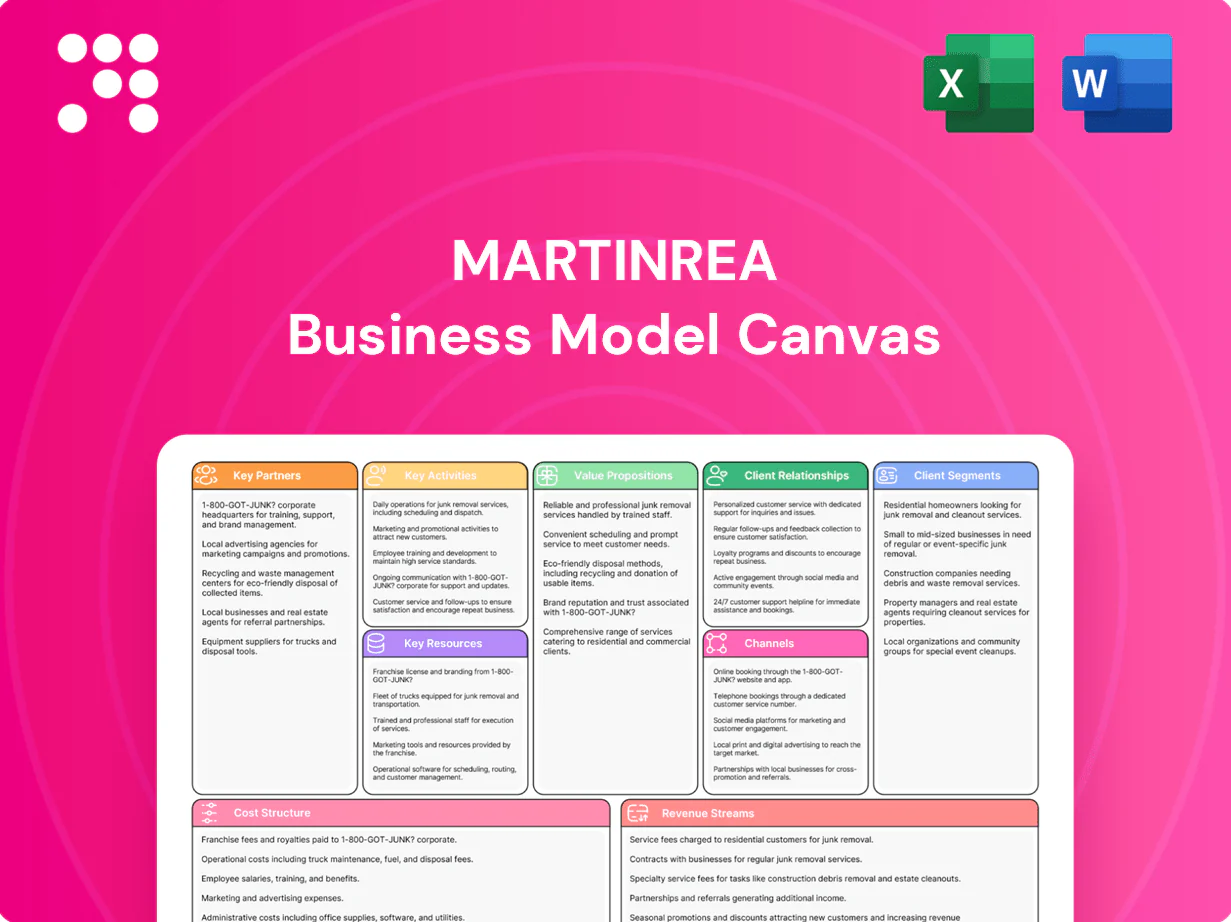
Martinrea Business Model Canvas

Complete Business Model Canvas: Strategic Blueprint for Automotive Supplier Growth
Unlock the full strategic blueprint behind Martinrea’s business model with our complete Business Model Canvas. This concise, actionable document maps value propositions, key partners, revenue streams and cost drivers to reveal growth levers and risks. Ideal for investors, strategists, and founders—download the Word and Excel files to benchmark, plan, and execute with confidence.
Partnerships

Global OEM collaborations
Global OEM collaborations secure program awards and long-term platform volumes for Martinrea, supporting its 2024 reported net sales of US$6.1 billion and enabling multi-year production commitments. Joint planning with OEMs aligns capacity to model cycles and regional demand, reducing mismatch risk and smoothing utilization. Early engagement drives design-for-manufacture, meeting cost targets and reducing launch overruns. These relationships underpin forecast visibility and capital investment justification.
Material suppliers (aluminum, advanced steels)
Sourcing high-grade aluminum alloys and AHSS is critical for lightweighting and structural performance, supporting roughly 6–8% fuel-efficiency gains per 10% vehicle weight reduction. Strategic agreements with mills stabilize pricing and ensure continuity of supply. Co-development tailors chemistries and gauges to forming and casting needs, improving yield, cutting scrap and enhancing part integrity.

Tooling, die, and equipment vendors
Presses, casting cells, robotics and precision dies require tight supplier integration for tool builds, maintenance and PPAP sequencing; industry targets for press uptime exceed 95% and PPAP readiness commonly ranges 30–60 days. Partners enable rapid tool builds and on-site support to meet cycle-time targets through joint trials that de-risk launches. Continuous equipment upgrades drive measurable productivity and quality improvements, often in the mid-single-digit percent range.

Technology and R&D institutions
Logistics and JIT providers
Logistics and JIT providers enable inbound and outbound just-in-time and just-in-sequence deliveries that align Martinrea assemblies with OEM line schedules, minimizing line stoppages and penalties. Regional hubs concentrate inventory close to plants, reducing shipping risk and buffer stock. Real-time tracking and strong carrier SLAs mitigate disruptions and protect margins.
- JIT/JIS alignment
- Regional hub inventory reduction
- Real-time tracking for OEM schedules
- Robust logistics to avoid penalties
Partner ecosystem secures volumes, lowers launch risk, enables lightweighting for US$6.1B 2024 sales
Strategic OEM, materials, equipment, R&D and logistics partners secure program volumes, reduce launch risk and enable lightweighting that supports Martinrea's 2024 net sales of US$6.1B. Supply agreements and co‑development stabilize aluminum/AHSS sourcing and improve yields. Equipment and logistics partners sustain >95% press uptime and JIT/JIS sequencing; additive tooling demand mirrored a ~US$18.6B 2024 market.
| Partner | Role | 2024 Metric |
|---|---|---|
| OEMs | Program awards/volume | Net sales US$6.1B |
| Materials | Lightweighting | 6–8% fuel gain/10% wt↓ |
| Equipment | Uptime/PPAP | >95% uptime |
| R&D | Innovation/IP | Additive market US$18.6B |
| Logistics | JIT/JIS delivery | Real‑time tracking |
What is included in the product
 Detailed Word Document
A comprehensive, pre-written Business Model Canvas tailored to Martinrea’s automotive components strategy, covering all 9 BMC blocks with value propositions, customer segments, channels and revenue streams, reflecting real-world operations and plans, including linked SWOT and competitive-advantage analysis—ideal for presentations, investor discussions and strategic decision-making.

 Customizable Excel Spreadsheet
High-level view of Martinrea’s business model with editable cells, relieving pain by consolidating operations, revenue streams, cost drivers and partner ecosystems into a single, actionable page for faster decision-making and team alignment.
Activities

Design and engineering for manufacturability
Design and engineering for manufacturability at Martinrea optimize weight, strength and cost through targeted material selection and topology optimization, aligning with 2024 product programs. CAD/CAE and simulation validate forming, casting and fluid routing before tooling release to reduce rework. Early DFMEA/PFMEA documented in launch plans lowers launch risk and warranty exposure. Close OEM collaboration shortens development cycles and accelerates time-to-production.
Advanced metal forming and aluminum casting
Advanced metal forming and aluminum casting use high-tonnage stamping (up to 3,000 tons), hydroforming and die-casting to produce structural components. Rigorous process control ensures dimensional accuracy and repeatability within industry tolerances. Automation increases throughput and safety, often improving output by 20–30%. Continuous improvement programs target yield uplift and scrap reduction around 15%.

Fluid management systems assembly
Design and assembly of lines, tubes and reservoirs focus on leak integrity and durability through precision joining and corrosion-resistant materials. Rigorous testing protocols validate pressure, corrosion and vibration performance across vehicle duty cycles. Modular designs simplify vehicle integration while standardization reduces part variety, lowering cost and manufacturing complexity.

Program management and launch (APQP/PPAP)
Structured APQP/PPAP gates coordinate tooling, trials and approvals, with cross-functional teams monitoring timing, cost and quality KPIs; targets include a 95% PPAP first-pass rate (industry standard 2024) and validated run-at-rate before SOP to reduce launch defects. Supplier readiness is verified through documented audits and trial production; lessons learned are captured and fed into subsequent programs to shorten cycle time and lower cost.
- Gates: tooling, trials, approvals
- KPIs: timing, cost, quality (95% PPAP first-pass)
- Supplier: readiness + run-at-rate before SOP
- Continuous improvement: lessons learned → future programs
Global supply chain and quality assurance
Strategic sourcing balances cost, risk and regulatory compliance across Martinrea's global supplier base, prioritizing dual-sourcing and supplier scorecards. In-line inspection and SPC maintain process capability and product standards at point-of-production. Certifications, third-party audits and IATF alignment ensure OEM regulatory alignment. Data-driven quality analytics reduce defects and warranty exposure through root-cause loops and corrective actions.
- Strategic sourcing: dual-sourcing, scorecards
- In-line inspection & SPC: real-time control
- Certs & audits: IATF alignment
- Data-driven: fewer defects, lower warranty risk
DFM & APQP cut launch risk — PPAP first-pass 95%
DFM, CAD/CAE and DFMEA cut launch risk and warranty exposure while close OEM ties shorten development. High-tonnage stamping (to 3,000 t), hydroforming and die-casting with 20–30% automation gains and ~15% scrap reduction sustain throughput. APQP/PPAP enforces 95% first-pass and run‑at‑rate before SOP. Dual-sourcing, SPC and IATF audits reduce defects.
| Metric | 2024 Target |
|---|---|
| PPAP first-pass | 95% |
| Automation uplift | 20–30% |
| Scrap reduction | ≈15% |
| Max stamping tonnage | 3,000 t |
What You See Is What You Get
Business Model Canvas
The Martinrea Business Model Canvas shown here is a true preview of the exact document you’ll receive—not a mockup or sample. Upon purchase you’ll download the same fully formatted file, ready to edit, present, and share. No surprises: the content, structure, and layout match this preview precisely.

Complete Business Model Canvas: Strategic Blueprint for Automotive Supplier Growth
Unlock the full strategic blueprint behind Martinrea’s business model with our complete Business Model Canvas. This concise, actionable document maps value propositions, key partners, revenue streams and cost drivers to reveal growth levers and risks. Ideal for investors, strategists, and founders—download the Word and Excel files to benchmark, plan, and execute with confidence.
Partnerships
Global OEM collaborations
Global OEM collaborations secure program awards and long-term platform volumes for Martinrea, supporting its 2024 reported net sales of US$6.1 billion and enabling multi-year production commitments. Joint planning with OEMs aligns capacity to model cycles and regional demand, reducing mismatch risk and smoothing utilization. Early engagement drives design-for-manufacture, meeting cost targets and reducing launch overruns. These relationships underpin forecast visibility and capital investment justification.
Material suppliers (aluminum, advanced steels)
Sourcing high-grade aluminum alloys and AHSS is critical for lightweighting and structural performance, supporting roughly 6–8% fuel-efficiency gains per 10% vehicle weight reduction. Strategic agreements with mills stabilize pricing and ensure continuity of supply. Co-development tailors chemistries and gauges to forming and casting needs, improving yield, cutting scrap and enhancing part integrity.
Tooling, die, and equipment vendors
Presses, casting cells, robotics and precision dies require tight supplier integration for tool builds, maintenance and PPAP sequencing; industry targets for press uptime exceed 95% and PPAP readiness commonly ranges 30–60 days. Partners enable rapid tool builds and on-site support to meet cycle-time targets through joint trials that de-risk launches. Continuous equipment upgrades drive measurable productivity and quality improvements, often in the mid-single-digit percent range.
Technology and R&D institutions
Logistics and JIT providers
Logistics and JIT providers enable inbound and outbound just-in-time and just-in-sequence deliveries that align Martinrea assemblies with OEM line schedules, minimizing line stoppages and penalties. Regional hubs concentrate inventory close to plants, reducing shipping risk and buffer stock. Real-time tracking and strong carrier SLAs mitigate disruptions and protect margins.
- JIT/JIS alignment
- Regional hub inventory reduction
- Real-time tracking for OEM schedules
- Robust logistics to avoid penalties
Partner ecosystem secures volumes, lowers launch risk, enables lightweighting for US$6.1B 2024 sales
Strategic OEM, materials, equipment, R&D and logistics partners secure program volumes, reduce launch risk and enable lightweighting that supports Martinrea's 2024 net sales of US$6.1B. Supply agreements and co‑development stabilize aluminum/AHSS sourcing and improve yields. Equipment and logistics partners sustain >95% press uptime and JIT/JIS sequencing; additive tooling demand mirrored a ~US$18.6B 2024 market.
| Partner | Role | 2024 Metric |
|---|---|---|
| OEMs | Program awards/volume | Net sales US$6.1B |
| Materials | Lightweighting | 6–8% fuel gain/10% wt↓ |
| Equipment | Uptime/PPAP | >95% uptime |
| R&D | Innovation/IP | Additive market US$18.6B |
| Logistics | JIT/JIS delivery | Real‑time tracking |
What is included in the product
Detailed Word Document
A comprehensive, pre-written Business Model Canvas tailored to Martinrea’s automotive components strategy, covering all 9 BMC blocks with value propositions, customer segments, channels and revenue streams, reflecting real-world operations and plans, including linked SWOT and competitive-advantage analysis—ideal for presentations, investor discussions and strategic decision-making.
Customizable Excel Spreadsheet
High-level view of Martinrea’s business model with editable cells, relieving pain by consolidating operations, revenue streams, cost drivers and partner ecosystems into a single, actionable page for faster decision-making and team alignment.
Activities
Design and engineering for manufacturability
Design and engineering for manufacturability at Martinrea optimize weight, strength and cost through targeted material selection and topology optimization, aligning with 2024 product programs. CAD/CAE and simulation validate forming, casting and fluid routing before tooling release to reduce rework. Early DFMEA/PFMEA documented in launch plans lowers launch risk and warranty exposure. Close OEM collaboration shortens development cycles and accelerates time-to-production.
Advanced metal forming and aluminum casting
Advanced metal forming and aluminum casting use high-tonnage stamping (up to 3,000 tons), hydroforming and die-casting to produce structural components. Rigorous process control ensures dimensional accuracy and repeatability within industry tolerances. Automation increases throughput and safety, often improving output by 20–30%. Continuous improvement programs target yield uplift and scrap reduction around 15%.
Fluid management systems assembly
Design and assembly of lines, tubes and reservoirs focus on leak integrity and durability through precision joining and corrosion-resistant materials. Rigorous testing protocols validate pressure, corrosion and vibration performance across vehicle duty cycles. Modular designs simplify vehicle integration while standardization reduces part variety, lowering cost and manufacturing complexity.
Program management and launch (APQP/PPAP)
Structured APQP/PPAP gates coordinate tooling, trials and approvals, with cross-functional teams monitoring timing, cost and quality KPIs; targets include a 95% PPAP first-pass rate (industry standard 2024) and validated run-at-rate before SOP to reduce launch defects. Supplier readiness is verified through documented audits and trial production; lessons learned are captured and fed into subsequent programs to shorten cycle time and lower cost.
- Gates: tooling, trials, approvals
- KPIs: timing, cost, quality (95% PPAP first-pass)
- Supplier: readiness + run-at-rate before SOP
- Continuous improvement: lessons learned → future programs
Global supply chain and quality assurance
Strategic sourcing balances cost, risk and regulatory compliance across Martinrea's global supplier base, prioritizing dual-sourcing and supplier scorecards. In-line inspection and SPC maintain process capability and product standards at point-of-production. Certifications, third-party audits and IATF alignment ensure OEM regulatory alignment. Data-driven quality analytics reduce defects and warranty exposure through root-cause loops and corrective actions.
- Strategic sourcing: dual-sourcing, scorecards
- In-line inspection & SPC: real-time control
- Certs & audits: IATF alignment
- Data-driven: fewer defects, lower warranty risk
DFM & APQP cut launch risk — PPAP first-pass 95%
DFM, CAD/CAE and DFMEA cut launch risk and warranty exposure while close OEM ties shorten development. High-tonnage stamping (to 3,000 t), hydroforming and die-casting with 20–30% automation gains and ~15% scrap reduction sustain throughput. APQP/PPAP enforces 95% first-pass and run‑at‑rate before SOP. Dual-sourcing, SPC and IATF audits reduce defects.
| Metric | 2024 Target |
|---|---|
| PPAP first-pass | 95% |
| Automation uplift | 20–30% |
| Scrap reduction | ≈15% |
| Max stamping tonnage | 3,000 t |
What You See Is What You Get
Business Model Canvas
The Martinrea Business Model Canvas shown here is a true preview of the exact document you’ll receive—not a mockup or sample. Upon purchase you’ll download the same fully formatted file, ready to edit, present, and share. No surprises: the content, structure, and layout match this preview precisely.
Original: $10.00
-65%$10.00
$3.50Description
Complete Business Model Canvas: Strategic Blueprint for Automotive Supplier Growth
Unlock the full strategic blueprint behind Martinrea’s business model with our complete Business Model Canvas. This concise, actionable document maps value propositions, key partners, revenue streams and cost drivers to reveal growth levers and risks. Ideal for investors, strategists, and founders—download the Word and Excel files to benchmark, plan, and execute with confidence.
Partnerships
Global OEM collaborations
Global OEM collaborations secure program awards and long-term platform volumes for Martinrea, supporting its 2024 reported net sales of US$6.1 billion and enabling multi-year production commitments. Joint planning with OEMs aligns capacity to model cycles and regional demand, reducing mismatch risk and smoothing utilization. Early engagement drives design-for-manufacture, meeting cost targets and reducing launch overruns. These relationships underpin forecast visibility and capital investment justification.
Material suppliers (aluminum, advanced steels)
Sourcing high-grade aluminum alloys and AHSS is critical for lightweighting and structural performance, supporting roughly 6–8% fuel-efficiency gains per 10% vehicle weight reduction. Strategic agreements with mills stabilize pricing and ensure continuity of supply. Co-development tailors chemistries and gauges to forming and casting needs, improving yield, cutting scrap and enhancing part integrity.
Tooling, die, and equipment vendors
Presses, casting cells, robotics and precision dies require tight supplier integration for tool builds, maintenance and PPAP sequencing; industry targets for press uptime exceed 95% and PPAP readiness commonly ranges 30–60 days. Partners enable rapid tool builds and on-site support to meet cycle-time targets through joint trials that de-risk launches. Continuous equipment upgrades drive measurable productivity and quality improvements, often in the mid-single-digit percent range.
Technology and R&D institutions
Logistics and JIT providers
Logistics and JIT providers enable inbound and outbound just-in-time and just-in-sequence deliveries that align Martinrea assemblies with OEM line schedules, minimizing line stoppages and penalties. Regional hubs concentrate inventory close to plants, reducing shipping risk and buffer stock. Real-time tracking and strong carrier SLAs mitigate disruptions and protect margins.
- JIT/JIS alignment
- Regional hub inventory reduction
- Real-time tracking for OEM schedules
- Robust logistics to avoid penalties
Partner ecosystem secures volumes, lowers launch risk, enables lightweighting for US$6.1B 2024 sales
Strategic OEM, materials, equipment, R&D and logistics partners secure program volumes, reduce launch risk and enable lightweighting that supports Martinrea's 2024 net sales of US$6.1B. Supply agreements and co‑development stabilize aluminum/AHSS sourcing and improve yields. Equipment and logistics partners sustain >95% press uptime and JIT/JIS sequencing; additive tooling demand mirrored a ~US$18.6B 2024 market.
| Partner | Role | 2024 Metric |
|---|---|---|
| OEMs | Program awards/volume | Net sales US$6.1B |
| Materials | Lightweighting | 6–8% fuel gain/10% wt↓ |
| Equipment | Uptime/PPAP | >95% uptime |
| R&D | Innovation/IP | Additive market US$18.6B |
| Logistics | JIT/JIS delivery | Real‑time tracking |
What is included in the product
Detailed Word Document
A comprehensive, pre-written Business Model Canvas tailored to Martinrea’s automotive components strategy, covering all 9 BMC blocks with value propositions, customer segments, channels and revenue streams, reflecting real-world operations and plans, including linked SWOT and competitive-advantage analysis—ideal for presentations, investor discussions and strategic decision-making.
Customizable Excel Spreadsheet
High-level view of Martinrea’s business model with editable cells, relieving pain by consolidating operations, revenue streams, cost drivers and partner ecosystems into a single, actionable page for faster decision-making and team alignment.
Activities
Design and engineering for manufacturability
Design and engineering for manufacturability at Martinrea optimize weight, strength and cost through targeted material selection and topology optimization, aligning with 2024 product programs. CAD/CAE and simulation validate forming, casting and fluid routing before tooling release to reduce rework. Early DFMEA/PFMEA documented in launch plans lowers launch risk and warranty exposure. Close OEM collaboration shortens development cycles and accelerates time-to-production.
Advanced metal forming and aluminum casting
Advanced metal forming and aluminum casting use high-tonnage stamping (up to 3,000 tons), hydroforming and die-casting to produce structural components. Rigorous process control ensures dimensional accuracy and repeatability within industry tolerances. Automation increases throughput and safety, often improving output by 20–30%. Continuous improvement programs target yield uplift and scrap reduction around 15%.
Fluid management systems assembly
Design and assembly of lines, tubes and reservoirs focus on leak integrity and durability through precision joining and corrosion-resistant materials. Rigorous testing protocols validate pressure, corrosion and vibration performance across vehicle duty cycles. Modular designs simplify vehicle integration while standardization reduces part variety, lowering cost and manufacturing complexity.
Program management and launch (APQP/PPAP)
Structured APQP/PPAP gates coordinate tooling, trials and approvals, with cross-functional teams monitoring timing, cost and quality KPIs; targets include a 95% PPAP first-pass rate (industry standard 2024) and validated run-at-rate before SOP to reduce launch defects. Supplier readiness is verified through documented audits and trial production; lessons learned are captured and fed into subsequent programs to shorten cycle time and lower cost.
- Gates: tooling, trials, approvals
- KPIs: timing, cost, quality (95% PPAP first-pass)
- Supplier: readiness + run-at-rate before SOP
- Continuous improvement: lessons learned → future programs
Global supply chain and quality assurance
Strategic sourcing balances cost, risk and regulatory compliance across Martinrea's global supplier base, prioritizing dual-sourcing and supplier scorecards. In-line inspection and SPC maintain process capability and product standards at point-of-production. Certifications, third-party audits and IATF alignment ensure OEM regulatory alignment. Data-driven quality analytics reduce defects and warranty exposure through root-cause loops and corrective actions.
- Strategic sourcing: dual-sourcing, scorecards
- In-line inspection & SPC: real-time control
- Certs & audits: IATF alignment
- Data-driven: fewer defects, lower warranty risk
DFM & APQP cut launch risk — PPAP first-pass 95%
DFM, CAD/CAE and DFMEA cut launch risk and warranty exposure while close OEM ties shorten development. High-tonnage stamping (to 3,000 t), hydroforming and die-casting with 20–30% automation gains and ~15% scrap reduction sustain throughput. APQP/PPAP enforces 95% first-pass and run‑at‑rate before SOP. Dual-sourcing, SPC and IATF audits reduce defects.
| Metric | 2024 Target |
|---|---|
| PPAP first-pass | 95% |
| Automation uplift | 20–30% |
| Scrap reduction | ≈15% |
| Max stamping tonnage | 3,000 t |
What You See Is What You Get
Business Model Canvas
The Martinrea Business Model Canvas shown here is a true preview of the exact document you’ll receive—not a mockup or sample. Upon purchase you’ll download the same fully formatted file, ready to edit, present, and share. No surprises: the content, structure, and layout match this preview precisely.











