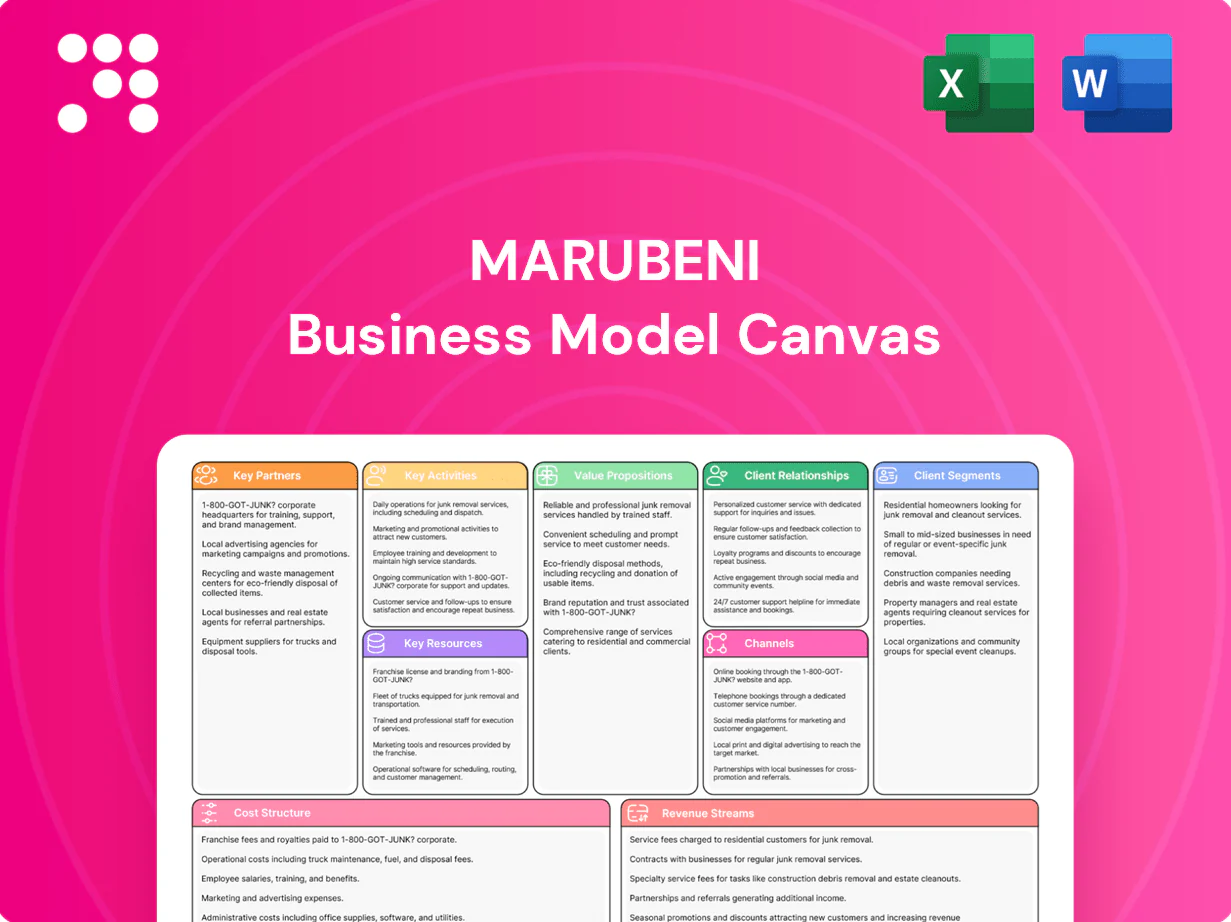
Marubeni Business Model Canvas

Unlock the strategic blueprint of a global trading, energy, and infrastructure business model
Unlock the full strategic blueprint behind Marubeni’s business model. This in-depth Business Model Canvas reveals how the company creates and captures value across global trading, energy, and infrastructure—ideal for investors, consultants, and executives. Download the editable Word/Excel canvas to benchmark, strategize, and act.
Partnerships

Resource producers & miners
Marubeni secures long-term supply through partnerships with upstream oil, gas and mineral producers, enabling stable offtake, joint development and shared exploration risk. Co-investments align incentives across cycles and support price resilience as Brent averaged about 86 USD/bbl in 2024. Strategic sourcing underpins downstream trading and processing, enhancing supply reliability and margin capture.
Manufacturers & EPC contractors
Marubeni partners with machinery OEMs and EPC contractors to deliver infrastructure, industrial plants and mobility solutions, leveraging its ~JPY 4.27 trillion consolidated revenue in FY2023 (year to March 2024) to underwrite large bids.
These alliances boost bid competitiveness and execution certainty, with joint engineering and financing packages shown to increase project win rates and reduce execution risk.
Lifecycle service agreements across projects deepen customer stickiness and support recurring revenue streams for long-term asset operations.

Agribusiness & food suppliers
Alliances with farmers, processors and agri-coops across over 60 countries secure predictable volumes and quality for Marubeni, while co-developed traceability and sustainability programs align products with buyer standards and regulatory demands. Co-investments in storage, logistics and processing upgrade value chains and reduce post-harvest loss, supporting integrated farm-to-fork offerings that leverage Marubeni’s global trading network.

Chemical producers & tech licensors
Licensing and supply agreements with chemical majors unlock advanced materials and specialty products, supporting Marubeni’s 2024 push into higher-margin chemicals and polymers. Technology partnerships accelerate plant development and regional market entry, while shared R&D shortens time-to-market for new applications and diversifies portfolio resilience.
- 2024: focus on specialty chemicals growth
- Shared R&D cuts commercialization time
- Licensing secures supply and regional access
Financial institutions & investors
Financial institutions, ECAs such as JBIC and NEXI, and specialist funds provide Marubeni with project and trade finance plus political-risk mitigation, enabling large-scale energy and infrastructure deals; co-sponsorship with institutional investors scales capital-intensive assets while structured finance solutions improve returns and balance-sheet efficiency. Hedging partners manage commodity and FX exposure across global commodity, renewable and trading portfolios.
- Banks/ECAs: project & trade finance
- Co-sponsors: scale capex-heavy projects
- Hedging partners: commodity & FX risk
- Structured finance: enhances returns & balance sheet
Long-term offtakes and co-investments secure energy, infrastructure and agri supply chains
Marubeni secures upstream supplies via long-term offtakes and co-investments (Brent ~86 USD/bbl in 2024), stabilizing trading margins. Partnerships with OEMs/EPCs leverage JPY 4.27 trillion revenue (FY2023) to win large infrastructure bids. Agri alliances in 60+ countries lock volumes and reduce post-harvest loss. ECAs, banks and hedge partners provide project finance and risk mitigation.
| Partnership | Role | 2024 datapoint |
|---|---|---|
| Upstream producers | Offtake/co-invest | Brent ~86 USD/bbl |
| OEMs/EPC | Execution & bids | Revenue JPY 4.27T (FY2023) |
| Agriculture partners | Supply & traceability | Presence in 60+ countries |
| Financial partners | Project finance & hedging | JBIC/NEXI & banks |
What is included in the product
 Detailed Word Document
A comprehensive Business Model Canvas tailored to Marubeni’s diversified trading, investment and industrial operations, covering customer segments, channels, value propositions and revenue streams across the nine BMC blocks. Includes narrative insights, competitive advantages, linked SWOT analysis and a polished format ideal for presentations, investor discussions and strategic decision-making.

 Customizable Excel Spreadsheet
High-level one-page snapshot of Marubeni’s business model with editable cells to quickly identify core components, condense strategy for fast review, and enable shareable team collaboration.
Activities

Global sourcing & trading
Marubeni orchestrates procurement and merchant trading across energy, metals, food and chemicals, managing contracting, logistics, hedging and price discovery to serve global customers.
Project development & investment
Marubeni originates, structures and invests in infrastructure and industrial assets, managing feasibility, EPC selection, financing and O&M oversight. Equity participation—often in the 20–30% range—aligns long-term incentives and secures downstream returns. Portfolio management reallocates capital to optimize risk-return across cycles. Fiscal reporting follows the year ending March 31, 2024.

Supply chain & logistics management
Operations span shipping, warehousing and last-mile distribution, with last-mile accounting for roughly 40% of total logistics cost in 2024. Digital tools in 2024 pilots improved visibility and traceability and lifted inventory turns by about 20%. Rigorous quality control ensures buyer-spec compliance across consignments. Multimodal optimization in 2024 reduced logistics costs by up to 18% and emissions by ~22%.

Marketing & customer solutions
Marubeni bundles products with financing, engineering, and after-sales services to deliver turnkey solutions across power, mobility, food, and ICT sectors; sector-focused teams tailor offers to specific end-user needs and regulatory contexts. Data-driven insights from project performance and market analytics inform dynamic pricing and bundling decisions, while dedicated relationship management drives repeat business and long-term contracts.
- Bundled offerings: product + financing + engineering + after-sales
- Sector teams: power, mobility, food, ICT
- Data-driven pricing & bundling
- Relationship management sustains repeat contracts
Risk management & compliance
Marubeni's risk management hedges commodity, FX and credit exposures to protect margins while aligning with its net-zero by 2050 commitment reported in 2024.
Robust governance enforces sanctions, ESG and safety compliance; counterparty and country risks are monitored continuously via centralized risk dashboards.
Insurance, contractual structures and collateral agreements are deployed to mitigate residual exposures and preserve financial resilience.
- Hedging: margin protection across commodities/FX/credit
- Governance: sanctions, ESG, safety controls
- Monitoring: counterparty & country risk oversight
- Mitigation: insurance & contractual risk transfer
Commodity trading, 20–30% infra stakes cut logistics cost by ≈18%
Marubeni manages commodity trading, procurement, logistics and hedging across energy, metals, food and chemicals, serving global buyers.
It originates and invests in infrastructure with typical equity stakes of 20–30%; fiscal year ending March 31, 2024.
Operations include shipping, warehousing and last-mile (≈40% logistics cost); 2024 pilots lifted inventory turns ~20% and cut logistics cost ≈18%.
| Activity | Metric | 2024 |
|---|---|---|
| Equity stakes | Range | 20–30% |
| Last-mile | Share of logistics cost | ≈40% |
| Inventory turns | Improvement | ~20% |
| Logistics cost | Reduction | ≈18% |
What You See Is What You Get
Business Model Canvas
The document previewed here is the authentic Marubeni Business Model Canvas—not a mockup or sample. Upon purchase you’ll receive this exact file, complete and ready to edit, present, or share. No surprises; what you see is what you get.

Unlock the strategic blueprint of a global trading, energy, and infrastructure business model
Unlock the full strategic blueprint behind Marubeni’s business model. This in-depth Business Model Canvas reveals how the company creates and captures value across global trading, energy, and infrastructure—ideal for investors, consultants, and executives. Download the editable Word/Excel canvas to benchmark, strategize, and act.
Partnerships
Resource producers & miners
Marubeni secures long-term supply through partnerships with upstream oil, gas and mineral producers, enabling stable offtake, joint development and shared exploration risk. Co-investments align incentives across cycles and support price resilience as Brent averaged about 86 USD/bbl in 2024. Strategic sourcing underpins downstream trading and processing, enhancing supply reliability and margin capture.
Manufacturers & EPC contractors
Marubeni partners with machinery OEMs and EPC contractors to deliver infrastructure, industrial plants and mobility solutions, leveraging its ~JPY 4.27 trillion consolidated revenue in FY2023 (year to March 2024) to underwrite large bids.
These alliances boost bid competitiveness and execution certainty, with joint engineering and financing packages shown to increase project win rates and reduce execution risk.
Lifecycle service agreements across projects deepen customer stickiness and support recurring revenue streams for long-term asset operations.
Agribusiness & food suppliers
Alliances with farmers, processors and agri-coops across over 60 countries secure predictable volumes and quality for Marubeni, while co-developed traceability and sustainability programs align products with buyer standards and regulatory demands. Co-investments in storage, logistics and processing upgrade value chains and reduce post-harvest loss, supporting integrated farm-to-fork offerings that leverage Marubeni’s global trading network.
Chemical producers & tech licensors
Licensing and supply agreements with chemical majors unlock advanced materials and specialty products, supporting Marubeni’s 2024 push into higher-margin chemicals and polymers. Technology partnerships accelerate plant development and regional market entry, while shared R&D shortens time-to-market for new applications and diversifies portfolio resilience.
- 2024: focus on specialty chemicals growth
- Shared R&D cuts commercialization time
- Licensing secures supply and regional access
Financial institutions & investors
Financial institutions, ECAs such as JBIC and NEXI, and specialist funds provide Marubeni with project and trade finance plus political-risk mitigation, enabling large-scale energy and infrastructure deals; co-sponsorship with institutional investors scales capital-intensive assets while structured finance solutions improve returns and balance-sheet efficiency. Hedging partners manage commodity and FX exposure across global commodity, renewable and trading portfolios.
- Banks/ECAs: project & trade finance
- Co-sponsors: scale capex-heavy projects
- Hedging partners: commodity & FX risk
- Structured finance: enhances returns & balance sheet
Long-term offtakes and co-investments secure energy, infrastructure and agri supply chains
Marubeni secures upstream supplies via long-term offtakes and co-investments (Brent ~86 USD/bbl in 2024), stabilizing trading margins. Partnerships with OEMs/EPCs leverage JPY 4.27 trillion revenue (FY2023) to win large infrastructure bids. Agri alliances in 60+ countries lock volumes and reduce post-harvest loss. ECAs, banks and hedge partners provide project finance and risk mitigation.
| Partnership | Role | 2024 datapoint |
|---|---|---|
| Upstream producers | Offtake/co-invest | Brent ~86 USD/bbl |
| OEMs/EPC | Execution & bids | Revenue JPY 4.27T (FY2023) |
| Agriculture partners | Supply & traceability | Presence in 60+ countries |
| Financial partners | Project finance & hedging | JBIC/NEXI & banks |
What is included in the product
Detailed Word Document
A comprehensive Business Model Canvas tailored to Marubeni’s diversified trading, investment and industrial operations, covering customer segments, channels, value propositions and revenue streams across the nine BMC blocks. Includes narrative insights, competitive advantages, linked SWOT analysis and a polished format ideal for presentations, investor discussions and strategic decision-making.
Customizable Excel Spreadsheet
High-level one-page snapshot of Marubeni’s business model with editable cells to quickly identify core components, condense strategy for fast review, and enable shareable team collaboration.
Activities
Global sourcing & trading
Marubeni orchestrates procurement and merchant trading across energy, metals, food and chemicals, managing contracting, logistics, hedging and price discovery to serve global customers.
Project development & investment
Marubeni originates, structures and invests in infrastructure and industrial assets, managing feasibility, EPC selection, financing and O&M oversight. Equity participation—often in the 20–30% range—aligns long-term incentives and secures downstream returns. Portfolio management reallocates capital to optimize risk-return across cycles. Fiscal reporting follows the year ending March 31, 2024.
Supply chain & logistics management
Operations span shipping, warehousing and last-mile distribution, with last-mile accounting for roughly 40% of total logistics cost in 2024. Digital tools in 2024 pilots improved visibility and traceability and lifted inventory turns by about 20%. Rigorous quality control ensures buyer-spec compliance across consignments. Multimodal optimization in 2024 reduced logistics costs by up to 18% and emissions by ~22%.
Marketing & customer solutions
Marubeni bundles products with financing, engineering, and after-sales services to deliver turnkey solutions across power, mobility, food, and ICT sectors; sector-focused teams tailor offers to specific end-user needs and regulatory contexts. Data-driven insights from project performance and market analytics inform dynamic pricing and bundling decisions, while dedicated relationship management drives repeat business and long-term contracts.
- Bundled offerings: product + financing + engineering + after-sales
- Sector teams: power, mobility, food, ICT
- Data-driven pricing & bundling
- Relationship management sustains repeat contracts
Risk management & compliance
Marubeni's risk management hedges commodity, FX and credit exposures to protect margins while aligning with its net-zero by 2050 commitment reported in 2024.
Robust governance enforces sanctions, ESG and safety compliance; counterparty and country risks are monitored continuously via centralized risk dashboards.
Insurance, contractual structures and collateral agreements are deployed to mitigate residual exposures and preserve financial resilience.
- Hedging: margin protection across commodities/FX/credit
- Governance: sanctions, ESG, safety controls
- Monitoring: counterparty & country risk oversight
- Mitigation: insurance & contractual risk transfer
Commodity trading, 20–30% infra stakes cut logistics cost by ≈18%
Marubeni manages commodity trading, procurement, logistics and hedging across energy, metals, food and chemicals, serving global buyers.
It originates and invests in infrastructure with typical equity stakes of 20–30%; fiscal year ending March 31, 2024.
Operations include shipping, warehousing and last-mile (≈40% logistics cost); 2024 pilots lifted inventory turns ~20% and cut logistics cost ≈18%.
| Activity | Metric | 2024 |
|---|---|---|
| Equity stakes | Range | 20–30% |
| Last-mile | Share of logistics cost | ≈40% |
| Inventory turns | Improvement | ~20% |
| Logistics cost | Reduction | ≈18% |
What You See Is What You Get
Business Model Canvas
The document previewed here is the authentic Marubeni Business Model Canvas—not a mockup or sample. Upon purchase you’ll receive this exact file, complete and ready to edit, present, or share. No surprises; what you see is what you get.
Description
Unlock the strategic blueprint of a global trading, energy, and infrastructure business model
Unlock the full strategic blueprint behind Marubeni’s business model. This in-depth Business Model Canvas reveals how the company creates and captures value across global trading, energy, and infrastructure—ideal for investors, consultants, and executives. Download the editable Word/Excel canvas to benchmark, strategize, and act.
Partnerships
Resource producers & miners
Marubeni secures long-term supply through partnerships with upstream oil, gas and mineral producers, enabling stable offtake, joint development and shared exploration risk. Co-investments align incentives across cycles and support price resilience as Brent averaged about 86 USD/bbl in 2024. Strategic sourcing underpins downstream trading and processing, enhancing supply reliability and margin capture.
Manufacturers & EPC contractors
Marubeni partners with machinery OEMs and EPC contractors to deliver infrastructure, industrial plants and mobility solutions, leveraging its ~JPY 4.27 trillion consolidated revenue in FY2023 (year to March 2024) to underwrite large bids.
These alliances boost bid competitiveness and execution certainty, with joint engineering and financing packages shown to increase project win rates and reduce execution risk.
Lifecycle service agreements across projects deepen customer stickiness and support recurring revenue streams for long-term asset operations.
Agribusiness & food suppliers
Alliances with farmers, processors and agri-coops across over 60 countries secure predictable volumes and quality for Marubeni, while co-developed traceability and sustainability programs align products with buyer standards and regulatory demands. Co-investments in storage, logistics and processing upgrade value chains and reduce post-harvest loss, supporting integrated farm-to-fork offerings that leverage Marubeni’s global trading network.
Chemical producers & tech licensors
Licensing and supply agreements with chemical majors unlock advanced materials and specialty products, supporting Marubeni’s 2024 push into higher-margin chemicals and polymers. Technology partnerships accelerate plant development and regional market entry, while shared R&D shortens time-to-market for new applications and diversifies portfolio resilience.
- 2024: focus on specialty chemicals growth
- Shared R&D cuts commercialization time
- Licensing secures supply and regional access
Financial institutions & investors
Financial institutions, ECAs such as JBIC and NEXI, and specialist funds provide Marubeni with project and trade finance plus political-risk mitigation, enabling large-scale energy and infrastructure deals; co-sponsorship with institutional investors scales capital-intensive assets while structured finance solutions improve returns and balance-sheet efficiency. Hedging partners manage commodity and FX exposure across global commodity, renewable and trading portfolios.
- Banks/ECAs: project & trade finance
- Co-sponsors: scale capex-heavy projects
- Hedging partners: commodity & FX risk
- Structured finance: enhances returns & balance sheet
Long-term offtakes and co-investments secure energy, infrastructure and agri supply chains
Marubeni secures upstream supplies via long-term offtakes and co-investments (Brent ~86 USD/bbl in 2024), stabilizing trading margins. Partnerships with OEMs/EPCs leverage JPY 4.27 trillion revenue (FY2023) to win large infrastructure bids. Agri alliances in 60+ countries lock volumes and reduce post-harvest loss. ECAs, banks and hedge partners provide project finance and risk mitigation.
| Partnership | Role | 2024 datapoint |
|---|---|---|
| Upstream producers | Offtake/co-invest | Brent ~86 USD/bbl |
| OEMs/EPC | Execution & bids | Revenue JPY 4.27T (FY2023) |
| Agriculture partners | Supply & traceability | Presence in 60+ countries |
| Financial partners | Project finance & hedging | JBIC/NEXI & banks |
What is included in the product
Detailed Word Document
A comprehensive Business Model Canvas tailored to Marubeni’s diversified trading, investment and industrial operations, covering customer segments, channels, value propositions and revenue streams across the nine BMC blocks. Includes narrative insights, competitive advantages, linked SWOT analysis and a polished format ideal for presentations, investor discussions and strategic decision-making.
Customizable Excel Spreadsheet
High-level one-page snapshot of Marubeni’s business model with editable cells to quickly identify core components, condense strategy for fast review, and enable shareable team collaboration.
Activities
Global sourcing & trading
Marubeni orchestrates procurement and merchant trading across energy, metals, food and chemicals, managing contracting, logistics, hedging and price discovery to serve global customers.
Project development & investment
Marubeni originates, structures and invests in infrastructure and industrial assets, managing feasibility, EPC selection, financing and O&M oversight. Equity participation—often in the 20–30% range—aligns long-term incentives and secures downstream returns. Portfolio management reallocates capital to optimize risk-return across cycles. Fiscal reporting follows the year ending March 31, 2024.
Supply chain & logistics management
Operations span shipping, warehousing and last-mile distribution, with last-mile accounting for roughly 40% of total logistics cost in 2024. Digital tools in 2024 pilots improved visibility and traceability and lifted inventory turns by about 20%. Rigorous quality control ensures buyer-spec compliance across consignments. Multimodal optimization in 2024 reduced logistics costs by up to 18% and emissions by ~22%.
Marketing & customer solutions
Marubeni bundles products with financing, engineering, and after-sales services to deliver turnkey solutions across power, mobility, food, and ICT sectors; sector-focused teams tailor offers to specific end-user needs and regulatory contexts. Data-driven insights from project performance and market analytics inform dynamic pricing and bundling decisions, while dedicated relationship management drives repeat business and long-term contracts.
- Bundled offerings: product + financing + engineering + after-sales
- Sector teams: power, mobility, food, ICT
- Data-driven pricing & bundling
- Relationship management sustains repeat contracts
Risk management & compliance
Marubeni's risk management hedges commodity, FX and credit exposures to protect margins while aligning with its net-zero by 2050 commitment reported in 2024.
Robust governance enforces sanctions, ESG and safety compliance; counterparty and country risks are monitored continuously via centralized risk dashboards.
Insurance, contractual structures and collateral agreements are deployed to mitigate residual exposures and preserve financial resilience.
- Hedging: margin protection across commodities/FX/credit
- Governance: sanctions, ESG, safety controls
- Monitoring: counterparty & country risk oversight
- Mitigation: insurance & contractual risk transfer
Commodity trading, 20–30% infra stakes cut logistics cost by ≈18%
Marubeni manages commodity trading, procurement, logistics and hedging across energy, metals, food and chemicals, serving global buyers.
It originates and invests in infrastructure with typical equity stakes of 20–30%; fiscal year ending March 31, 2024.
Operations include shipping, warehousing and last-mile (≈40% logistics cost); 2024 pilots lifted inventory turns ~20% and cut logistics cost ≈18%.
| Activity | Metric | 2024 |
|---|---|---|
| Equity stakes | Range | 20–30% |
| Last-mile | Share of logistics cost | ≈40% |
| Inventory turns | Improvement | ~20% |
| Logistics cost | Reduction | ≈18% |
What You See Is What You Get
Business Model Canvas
The document previewed here is the authentic Marubeni Business Model Canvas—not a mockup or sample. Upon purchase you’ll receive this exact file, complete and ready to edit, present, or share. No surprises; what you see is what you get.











