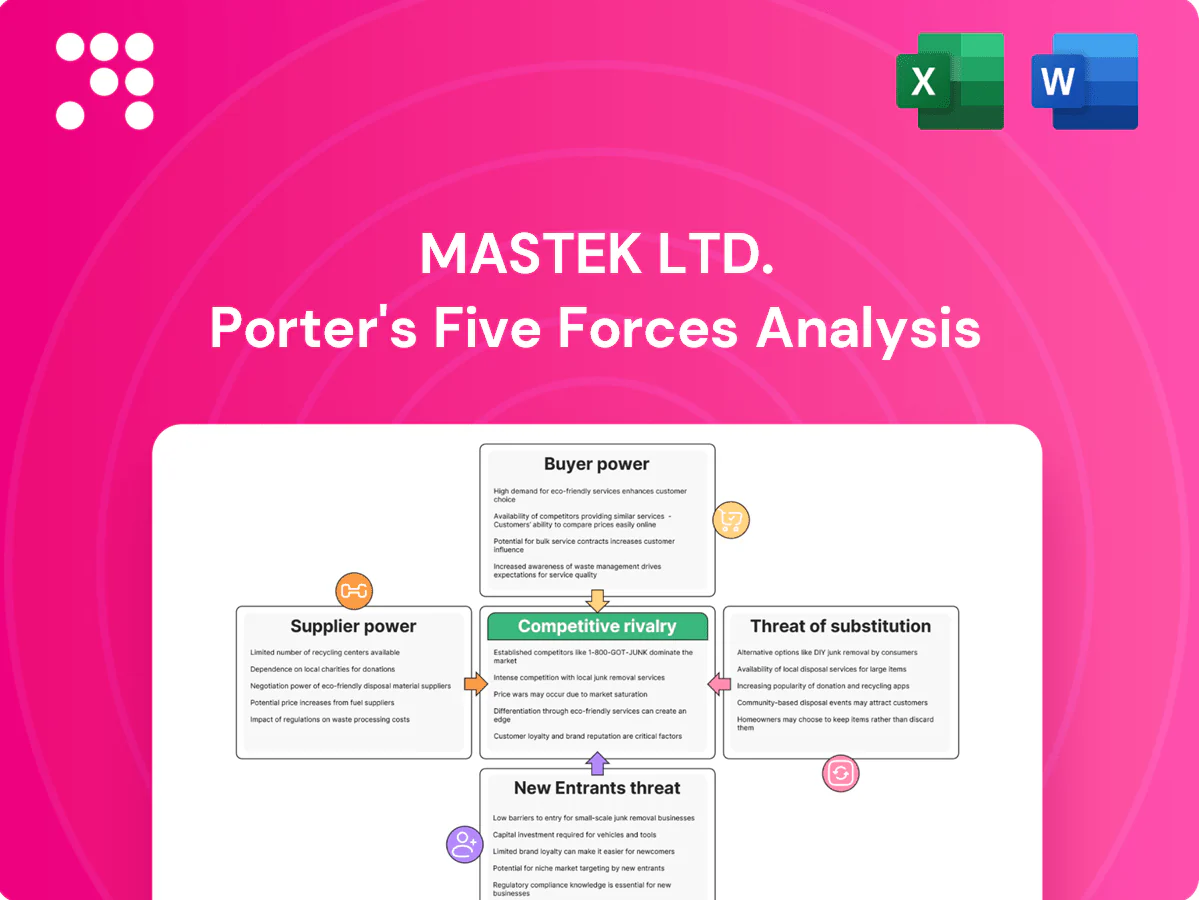
Mastek Ltd. Porter's Five Forces Analysis

Don't Miss the Bigger Picture
Mastek Ltd. faces moderate competitive intensity with strong buyer bargaining from enterprise clients, low supplier power, and evolving threats from niche digital consultancies and platform substitutes that could pressure margins. This brief snapshot only scratches the surface. Unlock the full Porter's Five Forces Analysis to explore Mastek Ltd.’s competitive dynamics in detail.
Suppliers Bargaining Power

Dependence on hyperscalers
Dependence on hyperscalers is critical for Mastek’s cloud migration services, given AWS, Azure and GCP together hold over 65% of the global cloud market as of 2024, concentrating supplier power. Certification tiers and partner-program rules shape margins and permissible solution scope, directly affecting pricing and delivery models. Negotiated discounts, consumption rebates and co-selling agreements can partially offset this leverage, but strategic reliance remains a constraint.
Talent scarcity and wage pressure
Experienced cloud, data and domain engineers are scarce, giving skilled labor strong bargaining power; Indian IT attrition averaged about 20–25% in 2024, pushing salary hikes near 15–20% in many firms. Wage inflation and higher attrition raise Mastek’s delivery costs and project margins. Visa constraints, onsite/offshore mix and tight offshore hiring markets intensify negotiating dynamics. Mastek’s training pipelines and captive academy partially offset supply risk by upskilling junior talent.

Specialized software/tool vendors
Analytics, DevSecOps and integration tool vendors extract power through licensing and usage fees that can form a material portion of program TCO, while high switching costs and retraining lock Mastek into specific stacks. Volume and enterprise agreements lower unit costs but constrain vendor roadmaps and integrations. Open-source adoption is widespread—Synopsys 2024 found 99% of codebases include OSS—limiting supplier leverage.

Subcontractors and niche partners
Peak-load staffing and niche-domain partners often command premiums that squeeze Mastek's margins; quality variability and delivery risk from small subcontractors raise reliance costs and remediation expenses.
Multi-vendor bench strategies enhance flexibility and reduce single-supplier risk while standardized SOWs and preferred-rate agreements help temper price spikes and improve cost predictability.
- Premiums for niche skills
- Delivery-risk raises reliance costs
- Multi-vendor bench for flexibility
- Standardized SOWs curb price spikes
Data providers and compliance costs
Regulated clients force Mastek to source vetted data and add compliance modules, with FY24 contracts often specifying vendor audits and certifications such as ISO and HIPAA for US healthcare work; these audit requirements increase delivery costs and project complexity. Limited approved suppliers in public sector tend to raise supplier leverage, while multi-year framework agreements in FY24 helped Mastek stabilize pricing and SLAs.
- Compliance-driven sourcing increases vendor costs and timelines
- Vendor audits/certs (ISO, HIPAA) add expense
- Few approved public suppliers heighten supplier power
- Long-term frameworks in FY24 reduced volatility
Hyperscalers, talent squeeze lift supplier power; OSS and frameworks temper volatility
Suppliers hold moderate-high power: hyperscalers (65% cloud share in 2024) concentrate leverage; Indian IT attrition 20–25% (2024) and 15–20% wage inflation strengthen labor suppliers; OSS use 99% (Synopsys 2024) lowers some vendor lock; FY24 multi-year frameworks reduced public-sector volatility.
| Factor | Metric (2024) |
|---|---|
| Hyperscaler share | 65% |
| Attrition (India) | 20–25% |
| Wage inflation | 15–20% |
| OSS prevalence | 99% |
What is included in the product
 Detailed Word Document
Tailored Porter's Five Forces analysis for Mastek Ltd. uncovering competitive intensity, buyer and supplier power, threat of new entrants and substitutes, and identifying disruptive trends and market barriers influencing its pricing, margins, and strategic positioning.

 Customizable Excel Spreadsheet
One-sheet Porter's Five Forces for Mastek Ltd.—condenses competitive pressures into a clear radar view for rapid strategy decisions and pitch decks. Customize force ratings, swap in your data, and integrate with Excel/Word deliverables—no macros or finance jargon required.
Customers Bargaining Power

Enterprise and government procurement
RFP-driven buying concentrates power with large clients, as many enterprise and government RFPs often exceed USD 5m, favoring incumbents.
Vendor consolidation and panels
Clients increasingly rationalize suppliers into a few strategic partners, making inclusion on vendor panels critical for Mastek as it reported FY2024 revenue of INR 1,339 crore; panel status boosts cross-sell potential but comes with strict price discipline. Rate cards face intense scrutiny as buyers benchmark against panel peers, compressing margins. Renewals and scope expansion hinge on delivery against performance KPIs and SLA targets.

Build-vs-buy optionality
Clients can insource via internal IT or captives, raising customer leverage as enterprises allocate more to technology (global IT spending ~$4.6 trillion in 2024, Gartner). Cost transparency and productivity benchmarks compress rates, while outcome‑based or fixed‑price deals transfer delivery risk to vendors; strong domain IP and differentiated offerings help Mastek resist commoditization and preserve pricing power.

Switching costs and multi-cloud
Modular architectures and open APIs reduce vendor lock-in and strengthen buyer negotiating power, yet complex legacy estates in many Indian enterprises increase switching frictions; Flexera 2024 reports 92% of organizations use multiple clouds, driving regular rebids. Multi-cloud strategies invite competitive procurement cycles, while Mastek’s strong delivery record and domain expertise can raise client stickiness and defend margins.
- Modular APIs: lower lock-in
- Legacy estates: higher switching cost
- 92% multi-cloud (Flexera 2024): more rebids
- Delivery track record: increases stickiness
Price sensitivity and budget cycles
Macro cycles tightened discretionary digital spend in 2024, with Gartner estimating global IT spending at about $5.4 trillion in 2024 and slower growth driving buyer conservatism; Mastek customers therefore prioritize quick ROI and clear TCO. Demand for agile, phased programs raised repricing frequency, making crisp value articulation and sector case studies decisive in procurement.
- ROI urgency: buyers demand payback within 12–18 months
- Repricing: agile/phased deals increase contract reviews and renegotiations
- Evidence: sector case studies and quantified TCO drive selection
RFP-driven buying compresses rates; multi-cloud and modular APIs fuel rebids and ROI pressure
RFP-driven procurement and panel rationalization concentrate power with large clients, compressing rates and forcing strict SLAs; Mastek reported FY2024 revenue of INR 1,339 crore. Modular APIs and 92% multi-cloud adoption (Flexera 2024) increase rebids, while buyers demand 12–18 month ROI, raising pricing pressure despite Mastek’s delivery-led stickiness.
| Metric | 2024 value | Implication |
|---|---|---|
| Mastek FY2024 rev | INR 1,339 crore | Scale for large RFPs |
| Multi-cloud | 92% (Flexera) | More rebids |
| Global IT spend | $4.6T (Gartner) | Competitive buyer market |
| Buyer ROI demand | 12–18 months | Shorter payback |
What You See Is What You Get
Mastek Ltd. Porter's Five Forces Analysis
You're looking at the actual Mastek Ltd. Porter's Five Forces Analysis. This preview shows the exact document you'll receive immediately after purchase—no surprises, fully formatted. It analyzes competitive rivalry, buyer and supplier power, and threats of new entrants and substitutes with supporting data and actionable insights. Upon payment you'll get instant access to this identical file.

Don't Miss the Bigger Picture
Mastek Ltd. faces moderate competitive intensity with strong buyer bargaining from enterprise clients, low supplier power, and evolving threats from niche digital consultancies and platform substitutes that could pressure margins. This brief snapshot only scratches the surface. Unlock the full Porter's Five Forces Analysis to explore Mastek Ltd.’s competitive dynamics in detail.
Suppliers Bargaining Power
Dependence on hyperscalers
Dependence on hyperscalers is critical for Mastek’s cloud migration services, given AWS, Azure and GCP together hold over 65% of the global cloud market as of 2024, concentrating supplier power. Certification tiers and partner-program rules shape margins and permissible solution scope, directly affecting pricing and delivery models. Negotiated discounts, consumption rebates and co-selling agreements can partially offset this leverage, but strategic reliance remains a constraint.
Talent scarcity and wage pressure
Experienced cloud, data and domain engineers are scarce, giving skilled labor strong bargaining power; Indian IT attrition averaged about 20–25% in 2024, pushing salary hikes near 15–20% in many firms. Wage inflation and higher attrition raise Mastek’s delivery costs and project margins. Visa constraints, onsite/offshore mix and tight offshore hiring markets intensify negotiating dynamics. Mastek’s training pipelines and captive academy partially offset supply risk by upskilling junior talent.
Specialized software/tool vendors
Analytics, DevSecOps and integration tool vendors extract power through licensing and usage fees that can form a material portion of program TCO, while high switching costs and retraining lock Mastek into specific stacks. Volume and enterprise agreements lower unit costs but constrain vendor roadmaps and integrations. Open-source adoption is widespread—Synopsys 2024 found 99% of codebases include OSS—limiting supplier leverage.
Subcontractors and niche partners
Peak-load staffing and niche-domain partners often command premiums that squeeze Mastek's margins; quality variability and delivery risk from small subcontractors raise reliance costs and remediation expenses.
Multi-vendor bench strategies enhance flexibility and reduce single-supplier risk while standardized SOWs and preferred-rate agreements help temper price spikes and improve cost predictability.
- Premiums for niche skills
- Delivery-risk raises reliance costs
- Multi-vendor bench for flexibility
- Standardized SOWs curb price spikes
Data providers and compliance costs
Regulated clients force Mastek to source vetted data and add compliance modules, with FY24 contracts often specifying vendor audits and certifications such as ISO and HIPAA for US healthcare work; these audit requirements increase delivery costs and project complexity. Limited approved suppliers in public sector tend to raise supplier leverage, while multi-year framework agreements in FY24 helped Mastek stabilize pricing and SLAs.
- Compliance-driven sourcing increases vendor costs and timelines
- Vendor audits/certs (ISO, HIPAA) add expense
- Few approved public suppliers heighten supplier power
- Long-term frameworks in FY24 reduced volatility
Hyperscalers, talent squeeze lift supplier power; OSS and frameworks temper volatility
Suppliers hold moderate-high power: hyperscalers (65% cloud share in 2024) concentrate leverage; Indian IT attrition 20–25% (2024) and 15–20% wage inflation strengthen labor suppliers; OSS use 99% (Synopsys 2024) lowers some vendor lock; FY24 multi-year frameworks reduced public-sector volatility.
| Factor | Metric (2024) |
|---|---|
| Hyperscaler share | 65% |
| Attrition (India) | 20–25% |
| Wage inflation | 15–20% |
| OSS prevalence | 99% |
What is included in the product
Detailed Word Document
Tailored Porter's Five Forces analysis for Mastek Ltd. uncovering competitive intensity, buyer and supplier power, threat of new entrants and substitutes, and identifying disruptive trends and market barriers influencing its pricing, margins, and strategic positioning.
Customizable Excel Spreadsheet
One-sheet Porter's Five Forces for Mastek Ltd.—condenses competitive pressures into a clear radar view for rapid strategy decisions and pitch decks. Customize force ratings, swap in your data, and integrate with Excel/Word deliverables—no macros or finance jargon required.
Customers Bargaining Power
Enterprise and government procurement
RFP-driven buying concentrates power with large clients, as many enterprise and government RFPs often exceed USD 5m, favoring incumbents.
Vendor consolidation and panels
Clients increasingly rationalize suppliers into a few strategic partners, making inclusion on vendor panels critical for Mastek as it reported FY2024 revenue of INR 1,339 crore; panel status boosts cross-sell potential but comes with strict price discipline. Rate cards face intense scrutiny as buyers benchmark against panel peers, compressing margins. Renewals and scope expansion hinge on delivery against performance KPIs and SLA targets.
Build-vs-buy optionality
Clients can insource via internal IT or captives, raising customer leverage as enterprises allocate more to technology (global IT spending ~$4.6 trillion in 2024, Gartner). Cost transparency and productivity benchmarks compress rates, while outcome‑based or fixed‑price deals transfer delivery risk to vendors; strong domain IP and differentiated offerings help Mastek resist commoditization and preserve pricing power.
Switching costs and multi-cloud
Modular architectures and open APIs reduce vendor lock-in and strengthen buyer negotiating power, yet complex legacy estates in many Indian enterprises increase switching frictions; Flexera 2024 reports 92% of organizations use multiple clouds, driving regular rebids. Multi-cloud strategies invite competitive procurement cycles, while Mastek’s strong delivery record and domain expertise can raise client stickiness and defend margins.
- Modular APIs: lower lock-in
- Legacy estates: higher switching cost
- 92% multi-cloud (Flexera 2024): more rebids
- Delivery track record: increases stickiness
Price sensitivity and budget cycles
Macro cycles tightened discretionary digital spend in 2024, with Gartner estimating global IT spending at about $5.4 trillion in 2024 and slower growth driving buyer conservatism; Mastek customers therefore prioritize quick ROI and clear TCO. Demand for agile, phased programs raised repricing frequency, making crisp value articulation and sector case studies decisive in procurement.
- ROI urgency: buyers demand payback within 12–18 months
- Repricing: agile/phased deals increase contract reviews and renegotiations
- Evidence: sector case studies and quantified TCO drive selection
RFP-driven buying compresses rates; multi-cloud and modular APIs fuel rebids and ROI pressure
RFP-driven procurement and panel rationalization concentrate power with large clients, compressing rates and forcing strict SLAs; Mastek reported FY2024 revenue of INR 1,339 crore. Modular APIs and 92% multi-cloud adoption (Flexera 2024) increase rebids, while buyers demand 12–18 month ROI, raising pricing pressure despite Mastek’s delivery-led stickiness.
| Metric | 2024 value | Implication |
|---|---|---|
| Mastek FY2024 rev | INR 1,339 crore | Scale for large RFPs |
| Multi-cloud | 92% (Flexera) | More rebids |
| Global IT spend | $4.6T (Gartner) | Competitive buyer market |
| Buyer ROI demand | 12–18 months | Shorter payback |
What You See Is What You Get
Mastek Ltd. Porter's Five Forces Analysis
You're looking at the actual Mastek Ltd. Porter's Five Forces Analysis. This preview shows the exact document you'll receive immediately after purchase—no surprises, fully formatted. It analyzes competitive rivalry, buyer and supplier power, and threats of new entrants and substitutes with supporting data and actionable insights. Upon payment you'll get instant access to this identical file.
Original: $10.00
-65%$10.00
$3.50Description
Don't Miss the Bigger Picture
Mastek Ltd. faces moderate competitive intensity with strong buyer bargaining from enterprise clients, low supplier power, and evolving threats from niche digital consultancies and platform substitutes that could pressure margins. This brief snapshot only scratches the surface. Unlock the full Porter's Five Forces Analysis to explore Mastek Ltd.’s competitive dynamics in detail.
Suppliers Bargaining Power
Dependence on hyperscalers
Dependence on hyperscalers is critical for Mastek’s cloud migration services, given AWS, Azure and GCP together hold over 65% of the global cloud market as of 2024, concentrating supplier power. Certification tiers and partner-program rules shape margins and permissible solution scope, directly affecting pricing and delivery models. Negotiated discounts, consumption rebates and co-selling agreements can partially offset this leverage, but strategic reliance remains a constraint.
Talent scarcity and wage pressure
Experienced cloud, data and domain engineers are scarce, giving skilled labor strong bargaining power; Indian IT attrition averaged about 20–25% in 2024, pushing salary hikes near 15–20% in many firms. Wage inflation and higher attrition raise Mastek’s delivery costs and project margins. Visa constraints, onsite/offshore mix and tight offshore hiring markets intensify negotiating dynamics. Mastek’s training pipelines and captive academy partially offset supply risk by upskilling junior talent.
Specialized software/tool vendors
Analytics, DevSecOps and integration tool vendors extract power through licensing and usage fees that can form a material portion of program TCO, while high switching costs and retraining lock Mastek into specific stacks. Volume and enterprise agreements lower unit costs but constrain vendor roadmaps and integrations. Open-source adoption is widespread—Synopsys 2024 found 99% of codebases include OSS—limiting supplier leverage.
Subcontractors and niche partners
Peak-load staffing and niche-domain partners often command premiums that squeeze Mastek's margins; quality variability and delivery risk from small subcontractors raise reliance costs and remediation expenses.
Multi-vendor bench strategies enhance flexibility and reduce single-supplier risk while standardized SOWs and preferred-rate agreements help temper price spikes and improve cost predictability.
- Premiums for niche skills
- Delivery-risk raises reliance costs
- Multi-vendor bench for flexibility
- Standardized SOWs curb price spikes
Data providers and compliance costs
Regulated clients force Mastek to source vetted data and add compliance modules, with FY24 contracts often specifying vendor audits and certifications such as ISO and HIPAA for US healthcare work; these audit requirements increase delivery costs and project complexity. Limited approved suppliers in public sector tend to raise supplier leverage, while multi-year framework agreements in FY24 helped Mastek stabilize pricing and SLAs.
- Compliance-driven sourcing increases vendor costs and timelines
- Vendor audits/certs (ISO, HIPAA) add expense
- Few approved public suppliers heighten supplier power
- Long-term frameworks in FY24 reduced volatility
Hyperscalers, talent squeeze lift supplier power; OSS and frameworks temper volatility
Suppliers hold moderate-high power: hyperscalers (65% cloud share in 2024) concentrate leverage; Indian IT attrition 20–25% (2024) and 15–20% wage inflation strengthen labor suppliers; OSS use 99% (Synopsys 2024) lowers some vendor lock; FY24 multi-year frameworks reduced public-sector volatility.
| Factor | Metric (2024) |
|---|---|
| Hyperscaler share | 65% |
| Attrition (India) | 20–25% |
| Wage inflation | 15–20% |
| OSS prevalence | 99% |
What is included in the product
Detailed Word Document
Tailored Porter's Five Forces analysis for Mastek Ltd. uncovering competitive intensity, buyer and supplier power, threat of new entrants and substitutes, and identifying disruptive trends and market barriers influencing its pricing, margins, and strategic positioning.
Customizable Excel Spreadsheet
One-sheet Porter's Five Forces for Mastek Ltd.—condenses competitive pressures into a clear radar view for rapid strategy decisions and pitch decks. Customize force ratings, swap in your data, and integrate with Excel/Word deliverables—no macros or finance jargon required.
Customers Bargaining Power
Enterprise and government procurement
RFP-driven buying concentrates power with large clients, as many enterprise and government RFPs often exceed USD 5m, favoring incumbents.
Vendor consolidation and panels
Clients increasingly rationalize suppliers into a few strategic partners, making inclusion on vendor panels critical for Mastek as it reported FY2024 revenue of INR 1,339 crore; panel status boosts cross-sell potential but comes with strict price discipline. Rate cards face intense scrutiny as buyers benchmark against panel peers, compressing margins. Renewals and scope expansion hinge on delivery against performance KPIs and SLA targets.
Build-vs-buy optionality
Clients can insource via internal IT or captives, raising customer leverage as enterprises allocate more to technology (global IT spending ~$4.6 trillion in 2024, Gartner). Cost transparency and productivity benchmarks compress rates, while outcome‑based or fixed‑price deals transfer delivery risk to vendors; strong domain IP and differentiated offerings help Mastek resist commoditization and preserve pricing power.
Switching costs and multi-cloud
Modular architectures and open APIs reduce vendor lock-in and strengthen buyer negotiating power, yet complex legacy estates in many Indian enterprises increase switching frictions; Flexera 2024 reports 92% of organizations use multiple clouds, driving regular rebids. Multi-cloud strategies invite competitive procurement cycles, while Mastek’s strong delivery record and domain expertise can raise client stickiness and defend margins.
- Modular APIs: lower lock-in
- Legacy estates: higher switching cost
- 92% multi-cloud (Flexera 2024): more rebids
- Delivery track record: increases stickiness
Price sensitivity and budget cycles
Macro cycles tightened discretionary digital spend in 2024, with Gartner estimating global IT spending at about $5.4 trillion in 2024 and slower growth driving buyer conservatism; Mastek customers therefore prioritize quick ROI and clear TCO. Demand for agile, phased programs raised repricing frequency, making crisp value articulation and sector case studies decisive in procurement.
- ROI urgency: buyers demand payback within 12–18 months
- Repricing: agile/phased deals increase contract reviews and renegotiations
- Evidence: sector case studies and quantified TCO drive selection
RFP-driven buying compresses rates; multi-cloud and modular APIs fuel rebids and ROI pressure
RFP-driven procurement and panel rationalization concentrate power with large clients, compressing rates and forcing strict SLAs; Mastek reported FY2024 revenue of INR 1,339 crore. Modular APIs and 92% multi-cloud adoption (Flexera 2024) increase rebids, while buyers demand 12–18 month ROI, raising pricing pressure despite Mastek’s delivery-led stickiness.
| Metric | 2024 value | Implication |
|---|---|---|
| Mastek FY2024 rev | INR 1,339 crore | Scale for large RFPs |
| Multi-cloud | 92% (Flexera) | More rebids |
| Global IT spend | $4.6T (Gartner) | Competitive buyer market |
| Buyer ROI demand | 12–18 months | Shorter payback |
What You See Is What You Get
Mastek Ltd. Porter's Five Forces Analysis
You're looking at the actual Mastek Ltd. Porter's Five Forces Analysis. This preview shows the exact document you'll receive immediately after purchase—no surprises, fully formatted. It analyzes competitive rivalry, buyer and supplier power, and threats of new entrants and substitutes with supporting data and actionable insights. Upon payment you'll get instant access to this identical file.











