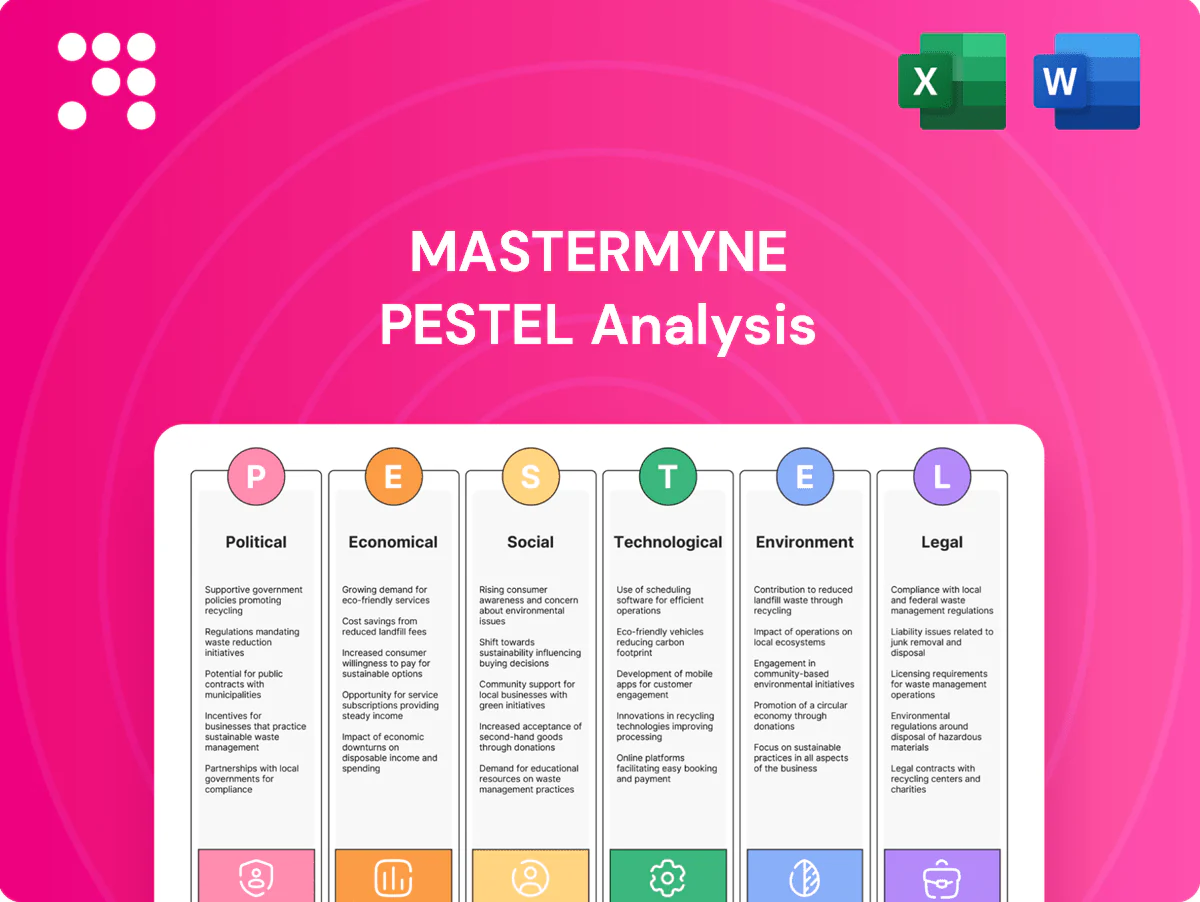
Mastermyne PESTLE Analysis

Your Shortcut to Market Insight Starts Here
Gain a competitive edge with our PESTLE Analysis of Mastermyne — concise, research-backed insight into the political, economic, social, technological, legal, and environmental forces shaping its future. Ideal for investors and strategists, it’s ready to use and fully editable. Purchase the full report now to access actionable intelligence and deep-dive findings instantly.
Political factors

Energy and resources policy direction
Shifts in Australian federal and state energy policy affect coal mine approvals, extensions and operating conditions; renewables now supply roughly 40% of NEM generation (2024–25) which tightens scrutiny on thermal coal and raises permitting risk for underground contractors. Metallurgical coal remains strategically important for steelmaking, yet approvals and environmental assessments increasingly add 6–24 month delays. Mastermyne must track policy signals to manage bid pipelines and capacity.
State royalties and incentives
Changes to Queensland and New South Wales coal royalties directly shift client production plans and contracting budgets, with increases tending to defer marginal projects or compress service margins. Incentives tied to regional job creation have proven capable of catalysing developments, making project economics sensitive to policy toggles. Scenario planning for royalty volatility guides pricing and resource allocation, while transparent pass-through clauses protect contractors from sudden cost shocks.

Infrastructure and regional development spend
Government investment in roads, rail and energy in Australian mining regions reduces operating costs and downtime for underground works, with longwall relocations typically costing A$20–40m and taking 6–12 months to mobilize. Infrastructure bottlenecks increase logistics risk and can add weeks of delay and significant cost overruns. Active engagement in regional planning secures co-benefits for mobilization efficiency and access to state-led upgrades. Timely funding visibility enables tighter scheduling and higher fleet utilization rates.

Industrial relations climate
Political posture on workplace relations shapes Mastermyne’s bargaining power, wages and rostering flexibility; Australia’s Wage Price Index rose about 4.0% year to March 2024 and mining enterprise agreements averaged roughly 4–6% increases in 2023–24, which can lift labor costs and reduce schedule agility at mine sites. A stable industrial relations setting supports predictable project execution and safety performance, and Mastermyne benefits from proactive relations with regulators, unions and clients.
- WPI ~4.0% (Y/Y to Mar 2024)
- Mining EBA rises ~4–6% (2023–24)
- Mining ≈10% of AUS GDP
- Proactive stakeholder engagement reduces stoppage risk
International trade and diplomatic settings
Export demand for Australian metallurgical coal is highly sensitive to diplomatic ties and market access in Asia; trade frictions can reroute volumes and disrupt clients’ capex plans and production continuity, which in turn affects longwall development pipelines that rely on stable offtake agreements.
- Align exposure with diversified client portfolios
- Prioritise clients across multiple Asian markets
- Monitor bilateral trade policies closely
- Stress-test revenues for redirected volumes
Policy risk rises as renewables ~40% of NEM; approvals delayed 6-24 months
Federal/state energy and permitting policy raises approval risk for thermal coal, with renewables ~40% of NEM (2024–25) increasing scrutiny and adding 6–24 month assessment delays for projects. Queensland/NSW royalty moves and WPI ~4.0% (Y/Y to Mar 2024) squeeze client budgets and lift labour costs; mining EBAs ~4–6% (2023–24). Export access volatility from Asia can redirect volumes and disrupt longwall pipelines.
| Metric | Value |
|---|---|
| Renewables (NEM) | ~40% (2024–25) |
| WPI | ~4.0% Y/Y (Mar 2024) |
| Mining EBA rises | ~4–6% (2023–24) |
| Approval delay | 6–24 months |
What is included in the product
 Detailed Word Document
Explores how macro-environmental factors uniquely affect Mastermyne across Political, Economic, Social, Technological, Environmental and Legal dimensions, with each section backed by relevant data and current trends. Designed for executives and investors, it includes detailed sub-points, forward-looking insights for scenario planning, and clean formatting ready for reports, decks or funding materials.

 Customizable Excel Spreadsheet
Provides a clean, visually segmented PESTLE summary of Mastermyne for quick referencing in meetings, easily shareable and editable so teams can align on external risks and strategic positioning during planning sessions.
Economic factors

Metallurgical coal price cycle
Metallurgical coal cycles drive Mastermyne capex and development timing: premium hard coking coal averaged about USD 260/t in H1 2025 (Platts), down from ~USD 480/t in 2021–22, with price upswings expanding scopes (secondary development, longwall moves) and lifting utilization by ~10–20%. Downcycles compress budgets and defer outbye services and relocations. Dynamic cost structures and flexible crews help buffer this volatility.
Inflation and input costs
Inflation in 2024–25 squeezed contractor margins as equipment, explosives, consumables and energy costs rose—Brent averaged about US$85/bbl in 2024 and Australian retail diesel averaged near A$1.90/L, lifting operating expenses. Supply agreements with escalation clauses help transfer price risk to principals and stabilise margins. Centralised procurement and standardisation across sites reduce cost drift and delivery variability. Where feasible, hedging key inputs (fuel, foreign exchange) can lock rates and improve project economics.

Loyal labor market and wage pressure
Skilled underground labour shortages in regional Australia lift wages (mining average annual earnings ~AU$160,000 in 2024, ABS) and drive turnover (up to ~20% on some regional sites in 2024 industry reports), risking schedule slippage and safety outcomes when markets tighten. Strengthening talent pipelines, training academies and retention incentives improves availability for specialised strata support roles. Multi-skilling boosts deployment flexibility and reduces single-skill bottlenecks.

Exchange rate movements
AUD depreciation to around 0.62 USD in mid-2025 can boost export competitiveness for Mastermyne clients and support higher production, while imported equipment and parts become more expensive, pressuring Mastermyne’s capex and opex; currency-aware procurement, hedging and inventory planning reduce volatility, and pricing models should incorporate FX sensitivities on major components and subcontracted services.
- FX impact: AUD ~0.62 USD (mid-2025)
- OpEx/CapEx risk: higher import costs
- Mitigation: hedging, currency-aware procurement
- Pricing: include FX sensitivity on key components
Interest rates and capital availability
Higher policy rates increase client hurdle rates and can delay project approvals; major central banks kept policy rates near 4–5% in 2024–25, tightening project economics. Contractors face higher borrowing costs for fleets and working capital, so strong balance-sheet management preserves bid competitiveness. Collaborative financing and JV arrangements can unlock stalled project starts.
- Higher client hurdle rates
- Rising fleet & working capital costs
- Balance-sheet strength = competitive bids
- Collaborative finance to enable starts
Policy risk rises as renewables ~40% of NEM; approvals delayed 6-24 months
Metallurgical coal ~USD 260/t H1 2025; AUD ~0.62 USD mid‑2025 boosts exports but raises import costs; Brent ~US$85/bbl (2024) and diesel ~A$1.90/L lift opex; mining avg earnings ~AU$160,000 (2024) and turnover ~20% increase labour costs; policy rates ~4–5% tighten client hurdle rates and financing.
| Metric | Value |
|---|---|
| Premium coking coal | ~USD 260/t (H1 2025) |
| AUD/USD | ~0.62 (mid‑2025) |
| Brent / Diesel | US$85/bbl; A$1.90/L (2024) |
| Labour | AU$160k avg; ~20% turnover (2024) |
| Policy rates | ~4–5% (2024–25) |
Preview the Actual Deliverable
Mastermyne PESTLE Analysis
The preview shown here is the exact Mastermyne PESTLE Analysis you’ll receive after purchase—fully formatted and ready to use. This is the real, finished file with no placeholders or surprises. After payment you’ll instantly download the identical, professionally structured document.

Your Shortcut to Market Insight Starts Here
Gain a competitive edge with our PESTLE Analysis of Mastermyne — concise, research-backed insight into the political, economic, social, technological, legal, and environmental forces shaping its future. Ideal for investors and strategists, it’s ready to use and fully editable. Purchase the full report now to access actionable intelligence and deep-dive findings instantly.
Political factors
Energy and resources policy direction
Shifts in Australian federal and state energy policy affect coal mine approvals, extensions and operating conditions; renewables now supply roughly 40% of NEM generation (2024–25) which tightens scrutiny on thermal coal and raises permitting risk for underground contractors. Metallurgical coal remains strategically important for steelmaking, yet approvals and environmental assessments increasingly add 6–24 month delays. Mastermyne must track policy signals to manage bid pipelines and capacity.
State royalties and incentives
Changes to Queensland and New South Wales coal royalties directly shift client production plans and contracting budgets, with increases tending to defer marginal projects or compress service margins. Incentives tied to regional job creation have proven capable of catalysing developments, making project economics sensitive to policy toggles. Scenario planning for royalty volatility guides pricing and resource allocation, while transparent pass-through clauses protect contractors from sudden cost shocks.
Infrastructure and regional development spend
Government investment in roads, rail and energy in Australian mining regions reduces operating costs and downtime for underground works, with longwall relocations typically costing A$20–40m and taking 6–12 months to mobilize. Infrastructure bottlenecks increase logistics risk and can add weeks of delay and significant cost overruns. Active engagement in regional planning secures co-benefits for mobilization efficiency and access to state-led upgrades. Timely funding visibility enables tighter scheduling and higher fleet utilization rates.
Industrial relations climate
Political posture on workplace relations shapes Mastermyne’s bargaining power, wages and rostering flexibility; Australia’s Wage Price Index rose about 4.0% year to March 2024 and mining enterprise agreements averaged roughly 4–6% increases in 2023–24, which can lift labor costs and reduce schedule agility at mine sites. A stable industrial relations setting supports predictable project execution and safety performance, and Mastermyne benefits from proactive relations with regulators, unions and clients.
- WPI ~4.0% (Y/Y to Mar 2024)
- Mining EBA rises ~4–6% (2023–24)
- Mining ≈10% of AUS GDP
- Proactive stakeholder engagement reduces stoppage risk
International trade and diplomatic settings
Export demand for Australian metallurgical coal is highly sensitive to diplomatic ties and market access in Asia; trade frictions can reroute volumes and disrupt clients’ capex plans and production continuity, which in turn affects longwall development pipelines that rely on stable offtake agreements.
- Align exposure with diversified client portfolios
- Prioritise clients across multiple Asian markets
- Monitor bilateral trade policies closely
- Stress-test revenues for redirected volumes
Policy risk rises as renewables ~40% of NEM; approvals delayed 6-24 months
Federal/state energy and permitting policy raises approval risk for thermal coal, with renewables ~40% of NEM (2024–25) increasing scrutiny and adding 6–24 month assessment delays for projects. Queensland/NSW royalty moves and WPI ~4.0% (Y/Y to Mar 2024) squeeze client budgets and lift labour costs; mining EBAs ~4–6% (2023–24). Export access volatility from Asia can redirect volumes and disrupt longwall pipelines.
| Metric | Value |
|---|---|
| Renewables (NEM) | ~40% (2024–25) |
| WPI | ~4.0% Y/Y (Mar 2024) |
| Mining EBA rises | ~4–6% (2023–24) |
| Approval delay | 6–24 months |
What is included in the product
Detailed Word Document
Explores how macro-environmental factors uniquely affect Mastermyne across Political, Economic, Social, Technological, Environmental and Legal dimensions, with each section backed by relevant data and current trends. Designed for executives and investors, it includes detailed sub-points, forward-looking insights for scenario planning, and clean formatting ready for reports, decks or funding materials.
Customizable Excel Spreadsheet
Provides a clean, visually segmented PESTLE summary of Mastermyne for quick referencing in meetings, easily shareable and editable so teams can align on external risks and strategic positioning during planning sessions.
Economic factors
Metallurgical coal price cycle
Metallurgical coal cycles drive Mastermyne capex and development timing: premium hard coking coal averaged about USD 260/t in H1 2025 (Platts), down from ~USD 480/t in 2021–22, with price upswings expanding scopes (secondary development, longwall moves) and lifting utilization by ~10–20%. Downcycles compress budgets and defer outbye services and relocations. Dynamic cost structures and flexible crews help buffer this volatility.
Inflation and input costs
Inflation in 2024–25 squeezed contractor margins as equipment, explosives, consumables and energy costs rose—Brent averaged about US$85/bbl in 2024 and Australian retail diesel averaged near A$1.90/L, lifting operating expenses. Supply agreements with escalation clauses help transfer price risk to principals and stabilise margins. Centralised procurement and standardisation across sites reduce cost drift and delivery variability. Where feasible, hedging key inputs (fuel, foreign exchange) can lock rates and improve project economics.
Loyal labor market and wage pressure
Skilled underground labour shortages in regional Australia lift wages (mining average annual earnings ~AU$160,000 in 2024, ABS) and drive turnover (up to ~20% on some regional sites in 2024 industry reports), risking schedule slippage and safety outcomes when markets tighten. Strengthening talent pipelines, training academies and retention incentives improves availability for specialised strata support roles. Multi-skilling boosts deployment flexibility and reduces single-skill bottlenecks.
Exchange rate movements
AUD depreciation to around 0.62 USD in mid-2025 can boost export competitiveness for Mastermyne clients and support higher production, while imported equipment and parts become more expensive, pressuring Mastermyne’s capex and opex; currency-aware procurement, hedging and inventory planning reduce volatility, and pricing models should incorporate FX sensitivities on major components and subcontracted services.
- FX impact: AUD ~0.62 USD (mid-2025)
- OpEx/CapEx risk: higher import costs
- Mitigation: hedging, currency-aware procurement
- Pricing: include FX sensitivity on key components
Interest rates and capital availability
Higher policy rates increase client hurdle rates and can delay project approvals; major central banks kept policy rates near 4–5% in 2024–25, tightening project economics. Contractors face higher borrowing costs for fleets and working capital, so strong balance-sheet management preserves bid competitiveness. Collaborative financing and JV arrangements can unlock stalled project starts.
- Higher client hurdle rates
- Rising fleet & working capital costs
- Balance-sheet strength = competitive bids
- Collaborative finance to enable starts
Policy risk rises as renewables ~40% of NEM; approvals delayed 6-24 months
Metallurgical coal ~USD 260/t H1 2025; AUD ~0.62 USD mid‑2025 boosts exports but raises import costs; Brent ~US$85/bbl (2024) and diesel ~A$1.90/L lift opex; mining avg earnings ~AU$160,000 (2024) and turnover ~20% increase labour costs; policy rates ~4–5% tighten client hurdle rates and financing.
| Metric | Value |
|---|---|
| Premium coking coal | ~USD 260/t (H1 2025) |
| AUD/USD | ~0.62 (mid‑2025) |
| Brent / Diesel | US$85/bbl; A$1.90/L (2024) |
| Labour | AU$160k avg; ~20% turnover (2024) |
| Policy rates | ~4–5% (2024–25) |
Preview the Actual Deliverable
Mastermyne PESTLE Analysis
The preview shown here is the exact Mastermyne PESTLE Analysis you’ll receive after purchase—fully formatted and ready to use. This is the real, finished file with no placeholders or surprises. After payment you’ll instantly download the identical, professionally structured document.
Description
Your Shortcut to Market Insight Starts Here
Gain a competitive edge with our PESTLE Analysis of Mastermyne — concise, research-backed insight into the political, economic, social, technological, legal, and environmental forces shaping its future. Ideal for investors and strategists, it’s ready to use and fully editable. Purchase the full report now to access actionable intelligence and deep-dive findings instantly.
Political factors
Energy and resources policy direction
Shifts in Australian federal and state energy policy affect coal mine approvals, extensions and operating conditions; renewables now supply roughly 40% of NEM generation (2024–25) which tightens scrutiny on thermal coal and raises permitting risk for underground contractors. Metallurgical coal remains strategically important for steelmaking, yet approvals and environmental assessments increasingly add 6–24 month delays. Mastermyne must track policy signals to manage bid pipelines and capacity.
State royalties and incentives
Changes to Queensland and New South Wales coal royalties directly shift client production plans and contracting budgets, with increases tending to defer marginal projects or compress service margins. Incentives tied to regional job creation have proven capable of catalysing developments, making project economics sensitive to policy toggles. Scenario planning for royalty volatility guides pricing and resource allocation, while transparent pass-through clauses protect contractors from sudden cost shocks.
Infrastructure and regional development spend
Government investment in roads, rail and energy in Australian mining regions reduces operating costs and downtime for underground works, with longwall relocations typically costing A$20–40m and taking 6–12 months to mobilize. Infrastructure bottlenecks increase logistics risk and can add weeks of delay and significant cost overruns. Active engagement in regional planning secures co-benefits for mobilization efficiency and access to state-led upgrades. Timely funding visibility enables tighter scheduling and higher fleet utilization rates.
Industrial relations climate
Political posture on workplace relations shapes Mastermyne’s bargaining power, wages and rostering flexibility; Australia’s Wage Price Index rose about 4.0% year to March 2024 and mining enterprise agreements averaged roughly 4–6% increases in 2023–24, which can lift labor costs and reduce schedule agility at mine sites. A stable industrial relations setting supports predictable project execution and safety performance, and Mastermyne benefits from proactive relations with regulators, unions and clients.
- WPI ~4.0% (Y/Y to Mar 2024)
- Mining EBA rises ~4–6% (2023–24)
- Mining ≈10% of AUS GDP
- Proactive stakeholder engagement reduces stoppage risk
International trade and diplomatic settings
Export demand for Australian metallurgical coal is highly sensitive to diplomatic ties and market access in Asia; trade frictions can reroute volumes and disrupt clients’ capex plans and production continuity, which in turn affects longwall development pipelines that rely on stable offtake agreements.
- Align exposure with diversified client portfolios
- Prioritise clients across multiple Asian markets
- Monitor bilateral trade policies closely
- Stress-test revenues for redirected volumes
Policy risk rises as renewables ~40% of NEM; approvals delayed 6-24 months
Federal/state energy and permitting policy raises approval risk for thermal coal, with renewables ~40% of NEM (2024–25) increasing scrutiny and adding 6–24 month assessment delays for projects. Queensland/NSW royalty moves and WPI ~4.0% (Y/Y to Mar 2024) squeeze client budgets and lift labour costs; mining EBAs ~4–6% (2023–24). Export access volatility from Asia can redirect volumes and disrupt longwall pipelines.
| Metric | Value |
|---|---|
| Renewables (NEM) | ~40% (2024–25) |
| WPI | ~4.0% Y/Y (Mar 2024) |
| Mining EBA rises | ~4–6% (2023–24) |
| Approval delay | 6–24 months |
What is included in the product
Detailed Word Document
Explores how macro-environmental factors uniquely affect Mastermyne across Political, Economic, Social, Technological, Environmental and Legal dimensions, with each section backed by relevant data and current trends. Designed for executives and investors, it includes detailed sub-points, forward-looking insights for scenario planning, and clean formatting ready for reports, decks or funding materials.
Customizable Excel Spreadsheet
Provides a clean, visually segmented PESTLE summary of Mastermyne for quick referencing in meetings, easily shareable and editable so teams can align on external risks and strategic positioning during planning sessions.
Economic factors
Metallurgical coal price cycle
Metallurgical coal cycles drive Mastermyne capex and development timing: premium hard coking coal averaged about USD 260/t in H1 2025 (Platts), down from ~USD 480/t in 2021–22, with price upswings expanding scopes (secondary development, longwall moves) and lifting utilization by ~10–20%. Downcycles compress budgets and defer outbye services and relocations. Dynamic cost structures and flexible crews help buffer this volatility.
Inflation and input costs
Inflation in 2024–25 squeezed contractor margins as equipment, explosives, consumables and energy costs rose—Brent averaged about US$85/bbl in 2024 and Australian retail diesel averaged near A$1.90/L, lifting operating expenses. Supply agreements with escalation clauses help transfer price risk to principals and stabilise margins. Centralised procurement and standardisation across sites reduce cost drift and delivery variability. Where feasible, hedging key inputs (fuel, foreign exchange) can lock rates and improve project economics.
Loyal labor market and wage pressure
Skilled underground labour shortages in regional Australia lift wages (mining average annual earnings ~AU$160,000 in 2024, ABS) and drive turnover (up to ~20% on some regional sites in 2024 industry reports), risking schedule slippage and safety outcomes when markets tighten. Strengthening talent pipelines, training academies and retention incentives improves availability for specialised strata support roles. Multi-skilling boosts deployment flexibility and reduces single-skill bottlenecks.
Exchange rate movements
AUD depreciation to around 0.62 USD in mid-2025 can boost export competitiveness for Mastermyne clients and support higher production, while imported equipment and parts become more expensive, pressuring Mastermyne’s capex and opex; currency-aware procurement, hedging and inventory planning reduce volatility, and pricing models should incorporate FX sensitivities on major components and subcontracted services.
- FX impact: AUD ~0.62 USD (mid-2025)
- OpEx/CapEx risk: higher import costs
- Mitigation: hedging, currency-aware procurement
- Pricing: include FX sensitivity on key components
Interest rates and capital availability
Higher policy rates increase client hurdle rates and can delay project approvals; major central banks kept policy rates near 4–5% in 2024–25, tightening project economics. Contractors face higher borrowing costs for fleets and working capital, so strong balance-sheet management preserves bid competitiveness. Collaborative financing and JV arrangements can unlock stalled project starts.
- Higher client hurdle rates
- Rising fleet & working capital costs
- Balance-sheet strength = competitive bids
- Collaborative finance to enable starts
Policy risk rises as renewables ~40% of NEM; approvals delayed 6-24 months
Metallurgical coal ~USD 260/t H1 2025; AUD ~0.62 USD mid‑2025 boosts exports but raises import costs; Brent ~US$85/bbl (2024) and diesel ~A$1.90/L lift opex; mining avg earnings ~AU$160,000 (2024) and turnover ~20% increase labour costs; policy rates ~4–5% tighten client hurdle rates and financing.
| Metric | Value |
|---|---|
| Premium coking coal | ~USD 260/t (H1 2025) |
| AUD/USD | ~0.62 (mid‑2025) |
| Brent / Diesel | US$85/bbl; A$1.90/L (2024) |
| Labour | AU$160k avg; ~20% turnover (2024) |
| Policy rates | ~4–5% (2024–25) |
Preview the Actual Deliverable
Mastermyne PESTLE Analysis
The preview shown here is the exact Mastermyne PESTLE Analysis you’ll receive after purchase—fully formatted and ready to use. This is the real, finished file with no placeholders or surprises. After payment you’ll instantly download the identical, professionally structured document.











