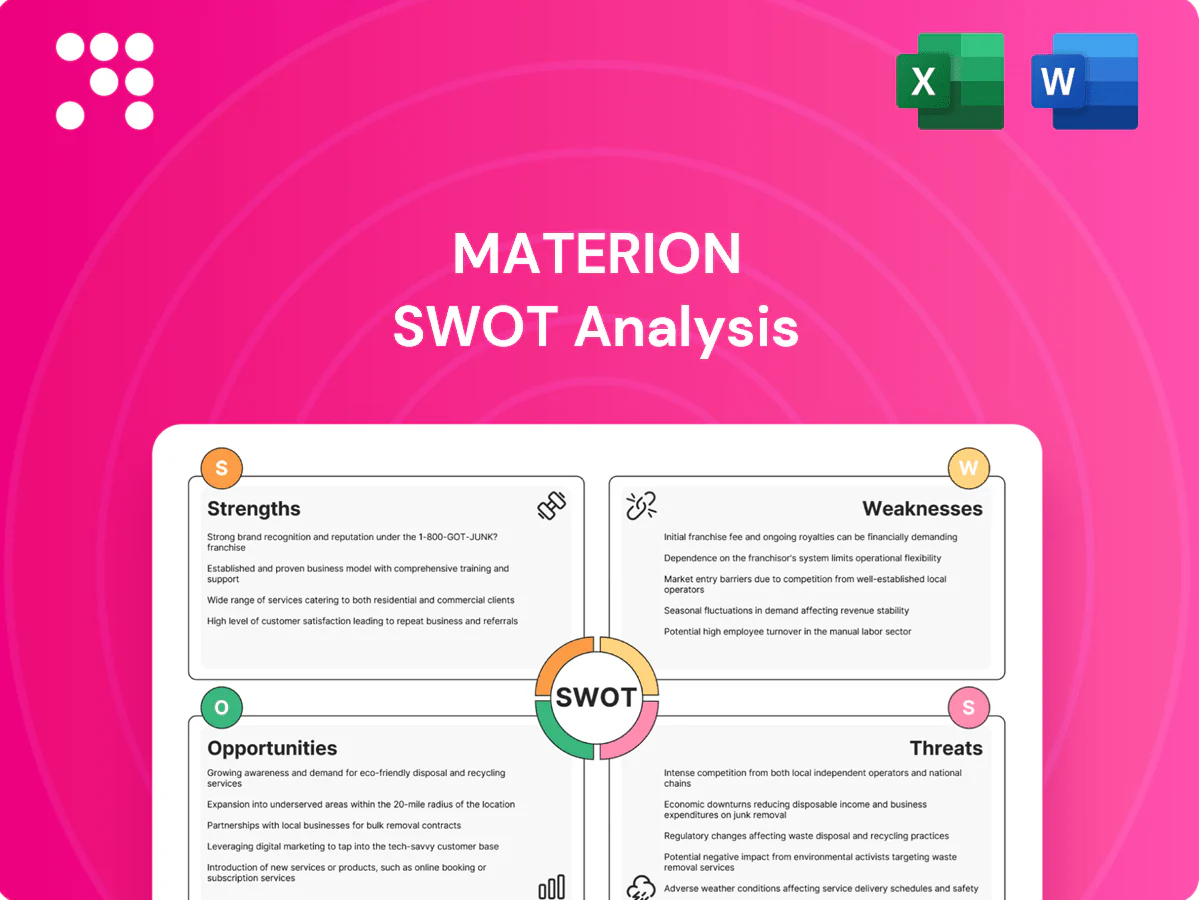
Materion SWOT Analysis

Dive Deeper Into the Company’s Strategic Blueprint
Materion’s SWOT analysis highlights its advanced materials expertise, diversified end-markets, and innovation pipeline while candidly addressing supply-chain sensitivity and cyclical demand risks; strategic opportunities in electronics and aerospace growth are clearly mapped. Want the full picture—with financial context and actionable recommendations—purchase the complete SWOT to get a professionally formatted, editable report and Excel model.
Strengths

Diversified end-markets
Materion reported approximately $1.15 billion in FY2024 revenue while serving aerospace, automotive, electronics and medical end-markets, reducing reliance on any single cycle.
This diversification smooths revenues and helped the company absorb sector-specific downturns during 2023–2024 demand swings.
Cross-industry insights accelerate solution transfer and reuse, supporting niche pricing power and operational resilience.
Deep materials science expertise
Materion (NYSE:MTRN) leverages proprietary know-how in high-performance alloys, specialty metals, ceramics and engineered materials to differentiate its product suite. Complex metallurgy and ceramics capabilities create high technical barriers to entry and drive design-in stickiness with aerospace, defense and electronics customers. Robust process control and quality systems support consistent, high-spec outputs and premium pricing. Market capitalization was about $1B in 2024, underscoring investor recognition of its niche position.

Customized, mission-critical solutions
Materion embeds itself early by delivering custom formulations tied to specific performance specs, securing design-in status that drives recurring demand across long product lifecycles. Mission-critical applications in aerospace, defense and semiconductor sectors make switching costly and risky for customers. Tailored solutions command premium pricing, supporting higher gross margins versus commodity materials. This deep technical integration strengthens customer stickiness and predictable revenue streams.

Integrated testing and R&D services
Integrated testing, analytical support and co-development shorten time-to-qualification, accelerating customer ramp and differentiating Materion (ticker MTRN) from pure-play commodity suppliers. Bundled services increase share-of-wallet and customer dependence; lab-to-production feedback loops measurably improve yields and reliability across electronics and aerospace in 2024.
- Shorter qualification: faster customer ramps
- Bundled services: increased wallet share
- Lab→production feedback: higher yields, reliability
- Clear differentiation vs pure-play suppliers
Quality, reliability, and compliance track record
Supplying regulated, high-spec industries requires stringent certifications and audits, and Materion's long compliance record underpins customer trust. Proven reliability is a key selection criterion for aerospace, medical, and electronics, driving repeat wins and premium pricing. A clean compliance history lowers customer risk and accelerates approvals; 2024 revenue ~1.4B underscores scale.
- Certifications/audits: regulatory readiness
- Customer focus: aerospace, medical, electronics
- Commercial impact: premium pricing, repeat wins
Specialty materials leader with $1.15B revenue, high technical barriers
Materion generated approximately $1.15B revenue in FY2024 across aerospace, automotive, electronics and medical, reducing single-market risk. Proprietary alloys, ceramics and engineering services create high technical barriers, design-in stickiness and premium pricing. Integrated testing, certifications and co-development shorten qualification and raise recurring revenue predictability; market cap ≈ $1B in 2024.
| Metric | 2024 |
|---|---|
| Revenue | $1.15B |
| Market cap | ≈$1B |
| Core end-markets | Aerospace, Automotive, Electronics, Medical |
What is included in the product
 Detailed Word Document
Provides a concise strategic overview of Materion’s internal strengths and weaknesses and external opportunities and threats, mapping competitive position, growth drivers, operational gaps, and market risks to inform strategic decision-making.

 Customizable Excel Spreadsheet
Provides a concise SWOT matrix for Materion, enabling fast alignment on materials-market positioning and targeted risk mitigation, ideal for executive briefings and strategic reviews.
Weaknesses

Cyclical demand exposure
Materion (MTRN) faces cyclicality as automotive, electronics and aerospace downturns drive order volatility; company revenue was $1.51 billion in fiscal 2024, amplifying sensitivity to end-market swings. Capex pauses in semiconductors or delayed aerospace programs can quickly reduce volumes given long program lead times. High fixed costs and 2024 adjusted operating margin pressure make downturns margin-dilutive, while forecasting complexity raises inventory and capacity planning risk.
Raw material price volatility
Specialty metals and precious inputs for Materion are highly price- and availability-sensitive, and sudden swings in metals markets have historically strained margins. Surcharges and pass-through mechanisms often lag spot moves, creating near-term margin compression. Hedging options are limited for complex alloys and ceramics, so risk mitigation is imperfect. Price volatility also complicates multi-year pricing and long-term contract negotiations.

Regulatory and EH&S burden
Handling hazardous materials like beryllium requires adherence to OSHA’s beryllium standard, including a PEL of 0.2 µg/m3, driving extensive engineering controls and medical surveillance. Compliance costs for monitoring, PPE, training and recordkeeping materially raise overhead and capital expenditures. Any lapse can trigger regulatory enforcement, civil litigation or plant shutdowns. Rigorous customer audits further increase personnel and documentation burdens.

Capital intensity and long lead times
Advanced processing equipment and specialty furnaces require significant capital outlays—often tens of millions and multi-year lead times—while customer qualification cycles (commonly 12–24 months in aerospace/industrial programs) delay revenue ramps, forcing careful timing of capacity additions to avoid underutilization and higher fixed costs; working capital also rises as bespoke inventories and WIP increase.
- High capex: tens of millions, multi-year buildouts
- Long qualification: ~12–24 months delays
- Timing risk: capacity vs underutilization
- Working capital: elevated custom inventories/WIP
Customer concentration and qualification risk
Design-in wins can concentrate Materion revenue in a few platforms or OEMs, so losing a platform or a redesign decision by a major customer can materially reduce sales; long qualification cycles mean replacement revenue is slow to materialize, while negotiating leverage often favors large, strategic customers.
- Concentration risk: few platforms/OEMs
- High impact if platform lost or redesigned
- Slow recovery due to lengthy qualifications
- Limited pricing power vs large customers
Cyclical metals supplier: revenue $1.51B, 12-24m qual cycle risks margins
Materion faces cyclical end-market exposure—revenue was $1.51 billion in fiscal 2024—making margins vulnerable to automotive, aerospace and semiconductor downturns. High fixed costs, long customer qualification (12–24 months) and tens-of-millions capex timings risk underutilization. Hazardous-material compliance (OSHA beryllium PEL 0.2 µg/m3) raises ongoing overhead and legal/execution risk.
| Metric | Value |
|---|---|
| Fiscal 2024 Revenue | $1.51 billion |
| Qualification cycle | 12–24 months |
| Typical capex | Tens of millions |
| Beryllium PEL (OSHA) | 0.2 µg/m3 |
Preview the Actual Deliverable
Materion SWOT Analysis
This is the actual SWOT analysis document you’ll receive upon purchase—no surprises, just professional quality. The preview below is taken directly from the full report and reflects the same structured, editable content included in your download. Buy now to unlock the complete, in-depth version immediately after payment.

Dive Deeper Into the Company’s Strategic Blueprint
Materion’s SWOT analysis highlights its advanced materials expertise, diversified end-markets, and innovation pipeline while candidly addressing supply-chain sensitivity and cyclical demand risks; strategic opportunities in electronics and aerospace growth are clearly mapped. Want the full picture—with financial context and actionable recommendations—purchase the complete SWOT to get a professionally formatted, editable report and Excel model.
Strengths
Diversified end-markets
Materion reported approximately $1.15 billion in FY2024 revenue while serving aerospace, automotive, electronics and medical end-markets, reducing reliance on any single cycle.
This diversification smooths revenues and helped the company absorb sector-specific downturns during 2023–2024 demand swings.
Cross-industry insights accelerate solution transfer and reuse, supporting niche pricing power and operational resilience.
Deep materials science expertise
Materion (NYSE:MTRN) leverages proprietary know-how in high-performance alloys, specialty metals, ceramics and engineered materials to differentiate its product suite. Complex metallurgy and ceramics capabilities create high technical barriers to entry and drive design-in stickiness with aerospace, defense and electronics customers. Robust process control and quality systems support consistent, high-spec outputs and premium pricing. Market capitalization was about $1B in 2024, underscoring investor recognition of its niche position.
Customized, mission-critical solutions
Materion embeds itself early by delivering custom formulations tied to specific performance specs, securing design-in status that drives recurring demand across long product lifecycles. Mission-critical applications in aerospace, defense and semiconductor sectors make switching costly and risky for customers. Tailored solutions command premium pricing, supporting higher gross margins versus commodity materials. This deep technical integration strengthens customer stickiness and predictable revenue streams.
Integrated testing and R&D services
Integrated testing, analytical support and co-development shorten time-to-qualification, accelerating customer ramp and differentiating Materion (ticker MTRN) from pure-play commodity suppliers. Bundled services increase share-of-wallet and customer dependence; lab-to-production feedback loops measurably improve yields and reliability across electronics and aerospace in 2024.
- Shorter qualification: faster customer ramps
- Bundled services: increased wallet share
- Lab→production feedback: higher yields, reliability
- Clear differentiation vs pure-play suppliers
Quality, reliability, and compliance track record
Supplying regulated, high-spec industries requires stringent certifications and audits, and Materion's long compliance record underpins customer trust. Proven reliability is a key selection criterion for aerospace, medical, and electronics, driving repeat wins and premium pricing. A clean compliance history lowers customer risk and accelerates approvals; 2024 revenue ~1.4B underscores scale.
- Certifications/audits: regulatory readiness
- Customer focus: aerospace, medical, electronics
- Commercial impact: premium pricing, repeat wins
Specialty materials leader with $1.15B revenue, high technical barriers
Materion generated approximately $1.15B revenue in FY2024 across aerospace, automotive, electronics and medical, reducing single-market risk. Proprietary alloys, ceramics and engineering services create high technical barriers, design-in stickiness and premium pricing. Integrated testing, certifications and co-development shorten qualification and raise recurring revenue predictability; market cap ≈ $1B in 2024.
| Metric | 2024 |
|---|---|
| Revenue | $1.15B |
| Market cap | ≈$1B |
| Core end-markets | Aerospace, Automotive, Electronics, Medical |
What is included in the product
Detailed Word Document
Provides a concise strategic overview of Materion’s internal strengths and weaknesses and external opportunities and threats, mapping competitive position, growth drivers, operational gaps, and market risks to inform strategic decision-making.
Customizable Excel Spreadsheet
Provides a concise SWOT matrix for Materion, enabling fast alignment on materials-market positioning and targeted risk mitigation, ideal for executive briefings and strategic reviews.
Weaknesses
Cyclical demand exposure
Materion (MTRN) faces cyclicality as automotive, electronics and aerospace downturns drive order volatility; company revenue was $1.51 billion in fiscal 2024, amplifying sensitivity to end-market swings. Capex pauses in semiconductors or delayed aerospace programs can quickly reduce volumes given long program lead times. High fixed costs and 2024 adjusted operating margin pressure make downturns margin-dilutive, while forecasting complexity raises inventory and capacity planning risk.
Raw material price volatility
Specialty metals and precious inputs for Materion are highly price- and availability-sensitive, and sudden swings in metals markets have historically strained margins. Surcharges and pass-through mechanisms often lag spot moves, creating near-term margin compression. Hedging options are limited for complex alloys and ceramics, so risk mitigation is imperfect. Price volatility also complicates multi-year pricing and long-term contract negotiations.
Regulatory and EH&S burden
Handling hazardous materials like beryllium requires adherence to OSHA’s beryllium standard, including a PEL of 0.2 µg/m3, driving extensive engineering controls and medical surveillance. Compliance costs for monitoring, PPE, training and recordkeeping materially raise overhead and capital expenditures. Any lapse can trigger regulatory enforcement, civil litigation or plant shutdowns. Rigorous customer audits further increase personnel and documentation burdens.
Capital intensity and long lead times
Advanced processing equipment and specialty furnaces require significant capital outlays—often tens of millions and multi-year lead times—while customer qualification cycles (commonly 12–24 months in aerospace/industrial programs) delay revenue ramps, forcing careful timing of capacity additions to avoid underutilization and higher fixed costs; working capital also rises as bespoke inventories and WIP increase.
- High capex: tens of millions, multi-year buildouts
- Long qualification: ~12–24 months delays
- Timing risk: capacity vs underutilization
- Working capital: elevated custom inventories/WIP
Customer concentration and qualification risk
Design-in wins can concentrate Materion revenue in a few platforms or OEMs, so losing a platform or a redesign decision by a major customer can materially reduce sales; long qualification cycles mean replacement revenue is slow to materialize, while negotiating leverage often favors large, strategic customers.
- Concentration risk: few platforms/OEMs
- High impact if platform lost or redesigned
- Slow recovery due to lengthy qualifications
- Limited pricing power vs large customers
Cyclical metals supplier: revenue $1.51B, 12-24m qual cycle risks margins
Materion faces cyclical end-market exposure—revenue was $1.51 billion in fiscal 2024—making margins vulnerable to automotive, aerospace and semiconductor downturns. High fixed costs, long customer qualification (12–24 months) and tens-of-millions capex timings risk underutilization. Hazardous-material compliance (OSHA beryllium PEL 0.2 µg/m3) raises ongoing overhead and legal/execution risk.
| Metric | Value |
|---|---|
| Fiscal 2024 Revenue | $1.51 billion |
| Qualification cycle | 12–24 months |
| Typical capex | Tens of millions |
| Beryllium PEL (OSHA) | 0.2 µg/m3 |
Preview the Actual Deliverable
Materion SWOT Analysis
This is the actual SWOT analysis document you’ll receive upon purchase—no surprises, just professional quality. The preview below is taken directly from the full report and reflects the same structured, editable content included in your download. Buy now to unlock the complete, in-depth version immediately after payment.
Description
Dive Deeper Into the Company’s Strategic Blueprint
Materion’s SWOT analysis highlights its advanced materials expertise, diversified end-markets, and innovation pipeline while candidly addressing supply-chain sensitivity and cyclical demand risks; strategic opportunities in electronics and aerospace growth are clearly mapped. Want the full picture—with financial context and actionable recommendations—purchase the complete SWOT to get a professionally formatted, editable report and Excel model.
Strengths
Diversified end-markets
Materion reported approximately $1.15 billion in FY2024 revenue while serving aerospace, automotive, electronics and medical end-markets, reducing reliance on any single cycle.
This diversification smooths revenues and helped the company absorb sector-specific downturns during 2023–2024 demand swings.
Cross-industry insights accelerate solution transfer and reuse, supporting niche pricing power and operational resilience.
Deep materials science expertise
Materion (NYSE:MTRN) leverages proprietary know-how in high-performance alloys, specialty metals, ceramics and engineered materials to differentiate its product suite. Complex metallurgy and ceramics capabilities create high technical barriers to entry and drive design-in stickiness with aerospace, defense and electronics customers. Robust process control and quality systems support consistent, high-spec outputs and premium pricing. Market capitalization was about $1B in 2024, underscoring investor recognition of its niche position.
Customized, mission-critical solutions
Materion embeds itself early by delivering custom formulations tied to specific performance specs, securing design-in status that drives recurring demand across long product lifecycles. Mission-critical applications in aerospace, defense and semiconductor sectors make switching costly and risky for customers. Tailored solutions command premium pricing, supporting higher gross margins versus commodity materials. This deep technical integration strengthens customer stickiness and predictable revenue streams.
Integrated testing and R&D services
Integrated testing, analytical support and co-development shorten time-to-qualification, accelerating customer ramp and differentiating Materion (ticker MTRN) from pure-play commodity suppliers. Bundled services increase share-of-wallet and customer dependence; lab-to-production feedback loops measurably improve yields and reliability across electronics and aerospace in 2024.
- Shorter qualification: faster customer ramps
- Bundled services: increased wallet share
- Lab→production feedback: higher yields, reliability
- Clear differentiation vs pure-play suppliers
Quality, reliability, and compliance track record
Supplying regulated, high-spec industries requires stringent certifications and audits, and Materion's long compliance record underpins customer trust. Proven reliability is a key selection criterion for aerospace, medical, and electronics, driving repeat wins and premium pricing. A clean compliance history lowers customer risk and accelerates approvals; 2024 revenue ~1.4B underscores scale.
- Certifications/audits: regulatory readiness
- Customer focus: aerospace, medical, electronics
- Commercial impact: premium pricing, repeat wins
Specialty materials leader with $1.15B revenue, high technical barriers
Materion generated approximately $1.15B revenue in FY2024 across aerospace, automotive, electronics and medical, reducing single-market risk. Proprietary alloys, ceramics and engineering services create high technical barriers, design-in stickiness and premium pricing. Integrated testing, certifications and co-development shorten qualification and raise recurring revenue predictability; market cap ≈ $1B in 2024.
| Metric | 2024 |
|---|---|
| Revenue | $1.15B |
| Market cap | ≈$1B |
| Core end-markets | Aerospace, Automotive, Electronics, Medical |
What is included in the product
Detailed Word Document
Provides a concise strategic overview of Materion’s internal strengths and weaknesses and external opportunities and threats, mapping competitive position, growth drivers, operational gaps, and market risks to inform strategic decision-making.
Customizable Excel Spreadsheet
Provides a concise SWOT matrix for Materion, enabling fast alignment on materials-market positioning and targeted risk mitigation, ideal for executive briefings and strategic reviews.
Weaknesses
Cyclical demand exposure
Materion (MTRN) faces cyclicality as automotive, electronics and aerospace downturns drive order volatility; company revenue was $1.51 billion in fiscal 2024, amplifying sensitivity to end-market swings. Capex pauses in semiconductors or delayed aerospace programs can quickly reduce volumes given long program lead times. High fixed costs and 2024 adjusted operating margin pressure make downturns margin-dilutive, while forecasting complexity raises inventory and capacity planning risk.
Raw material price volatility
Specialty metals and precious inputs for Materion are highly price- and availability-sensitive, and sudden swings in metals markets have historically strained margins. Surcharges and pass-through mechanisms often lag spot moves, creating near-term margin compression. Hedging options are limited for complex alloys and ceramics, so risk mitigation is imperfect. Price volatility also complicates multi-year pricing and long-term contract negotiations.
Regulatory and EH&S burden
Handling hazardous materials like beryllium requires adherence to OSHA’s beryllium standard, including a PEL of 0.2 µg/m3, driving extensive engineering controls and medical surveillance. Compliance costs for monitoring, PPE, training and recordkeeping materially raise overhead and capital expenditures. Any lapse can trigger regulatory enforcement, civil litigation or plant shutdowns. Rigorous customer audits further increase personnel and documentation burdens.
Capital intensity and long lead times
Advanced processing equipment and specialty furnaces require significant capital outlays—often tens of millions and multi-year lead times—while customer qualification cycles (commonly 12–24 months in aerospace/industrial programs) delay revenue ramps, forcing careful timing of capacity additions to avoid underutilization and higher fixed costs; working capital also rises as bespoke inventories and WIP increase.
- High capex: tens of millions, multi-year buildouts
- Long qualification: ~12–24 months delays
- Timing risk: capacity vs underutilization
- Working capital: elevated custom inventories/WIP
Customer concentration and qualification risk
Design-in wins can concentrate Materion revenue in a few platforms or OEMs, so losing a platform or a redesign decision by a major customer can materially reduce sales; long qualification cycles mean replacement revenue is slow to materialize, while negotiating leverage often favors large, strategic customers.
- Concentration risk: few platforms/OEMs
- High impact if platform lost or redesigned
- Slow recovery due to lengthy qualifications
- Limited pricing power vs large customers
Cyclical metals supplier: revenue $1.51B, 12-24m qual cycle risks margins
Materion faces cyclical end-market exposure—revenue was $1.51 billion in fiscal 2024—making margins vulnerable to automotive, aerospace and semiconductor downturns. High fixed costs, long customer qualification (12–24 months) and tens-of-millions capex timings risk underutilization. Hazardous-material compliance (OSHA beryllium PEL 0.2 µg/m3) raises ongoing overhead and legal/execution risk.
| Metric | Value |
|---|---|
| Fiscal 2024 Revenue | $1.51 billion |
| Qualification cycle | 12–24 months |
| Typical capex | Tens of millions |
| Beryllium PEL (OSHA) | 0.2 µg/m3 |
Preview the Actual Deliverable
Materion SWOT Analysis
This is the actual SWOT analysis document you’ll receive upon purchase—no surprises, just professional quality. The preview below is taken directly from the full report and reflects the same structured, editable content included in your download. Buy now to unlock the complete, in-depth version immediately after payment.











